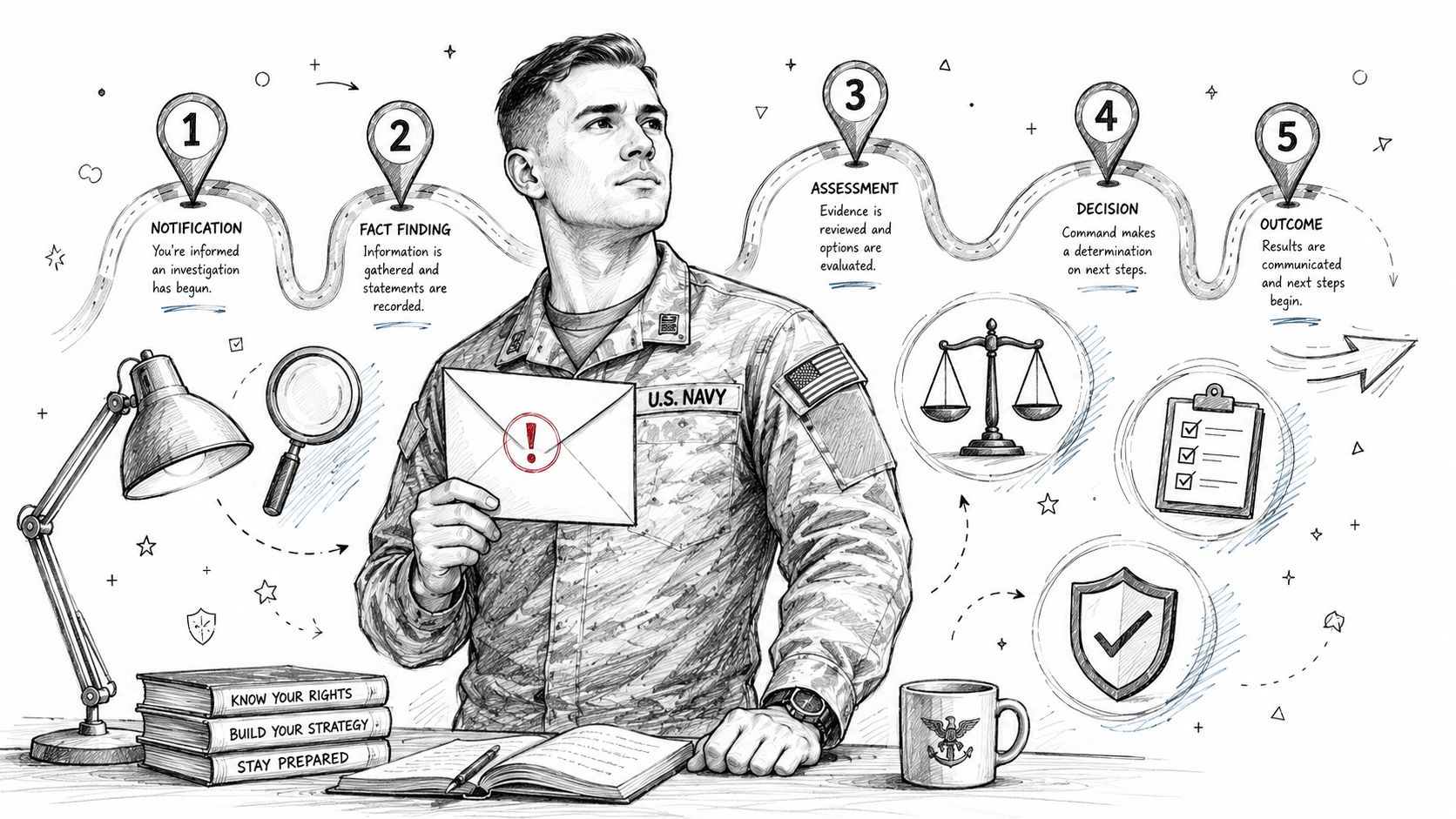
You got called into the commander’s office, the first sergeant is standing there, and somebody slides paperwork across the desk. Your stomach drops. You start thinking the same things almost everyone thinks in that moment. Maybe this is just a misunderstanding. Maybe if you explain yourself, this goes away. Maybe being cooperative will help.
That thinking gets people wrecked.
A command directed investigation is not a casual conversation and it is not a chance to “clear things up” by talking your way out of it. It is the point where command starts building a record. That record can damage your reputation, trigger punishment, wreck promotions, kill a clearance, and set up separation or even worse. If you handle the first few days badly, you hand the government the rope and they use it.
What matters now is simple. Stop talking. Start preserving evidence. Get legal advice before you answer questions, hand over a statement, or try to contact witnesses. If you remember nothing else from this article, remember that.
Table of Contents
- You Are Notified of a Command Directed Investigation Now What
- Decoding the CDI Administrative Inquiry vs Criminal Investigation
- The Five Stages of a Command Directed Investigation
- The Trap of the Informal Inquiry
- Career-Ending Mistakes to Avoid During a CDI
- Why Your Appointed Military Lawyer Is Not Enough
- Your Command Directed Investigation Questions Answered
You Are Notified of a Command Directed Investigation Now What
The moment usually looks the same. You’re told to report. The door closes. Somebody says there are allegations, concerns, or complaints. You’re handed a notification letter or told an investigating officer will contact you. You try to read faces in the room. Nobody tells you much. Everybody acts calm. You are not calm.
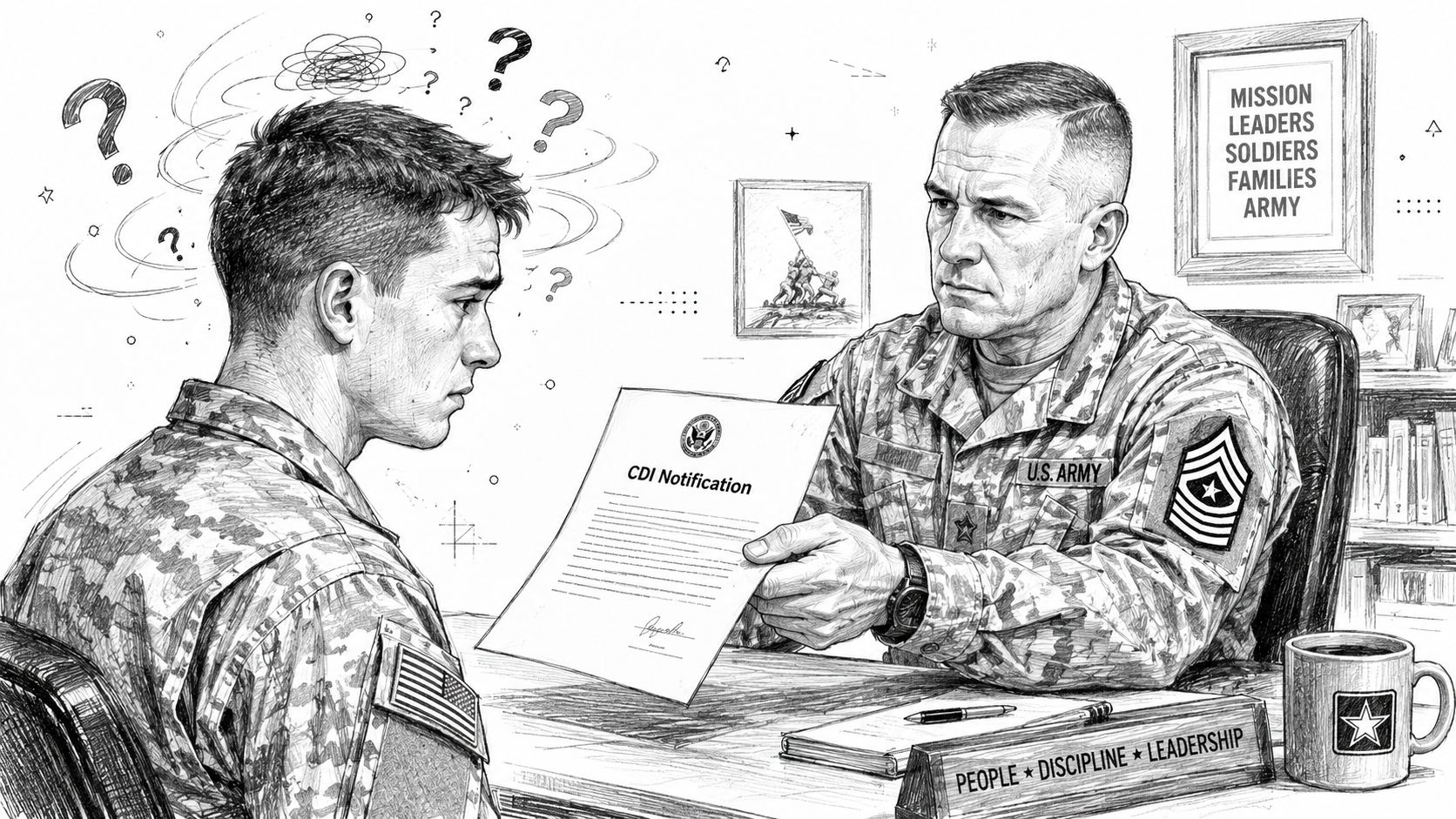
That is the moment the fight starts.
A lot of service members hurt themselves right there by trying to be helpful. They start explaining timelines, texts, jokes, relationships, motives, or side conversations. They think silence looks guilty. It doesn’t. Uncontrolled talking is what buries people. If there is any possibility your words could be used against you, you need to think immediately about your rights under Article 31 of the UCMJ.
Your first moves in the first hour
Do these things in this order:
- Stop volunteering information. Don’t try to “clear it up” in the room.
- Ask what you are being told in writing. Save every page, email, text, and calendar notice.
- Write down your memory immediately. Names, dates, locations, witnesses, devices, messages, duty schedules.
- Preserve evidence. Don’t edit messages. Don’t delete anything. Don’t “clean up” your phone.
- Contact counsel before any interview.
Practical rule: The government counts on unrepresented service members to make damaging statements early. Don’t be one of them.
What this moment really means
You are now dealing with a process built to inform command decision-making, not to make you feel heard. The people around you may be polite. That doesn’t mean they are neutral. The record created from this point forward may follow you into an Article 15, a reprimand, a referral evaluation, a separation action, a clearance problem, or a criminal referral.
Treat the notice like a fire alarm. Not because panic helps. Because speed does.
Decoding the CDI Administrative Inquiry vs Criminal Investigation
The term “administrative” often prompts a relaxed response. That’s a mistake.
What a CDI actually is
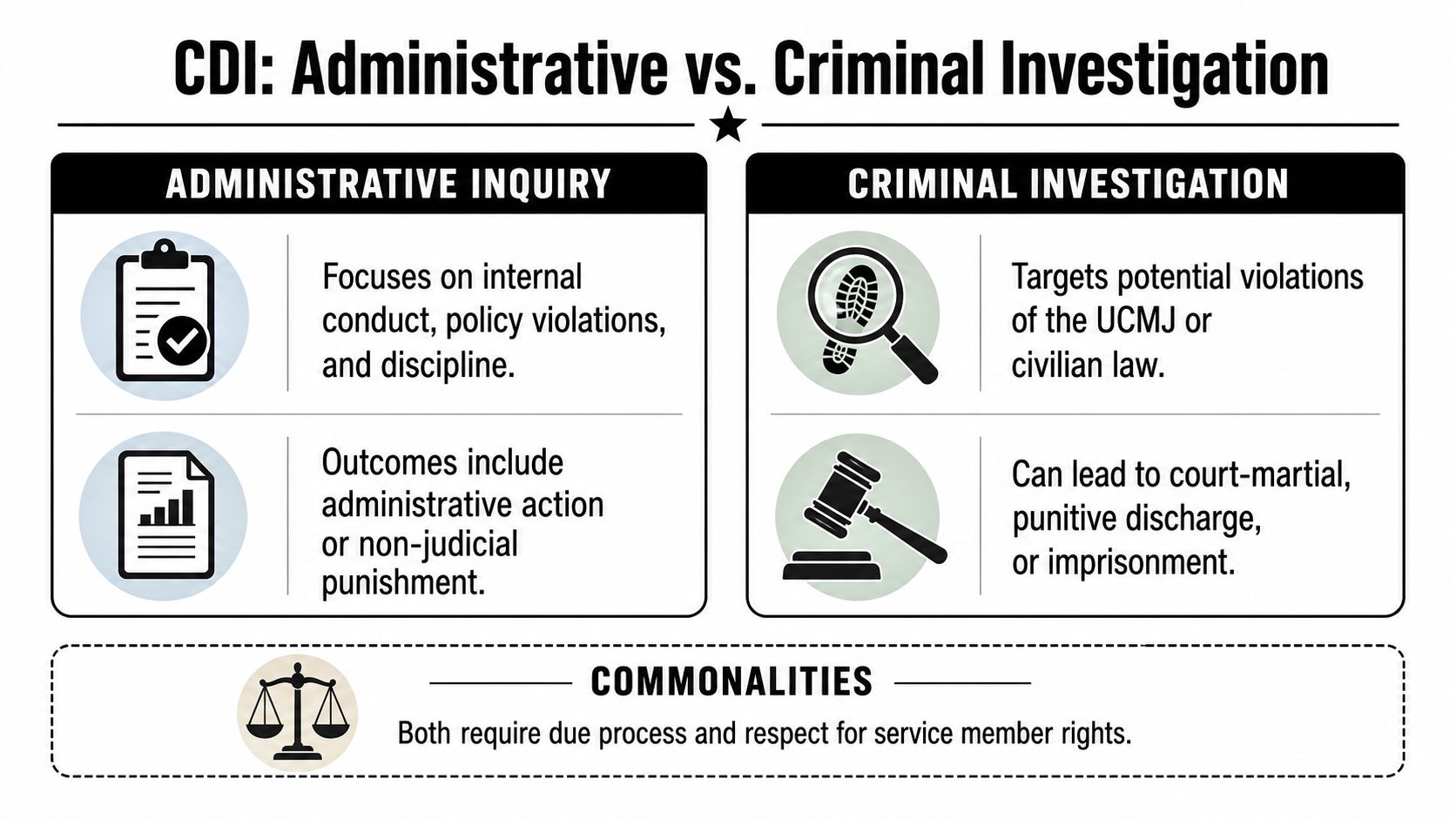
A Commander Directed Investigation is a formal, administrative inquiry started by a commander to gather information about alleged misconduct or other concerns inside the unit. It is not the same thing as a criminal investigation by OSI, CID, or NCIS. But don’t confuse “not criminal” with “not dangerous.” A CDI can directly lead to Non-Judicial Punishment, reprimands, and even referral for Court-Martial charges under the UCMJ, and in the Air Force it includes a 14-day window for the subject to submit a written response.
That means the command directed investigation often becomes the launch platform for punishment, even when no criminal investigator knocked on your door first.
If you need the broader context of law enforcement and command investigations, this guide on CID, NCIS, OSI, and CGIS investigations helps put the agencies and their roles in perspective.
Why administrative does not mean safe
A criminal investigation tries to build a criminal case. A CDI tries to build a command record. Either one can ruin your career if you mishandle it.
Here’s the practical difference:
- A CDI focuses on command action. The commander wants findings and a usable paper trail.
- A criminal investigation focuses on prosecutable offenses. Agents look for criminal violations and evidence for trial.
- A CDI can still feed criminal exposure. Facts gathered administratively can push the case into something bigger.
- A CDI often feels less formal. That false sense of safety makes people talk too much.
The label on the process matters less than the consequences attached to it.
CDI vs criminal investigation at a glance
| Aspect | Command Directed Investigation (CDI) | Criminal Investigation (OSI/CID/NCIS) |
|---|---|---|
| Primary purpose | Gather facts for command decisions about misconduct, policy, or discipline | Investigate possible criminal violations |
| Who starts it | Commander or appointing authority | Criminal investigative agency |
| Nature of process | Administrative and command-driven | Law enforcement driven |
| Possible outcomes | NJP, reprimand, negative evaluation, separation action, referral to further proceedings | Court-martial referral, criminal charges, confinement exposure |
| How people get trapped | They think it is minor and talk freely | They know it is serious, but still waive rights out of fear |
The key distinction most people miss
A formal command directed investigation is at least supposed to follow rules. There is structure. There are required steps. There is a chance to respond in writing.
That structure matters because if the investigating officer cuts corners, a good defense lawyer knows where to attack the case. Missing documents, thin credibility findings, sloppy scope expansion, and unsupported conclusions are not small technicalities. They are pressure points.
The Five Stages of a Command Directed Investigation
If you don’t understand the timeline, you will always be reacting one step behind command.
How the process unfolds
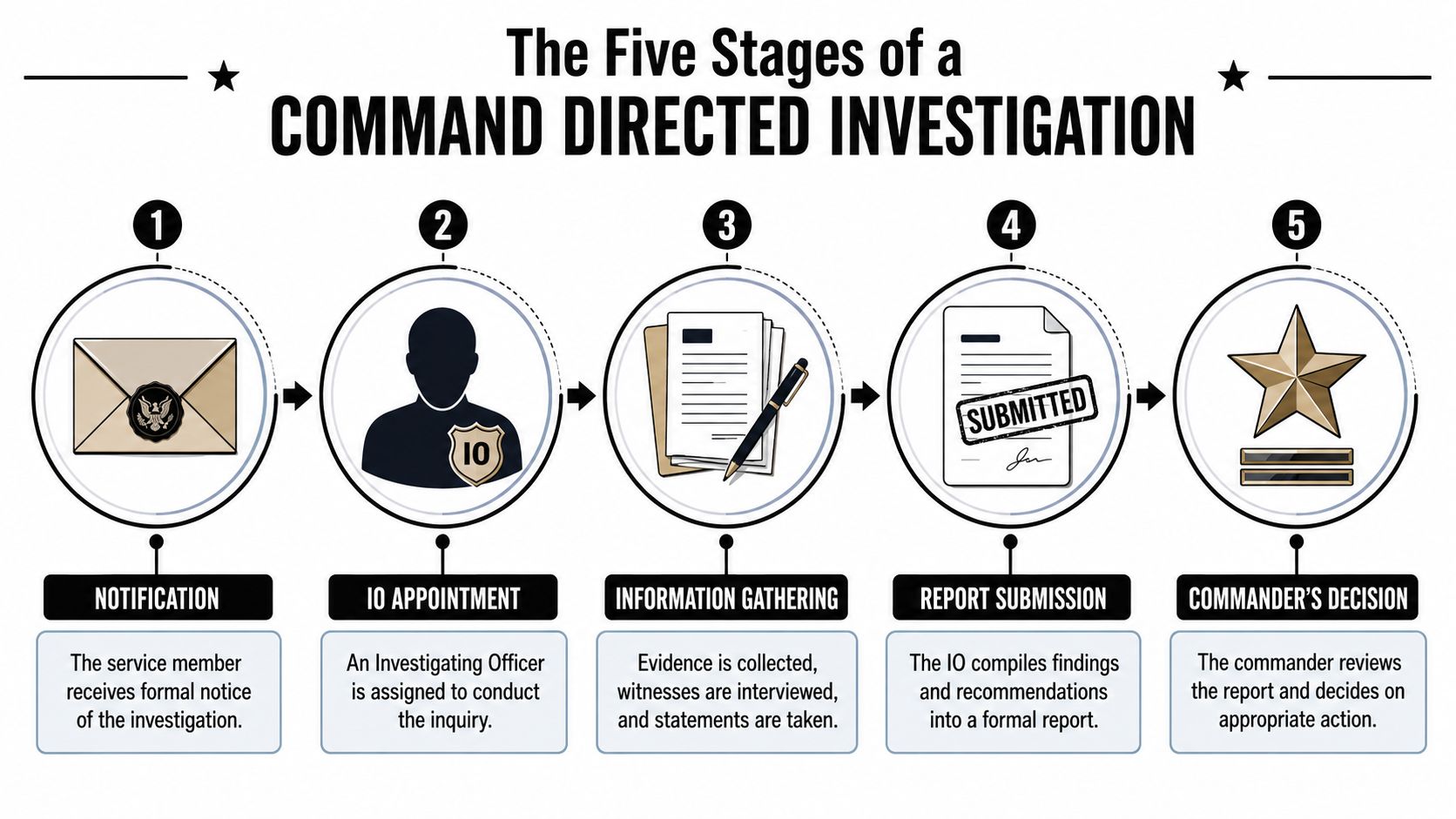
In the Air Force, the CDI follows a formal five-stage process under AFI 51-604: Notification, IO Appointment, Evidence Collection and Interviews, Findings and Recommendations, and Command Decision. The investigating officer works from a letter of appointment that defines the scope, sets the deadline, and identifies a legal advisor. If adverse findings are likely, the IO must issue a Tentative Conclusion Letter, which triggers a mandatory 14-day rebuttal period before the report is finalized, and there is no formal appeal process afterward, as explained in this breakdown of the Air Force CDI five-stage process and TCL rebuttal window.
That last point is the one that matters most. No formal appeal means you cannot afford to treat the rebuttal as an afterthought.
If you are in the Army world and people are comparing procedures, the structure of 15-6 investigations is worth understanding because commanders and lawyers often borrow assumptions across systems. That can create confusion if you don’t know which rules apply.
Stage 1 through Stage 3
Notification
You learn you are the subject, or at least that your conduct is under review. This is when you stop talking casually and start acting strategically.Investigating officer appointment
The IO gets authority from the appointing letter. Scope matters here. If the scope is narrow, your lawyer may later challenge efforts to wander into unrelated accusations.Evidence collection and interviews
At this stage, cases often tilt. The IO collects statements, messages, records, and interviews witnesses. If you speak without preparation, you help shape the narrative against yourself.
Where the real fight happens
The biggest mistake is waiting for the final result and then asking what can be done. By then, the answer is often “not much.”
The primary battlefield is the Tentative Conclusion Letter and the 14-day rebuttal window.
Your rebuttal is not a complaint letter. It is not a rant about unfair treatment. It is a targeted legal and factual attack. A serious rebuttal can do several things at once:
- Challenge the evidence. Point out missing context, inconsistent witness accounts, and unsupported inferences.
- Force procedural accountability. If the report lacks clear reasoning, proper analysis, or support for credibility calls, that matters.
- Add mitigation and defense evidence. Messages, records, sworn statements, timeline documents, and performance context belong here.
- Shape what the commander sees. If your side is not organized, documented, and forcefully presented, command sees only the government’s version.
A weak rebuttal invites a bad final report. A strong rebuttal can stop damage before it hardens into official findings.
Stage 4 and Stage 5
Findings and recommendations come next. The IO decides whether allegations are substantiated, unsubstantiated, or inconclusive. Then comes the command decision. That is where paperwork starts moving fast. Once command acts, the focus often shifts from truth-finding to damage control.
That is why the same advice applies every time. Fight hard before the ink dries.
The Trap of the Informal Inquiry
The most dangerous phrase in this area is “It’s just an informal inquiry.”
Why informal is more dangerous than it sounds
A formal command directed investigation is at least rule-bound. An informal Commander’s Inquiry is not the same creature. That distinction gets missed constantly. According to the source discussing this confusion, 68% of service members confuse a formal CDI with an informal Commander’s Inquiry, which leads many to miss protections like rebuttal rights that are tied to a formal CDI process under rules such as AFMAN 1-101, and an inquiry can escalate to a formal investigation without notice, as noted in this discussion of the difference between a Command Directed Investigation and a Commander’s Inquiry.
That confusion is dangerous because people lower their guard.
An informal inquiry may sound like a leadership fact-finding conversation. In practice, it can become a staging area. Witnesses talk. Emails get gathered. Timelines get built. Your own statements may supply the roadmap for a later formal case.
What to do when they say they just want to ask a few questions
If someone says this is “off the record,” “informal,” or “just command trying to understand what happened,” assume none of that protects you.
Use this posture instead:
- Be respectful, not chatty. Professional silence beats emotional explanation.
- Ask the status of the matter. Is this a formal CDI, an inquiry, or something else.
- Request time to consult counsel. Do that before making a written or oral statement.
- Preserve every relevant item. Screenshots, messages, emails, schedules, photos, leave records, and duty logs.
- Do not contact witnesses to align stories. That can be spun as interference.
The trap works because service members want to seem cooperative. I understand that instinct. Ignore it. Cooperation without strategy is usually surrender with extra steps.
Career-Ending Mistakes to Avoid During a CDI
A command directed investigation becomes much harder to beat when you help build it.
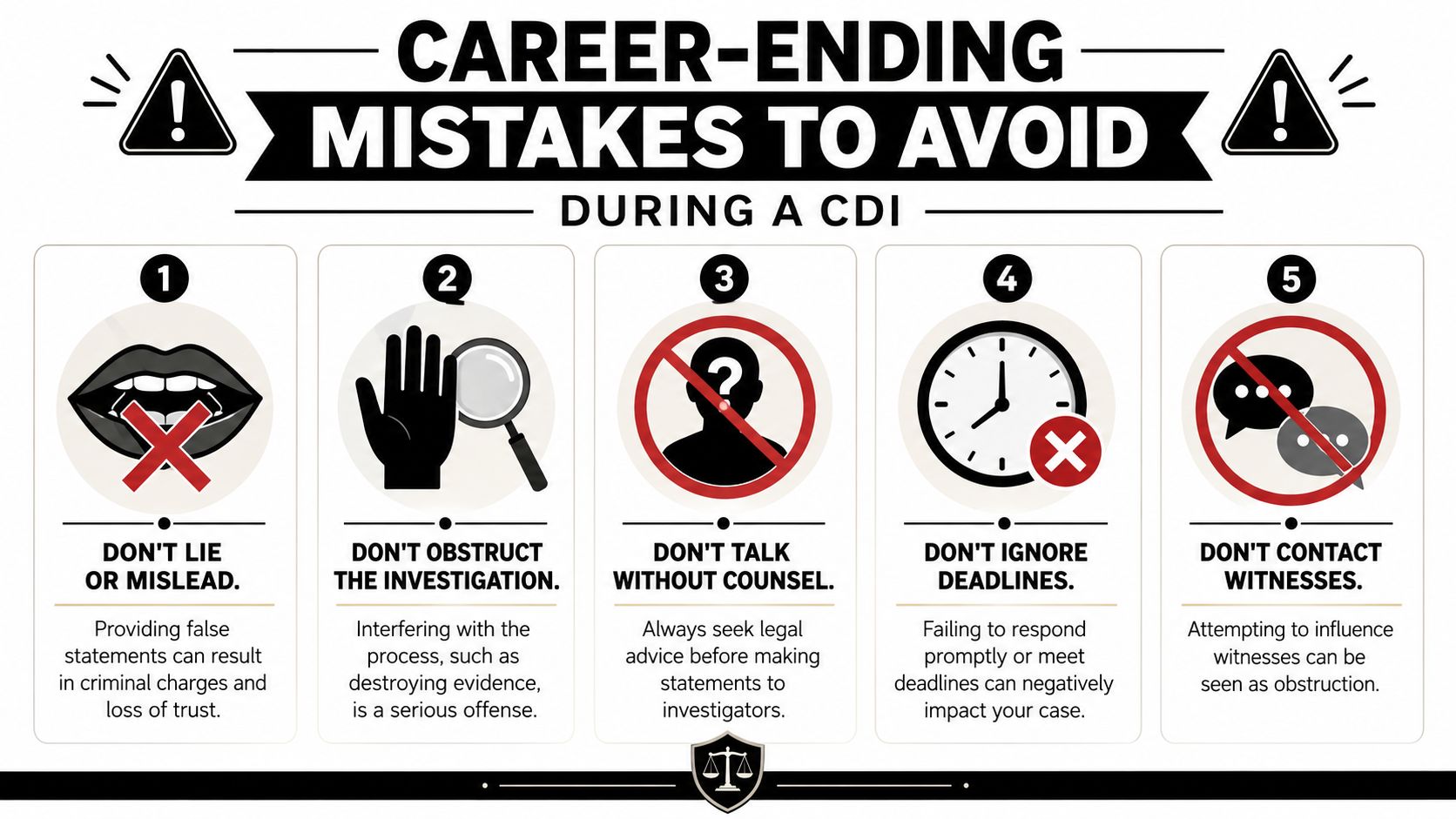
Mistakes that come up over and over
The stakes are not theoretical. Data from 2025 to 2026 Air Force IG reports found that 42% of CDI outcomes led directly to administrative sanctions, and 73% of subjects reported they were not informed of the full scope of allegations until receiving the final report, which can cripple your ability to gather defense evidence, according to the reported Air Force IG findings on CDI sanctions and notice problems.
Here are the mistakes that do the most damage:
Talking without counsel
You think you’re adding context. You’re usually locking in admissions, inconsistencies, or wording that gets quoted back at you.Trusting the investigating officer to be neutral
The IO may be professional, but the process serves command needs. Never mistake courtesy for advocacy.Ignoring deadlines
If you burn through the rebuttal period, you lose the best chance to shape the record.Deleting or editing evidence
Panic drives bad decisions. Don’t clean up messages, devices, or accounts. That creates a second problem.Contacting witnesses
Even innocent outreach can be twisted into pressure, influence, or obstruction.Believing “there’s no evidence”
Command cases are often built from partial texts, witness impressions, and selective context. Thin evidence still causes real damage if nobody fights it.
Your silence protects you. Your records protect you. Your strategy protects you. Good intentions do not.
Your immediate defensive checklist
Use this checklist today:
- Save everything on your phone, cloud accounts, laptop, and messaging apps.
- Create a private timeline with dates, locations, and names.
- List favorable witnesses and what each person knows.
- Identify bad facts early so your lawyer can deal with them instead of getting surprised later.
- Prepare for the rebuttal window long before the letter arrives.
People lose these cases because they drift. Don’t drift.
Why Your Appointed Military Lawyer Is Not Enough
You may have access to appointed military counsel. Use that right. But don’t fool yourself into thinking that alone is always enough for a serious command directed investigation.
The problem with waiting on the system
Appointed counsel often enters the picture after damage has already started. They may be skilled, hardworking, and honorable. Many are. But they are also working inside a system with heavy caseloads, rotating assignments, and command-generated timelines.
A CDI rewards early, aggressive intervention. You need somebody who can move immediately, challenge scope, organize defense evidence, and build a rebuttal package with one objective: stopping the administrative train before it gains speed.
That kind of work is not passive. It is not box-checking. It is not “let’s see what happens first.”
What independent civilian counsel does differently
Experienced civilian military defense lawyers bring three things that matter in this fight.
First, independence. Civilian counsel does not work inside your command structure.
Second, focused experience. A seasoned UCMJ lawyer or court-martial attorney has usually seen the same command tactics, the same witness problems, and the same paper trail tricks before.
Third, time and control. A strong civilian defense team can push evidence collection, draft witness outreach plans through proper channels, and build a rebuttal that reads like a case file, not an emotional plea.
If your career, retirement, clearance, or freedom is at stake, “free” should not be your only decision-making metric. The issue is not whether appointed counsel is bad. The issue is whether your case is too important to handle with limited resources and delayed strategy.
Your Command Directed Investigation Questions Answered
Do I have to talk to the investigating officer
No. You should not give a statement casually. Get legal advice first. Once you speak, you can’t unsay it.
What does substantiated mean
It means the investigating officer concluded the allegation is supported. In practice, that can be enough to trigger command action even if nobody ever proves a criminal case.
Can a CDI lead to Article 15 or court-martial
Yes. A CDI is administrative, but its findings can feed serious consequences. In the most severe UCMJ cases, the stakes can be extreme. For example, under Article 120(a), rape carries a maximum punishment of life imprisonment without the possibility of parole, and a mandatory dishonorable discharge for enlisted members or dismissal for officers is required by statute, as explained in this Article 120 sentencing guide. Don’t assume an administrative start means an administrative ending.
Can I appeal the result
Not in any formal guaranteed way in the Air Force CDI process, which is why the rebuttal stage matters so much. Waiting for a later fix is usually a losing plan.
Should I wait and see before hiring civilian counsel
No. Waiting helps the government and hurts you. Evidence goes stale. Witness memories shift. Command narratives harden.
Can my family help
Yes, if they help the right way. They can gather documents you already lawfully possess, help organize timelines, and support communication with counsel. They should not contact command, message witnesses, or post about the case online.
If you are under a command directed investigation, or even an “informal” inquiry that smells like one, act like the stakes are real because they are. Stop talking. Preserve evidence. Get strategic legal advice before the investigating officer gets your version in a form that can be used against you.
Do not wait for the final report. By then, your best opening may already be gone.
Your career is on the line. In some cases, your freedom is too.