You’re probably reading this because the phone rang, your command called you in, CID, NCIS, OSI, or CGIS wants an interview, or someone finally said the words court martial charges out loud. Your stomach dropped for a reason. This isn’t routine paperwork. It’s a threat to your freedom, your career, your clearance, and your name.
Most service members make their worst mistakes in the first hours. They try to explain. They trust that command will “be fair.” They think silence looks guilty. That instinct destroys cases. The military justice system starts building against you long before you feel ready, and from the investigation stage forward, the process is not designed to protect you.
If you’re under investigation or facing court martial charges, treat this like a live-fire event. Every text, every statement, every search, every casual conversation can become evidence.
Table of Contents
- What Court Martial Charges Mean for Your Freedom
- The Unforgiving Timeline from Investigation to Trial
- Strategic Insight How the Government Case Is Built and Broken
- The Five Biggest Mistakes That End Military Careers
- Your Rights and Immediate Defensive Actions
- Why an Experienced Civilian Defense Lawyer Is Non-Negotiable
- Frequently Asked Questions About Court Martial Charges
What Court Martial Charges Mean for Your Freedom
Court martial charges aren’t just “getting in trouble.” They are formal criminal allegations under the UCMJ. Once you understand the language, you understand the danger.
The words that matter
An Article is the law the government says you violated. A charge is the formal accusation under that Article. A specification is the government’s factual story about what you supposedly did.
That distinction matters because the government doesn’t win by throwing around labels. It wins by proving specific facts. Good military defense lawyers attack those facts early. Dates. Messages. witness statements. digital records. motive. bias. chain of custody. That’s where cases live and die.
For a quick foundation on the military court system, review these court-martial basics. Then get back to your own case and stop reading generic internet reassurance.

Practical rule: If you can’t explain which Article, which charge, and which specification you’re facing, you are not yet in control of your defense.
The forum controls the risk
Not all court martial charges go to the same kind of proceeding. The forum changes your exposure.
According to this breakdown of court-martial punishment levels, a general court-martial has no cap on confinement and can impose life in prison, a special court-martial is capped at 12 months of confinement, and a summary court-martial is capped at 1 month. The same source states that the death penalty is authorized for 14 offenses under the UCMJ, typically during a time of war.
Here’s the clean version:
| Forum | Maximum confinement exposure |
|---|---|
| General court-martial | No cap, can include life in prison |
| Special court-martial | 12 months |
| Summary court-martial | 1 month |
The point isn’t academic. The point is this: once court martial charges are preferred and pushed toward a forum, your case becomes a fight over consequences that can permanently alter your life.
Service members get trapped when they treat the early phase like command discipline. It isn’t. It’s criminal exposure with military rules, military pressure, and very little patience for your learning curve.
The Unforgiving Timeline from Investigation to Trial
The military justice timeline is dangerous because the government acts while you hesitate. Investigators gather statements. Digital evidence gets reviewed. Command forms opinions. People talk. By the time you decide to “wait and see,” the case file is already growing.

Step 1 The investigation starts before you can react
CID, NCIS, OSI, or CGIS usually aren’t calling to “hear your side” because they’re undecided. They’re collecting admissions, locking in inconsistencies, and preserving evidence in a form that helps the prosecution later.
If your case grew out of a command inquiry or fact-finding process, understand how those records can feed a criminal case by reviewing 15-6 investigations and related command investigations. Don’t assume those processes stay separate.
What should you be thinking at this stage?
- Who already spoke: Friends, supervisors, spouses, complainants, and witnesses may already have made statements.
- What devices exist: Your phone, cloud accounts, apps, and location history may become central.
- What you must not do: Don’t delete, edit, coach, confront, or “clean up” anything.
Step 2 Preferral changes everything
The first formal step is preferral of charges. According to the 8th Army Trial Defense Service information paper on courts-martial, preferral happens when an accuser signs a charge sheet under oath. That event triggers key rights, including the right to remain silent and the right to legal representation. The same source explains that, depending on severity, the case may then be referred to a summary, special, or general court-martial, and the process can take weeks to over a year.
That means the moment charges are preferred, you stop thinking like someone “answering questions” and start thinking like a defendant in a prosecution.
Once preferral happens, every delay helps the government more than it helps you.
Step 3 Article 32 and referral to trial
A general court-martial case doesn’t just jump straight to trial. There is an Article 32 stage before that, and then a referral decision placing the case into a trial forum.
Here is the simplified sequence:
- Investigation
- Preferral of charges
- Article 32 process in general court-martial cases
- Referral to a court-martial forum
- Arraignment, motions, trial
At each step, the government is trying to harden its theory. Your defense team should be doing the opposite. It should be testing witnesses, preserving favorable evidence, identifying search problems, exposing bias, and stopping weak assumptions from becoming “facts” through repetition.
Strategic Insight How the Government Case Is Built and Broken
Most weak court martial charges don’t look weak at the start. They look organized. They come with timelines, screenshots, interview summaries, lab reports, command concern, and confident prosecutors. That appearance fools families and young counsel all the time.
The core question is simpler. Can the government prove its case with reliable evidence after a trained defense lawyer starts pulling it apart?
How prosecutors build momentum
The military justice system gives the government an early structural advantage. Investigators often control the evidence flow before the defense can meaningfully test it. Digital evidence is especially dangerous because it creates an illusion of certainty. A screenshot isn’t context. A partial extraction isn’t the whole device. A timeline generated by an investigator isn’t neutral.
One of the ugliest realities in these cases is what many service members experience as trial by ambush. The case narrative can harden around digital material and investigator summaries long before the defense gets a fair chance to challenge the collection, interpretation, or omissions. That’s why experienced court-martial attorneys move fast on device history, metadata, consent issues, scope of search, and alternate explanations.
Another major shift changed who decides prosecution in many serious cases. According to this analysis of the 2023 changes to the Manual for Courts-Martial and the Office of the Special Trial Counsel, the Office of the Special Trial Counsel (OSTC), not the chain of command, now has exclusive authority to prosecute covered offenses. The source explains that this reform means specially trained, independent military lawyers, not your commander, are the ones deciding your fate.
That changed the battlefield. It did not make it friendlier.
Where strong defense teams break the case
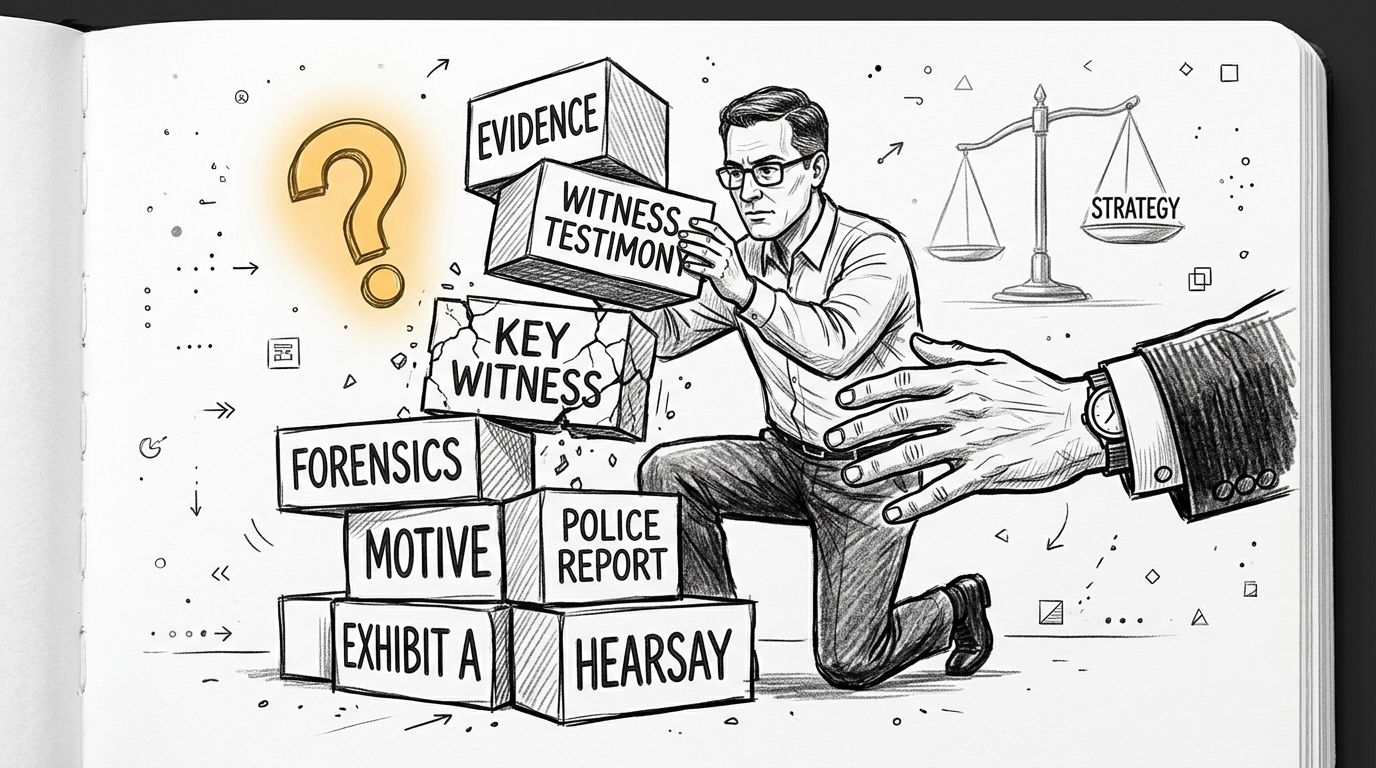
A serious defense doesn’t just argue innocence. It attacks the prosecution’s building blocks.
Look at the pressure points:
- Witness credibility. Motive to lie, memory gaps, prior inconsistent statements, coordination with others.
- Digital evidence integrity. Missing context, selective extraction, shared devices, weak attribution, bad timeline assumptions.
- Investigation flaws. Leading questions, tunnel vision, ignored leads, sloppy preservation.
- Legal defects. Search problems, statement issues, improper influence, evidentiary overreach.
- Case theory mismatch. Facts that don’t fit the charged specification.
Some cases collapse because the evidence is thin. Others collapse because the government overcharged. Others become defensible because the first statement a service member gave was taken under pressure and can be challenged.
The government usually wins when the accused reacts emotionally and the defense reacts late.
Experienced military defense lawyers are ruthless about sequence. Preserve first. Analyze second. Litigate early. Force the government to prove what it assumed.
If you’re facing court martial charges, you need counsel who understands that the fight starts long before opening statements.
The Five Biggest Mistakes That End Military Careers
Panic makes people do stupid things. The military system punishes stupid things fast.
A bad first move can turn a defensible case into a disaster. That’s especially true when the accusation already carries command attention and digital evidence issues.
Five errors that bury good defenses
The first mistake is the classic one.
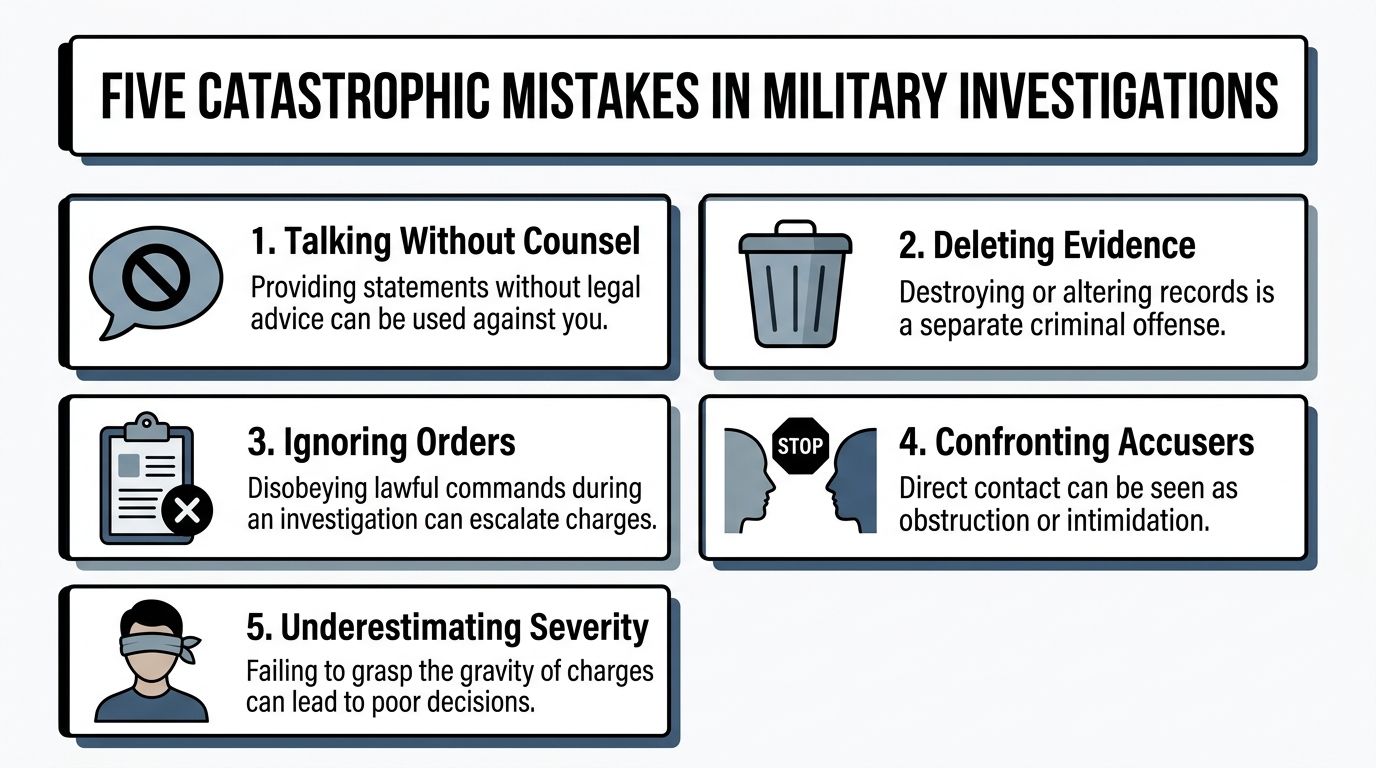
- Talking to investigators without counsel. You will not out-explain a trained investigator in a recorded setting. They don’t need a confession. They need inconsistencies, half-admissions, or a statement they can compare against later evidence.
The second is command dependence.
- Trusting command to make it disappear. Your commander may care about you as a person. That does not make the command structure your defense team.
A third error shows up in almost every serious case.
- Waiting too long to hire experienced counsel. Time matters. Evidence gets overwritten. Witnesses align stories. Phones change hands. Delay weakens position.
Here’s another trap people walk into.
- Believing there’s “no evidence.” You don’t know what the government has. Testimony is evidence. Messages are evidence. Silence can leave bad assumptions uncontested.
The fifth mistake is deadly because it sounds practical.
- Treating a summary court-martial like no big deal. According to this overview of summary court-martial consequences, 74% of service members mistakenly believe these convictions are non-criminal, yet 58% face permanent security clearance downgrades and 41% suffer career-ending administrative actions as a direct result.
That myth has ended a lot of careers.
This short video addresses how fast service members make self-destructive decisions once an investigation begins.
A sixth mistake belongs on the list too, even without a statistic attached. Don’t confront the accuser. Don’t ask mutual friends to “fix it.” Don’t message witnesses. That behavior can become a new allegation or poison your defense.
Your Rights and Immediate Defensive Actions
You need an action plan, not motivation. If you’ve been accused, questioned, or notified of possible court martial charges, do these things now.
What to do in the next 24 hours
- Invoke your right to remain silent. Say: “I am invoking my right to remain silent. I want a lawyer.”
- Stop volunteering information. Not to investigators. Not to command. Not to your first sergeant. Not to your buddy who “knows legal.”
- Do not consent to searches. Phone, room, car, cloud account, locker, or personal property.
- Preserve evidence. Save messages, call logs, social media, photos, receipts, travel records, and names of witnesses.
- Write a private timeline for your lawyer. Dates, locations, who said what, who was present, what devices were used.
- Hire experienced civilian counsel immediately.
Use your rights like they matter
Before a general court-martial, an Article 32 investigation is mandatory unless waived. According to the Navy Region Mid-Atlantic summary of the military justice process, that process gives the accused the right to be present, to have counsel, to cross-examine every government witness, and to present defense evidence. The same source says those protections are greater than a civilian grand jury.
Those rights are powerful only if someone competent uses them aggressively.
Here’s what that means for you in plain English:
- Don’t waive blindly. Waiving stages or rights without strategy is how people lose their advantage.
- Don’t confuse having rights with using rights well. A weak lawyer can waste strong procedural protections.
- Don’t wait for fairness. Force the government to meet its burden.
Rights unused are just words on paper.
Why an Experienced Civilian Defense Lawyer Is Non-Negotiable
A lot of service members ask the wrong question. They ask, “Why pay for a lawyer if I get one for free?” The right question is, “Who gives me the best chance to protect my freedom, rank, retirement, and record?”
Free counsel is not the same as the right counsel
Detailed military defense counsel can work hard and mean well. Some are excellent. Some are very young. Some are overloaded. All of them operate inside the same institution prosecuting you.
That matters.
An experienced civilian military defense lawyer is independent. No command relationship. No military rating chain. No institutional pressure to stay inside the lane. When the case demands aggressive litigation, outside experts, hard cross-examination, or a direct challenge to how the government built the file, independence matters.
If you’re comparing options, start with attorneys who focus specifically on court-martial defense lawyers, not general criminal lawyers who occasionally touch a UCMJ case.
What independent defense changes
Experienced civilian counsel brings advantages that are practical, not theoretical:
- Focused trial experience. Court-martial practice is its own battlefield.
- Strategic speed. Good counsel starts protecting evidence and witnesses immediately.
- Independent case theory. Your lawyer works for you, not the institution.
- Resource control. Civilian teams often use their own investigators and experts.
- Credibility with high-stakes litigation. Serious cases need serious courtroom skill.
You don’t hire experienced counsel because it looks proactive. You hire experienced counsel because the military justice system is structurally tilted, and you need someone whose only loyalty is to your defense.
Frequently Asked Questions About Court Martial Charges
Can I refuse to talk to investigators
Yes. You should invoke your right to remain silent and request a lawyer. Silence is not weakness. Uncounseled talking is what buries people.
What happens at an Article 32 hearing
In a general court-martial case, it is a mandatory pretrial investigation unless waived. It gives the defense a chance to be present, have counsel, cross-examine government witnesses, and present evidence. That’s one of the few early chances to test the case in a meaningful way.
Will I go to jail
Maybe. The answer depends on the forum, the charge, the facts, and the litigation. Some cases carry limited exposure. Some carry catastrophic exposure. If your case is headed toward a general court-martial, you must treat confinement as a real possibility.
How is guilt decided in a general court-martial
According to the summary of U.S. courts-martial voting rules, a conviction in a general court-martial requires a three-fourths (75%) majority vote of the members to find the accused guilty. A capital offense requires a unanimous verdict.
That means panel composition, credibility, and trial presentation matter enormously.
Do I need a lawyer immediately
Yes. Early action preserves options. Delay helps investigators, prosecutors, and the story they are building.
Can a summary court-martial still wreck my career
Yes. Even if someone around you minimizes it, the downstream damage can be brutal. As noted earlier, the “harmless” label is one of the most dangerous myths in military justice.
If you’re under investigation, have been contacted by CID, NCIS, OSI, or CGIS, or you’re already facing court martial charges, act now. Stop talking. Preserve evidence. Get independent counsel.
Your career is on the line. Your freedom may be too.
Because it is.