
The need for a JAG military attorney often indicates you’re already in the danger zone. Maybe CID, NCIS, OSI, or CGIS called. Maybe your command told you not to worry. Maybe someone said, “Wait until they assign you a JAG.” That advice gets service members crushed.
Your career, freedom, clearance, retirement, and reputation can all start unraveling before charges ever appear on paper. The military justice system doesn’t pause so you can catch up. It moves fast when command wants action, and it progresses unnoticed when investigators are building the case against you.
The hard truth is simple. The most important part of your case often happens before your appointed military lawyer is in the fight. If you miss that window, you’re playing defense after the damage is already done.
Table of Contents
- What a JAG Military Attorney Is and What They Are Not
- The Timing Paradox Why Your Appointed JAG Arrives Too Late
- JAG Involvement in Investigations Courts-Martial and NJP
- Civilian Defense Counsel vs Appointed JAG Attorney
- 5 Costly Mistakes When Relying on a JAG
- How to Choose Your Legal Representation
- Frequently Asked Questions About Military Lawyers
- Can I refuse to talk to CID NCIS OSI or CGIS
- Is a JAG military attorney a real lawyer
- Will a JAG automatically represent me during the investigation
- Can I hire a civilian lawyer and still work with military counsel
- Is an Article 15 something I can handle myself
- Will I go to jail
- Are conversations with my lawyer confidential
- How fast should I act
What a JAG Military Attorney Is and What They Are Not
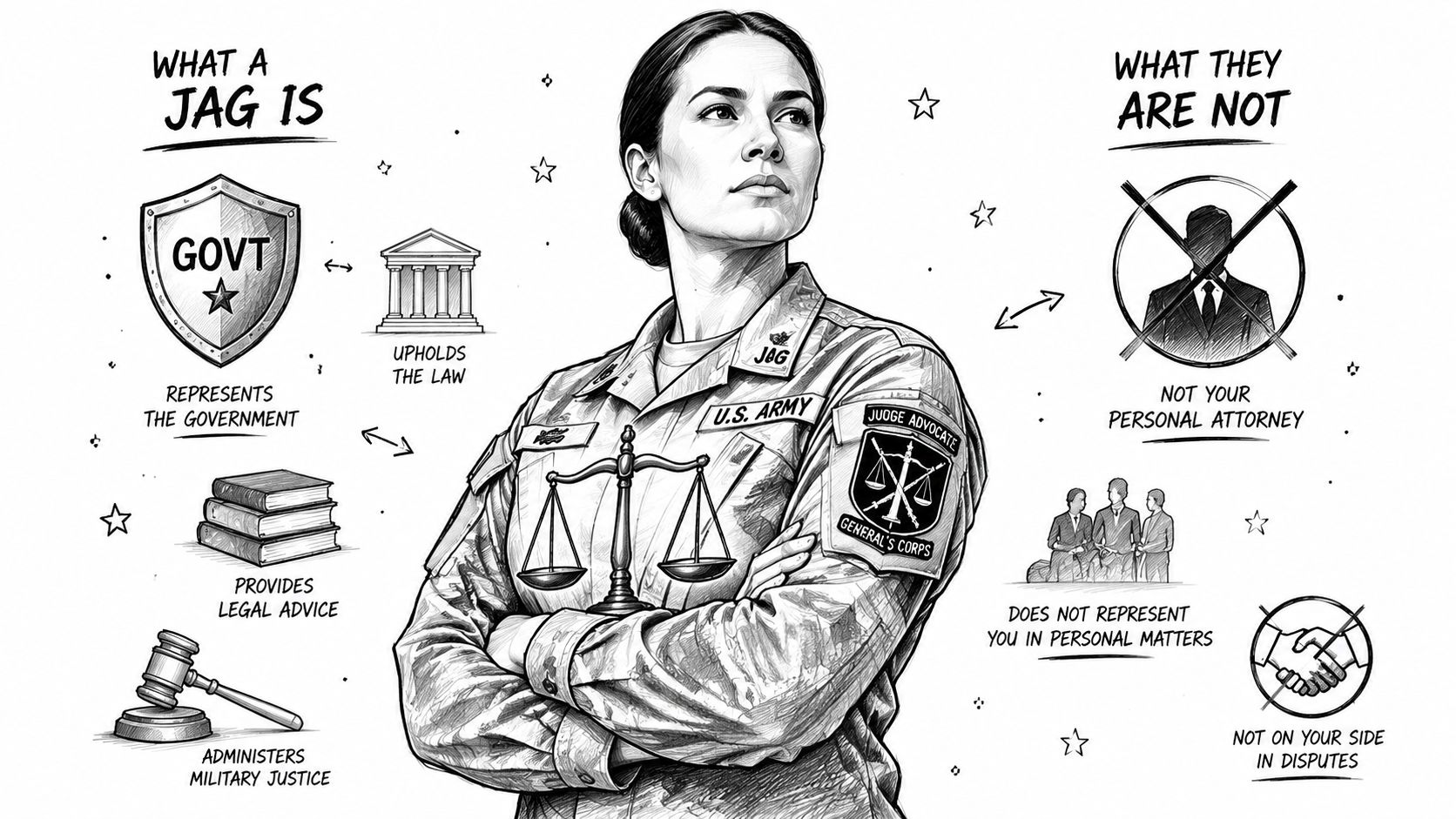
A JAG military attorney is a licensed lawyer who serves as a military officer inside the system you’re dealing with. That’s not necessarily bad. But if you misunderstand what a JAG is, you’ll make bad decisions at the worst possible time.
Who JAG officers are
The Army’s own recruiting materials state that the U.S. Army Judge Advocate General’s Corps is the largest law firm in the United States, with an active component attorney strength of 1,843 as of the end of Fiscal Year 2024. The same Army source states that to become an Army JAG officer, a candidate must hold a Juris Doctor from an ABA-accredited law school, be licensed to practice law, and be under 42 at the time of commission (Army JAG career qualifications).
That tells you two things.
First, these are real lawyers with real credentials. Second, they are also commissioned officers in a structured chain of command. Their careers develop inside the institution that is investigating you, charging you, separating you, or prosecuting you.
If you need a basic orientation to how the military justice system works, read this guide to the UCMJ system and military justice. Then come back to the strategic problem.
What that means for you
A JAG is not automatically “your lawyer” the moment trouble starts. JAG officers serve many roles. Some advise command. Some prosecute. Some defend. Some handle administrative law, ethics, claims, or operational matters.
Practical rule: Stop using the word “JAG” as if it means “personal defense attorney.” It doesn’t.
That distinction matters because service members often hear “talk to JAG” and assume legal protection is already in place. It usually isn’t. A government lawyer inside the military system may be excellent, ethical, and hardworking. But their function depends on the job they’re assigned, the timing of your case, and whether they’ve even entered it yet.
Your command has lawyers. The prosecution has lawyers. The system has lawyers. The real question is whether you have a defense lawyer in the room early enough to matter.
The Timing Paradox Why Your Appointed JAG Arrives Too Late
The biggest misconception in military justice is that waiting for your appointed JAG is a safe move. It isn’t. In serious cases, that delay can wreck your defense before it begins.

The case starts before your defense does
Here’s the timing paradox. The investigation starts early. The command starts making judgments early. Investigators start shaping the file early. But your detailed military defense counsel often arrives later, after important decisions have already hardened.
One published explanation of this problem puts it plainly: civilian military lawyers can actively shape OSTC decisions and investigator interviews during the pre-charging window, whereas appointed JAG counsel are frequently assigned only after charges are filed, limiting their ability to prevent court-martial initiation. Service members who wait risk losing the opportunity for a better outcome before the OSTC files charges (pre-charge role of civilian counsel in OSTC cases).
That is the part command won’t spell out for you.
By the time you’re formally assigned defense counsel, investigators may already have:
- Locked witness statements
- Framed your conduct in the worst possible light
- Advised command on charging options
- Created an interview record that hurts you
- Pushed the case toward court-martial instead of a lesser outcome
If your first legal move happens after all that, you’re late.
What a civilian lawyer can do in that gap
An experienced civilian military defense lawyer can step in during the part of the case where outcomes are still fluid. That means contacting investigators, controlling your communication, protecting you from a disastrous “just tell your side” interview, and pushing for a smarter resolution before charging decisions are final.
See this deeper breakdown of how experienced counsel fight during the military investigation phase.
Waiting for “free counsel” can be the most expensive decision you make.
Strategy triumphs over panic. Truth matters, but truth alone doesn’t organize evidence, stop a bad interview, challenge credibility, or redirect a command narrative. Lawyers do that. Early.
If CID, NCIS, OSI, CGIS, or command has contacted you, assume the file is already moving. Act like the pre-charge window is your best chance, because in many cases it is.
JAG Involvement in Investigations Courts-Martial and NJP
Not every military case is the same. The role of a JAG military attorney changes depending on whether you’re under investigation, facing Non-Judicial Punishment, dealing with an administrative board, or headed into a court-martial.
Investigations and early command action
In the investigation phase, the danger is often hidden. CID, NCIS, OSI, or CGIS may act like they’re just gathering facts. They are building a case. Command may also be collecting statements, preserving messages, and deciding whether to escalate.
This is why “I haven’t been charged yet” is a weak comfort. A lot can happen before formal charges.
Article 15 and administrative action
At Article 15, also called Non-Judicial Punishment, the proceeding is not neutral in the way many service members assume. One military defense source describes the Commanding Officer as acting as accuser, judge, and jury simultaneously, which is exactly why these cases need careful handling from the start (Article 15 practice overview).
That same source states that if you want to appeal an Article 15 finding or punishment, you have 5 calendar days to do it, and missing that deadline forfeits the appeal right. That’s a brutal deadline if you’ve spent the first few days confused, embarrassed, or trusting command to “fix it.”
If you’re trying to understand the practical consequences, this overview of what an NJP means in the military is worth reading.
Courts-martial and where the stakes explode
There are three types of courts-martial under the UCMJ: Summary, Special, and General. They carry different levels of exposure. A General Court-Martial is the only forum that can impose a sentence of death or more than 10 years of confinement (court-martial classifications and punishments).
That should reset your thinking immediately.
- Summary Court-Martial: Lower level, but still dangerous for your record and career.
- Special Court-Martial: More formal, more exposure, more lasting damage.
- General Court-Martial: Life-changing risk. Treat it that way from day one.
If the government is considering a court-martial, you are not in a paperwork problem. You are in a criminal case.
Civilian Defense Counsel vs Appointed JAG Attorney
The wrong question is, “Why pay for a lawyer when JAG is free?” The right question is, “Who gives me the best chance to protect my career, freedom, and future?”
What free really costs
Appointed military defense counsel can be committed and capable. Some are excellent. But the system does not assign lawyers based on what your case deserves. It assigns who is available.
A civilian military defense attorney has one client. You. That changes everything.
A civilian lawyer is not reporting inside your command structure. A civilian lawyer is not rotating out because of military staffing needs. A civilian lawyer can get involved before the case hardens, build a theory early, and pressure weak evidence before the government settles on a charge sheet.
Military-appointed counsel often enters the fight after key decisions are already made. That isn’t a knock on individual JAGs. It’s a structural problem.
Side-by-side comparison
| Factor | Appointed JAG Military Attorney | Civilian Military Defense Attorney |
|---|---|---|
| When representation often becomes practical | Often after the case is already moving through command or charging channels | Can step in as soon as investigators or command make contact |
| Chain of command independence | Works inside the military system | Works outside the chain of command |
| Caseload control | Often driven by assignment demands | Can focus the representation around your case |
| Strategic role before charging | Frequently limited by timing | Can act during the pre-charge window |
| Choice | You don’t control who gets assigned | You choose based on experience and fit |
| Trial posture | Varies widely by assignment and background | You can target lawyers who focus on court-martial defense |
| Client loyalty | Ethical duty to client, but inside a government structure | Undivided loyalty to the client alone |
Ask yourself the uncomfortable question. If your rank, family, retirement, and liberty are at risk, do you want to hope the system assigns the right lawyer at the right time, or do you want to build your own defense on purpose?
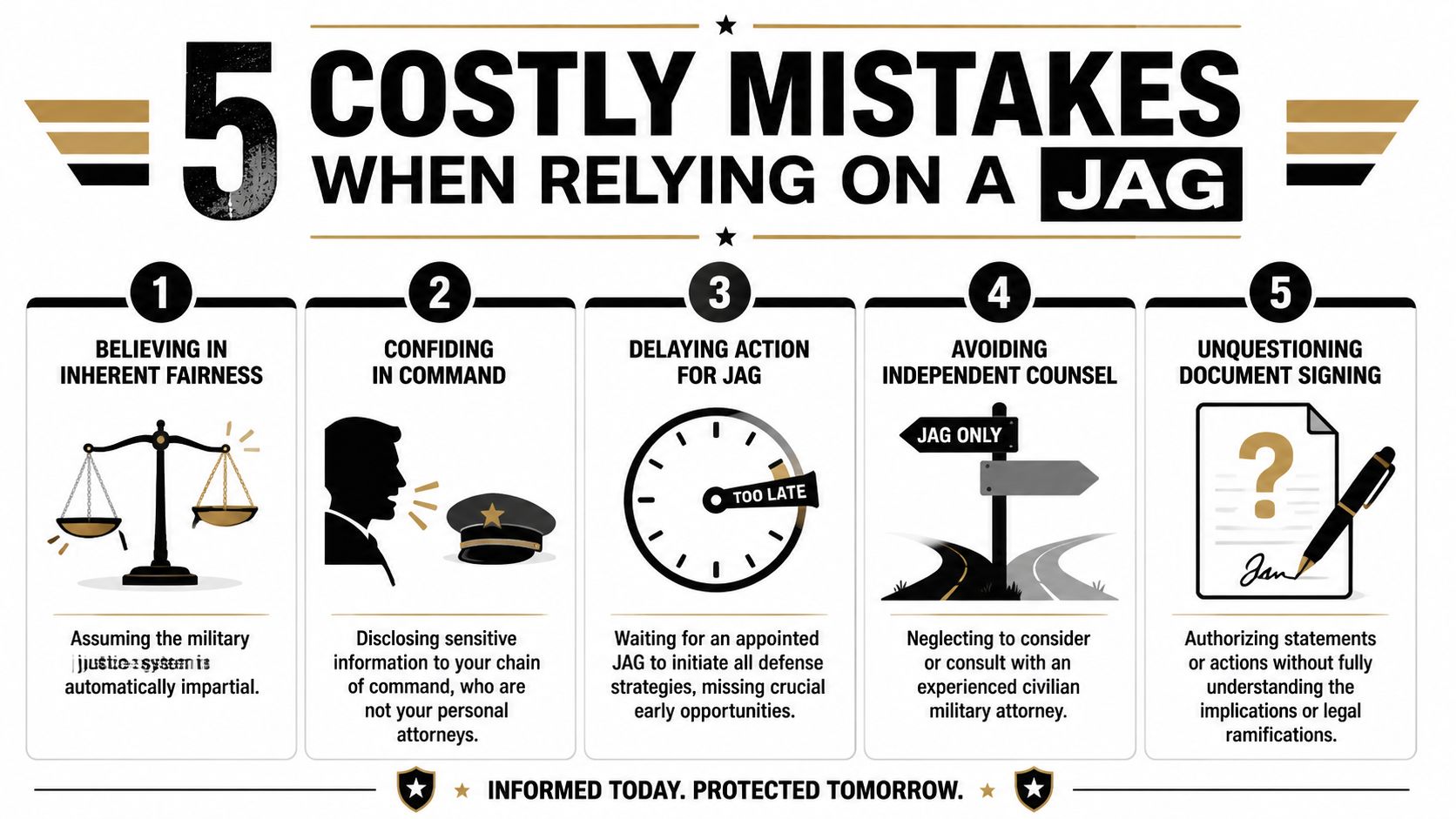
5 Costly Mistakes When Relying on a JAG
Most service members don’t lose because they are guilty. They lose because they make preventable mistakes early.
The errors that bury good defenses
Waiting for assignment before acting
If investigators are already circling, waiting for a later-appointed JAG can waste the most valuable part of the case.Talking to investigators to “clear things up”
Service members love this mistake. They think honesty alone will save them. It won’t if the interview is structured to lock you into harmful details.Confiding in command
Your commander, first sergeant, chief, or supervisor is not your personal defense team. They may be professional. They may even like you. They are not there to protect you.Signing documents too quickly
Statements, acknowledgments, rights advisements, rebuttal deadlines, election forms. People sign because they’re stressed. Bad move.Assuming the process is fair because it’s official
The military justice system runs on authority, speed, and command priorities. It does not exist to protect the accused first.Believing “there’s no evidence” means there’s no case
Weak evidence still becomes a strong case if you help investigators fix the gaps.Treating Article 15 like minor discipline
NJP can damage rank, pay, promotion, reputation, and later options. Casual treatment causes lasting harm.
The first version of the story usually sticks. If you let investigators write it without resistance, you’ll spend the rest of the case trying to undo it.
How to Choose Your Legal Representation
You don’t need a motivational speech. You need a decision standard.
Questions to ask immediately
If you’re speaking with an appointed JAG or a civilian attorney, ask direct questions.
- How much court-martial experience do you have? Ask about defended cases, not just office titles.
- What is your first move in my case? If the answer is vague, that’s a warning.
- What should I stop doing today? Strong defense lawyers give immediate behavior guidance.
- How do you handle investigators and command contact? You need a plan, not a shrug.
- What weaknesses do you see right now? Good lawyers spot advantages early.
A lawyer who can’t explain strategy in plain English is a bad fit for a stressed client in a military crisis.
When civilian counsel is the smart move
If you’re facing a sexual assault allegation, violence allegation, fraud accusation, serious UCMJ charge, adverse security consequence, or likely separation, civilian counsel is often the smarter play. The same is true if you’re still in the investigation phase and nobody has protected your position yet.
For Coast Guard members, timing can differ in important ways. The Coast Guard states that a member is entitled to a detailed military defense attorney automatically upon the preferred charging of Special or General Court-Martial charges, and also upon formal notification of an Administrative Separation Board, which provides representation before factual findings are made (Coast Guard defense counsel rights).
That’s useful. It still doesn’t erase the need for early strategy in serious cases.
Use this rule. If the allegation could cost you your career, liberty, retirement path, or professional reputation, don’t make your lawyer choice based only on price. Make it based on timing, experience, and whether that lawyer is built to fight the government.
Frequently Asked Questions About Military Lawyers
Can I refuse to talk to CID NCIS OSI or CGIS
Yes. You should get legal advice before answering questions. “Helping them understand” is how many service members hand over the government’s best evidence.
Is a JAG military attorney a real lawyer
Yes. JAG officers are licensed attorneys. The issue is not whether they’re real lawyers. The issue is whether the right defense lawyer is involved early enough and has the right experience for your case.
Will a JAG automatically represent me during the investigation
Not necessarily in the way service members assume. That gap is the timing problem that traps people.
Can I hire a civilian lawyer and still work with military counsel
Yes. In many cases, that is the strongest setup. Civilian counsel can provide early strategy and independent firepower while detailed military counsel remains part of the defense team.
Is an Article 15 something I can handle myself
That’s a gamble. Bad statements, missed deadlines, and sloppy elections can hurt you fast.
Will I go to jail
Maybe. It depends on the allegation, the forum, and how the case develops. If court-martial is on the table, treat confinement exposure as real.
Are conversations with my lawyer confidential
Conversations with your defense lawyer are generally where you should be speaking candidly. Conversations with command, friends, coworkers, and your unit are not safe substitutes.
How fast should I act
Immediately. Delay helps investigators, not you.
If you’re under investigation, facing NJP, staring at separation, or worried charges are coming, do not wait for the system to protect you. It won’t. The pre-charge window is where cases are often saved or lost.
Talk to qualified defense counsel now. Your career is on the line, and the clock is already running.