
Pennsylvania courts had 10,847 pending warrants at year end 2022, and more than 80% of the open warrants cited in the court’s earlier discussion were tied to non-felony matters like missed court dates, unpaid fines, or compliance failures. For a service member, an outstanding warrant is never just a docket problem, it can hit your career, your travel, and your credibility fast.
A lot of people think a bench warrant is something that only lands on civilians who ignore court. That’s wrong. Service members sometimes learn about a Pennsylvania warrant while deployed, between duty stations, or right when a routine move has already turned every part of life into a timing problem. When that happens, you need facts, not panic, and you need a plan that respects both Pennsylvania procedure and the reality of military life.
Table of Contents
- The Situation Most Service Members Never Expect
- What a Bench Warrant Is in Pennsylvania
- How Pennsylvania Courts Issue Bench Warrants
- Consequences and the 72-Hour Hearing Rule
- County-Level Differences That Affect Your Case
- How to Clear a Bench Warrant in Pennsylvania
- What Every Service Member Needs to Know Before Acting
The Situation Most Service Members Never Expect
A staff sergeant gets a call from home while on rotation. A family member found a court notice, then an online search confirms there’s an active bench warrant in Pennsylvania. He hasn’t been arrested, he hasn’t been convicted of anything new, and he’s halfway through a move that already has his household split across two states. That’s the kind of mess that turns a court issue into a command issue.

Pennsylvania bench warrants don’t stay on paper. They can surface during a traffic stop, routine law-enforcement contact, travel screening, or administrative processing. For a service member, the practical damage is often wider than the legal case itself, because unanswered court business can spill into leave approval, security review, or separation paperwork.
Practical rule: If you’ve got an outstanding warrant, treat it like an active operational problem, not an administrative annoyance.
The worst mistake is assuming deployment or reassignment pauses the obligation. Courts don’t see it that way. If you missed a hearing, ignored a payment order, or didn’t respond to a summons the way Pennsylvania law requires, the warrant can sit there until someone forces a resolution.
For military families, that’s the trap. Mail gets forwarded late, orders move people fast, and a low-level matter can sit unresolved until it becomes a handcuff issue. The right response is not to wait for the warrant to find you. It’s to verify the case, identify the county, and move first.
What a Bench Warrant Is in Pennsylvania
A bench warrant is a judge’s order directing law enforcement to arrest someone because that person did not comply with a court obligation. It comes from the bench, which is why the term matters. It is not the same thing as a standard criminal arrest warrant based on probable cause.

Why the label matters
Pennsylvania uses bench warrants in more than one setting. They can arise in criminal cases, civil and domestic-relations matters, and payment-default situations tied to court-ordered amounts. The trigger changes, but the core effect is the same. A judge has decided that your noncompliance now justifies arrest authority.
That is why service members should not brush off a warrant because the underlying case looks minor. A missed traffic or summary-court matter can still become an active bench warrant, and active warrants create real friction when you are trying to pass through a base gate, clear a move, or explain your status to command.
What it is not
It is not a vague threat. It is not a warning letter. It is not a substitute for a criminal arrest warrant. Pennsylvania procedure treats the notice and hearing requirements seriously, which means the court has to follow the proper trigger before issuing one.
The takeaway is simple. In Pennsylvania, a bench warrant is a live enforcement order. If it exists, you need to know the county, the trigger, and the fastest lawful way to get it under control.
How Pennsylvania Courts Issue Bench Warrants
Pennsylvania doesn’t let judges issue bench warrants on impulse. The rules build in notice requirements, and that matters because the government has to show more than simple absence before the court can turn nonappearance into arrest authority.
The notice problem is the first checkpoint
For failure-to-appear situations, Pennsylvania civil procedure requires a finding that the person had sufficient notice of the hearing before a bench warrant can issue. The rule expressly says notice cannot rest solely on first-class mail service. That’s a real safeguard, not a decorative one, because weak proof of notice creates a weak warrant basis. See the notice requirement in Pennsylvania Rule 1140.
For criminal procedure, Rule 430 allows a bench warrant when a defendant fails to respond to a citation or summons served personally or sent by certified mail with return receipt requested, or when the defendant fails to appear for execution of sentence as required. The same rule also allows a warrant for default on restitution, fines, or costs, but only after notice and a 10-day response window. That is the part too many generic explainers skip. The debt-to-arrest pathway exists, but it is not supposed to be automatic. See Pennsylvania Criminal Procedure Rule 430.
Payment default is not the same as evasion
If the warrant was triggered by unpaid court-ordered money, the legal question is more nuanced than “did the person show up.” The court has to deal with notice, opportunity to respond, and the actual default. In practical terms, that means financial instability, missed mail, and relocation can all matter.
Courts care about proof of notice first. If notice is shaky, the warrant is easier to attack. If the warrant is tied to money, the underlying payment history matters just as much as the missed hearing.
That’s the strategic point for service members. Don’t assume every bench warrant means the court has a solid paper trail. Sometimes it does. Sometimes it doesn’t. A lawyer who knows Pennsylvania procedure will start with the trigger, the notice method, and the county record before deciding how to clear it.
Consequences and the 72-Hour Hearing Rule
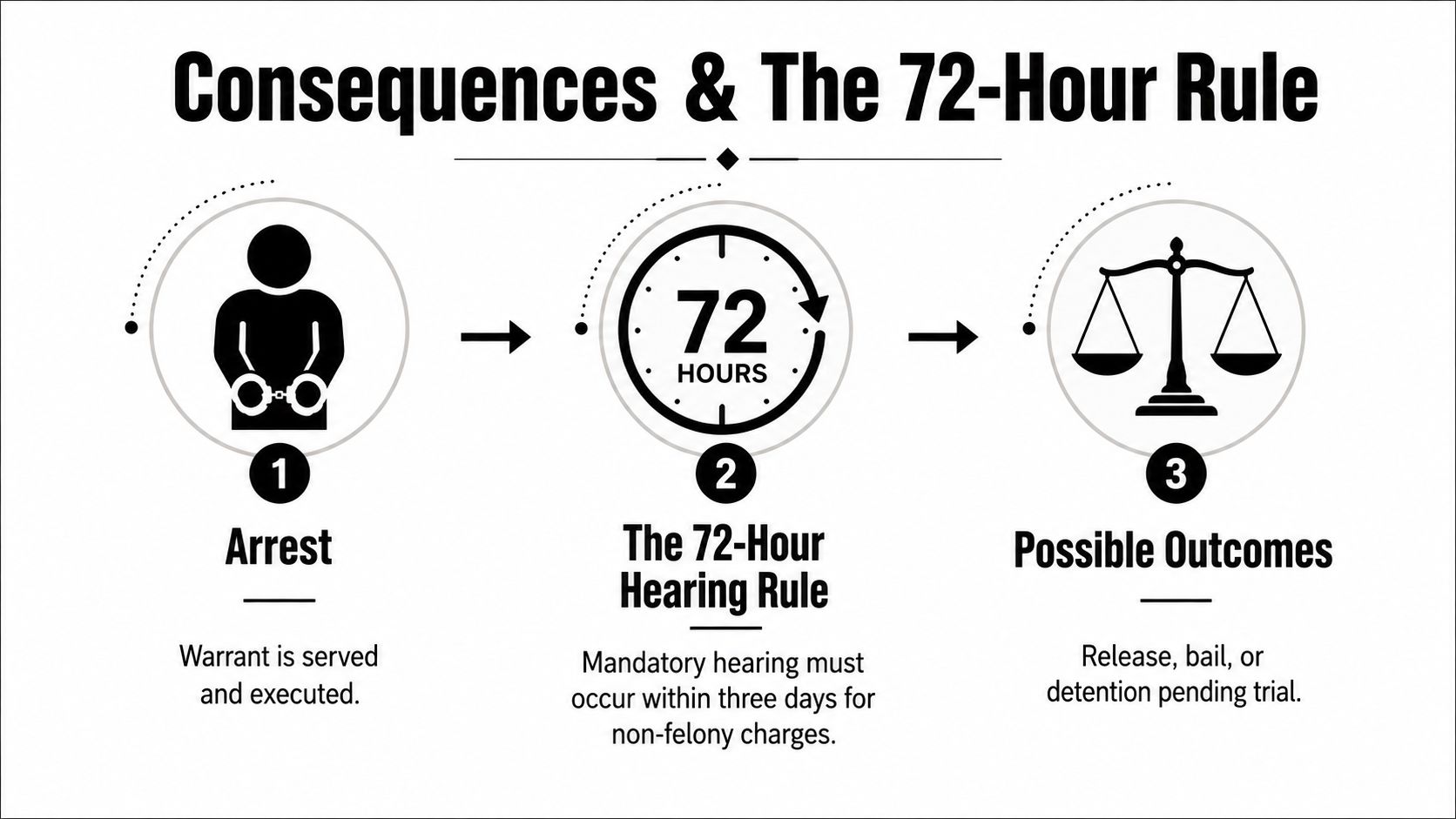
Once a bench warrant is executed, the clock turns on the government. Under 234 Pa. Code Rule 150, a detained person generally cannot be held without a bench-warrant hearing for more than 72 hours, or until the close of the next business day if that deadline falls on a non-business day. If the hearing is not held in time, the warrant expires by operation of law. See Rule 150’s timing requirement.
What happens after arrest
The rule requires the person to be taken before the proper judicial officer without unnecessary delay. If the arrest happens in the county that issued the warrant and the hearing cannot be held right away, the person is lodged in the county jail pending the hearing. The point is fast judicial review, not open-ended detention. That due-process limit is the part that matters most when time is tight.
Philadelphia’s 2023 Annual Report recorded 8,761 total warrants disposed in that year, and Westmoreland County reported 1,043 individuals in Bench Warrant status as of December 31, 2023. Those county figures show this is not a rare side issue. It is part of the regular Pennsylvania court workflow. Philadelphia’s 2023 Annual Report and the county’s bench-warrant status reporting point to the same reality, just from different angles.
Why this matters for military life
For a service member, a warrant can affect more than a court date. It can complicate leave, travel, and any situation where local police run your name. It can also create trouble if you are trying to resolve a case while dealing with a transfer, temporary duty, or family relocation.
The smart move is to act before the warrant turns into a custody event. Once you are in custody, the county and the judge control the tempo.
County-Level Differences That Affect Your Case
Pennsylvania is not a one-size-fits-all warrant system. County practice matters, and it matters a lot. Some counties are open to attorney-arranged surrender terms. Others want the person physically in front of the court before they’ll discuss recall or release.
The county controls the pace
That means two service members with similar bench warrants can face very different outcomes depending on where the warrant was issued. One county may allow a lawyer to line up a same-day appearance and reduce the risk of jail time. Another may insist on a more formal in-person process. You don’t guess your way through that. You verify it.
Domestic-relations cases sit in their own lane. Under Rule 1910.13-1, a request for a bench warrant in that setting must be made within 60 days of the failure to appear, and the request has to include a certification that the party hasn’t appeared in another domestic-relations matter involving the same parties since the missed appearance. See Rule 1910.13-1. That’s a specific family-court mechanism, not a criminal one.
Why service members get caught here
Military life creates the perfect conditions for county confusion. Orders change. Mail gets rerouted. A hearing notice reaches the wrong address. A spouse opens a letter after a move. A commander expects you to report while a court expects you to appear in person somewhere else.
That’s why a bench warrant in one Pennsylvania county can be manageable, while the same fact pattern in another county gets ugly fast. The right first question is not “Can I beat this?” It’s “Which county issued it, and what does that county do when counsel calls?”
How to Clear a Bench Warrant in Pennsylvania
If you find an active bench warrant, do not improvise. Verify it first, then build a controlled surrender plan. Plenty of warrants can be resolved without a surprise arrest at the courthouse, but only when someone who understands Pennsylvania county practice gets involved early.
The cleanest path is usually controlled surrender
In many cases, experienced counsel can contact the court or the prosecuting authority before you appear. That can open the door to a pre-arranged surrender, a same-day hearing, or a court appearance that keeps you out of a sudden arrest in the lobby. If the warrant came from a payment default, the financial issue may need to be fixed first. If it came from a missed appearance, the fight is about notice and recall.
Use this sequence:
- Discovery. Confirm the warrant through court records or an attorney check. Do not rely on rumor or a single online listing.
- Counsel. Retain a lawyer who knows Pennsylvania bench-warrant practice and the local county. If you are comparing representation, this guide on choosing military defense counsel gives you a solid starting point.
- Surrender plan. Decide whether to appear voluntarily, have counsel arrange a walk-through, or clear the warrant before you show up.
- Court appearance. Go in ready to address the underlying problem, not just the warrant.
The military angle matters here. Service members get burned by address changes, deployment schedules, and duty station moves that break the notice chain, and counties do not all handle those failures the same way. A lawyer who understands that pressure can often use it to shape the way the court sees the case.
What not to do
Do not show up unprepared and hope the clerk sorts it out. Do not assume the sheriff will let you walk out. Do not call the court and start explaining the facts without legal advice if the case is criminal or payment-related.
Best practice: Fix the reason for the warrant before you step into the courthouse, because the warrant is only part of the problem.

What Every Service Member Needs to Know Before Acting
The danger in bench warrants in PA is delay. The longer you wait, the more likely the warrant collides with a stop, a move, a command inquiry, or a family emergency. Service members are especially vulnerable because the very things that make military life work, mobility, relocation, and fast change, are the same things that create missed hearings and broken notice chains.
Pennsylvania’s rules give you openings, but only if you use them early. The notice requirement, the payment-default window, the county-specific practice, and the 72-hour hearing rule all create influence. None of that helps if you sit still and hope the system forgets you.
Clear priorities
- Find the county immediately. County practice drives the next move.
- Identify the trigger. Missed hearing, payment default, or another noncompliance issue.
- Stop talking casually about it. Loose comments to coworkers, command, or police can make a bad situation worse.
- Get counsel before you appear. A controlled resolution beats a surprise arrest.
- Treat the warrant like a readiness issue. If the court problem is active, the military problem can become active too.
The smart move is simple. Confirm the warrant, map the county process, and bring in counsel before the warrant brings law enforcement to you. If you’re dealing with bench warrants in PA and you’re also carrying military obligations, contact a civilian military defense lawyer today, compare strategy before you act, and get the case under control before a routine contact turns into an arrest.