You’re staring at a DD-214 that says General (Under Honorable Conditions), and it keeps showing up where you don’t want it. A federal application stalls. A benefits question gets kicked back. A clearance review gets tighter than it should be. The discharge might feel old, but the paperwork is still alive, and people still read it like it matters.
That’s because it does matter. An upgrade military discharge from general to honorable is not a cosmetic change. It can change how employers, boards, and benefit agencies read your service record, and it can change the advantage you have when you explain your past. If you’re trying to move on, the characterization on your record is still making decisions with you, not for you.
Table of Contents
- Why a General Discharge Still Follows You Years Later
- DRB vs. BCMR Choosing the Right Forum
- The Legal Theories That Actually Win Upgrades
- Filing the Application Forms and Evidence Package
- What a Persuasive Personal Statement Looks Like
- What Actually Changes After the Upgrade and When to Hire a Lawyer
- Discharge Upgrade Questions Veterans Actually Ask
Why a General Discharge Still Follows You Years Later
A veteran can do everything right after separation and still get stuck on the same old label. This comes up with people trying to get back into federal work, trying to sort out education benefits, or trying to explain a security clearance issue that should have ended years ago. The problem isn’t memory. The problem is the DD-214.
There are three basic discharge characterizations many service members care about, honorable, general, and less-than-honorable. A General discharge sits in the middle. It says your service was not bad enough to be fully negative, but it also wasn’t clean enough to earn the strongest characterization. That middle ground still creates friction because agencies and employers treat it as a warning sign, not a clean slate.
The history matters too. Training material covering World War II through the post-9/11 era shows that more than 2.36 million veterans received a less-than-fully honorable discharge, and general discharges rose from 0.2% in World War II to 8.4% in the post-9/11 period, with counts including 12,979 in World War II, 122,381 in the Korean War, 354,484 in Vietnam, 128,315 in the Gulf War era, and 150,434 in the post-9/11 era training material. That is why upgrade dockets are crowded. General discharges are recurring administrative outcomes, not rare accidents.
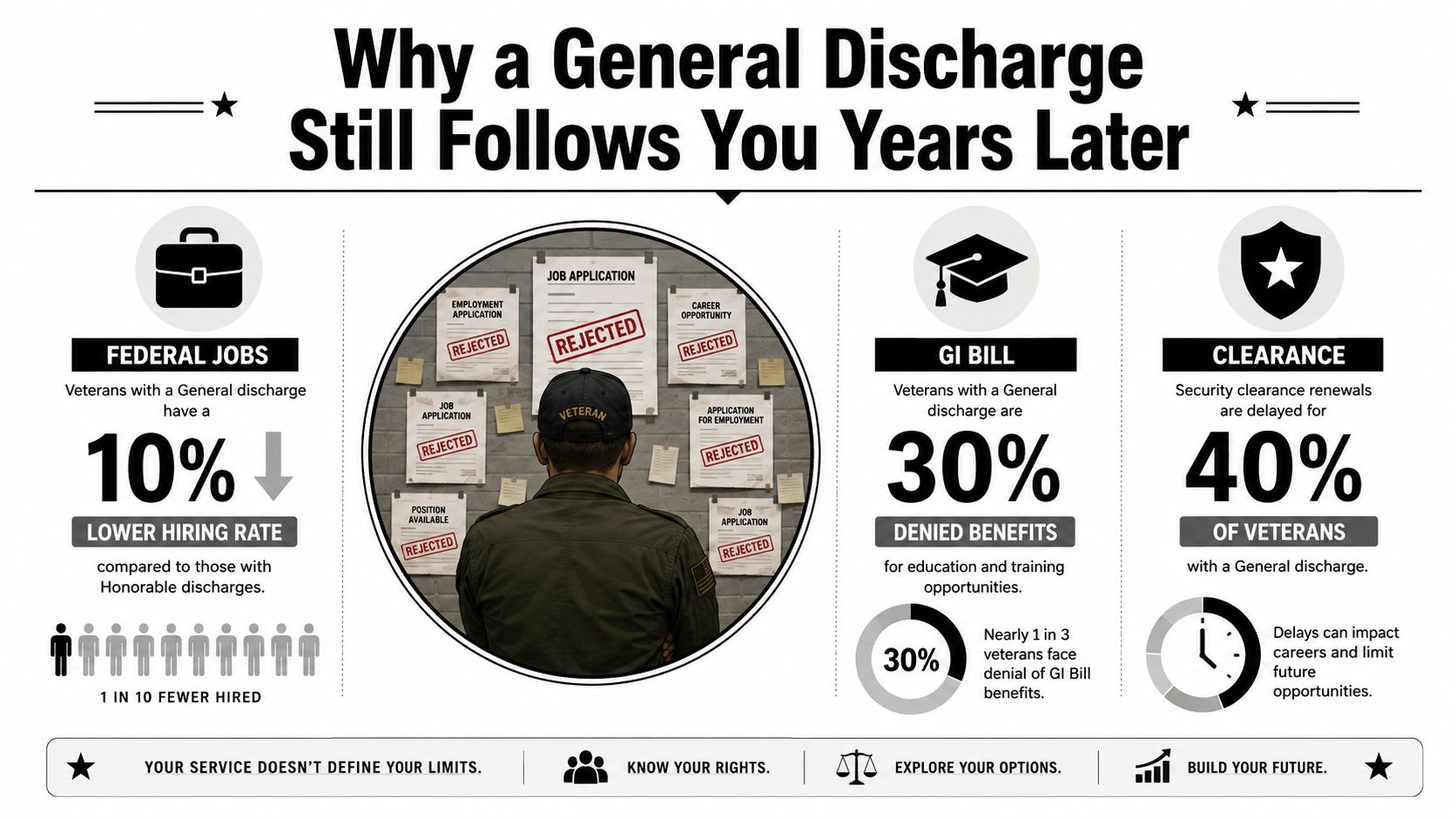
Here’s the practical point. A General discharge can sit in the background while you try to get hired, get educated, or get cleared, and it keeps forcing you to explain yourself. If you’re trying to move past it, the stakes are bigger than pride. They reach into compensation, schooling, and cleared work.
Practical rule: if the characterization block on the DD-214 is costing you time, money, or access, treat the upgrade like a legal case, not a paperwork favor.
A lot of veterans also miss the downstream question. If a General becomes Honorable, the change is real, but not every benefit changes automatically. That’s why the discharge characterization matters so much at the start, and why the downstream consequences need separate attention later. For a broader look at how less-than-honorable service affects benefits, see this overview of other-than-honorable discharge benefits.
DRB vs. BCMR Choosing the Right Forum
Your first mistake is filing in the wrong forum. The Discharge Review Board, or DRB, is the faster and narrower path. The Board for Correction of Military Records, or BCMR, is broader, slower, and built for tougher cases. Pick the wrong one and you burn time, miss your best arguments, and weaken the record you need to win.
When the DRB makes sense
Start with the DRB if you are within the 15-year window and you want a direct upgrade of the discharge characterization. The DRB can upgrade a General discharge to Honorable, and it can also change the reason or basis for separation, but it cannot overturn, pardon, or erase a court-martial conviction Marine Corps memo. That limit is the dividing line. If your case rises or falls on a court-martial conviction, the DRB is not where you finish.
When the BCMR makes sense
Go to the BCMR if you are outside the DRB window, need broader corrective relief, or your discharge problem is tied to record errors that go beyond characterization. The BCMR is also the right forum when the evidence you need was not available at separation, or did not exist yet. That is where medical records, later diagnoses, and correction-based arguments belong.
| Factor | Discharge Review Board | Board for Correction of Military Records |
|---|---|---|
| Discharge characterization | Can change it | Can change it |
| Court-martial conviction limit | Cannot overturn it | Broader authority, but conviction issues remain legally hard |
| Timing | Best within 15 years | Used when outside the DRB window or for broader relief |
| Scope | Narrower review | Broader correction power |
The rule is plain. File DRB first if the record is straightforward and you are inside the window. File BCMR first if the file is older, more complicated, or tied to more than discharge wording. A BCMR-style case forced into a DRB package usually comes in underdeveloped, and that hurts your chances.
The Legal Theories That Actually Win Upgrades
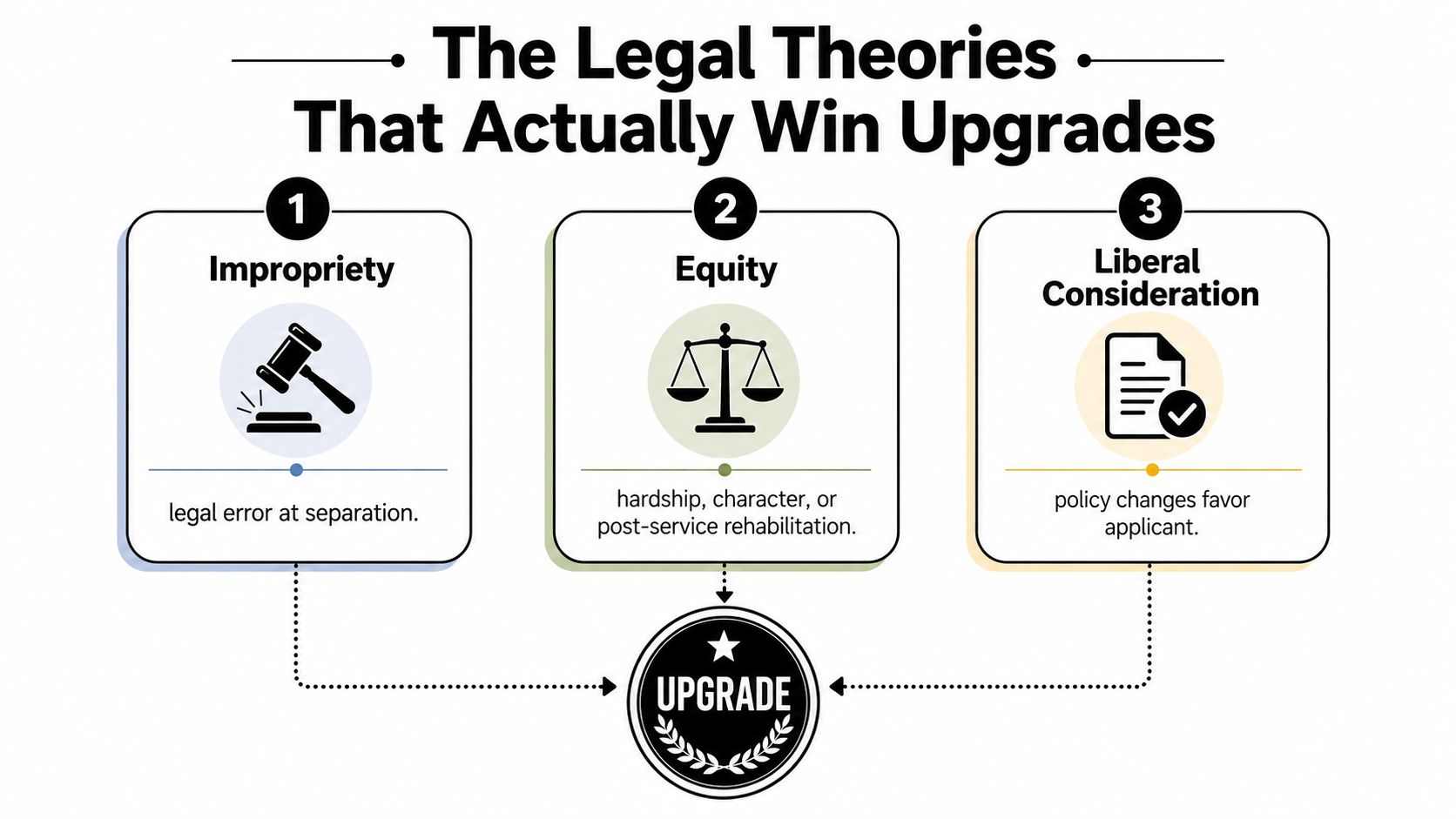
The board does not award upgrades because your letter sounds sincere. It upgrades when the record supports a legal theory. There are three theories that matter in practice, and every serious package should be built around one of them.
Impropriety
Impropriety means the separation was legally wrong. Maybe the command used the wrong process. Maybe the paperwork was defective. Maybe the basis for discharge did not match the facts. If you have a real procedural problem, don’t bury it under emotion. Put it front and center and prove it with the record.
Equity
Equity is the fairness argument. This area involves post-service conduct, rehabilitation, employment history, awards, and community evidence. The strongest equity cases are not about “I deserve a second chance.” They show that the original discharge is too harsh when measured against the whole person and the passage of time.
Liberal consideration
Modern boards give liberal consideration to mental-health-related evidence, including PTSD, TBI, and related conditions when they plausibly contributed to misconduct. A July 2025 GAO-reported dataset summarized in independent military-justice analysis says DoD reviewed more than 21,000 discharge upgrade cases from January 2018 through March 2024, with approval rates ranging from about 18% to nearly 49% depending on board and service military-justice analysis. That spread tells you something important. Forum selection and proof quality still matter.
The board is not looking for a sad story. It is looking for a record that makes the discharge look wrong, unfair, or out of step with modern policy.
That’s why mental health cases still need evidence, not just sympathy. If PTSD, TBI, or MST played a role, you need records that connect the condition to the misconduct. A clean narrative helps, but the medical backbone is what gives the narrative legal weight.
Filing the Application Forms and Evidence Package
The forms are not complicated, but people still botch them. For DRB cases, the standard form is DD Form 293. For BCMR cases, the standard form is DD Form 149. On either form, you need to say exactly what you want, and you need to choose the review type carefully. Official instructions require applicants to indicate whether they want an in-person appearance in Washington, D.C., a traveling board, or a records-only review instructions.
What belongs in the packet
Your package should be built around proof, not hope. That usually means service treatment records, post-service medical records, VA records, employment history, character letters, and awards or commendations. If your case turns on mental health, include the records that show when the problem started and how it affected conduct. If your case turns on equity, show how your life after service has looked.
A practical guide says many discharge-upgrade applications take 4 to 12 months to process, and that a records-only review is usually faster while a hearing can improve the chance of success because you get to explain the case directly process guide. That timing matters. If your record is strong on paper, a records review can be efficient. If your credibility is part of the win, a hearing is often the better play.
For a form-and-document roadmap, this upgrade process guide is useful, but don’t let a checklist replace strategy. The board reads what you give it. If the file is thin, the result usually is too.
What the board wants to see
- Clear request: State whether you want an Honorable discharge and why.
- Specific theory: Impropriety, equity, or liberal consideration.
- Proof trail: Medical records, service records, and post-service evidence that support the same story.
- Clean organization: A board member should understand the case in minutes, not after a scavenger hunt.
The forms matter because they set the frame. If you ask for relief vaguely, the board treats the case vaguely. That is how good cases get buried.
What a Persuasive Personal Statement Looks Like
A winning personal statement is not a confession, and it is not a therapy exercise. It is a legal narrative. It tells the board why the discharge happened, what was going on at the time, and why the record should now be corrected. If you can’t connect those dots, the board will fill in the gaps against you.
What worked in a real-world style package
A veteran with a PTSD-related misconduct discharge built a file around service records, a later VA PTSD diagnosis, employment history after service, and a statement that tied the diagnosis to the behavior that triggered separation. The point was not that the veteran became a perfect citizen after discharge. The point was that the misconduct fit a medical and service-history pattern the original board had not credited. That kind of package gives the board a reason to say the original outcome was too harsh or no longer fair.
The contrast is obvious. A heartfelt letter with no records, no diagnosis, and no explanation for the misconduct usually goes nowhere. Boards see emotion all day. They need evidence.
What strong writing looks like
A persuasive statement should do four things:
- Name the problem. State the discharge basis and the event or pattern that led to it.
- Tie it to the record. Point to service documents, treatment notes, or evaluation records that show the context.
- Show what changed. Use post-service work, school, treatment, or community involvement.
- Make the legal ask. Say why the discharge is improper or inequitable, or why liberal consideration should apply.
Common failure points are predictable. People use the wrong form, leave out the narrative, skip medical evidence, miss the 15-year DRB window, pick records-only when they needed a hearing, or file with the wrong branch board. Each mistake has a fix, but only if you catch it before submission.
My blunt advice: if your statement reads like a life story but not a legal argument, rewrite it.
The self-audit is simple. Does every key claim in the statement match a document in the packet? Does the theory fit the forum? Does the board have enough proof to say yes without guessing? If any answer is no, the package is not ready.
What Actually Changes After the Upgrade and When to Hire a Lawyer
A lot of veterans think the upgrade itself automatically resets everything. It doesn’t. Official guidance says an upgrade can change the discharge characterization and, in some cases, the RE code, but benefit eligibility often still depends on the specific program, and the VA can run a separate character-of-service review official guidance. That means the legal win and the benefit win are related, but they’re not identical.
What changes, and what doesn’t
If your record moves from General to Honorable, that is a major upgrade in itself. It improves how employers read the file, it helps with future applications, and it removes a major obstacle in the service record. But you still need to verify benefit-specific rules, because some programs look at more than just the final discharge label.
When to hire a lawyer
Hire counsel when the file is contested, the facts are messy, or the mental health angle matters. A civilian military defense lawyer is useful because they’re not inside your chain of command, they can spot weak evidence faster, and they know how DRBs and BCMRs react to the packet. That independence matters when your old command’s paperwork is still shaping the narrative.
The difference between self-filing and represented filing usually shows up in the details. Attorneys know when the case needs a hearing, when the records file is enough, and when the better move is to build around medical proof before asking for relief. In the right case, that changes the result.
For administrative separation issues that overlap with upgrade strategy, this Army-focused guide helps frame how separations are treated when the record is still fresh.
Discharge Upgrade Questions Veterans Actually Ask
Is a discharge upgrade permanent?
Yes, if the board grants it, the change to the record is permanent unless a later correction process changes it again. That’s why the first filing matters so much.
Does an Honorable upgrade show up on a background check?
The upgraded DD-214 is still part of your military history, so the record isn’t hidden. What changes is the characterization, and that matters because decision-makers read the upgraded version instead of the old one.
How long does it take to get benefits back?
There’s no single clock for every benefit. The discharge board changes the record, then the VA or another agency may still have to make its own determination depending on the program involved.
Can the board verify the new discharge online?
Veterans often use the correction-board process and portal tools to confirm the record after a successful case. Keep your final decision letter and updated discharge paperwork together.
Should I ask for a hearing?
If your credibility, mental health evidence, or explanation for the misconduct is central, a hearing can help. If the file is clean and documentary, a records review may be enough and can move faster.
What if my application was denied before?
Fix the defects before filing again. If the first packet was thin, the second one needs better documents, a tighter theory, and a clearer link between the facts and the legal standard.
Do I need a lawyer immediately?
If your case involves PTSD, TBI, MST, a court-martial issue, or a complicated separation basis, yes. Waiting usually means you lose time, lose influence, and submit a weaker record.
Do not keep guessing with a record that already hurt you once. Get the forum right, build the evidence correctly, and submit a package that answers the board’s legal question. If you’re serious about upgrading a General discharge to Honorable, speak with a civilian military defense lawyer now, before another weak filing costs you another year.