
You’re likely reading this after the phone call, the knock at the door, the command meeting, or the order to stay away from your own home. Your spouse, partner, or ex said something happened. CID, NCIS, OSI, or command wants a statement. You’re being told to cooperate. You’re thinking this is a misunderstanding that will calm down if you explain yourself.
That instinct can wreck your case.
UCMJ Article 128b – Domestic Violence is one of the most dangerous charges a service member can face because it hits every pressure point at once: confinement, discharge, firearms rights, security issues, family access, command restrictions, and public labeling. The government doesn’t need your situation to be neat. It only needs enough evidence to move the case forward while you make mistakes.
If you are under investigation, your job right now is not to “clear things up.” Your job is to stop the bleeding, preserve evidence, and get a real military defense lawyer involved immediately.
Table of Contents
- What Is UCMJ Article 128b Really?
- The Path from Accusation to Court-Martial
- Punishments and Lifelong Consequences
- How We Fight and Win Article 128b Cases
- Why Military Domestic Violence Cases Are Different
- Common Mistakes That Will Destroy Your Defense
- Frequently Asked Questions About Article 128b
- Can they charge me without injuries or photos
- What if the other person wants to drop it
- Can property damage or harming a pet become Article 128b
- Who helps the alleged victim
- Will this affect my clearance
- Can my spouse or partner’s texts help me
- Should I hire a lawyer before charges are preferred
- What should I do today
What Is UCMJ Article 128b Really?
You get called into the office after an argument at home. By lunch, command is treating you like a domestic abuser, investigators want a statement, and your phone suddenly matters more than your side of the story.
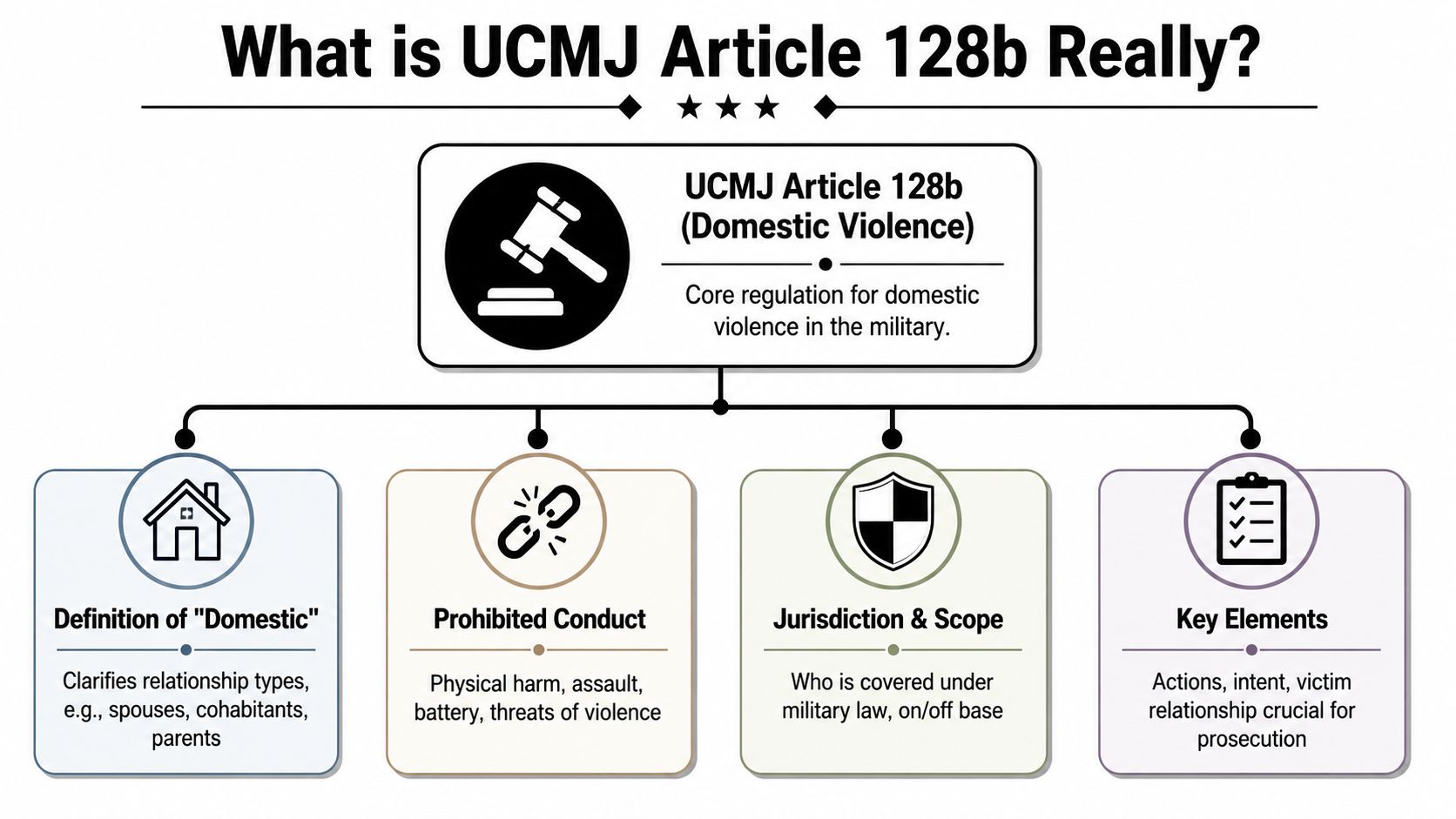
That is what Article 128b does. It gives the government a charge built for relationship allegations, with a domestic violence label attached from the first move. It has been part of the UCMJ since 2019, and prosecutors use it to frame the case early, shape command response, and box you into the worst possible narrative. Read the statute itself at 10 U.S.C. § 928b. If you need the larger court-martial context, start with this overview of how a military case moves from investigation to trial.
The charge is broader than accused service members realize
Article 128b is not limited to punching a spouse. Prosecutors can use it for alleged violence against a spouse, intimate partner, dating partner, or immediate family member. They can also build the case around conduct meant to threaten or intimidate that person, alleged violations of a protection order, strangulation or suffocation claims, and in some cases acts against property or animals if the government says the point was to threaten the protected person.
That breadth is the first weakness in their case.
The broader the theory, the more room there is to attack intent, context, witness bias, and charging decisions. A heated argument becomes “intimidation.” A grab during mutual chaos becomes “violence.” Damaged property becomes proof of fear. Neck contact gets exaggerated into strangulation because the word itself scares panels and commanders. A serious defense lawyer does not accept the label. He breaks down each element and forces the government to prove the exact act, the exact relationship, and the exact intent.
Article 128b lets the government repackage ordinary bad facts into a domestic violence case
This charge often works like a wrapper. Conduct that might once have been charged as assault, communicating a threat, or another offense now gets repackaged as domestic violence if the allegation involves the right relationship and the government can argue intimidation or harm. That matters because the title of the charge drives everything before anyone hears the full evidence.
Your defense has to start there.
Do not waste time arguing, “I did not mean it that way.” Prosecutors file charges based on what they can frame and what they think they can prove. Your lawyer’s job is to attack the frame. Was there a real domestic relationship under the statute? Are the statements consistent? Did the complaining witness change details? Is there medical proof, or only panic and assumption? Did investigators ignore exculpatory texts, prior false accusations, mutual combat, alcohol, or a motive to gain custody, housing, revenge, or command sympathy?
Those are not side issues. They are where Article 128b cases get won.
Practical rule: If the allegation involves a relationship, an argument at home, a no-contact order, damage to property, or any claim about pressure to the neck, assume the government is looking for a way to charge Article 128b. Act accordingly. Say less. Save your defense for counsel who knows how to tear this charge apart.
The Path from Accusation to Court-Martial

The first hours matter most
A domestic violence allegation usually starts fast and ugly. Someone calls law enforcement, command, a supervisor, or base security. Responders separate people, take photos, ask for statements, and decide who looks like the aggressor before they know the full story.
By the time you think you have a chance to explain, the system has already started writing its version of events.
Expect some combination of the following in the opening phase:
- Initial report and scene response. Investigators or responders document injuries, damage, emotional state, and statements.
- Protective restrictions. You may be ordered to leave the home, stay away from your spouse or partner, or avoid contact.
- Command involvement. Your chain of command is almost never passive in these cases.
- Searches and device requests. Law enforcement may want your phone, messages, social media, or consent to search.
If you don’t understand the larger process, read a grounded overview of how courts-martial work from investigation through trial. Then call counsel who handles these cases for a living.
How the case hardens
Once CID, NCIS, OSI, or CGIS gets traction, the focus shifts from “what happened” to “what can we prove.” That’s a very different question.
They’ll look for:
- Your own words. Texts, apologies, angry messages, voicemail, social media, body-camera audio.
- Relationship evidence. They must establish the protected relationship.
- Corroboration. Photos, neighbors, medical records, 911 audio, prior incidents, child witnesses, command records.
- Order violations. If you contact the alleged victim after being told not to, you may hand them a fresh allegation.
Then come the legal milestones. Charges may be preferred. In more serious cases, there may be an Article 32 preliminary hearing. The convening authority may later refer the case to court-martial.
The government builds these cases while the accused is distracted, isolated, and hoping command will “be fair.” That’s when good defenses get lost.
Where strategy changes the outcome
Strong defense work starts before the charge sheet hardens.
Early counsel can:
- Preserve favorable evidence. Phone data disappears. Doorbell footage gets overwritten. Witnesses move.
- Control your communications. One reckless text can become the cleanest exhibit in the case.
- Frame the facts before command freezes them. Prompt defense submissions can matter.
- Expose weaknesses early. Inconsistencies, mutual combat, motive to lie, timeline problems, and missing witnesses don’t get better with delay.
The path to court-martial is not automatic. But if you drift through the early stages without a strategy, you make referral easier.
Punishments and Lifelong Consequences
You can be standing in formation one month and fighting to keep your liberty the next.
An Article 128b conviction can strip rank, pay, career, gun rights, security clearance options, and future civilian work in one shot. If command treats the case as aggravated, the sentencing exposure gets ugly fast. The point is simple. You do not defend this case like a bad domestic argument. You defend it like a threat to your freedom and your future.

A conviction gives the government maximum pressure
The sentence is only part of the problem. The charge itself gives prosecutors and command a weapon. They use sentencing exposure to push pleas, demand admissions, and make a service member feel trapped before the defense has tested the case.
A strong defense lawyer attacks that pressure early. He forces the government to prove injury, intent, relationship status, witness credibility, and causation instead of letting them hide behind the label “domestic violence.” He looks for overcharging, weak medical proof, inconsistent statements, mutual physical contact, self-defense facts, and command assumptions that outran the evidence. If the government cannot prove the story cleanly, the punishment threat loses force.
A conviction can bring:
- A punitive discharge. That can erase the career you built and stain every job application after service.
- Reduction in rank. A drop to E-1 crushes income, authority, and retirement math.
- Forfeiture of pay and allowances. Financial damage starts fast.
- Confinement. You can go to jail over this.
If you’re also trying to understand what bad paper can do after separation, read this breakdown of other than honorable discharge benefits and consequences. A punitive discharge can hit even harder.
Before the video below, get this straight. “Minor” facts do not guarantee a minor outcome. Weak cases still produce devastating sentences when the accused talks too much, hires the wrong lawyer, or waits too long to build the defense.
The record can follow you for decades
The fallout does not end when the sentence is read. A domestic violence conviction can trigger federal firearm restrictions under the Lautenberg rules. For many service members, that alone can wreck military duties and shut off post-service jobs in law enforcement, security, contracting, and any role tied to weapons.
It also poisons everything around the case. Clearance reviews get harder. Command trust disappears. Family court fights get worse. Civilian employers see a violence record and move on to the next applicant.
In these cases, experienced defense work matters most. The right lawyer does not just argue for mercy at sentencing. He works to prevent the conviction that triggers the lasting damage in the first place. That means challenging the protected relationship element, limiting bad-act evidence, cutting off sloppy hearsay, exposing motives to fabricate, and forcing the government to explain every gap in its proof.
Lose this the wrong way, and you are not dealing with a temporary setback. You are carrying a federal-level stigma that can outlive your enlistment by decades.
How We Fight and Win Article 128b Cases
Attack the story before the charge sheet
The government usually presents these cases as simple. They rarely are.
Domestic violence allegations often grow out of breakups, jealousy, alcohol, custody fights, fear of command involvement, money disputes, or a chaotic argument where both people were yelling and moving. That doesn’t make every allegation false. It does mean the accusation is often only one version of a fast-moving event.
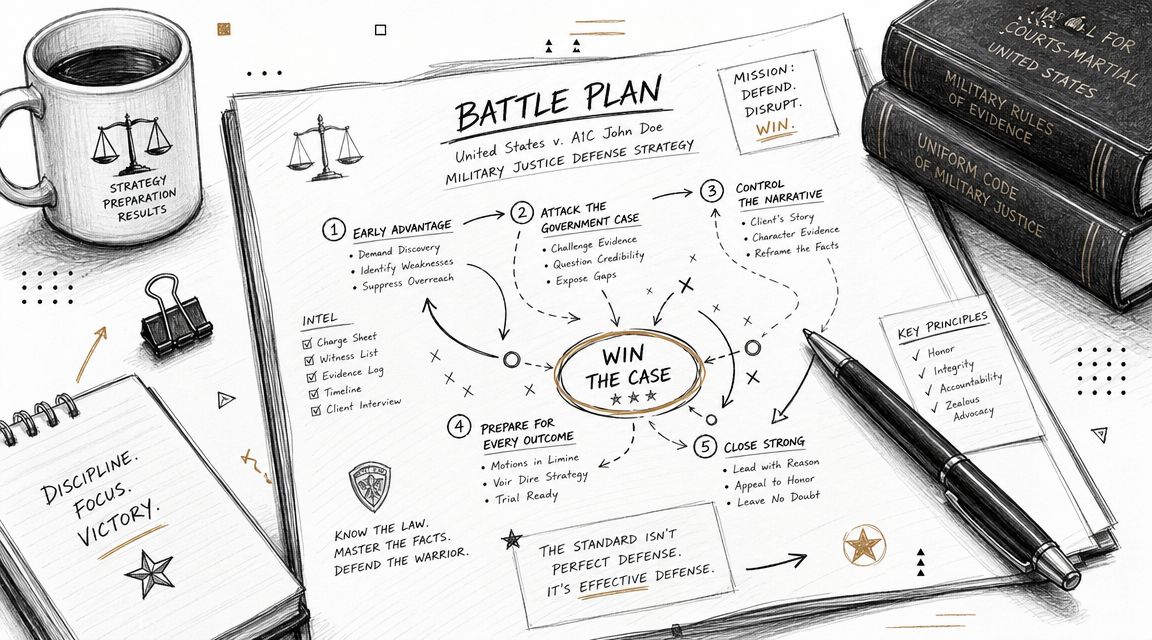
A serious defense lawyer starts by dismantling the prosecution narrative piece by piece:
- Timeline pressure points. When did the first accusation appear, and what changed in later versions?
- Motive analysis. Divorce advantage, housing fights, infidelity exposure, custody pressure, immigration concerns, and command sympathy can matter.
- Statement comparison. 911 calls, written statements, text messages, interviews, and medical histories often don’t line up cleanly.
- Missing evidence. No photos taken at the right time, no canvass for witnesses, no preservation of video, no effort to collect exculpatory messages.
- Mutuality and self-defense facts. Who blocked the exit, who grabbed first, who chased whom, who was trying to leave.
A lot of these cases are won by proving the government’s neat story is false, incomplete, or impossible to trust.
Strangulation cases demand technical defense work
Strangulation and suffocation allegations are their own battlefield. Secondary military defense sources describe this prong as focused on the mechanism of injury, not visible injury. They also state the government doesn’t have to prove prolonged unconsciousness or a visible mark, and that intentional, knowing, or reckless conduct can qualify while negligence does not.
That means the defense can’t just stand up and say, “There are no marks.” That’s amateur work.
A real defense in a strangulation case looks at:
- Exact words used by the accuser. “Touched my neck” is not the same as impaired breathing or blood flow.
- Mens rea. Was this intentional, reckless, accidental, or part of trying to disengage?
- Body mechanics. Do the physical movements described make sense?
- Medical detail. Symptoms reported later can be real, exaggerated, misremembered, or caused by something else.
- Audio and witness evidence. Breathing, screaming, pauses, and real-time descriptions can help or hurt either side.
In neck-contact cases, details decide everything. Hand placement, duration, movement, and the difference between reckless conduct and mere negligence can decide whether the charge stands or collapses.
What experienced counsel actually does
Good lawyers don’t just “represent” you. They build the file the government failed to build.
That includes:
| Defense task | Why it matters |
|---|---|
| Immediate evidence preservation | Texts, photos, app data, and surveillance can disappear fast |
| Independent witness interviews | Command and investigators often miss or ignore favorable witnesses |
| Digital reconstruction | Message timing and call logs can destroy a fabricated timeline |
| Cross-examination planning | Inconsistency is useless unless counsel knows how to expose it cleanly |
| Charge-shaping and negotiation | The way allegations are framed can change the entire risk profile |
When looking for counsel, look for lawyers with sustained court-martial practice, not generic criminal defense branding.
Why Military Domestic Violence Cases Are Different
This is not civilian court with uniforms
A civilian criminal lawyer who “also handles military cases” can hurt you. Military domestic violence cases run inside a system with command power, military investigators, service-specific culture, and panels drawn from your professional world.
That changes the pressure in ways civilians often underestimate.
Here’s the comparison that matters most:
| Issue | Civilian court | Military system |
|---|---|---|
| Employer influence | Usually separate from prosecution | Command involvement can shape your daily life immediately |
| Protective restrictions | Civil protective orders | Military protective orders and command directives can hit fast |
| Case consequences | Criminal exposure | Criminal exposure plus career, clearance, and administrative fallout |
| Factfinder environment | Civilian jurors | Members from the military community or a military judge |
| Parallel actions | Sometimes limited | Investigations, no-contact rules, adverse paperwork, separation actions can run at the same time |
Military cases also carry unique process issues involving victim support and protection orders. The Army JAG School has noted that the Domestic Violence Victim addition to SVC and LA programs allows victim representation in qualifying domestic violence matters, including Article 128b scenarios, in this Army Lawyer practice note on domestic violence victim representation. You need to understand that the other side may have a lawyer helping them through the process even before trial.
Why civilian military defense counsel matters
Detailed military defense requires someone independent from command, comfortable challenging investigators, and experienced in courts-martial. Appointed military counsel can include talented lawyers. But the system does not pause while they juggle a full caseload and institutional constraints.
You need counsel who can do three things fast:
- Move early with command and investigators
- Build an independent factual record
- Try the case if negotiations fail
That’s what serious Article 128b defense requires.
Common Mistakes That Will Destroy Your Defense
Mistakes that come up over and over
Most bad outcomes start with unforced errors. Avoid these.
- Talking to investigators because you think honesty will fix it. It usually gives the government admissions, inconsistencies, and new leads. Learn your rights under Article 31 of the UCMJ and invoke them.
- Sending apology texts. You may mean “I’m sorry this blew up.” They’ll argue you admitted guilt.
- Violating a no-contact order or MPO. Even if the other person invited the contact, you can still make your case worse.
- Deleting messages, photos, or posts. That can look like consciousness of guilt and destroy evidence your lawyer needed.
- Giving command a casual version of events. Your chain is not your defense team.
- Assuming recantation ends the case. It often doesn’t. Prosecutors may move forward anyway.
- Consenting to broad searches. Phones contain your whole life. Once investigators get in, they don’t stay in one lane.
- Waiting for charges before hiring counsel. By then, the government may already have shaped the evidence.
- Trusting that a lack of injury means no case. Especially in strangulation allegations, that assumption is dangerous.
- Taking legal advice from friends in the unit. They won’t be sitting beside you if this goes to trial.
The accused service member usually harms his own case before the government does. Silence, evidence preservation, and discipline matter more than explanations.
If you only remember one point from this article, remember this: panic creates evidence. Stop producing it.
Frequently Asked Questions About Article 128b
Can they charge me without injuries or photos
Yes.
The government does not need bruises, blood, or dramatic pictures to bring an Article 128b case. Prosecutors often build these cases around one statement, a 911 call, bodycam audio, neighbor observations, medical complaints, text messages, or your own words after the argument. In strangulation allegations, that problem gets worse because visible injury may be absent while the accusation still sounds serious to command and a panel.
A good defense lawyer attacks the proof, not the optics. Was the statement changed later. Did the medical timeline fit the allegation. Did witnesses see anything, or just hear yelling and assume the rest.
What if the other person wants to drop it
The case can still move forward.
Command and prosecutors decide whether to investigate and prosecute. A recantation helps only if your lawyer knows how to use it. Sometimes it exposes motive, outside pressure, jealousy, custody advantage, or plain inconsistency. Sometimes it does nothing because the government already has recordings, photos, or admissions.
Do not assume reconciliation saves you. Build your defense as if trial is coming.
Can property damage or harming a pet become Article 128b
Yes, and accused service members get blindsided by this.
The government may treat damage to property, including an animal, as domestic violence if it claims the act was meant to threaten, intimidate, punish, or control a protected person. Breaking a phone, punching a hole in a wall, smashing a windshield, or hurting a pet can become far more than an angry outburst once investigators frame it as coercion.
That charge is also vulnerable. Intent matters. A defense lawyer will dig into context, timing, witness assumptions, prior statements, and whether the government can prove the act was directed at a person rather than property.
Who helps the alleged victim
You should assume the complaining witness is getting guidance on the process and help dealing with command channels.
That matters for one reason. Statements can become more polished over time. Details may get repeated, refined, and hardened before your lawyer gets a full shot at them. An experienced defense attorney will compare every version, line by line, and look for additions, omissions, and influence from outside sources.
Will this affect my clearance
Yes.
Even before any conviction, an allegation can trigger command scrutiny, duty restrictions, firearm problems, and security clearance concerns. If the case ends in adverse action, a conviction, or ugly facts in the record, the risk to your clearance and career gets much worse.
Can my spouse or partner’s texts help me
They can help a lot. They can also hurt you if your lawyer gets them too late.
Texts, call logs, photos, location data, rideshare receipts, doorbell footage, metadata, social media posts, and witness messages often decide these cases. The government will cherry-pick what fits its theory. Your lawyer’s job is to force the full record into view, preserve it correctly, and use it to expose gaps, motive, timing problems, and contradictions.
Should I hire a lawyer before charges are preferred
Yes. That is when strong cases get weakened.
Early defense work means preserving favorable evidence before it disappears, stopping you from making admissions, challenging overbroad searches, identifying witnesses before command shapes their stories, and pushing back before investigators lock in a one-sided narrative. If you wait, you give the government a head start it does not deserve.
What should I do today
Do three things.
Stop talking about the facts to anyone except your lawyer. Save every text, photo, message, and call record exactly as it is. Get experienced civilian military defense counsel involved now, while the government’s case is still soft enough to break.
If you are being investigated for UCMJ Article 128b – Domestic Violence, treat it like the threat it is. Your rank, your clearance, your freedom, and your future are all in play.
Get counsel. Get organized. Stop feeding the case against yourself.