Article 86 of the UCMJ makes it an offense to fail to report to an appointed duty, leave that duty without authority, or remain absent from your unit without authority.
You may be reading this after missing formation, receiving a call from your supervisor, or learning that your spouse has been reported AWOL. The immediate questions are practical: Can the command take your rank? Will you be confined? Does returning voluntarily help?
The answers start with the exact allegation, not the word AWOL. A missed reporting time and a prolonged absence are different cases, and your career, pay, reputation, and freedom can turn on how the government proves the timeline.
Table of Contents
- What Article 86 Prohibits in Plain English
- Punishment Limits by Length of Absence
- AWOL Versus Desertion and Where the Line Falls
- Short Absences and Late Arrivals Still Count
- How an Article 86 Case Moves From Report to Disposition
- Defenses and Mitigation That Hold Up Under Scrutiny
- Mistakes That Make an Absence Case Worse and Your First 72 Hours
- Frequently Asked Questions About Article 86
- Why Civilian Defense Counsel Matters in an Article 86 Case
What Article 86 Prohibits in Plain English
Article 86, codified at 10 U.S.C. § 886, prohibits failing to report to an appointed place of duty, leaving that place without authority, or remaining absent without authority from a required unit, organization, or place of duty. It applies across the armed forces, not just to soldiers who leave an installation.
Think of the statute as the speed-limit sign and the Manual for Courts-Martial as the fine schedule. The statute identifies prohibited conduct; the punishment framework separates that conduct into categories.
Match the allegation to what actually happened
- Failure to report: Your calendar says you had an appointed duty at a designated time, but you didn’t arrive as required.
- Leaving appointed duty: You reported, then departed without permission or proper relief.
- Remaining absent: You stayed away from your unit or another required duty location without authority.
These aren’t interchangeable descriptions. A supervisor’s statement that you weren’t present doesn’t resolve whether you knew about the appointment, had permission to leave, or were required somewhere else.
The government must identify the charged event with enough precision to prove it. Each alleged absence needs a defensible beginning and ending; separate episodes shouldn’t be treated as an undifferentiated stretch of misconduct.
Practical rule: Start with the specification, not the unit’s shorthand description of what happened.
For a UCMJ Art 86 defense, counsel checks the specification language, the alleged dates, and how the absence ended before discussing a plea. A sympathetic explanation matters, but it doesn’t replace examining whether the government charged the correct offense.
Punishment Limits by Length of Absence
An Article 86 charge is not one punishment. It is a set of duration based categories, and the category controls the ceiling. A missed formation and a month long absence share a statute but they do not share exposure. Short failure to report cases can still produce confinement, forfeiture, and reduction, so read the alleged dates before you estimate risk.
| Absence Category | Maximum Confinement | Forfeiture | Other Maximum Penalties |
|---|---|---|---|
| Failure to report to or leaving an appointed place of duty | 1 month | Two-thirds pay per month for 1 month | Reduction to lowest enlisted grade |
| Absence from unit, organization or required duty of 3 days or less | 1 month | Two-thirds pay per month for 1 month | Reduction to lowest enlisted grade |
| Absence over 3 days, up to 30 days | 6 months | Two-thirds pay per month for 6 months | Reduction to lowest enlisted grade |
| Absence over 30 days | 1 year | All pay and allowances | Dishonorable discharge |
| Absence over 30 days ended by apprehension | 18 months | All pay and allowances | Dishonorable discharge |
| Absence from guard or watch | 3 months | Two-thirds pay per month for 3 months | Reduction to lowest enlisted grade |
| Guard or watch absence with intent to abandon, or absence intended to avoid maneuvers or field exercises | 6 months | Two-thirds pay per month for 6 months | Bad-conduct discharge |
These duration thresholds and maximum punishments come from the Manual for Courts-Martial punishment reference; they are maximum exposure, not predicted sentences.
Read the category before predicting the outcome
Start by identifying when the unauthorized absence legally began. Then establish the termination event, calculate the duration, and determine which specification fits.
Do not substitute a personnel system entry for that analysis. An administrative entry may reflect when someone processed paperwork rather than when the absence began or ended. Build the timeline from duty rosters, formation records, orders, travel records, and return paperwork, then test whether the charged start and end dates hold.
The method of return also matters. Apprehension is not only an unfavorable sentencing fact in a prolonged absence case. It can change the applicable punishment category. Counsel should examine who located the member, what authority took control, and whether the member had already surrendered. Voluntary return, surrender to military authority, and apprehension by civil or military police are different facts with different proof and sentencing consequences.
Guard, watch, and exercise avoidance allegations require particular attention because the assigned duty and alleged intent affect exposure. Do not treat them as ordinary missed formations. The government must prove the guard or watch status, or the intent to avoid maneuvers or field exercises, and those issues often turn on orders, duty assignments, witness statements, and what the member said or did before departure.
Distinguish the ceiling from the likely disposition
The applicable court martial forum, any agreement, the member’s record, and the evidence presented can constrain the actual outcome. A commander may also pursue administrative action or nonjudicial punishment rather than a criminal trial.
That creates a real strategic trade off. Contesting an unsupported category may be necessary, while resolving a well supported allegation through a less damaging disposition may better protect rank, pay, and discharge characterization. The choice depends on proof, duration, duty type, return history, and prior misconduct.
Before any plea discussion, verify the duty records against the alleged dates. A small discrepancy near a category boundary can be more consequential than a lengthy character statement. One day can move the ceiling from one month to six months, and crossing 30 days can introduce a punitive discharge. Check weekends, holidays, shift changes, permissive absence, and conflicting duty assignments before accepting the charged duration.
AWOL Versus Desertion and Where the Line Falls
The decision question is whether the government can prove an unauthorized absence alone or the additional intent required for desertion. Length matters, but length doesn’t automatically establish desertion.
The distinction turns on legal elements, not just short versus permanent physical absence.
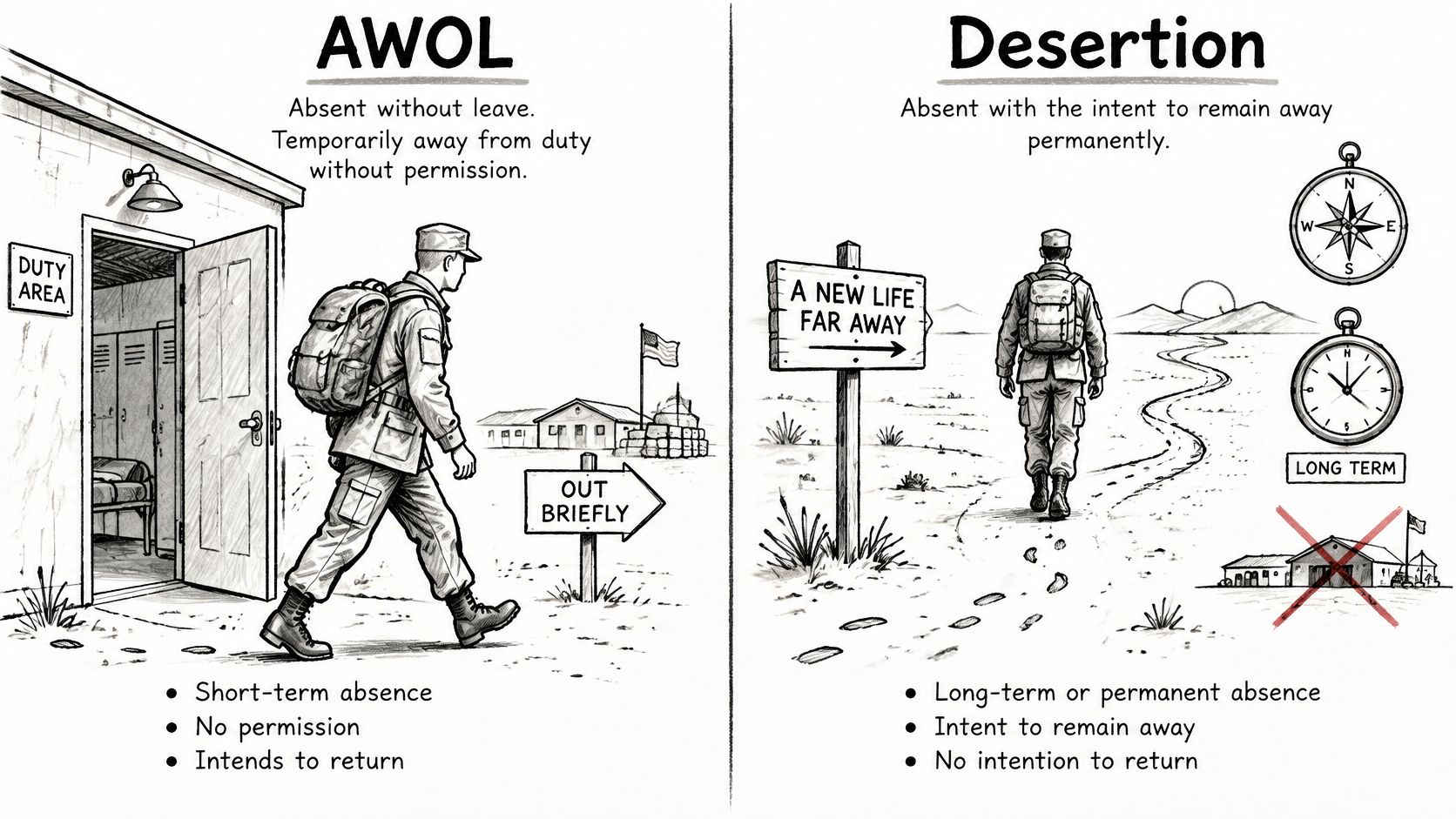
| Factor | Article 86 Unauthorized Absence | Article 85 Desertion |
|---|---|---|
| Core proof | Absence without authority from a duty, post, or unit | Absence plus a specific intent listed in the statute |
| Role of intent | Permanent-abandonment intent isn’t required for basic absence; special guard, watch, and exercise theories can involve intent | Required element |
| Intent examples | Not required for basic absence | Intent to remain away permanently, avoid hazardous duty, or shirk important service |
| Typical evidence | Duty rosters, formation records, gate logs, texts, return or surrender records | Pre-departure conduct, statements, moving or selling property, changed contact information |
| Maximum exposure | Category-specific confinement ceilings; punitive discharge available in some categories | Dishonorable discharge may be available; verify the current MCM confinement maximum for the charged theory |
The Army’s offense guidance separates ordinary absence categories from allegations involving apprehension or avoidance of exercises. That distinction prevents the label AWOL from concealing materially different proof requirements.
Intent must be proved from the whole record
Prosecutors may rely on selling property, moving belongings out of housing, statements about never returning, or changing contact information. Defense counsel should examine the context rather than accept an investigator’s interpretation.
Selling furniture before a move doesn’t necessarily show abandonment. A message arranging a return may undermine the government’s theory, although a later return doesn’t automatically erase an earlier intent to remain away permanently.
The timing of intent can affect both charging and trial strategy. Prosecutors may allege overlapping absence and desertion theories, but counsel must evaluate the elements and permissible treatment of those allegations separately.
Deployment-related facts can also raise a distinct missing-movement allegation. Missing a departure isn’t another name for desertion.
For additional discussion of the distinction:
The defense question is what you intended at the legally relevant time and what admissible evidence establishes it. The unit’s first label doesn’t decide the case.
Short Absences and Late Arrivals Still Count
A 2025 Department of Defense good-order-and-discipline report described an E-5 punished under Article 86 for failing to report for three days or less and an E-6 reduced in rank after arriving approximately five hours late without notifying the chain of command. Staying on the installation doesn’t eliminate disciplinary exposure.
A canceled flight doesn’t answer every question
Say a Reserve soldier’s drill-weekend flight is canceled, but the soldier doesn’t contact the unit until the following morning. The cancellation supports the explanation for delayed travel; it doesn’t explain every missed opportunity to notify the command.
Counsel should preserve the airline notice, rebooking attempts, reporting instructions, and communications. The decisive issue may be whether the soldier received authorization to report later, not whether the airline caused a genuine problem.
Now consider a Guard member who misses an early formation after a car breaks down and can’t reach the first sergeant. A tow receipt supports the breakdown, while call logs establish attempted notice. Neither document, standing alone, proves permission to miss duty.
The government’s proof still matters
For a failure-to-report allegation, examine:
- Appointment authority: Did a competent authority appoint the duty?
- Knowledge: Did the member know the required time and place?
- Unauthorized absence: Was the failure to appear without authority?
The command’s response matters too. A supervisor may approve an alternate reporting arrangement, deny a request, or never receive the message. Those are different evidentiary situations.
Texts, duty rosters, gate records, medical documentation, and witness credibility help distinguish them. A late arrival can lead to nonjudicial punishment or court-martial referral, so prompt notice and a preserved written record are practical protections, not administrative niceties.
How an Article 86 Case Moves From Report to Disposition
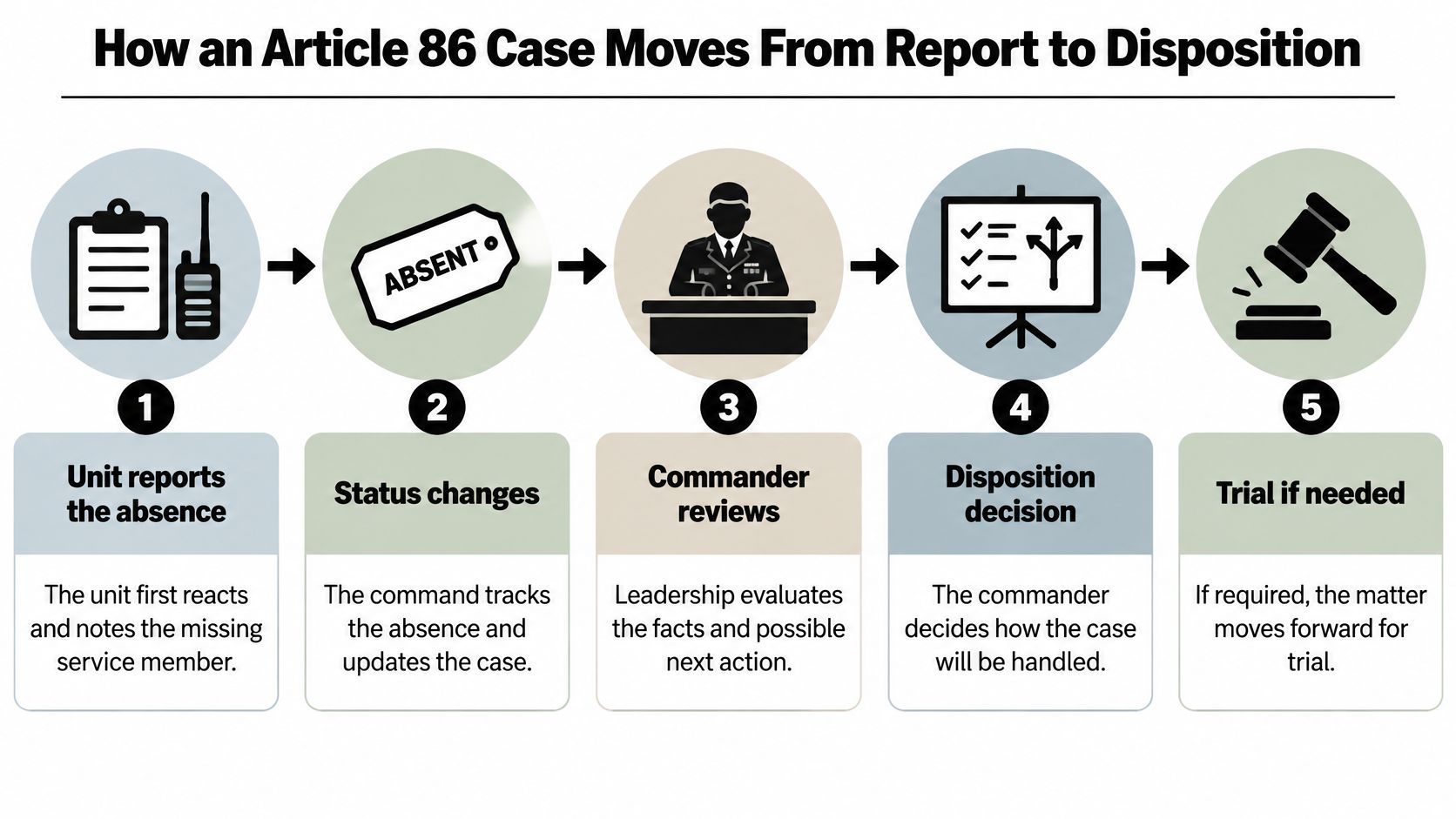
The process begins with unit accountability and may end without trial. At each stage, the member should understand what the official record says and who is making decisions.
This flowchart shows the broad progression.
From the initial report to command review
The unit reports the absence. Personnel staff may update the member’s status. Check whether the reporting timestamp matches the underlying duty event.
The command attempts contact. Leaders may contact the member or family, conduct searches, and pursue notices through appropriate channels. Preserve messages without asking family members to negotiate legal issues.
The member returns, surrenders, or is apprehended. Authorities document the event that may terminate the absence. Counsel should verify the receiving authority, timing, and circumstances rather than accept a summary entry.
Investigators may become involved. CID, NCIS, OSI, or CGIS may investigate associated conduct or circumstances surrounding apprehension. They collect evidence for an official inquiry, not to advise you; decline substantive questioning and request counsel clearly.
From disposition to possible trial
The commander evaluates available action. Possibilities include no action, administrative measures, or nonjudicial punishment in the military. Defense submissions can address both proof weaknesses and why a particular disposition is appropriate.
A preliminary hearing may precede general court-martial referral. The Article 32 process addresses probable cause and other referral-related questions. Counsel can challenge the government’s presentation, but it isn’t a full trial, and witness-testing opportunities can be limited.
The convening authority decides referral. Summary, special, and general courts-martial have different jurisdictional and punishment limits. The charge’s theoretical maximum doesn’t by itself determine the forum.
Trial and post-trial proceedings follow if necessary. Counsel litigates the findings and, after a conviction, sentencing issues. Review and appellate options require attention to the forum, sentence, and applicable rules.
Don’t wait for the final stage to correct a bad record. Counsel can seek preservation, identify missing witnesses, and present relevant documentation while decision-makers are still evaluating the case.
Defenses and Mitigation That Hold Up Under Scrutiny
The government needs a valid duty or unit requirement, an unauthorized absence, and a legally sufficient timeline. The military appellate court’s unauthorized-absence digest identifies a definite inception date as indispensable and treats unauthorized absence as a completed, noncontinuing offense whose duration affects punishment.
That legal description doesn’t mean remaining away is harmless. It means counsel must scrutinize when the charged offense began and how its duration was established.

Match the defense to the missing proof
| Defense Theory | What the Government Must Prove | Evidence to Pull |
|---|---|---|
| Wrong or unprovable start date | A definite inception date and the absence’s length | Duty rosters, time-zone conversions, leave and pass forms, electronic messages |
| No notice of the duty | Knowledge of the appointed place and time | Orders, text messages, roll-call sheets, unit recall rosters |
| Authority or excuse | Absence without authority, subject to any legally applicable defense | Leave approvals, emergency messages, medical records, transportation records |
| Timely return or surrender | The termination event and its date | Gate logs, surrender statements, witnesses at the return point |
| No intent for desertion-style allegations | The specific charged intent | Pre-departure conduct, communications, reasons for return |
Time-zone conversions, overlapping leave entries, and inconsistent reporting instructions can expose weaknesses in the start date. A roster entered after the event deserves comparison with contemporaneous messages, not automatic acceptance.
Credibility requires the same discipline. Ask whether a supervisor observed the absence, relied on another person’s report, or reconstructed the timeline from memory.
Surrender also requires more than being physically near military personnel. Counsel should establish that the member presented to military authority, disclosed the unauthorized-absence status, and submitted or showed willingness to submit to military control.
Separate a defense from mitigation
A family emergency can be compelling without legally authorizing an absence. Medical or mental health records are stronger when they connect the condition to the conduct rather than merely establish a diagnosis.
Mitigation may include voluntary return, documented treatment, a proven emergency, an otherwise strong service record, and appropriately advised cooperation. Restitution belongs in the presentation only where the alleged conduct caused a relevant loss.
A truthful explanation isn’t a defense strategy until counsel connects it to admissible evidence and a legally meaningful issue.
Sometimes the strongest result comes from negotiating a lesser absence allegation instead of desertion, or a nonjudicial disposition instead of trial. That decision requires comparing the government’s provable case with the consequences of the proposed resolution, not accepting the first offer.
Mistakes That Make an Absence Case Worse and Your First 72 Hours
Use the first 72 hours as an action plan, not as permission to delay a required return or ignore lawful orders. If you’re currently absent, seek prompt legal help arranging a lawful return.
Build a usable record immediately
- Write a private timeline for counsel. Include dates, times, locations, people contacted, and the method of contact.
- Preserve original records. Keep orders, leave papers, complete message threads, call logs, travel records, and medical documentation.
- Stop public discussion. Don’t debate the allegation with peers, potential witnesses, or social-media audiences.
- Coordinate communications through counsel. Follow lawful reporting requirements while getting advice before making substantive statements about suspected misconduct.
Avoid these costly mistakes
- Leaving everything in scattered messages: Incomplete screenshots and undocumented calls invite conflicting timelines. Preserve full conversations and identify missing records.
- Signing without understanding: A short statement can concede unauthorized status, dates, or intent.
- Treating an interview as casual: Informal conversation with an investigator can still produce evidence. Understand your Article 31 rights before discussing suspected misconduct.
- Assuming command will handle it informally: A reassuring conversation isn’t a binding disposition agreement, and administrative consequences may remain.
- Waiting until a hearing: Access logs, witness memories, and electronic communications may become harder to obtain.
- Believing there’s no evidence: Duty rosters, phone records, access records, and your own messages may already establish substantial portions of the case.
- Coordinating stories or posting online: You can create additional witnesses and potentially expose yourself to separate allegations.
Before signing: Ask whether the document merely acknowledges receipt or also admits facts, waives rights, or accepts a proposed action.
You have the right to consult counsel about proposed Article 15 nonjudicial punishment. Get advice before making elections or signing substantive statements, and don’t ignore response deadlines while arranging that consultation.
Frequently Asked Questions About Article 86
Can I refuse to talk to CID or NCIS?
Yes. You may decline substantive questioning about suspected misconduct and request counsel. State that clearly rather than answering questions while trying to appear cooperative.
Does a late arrival count as Article 86?
Yes. A failure-to-report allegation doesn’t require leaving the installation or disappearing for an extended period. The duty appointment, your knowledge, and authorization remain central.
Will I go to jail for an AWOL charge?
Confinement is possible, but it isn’t automatic. The charged category, forum, admissible evidence, negotiated terms, and mitigation affect the outcome.
Do I need a lawyer immediately?
Yes, if you’re suspected of an offense, notified of proposed nonjudicial punishment, or facing court-martial charges. Early advice can prevent damaging statements and preserve useful evidence.
What happens at an Article 32 hearing?
A preliminary hearing officer evaluates probable cause and other matters relevant to referral. Defense counsel can challenge weaknesses, but the hearing doesn’t provide all the procedures or witness access available at trial.
Can an AWOL charge become desertion?
Yes, if the evidence supports the additional required intent. The government must prove the applicable desertion theory, not merely characterize the absence as unusually long.
Why Civilian Defense Counsel Matters in an Article 86 Case
Military-appointed defense counsel are available without attorney fees to eligible service members and serve a defense function independent of the prosecuting command. Civilian military defense lawyers are privately retained and can work alongside appointed counsel.
The relevant difference isn’t that civilian counsel automatically have better judgment. It’s whether the particular lawyer has the experience, preparation time, and trial skill your case requires.
Choose experience you can evaluate
Ask prospective court-martial attorneys about:
- Relevant trial work: Experience defending contested cases in your branch, not prior military service alone.
- Absence-case strategy: How they analyze authorization, termination, intent, and competing disposition options.
- Availability: Who will handle the matter and communicate with your family.
- Independence and teamwork: How they’ll work with appointed counsel while protecting your interests.
- Written fee terms: What investigation, travel, experts, trial, and post-trial work the agreement includes.
Appointed counsel’s workloads and experience differ. Civilian counsel’s do too, so don’t assume a private fee guarantees personal attention or superior results.
The Military Justice Guide publishes plain-English articles on choosing civilian military defense counsel. Use them alongside referrals and direct consultations, and speak with several attorneys before choosing a UCMJ lawyer.
For a serious absence or desertion allegation, an experienced civilian lawyer can provide an independent assessment before you commit to a statement, election, or agreement.
If you’re under investigation or have received notice of an Article 15 or court-martial referral, contact defense counsel now. Don’t wait for the command to finish building its record. The first decisions can shape your options, and your career is on the line.