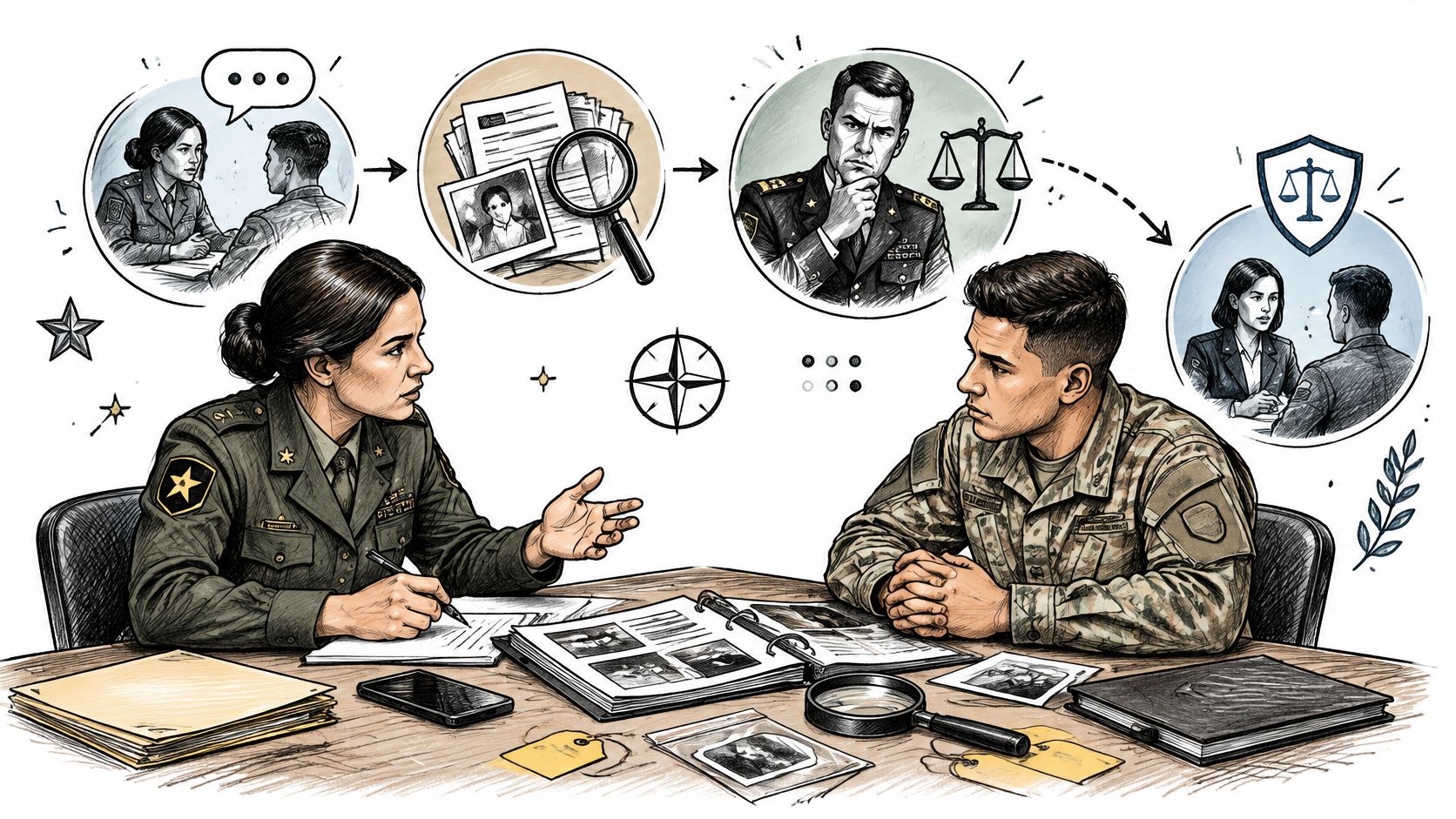
Your supervisor tells you to report to CID. An agent calls about a complaint but won’t explain much over the phone. Your spouse wants to know whether you could lose your career, and you’re wondering whether a quick explanation will make the problem disappear.
CID writes the investigative file. It doesn’t decide whether you’re guilty. But the way agents organize statements, describe inconsistencies, and summarize evidence can influence everyone who reads that file afterward. Your first priority is protecting your rights. Your next priority is helping defense counsel identify what the decision-maker needs to see before the government commits to a course of action.
Table of Contents
- Who Runs a CID Investigation and What It Decides
- How a CID Case Starts and Moves From Report to Decision
- Your Rights When CID Asks to Talk
- Evidence Collection and Where CID Cases Break Down
- Referral, Disposition and Protective Orders Explained
- Why a Closed Investigation Can Still Follow You
- Confirm Your Status and Call Civilian UCMJ Counsel Now
- Frequently Asked Questions About CID Investigations
Who Runs a CID Investigation and What It Decides
The CID investigation process separates evidence gathering from disposition. Investigators develop the facts; legal advisers assess them; the responsible authority decides what happens next.
The Government Accountability Office’s military investigations review describes investigators interviewing witnesses, alleged victims, and suspects, collecting evidence, and submitting results for disposition, with CID consulting a judge advocate before determining whether an allegation is founded or unfounded. Those investigative labels are not verdicts.
Investigating Agencies by Branch
| Branch | Investigative agency | Typical cases | Who decides |
|---|---|---|---|
| Army | Army CID | Serious crimes involving Army personnel and installations | Commander with judge advocate advice |
| Navy and Marine Corps | NCIS | Sailors and Marines, naval installations, joint cases | Commander with judge advocate advice |
| Air Force and Space Force | AFOSI | Airmen and Guardians, Air Force installations | Commander with judge advocate advice |
| Coast Guard | CGIS | Coast Guard personnel and facilities | Commander with legal advice |
These are ordinary command-disposition pathways, not a complete allocation of prosecutorial authority. Special trial counsel can control prosecution decisions for covered offenses. Counsel must identify the actual decision-maker rather than assume your immediate commander controls everything.
Jurisdiction can arise through an installation, military personnel, dependents, or another defense connection. Overseas service doesn’t place an allegation beyond investigative reach. The practical differences among CID, NCIS, OSI, and CGIS matter when identifying who holds evidence and which legal authorities apply.
Practical rule: Treat the report as an influential account that must be checked against its underlying evidence, not as a substitute for that evidence.
Agents can collect physical and digital material, conduct interviews, and pursue authorized investigative measures. They cannot convert an allegation into a conviction by calling it founded. The government still must prove criminal charges through the applicable judicial process, and you retain procedural rights throughout.
How a CID Case Starts and Moves From Report to Decision
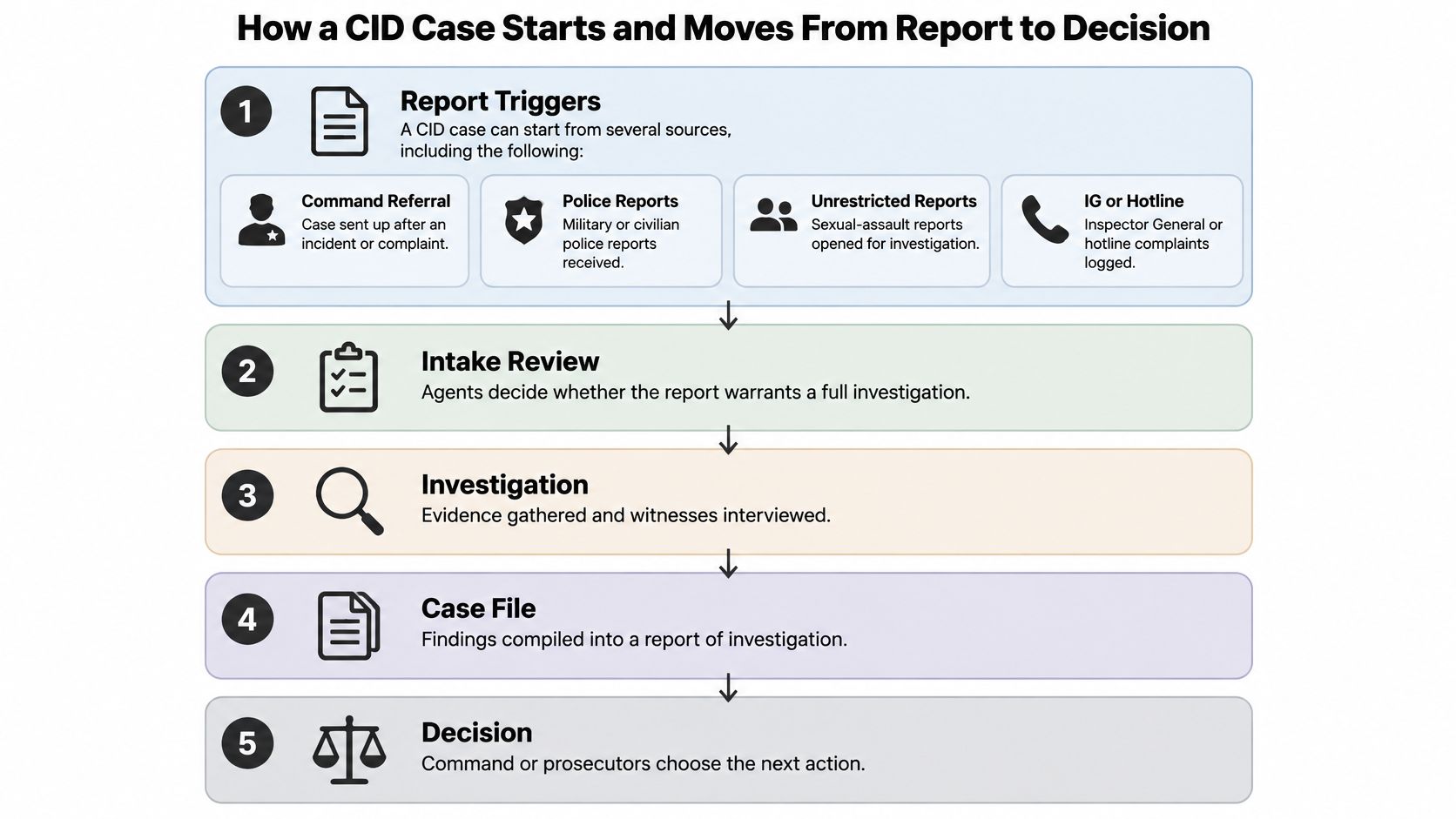
A case can start with a command referral, military or civilian police report, unrestricted sexual-assault report, Inspector General complaint, hotline tip, or financial audit. Pay and travel allegations belong in this picture too.
A Government Accountability Office review described on Army CID’s mission page examined 285 Army CID military-pay investigations from fiscal years 2010 and 2011, identifying 320 potential fraud incidents and estimated government losses of slightly more than $6 million. Those figures concern that specific review, not the likelihood that any individual pay discrepancy is criminal.
The Army military justice process overview describes the basic progression: investigation, interviews, evidence collection, a probable-cause opinion from military legal personnel, and a decision about how to proceed. Actual cases overlap and loop back when new information emerges.
Step 1, The Case Opens
Agents assess the report, jurisdiction, and investigative responsibility, then assign and develop the file. You may not know this has happened.
An informal invitation to stop by can be your first indication, not the investigation’s first event. Save the message, note who contacted you, and obtain advice before providing an account.
Step 2, Investigators Conduct Interviews
Agents commonly begin with the reporting person and other witnesses, then approach the suspect. That sequence isn’t guaranteed, and a witness can become a suspect as questioning develops.
Interviews may produce recordings, sworn statements, or investigator summaries. Those formats aren’t interchangeable: a summary reflects what the writer selected, while a recording may preserve qualifications, uncertainty, and the exact question asked.
Defense counsel should identify potentially favorable witnesses early. You shouldn’t contact people to coordinate recollections or persuade them to support you.
Step 3, Agents Collect and Analyze Evidence
The investigation may involve clothing, photographs, financial records, phone extractions, cloud accounts, laboratory analysis, and documents obtained from another agency. Digital work can continue for months after witness interviews appear finished.
Your lawyer should distinguish evidence that exists from evidence investigators have actually obtained. A witness mentioning a message doesn’t establish its complete wording, surrounding conversation, or authenticity.
Preservation matters here. Counsel can seek retention of surveillance footage, access logs, account records, or other material that could disappear through routine deletion.
Step 4, CID Organizes the Investigative Summary
Agents assemble the evidence and describe their findings. Military legal personnel assess probable cause and legal issues.
This is a consequential defense intervention point. Counsel can identify an omitted witness, provide an authenticated document, challenge a misleading chronology, or explain why an apparent inconsistency isn’t an inconsistency.
Submission isn’t automatic. Providing a lengthy client statement may expose the client to unnecessary questioning or lock the defense into an incomplete account. Sometimes the strongest submission is a narrow, independently supported correction.
Step 5, The Responsible Authority Chooses a Disposition
Possible paths include no action, administrative measures, nonjudicial punishment, court-martial proceedings, or civilian prosecutorial review. Investigative closure and a decision not to prosecute aren’t necessarily the same event.
The defense should identify the decision-maker, the anticipated submission route, and any response deadline. Waiting for a finished report can mean missing the best opportunity to correct its central premise.
The strongest early defense submission doesn’t merely deny the allegation. It identifies a material problem and gives the reader reliable evidence to verify it.
Your Rights When CID Asks to Talk
If you’re suspected of an offense and another person subject to the UCMJ questions you about it in an official investigative or disciplinary capacity, rights warnings matter. A unit office doesn’t make suspected-misconduct questioning harmless.
Army legal training materials on suspect questioning explain Article 31(b) warnings, identify consultation with counsel, and state that DA Form 3881 should ordinarily document the advisement and your election. A renewed interview may require another advisement.
Match the Right to the Response
| Right or protection | What it protects | Action to take |
|---|---|---|
| Notice of the suspected offense | Understanding what the questioning concerns | Ask what offense you’re suspected of |
| Remaining silent | Avoiding compelled self-incrimination | Clearly decline substantive questions |
| Warning about use of statements | Understanding that an explanation can become evidence | Don’t offer an informal account |
| Consultation with counsel | Making an informed decision about participation | Request a lawyer before answering |
Notice of the allegation helps you understand the interview’s purpose. Ask whether you’re a witness, subject, or suspect, and ask what misconduct the questions concern.
Silence protects you from supplying an account before you understand the evidence. A protected decision to remain silent cannot properly be used as evidence of guilt at court-martial. State clearly that you’re invoking that right.
Consulting counsel lets you evaluate whether any statement serves your interests. Say that you want a lawyer and won’t answer questions, then stop discussing the allegation.
The distinction between witness and suspect matters, but the investigator’s label isn’t conclusive. If questions turn toward your possible misconduct, don’t assume an earlier witness designation settles your rights.
A clear invocation is better than an ambiguous remark about possibly needing help. You don’t need to argue, explain your innocence, or justify asking for counsel. Understanding Article 31 of the UCMJ helps you recognize the issue before a seemingly routine conversation becomes evidence.
Evidence Collection and Where CID Cases Break Down
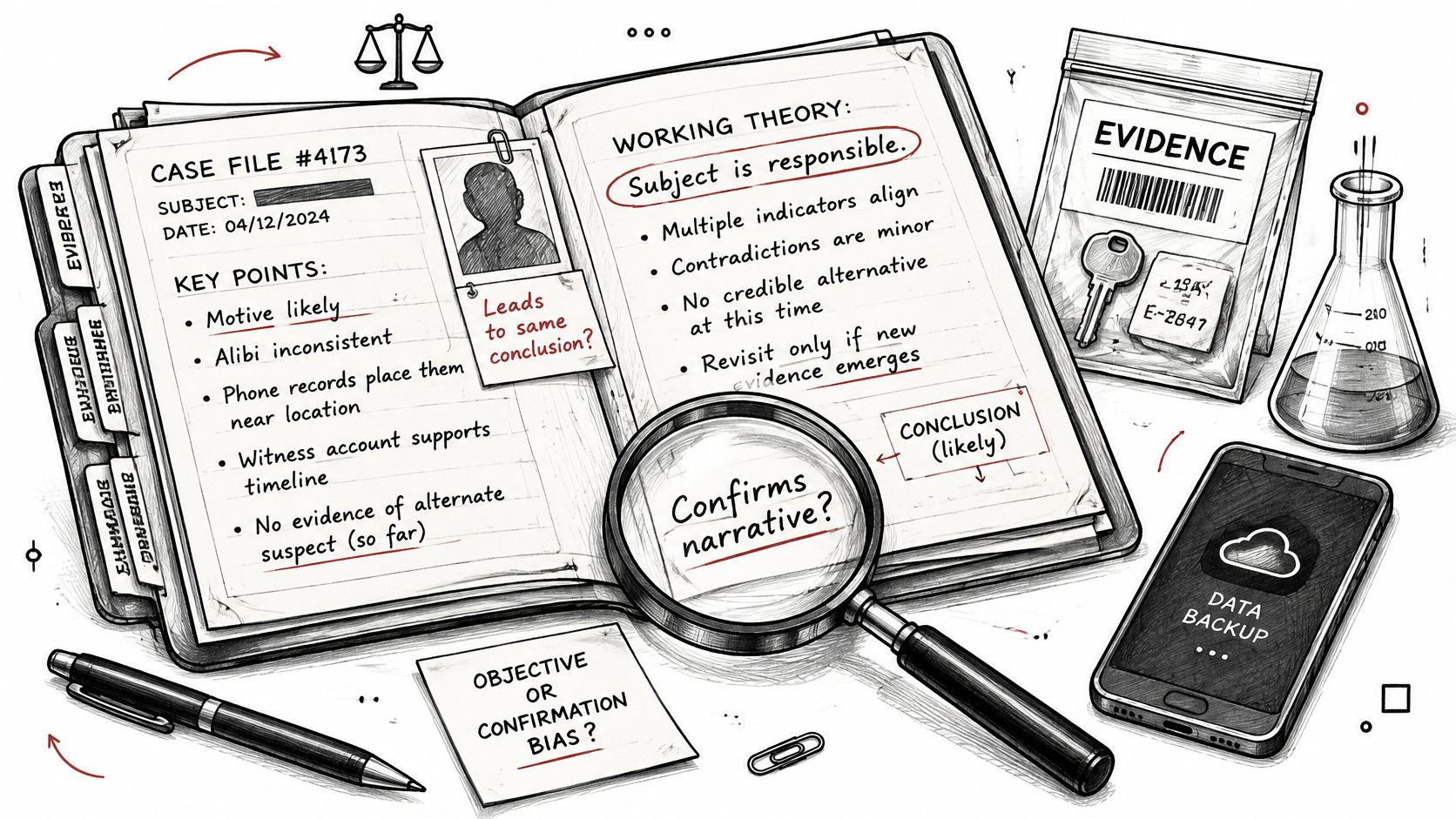
A CID file isn’t a neutral transcript of everything that happened. People choose which witnesses to interview, what questions to ask, and which facts to emphasize. That doesn’t establish bad faith, but it does mean the defense must test the account rather than accept its organization as fact.
The Army’s CID career and capabilities guidance describes cybercrime, forensic support, physical-evidence evaluation, sworn statements, and joint work with federal, state, local, and foreign agencies. A single report can therefore contain material produced under different authorities and maintained in different systems.
Check Authority, Identity, and Completeness
Experienced military defense lawyers don’t start by counting how many pages the government collected. They ask whether each important item reliably proves what the investigator says it proves.
- Search scope: Compare the authorization with the accounts, devices, dates, and material that were searched.
- Evidence custody: Identify collection, transfers, storage, and unexplained handling gaps.
- Digital interpretation: Check timestamps, account ownership, extraction limitations, missing attachments, and surrounding messages.
- Laboratory support: Obtain the underlying work where available, not merely the conclusion repeated in the report.
A custody gap doesn’t automatically exclude evidence. An extraction limitation doesn’t automatically establish innocence. The useful question is whether the defect undermines authenticity, reliability, admissibility, or the inference the government wants to draw.
Test Credibility Against Independent Records
Compare a witness’s earliest account with later statements to CID, local police, medical personnel, or command. Separate an actual contradiction from an innocent difference in wording.
Check whether witnesses discussed events together before interviews, whether an investigator documented an interview only afterward, and whether the summary includes the witness’s uncertainty. Look for favorable material investigators didn’t pursue.
Say an allegation places you at a location after a unit event. A complete message thread, access record, and independent witness may challenge that timing more effectively than a broad assertion that the complainant is unreliable.
Credibility depends on the quality of corroboration, not the thickness of the file.
Request the complete investigative file and custody records early through the available channels, while recognizing that immediate access may be limited. Map which agency holds each item, including hospital records and partner-agency recordings. A response from CID alone may not identify everything the defense needs.
Referral, Disposition and Protective Orders Explained
CID’s findings influence disposition, but investigators don’t impose punishment. Commanders act with legal advice within their authority, while prosecutorial decisions for covered offenses may belong to special trial counsel.
The Government Accountability Office’s review of investigative coordination describes military and civilian investigative or prosecutorial activity that can proceed in parallel. An explanation offered in one proceeding can create problems in another, so defense counsel must coordinate the response.
Possible Command Outcomes After a CID Investigation
These outcomes aren’t a guaranteed sequence. Administrative separation can accompany other action, and civilian prosecution is a separate pathway rather than merely a higher rung.
| Outcome | Typical trigger | Who decides | Your exposure |
|---|---|---|---|
| Closed as unfounded or no action | Insufficient or unreliable evidence | CID determines investigative findings; command decides no action with legal advice | No punishment, but the file may remain |
| Administrative action | Minor misconduct or policy violation | Commander | Counseling, reprimand, or GOMOR affecting career |
| Nonjudicial punishment (Article 15) | Minor offenses | Commander | Punishment without trial, usually refusable with consequences |
| Court-martial referral | Serious offenses | Convening authority, subject to applicable special trial counsel authority | Criminal conviction, confinement, possible punitive discharge |
| Civilian prosecution | Civilian jurisdiction or prosecutorial interest | Civilian prosecutor | Separate criminal exposure requiring coordinated defense |
| Administrative separation | Pattern issues or misconduct addressed without trial | Separation authority | Discharge characterization affecting benefits and employment |
Refusing nonjudicial punishment can move the government toward court-martial consideration; it doesn’t force dismissal or guarantee trial. Exceptions apply to the ability to refuse. Counsel should compare the actual evidence and available procedures before recommending an election.
Interim Orders Need a Separate Response
Command may issue a military protective order or no-contact order while the allegation remains unresolved. Violating a lawful order can create a separate Article 92 allegation, even if the original accusation doesn’t result in charges.
Restriction and pretrial confinement require their own legal analysis. Obtain the order, understand its boundaries, and ask counsel to seek clarification or modification rather than improvising an exception.
Written submissions matter because decision-makers may rely heavily on summaries. The defense should correct material omissions before referral where possible. Every disposition also warrants an administrative review: separation proceedings and discharge characterization can remain important even without a criminal conviction.
Why a Closed Investigation Can Still Follow You
No charges doesn’t mean no continuing consequences. Closure doesn’t automatically delete investigative records, and later suitability, promotion, or security-clearance reviewers may still encounter them.
CID’s official records-access guidance distinguishes Privacy Act requests concerning records about an individual, petitions to amend records, and broader FOIA requests. These routes serve different purposes; none guarantees immediate access or automatic removal.
Build a Specific Correction Request
- Request access: Identify yourself and the relevant investigation clearly, using the agency’s submission requirements.
- Locate the disputed entry: Identify the statement, omission, or record field precisely.
- Explain the defect: Show why it is inaccurate, irrelevant, untimely, or incomplete.
- Attach support: Include documents that establish the correction rather than merely repeating your disagreement.
- Preserve the paper trail: Keep the request, response, attachments, and original evidence.
A subject’s access rights aren’t identical to a victim’s or third party’s rights. Privacy protections, investigative restrictions, and other exemptions can limit disclosure, and FOIA production may contain substantial redactions.
Don’t assume a records request will finish before a separation board or clearance deadline. Counsel may need to submit the available correction evidence directly to that decision-maker while the records process continues.
Records strategy: Identify the exact error and the document that disproves it. A general assertion of unfairness gives the reviewer little to evaluate.
The next reviewer may read the existing entry without knowing your explanation. That makes record accuracy a separate defense objective, not an afterthought once criminal exposure ends.
Confirm Your Status and Call Civilian UCMJ Counsel Now
Start with actions that preserve choices rather than create new evidence.
- Confirm your status. Ask whether you’re a subject, suspect, or witness, and request written notice if available.
- Invoke clearly. State that you’re exercising your right to remain silent and want a lawyer.
- Separate consent from authority. Don’t consent to searches before advice. Request any authorization in writing, but don’t obstruct a lawful search.
- Limit case discussions. Don’t explain the allegations to peers, supervisors, relatives, or social-media audiences.
- Preserve everything. Retain devices, messages, documents, and account information. Never delete potentially relevant material.
- Prepare a private chronology. Write it for counsel, identify uncertainties, and don’t circulate it. A label alone doesn’t create privilege.
- Get advice before responding. Bring proposed punishment, GOMOR, protective-order issues, and separation paperwork to counsel promptly.
Choose Counsel by Relevant Work
Military defense organizations, including Trial Defense Service, Defense Service Office, and branch equivalents, provide independent defense representation within their assigned roles. Don’t assume military counsel works for your commander or that help is unavailable before charges; ask the appropriate office what assistance it can provide.
Civilian counsel is retained at your expense and can establish an engagement during the investigative phase. A specialist may bring deeper relevant trial experience, but civilian status alone proves nothing. Ask court-martial attorneys about contested trials, investigative submissions, forensic review, availability, and who will personally handle your case.
Ask specifically how the lawyer approaches defense work during the military investigation phase. A useful answer identifies evidence to preserve and decisions to influence, not merely a promise to fight.
Mistakes That Make the Defense Harder
- Explaining without advice: You may answer a question whose significance you don’t understand.
- Relying on command: Professional treatment isn’t a substitute for defense representation.
- Assuming there’s no evidence: You may not have seen it.
- Contacting witnesses: Attempts to help can look like pressure or coordination.
- Ignoring paperwork: Administrative deadlines can matter independently of prosecution.
Frequently Asked Questions About CID Investigations
Can I Refuse to Talk to CID?
Yes, you can decline substantive questioning as a suspect and request counsel. Clearly invoke rather than hoping an investigator interprets hesitation as a request to stop. Protected silence isn’t evidence of guilt at court-martial.
Do I Need a Lawyer Immediately?
Get advice before making a statement or responding to adverse-action paperwork. Early consultation helps you avoid decisions that are difficult to undo, even if charges never follow.
How Long Does a CID Investigation Take?
There’s no single standard timeline. Witness availability, digital analysis, laboratory work, and partner-agency coordination can keep a case active after visible investigative activity stops.
Will I Go to Jail?
An investigation doesn’t automatically result in confinement. Pretrial confinement requires separate justification, and punishment following conviction depends on the charges, findings, and sentence. Ask counsel to assess your actual exposure rather than speculate from the allegation’s label.
Can I See My CID File?
You can seek records through applicable Privacy Act or FOIA procedures. Access may be incomplete or delayed, and a request doesn’t necessarily produce every partner agency’s records.
Does Closure Without Charges Erase the Record?
No. Review the retained information and consider an amendment petition when a specific entry is inaccurate, untimely, or incomplete. Disagreement with an outcome alone isn’t the same as proving a factual error.
If you’re under investigation, contact qualified military defense counsel before your next substantive conversation or paperwork response. Don’t wait for charges to take the situation seriously. Investigators can establish the case’s direction in its first weeks; your lawyer needs time to preserve evidence, correct material omissions, and protect your career and freedom.