
An Air Force Article 15 is nonjudicial punishment a commander can impose without a court-martial. After the paperwork is served, you generally have three duty days to accept the process or demand trial, according to the Barksdale Air Force Base ADC fact sheet. Possible punishments include reduction in rank, forfeiture of pay, restriction, extra duty, and a reprimand. Nonjudicial does not mean minor.
An NCO puts an AF Form 3070 in your hand outside the commander’s office and says the squadron will “take care of it here.” That describes where the matter is handled, not what is at stake. Under Article 15, UCMJ, and AFI 51-202, your commander decides whether the allegation is proved and what punishment to impose. You may refuse Article 15 and demand trial before punishment is imposed, except when attached to or embarked on a vessel, under 10 U.S.C. § 815. Get counsel’s advice before signing or discussing the allegation.
Accepting Article 15 is a legal election, not merely a faster route. The record can outlast the extra duty, so weigh the choice against the evidence and the consequences of accepting punishment.
Table of Contents
- What an Article 15 Is in the Air Force
- Article 15 Versus Court-Martial Side by Side
- Punishment Limits Commanders Can Impose
- Your Rights, the Step-by-Step Process and Your Appeal
- Career and Records Fallout After Article 15
- Where Government Article 15 Cases Are Weak and What Counsel Checks
- Frequently Asked Questions About Article 15 in the Air Force
- Common Mistakes and When to Call a UCMJ Lawyer
What an Article 15 Is in the Air Force
You are called in after a failed dorm inspection or a missed appointment. The commander slides AF Form 3070 across the desk and says the matter will stay “at the squadron level.” The form starts nonjudicial punishment proceedings under Article 15 of the UCMJ. AFI 51-202 governs the Air Force process. It falls between corrective action, such as a letter of counseling, and a court-martial. The commander reviews the file, decides whether the allegation is proved, and selects any punishment. No military judge decides the case.
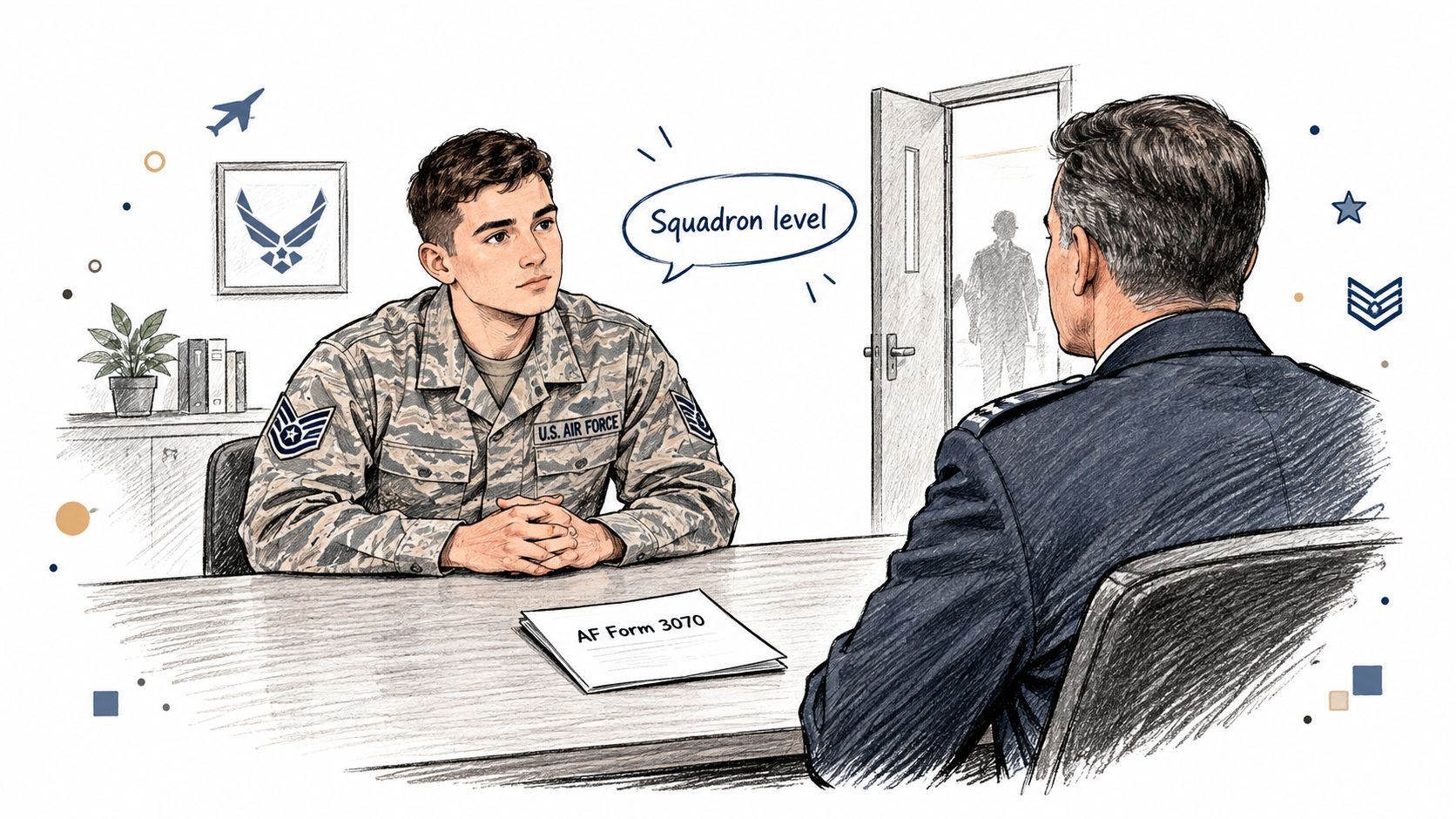
Article 15 is part of a longstanding disciplinary process. The Department of the Air Force has tracked Article 15 and court-martial data since 1974. Common allegations include dereliction of duty, failure to obey an order or regulation, government travel card misuse, and AWOL. Because these cases are familiar to command staff, the paperwork can feel routine across the desk. For the member facing it, the consequences are personal and can last beyond the immediate case.
Possible punishments include reductions in rank, forfeitures of pay, restrictions, extra duty, and reprimands. For a cadet, an Article 15 case may also raise the prospect of disenrollment, discharge, or recoupment of education costs. Those potential career and financial consequences make the election a legal decision, not a paperwork shortcut.
Nonjudicial does not mean low impact. A commander can impose serious consequences through this process, even without a public court-martial.
Article 15 Versus Court-Martial Side by Side
The election is the case. Accepting asks the commander to decide. Demanding trial asks the government to prove a crime. Read the factors before you listen to anyone who calls one path “the easy one.”
| Factor | Article 15 (NJP) | Court-martial |
|---|---|---|
| Who decides guilt | Commander acts as fact-finder | Military judge or panel decides |
| Proof standard | Preponderance of the evidence | Beyond a reasonable doubt |
| Criminal conviction | No conviction, but UIF and records consequences possible | Federal conviction if found guilty |
| Maximum punishment | Statutory ceilings by grade and command authority | Full sentencing range for each charge |
| Counsel | Military counsel free; civilian counsel at own expense | Detailed military counsel free; civilian counsel at own expense |
| Right to refuse | Yes, if you demand court-martial before punishment, unless attached to or embarked on a vessel | Not applicable |
| Appeal | Five calendar days to the next superior authority | Post-trial review through military appellate courts |
| Typical timeline | Air Force goal of processing 80% within 30 calendar days | Often several months from preferral through findings and review |
| Public record | Non-public | Public trial record |

Who decides, and how sure they must be
At an Article 15, one officer weighs the file. At a court-martial, a military judge or a panel does, and the government must prove the offense beyond a reasonable doubt. The Article 15 bar is a preponderance of the evidence, which means more likely than not. A thin statement that would never survive cross-examination can still be “enough” in the commander’s office. That gap is why a weak case sometimes belongs in a courtroom and a strong case sometimes does not.
What “no conviction” actually buys you
An Article 15 is not a federal conviction. A guilty finding at court-martial is. The trade is punishment range. 10 U.S.C. § 815 says you generally can’t be punished under Article 15 after you demand trial before punishment is imposed, except if you’re attached to or embarked in a vessel. The same statute lets the President and the service secretary limit which commanders may punish, which punishments they may use, and how a demand for court-martial affects the case. Air Force paperwork, not the statute’s general language, controls the day you sign. AFI 51-202, Article 15, and Part V of the Manual for Courts-Martial are the rights pages counsel should walk with you.
Speed against exposure
Davis-Monthan Air Force Base reported six Article 15 actions in May 2013 and stated that the Air Force metric was to process 80% of Article 15 cases within 30 calendar days. A court-martial is slower, public, and open to confinement and a punitive discharge. Speed is not a gift if the allegation is overcharged, the witness is shaky, or a conviction would end a clearance you can’t replace. Demand trial only after an evidence audit, not because someone in the shop said “fight it.”
Punishment Limits Commanders Can Impose
Find your grade before you guess what “they’ll probably give me.” These figures are statutory ceilings, not the sentence you will receive. The commander may impose only what your status and that officer’s command level allow. Air Force-specific limits sit in AFI 51-202 and on the reverse of AF Form 3070.
| Punishment | Who may receive it | Statutory ceiling |
|---|---|---|
| Arrest in quarters | Officers, imposed by a GCMCA or a general or flag officer | Up to 30 days |
| Forfeiture of pay | Officers | Up to one-half month’s pay per month for two months |
| Restriction | Officers | Up to 60 days |
| Detention of pay | Officers | Up to one-half month’s pay per month for three months |
| Correctional custody | Enlisted and other personnel | Up to 7 days |
| Forfeiture of pay | Enlisted and other personnel | Up to 7 days’ pay |
| Reduction in grade | Enlisted, where the imposing officer holds promotion authority | Next inferior pay grade |
| Extra duties | Enlisted and other personnel | Up to 14 consecutive days |
| Restriction | Enlisted and other personnel | Up to 14 consecutive days |
| Detention of pay | Enlisted and other personnel | Up to 14 days’ pay |
| Reprimand | Any member | No day-count or pay ceiling stated in the statute |
Officer ceilings
Under 10 U.S.C. § 815, a general court-martial convening authority, or a general or flag officer in command, may impose on an officer arrest in quarters for up to 30 days, forfeiture of up to one-half of one month’s pay per month for two months, restriction for up to 60 days, or detention of up to one-half of one month’s pay per month for three months. A squadron commander who lacks that authority can’t reach those numbers just because the allegation sounds serious.
Enlisted and other personnel
Other personnel may face correctional custody for up to seven days, forfeiture of up to seven days’ pay, reduction to the next inferior pay grade when the imposing officer has the promotion authority, extra duties for up to 14 consecutive days, restriction for up to 14 consecutive days, or detention of up to 14 days’ pay. A reprimand can be added without a day or dollar cap in the statute. It is still punishment, and it is still a document.
A ceiling is the most the law allows, not what fairness requires. A reduction changes base pay, promotion timing, and later administrative decisions long after the restriction ends. If the form lists a punishment your imposing officer can’t lawfully give, that is a defect, not a detail to fix after you sign.
Your Rights, the Step-by-Step Process and Your Appeal
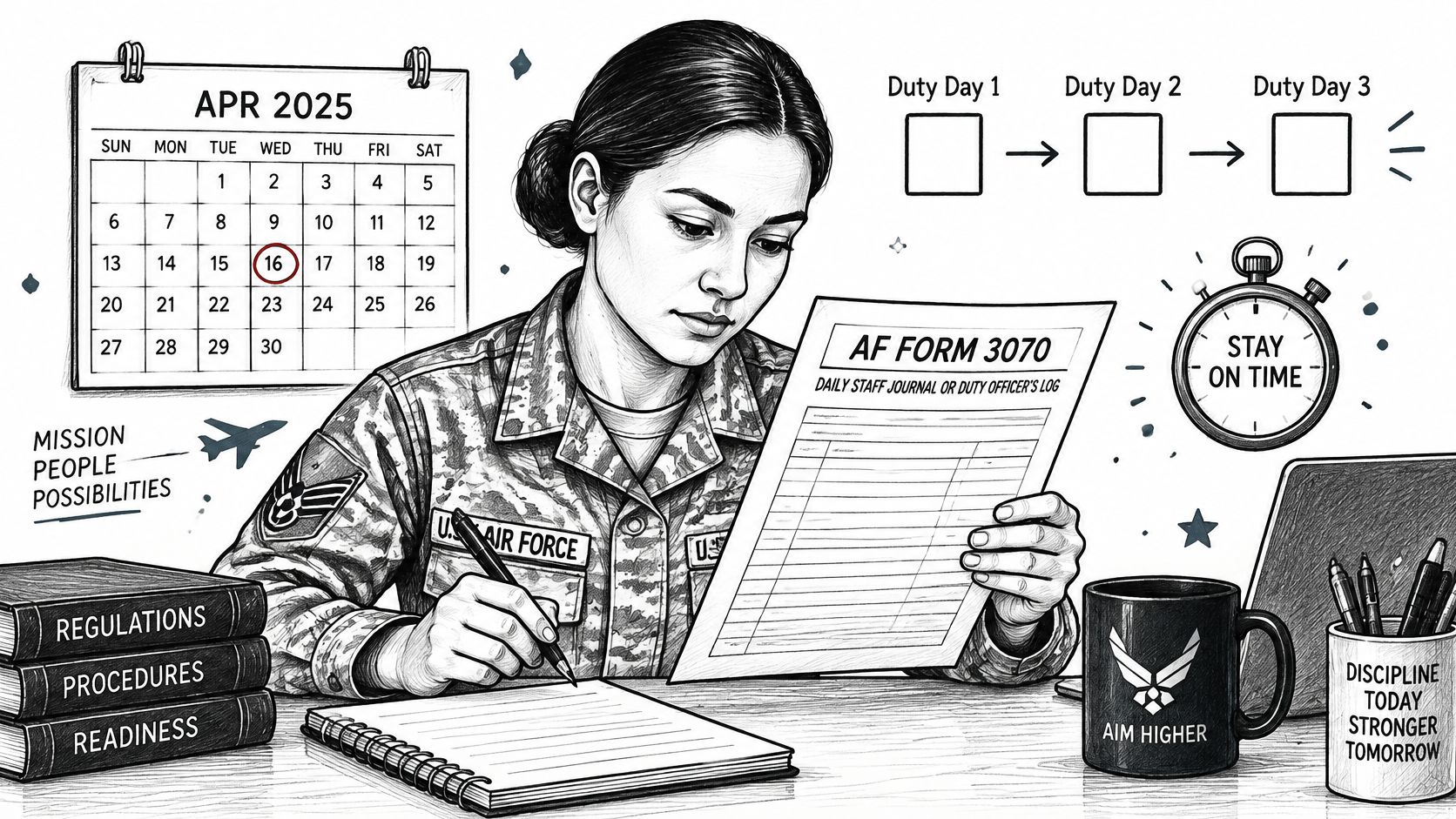
The clock is the first fact on the form. Everything else is a choice you make inside a very short window.
The sequence that actually matters
Notice. You receive AF Form 3070 with the allegations and a statement of rights. Write down the date and time of service. Per the Barksdale Air Force Base ADC fact sheet, you generally have three duty days to respond, and extensions can be available. The mistake is treating day one as a thinking day instead of a working day.
The file and your counsel. You’re entitled to review the evidence, consult military counsel at no cost, or hire civilian counsel at your expense, and to submit matters on guilt, innocence, extenuation, or mitigation. Don’t fill the silence with a statement. Your Article 31 rights exist so you aren’t compelled to explain the allegation to investigators or to the same chain that will punish you.
The election. You accept, you demand court-martial before punishment is imposed, or you ask in writing for more time. Acceptance is not an admission of guilt or a guilty plea. It is a request that the commander, not a court, act as judge and jury. If you’re attached to or embarked on a vessel, the demand-trial option is off the table. Don’t decide from embarrassment.
The presentation. Character statements, awards, deployment history, a clean record, and documents that fix the timeline belong in the package. A verbal “I’m a good Airman” disappears. Paper doesn’t. Skip the angry rebuttal that admits the elements while arguing about tone.
The decision. The commander finds the facts and selects punishment from the authorized list. Your influence is whatever is already in the file plus what you added. A late email after the decision is not a presentation.
Execution and the file. If the punishment can’t be finished inside the filing window your base uses, an Unfavorable Information File entry follows as a matter of rule rather than discretion. Ask counsel what will be filed before you agree to a schedule you can’t complete.
Appeal. Government Accountability Office materials describe the ordinary Air Force window as five calendar days after punishment to appeal to the next superior authority. Grounds are legal error or punishment out of proportion to the offense. Keep copies and a receipt. An appeal you mention in the shop but never submit is not an appeal.
Counsel uses that same short window to test defects, jurisdiction, offense severity, and whether the NJP ceiling is safer than court-martial exposure. You use it to stop talking.
A short walk-through of how members talk about this choice is here, and it is not a substitute for reading your own form.
Career and Records Fallout After Article 15
An Article 15 is not a criminal conviction, but it can still affect your career. A commander’s paperwork may follow you into promotion, assignment, reenlistment, or separation decisions. Treat acceptance as a legal election with record consequences, not as a harmless shortcut.
Air Force guidance addresses whether punishment that remains unfinished can lead to an Unfavorable Information File entry. Do not assume a schedule makes the paperwork disappear. Before you accept a restriction or extra-duty schedule, ask counsel what records the command plans to create and how the timing may affect your file.
Where the paper gets read
- Promotion boards may consider unfavorable information when comparing your record with those of other Airmen. A reduction can also affect whether you remain competitive for a promotion cycle.
- Reenlistment and assignment decisions can be affected by the same file, including when a special-duty position, short-tour assignment, or reenlistment bonus is under consideration.
- Security clearance adjudication can consider reliability. A reprimand involving false statements, travel cards, or disobedience may be viewed differently from a late report to duty, but either can appear in the package.
- Administrative separation is a separate action. An administrative separation board may consider the Article 15 as part of an alleged pattern, even after the punishment is complete.
The effect depends on the punishment, the wording of the specification, later command decisions, and your Air Force specialty. A crew chief and an intelligence analyst may face different career consequences from the same entry. Do not assume the record disappears when a UIF period ends. Later decision-makers may still refer to documents that were filed.
Before signing anything that will be placed in your records, have counsel review the actual documents. A supervisor’s summary is not a substitute for reading the paperwork and understanding what it could mean for your career.
Where Government Article 15 Cases Are Weak and What Counsel Checks
An Article 15 is a fast command process. It is not a neutral inquiry. Investigators and the first sergeant often frame the file before you see a page of it. Experienced military defense lawyers start by attacking that frame, not by asking how sorry you are.
What gets tested first
Charging language. The specification has to match a real UCMJ offense and the facts in the packet. “Disrespect” written like a novel, with no quoted words and no witness who heard them, is a pleading problem. So is a dereliction charge that never identifies the duty.
Witness statements. Counsel checks whether rights advisements were given, whether two statements use the same unlikely phrase, and whether the timeline contradicts duty logs. A statement taken after someone was told “just write what the commander needs” is a credibility problem, not corroboration.
Records that should exist. Time cards, leave forms, travel vouchers, dorm sign-in logs, and message traffic either show what command claims or they don’t. If the government travel card allegation depends on a voucher nobody produced, the file is incomplete. Incomplete is not the same as proved.
What they left out. Performance reports, deployment awards, and prior counseling that cuts against a “pattern” often never make the commander’s read-ahead. If you don’t put them in, they don’t exist in that room.
Forum shopping. Sometimes an incident is labeled minor so it stays below court-martial referral while a parallel action, a clearance flag or a separation memo, keeps growing. The Article 15 is then a building block, not the whole case.
A clean mitigation package changes punishments more often than a speech in the commander’s office. A commander who sees a provable lapse plus documented service often lands in a different place than one who sees only the charge sheet.
Strategy is the audit. Accept when the proof is solid and the ceiling is safer than a conviction. Contest the specification when the words don’t match the facts. Demand trial when the case is thin and the career cost of a finding is worse than the risk of court. Guessing how the commander “usually is” is not one of those three moves.
Frequently Asked Questions About Article 15 in the Air Force
Can I refuse an Article 15?
Yes. You may demand trial by court-martial before punishment is imposed. That option is not available if you’re attached to or embarked on a vessel. Make the demand in the way the form and your counsel describe, not in a side conversation.
Is an Article 15 a criminal conviction?
No. It can still follow you. A UIF entry and the supporting documents are readable in promotion, reenlistment, assignment, and clearance decisions.
Will I go to jail?
The Article 15 punishments in the statute don’t include court-martial confinement. Enlisted members can face correctional custody. Officers can face arrest in quarters. Confinement and a punitive discharge sit on the court-martial side of the election, which is one reason the election is serious.
Do I need a lawyer immediately?
Yes. The response window starts when the form is served, and the choice you make inside it is hard to undo. Free military counsel is available. A civilian UCMJ lawyer is available at your expense if you want someone outside the chain.
Can I appeal?
Yes. After punishment, you may appeal to the next superior authority on legal error or on punishment that doesn’t fit the offense. Put it in writing, on time, and keep a copy.
Will the Article 15 show up later?
It can. Promotion boards, assignment managers, and separation boards can read the action after any UIF period has ended. What they see depends on what was filed, not on what people in the unit remember.
Common Mistakes and When to Call a UCMJ Lawyer
Most bad Article 15 outcomes start before the commander ever decides the facts.
- Signing AF Form 3070 because it feels routine. The form is the election. Routine is how people waive options.
- Talking to investigators or the first sergeant without counsel. A clarifying text becomes the proof.
- Trusting the squadron to “handle it.” The squadron is the prosecutor and the forum.
- Believing there is no evidence. The file was built to a lower standard than a trial. Thin is not empty.
- Waiting until the response window is gone to call anyone. Late counsel can still help on appeal. They can’t rewind a signature.
- Writing a statement that admits the elements while you argue about fairness. Fairness is mitigation. Elements are the case.
- Treating free military counsel and independent counsel as the same job. Military defense counsel is free and should be in the room. A civilian court-martial attorney sits outside the chain, tries cases, and can compare NJP exposure with court-martial exposure without a commander in the rating chain.
In the first days after service, useful counsel gets the full evidence, tests jurisdiction and the specification, and builds mitigation before the commander decides. Compare court-martial attorneys on trial experience, communication, and fit. No credential guarantees a result. You still have to talk to more than one lawyer and judge the strategy.
The clock started when the form hit your hand. Call before you sign.
If you’re holding an Air Force Article 15, or OSI has already asked for a statement, don’t wait for the commander’s calendar to become your deadline. Talk to military defense counsel and to an independent UCMJ lawyer before you accept, demand trial, or put a word in writing. Your rank, your pay, and the next board that reads your record are already in the file.