
An Army court-martial is a military trial under the Uniform Code of Military Justice that can decide guilt and impose punishment. Special and general courts-martial are criminal proceedings; a summary court-martial is a noncriminal disciplinary forum. The level and the convening authority’s choices shape what you face, and early decisions can affect the case before trial.
CID may ask you to interview, your commander may mention charges, or your spouse may come home with paperwork neither of you understands. Treat those developments seriously. What you say and do before entering a courtroom can affect your freedom, military record and career. Get advice before answering questions or responding to paperwork.
Table of Contents
- What an Army Court-Martial Is and Who It Covers
- Summary, Special and General Courts-Martial Compared
- How an Army Court-Martial Moves From Investigation to Appeal
- Your Rights as the Accused and the Defenses Lawyers Use
- Maximum Punishments at Each Court-Martial Level
- Where Government Cases Break Down
- Mistakes That Cost Service Members Their Case
- Army Court-Martial Questions Answered
- Hire Civilian Military Defense Counsel Before Charges Are Referred
What an Army Court-Martial Is and Who It Covers
Consider a hypothetical soldier asked to come to CID for a routine interview. The soldier answers questions without advice, assuming an explanation will settle the matter. Later, a charge sheet arrives, and that explanation is now something defense counsel must work around.
A court-martial isn’t a command meeting with more formal paperwork. Congress enacted the UCMJ in 1950, replacing separate service systems with a framework that now applies across the Army, Navy, Air Force, Marine Corps, Space Force and Coast Guard. It has its own substantive law, Military Rules of Evidence, trial procedures and appellate structure, as explained in the Congressional Research Service overview of military courts-martial.
Duty status comes before exposure
Active-duty soldiers fall within the federal military-justice system. For Reserve soldiers, counsel must examine status when the alleged offense occurred, not merely whether the soldier currently wears a uniform.
The Army’s military-justice regulation addresses Reserve Component jurisdiction for offenses committed in Title 10 status and summary proceedings during active duty, annual training or inactive-duty training. National Guard cases require a separate federal-versus-state analysis.
A court-martial also isn’t Article 15 nonjudicial punishment or an administrative separation board. Those processes involve different authority and consequences, even when they arise from the same allegations.
First practical rule: Give your lawyer the actual orders, amendments and duty-status records. A verbal description of your status isn’t enough.
Status determines the governing legal framework. The next question is who has authority to send the allegations to which forum.
Summary, Special and General Courts-Martial Compared
The court level sets the available procedures and punishment limits. Your status and the authority bringing the case also matter. A charge that sounds minor can still carry serious career consequences, so identify the proposed forum before deciding how to respond.
| Court level | What it handles | Who convenes it | Who decides the case | Appointed counsel |
|---|---|---|---|---|
| Summary | Minor misconduct; enlisted accused only | Authorized summary court-martial convening authority | One commissioned officer | No automatic right; civilian counsel may be retained |
| Special | Misdemeanor-comparable offenses; some more serious misconduct | Authorized special court-martial convening authority | Military judge alone or panel, depending on the forum | Detailed defense counsel; certification requirements apply when a bad-conduct discharge is possible |
| General | Felony-comparable and capital offenses | Authorized general court-martial convening authority | Military judge alone or panel; capital cases require members | Detailed defense counsel |
The misdemeanor and felony comparisons describe relative seriousness, not formal military offense classifications. The charges, authorized forum and applicable procedures must be considered together.
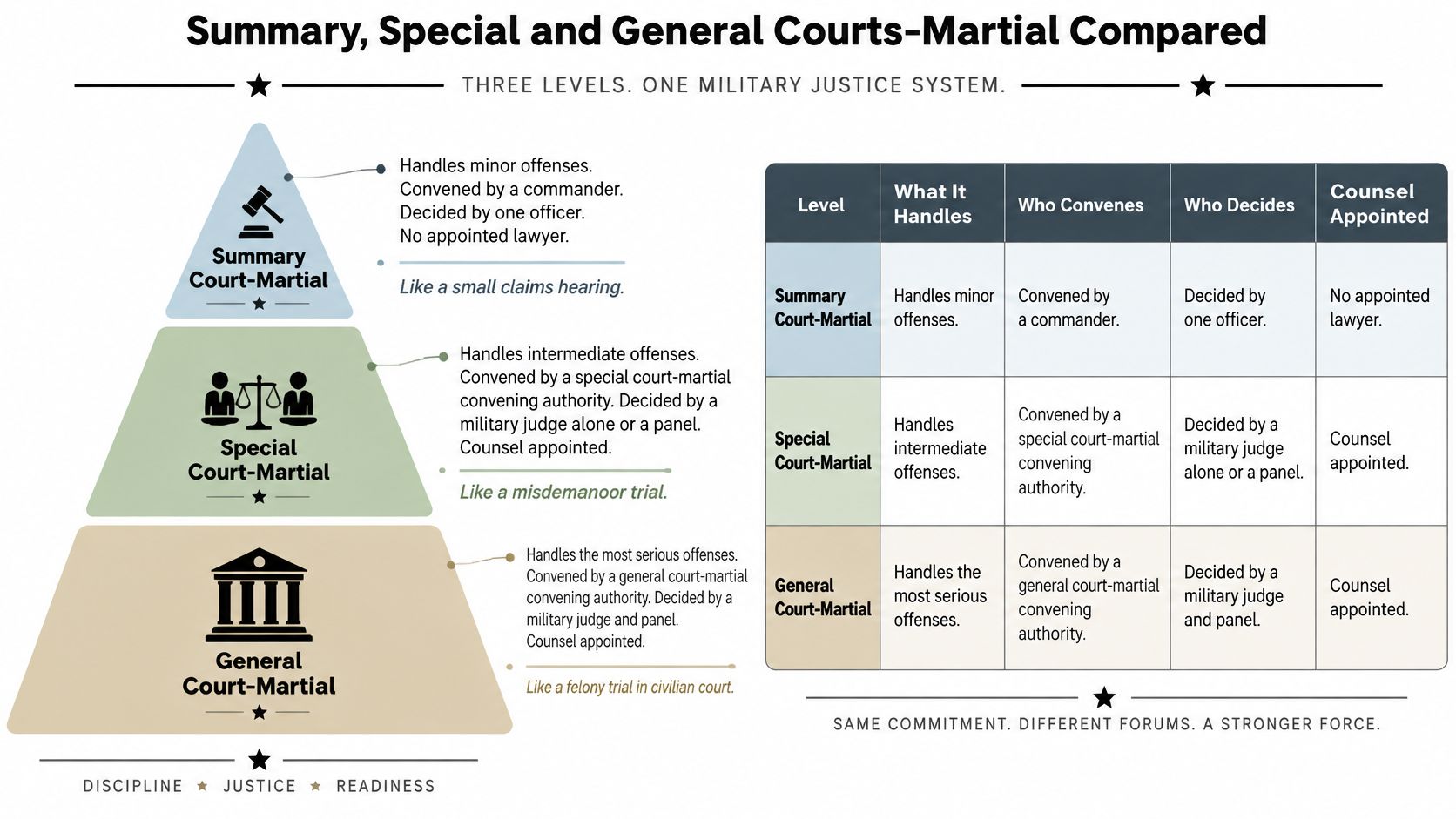
What the levels mean in practice
Summary court-martial is the system’s limited disciplinary forum for enlisted accused. It is sometimes compared to traffic court, but that analogy can mislead: this remains a military proceeding, and its consequences deserve legal attention.
The Government Accountability Office describes summary courts-martial as a narrower, noncriminal forum, while special and general courts-martial perform criminal functions in its review of military-justice investigations and records. That distinction does not make summary proceedings consequence-free. The label describes the forum’s legal character, not whether a soldier should take the case seriously.
Special court-martial is comparable to misdemeanor court in relative seriousness. A criminal conviction and possible punitive discharge can still affect a soldier’s career and future options.
General court-martial is comparable to felony court and has the broadest jurisdiction. The convening authority’s forum choice can shape the case’s exposure, so counsel should scrutinize the evidence and proposed charges before referral. For covered offenses, special trial counsel authority may also apply. Do not assume every prosecution decision rests exclusively with the accused’s commander.
Guard cases require a different authority check
For Guard members not in federal service, 32 U.S.C. § 326 provides for courts constituted like comparable Army and Air Force courts, while punishment is governed by applicable state or territorial law. The statutory provisions governing nonfederal Guard courts-martial address the courts and applicable punishment framework. Check the member’s status and the source of authority rather than assuming federal rules or authority apply.
How an Army Court-Martial Moves From Investigation to Appeal
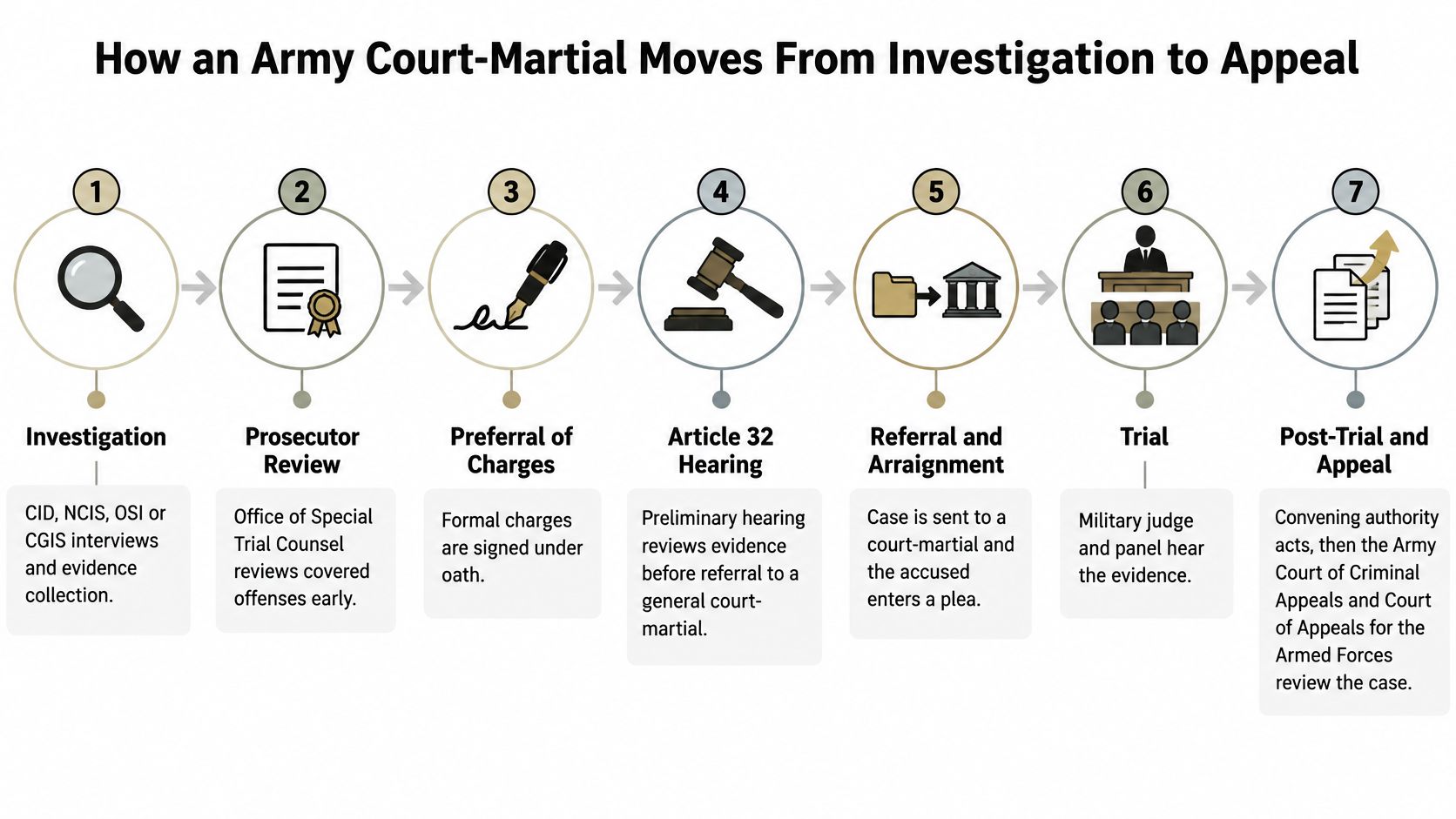
A soldier’s case can change course before anyone enters a courtroom. The level of court and the convening authority’s choices shape what the accused faces, while early decisions about evidence, charges, and forum can affect the result long before trial.
The flow chart shows eight stages, from investigation through appeal. The path and procedures depend on the case and applicable rules.
Investigation and charging
Investigation. CID may gather interviews, digital material, and other evidence. NCIS, OSI, or CGIS may become involved when allegations cross service lines. A command inquiry can create a separate record, so distinguish criminal questioning from an Army administrative investigation. Preserve relevant evidence before it disappears.
Prosecutor review and preferral. Preferral formally places allegations on a charge sheet, but prosecutorial decisions can begin earlier. The Army’s report on special trial counsel operations describes the office’s prosecution of domestic violence cases. It does not establish the broader case-count figures sometimes attributed to it. Identify who controls disposition and address that decision-maker early.
Article 32 preliminary hearing. Before referral to a general court-martial, a hearing is generally required unless properly waived. The officer considers whether the specifications allege offenses, probable cause supports them, and jurisdiction exists. Cross-examination is limited to the hearing’s purpose, not an unrestricted preview of trial. The Article 32 statutory framework also makes clear that noncompliance does not itself create a jurisdictional defect. Focus on contradictions or missing evidence that matter to the referral decision.
Referral. The authorized decision-maker sends charges to a particular court-martial. That choice affects the accused’s exposure. Defense submissions should address the evidence, appropriate forum, and possible alternatives with concrete reasons, rather than appealing only for sympathy.
Litigation, sentence, and review
Pretrial litigation. Arraignment, discovery disputes, motions, and scheduling narrow the case to specific issues. Counsel should check deadlines and applicable speedy-trial requirements against the actual procedural history. Identify what government evidence should be requested or challenged before trial.
Trial. Pleas, permitted forum elections, witness examination, and evidentiary rulings shape what the fact-finder hears. The prosecution must prove guilt beyond a reasonable doubt. The defense should be ready to explain gaps in proof without relying on the accused’s testimony.
Sentencing. After a conviction, the focus turns to aggravation and mitigation. Service records, treatment documentation, and a credible rehabilitation plan can help present a fuller account of the accused. Organize that evidence before sentencing begins.
Post-trial and appeal. Counsel must identify available submissions, the convening authority’s limited powers, and the applicable review route. Depending on eligibility, review may proceed to the Army Court of Criminal Appeals and potentially the Court of Appeals for the Armed Forces. Preserve issues in the record and track each deadline.
Your Rights as the Accused and the Defenses Lawyers Use
Get advice before creating evidence against yourself. Ask counsel to explain your right to remain silent, applicable warnings, access to representation and the consequences of any requested consent or waiver.
Bring the actual paperwork to that consultation.
A useful starting point is understanding Article 31 rights during military questioning. Don’t assume you can undo an interview later just because you felt pressured, misunderstood a question or believed cooperation would help.
The preliminary-hearing framework recognizes notice, counsel, participation and relevant witness examination while also protecting specified victim participation rights. The regulation addressing preliminary-hearing procedures underscores that these are structured legal proceedings, not informal meetings.
A defense checklist, not a list of promises
An experienced UCMJ lawyer tests potential defenses against the charged elements and actual evidence:
- Mistake of fact: What did the accused sincerely believe, and what legal requirements apply to that belief, particularly concerning consent?
- Missing intent or knowledge: Does the evidence establish the required mental state, rather than merely suspicious conduct?
- Self-defense: Who initiated the encounter, what threat existed, and what contemporaneous evidence supports the response?
- Alibi or misidentification: Do timestamps, access records or independent witnesses place the accused elsewhere?
- Order-related issues: Was the alleged order lawful, applicable and communicated?
- Unlawful command influence: Did improper pressure affect witnesses or decisions?
- Search and statement problems: Was evidence obtained lawfully, and were statements voluntary?
- Limitations and timing: Which filing limits, exceptions and procedural deadlines govern this particular allegation?
Don’t select a defense because its label sounds promising. A mistake-of-fact argument without supporting communications or circumstances may accomplish little; a narrow challenge to an essential element may accomplish much more.
This additional video can help frame questions for a legal consultation.
Keep mitigation separate from the merits
Preparing mitigation isn’t an admission of guilt. It’s contingency planning that protects the client if negotiations become appropriate or the court returns a conviction.
A denial tells counsel your position. Documents, witnesses and properly developed legal objections give counsel something to use.
Maximum Punishments at Each Court-Martial Level
The court level sets the outer limits of punishment, but it does not determine the sentence by itself. The convening authority’s forum decision affects which limits apply. Your actual exposure depends on the charged specifications, your status, and the applicable Manual for Courts-Martial (MCM).
| Court level | Maximum confinement | Punitive discharge | Forfeitures | Reduction in grade |
|---|---|---|---|---|
| Summary | For enlisted accused, up to 30 days, or 45 days if the accused is an E-5 or above. | None | Two-thirds pay per month for one month | E-1 for enlisted accused |
| Special | Up to 12 months, subject to the offense-specific maximum | Bad-conduct discharge, if authorized | Two-thirds pay per month for 12 months | E-1 for enlisted accused |
| General | The maximum for each offense under the applicable MCM rules, including life confinement for offenses that authorize it | Bad-conduct or dishonorable discharge, when authorized | Total forfeitures may be imposed | E-1 for enlisted accused |
These are general limits, not a calculation for a particular case. Check the current Manual for Courts-Martial sentencing rules against every specification and the accused’s grade and status. A single headline maximum can mislead: separate offenses may carry different limits, and the authorized forum matters.
What sets your actual exposure
Before deciding how to plead, have counsel calculate confinement and financial consequences together. Forfeitures and reduction in grade can affect the household immediately; a punitive discharge can also change benefits, employment prospects, and the permanent military record.
The forum choice can change the stakes. A special court-martial has a confinement cap and cannot impose a dishonorable discharge, while a general court-martial can authorize more severe punishment where the charged offenses permit it. Ask counsel to identify the exact ceiling for each specification, then compare that exposure with the likely sentencing issues in the case.
Early decisions shape that comparison. The charges referred, the forum selected, and any plea terms can narrow or expand sentencing exposure before the trial begins. Get the calculation in writing, including confinement, forfeitures, reduction, and discharge risk. Prepare mitigation early, with documents supporting treatment, service history, or rehabilitation rather than relying on last-minute assertions.
Where Government Cases Break Down
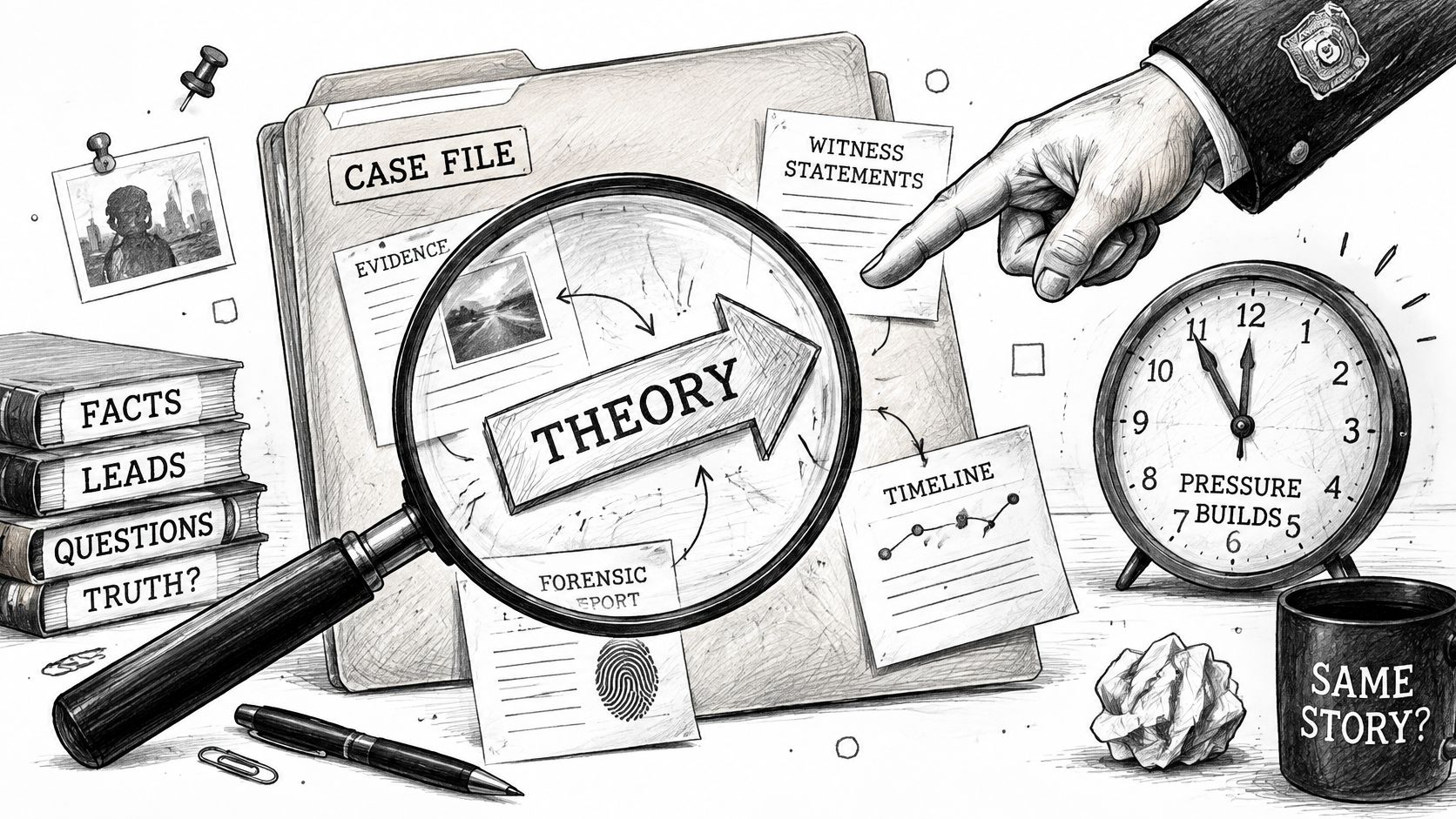
A case may reach trial with a theory that has never been tested against the full record. The investigation reflects what agents found and chose to pursue. Defense counsel should examine the underlying evidence independently, including material that could weaken the government’s account.
Test the underlying material
Check whether video is missing, digital extractions are incomplete, evidence handling is documented, testing was delayed, or messages have been separated from their surrounding conversation. Compare witness accounts across interviews with independent records. A discrepancy can guide questioning, but it does not by itself prove dishonesty.
A suppression motion may keep evidence out if the law supports it. Other gaps may give counsel grounds to challenge a witness or negotiate. The court level and the convening authority’s decisions also shape exposure, so early review can affect the choices available before trial.
Check the paperwork against the record: compare the findings and sentence with the post-trial action, court-martial order, and personnel entries. For the order itself, review the Army personnel regulation on preparation and distribution of military orders. Flag any mismatch for counsel to address.
Statistics don’t assess your evidence
The Department’s FY2025 sexual-assault disposition appendix reports 130 completed trials in the relevant category, including 98 convictions on any charge and 32 acquittals. The figures exclude pending cases and pending preferrals, and do not separate every charge outcome, plea posture, or sentence.
Those totals cannot predict an individual case. An acquittal also does not automatically resolve administrative separation, evaluations, or clearance review.
The practical objective is to build a position grounded in evidence. A truthful account still needs a strategy to prove it and challenge the government’s version.
Mistakes That Cost Service Members Their Case
These mistakes can narrow options before counsel has a fair opportunity to assess the evidence:
- Talking without advice: An interview with CID, NCIS, OSI or CGIS can turn an attempted explanation into evidence the defense must confront.
- Expecting command to defend you: A commander’s responsibilities aren’t the same as your lawyer’s responsibilities.
- Waiting for charges: Delay can leave counsel trying to recover evidence and influence decisions that have already advanced.
- Assuming there’s no evidence: Testimony and communications require analysis even when there’s no video or physical evidence.
- Contacting complainants or witnesses: Direct outreach can undermine the defense and create additional problems, particularly where contact restrictions apply.
- Posting about the incident: Messages and social posts can contradict your account or expose private defense discussions.
- Signing without understanding: Consent forms, statements and waivers deserve legal review before you sign.
- Ignoring the personnel record: Disciplinary entries can remain consequential after punishment ends, and record transfer isn’t automatic under Army Regulation 600-37.
- Accepting a plea without a complete comparison: Evaluate the proposed sentence, discharge consequences and litigation alternatives together.
What to bring counsel
Bring the charge sheet, orders, interview requests, restrictions, administrative notices and relevant communications. Preserve originals and explain what’s missing.
Don’t delete material, coordinate accounts or try to conduct witness interviews yourself. Give counsel the uncomfortable facts privately so the defense can prepare for them.
Army Court-Martial Questions Answered
Can I refuse to talk to CID?
Yes. If CID questions you as a suspect, you can remain silent under Article 31 and ask for a lawyer before answering. Do not guess about what to say or sign. Tell the agents clearly that you want counsel, then stop substantive questioning. Separate legal reporting duties may still apply, so ask counsel what you must report.
What happens at an Article 32 hearing?
Before a case can generally be referred to a general court-martial, an Article 32 preliminary hearing is required unless it is waived. An impartial officer reviews the allegations, probable cause and jurisdiction. Defense counsel may examine relevant evidence and witnesses within the hearing’s scope, but the officer does not decide guilt. It is a screening step for a possible general court-martial, not a special or summary court-martial.
Will I go to jail after an Army court-martial?
Confinement depends in part on the court level and the charges. A summary court-martial has limited punishment authority, while special and general courts-martial can impose greater confinement, subject to the offenses and applicable limits. A conviction does not automatically mean jail, but a plea or finding of guilt can carry confinement. The convening authority’s decisions about referral and the charges shape the exposure; the evidence and sentencing position matter too.
Questions about representation and status
Do I need a lawyer before charges arrive?
Seek advice before an interview, statement or waiver, not after a charge sheet arrives. Early legal advice can help preserve relevant material and address allegations before key decisions are made.
Do I need civilian counsel if I already have military defense counsel?
Not automatically. Compare the case team’s experience, workload and strategy with those of civilian court-martial lawyers. A civilian title alone does not prove greater skill, and capable detailed counsel can be an important part of the defense.
What if I’m a Guard or Reserve member back in civilian life?
Returning to civilian life does not settle whether the military can exercise jurisdiction. Counsel will need to review your status at the time of the alleged conduct, your current status, orders and any recall-related paperwork.
Does an Article 15 prevent a later court-martial?
Generally, a commander may not impose nonjudicial punishment under Article 15 and later try the same offense at court-martial. Whether that protection applies depends on the conduct addressed, the disposition documents and whether the proposed charges cover the same offense. Have counsel compare those records before assuming the matter is closed.
Family guidance: Help gather records and arrange a confidential consultation. Do not contact witnesses or circulate the soldier’s account to try to clear things up.
Hire Civilian Military Defense Counsel Before Charges Are Referred
| Factor | Military-appointed counsel | Civilian defense counsel |
|---|---|---|
| Cost | Free to the accused | Personal expense under the engagement agreement |
| Choice of lawyer | Detailed assignment; additional requests depend on applicable rules | Selected by the client |
| Presence at early interviews | Confirm availability immediately | Can be retained during investigation |
| Trial focus | Depends on experience and assignment | Verify actual military-justice trial practice |
| Continuity through appeal | Representation may change | Depends on the agreed scope; appeal isn’t automatically included |
| Independence from command | Defense function is separate from prosecution and command advice | Outside the military chain of command |
Choose demonstrated ability, not a label. Experienced civilian military defense lawyers can add independent investigation, focused trial preparation and continuity, but none of those advantages should be assumed without asking direct questions.
Vet the lawyer who will handle your case
- Ask about comparable work: Confirm experience with your branch, court level and allegation.
- Identify the courtroom lawyer: Ask who attends the hearing and who tries the case.
- Test the immediate plan: Ask how counsel would handle an interview request tomorrow.
- Check professional depth: Review military-justice teaching, substantive writing, continuing education and peer standing.
- Read the agreement: Confirm investigation, experts, travel, trial and appellate scope in writing.
Consult more than one attorney when circumstances permit. Evaluate how each lawyer identifies weaknesses, explains trade-offs and works with detailed military counsel, not who promises the strongest result.
If you’re under investigation or have received charges, request counsel before substantive questioning, stop discussing the allegations outside confidential legal advice, and arrange a civilian military defense consultation today. Bring your orders, notices and charge sheet, and ask for a concrete plan covering evidence preservation, charging authority and forum exposure. Your career, record and freedom deserve a defense strategy before referral, not merely a trial date.