Any unauthorized absence can become a criminal case under Article 86, but the outcome depends on its duration, intent, and how the absence ends, not only on a missed movement. In the Army, a Soldier officially determined to be absent without authority can also lose pay for the unauthorized period, with potential consequences for service records and a military career. Army compensation policy
A Soldier misses formation after a family crisis, then stops answering the phone. The spouse is frightened, the unit is trying to locate the Soldier, and every hour that passes can make it harder to establish what happened. If you're asking what UA in the military means for a service member or family, the immediate priority is not guessing at the eventual charge. It's preserving the facts and getting advice before the command's first account becomes the only account in the file.
Table of Contents
- The First 24 Hours When a Service Member Goes UA
- What UA, AWOL, and Desertion Mean Under Article 86
- Punishments, Pay Loss, and the Administrative Domino Effect
- When Mental Health, Family Crisis, and Involuntary Absence Become Defenses
- Your Immediate Action Plan If You Are Facing a UA Allegation
- Why Civilian Military Defense Counsel Changes the Outcome
- Do Not Wait. The Clock Is Already Running
The First 24 Hours When a Service Member Goes UA
A Soldier misses formation, and the unit starts building a timeline. The Army's law-enforcement guidebook directs the unit to verify the continuous unauthorized absence, promptly check the Soldier's location and reason for being gone, and look for explanations such as injury, hospitalization, or a natural disaster. Once the absence is verified, the unit must notify the Military Police Investigation section within 24 hours and forward a DA Form 4187 to the servicing personnel office. Fort Irwin's law-enforcement guidebook
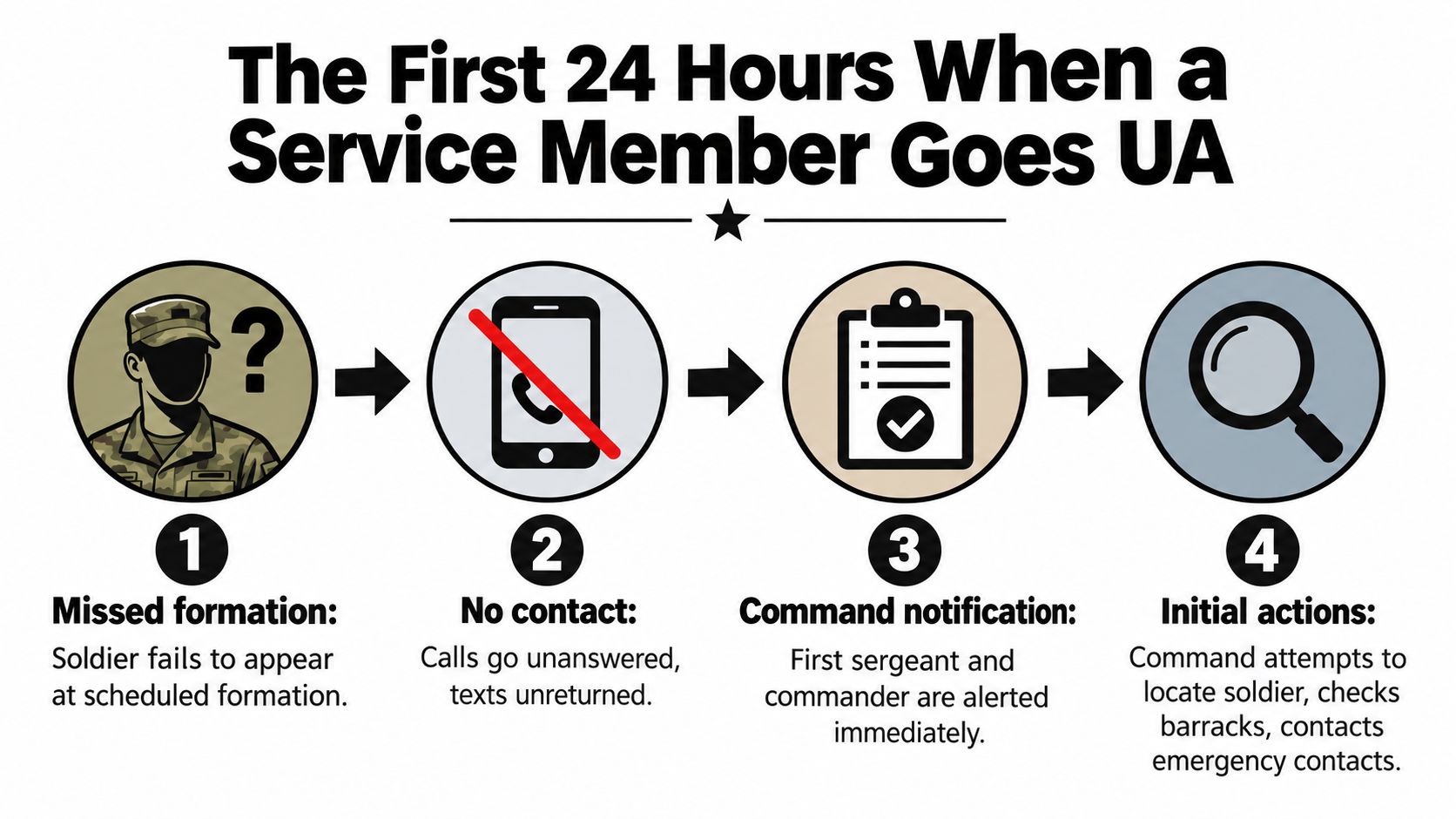
The first record may shape the government's account of the absence. It can include when the Soldier was expected, when the unit noticed they were gone, who attempted contact, and what the inquiry found. Check the duty roster, call logs, texts, and any emergency reports. A roster with the wrong reporting time or a call that was never logged can undermine the timeline later.
What families should do right away
If you're a spouse or family member, give the unit accurate information promptly. Report a hospital admission, family emergency, or transportation failure, and preserve records that support what you say. Stick to what you know. Speculating about why the Soldier left can muddy the facts.
The Fort Irwin guidebook says next of kin must receive a letter mailed on the tenth day of AWOL. Do not wait for that letter to contact the unit. If addiction or another health crisis is involved, families can also consult this complete veterans recovery resource while seeking immediate, appropriate support.
Practical rule: Preserve messages, call records, travel details, and medical paperwork before they disappear or memories fade.
An unrecorded 2 a.m. call from a Soldier to a spouse could matter if it shows an emergency or an attempt to report, yet the unit's file may show no contact at all. That gap can affect whether the absence is treated as excused or voluntary. Before anyone gives a detailed account to investigators or command, get legal advice about what records exist and how to preserve them. A plan to return does not keep the inquiry from becoming a criminal investigation.
What UA, AWOL, and Desertion Mean Under Article 86
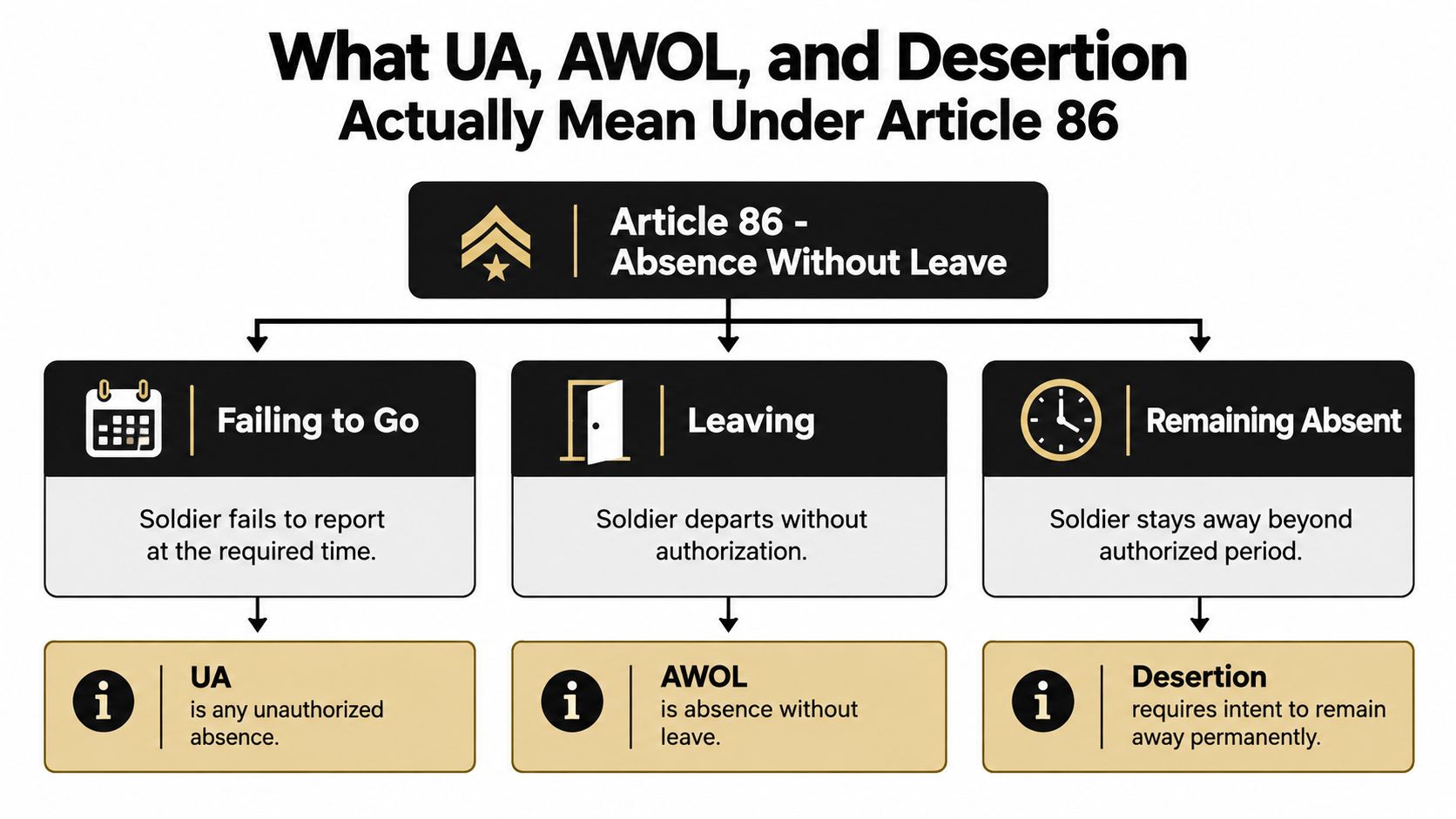
A missed formation, an unauthorized departure, and an extended absence can all lead to an Article 86 allegation, but they are not interchangeable. Article 86 covers failing to go to an appointed place of duty at the required time, leaving that place without authority, and remaining absent from a unit or duty location where the service member was required to be. The evidence, not the unit's label, determines what the government can prove.
For a charge alleging that a person remained absent, the Army's Criminal Law Deskbook identifies three prosecution elements: absence from a required unit or place of duty, lack of authorization from someone competent to grant leave, and an absence lasting for a legally provable period. Army Criminal Law Deskbook on absence without leave
What the government must establish
The duty requirement must be clear enough to prove where the service member was supposed to be and when. Prosecutors must also establish whether competent authority granted permission, whether the member reasonably believed permission existed, and whether the absence began and ended when the government claims.
Those details create evidence fights. The government must establish a definite start date; an imprecise account can weaken the charge. The Army deskbook describes the absence as beginning with the unauthorized departure and ending when the member surrenders to military authorities. Duty rosters, sign-in records, leave forms, and communications can help test that timeline. A missing or inaccurate record can matter.
UA and AWOL are commonly used terms for unauthorized absence, though usage varies among services. Desertion is different. A 30-day absence triggers an Army reporting procedure, but duration alone does not prove desertion. The government must also prove the required intent, such as an intent to remain away permanently, avoid hazardous duty, or shirk important service.
Why the duration matters
The Manual for Courts-Martial sets different maximum-punishment bands for absences of three days or less, more than three through 30 days, and more than 30 days. The longest category includes exposure to a punitive discharge. The applicable charge, rules, and facts determine the potential punishment; a band does not predict an individual sentence.
How the absence ended can also affect how prosecutors characterize the case and how the defense challenges the timeline. A voluntary return, an involuntary barrier, or a timely effort to communicate may all matter. Duration is one part of the analysis, not a substitute for proving the alleged offense.
Punishments, Pay Loss, and the Administrative Domino Effect
A Soldier can lose pay before a court-martial decides the allegation. Under the Army's compensation policy, a Soldier officially determined to be absent without authority is not entitled to pay and allowances for that period, unless the absence is excused as unavoidable under applicable law. Unauthorized absence can also affect the pay-entry basic date and basic active-service date. Those consequences make the first pay and personnel records worth checking, not just the charge itself. Army compensation and entitlements policy
The administrative and criminal tracks can proceed on different timelines. Command may address the absence administratively or through nonjudicial punishment while prosecutors decide whether to pursue a court-martial. A pay adjustment or altered service record does not establish the criminal outcome, and a later correction may not update every related record. Keep copies and check each entry.
Comparing the punishment bands
Duration changes the maximum punishment available under Article 86. The Manual for Courts-Martial sets separate bands for absences of three days or less, more than three through 30 days, and more than 30 days. The longest band carries punitive-discharge exposure. That exposure is a ceiling, not a prediction of what a particular case will produce. The charge and its specifications matter, as do the facts and the applicable Manual provisions.
For a Soldier, the practical distinction is broader than confinement. A punitive discharge can affect the ability to remain in service, while a pay determination can affect income and service records before the criminal case is resolved. Do not treat one track as a substitute for the other. Have counsel review the specific charge and the current punishment rules rather than relying on a general duration band.
The career consequences need a separate response
A UA allegation may lead to administrative separation processing or affect rank, clearance review, and future benefits. None of those outcomes is automatic, but each can carry consequences independent of a court-martial. A Soldier facing separation should understand the process and its possible effects; this guide to administrative separation and military discharges outlines issues to discuss with counsel.
Build a parallel record. Save pay statements, personnel documents, duty records, leave requests, and command correspondence. If the absence is later reclassified or excused, verify that finance and personnel entries were corrected. A decision on paper does not guarantee every office updates its records.
When Mental Health, Family Crisis, and Involuntary Absence Become Defenses
A Soldier admitted to a hospital while absent may have evidence that the absence was involuntary. A family emergency, by contrast, may explain why the Soldier left but still leave the government able to prove the absence was unauthorized. The legal questions remain whether the absence was authorized, whether the Soldier had a duty to be present, and whether the government can prove the charged period.
Commanders may approve reclassifying AWOL as authorized absence or excuse an absence as unavoidable when it did not exceed 15 days. That administrative option is not a guarantee, and it does not decide a criminal case. Preserve hospital admission and discharge records, emergency communications, transportation records, and messages to the chain of command. The rule is addressed in Army Regulation 630-10.
Separate a defense from mitigation
A defense challenges whether the government can prove the offense. Mitigation accepts that the conduct may be established and gives decision-makers context for evaluating it. A hospital admission during the absence can support a defense that the absence was involuntary. A documented crisis followed by a voluntary return may instead support mitigation, while leaving the unauthorized absence provable.
Family emergencies need the same careful documentation. Record what happened, when it happened, who was affected, and whether the Soldier sought permission or tried to report the situation. Preserve original messages rather than editing them or drafting a polished account afterward. A reconstructed story can create inconsistencies; contemporaneous records can help establish the sequence of events.
For trauma symptoms, treatment information can support informed discussions with qualified clinicians. This overview helps readers compare PTSD treatment approaches. It is not a substitute for legal advice or a clinical assessment.
The practical distinction: Context can affect how a command or court evaluates a case. Preserve the evidence that supports that context.
The same records may matter in a command inquiry, an Article 15, a separation case, or a court-martial. Get legal advice before submitting a written account. An attempt to explain the absence can unintentionally concede a date, suggest the absence was unauthorized, or give the government evidence about intent.
Your Immediate Action Plan If You Are Facing a UA Allegation
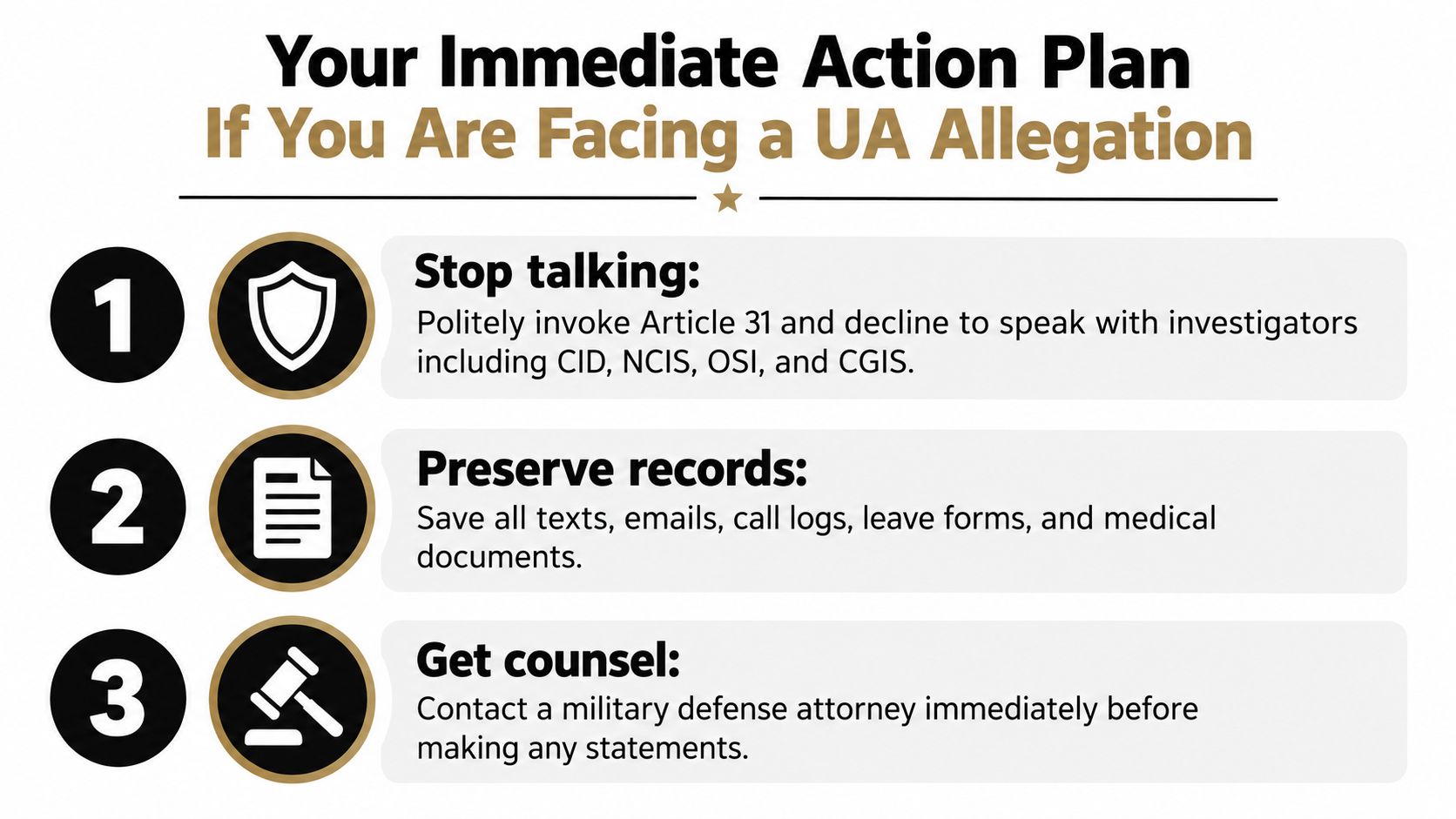
Don't try to talk your way out of a serious allegation before you know what the government thinks happened. If investigators are contacting you, stop discussing the substance of the case and get counsel.
Prioritize the evidence
- Invoke your rights: If CID, NCIS, OSI, or CGIS wants to question you, politely state that you're invoking your rights and want a lawyer before answering questions. Article 31 concerns the rights of service members questioned about suspected offenses. Read this explanation of Article 31 rights before making a statement.
- Preserve original records: Save texts, emails, call logs, leave requests, duty schedules, medical documents, emergency-call records, towing receipts, and names of witnesses. Don't delete, crop, rewrite, or selectively forward material.
- Write a private timeline for counsel: Note when you were told to report, when you tried to contact the unit, what prevented you from reporting, and who can verify each fact. Keep guesses separate from what you know.
Get legal advice before choosing your next move
Contact military defense counsel and ask for a JAG referral. A civilian defense lawyer can assess the case in parallel, including the evidence supporting the timeline and any administrative options. Don't assume that returning, explaining yourself to a supervisor, or sending a long text to the commander will solve the problem. Get advice on how to communicate and what records to provide.
An Article 15 isn't the same as a court-martial, but it can still carry meaningful career consequences. Command may prefer an administrative resolution, yet that doesn't mean the process is informal or risk-free. Ask counsel to identify the possible paths and consequences before you respond or accept a disposition.
Do not fill gaps with guesses. If you don't know exactly when a message was received or who approved leave, say so to your lawyer and locate the record.
The immediate objective is simple: protect your rights, preserve the evidence, and avoid turning an unclear absence into a damaging statement about intent.
Why Civilian Military Defense Counsel Changes the Outcome
Appointed military defense counsel can provide important representation. But a service member should understand the structure: detailed counsel work within the military justice system, while command authorities make decisions that can affect whether and how a case proceeds. A civilian lawyer can offer an independent defense perspective and, in a serious case, focus dedicated time on trial preparation.
That difference matters in a UA case because the fight may be about a narrow factual point. Was the duty appointment clear? Did a competent authority grant permission? Can the government prove a definite start time? Did the absence end with surrender, or is the government relying on an incomplete record? A court-martial attorney needs to test each point against actual records and witnesses.
What an experienced defense team can examine
Civilian military defense lawyers may help challenge an inaccurate timeline, investigate whether the service member tried to contact the unit, and identify records the government overlooked. Depending on the case posture, counsel may also pursue administrative reclassification, seek deferments, negotiate over disposition, or prepare to litigate at court-martial.
An Article 32 hearing isn't automatic in every UA matter; whether it applies depends on the charges and procedural posture. Where a preliminary hearing is available, counsel can assess the evidence and identify deficiencies for further litigation. A lawyer should explain what is available in the specific case, not promise a hearing or an outcome.
Choosing counsel takes more than comparing advertising claims. Ask about court-martial practice, experience with the relevant service and procedural issues, who will handle the work, and how counsel will communicate with the family. This guide to choosing a military defense lawyer offers practical questions to use in those conversations.
No lawyer can guarantee a result. But waiting can narrow the time available to preserve records, reach witnesses, and address the command's account before it hardens into the working narrative.
Do Not Wait. The Clock Is Already Running
A UA allegation can affect a Soldier's pay and personnel record before anyone decides whether to bring criminal charges. The command's initial timeline may become the working account unless someone challenges gaps in attendance records, contact attempts, or the reason the Soldier could not return. Preserve messages, call logs, travel records, medical documents, and witness names while they are still available.
The Fort Irwin 24-hour notification rule and the AR 630-10 15-day window have different consequences. The first can set an investigation in motion; the second may affect how the absence is classified. At 30 consecutive days, the administrative process can move toward desertion reporting and separation paperwork. Those steps can affect a Soldier's status and career even while the facts remain disputed.

Do not wait for a court-martial charge to check whether the attendance record is accurate or whether the absence was involuntary. Phones get replaced, witnesses become harder to reach, and memories fade. Delay gives the command's version room to harden while useful evidence disappears.
If you are under investigation, or a family member is trying to help, contact qualified counsel now. Use the Military Justice Guide to prepare your questions, then compare civilian military defense attorneys, check each lawyer's license with the state bar, and request consultations. Ask who will handle the case, how counsel will preserve evidence, and how they will test the command's timeline.
The cost of acting early is a legal consultation. Waiting can cost the chance to correct records, protect pay and career interests, or challenge a criminal allegation. Your career, your clearance, and your freedom are still at stake. Start the fight now.