
You’re sitting across from a VA representative, a civilian employer, or a lender, and you’re learning that one line on your DD-214 now controls decisions you expected to make freely. That’s the moment you start looking for a military discharge attorney. Don’t wait for that moment if you can still influence the record. The work is administrative, deadline driven, and unforgiving of missing documents.
Table of Contents
- Why Your Discharge Characterization Is a Lifetime Issue
- The Four Forums Where a Discharge Attorney Works
- How Counsel Builds a Discharge Case From the Ground Up
- Questions to Ask a Prospective Discharge Attorney
- Fee Structures and What You Are Actually Paying For
- Why Specialized Civilian Counsel Beats the Alternatives
- Discharge Myths That Cost Veterans Years
Why Your Discharge Characterization Is a Lifetime Issue
A sergeant leaves service thinking the misconduct chapter is behind him. Two years later he applies for a federal job, then for VA health care, then for a home loan. Each file reviewer asks for the same document, reads the same characterization of service, and reaches a similar conclusion without ever meeting him.
That pattern repeats because separation paperwork travels farther than the service member does. An other than honorable discharge can complicate benefits eligibility, while the narrative reason for separation and separation code can shape how employers interpret the service. A general discharge under honorable conditions looks different from an honorable discharge, even when the underlying service included strong evaluations and deployments.
The scale matters. GAO reporting on discharge characterizations assigned from January 2002 through March 2024 puts the number at more than 4.2 million service members. You’re not dealing with a local personnel clerk’s private opinion. You’re dealing with a national system built around records, deadlines, and written proof.
The infographic below maps where that one characterization tends to surface after service.

What the Paper Actually Controls
- VA access: Eligibility isn’t determined by your explanation alone. The characterization, the facts behind it, and any separate VA determination all matter, which is why many veterans review benefits after an other than honorable discharge before assuming nothing is available.
- Civilian work: Employers, licensing bodies, and clearance investigators may request discharge documents and ask you to explain inconsistencies.
- Education and housing: Benefit programs apply their own eligibility rules, so an adverse characterization can delay or block plans that depend on them.
Your discharge doesn’t describe your whole service. It does become the first document strangers use to judge it.
The strongest intervention often happens before the discharge is finalized, when counsel can still challenge the basis, submit matters, and preserve witnesses. After separation, counsel must reconstruct that record from personnel files, medical records, and post-service evidence. Both tasks require strategy, but reconstruction is slower and gaps are harder to close.
The Four Forums Where a Discharge Attorney Works
Most veterans ask for an upgrade. A competent military discharge attorney first asks which forum can grant the specific relief you need. Filing in the wrong place wastes time and can create an adverse record that follows the next application.
The comparison below shows why these forums shouldn’t be treated as interchangeable filing portals.

Discharge Review Board
A Discharge Review Board, or DRB, generally examines characterization and separation reason under propriety or equity standards. It typically offers documentary review and may offer a personal appearance hearing. GAO guidance on DRB filing limits and exclusions notes a general 15-year limit after separation, and DRBs generally cannot review a dishonorable discharge or dismissal imposed by a general court-martial.
Board for Correction of Military Records
A Board for Correction of Military Records, called a BCMR or BCNR depending on the service, addresses error or injustice in the record. Its reach is broader than characterization alone. Correction boards generally use a 3-year discovery period, although that period may be waived in the interest of justice. This is often the forum when the requested relief exceeds DRB authority or the DRB deadline has passed.
VA Character of Discharge Determination
VA makes its own decision. A VA character-of-discharge determination can establish eligibility for some benefits without changing the military characterization or correcting the service record. VA information on character-of-discharge review explains that people with an OTH discharge may still qualify for certain service-connected care, sexual assault or harassment related care, combat theater mental health services, and emergency mental health treatment. A rule effective June 25, 2024, expanded access for some former service members, so parallel VA review may be tactically important while a board case is pending.
Pre-Separation Defense
Before separation, the fight is retention or a better characterization, not correction. Eligible members generally can consult counsel, submit statements and documents, and in qualifying cases receive a board. If your command has started that process, review how administrative separation boards work immediately. The forum choice is simple to state and hard to execute. Match the remedy, deadline, evidence, and legal standard first.
How Counsel Builds a Discharge Case From the Ground Up
Board work isn’t won by attaching praise letters to a form and hoping reviewers connect the dots. Counsel builds an auditable record, identifies the governing standard, and tells the board exactly what correction is authorized and why.
The workflow below reflects the sequence a serious military discharge attorney should use before filing.
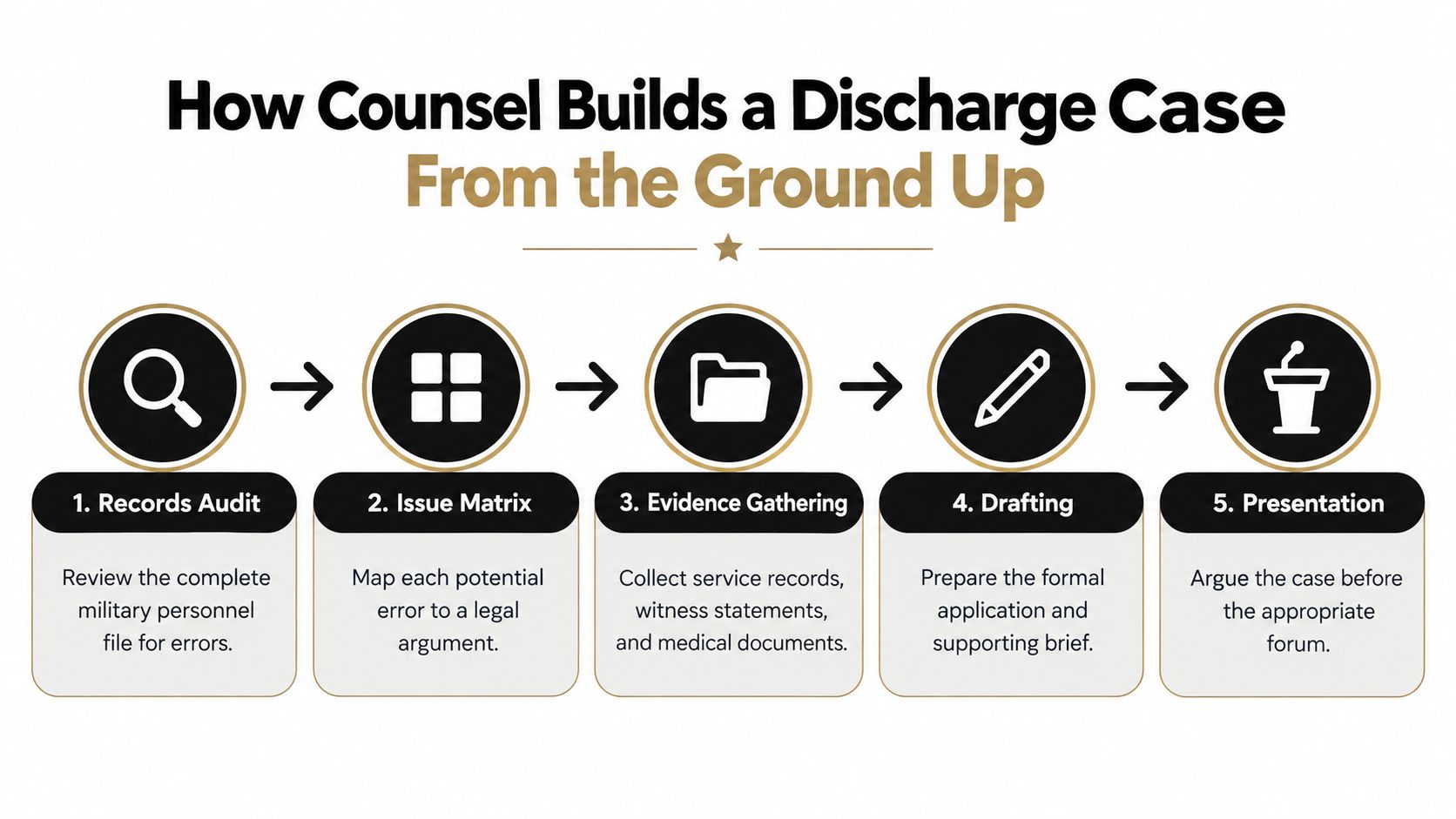
Step 1 Audit Jurisdiction and the Complete File
Counsel obtains the DD-214, any DD-215, personnel file, separation packet, service treatment records, behavioral health records, evaluations, awards, disciplinary history, and prior board applications. Dates are checked against the forum’s filing window. Missing pages, inconsistent separation codes, and unsigned counseling forms become issues to prove, not details to overlook.
Boards decide paper cases on the paper supplied. GAO found boards applied liberal consideration policies in more than 21,000 cases from January 2018 through March 2024, while approximately 43% of documents that should have been publicly posted were missing or unavailable in the reading room, a gap described in the GAO report cited earlier. Independently verifiable exhibits therefore carry more weight than unsupported assertions.
Step 2 Build an Issue Matrix
- Allegation: State the claimed error, inequity, or injustice in one sentence.
- Record proof: Cite the exhibit, date, and page supporting it.
- Explanation: Link the documented condition, procedural defect, or command action to the separation outcome.
- Requested remedy: Specify the characterization, narrative reason, separation code, or other correction sought.
Step 3 Separate Law From Mitigation
Post-service employment, treatment, education, and community work can support equity, but they don’t prove the original separation was legally improper. Strong petitions address adverse facts directly and use dated rehabilitation evidence rather than conclusory declarations. They also avoid overstating comparable board decisions, which aren’t binding precedent.
If you’re comparing this process with your own packet, the steps for upgrading a military discharge offer a useful baseline. The key difference counsel adds is selection. Every exhibit should earn its place by proving an element under propriety, equity, error, or injustice.
A thick packet isn’t a strong packet. A board needs a chronology it can verify without guessing.
Questions to Ask a Prospective Discharge Attorney
Don’t hire based on confidence alone. Ask questions that force the lawyer to describe forum selection, evidence development, and hearing preparation in your case. Vague answers at consultation usually become vague filings later.
Bring your discharge documents to the meeting pictured in concept below, and expect counsel to identify missing records before promising relief.

Questions That Reveal Real Experience
- Which forum fits my requested relief: The lawyer should distinguish a DRB from a BCMR or BCNR and explain the deadline, authority, and standard for each.
- What exactly can be changed: Ask whether you need a characterization upgrade, a narrative reason change, a separation code correction, or all three.
- Have you handled personal appearance hearings: Documentary review experience alone doesn’t show the lawyer can prepare testimony, witnesses, and cross-cutting record questions.
- Which records are missing: A credible answer names personnel, medical, command, and post-service records rather than asking only for character letters.
- How will you handle adverse facts: Counsel should confront the misconduct or performance record and explain mitigation with dated evidence.
Answers That Should Concern You
Be cautious if the attorney quotes an unsupported personal win rate. Board outcomes vary substantially, and aggregate statistics aren’t a probability for your case. Air Force quarterly review board statistics recorded 41.0% relief for the Air Force Discharge Review Board and 28.6% for the Air Force Board for Correction of Military Records in one dataset, with relief categories extending beyond upgrades. Those figures help set expectations. They don’t prove what any individual lawyer will achieve.
Fee Structures and What You Are Actually Paying For
Price only makes sense when you know whether you’re buying record development or document submission. A cheap petition that skips the personnel file, medical chronology, and forum analysis can cost you the strongest available filing opportunity.
Discharge Attorney Engagement Models Compared
| Fee Model | Typical Use Case | What Is Included | Watch-Out |
|---|---|---|---|
| Flat fee | Defined DRB application | Records review, brief, exhibits, filing | Hearing preparation or travel may be excluded |
| Phased fee | Uncertain forum or incomplete records | Paid audit first, filing decision second | Confirm what triggers the next phase |
| Hourly | Complex BCMR or BCNR petition | Research, drafting, evidence development as needed | Require estimates and regular billing detail |
| Hearing fee | Personal appearance before a board | Witness preparation, testimony, argument, travel time | Expert and travel costs may be separate |
Ask who performs the work. Paralegal record organization can be efficient, but the legal theory, remedy request, and hearing presentation should be attorney driven. Ask also about investigators, medical experts, record retrieval, travel, and whether a VA character-of-discharge application is included.
The same discipline applies when you rebuild your civilian career after separation. StoryCV’s take on resume writers is a useful parallel on evaluating a professional service by process and fit rather than price alone. In discharge work, you’re paying for judgment about jurisdiction, deadlines, proof, and adverse facts.
No ethical military discharge attorney can guarantee an upgrade. What you should expect is a defined scope, a realistic assessment, and a filing that doesn’t waste your best evidence.
Why Specialized Civilian Counsel Beats the Alternatives
Detailed military counsel serves an important role, especially in court-martial defense. But post-service discharge review is different. Once you’re separated, military counsel is generally no longer available to build your DRB or correction board case.
At a general or special court-martial, 10 U.S.C. § 827 on defense counsel rights entitles the accused to a qualified judge advocate as detailed counsel. The accused may also retain civilian counsel at personal expense or request a reasonably available military lawyer of the accused’s own selection. That distinction matters when an active case could produce the discharge you’re later forced to challenge.
What Specialization Changes
- Independence: Civilian counsel works outside your command structure and answers to you.
- Continuity: A civilian military discharge attorney can remain involved from separation defense through later board review.
- Focused record work: Specialists know how separation packets, evaluation reports, medical entries, and board standards interact.
- Resource coordination: Counsel can organize witnesses, experts, and detailed counsel communication before interviews, motions, or plea discussions narrow the options.
DIY filing is possible, and legal aid or veterans organizations may help straightforward cases. The trade-off is capacity. A form-driven filing often fails to distinguish an upgrade from a narrative reason correction, overlooks a waivable deadline, or submits character evidence without tying it to the governing standard.
Experience depth also matters, but don’t treat years alone as proof. Look for sustained military justice practice, actual board hearings, teaching or writing in the field, and a willingness to discuss unfavorable evidence. Representation quality is controllable. The underlying record is not, which is precisely why counsel must be selective and candid from the first consultation.
Discharge Myths That Cost Veterans Years
Bad assumptions delay good cases. They also push veterans into the wrong forum, where a denial gets mistaken for proof that no relief exists anywhere.
Myth One Any Discharge Can Be Fixed With a Form Letter
No. Boards apply legal standards to a documented record. Historical evidence shows access itself has long been uneven. GAO historical analysis of discharge review applications reported approximately 550,000 service members separated with less than fully honorable discharges in 1975 and only about 62,000 applications processed. That was roughly 11 applications for every 100 such separations. The same analysis reported that upgrades represented about 86% of cases in which the Army Board granted relief. That was not a success rate for all applicants, and it shouldn’t be sold as one today.
Myth Two an OTH Discharge Ends Every VA Option
An OTH characterization is serious, but VA eligibility is a separate analysis. Some care may remain available, and a VA character-of-discharge determination can open benefits without changing the DD-214. Conversely, a board upgrade doesn’t automatically decide every VA issue or erase every adverse entry from history. Ask which problem you’re solving. Benefits access, record correction, employment presentation, and characterization relief may require coordinated filings.
Myth Three Missing the Preferred Deadline Ends the Case
Deadlines are real, but they’re forum specific. If the DRB route is unavailable, correction board review may still be possible, and the correction board period can be waived. Don’t guess from an online summary. Have counsel calculate from the separation date, discovery of the alleged error, and any prior filings.
Myth Four Silence Before Separation Is Harmless
This mistake starts on active duty. Army administrative separation guidance identifies board eligibility when an OTH characterization is contemplated or the member has more than six years of service, and it notes that an upgrade is neither automatic nor guaranteed. If you waive responses, skip medical documentation, or let favorable witnesses scatter, later counsel inherits those gaps.
Regulations also contain traps. DoD Instruction 1332.14 on enlisted administrative separations states that in certain specified cases, notification procedures may be used and an administrative board isn’t required despite years of service. Longevity alone doesn’t guarantee a hearing.
Officers face a different structure. DoD Instruction 1332.30 on officer separations and Boards of Inquiry requires written notice at least 30 days before the hearing when a case is referred to a Board of Inquiry. Treat those 30 days as preparation time for records, witnesses, evaluations, medical evidence, and a retention theory.
What to Do This Week
- Pull your documents: Get the DD-214, any DD-215, personnel file, separation packet, and service treatment records.
- Calendar both clocks: Identify the DRB and correction board periods before choosing a forum.
- Preserve witnesses: Save names, contact information, evaluations, awards, and contemporaneous messages while they’re still available.
- Interview counsel: Consult two or three military discharge attorneys and compare their forum analysis, record plan, fees, and candor.
Practical rule: Don’t file the fastest petition. File the petition the correct board has authority to grant.
If you’re facing administrative separation, living with an adverse characterization, or unsure whether VA review or record correction fits your goal, contact a qualified military discharge attorney now. Bring your DD-214 and separation paperwork to the first consultation. Deadlines keep running, witnesses move, and records become harder to reconstruct, so get a forum specific assessment before you file anything.