You’re handed DD Form 2873, told to leave your home, and warned not to contact your spouse, partner, or child. Then someone mentions investigators, Article 15, court-martial, or separation. Your career, security clearance, housing, family access, and reputation can all feel exposed at once.
A military protective order is serious, but panic creates bad evidence. Comply with every written restriction, stop discussing the allegations, preserve the paperwork, and get independent defense counsel before making statements. If the conflict is still active, use practical de-escalation resources such as guidance to stop the argument before it escalates. Then speak with court-martial defense lawyers who can protect your position before command and investigators define the story for you.
Table of Contents
- You Just Got Hit With an MPO and Your Career Is Now at Risk
- What Military Protective Orders Actually Do to You
- How Military Protective Orders Differ From Civilian Orders
- How an MPO Is Issued Enforced and Ended
- What a Violation Can Cost You Under UCMJ and Beyond
- Common Mistakes That Turn an MPO Into a Conviction
- Why Experienced Civilian Defense Counsel Is Essential Now
You Just Got Hit With an MPO and Your Career Is Now at Risk
The shock usually arrives in a hallway, office, or command meeting. A commander or representative gives you DD Form 2873. You’re told not to return home, not to call, not to send messages through relatives, and not to approach a protected person. You may have minutes to collect essentials, but the legal consequences can last far longer than the argument that triggered the order.
An MPO often signals an active investigation involving alleged domestic or sexual violence. It doesn’t prove the allegation, and it isn’t a conviction. It does tell you that command has chosen immediate restrictions while facts are being collected. The order can shape witness access, housing, family contact, weapons access, duty arrangements, and the government’s view of your conduct from that point forward.
Your first objective is not to explain yourself. It’s to avoid creating a new violation while counsel builds a defense.
Read every line. Identify each protected person, prohibited location, communication method, exception, and instruction about weapons or property. Don’t assume that a friendly text, a request to retrieve belongings, or a message sent through a child is harmless. The order controls your conduct unless the issuing commander formally changes or rescinds it.
Your next move should be disciplined:
- Stop contact: Don’t call, text, email, message, visit, react to social media, or use another person to communicate.
- Preserve evidence: Keep the order, relevant messages, photographs, calendars, location records, and names of witnesses. Don’t edit or delete anything.
- Use your rights: If investigators want an interview, politely state that you want counsel before answering questions.
- Get advice before command meetings: A command representative may sound informal while documenting statements for later use.
- Protect your logistics: Arrange housing, medication, clothing, transportation, and child-related matters through approved channels and counsel.
An MPO can precede nonjudicial punishment, administrative separation, or court-martial proceedings. A violation can become a separate allegation even when the original dispute remains contested. Your explanation may be true, but an unplanned explanation can still damage your case.
What Military Protective Orders Actually Do to You
A military protective order is a written command directive, commonly issued on DD Form 2873. It isn’t a suggestion, private agreement, or ordinary relationship boundary. Under Department of Defense Instruction 6400.06, commanders may issue an MPO to protect an alleged victim of domestic or sexual violence, and the order may cover members of that person’s family or household. The form warns that violating the order may constitute an offense under Article 90 of the UCMJ. The Government Accountability Office’s military protective order review also explains the broader requirement that service members subject to the UCMJ comply with military and civilian protective orders.

Read DD Form 2873 as an operational document
Start with the names. Determine exactly who is protected. The order may cover an alleged victim, children, other household members, or additional people specifically identified by command.
Next, mark every form of prohibited communication:
- Direct contact: Calls, texts, emails, letters, visits, and face-to-face conversations.
- Indirect contact: Messages through friends, relatives, coworkers, children, or unit members.
- Digital contact: Social media messages, comments, tags, reactions, and posts aimed at the protected person.
- Physical proximity: Entering a home, workplace, school, unit area, or another listed location.
- Property and weapons restrictions: The order may address firearms, pets, personal property, or access to shared spaces.
Military OneSource describes MPO provisions that can restrict returning home, entering a workplace, possessing weapons, and contacting a protected person. The same materials identify DD Form 2873 as the standard form and recognize that provisions may address pets or other protected property. The practical task is to map the written restrictions onto your daily routine before you accidentally cross a line.
A protected person’s invitation doesn’t cancel the order
If the protected person calls first, asks you to come home, or says the order is over, don’t treat that as permission. The order remains in force unless the issuing command formally modifies or rescinds it. Save the communication without responding, and send it to counsel.
The Army’s DD Form 2873 guidance emphasizes that an MPO is a lawful command order. If you disagree with the allegations or believe the restrictions are excessive, compliance remains mandatory while counsel seeks a lawful change.
How Military Protective Orders Differ From Civilian Orders
The biggest mistake families make is treating an MPO as a universal restraining order. It isn’t. An MPO and a civilian protection order can address the same danger, but they come from different authorities and solve different jurisdictional problems.
| Feature | Military Protective Order | Civilian Protection Order |
|---|---|---|
| Issuing authority | Military commander under command authority | Civilian court under state or territorial law |
| Main purpose | Immediate command and installation restrictions | Judicial protection in civilian jurisdictions |
| Duration | Continues until the issuing commander modifies, rescinds, or replaces it | Commonly has a court-defined duration |
| Geographic reach | Strongest within the installation and command structure | Designed for civilian locations and broader legal recognition |
| Enforcement | Military law enforcement and command channels | Civilian law enforcement and courts |
| Best use | No-contact, housing, access, weapons, and installation controls | Residence, workplace, travel, and off-base protection |
Under 10 U.S.C. § 1567, an MPO doesn’t automatically end after a fixed number of days. It remains effective until the issuing commander terminates or replaces it. That matters after deployment, reassignment, separation, or a change in the underlying investigation. Verify the current status with the issuing command. Don’t rely on a rumor, a verbal comment, or the passage of time.
The statute also creates continuity requirements when the subject transfers units. The losing commander must notify the gaining commander no later than the transfer date, and the gaining commander must notify appropriate civilian authorities within seven days. Changes and termination also require notice to civilian authorities. Those rules help prevent an MPO from disappearing during a personnel move, but they don’t eliminate the need to confirm the order’s status and scope.
The two-order strategy
An MPO can regulate conduct through military command mechanisms, especially on an installation. It may control access to housing, workplaces, weapons, and military facilities. But off-base protection often requires a civilian protection order because an MPO isn’t a civilian judicial order and may not receive interstate recognition through the same process.
The statutory framework for military and civilian protective-order coordination requires installations to honor qualifying civilian protection orders and addresses notifications involving issuance, transfers, changes, and termination. For a protected person, the practical recommendation is direct: request an MPO for command and installation protection, and separately seek a civilian order when safety concerns extend into civilian communities or across state lines.
For a service member, the same distinction creates a compliance map. Know whether each restriction concerns federal property, an installation, a civilian residence, a workplace, or another state. Your lawyer should assess both orders together rather than treating the MPO as the entire safety plan.
How an MPO Is Issued Enforced and Ended
Step 1, a report creates immediate risk management
A reported threat, domestic incident, sexual-violence allegation, or related concern can prompt command action before a criminal case reaches trial. DOD Incident Determination Committees review reported incidents administratively, and commanders may use committee decisions as one partial basis for issuing or removing a military protective or no-contact order. That administrative process doesn’t decide guilt.
DOD recorded more than 40,000 domestic-abuse incidents meeting its criteria from fiscal years 2015 through 2019, with 74% classified as physical abuse, according to the GAO report on domestic abuse and military protective orders. In fiscal year 2023, DOD recorded 26,978 reports of domestic and child abuse, of which 14,110 incidents, about 52.3%, met the department’s definition of abuse. Those figures aren’t counts of MPOs issued. They show the scale of the incidents in which commanders may consider protective or no-contact measures.
Step 2, command identifies restrictions
The issuing commander determines the people, places, communications, and conduct covered by the order. Counsel should examine whether the language is specific enough to follow and whether restrictions interfere with necessary work, medical care, child logistics, or legal preparation.
Don’t negotiate the order yourself in the first meeting. Ask counsel to identify lawful avenues for modification, clarification, or retrieval of personal property.
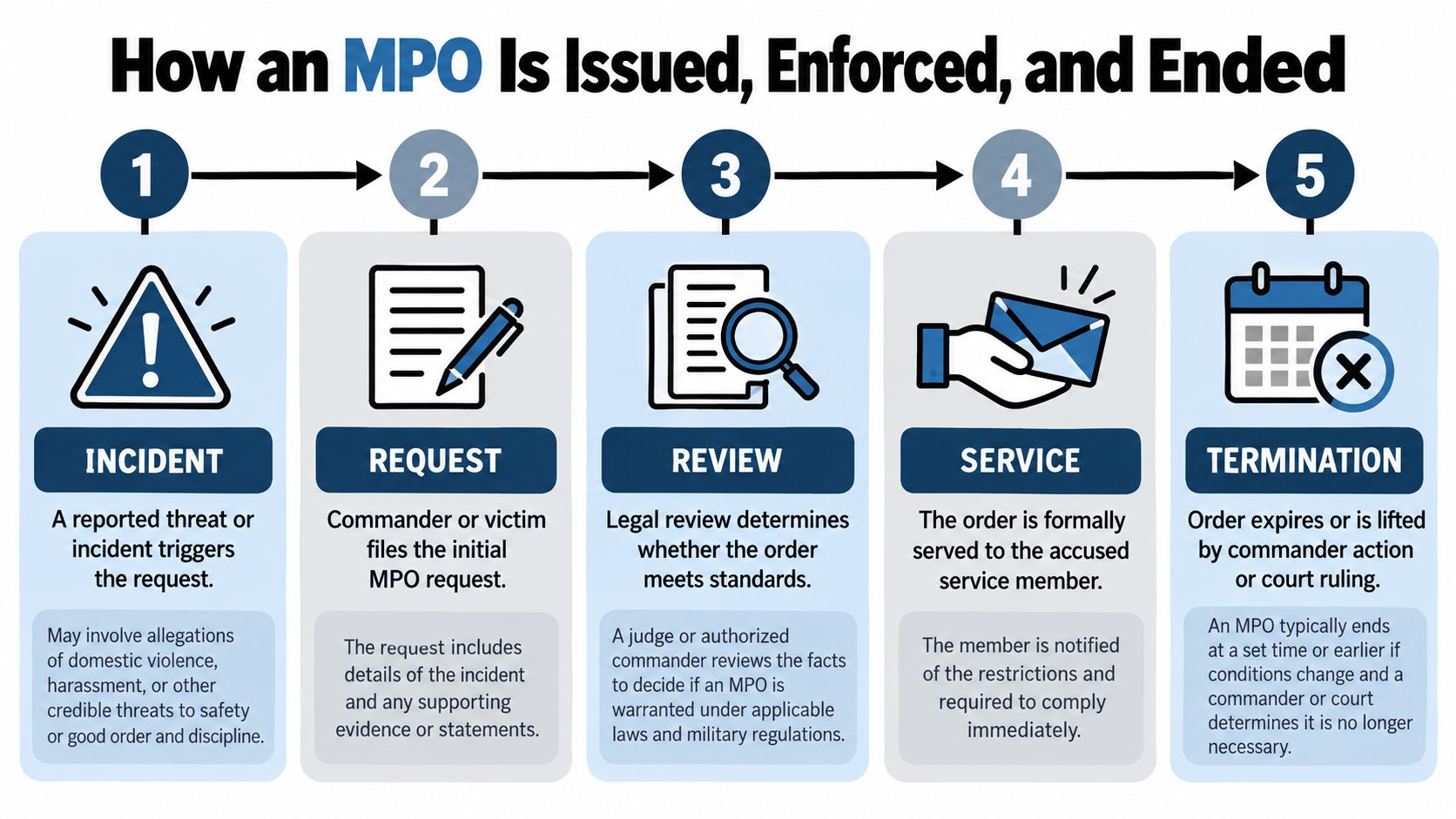
Step 3, the order is served and compliance begins
Once you receive the order, assume every term is enforceable. Photograph or scan each page for your records, then create a personal compliance checklist. Don’t rely on memory, especially if the order affects housing, duty location, transportation, children, or firearms.
If law enforcement reports a violation, your lawyer needs the exact order, proof of service, messages, location evidence, witness names, and a timeline. Preserve evidence without contacting the protected person to “clear things up.”
Step 4, transfers create a new documentation risk
When the subject transfers units, the losing and gaining commands must communicate as required by law. A move doesn’t automatically terminate the MPO. Deployment, PCS, reassignment, or separation can change who administers the order, but you still need confirmation from the responsible command.
Never assume that a new unit, new duty station, or silence from command means the order ended.
Step 5, modification or termination requires confirmation
An MPO remains effective until the issuing commander modifies, rescinds, or replaces it. Get the change in writing and preserve proof that the relevant military and civilian authorities were notified. If the command says the order is lifted but hasn’t provided documentation, ask counsel to confirm the status before resuming any conduct.
A court-martial protective-order proposal under Section 542 of the William M. (Mac) Thornberry National Defense Authorization Act for Fiscal Year 2021 highlighted the difference between commander-issued MPOs and court-issued protective orders. Don’t confuse command action with a judicial ruling. They’re separate authorities with different procedures and effects.
What a Violation Can Cost You Under UCMJ and Beyond
One text can create a second case. One visit to a prohibited residence can become a new law-enforcement report. One message through a friend can give investigators an alleged violation that they can use to argue you ignored command authority.
DD Form 2873 warns that violating an MPO may constitute an offense under Article 90 of the UCMJ. A violation may also be prosecuted under Article 92 for failure to obey an order or regulation, and the consequences can include nonjudicial punishment, court-martial proceedings, or other disciplinary action. Review the separate implications of UCMJ Article 92 and failure to obey an order or regulation with counsel before responding to any alleged breach.
A violation can also affect the underlying investigation. Prosecutors may argue that the conduct shows disregard for command instructions, undermines credibility, or supports a narrative of intimidation or continued risk. Command may consider the incident in an Article 15 decision, a GOMOR, an administrative separation action, a clearance review, or a housing and weapons determination.
The enforcement problem is practical, not theoretical
An order’s legal force doesn’t guarantee that every responding agency can verify it immediately. Recent scholarship reports that MPOs aren’t systematically entered into the FBI’s National Crime Information Center, while military law enforcement may have limited access to NCIC records containing civilian protection orders. A survivor reporting conduct away from an installation may face delays while agencies identify the issuing command and confirm the order.
State policy developments have begun addressing registration and notification procedures. West Virginia’s House Bill 4366, for example, addresses recognition of military protective orders in state courts and allows law enforcement to notify the agency that entered an MPO into NCIC when probable cause supports a suspected violation, as described in the West Virginia Legislature’s completed-legislation summary.
For everyone involved, the operational questions matter:
- Where is the order recorded?
- Which agency receives the first report?
- Who can verify the issuing command?
- What evidence preserves the sequence of events?
- Is a civilian order needed for off-base enforcement?
The answer isn’t to test the system. Comply, preserve evidence, and let counsel address scope, notice, mistaken identity, accidental proximity, or disputed communications through the proper channel.
Common Mistakes That Turn an MPO Into a Conviction
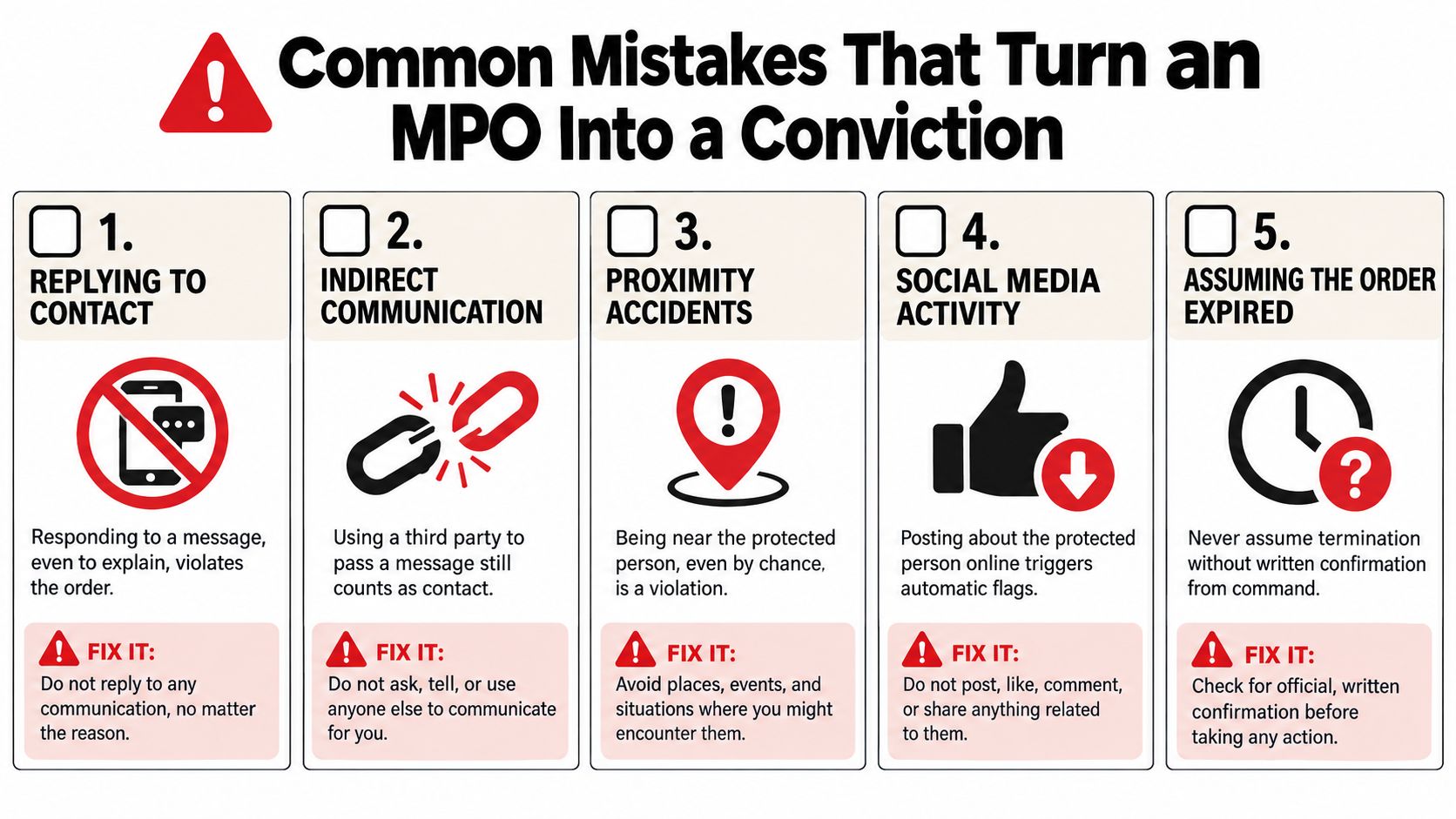
Most MPO damage comes from avoidable conduct after service. The order itself may be defensible, overbroad, or based on incomplete information. A careless response gives the government a cleaner case.
Mistake one, talking to investigators to explain
CID, NCIS, OSI, and CGIS investigators aren’t there to help you organize your side of the story. Even a voluntary interview can produce inconsistencies, admissions, or statements that sound different when separated from the context you intended.
State that you want to speak with counsel before answering questions. Learn more about protecting yourself under Article 31 of the UCMJ before any interview.
Mistake two, trusting command to handle it fairly
Command may care about safety and discipline, but command isn’t your defense team. A meeting that feels like a welfare check can become evidence. Don’t accuse, threaten, plead, or speculate. Keep communications professional and limited to necessary duty matters.
Mistake three, replying because the protected person contacted you
A reply doesn’t become lawful because the other person initiated the conversation. Don’t answer, don’t ask a friend to answer, and don’t use children as messengers. Preserve the contact and give it to counsel.
Mistake four, assuming no evidence means no case
Evidence can include messages, call logs, location data, access records, social media, witness accounts, medical records, and your own statements. Investigators may obtain information you don’t know exists. Don’t delete anything, and don’t attempt to manufacture a competing record after the fact.
Mistake five, waiting until charges arrive
By the time charges are preferred, witnesses may have settled on their accounts and digital evidence may be harder to recover. Early counsel can preserve favorable material, identify credibility problems, request clarification, challenge unnecessary restrictions, and prepare for possible NJP, Article 32 proceedings, court-martial, or separation.
The safest message is the one you don’t send. The strongest explanation is the one counsel helps you deliver at the right time.
Why Experienced Civilian Defense Counsel Is Essential Now
Military defense counsel can provide important representation, and you should use your appointed rights. Serious MPO cases also demand an independent assessment from a civilian military defense lawyer who isn’t embedded in the command structure and whose practice centers on high-stakes UCMJ litigation.
A seasoned civilian attorney can examine the MPO’s wording, service, scope, and practical effect. Counsel can seek a modification through the proper command channel, protect your statements, investigate witnesses before memories harden, preserve favorable records, and prepare for the possibility that an MPO allegation becomes Article 92, Article 90, NJP, an Article 32 hearing, court-martial litigation, or administrative separation.
Ask any lawyer you consult:
- How much court-martial trial experience do you have?
- Have you handled domestic-violence and sexual-assault investigations?
- Can you represent clients across branches and locations?
- Who will personally handle interviews, command negotiations, and hearings?
- What evidence should be preserved today?
- How will you address the on-base and off-base enforcement gap?
An MPO isn’t a conviction, but it can become a career weapon when you violate it, speak impulsively, or wait for command to tell you what happens next. Save DD Form 2873, stop all prohibited contact, preserve every relevant record, and contact an experienced civilian defense lawyer today. If you’re under investigation or facing an alleged violation, delay gives the government time to shape the case while your options narrow.