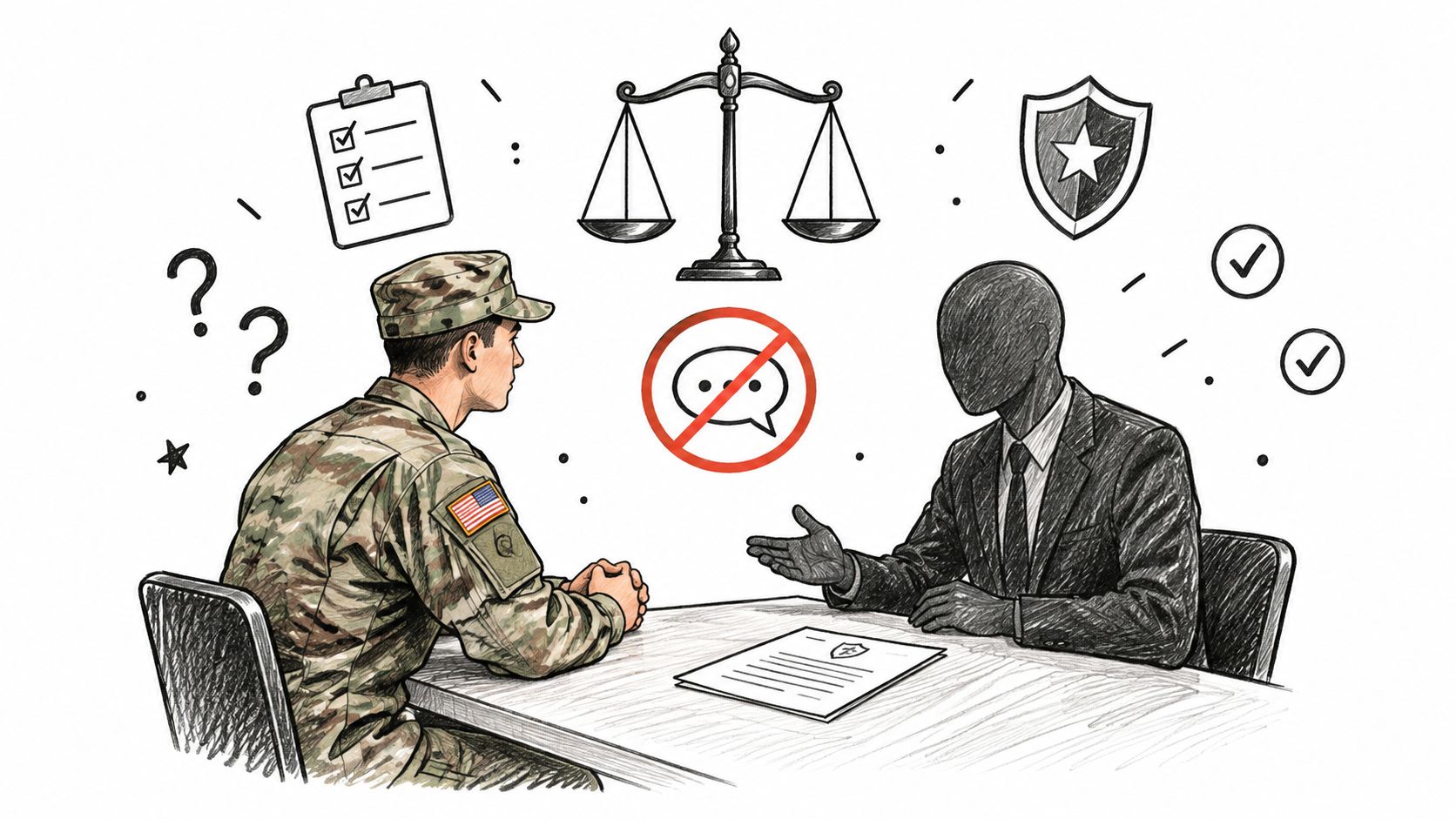
You get a call from your squad leader. “Come by the office and explain what happened.” No rights warning. No charge sheet. No investigator in the room. Just a closed door, a superior, and a request that sounds easy to satisfy.
That is how many military cases begin. A CID, NCIS, OSI, or CGIS interview may follow. So may an Article 15, administrative separation, security-clearance problem, or court-martial. Your words can affect your career, liberty, family, reputation, and future benefits long before anyone formally accuses you.
UCMJ Article 31 is the protection you need to understand before you answer. It addresses compelled self-incrimination, required warnings, improper questioning, and the exclusion of statements obtained unlawfully. This guide focuses on the traps that matter in real life, including informal command conversations, repeated questioning after a waiver, and the difference between signing a rights form and making a valid waiver.
Table of Contents
- Why This Call Matters Right Now
- What Article 31 Actually Says
- When the Warning Is Required
- How Questions Become Evidence Against You
- Why a Signed Waiver Does Not End the Story
- How Defense Lawyers Attack the Violation
- Seven Mistakes That Kill Cases Before They Start
- Why Civilian Military Defense Counsel Changes the Math
Why This Call Matters Right Now
The first mistake is treating the call as ordinary business.
Your squad leader may say the command is “just trying to understand what happened.” A first sergeant may tell you that cooperation will clear everything up. An investigator may begin with friendly questions about your schedule, your relationships, or your whereabouts. The setting feels informal, but the answers can become evidence.
A service member who walks into that office without preparation often starts explaining before anyone says the word “suspect.” The explanation becomes longer. Details get guessed. Dates shift. Other people’s conduct gets mentioned. By the time the warning arrives, the government may already have useful admissions, inconsistencies, or leads.
Practical rule: If someone in the military wants an official explanation about suspected misconduct, treat the meeting as legally significant before you know whether charges will follow.
Article 31 exists because military rank creates pressure that civilian questioning may not. You may be speaking to someone who evaluates your performance, controls your duties, influences your future, or carries authority over your daily life. You don’t need to be handcuffed for that pressure to matter.
The consequences aren’t limited to a courtroom. A statement may shape a command investigation, an adverse administrative action, a security-clearance review, or a separation decision. Even when the government can’t prove a criminal charge, a careless interview can damage credibility and narrow your options.
You should read this practical guide to defense strategy during the military investigation phase before you report. The immediate priorities are simple: find out why you’re being called, avoid substantive answers, and contact counsel before the meeting.
There are no harmless “just conversations” once the command is investigating possible misconduct. Understanding Article 31 after you talk is often too late to protect the statement you already gave.
What Article 31 Actually Says
The modern statute is 10 U.S.C. § 831, commonly called Article 31 of the UCMJ. The Uniform Code of Military Justice was enacted in 1950, Article 31 first appeared in statutory form in 1951, and the provision predates the civilian Miranda warning, which became the governing constitutional standard in 1966. Army legal scholarship describes Article 31’s language as having changed very little since enactment.
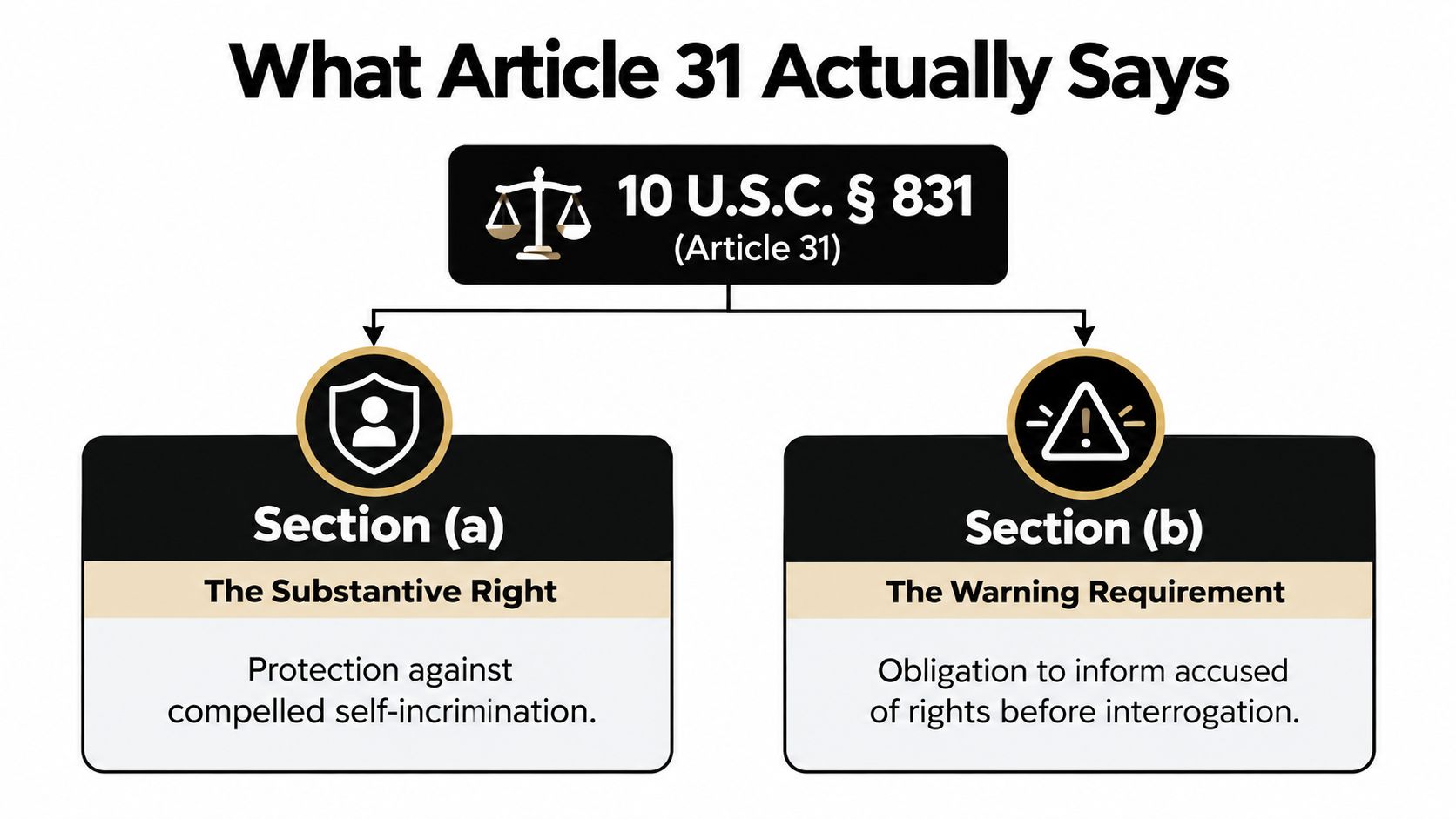
The statute contains four connected protections.
Article 31(a) protects against compelled self-incrimination
Section (a) prohibits compelling a person subject to the UCMJ to incriminate themselves or answer questions when the answers may tend to incriminate them. This is more than permission to stay quiet. It is a substantive protection against being forced to provide potentially damaging information.
Military authority matters here. A subordinate may feel required to answer a superior, even without an explicit threat. The protection exists because obedience and rank can make a question feel like an order.
Article 31(b) requires a complete warning
Before interrogating or requesting an official statement from an accused or suspected person, the questioner must disclose three things:
- The nature of the accusation: You must be told what offense or suspected misconduct is being investigated.
- The right not to make a statement: You don’t have to answer questions about the offense.
- The evidentiary consequence: Any statement you make may be used as evidence at a court-martial.
A warning isn’t complete merely because someone reads a card quickly or asks whether you understand. The content, timing, circumstances, and later conduct all matter.
Article 31(c) protects against compelled tribunal testimony
Section (c) protects against compelled, immaterial, degrading testimony before a military tribunal. This provision addresses compelled testimony in the tribunal setting rather than the ordinary investigative interview.
Article 31(d) provides the remedy
Section (d) is the enforcement mechanism. A statement obtained in violation of Article 31, or through coercion, unlawful influence, or unlawful inducement, may not be received against the service member at a court-martial. That doesn’t guarantee dismissal, acquittal, or suppression in every case. Courts examine the facts and prejudice.
The structure matters because Article 31 combines a substantive privilege, a warning requirement, and an evidentiary remedy. It isn’t merely a script investigators recite before asking questions.
When the Warning Is Required
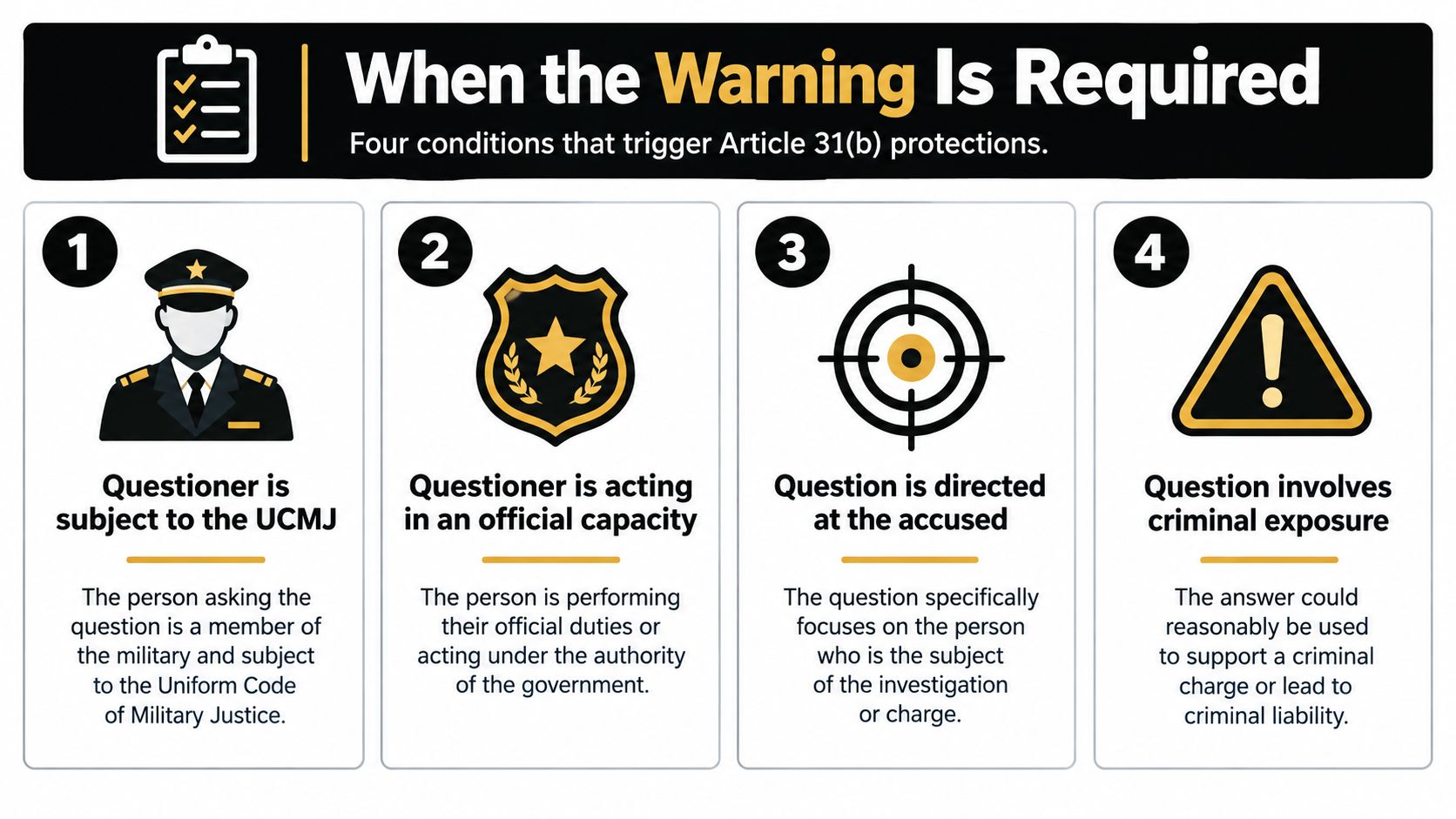
Article 31(b) doesn’t apply to every casual exchange. It applies when four conditions come together. If the facts point toward all four, stop answering and get counsel.
The four-part trigger
-
The questioner is subject to the UCMJ. This commonly includes commanders, supervisors, military police, and military investigators. The person doesn’t need to be a detective.
-
The questioner interrogates you or requests an official statement. Direct questions aren’t the only concern. A request to “write down what happened” can qualify, as can conduct objectively designed to obtain an incriminating response.
-
You are an accused person or someone suspected of an offense. Formal charges aren’t required. The legal materials recognize that mere suspicion may trigger the warning obligation.
-
The questions concern the offense being investigated. The warning must identify the nature of the relevant accusation. A warning about one suspected offense doesn’t automatically authorize questioning about an unrelated offense.
The key point is that Article 31(b) can apply before charges are preferred. A commander asking you to explain missing property, a supervisor asking about an alleged assault, or a military investigator arranging an “informal” interview may all be operating within the rule.
The Court of Appeals for the Armed Forces uses an objective approach to determine whether conduct amounts to interrogation or a request for a statement. A friendly tone doesn’t decide the issue. Neither does the absence of handcuffs.
Ask yourself:
- Is the person asking questions acting for an official military purpose?
- Does the person already suspect you of misconduct?
- Are the questions aimed at an offense?
- Are you being asked to explain, admit, deny, or write something down?
If the answer is yes, don’t try to solve the legal issue in the room. Say that you won’t make a statement until you’ve consulted counsel. A service member’s safest course is to avoid substantive answers even when the meeting is presented as routine.
How Questions Become Evidence Against You
An interview often starts with rapport. The investigator asks how you’re doing, whether you had trouble finding the office, or how long you’ve been assigned to the unit. Then the questions narrow.
“Where were you that night?”
“Who was with you?”
“Did you see the equipment?”
“Why would someone say you were there?”
Each question seems manageable. Together, they build a timeline and test your reactions. The investigator may return to the same event from a different angle, looking for an inconsistency that can later be described as deception.
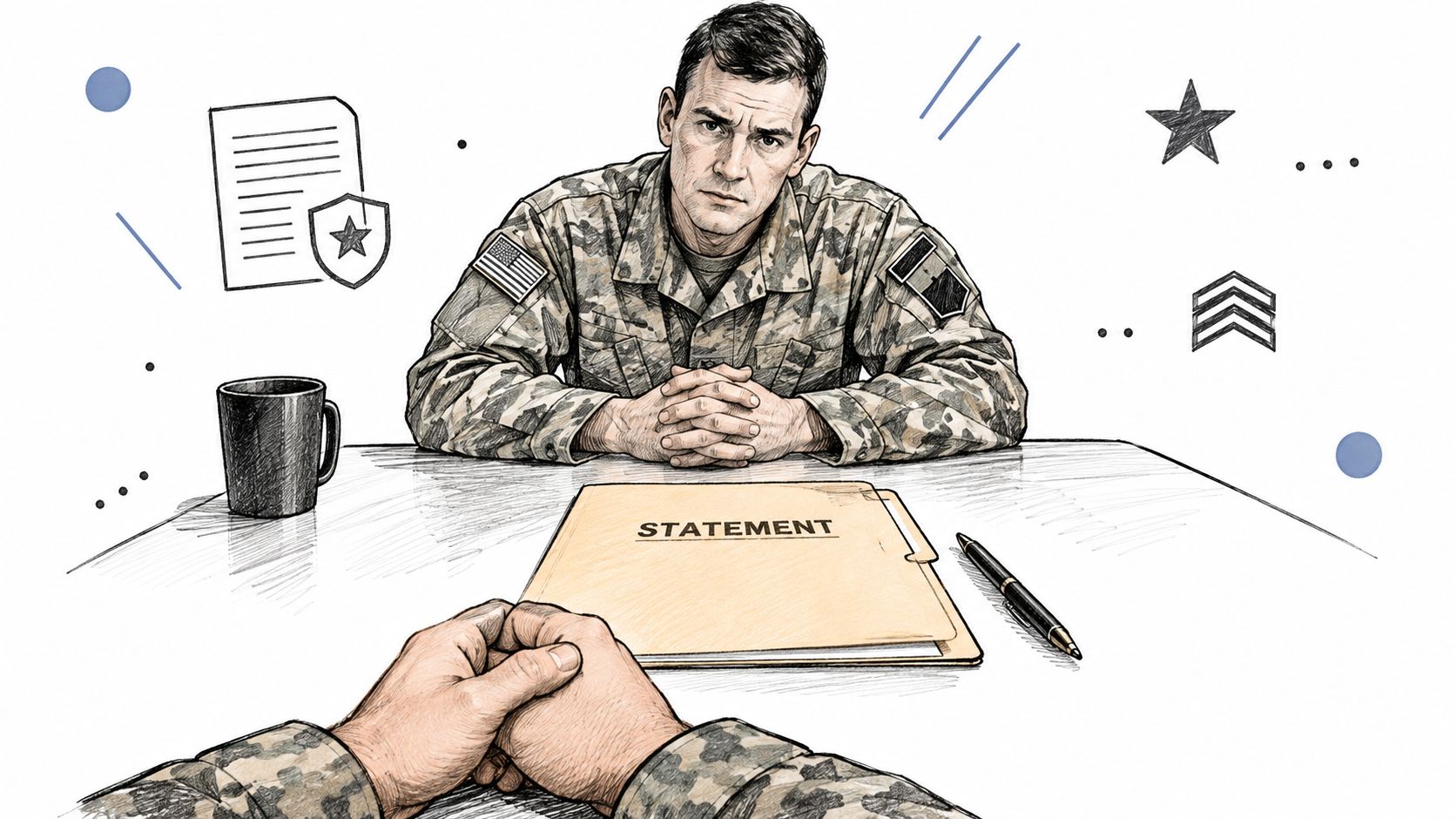
Consider a hypothetical CID interview. The agent says the meeting concerns a workplace incident and begins with harmless background questions. After you explain your movements, the agent introduces a witness account. You deny part of it. The agent asks whether you might have forgotten. Eventually, the agent asks you to “put everything in your own words” in a written statement.
The danger isn’t limited to an obvious confession. Your statement can supply:
- A date the government couldn’t otherwise establish.
- A name for a witness.
- A motive the investigator hadn’t considered.
- A contradiction with another statement.
- A basis for searching a phone, room, vehicle, or account.
- An admission that places you at the relevant location.
If a question about the suspected offense comes before a complete warning, that timeline matters. So does a partial warning followed by continued questioning. So does a new round of questioning after you invoked your rights.
The same problem can arise in an Article 15 inquiry. A command may call an interview administrative or fact-finding, but the label doesn’t control if the conduct is objectively designed to obtain a statement about suspected misconduct. You need to know whether the conversation is being documented, who requested it, who is present, and what the command already believes.
The relationship between Article 31 and false official statements also matters. A rushed explanation can create a separate credibility problem, which is why service members should understand the risks described in this guide to UCMJ Article 107 and false official statements.
An interview isn’t designed to help you tell your side in a neutral setting. Investigators collect information that supports the investigation. Your job is not to fill every silence. Your job is to protect your rights and preserve the facts for counsel.
Why a Signed Waiver Does Not End the Story
A signature doesn’t magically make every later statement admissible.
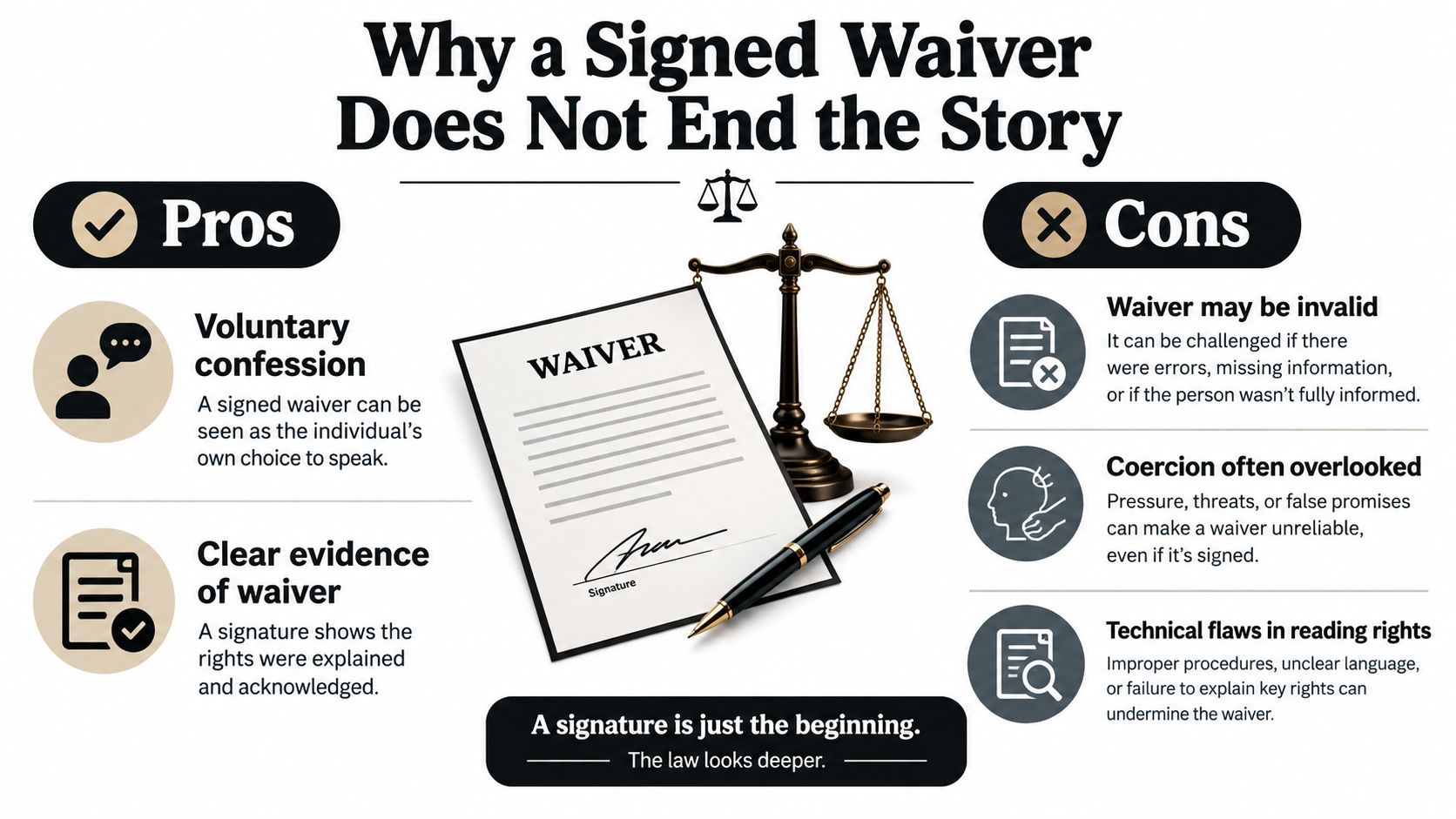
A valid waiver must be knowing, intelligent, and voluntary. That requires more than proving that an investigator read words from a card and obtained a signature. Counsel will examine your physical and mental condition, the pressure applied, what you understood, what you were told about the accusation, and what happened before and after the signature.
Acknowledgment is not the same as waiver
You may sign a form acknowledging that rights were read without making a clear, voluntary decision to surrender those rights. Capacity matters. Confusion matters. Intoxication matters. So does the way investigators describe the form.
Marine Corps legal guidance specifically cautions against questioning someone under the influence of drugs or alcohol, even when the person appears to waive Article 31 rights. Pressure, threats, promises, unlawful influence, and unlawful inducement can also undermine the government’s position.
Remember: A rights card records paperwork. It doesn’t erase coercion, confusion, impairment, or improper questioning.
A service member can remain silent, ask to consult counsel, decline to discuss an allegation, or make a limited statement. Those are different choices. Saying “I want a lawyer” is not the same as saying “I understand my rights.” Saying “I won’t discuss this” is not the same as answering one question and then signing a form.
Repeated questioning creates another problem. If you initially invoke, investigators shouldn’t treat your silence as an invitation to keep working until you give in. If you waived and then the interview changes direction, becomes more aggressive, or continues after you ask to stop, document the sequence for counsel.
If you need to sign a document electronically during an unrelated administrative process, a PDF signature guide for freelancers can explain the mechanics of digital signatures. That technical information says nothing about whether a military rights waiver was legally valid, which depends on the circumstances.
Don’t promise yourself that a signed card will be defeated later. Don’t assume it ends the analysis either. Preserve the details immediately, including what you drank or took, how long you had slept, who was present, whether the interview was recorded, and exactly when you asked to stop.
How Defense Lawyers Attack the Violation
A possible Article 31 problem only helps if counsel can prove what happened. The defense starts by reconstructing the interview, not by arguing from memory.
Step 1 begins with the timeline
Write down the sequence while you still remember it:
- Who contacted you and what they said.
- Where the meeting occurred.
- Who attended.
- What was said before any warning.
- The exact wording of the warning, if you remember it.
- Whether you signed a form.
- Whether the interview was recorded.
- What happened after you invoked or asked to stop.
- Whether the subject changed during questioning.
Don’t embellish. Don’t coordinate accounts with coworkers. Give the raw facts to your lawyer.
Step 2 moves the issue into litigation
Defense counsel can object to the statement’s use and raise the issue during the court-martial process. The defense may seek a pretrial ruling on admissibility and litigate the facts in an Article 39(a) session.
The government may argue that no warning was required, that the statement was voluntary, that the waiver was valid, or that any error caused no meaningful prejudice. The defense must answer those arguments with the exact setting, participants, wording, timing, and conduct.
Step 3 preserves the record
A favorable ruling can keep the statement from the members or judge. An unfavorable ruling may still create issues for review if counsel made the objection, developed the evidence, and preserved the legal argument.
Under 10 U.S.C. § 831), a statement obtained in violation of Article 31, or through coercion, unlawful influence, or unlawful inducement, may not be received against the person at a court-martial. The Court of Appeals for the Armed Forces has described Article 31(b) protections as broader in important respects than Fifth Amendment protections, but the result remains dependent on the facts and prejudice analysis.
The warning card is only one exhibit. A recording, investigator notes, text messages, appointment records, medical information, and witness testimony may tell the more important story. That’s why you should contact counsel before giving anyone a polished reconstruction of events.
Seven Mistakes That Kill Cases Before They Start
You get told to come in and “clear a few things up.” Before that meeting even happens, plenty of service members hand the government the pieces it needs. The damage usually starts with ordinary decisions made in the barracks, in the parking lot, or on the phone.
The first bad move is talking before you have counsel. Service members often think a straight answer will shut the problem down. In real cases, it gives investigators admissions, timelines to test, and details they did not have five minutes earlier. It can also muddy a later fight over how the questioning started and what warnings were missing.
The next mistake is trying to be helpful. You do not know what they already have, who has talked, or whether they are probing for a confession, a contradiction, or a new witness. Filling silence with guesses can build their case for them.
A lot of people also trust the command-side setup. A first sergeant, chief, or supervisor may call it an informal conversation or say nobody is accusing you of anything. Labels do not control this issue. The actual questions are why they are asking, what role that person is playing, and whether you were already the suspect.
Then come the messages. Texting teammates about the allegation is a gift to the case against you. A group chat can look like coordination, pressure on witnesses, or a shifting story. Social media is worse. A post written to protect your name can read like an admission or turn into evidence of retaliation.
One more mistake shows up all the time. Drinking with unit members before any statement gets taken. Alcohol changes judgment, creates extra witnesses, and makes later arguments about memory and voluntariness harder.
The last error is waiting for charges before hiring civilian counsel. By then, the interview may be done, the rights card signed, and the waiver issue framed in the government’s favor. If you already made one of these mistakes, stop talking, stop texting, stop posting, and give your lawyer a full, accurate timeline.
Why Civilian Military Defense Counsel Changes the Math
A detailed military defense attorney is trained and operates within the military justice system. That counsel can provide important representation. But serious cases often require an independent defense strategy developed before the next interview, not after the command has finished collecting statements.
A retained civilian military defense lawyer isn’t part of your command structure. That independence matters when the command, law enforcement, or prosecution team is pushing for cooperation. Experienced military defense lawyers and court-martial attorneys can negotiate before an interview, challenge the government’s investigative assumptions, preserve evidence, and prepare a suppression strategy while memories and records are fresh.
The difference isn’t that civilian counsel has a magic answer. The difference is focus and positioning. A lawyer who handles one matter at a time can study the timeline, identify credibility problems, examine the warning, and decide whether silence, a carefully controlled response, or litigation best serves the case.
You can use this guide to choosing a military defense lawyer to evaluate trial experience, military justice focus, communication, and independence. Firms serving this audience also need clear, ethical public information, and SimpleLab Digital’s law firm marketing guidance discusses how criminal-defense practices communicate their services online.
You don’t need to wait for preferral, an Article 32 hearing, or a court date. If someone has called you in for questioning, contact an experienced UCMJ lawyer now. Don’t give another statement, don’t sign a waiver under pressure, and don’t assume the system will protect your interests automatically. Your next conversation may determine whether the government gets its strongest evidence for free.
Frequently asked questions
Can I refuse to talk to CID, NCIS, OSI, or CGIS?
You can decline to make a statement and request counsel. State that decision clearly and stop answering substantive questions. Don’t argue, speculate, or try to persuade the investigator that you’re innocent.
Does Article 31 apply to a commander or supervisor?
It can. If the person is subject to the UCMJ, is requesting a statement or interrogating you, suspects you of an offense, and asks about that offense, the warning requirement may apply. The person’s rank and the meeting’s informal label don’t decide the issue.
Can Article 31 apply before charges are filed?
Yes. Mere suspicion can trigger the warning obligation. A formal charge isn’t required before a suspected service member receives the protection.
Is a signed Article 31 waiver always valid?
No. The waiver must be knowing, intelligent, and voluntary. Counsel can examine capacity, intoxication, confusion, pressure, threats, inducements, the completeness of the warning, and what happened after the signature.
What happens if investigators questioned me before the warning?
The statement may be challengeable, but the result depends on the facts. Counsel will examine what was asked, when suspicion arose, whether the questions concerned the offense, what warnings followed, and whether later statements were connected to the earlier exchange.
Can I invoke my rights after I already waived them?
Yes. If you decide the interview should stop, say so clearly and request counsel. Don’t keep talking while hoping the investigator will understand an indirect request.
Will a violation dismiss my case?
Not automatically. Article 31(d) provides that a tainted statement may not be received against you at a court-martial, but the case may continue with other evidence. The strength of the motion and the government’s remaining proof depend on the specific record.
Do I need a lawyer before the first questioning session?
Yes, if you can arrange it. Early advice can prevent damaging statements, preserve the interview timeline, and give counsel time to address the command before the government’s theory hardens.
If you’re under investigation or have been told to report for questioning, contact a civilian military defense lawyer before you speak. Don’t wait for charges, an Article 15, an administrative separation notice, or a court-martial referral. Stop discussing the allegation, preserve every message and document, and arrange a confidential consultation now. Your career, freedom, reputation, and future may turn on what you say next.