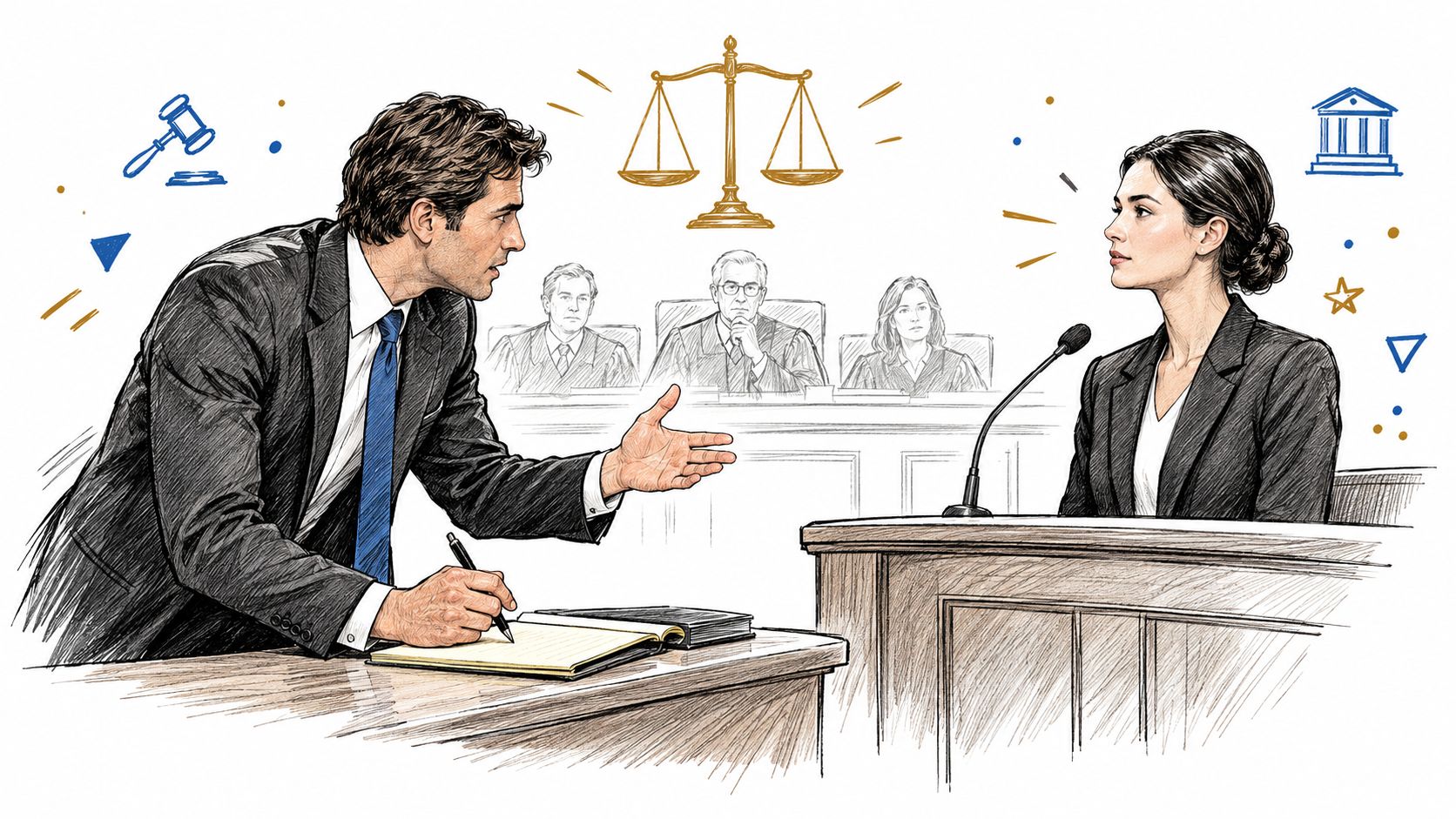
You’re sitting at counsel table while a government witness describes events in a way that could affect your freedom, career, security clearance, family, and reputation. The testimony sounds confident. Some of it may be wrong. Some may be incomplete. The panel is watching the witness, but it’s also watching the defense lawyer decide what to challenge and what to leave alone.
That moment isn’t won with anger or theatrics. Knowing how to cross examine witnesses in court-martial requires preparation, control, and a clear reason for every question. A strong cross-examination can expose a weak observation, reveal bias, establish an omission, or force an admission that changes how the panel understands the entire case. A careless one can repair the witness’s credibility and make the defense look unfocused.
Table of Contents
- The Reality of Cross-Examination in Military Justice
- Building Your Case Theory and Witness Map
- Executing Leading Questions and Controlling Scope
- Critical Pitfalls That Destroy Defense Credibility
- Why Civilian Defense Counsel Changes the Outcome
- Court-Martial Defense Questions and Next Steps
The Reality of Cross-Examination in Military Justice
A government witness has finished direct examination. The panel has heard a clean account of the prosecution’s case, and the witness appears confident. Cross-examination gives the defense its first controlled opportunity to test that account in public. The pressure can be intense, but the objective is not performance. It is to establish facts the witness must accept, expose limits in the witness’s knowledge, and prevent untested testimony from carrying the case.
Cross-examination is the principal means of testing a witness’s believability and the truth of testimony. The Sixth Amendment gives an accused the right to confront witnesses. Modern confrontation doctrine treats a prior opportunity to cross-examine as a decisive safeguard when testimonial statements are offered against a defendant. In Crawford v. Washington, the Supreme Court reinforced that testimonial hearsay generally cannot be admitted unless the declarant is unavailable and the defendant previously had an opportunity for cross-examination. The constitutional background and practical court-martial basics are summarized in this court-martial basics resource.
The purpose is narrower than new counsel expect
A defense lawyer may pursue several related objectives:
- Secure favorable admissions: Establish facts about distance, lighting, timing, perception, motive, memory, procedure, or investigative gaps.
- Expose inconsistency: Compare testimony with a prior statement, recorded interview, document, physical evidence, or another witness.
- Show bias or influence: Identify relationships, expectations, incentives, pressure, or reasons the witness may favor the government’s account.
- Limit the testimony: Clarify what the witness did not see, hear, record, or reliably remember.
- Protect the theory of defense: Build the facts the panel needs to understand reasonable doubt or an alternative explanation.
Each objective requires a defined point. “Attack credibility” is too broad to guide questioning. “The witness could not see the doorway,” “the witness did not record the conversation,” or “the witness learned that detail from someone else” gives the defense a usable target.
The strongest cross-examinations often sound modest. A witness may concede that the room was poorly lit, the interview occurred later, or a significant fact was absent from the first account. Such an admission can matter more than a dramatic confrontation because it gives the panel a concrete fact without asking members to decide the case through emotion.
Military panels notice discipline
A civilian tactic that appears aggressive in a television courtroom can alienate a military panel. Service members understand chain of command, investigations, standard operating procedures, and the consequences of poor judgment. They also recognize when counsel is bullying a witness instead of proving a point.
Practical rule: Make the witness look unreliable through the evidence. Do not ask the panel to dislike the witness because you dislike the testimony.
Military justice also imposes procedural limits that affect how cross-examination works. Federal Rule of Evidence 611 governs the mode and order of examining witnesses in federal court, reflecting the broader common-law approach to courtroom control. Rule 611(c) ordinarily permits leading questions on cross-examination while generally restricting them on direct examination. That advantage allows the opposing party to test testimony rather than just invite another narrative.
Counsel must still stay within the permitted scope, evidentiary rulings, and the purpose of the examination. Aggressive questioning that draws an avoidable objection can interrupt momentum and signal that the defense is reaching. A disciplined lawyer chooses questions that advance the case theory and stops after securing the admission.
In military justice, credibility is often the battlefield, but credibility attacks must connect to concrete evidence. A witness who changes a material detail, lacked an opportunity to observe, received information from others, or ignored an obvious investigative lead gives the defense a usable point. Nervousness alone may prove little. The panel needs a reason to doubt the testimony, and cross-examination must supply it without sacrificing the defense’s credibility.
Building Your Case Theory and Witness Map
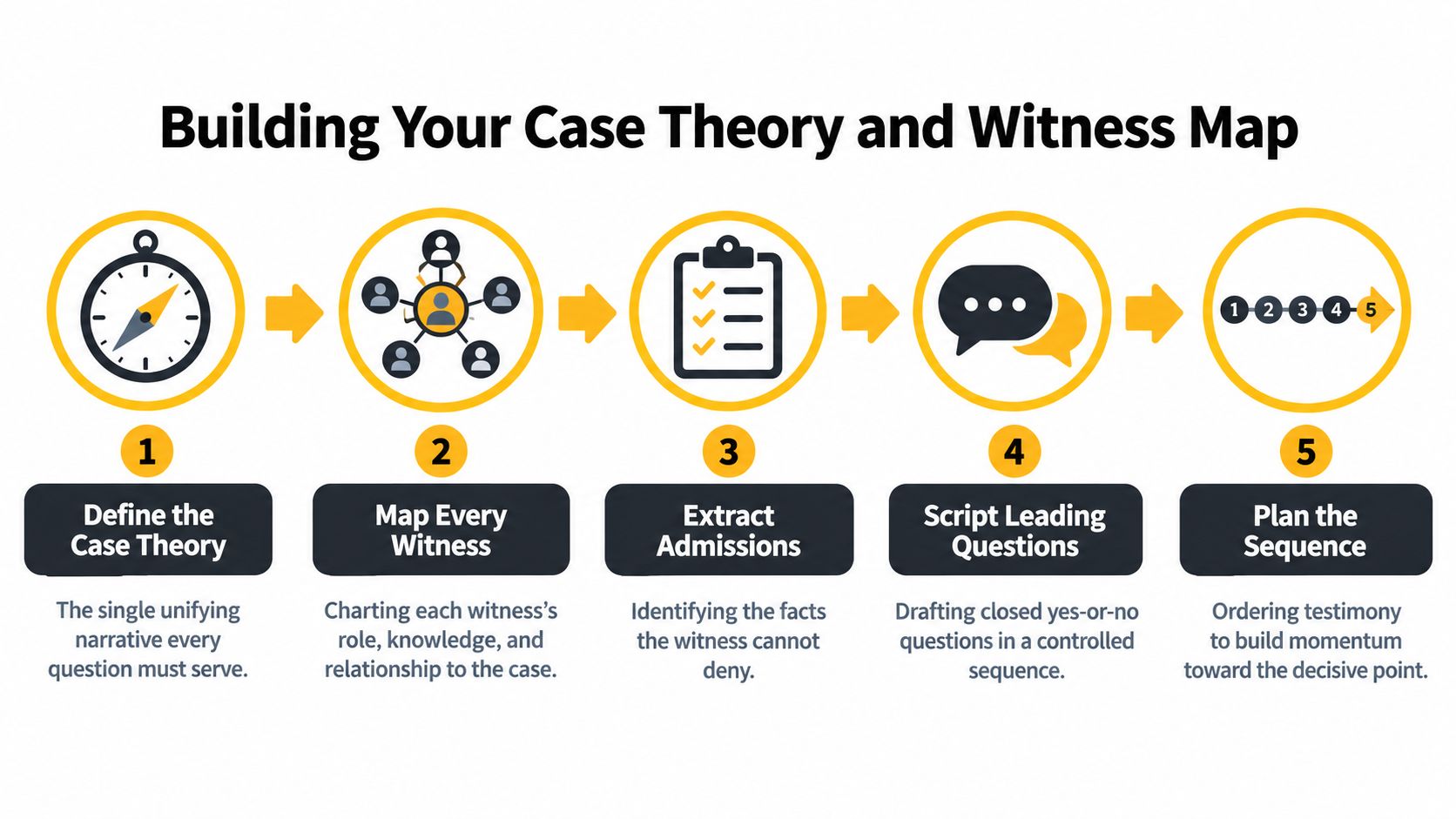
Before drafting questions, decide what the case is about. Not every possible defense can become the organizing principle. A lawyer who tries to prove that a witness was lying, mistaken, biased, poorly trained, influenced by others, and confused may leave the panel with no clear conclusion.
Choose one case theory that can organize the cross-examination. It might be that the witness’s observation was unreliable, that the investigation shaped the account, that the accused’s conduct had an innocent explanation, or that the government cannot prove a required fact with dependable evidence. Every witness should have a defined relationship to that theory.
Start with the admission, not the question
For each government witness, write down the exact admissions you need. “Attack credibility” is not an admission. “The witness was outside the room,” “the witness did not record the conversation,” or “the witness learned the detail from someone else” are usable targets.
Then build a witness map:
- Identify the witness’s role. Determine whether the person is an alleged victim, eyewitness, investigator, command witness, medical provider, forensic examiner, or expert.
- Separate personal knowledge from repetition. Mark what the witness personally observed and what came from reports, conversations, assumptions, or later information.
- List the government’s expected use of the witness. A witness may provide identification, intent, injury evidence, corroboration, background, or an investigative conclusion.
- Assign the witness a limited cross objective. Don’t give one witness every defense argument. Take the concession that witness can provide.
- Order the questions. Begin with facts the witness cannot reasonably dispute, then move toward the point that matters to your theory.
Preparation includes more than reading the final report. Review prior statements, interview recordings, texts, photographs, medical records, digital evidence, and the chronology of the investigation. If the witness used an interpreter or gave testimony in more than one language, counsel must also examine interpretation quality, terminology, pauses, corrections, and whether the witness understood the question. A practical resource on how to prepare witness interviews with interpreters can help counsel identify operational issues before testimony begins.
A useful preparation file separates facts, sources, and arguments. Facts are what the evidence establishes. Sources are where the fact came from. Arguments are the conclusion you want the panel to draw. Keeping those categories separate prevents a common error, asking a witness to agree with your argument instead of securing the underlying facts.
The best cross-examination plan tells you not only what to ask, but what you’ll leave untouched.
Military investigations can create the conditions for later credibility problems. Interviews may be delayed, witnesses may discuss events with one another, investigators may pursue a favored theory, and exculpatory leads may receive less attention. Counsel should study how the account developed, not merely whether the final statement sounds persuasive. The defense strategy must be formed before testimony begins, just as it should be during the military investigation phase.
Executing Leading Questions and Controlling Scope
Leading questions are the mechanical foundation of effective cross-examination. They contain the fact you want the witness to confirm and restrict the witness’s opportunity to restart the narrative. “You were standing outside the room,” is usually more controlled than, “Where were you standing?”
The question should do work before the witness answers. It should identify one fact, use familiar language, and avoid unnecessary adjectives. If the witness can answer with a speech, the question probably gives away too much control.
Build a controlled sequence
A disciplined sequence often follows this pattern:
- Establish the setting: Where the witness was, what the witness could see or hear, and what conditions existed.
- Lock in personal knowledge: What the witness observed directly, rather than what someone later reported.
- Confirm the prior account: When and how the witness first described the event.
- Expose the gap: What the witness omitted, changed, could not recall, or learned later.
- Tie the point to the case theory: Ask the final question that makes the limitation clear.
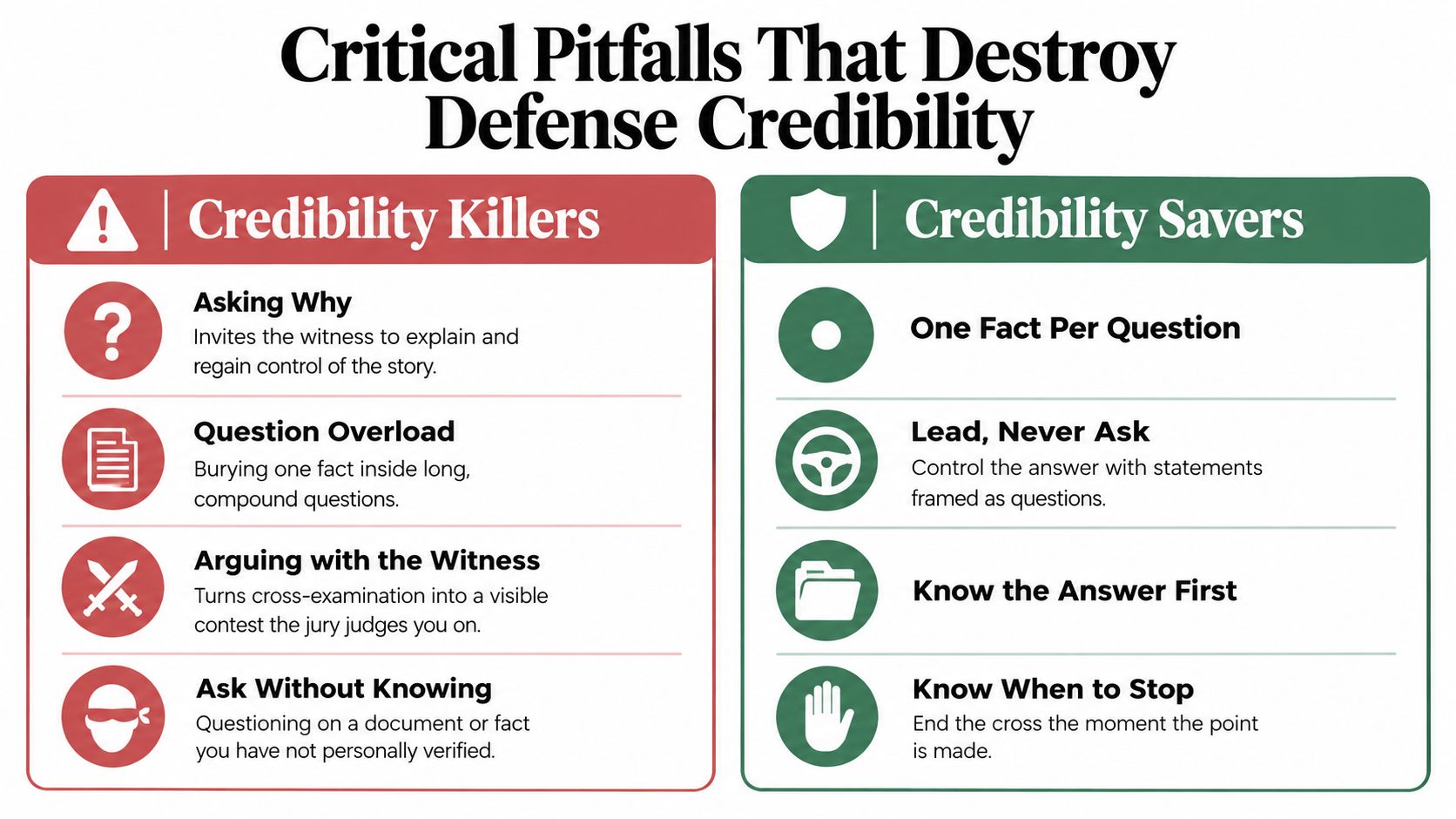
Each question should generally contain one factual proposition. Compound questions create escape routes. If you ask whether the witness was tired and distracted, the witness can deny one part and accept the other. Separate them.
The Federal Rules of Evidence limit cross-examination to the subject matter of direct examination and matters affecting the witness’s credibility, although a judge may permit additional inquiry as if on direct examination. That limitation has operational consequences. A lawyer who launches an unrelated attack may draw an objection, lose the line of questioning, or teach the government how to repair the issue on redirect. The scope rule is discussed in the federal evidence provisions governing examination and credibility.
Use documents with precision
Impeachment works only when the witness is committed to the current version before the prior statement is introduced. The sequence should be controlled:
- Establish the present testimony.
- Confirm that the witness made or adopted the earlier statement.
- Establish the circumstances that make the earlier statement reliable or significant.
- Direct the witness to the exact inconsistency.
- Stop once the contradiction is clear.
Don’t wave a long report at the panel and ask the witness to explain every difference. Identify the specific line, omission, or change. If the document is ambiguous, you may create confusion instead of impeachment.
Experts and forensic witnesses require a different approach. Broad attacks on intelligence or honesty are usually weaker than focused attacks on qualifications, factual foundation, methodology, testing, assumptions, and gaps in the analysis. A forensic opinion may sound scientific while depending on incomplete facts or an untested assumption. The cross should expose that dependency without pretending the defense has disproved more than it has.
Scope is a tactical boundary
A judge may allow latitude when credibility is genuinely at issue, but the defense should not rely on latitude. Plan each topic against the direct examination. If the government opens a door, use it. If it doesn’t, preserve the point for an appropriate witness, exhibit, argument, or later ruling.
The same discipline applies to redirect and recross. When the government repairs a witness, recross should address the repair rather than become a second direct examination. The lawyer who keeps asking questions after the useful point has been made risks allowing the witness to explain away the admission.
Critical Pitfalls That Destroy Defense Credibility
Cross-examination can expose falsehoods, but it doesn’t automatically produce truth. Legal scholarship has warned that an honest witness may appear hesitant, confused, or defiant under aggressive questioning. A panel may discount truthful evidence if the questioning makes the witness seem mistreated or if the lawyer appears more interested in winning an argument than finding a reliable fact.
Overcrossing gives the witness a second chance
Overcrossing means continuing after the defense has obtained the necessary admission or contradiction. The lawyer sees momentum and keeps going. The witness eventually explains the answer, qualifies it, or supplies the government with a better version of the testimony.
The danger is especially high when the witness has already been impeached. A successful contradiction belongs to the defense the moment the panel understands it. Additional questions may let the witness say the difference resulted from stress, poor wording, an incomplete interview, or an innocent lapse in memory.
Common errors have predictable consequences
- Open-ended questions: “Why did you leave that out?” invites the witness to explain, justify, and regain control.
- Compound questions: Multiple facts in one question make it difficult for the panel to know what the witness accepted or rejected.
- Argument with the witness: Sarcasm and accusations turn the exchange into a contest that the panel may judge the lawyer on.
- Questions without verified answers: If the lawyer hasn’t checked the document, timing, or recording, the witness may expose the mistake.
- Repetition after denial: Asking the same question in a more forceful tone doesn’t create evidence.
- Collateral attacks: Minor inconsistencies can distract from a stronger contradiction and make the defense appear petty.
- Unnecessary hostility: A vulnerable witness may look more credible when the defense appears cruel or impatient.
- Ignoring an answer: A witness’s unexpected answer may create a better line of inquiry than the lawyer’s prepared script.
A cross-examination isn’t successful because the lawyer asked many questions. It succeeds because the panel remembers the right facts.
Tone matters. A calm lawyer can challenge a witness firmly without appearing threatened by the answer. Short pauses, neutral language, and a measured pace help the panel follow the evidence. The goal isn’t to make every witness look dishonest. Sometimes the strongest result is to show that a witness is sincere but mistaken, honest but limited, or certain about a conclusion the underlying facts don’t support.
Before asking the final question in a sequence, identify its risk. If the answer is unfavorable, can the defense recover? If the answer is favorable, does it add anything? If neither answer helps, sit down. The military panel doesn’t need every weakness in the witness. It needs the weakness that matters to the verdict.
Why Civilian Defense Counsel Changes the Outcome
Military-appointed counsel can provide valuable representation, and an accused has the right to consult counsel about the available choices. The practical comparison in a serious court-martial, however, should focus on experience, workload, independence, and preparation time, not on labels alone.
A military defense counsel may be capable and committed while also managing office responsibilities, newer counsel, administrative demands, and several cases at different stages. An experienced civilian military defense lawyer typically concentrates on defense litigation and can devote substantial time to discovery review, witness preparation, expert consultation, motions, and trial sequencing. That difference matters when the case includes extensive digital evidence, forensic testimony, interpreters, delayed reports, or several versions of a witness account.
Independence changes the questions counsel can ask
Civilian counsel doesn’t sit inside the accused’s chain of command or answer to military supervisors for the defense strategy. That independence can make it easier to challenge command decisions, investigative failures, forensic conclusions, and government witnesses without institutional pressure.
The strongest civilian counsel also understands what not to do. Aggressive advocacy isn’t measured by volume or personal attacks. It means identifying the government’s proof, selecting the witnesses who can weaken it, and applying pressure where the evidence is vulnerable. A lawyer who has tried serious court-martial cases knows that a panel may forgive a witness’s uncertainty, but it won’t forgive a defense that appears careless with the facts.
Compare counsel by questions, not promises
Ask prospective court-martial attorneys:
- Trial experience: How often does the lawyer personally conduct contested trials and cross-examinations?
- Case analysis: Who will review the investigation, digital evidence, medical records, and witness statements?
- Witness strategy: What does the lawyer look for before deciding whether to cross-examine?
- Expert issues: Can the lawyer identify weaknesses in forensic qualifications, methods, and factual assumptions?
- Communication: Who will explain developments to the service member and family?
- Independence: Will the lawyer challenge command and investigative decisions when the evidence requires it?
Families should speak with multiple court-martial defense lawyers and evaluate strategy, communication, and fit.
Court-Martial Defense Questions and Next Steps
Can I refuse to talk to CID, NCIS, OSI, or CGIS?
You generally have the right to remain silent and to consult counsel. Don’t try to solve an active investigation by guessing, explaining, or sending messages to investigators without legal advice. A seemingly helpful statement can create admissions, inconsistencies, or new investigative leads.
Does the accused have the right to cross-examine government witnesses?
Yes. Confrontation and cross-examination are central protections in an adversarial criminal proceeding. In practice, defense counsel uses cross-examination to test what a witness personally knows, whether the account changed, whether bias exists, and whether the testimony fits the other evidence.
What happens at an Article 32 hearing?
The hearing process depends on the charges, referral posture, evidence, and applicable procedural decisions. Defense counsel reviews the notice and evidence, advises the accused, litigates appropriate issues, and cross-examines witnesses when testimony is presented. The accused should treat the hearing as a strategic stage, not as an informal conversation.
Will I go to jail?
No lawyer can responsibly predict confinement from a short description. The answer depends on the charged offenses, admissible evidence, findings, sentencing law, forum, aggravating facts, mitigation, and the defense strategy. Do not make decisions based on rumors or promises from people who haven’t reviewed the case.
Do I need a lawyer immediately?
Yes, if you’re under investigation or facing potential UCMJ action, early legal advice matters. Counsel can protect communications, identify preservation issues, address interviews, evaluate witnesses, and prevent avoidable mistakes before the government’s theory hardens.
Should I prepare my own legal brief or cross-examination outline?
Don’t assume a template fits your facts. Legal writing requires a careful connection between the rule, the record, and the requested relief. A general guide to drafting legal briefs may help explain organization, but a court-martial filing and trial outline should be prepared or reviewed by counsel who understands military procedure.
The first step is not writing an angry response to the allegation. It’s preserving your rights, stopping unnecessary discussion, and obtaining an independent case assessment. If you’re under investigation, facing an Article 15, administrative separation, or court-martial, contact an experienced civilian UCMJ lawyer now. Do not wait for charges to be preferred or for a witness to take the stand. Your career, freedom, and reputation may depend on the decisions made before cross-examination ever begins.
If investigators have contacted you or command action is underway, arrange a confidential consultation with experienced military defense lawyers immediately. Bring every notice, message, statement, and document you have, and don’t discuss the facts with anyone else until counsel advises you.