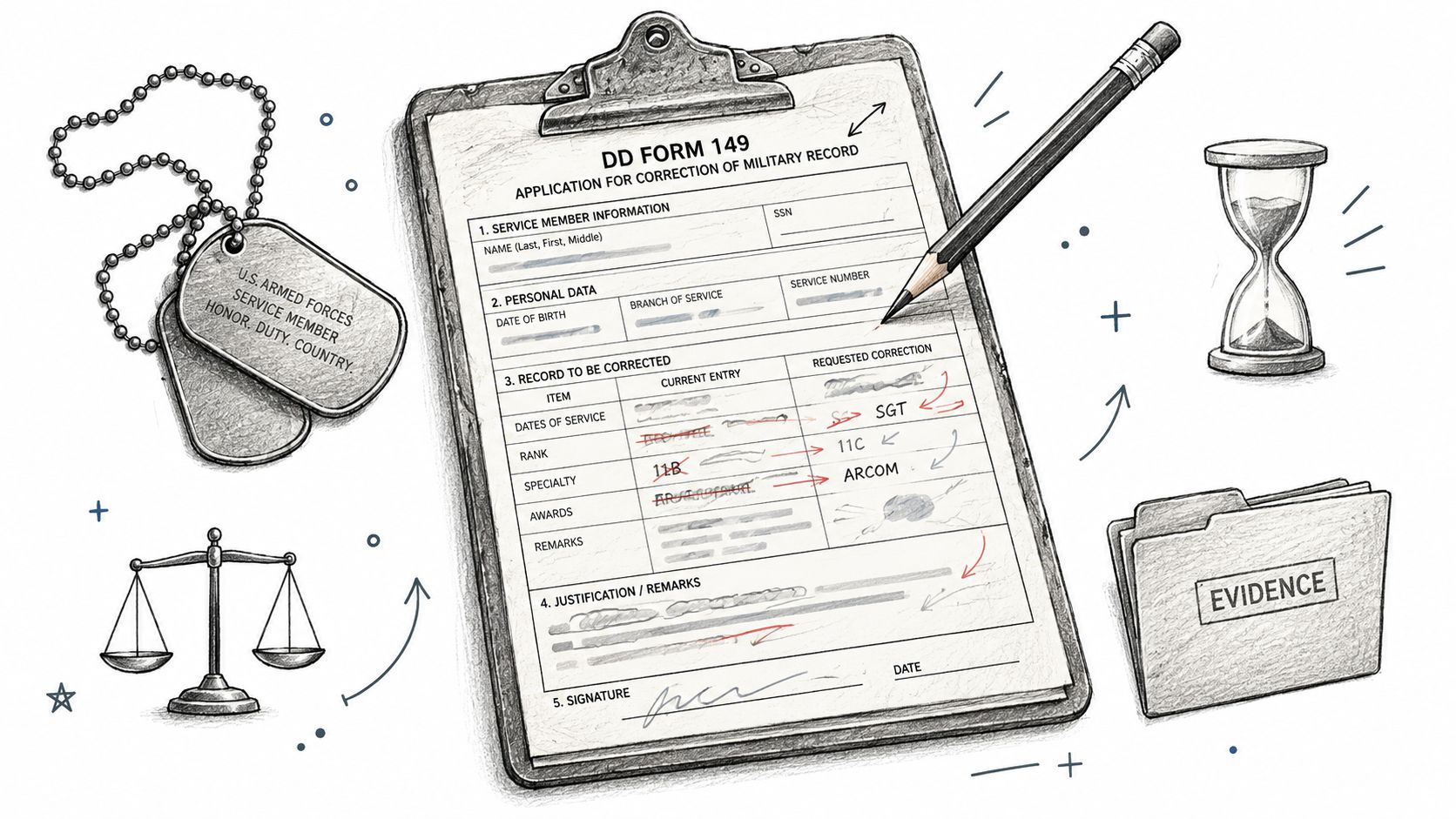
Correcting a military record is possible through a Board for Correction of Military Records using DD Form 149, but you must prove an error or injustice with evidence. The normal filing deadline is three years from discovery unless the board grants a waiver in the interest of justice.
You may have discovered the problem after leaving the service. Your DD-214 may show the wrong characterization, a missing award, an incorrect pay entry, an inaccurate evaluation, or a separation decision that continues to affect employment, benefits, promotions, or security-clearance decisions. You may also be serving now and realize that an old administrative mistake is damaging your record.
The system offers a legal remedy, but it doesn’t reward vague complaints or emotional narratives standing alone. Boards want a precise allegation, a documented record, a legally sound explanation of why the entry is erroneous or unjust, and a specific correction. Filing quickly matters, but filing in the wrong forum or with an incomplete packet can waste months.
The most important decision isn’t how to fill out the form. It’s identifying where the error lives, which board has authority, what evidence proves the problem, and how timing affects your case.
Table of Contents
- Understanding the Legal Path to Correct Your Military Record
- How to File a Correction of Military Record Properly
- Legal Standards, Burden of Proof, and Timing Rules
- Choosing the Right Forum for Your Case
- Why Civilian Military Defense Counsel Changes Outcomes
- When Delay Is Not Fatal and How to Re-File Successfully
- Taking Action Before Your Next Opportunity Fades
Understanding the Legal Path to Correct Your Military Record
A correction of military record begins with a legal authority, not a customer-service request. 10 U.S.C. § 1552 authorizes each service secretary to correct military records through civilian boards, including records affected by error or injustice. The authority can reach significant matters, including discharge characterizations, evaluations, pay-related entries, awards, and other official service records. The Air Force explanation of military personnel records also recognizes that a correction board may review a discharge issued by court-martial.
The practical path depends on the type and age of the record. A recent separation generally begins with a Discharge Review Board, while an older separation or a case that has already gone through discharge review generally moves to the service’s Board for Correction of Military Records. Those forums aren’t interchangeable. A discharge review board has a narrower function, while a correction board can address broader allegations involving the military record.
The system operates at real administrative scale
This isn’t a niche remedy used only by a handful of veterans. In 1995, service boards received 25,273 applications, took board action on 12,901 applications, and administratively corrected 13,449 military records, according to the quarterly review-board statistics. Those figures demonstrate both the durability and scale of the correction process.
The government has also used correction authority proactively. The Department of Defense announced a review of eligible DADT-era separations on September 20, 2023, and completed that review in October 2024. Of 851 cases proactively reviewed, 96.8% resulted in relief, and DoD reported that more than 96% of roughly 13,500 service members separated under DADT who served long enough to receive a merit-based characterization now hold an honorable discharge. The Congressional Research Service summary of the DADT review describes the scope and outcome.
Strategic point: The existence of a remedy doesn’t mean the board will find your case persuasive. It means you have a forum in which disciplined evidence and careful legal framing can change the official record.
Treat the process like litigation. Identify the exact entry, determine who created it, locate the supporting documents, and explain the specific correction required. For useful general guidance on presenting a clear, credible professional message online, see setting the record straight on SEO. The same principle applies here: clarity beats volume, and unsupported assertions create avoidable weaknesses.
How to File a Correction of Military Record Properly
A strong packet follows a sequence. Skip a step and you may create a procedural problem before the board ever reaches the merits.
Build the record before drafting the argument
Start by gathering the documents that establish what happened and what the record says now:
- Service records: Obtain the relevant personnel, medical, evaluation, pay, award, separation, and disciplinary records.
- Orders and correspondence: Include orders, counseling documents, prior appeals, command responses, and agency correspondence.
- Witness support: Use signed statements when another person can establish facts that the official record omits.
- Requested relief: State the exact entry you want changed and the precise replacement or correction sought.
Then exhaust lower-level administrative remedies when they are available. A servicing personnel office may be able to correct a straightforward database or document error without board litigation. The board should not be your first stop when an ordinary personnel correction is still available.

Draft DD Form 149 as a legal pleading
Use the current service process and the current version of DD Form 149. Navy correction cases require a signed form, supporting documentation, and identifying information such as the applicant’s name, service number or Social Security number, address, email, and telephone numbers, as explained in the Navy Board application process.
Your statement should answer four questions:
- What exact entry is wrong or unjust?
- What should the entry say or reflect instead?
- Which document proves the problem?
- Why does the correction matter under the circumstances?
Attach clear copies. Don’t send originals. The Department of Defense instructions require an applicant to show, to the board’s satisfaction, that the disputed entry was erroneous or unjust. A broad statement that the command treated you unfairly won’t meet that burden without records connecting the allegation to a specific correction.
Protect the deadline and submission trail
Title 10 generally creates a three-year filing window from discovery of the error or injustice, although the board may excuse late filing in the interest of justice. Explain any delay in the initial packet rather than hoping the board overlooks it. Save the completed application, every attachment, proof of submission, and later correspondence.
If your issue involves a discharge characterization, review the military discharge upgrade process before choosing the forum. The wrong application can send a viable claim into the wrong queue.
The required video is available here:
Legal Standards, Burden of Proof, and Timing Rules
Boards don’t correct records because an applicant is disappointed with an old decision. They correct records when the evidence establishes error or injustice.
An error usually involves a factual, procedural, or administrative mistake. Examples include an incorrect date, a missing document, a misapplied rule, an inaccurate evaluation entry, or a decision based on information that the official record does not support. An injustice can exist even when the paperwork was technically completed. It requires a persuasive showing that leaving the record unchanged would be unfair under the circumstances.
The distinction matters because your brief must connect facts to relief. Don’t write, “My discharge was unfair.” Write what the command recorded, identify the evidence that contradicts it, explain the process defect or inequity, and state the correction that would remove the harm.
The applicant carries the burden
The applicant bears the burden of proof. Air Force correction-board guidance requires evidence supporting the allegation of error or injustice, and the DD Form 149 instructions require sufficient evidence of a probable material error or injustice. The Air Force correction-board decision materials illustrate the documentation-driven nature of that standard.
A persuasive packet usually combines:
- Contemporaneous records, not only memories formed years later.
- Orders and evaluations that establish what should have occurred.
- Medical evidence when health, trauma, or impairment explains conduct or process failures.
- Prior correspondence showing what the command or agency knew.
- A focused affidavit or statement that fills a specific gap instead of repeating the entire history.
Forum statistics expose strategic differences
Public quarterly statistics show why forum selection and evidence quality matter. In one Air Force quarterly report, the Air Force Discharge Review Board approved 39.60% of 134 cases, while the Board for Correction of Naval Records approved 12.30% of 284 cases. These figures appear in the military review-board quarterly report.
Those rates aren’t promises or predictions for an individual applicant. They do show that boards, case types, and evidentiary postures produce materially different results. Treating forum selection as a clerical detail is a serious mistake.
Expect a long queue. Practitioner guidance commonly warns of waits of up to 18 months before a board considers a case. Use that time to preserve evidence and prepare for follow-up, not to assume silence means approval. For broader context on the military justice system and how administrative records interact with defense strategy, consult this guide to the UCMJ system.
Choosing the Right Forum for Your Case
The correct forum depends on three questions: How old is the separation? Where does the error exist? What relief are you requesting?
For separations under 15 years, the discharge review board is generally the first venue for reviewing the characterization or narrative reason for separation. Older separations, and cases already reviewed through the discharge-review process, generally move to the service correction board. A correction board also handles broader record issues that aren’t limited to discharge characterization.
That distinction can change the entire presentation. A discharge review request focuses on whether the separation should be changed. A correction petition may need to prove that a particular evaluation, pay entry, award, promotion record, medical entry, or administrative decision was erroneous or unjust.
Match the forum to the record location
Some problems aren’t board cases at all, at least initially. The Navy directs certain corrections involving the Official Military Personnel File, Enlisted Service Record, or corporate databases to the servicing personnel office. The Navy document-correction guidance explains that pathway.
The Army highlights online filing through its Army Review Boards Agency portal for appropriate applications. That doesn’t mean every Army records problem belongs there. It means applicants should follow the service-specific routing instructions rather than mailing a generic packet to an assumed destination.
The National Archives no longer creates DD Form 215 corrections for DD-214 updates under Department of Defense guidance. If the record is archival, the matter is routed to the appropriate service correction board. The National Archives correction guidance explains the distinction between archival and nonarchival records.
Use this decision path
- Recent discharge issue: Start with the applicable discharge review board unless the matter falls outside its authority.
- Older or previously reviewed discharge: Evaluate a Board for Correction of Military Records petition.
- Personnel-file or database error: Contact the servicing personnel office first.
- Archival record: Follow the service-board route rather than treating the National Archives as the correction authority.
- Multiple errors: Separate each issue and identify the agency or board responsible for each one.
Filing in the wrong place can delay relief even when the underlying mistake is obvious. A correct fact submitted to the wrong forum is still a failed strategy.
Why Civilian Military Defense Counsel Changes Outcomes
A correction petition is administrative, but it is still adversarial. The government has the official record, the institutional memory, and the advantage of writing the first version of events. Your job is to overcome that record with admissible, coherent, and strategically organized proof.
Military-appointed counsel can provide important representation during qualifying military justice matters. But correction petitions often arise after the immediate proceeding has ended, and many applicants need a lawyer who will reconstruct the entire record rather than address a single hearing or charge. A seasoned civilian military defense lawyer brings independence from the chain of command and can work across UCMJ defense, court-martial practice, administrative separation, discharge review, and records correction.
The real value is evidence architecture
Experienced counsel looks for contradictions between:
- The command’s stated reason and the contemporaneous documents.
- The official entry and orders or evaluations.
- The applicant’s conduct and overlooked medical evidence.
- The stated process and the notice or opportunity in fact provided.
- The final record and prior agency correspondence.
That analysis turns a personal grievance into a legal theory. It also exposes credibility problems before the board finds them. If a date is wrong, correct it. If a witness is unreliable, address the weakness. If the record is incomplete, explain what is missing and identify the document or testimony that fills the gap.

A civilian lawyer can also prepare the case for the next stage if the board denies relief. That requires preserving the arguments, presenting new evidence when available, and avoiding a first filing that makes later repair harder. Review how to choose a military defense lawyer before selecting counsel.
Ask about records-correction experience, service-specific practice, evidence strategy, and who will personally handle the petition.
When Delay Is Not Fatal and How to Re-File Successfully
Missing the normal filing period doesn’t automatically end the case. Boards may waive untimeliness when review is in the interest of justice, but the applicant must explain both why the filing was late and why the board should consider the merits now.
A weak waiver request says, “I didn’t know I could file.” A stronger one identifies when the applicant discovered the problem, why the significance became clear only later, what prevented earlier action, and why the available evidence now supports review. The explanation must be tied to fairness, not convenience.
The Navy states that a correction request is generally due within three years of discovering the error, but the board may waive the limit in the interest of justice. The Navy also explains that a denied applicant may submit a new request only when relevant evidence exists that the board didn’t previously consider, as described in the Navy correction-board FAQ.
Re-filing requires more than a rewritten story
A second petition should not merely rearrange the first one. Look for evidence that changes the board’s ability to decide:
- New service records: Documents obtained through a later records request or personnel-office review.
- Medical documentation: Records that explain conduct, capacity, treatment, or a previously undocumented condition.
- Witness statements: Specific accounts addressing a disputed fact, process failure, or command knowledge.
- Service-history confirmation: Awards, evaluations, assignments, or performance evidence that changes the context.
- Prior-agency material: Correspondence or decisions that reveal an omission or contradiction.
A re-filed petition must give the board a reason to reconsider, not another opportunity to reject the same theory.
Delay can be excusable, but repetition is not strategy. Have counsel compare the prior denial with the proposed new submission line by line. Identify what the board previously decided, what evidence it lacked, and why the new material is relevant to the requested correction.
Taking Action Before Your Next Opportunity Fades
A correction of military record is possible, but success depends on disciplined execution. Choose the right forum, identify the exact entry, prove error or injustice, address timing, and preserve every supporting document.
Self-filed packets often fail because applicants submit a narrative instead of an evidentiary case. They omit the precise correction, skip lower-level remedies, send incomplete attachments, use the wrong service process, or re-file without new evidence. Those mistakes can consume a long period while employment, benefits, clearance matters, and professional opportunities remain tied to the inaccurate record.
Frequently asked questions
Can I correct a military record after separation?
Yes. The available route depends on the record, the requested relief, and the age of the separation. Recent discharge matters generally begin with discharge review, while older or broader claims may require a correction-board petition.
Do I need DD Form 149?
Usually, yes, for a correction-board petition. The application must identify the alleged error or injustice and include supporting evidence.
What if I missed the filing deadline?
Ask for an interest-of-justice waiver and explain the delay with evidence. Do not assume the board will excuse lateness automatically.
Can I re-file after a denial?
You may be able to submit a new request when relevant evidence exists that the board didn’t previously consider. Repeating the same packet is unlikely to solve the original problem.
Should I contact my personnel office first?
Yes, when the issue is a straightforward document, personnel-file, or database correction. A board petition may be unnecessary at that stage.
How long will the process take?
Plan for a substantial wait. Practitioner guidance commonly warns of waits of up to 18 months before board consideration, so submit a complete packet rather than relying on a quick correction.
If an inaccurate military record is affecting your discharge status, pay, promotion history, benefits, employment, or clearance, contact an experienced civilian military defense lawyer before submitting DD Form 149. Bring the complete record, prior correspondence, and every document connected to the disputed entry. Don’t spend months filing the wrong petition or preserve a weak theory that becomes harder to repair. Get a forum assessment, evidence review, and timing strategy now, while your next opportunity to obtain relief remains available.