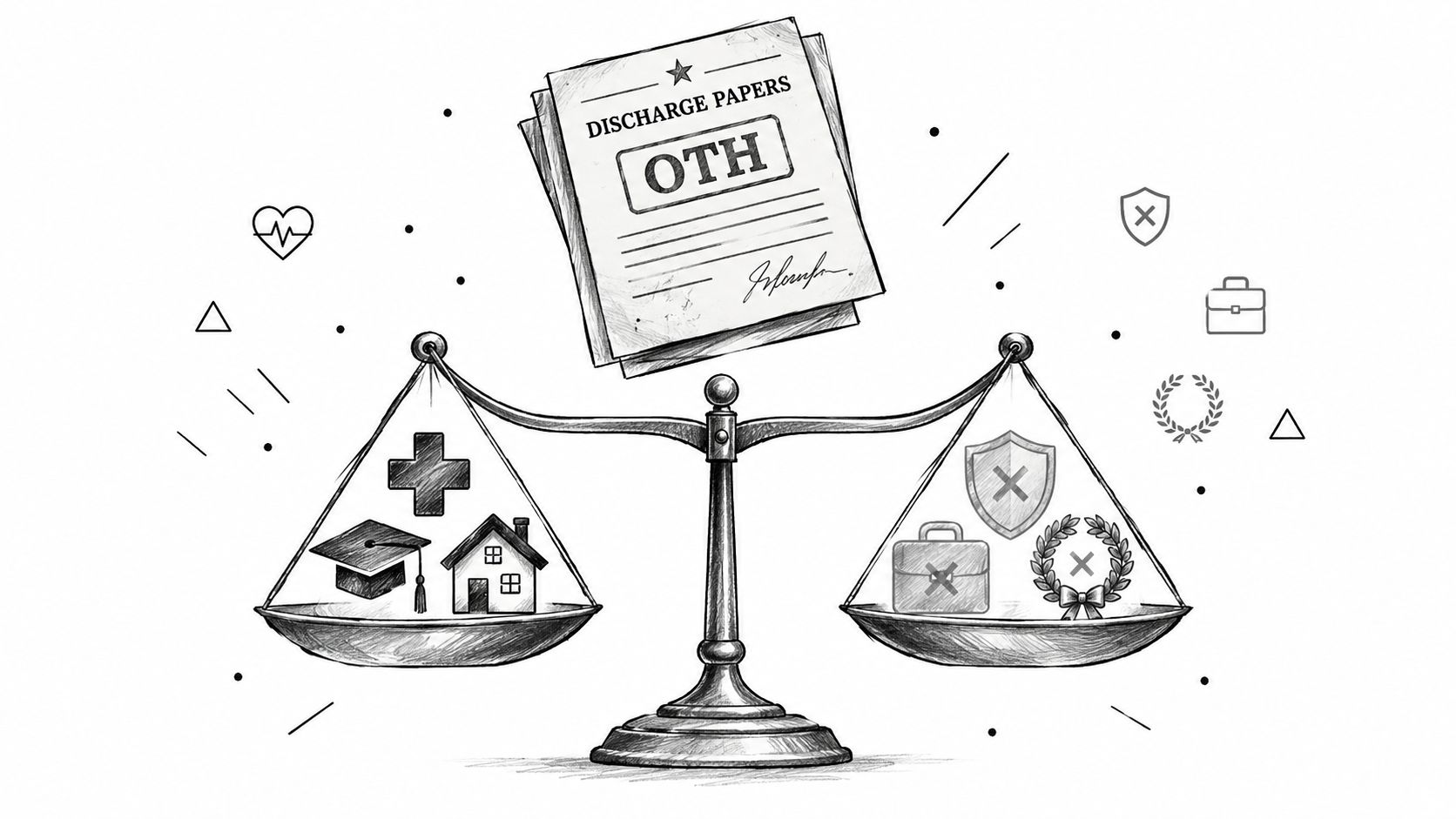
You’re staring at an Other-Than-Honorable discharge and trying to answer one question: “Did I lose everything?” The answer is no, but that doesn’t mean the consequences are minor. An OTH discharge can affect health care, disability compensation, education, housing, employment, licensing, and your family’s financial stability. The most common mistake is treating the DD-214 label as the final answer. For VA purposes, it often isn’t.
The VA conducts its own character of discharge review. A separate military review board may also consider an upgrade. Those are different paths, with different purposes, and waiting for one before pursuing the other can cost you time and access. Your record, the reason for separation, the evidence behind the misconduct, and the way the claim is presented all matter.
Table of Contents
- What an Other-Than-Honorable Discharge Actually Means
- Federal Benefits Retained and Lost With an OTH Discharge
- How the VA Character of Discharge Review Works
- Upgrading an OTH Discharge Through the Military Review Boards
- Security Clearance, Employment, and Veterans’ Preference Impact
- Real-World Scenarios and Strategic Lessons From OTH Cases
- Your Action Plan and Why Civilian Defense Counsel Matters Now
- Frequently Asked Questions About OTH Discharge Benefits
- Can an OTH discharge block all VA benefits?
- Can I receive VA disability compensation with an OTH discharge?
- Does a VA decision upgrade my DD-214?
- Should I wait for a discharge upgrade before applying for VA benefits?
- Can an OTH affect a security clearance?
- Is an OTH the same as a Bad Conduct Discharge?
- Do I need a lawyer immediately?
What an Other-Than-Honorable Discharge Actually Means
Military discharge characterizations sit on a ladder. At the top is Honorable. Below it is General, Under Honorable Conditions. Other Than Honorable, commonly called OTH, falls below General. Bad Conduct and Dishonorable discharges are more serious punitive outcomes associated with court-martial proceedings.
That distinction matters. An OTH is generally an administrative separation characterization, not a court-martial conviction. It can follow alleged misconduct, drug use, a pattern of disciplinary problems, failure to adapt, or other conduct the command considers incompatible with continued service. The exact authority and procedure depend on the branch and the governing service regulation.
An OTH still carries serious practical consequences. Employers, licensing authorities, security-clearance adjudicators, and benefits agencies may see the characterization without understanding the underlying record. The label can therefore create problems far beyond the separation itself.
OTH is not the same as a punitive discharge
A court-martial can impose a Bad Conduct or Dishonorable discharge. A command administrative process cannot impose a Dishonorable discharge as an administrative penalty. Officers and enlisted service members also move through different separation procedures, so the same phrase, “administrative separation,” doesn’t describe every case in the same way.
You need to identify three things before analyzing benefits:
- The exact characterization, as shown on the DD-214 or applicable separation document.
- The narrative reason and separation authority, which explain why the service took action.
- The underlying record, including investigations, counseling, medical evidence, evaluations, and separation-board documents.
| Discharge Type | Issuing Authority | Typical Reason | Legal Status | VA Treatment |
|---|---|---|---|---|
| Honorable | Military separation authority | Satisfactory service | Administrative characterization | Generally supports eligibility for VA benefits, subject to benefit-specific rules |
| General, Under Honorable Conditions | Military separation authority | Service with meaningful deficiencies but not wholly disqualifying | Administrative characterization | Generally supports eligibility for most VA benefits |
| Other Than Honorable | Military separation authority | Serious or persistent administrative misconduct concerns | Administrative characterization, not itself a court-martial conviction | Requires careful VA character-of-discharge analysis |
| Bad Conduct or Dishonorable | Court-martial authority | Criminal offenses established through military justice proceedings | Punitive discharge | Can create substantially more severe restrictions |
An OTH is a gray-zone discharge, but gray doesn’t mean hopeless. The Army administrative discharge process illustrates why the facts leading to the characterization must be examined rather than inferred from the label alone.
Federal Benefits Retained and Lost With an OTH Discharge
The phrase OTH discharge benefits is misleading if it suggests one universal answer. VA eligibility is fragmented. A benefit may be unavailable unless the VA makes a favorable determination, while a targeted health service remains accessible without full enrollment.
The VA states that a former service member with an OTH, Bad Conduct, or similar discharge may qualify after a separate character of discharge determination. The VA also identifies services that may remain available even without standard enrollment, including treatment for a VA-rated service-connected disability, care related to military sexual trauma, certain mental and behavioral health care, emergency mental health care during a crisis, and Vet Center counseling. See the VA’s official explanation of benefits available after an OTH discharge.
Treat each benefit as its own legal question
Do not assume that losing one program eliminates every other program. The practical analysis looks like this:
| Benefit | Default OTH Status | How Status Can Change | Governing Authority |
|---|---|---|---|
| VA health care enrollment | Restricted and subject to VA review | A favorable character-of-discharge determination may open broader access; targeted services may remain available under VA rules | VA eligibility rules |
| Service-connected disability compensation | Not automatic | VA review may find the service was under conditions other than dishonorable for benefits purposes | VA character-of-discharge rules |
| Military sexual trauma care | A targeted pathway may remain available | Eligibility depends on the service and treatment circumstances recognized by VA | VA health-care guidance |
| Emergency mental health care in crisis | Certain emergency services may remain available | Access depends on the crisis-care rules and circumstances | VA health-care guidance |
| Vet Center counseling | May remain available for qualifying counseling needs | The service and counseling basis control access | VA Vet Center rules |
| GI Bill education benefits | Generally restricted by the discharge characterization | An upgrade or favorable determination may change eligibility, depending on the program | VA education rules |
| VA home loan guaranty | Not automatic | A qualifying upgrade or VA determination may reopen eligibility | VA loan eligibility rules |
| Burial and related honors | Must be evaluated under the applicable rules | The discharge characterization and service record control the result | VA and federal burial rules |
| TRICARE | Normally ends when military status ends | Separate eligibility categories may apply, but an OTH alone doesn’t preserve ordinary active-duty coverage | Department of Defense rules |
The National Park Service records how discharge status became tied to federal veterans’ benefits after Congress enacted the GI Bill of Rights. It also notes that “blue discharges” were barred from benefits, demonstrating that restrictions based on separation characterization have deep historical roots. At the same time, VA data summarized by the National Park Service show that eligibility determinations for former service members with OTH or special-court-martial Bad Conduct discharges have produced access for many applicants, not automatic rejection.
The key point is simple: don’t abandon a disability claim because the DD-214 says OTH. File the appropriate claim, present the record, and force the VA to decide the character issue under its own rules.
How the VA Character of Discharge Review Works
A VA character-of-discharge review doesn’t change your DD-214. It decides whether your service qualifies for VA purposes. That distinction is important. You can pursue VA eligibility even if a military review board later denies an upgrade, and a later military upgrade can create broader consequences beyond the VA decision.
Start with the underlying benefit
The VA’s public guidance explains that a former service member with a potentially disqualifying discharge may pursue two separate routes: a discharge upgrade through the military and a VA Character of Discharge review for benefits. You generally begin the VA route by filing the underlying benefits claim and clearly explaining why the circumstances of service should not bar eligibility. Review the VA disability eligibility guidance before filing.
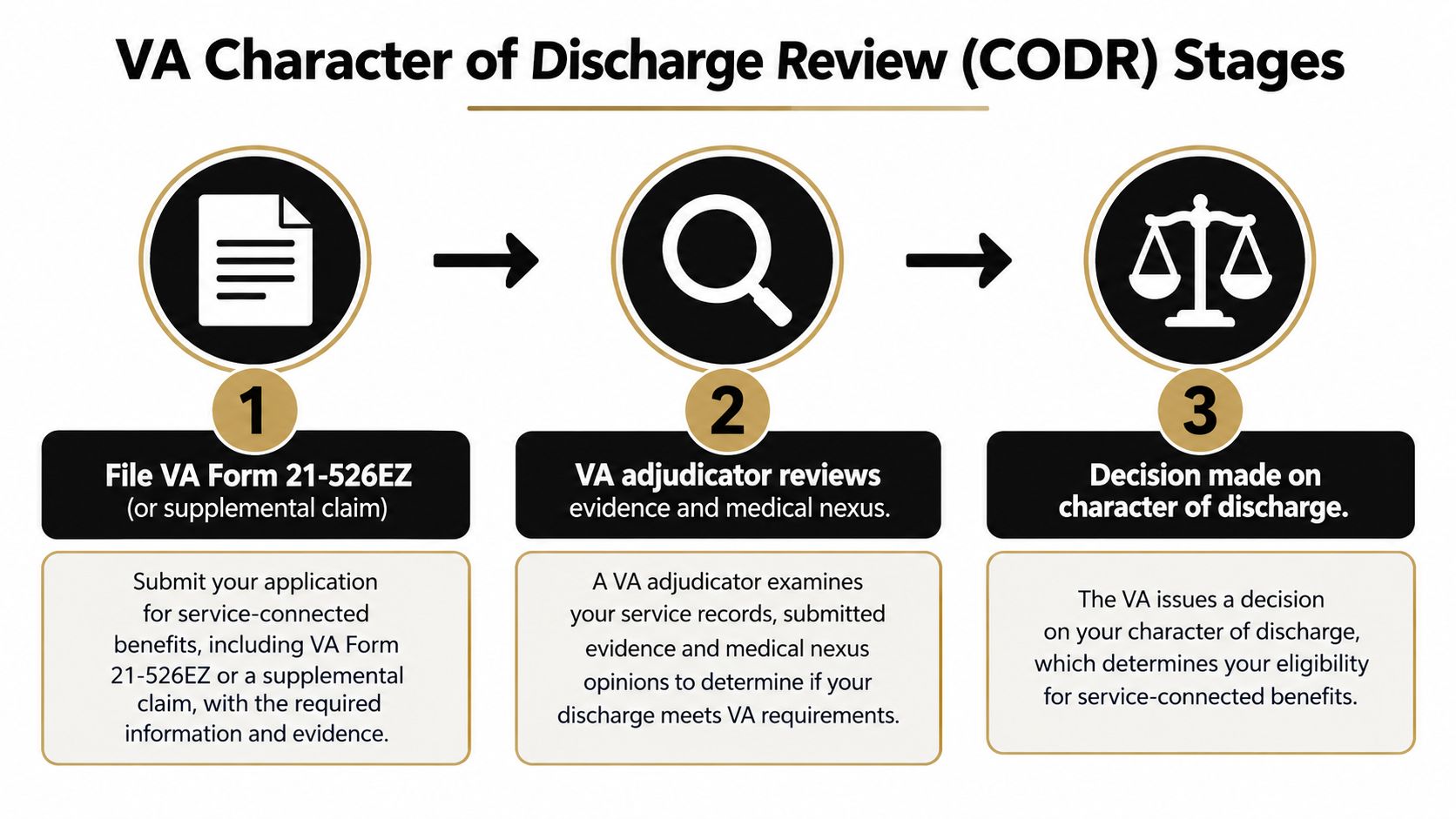
The VA will examine military personnel records, the separation documents, and evidence explaining the conduct that led to discharge. A bare statement that “I was having a hard time” is rarely enough. The stronger presentation ties the misconduct to documented circumstances, such as untreated mental-health symptoms, trauma, substance-use problems, command failures, family emergencies, or other facts supported by records and credible witnesses.
Build the evidentiary record
Gather the documents before you file if possible:
- Separation records: DD-214, notification documents, board findings, reprimands, counseling statements, and command recommendations.
- Medical evidence: Service treatment records, behavioral-health evaluations, post-service diagnoses, treatment notes, and professional opinions.
- Witness evidence: Statements from family members, supervisors, coworkers, fellow service members, or others who observed the relevant symptoms and circumstances.
- Positive service evidence: Evaluations, awards, deployment records, performance history, and evidence showing the misconduct was not the whole story.
- A coherent chronology: Dates and events should match. Contradictions damage credibility faster than unfavorable facts do.
The VA states that a 2014 final rule expanded access for some people separated under OTH conditions or by special court-martial. That rule also reflects the broader principle that compelling circumstances and the surrounding record matter. Don’t submit a disorganized packet and expect the adjudicator to reconstruct your life.
A favorable VA determination can open benefit pathways without changing the military record. An unfavorable decision isn’t necessarily the end, but appeals and additional evidence must be handled strategically.
Upgrading an OTH Discharge Through the Military Review Boards
An OTH discharge is not necessarily permanent. The service-specific Discharge Review Board and the applicable Board for Correction of Military Records can provide separate avenues for relief. They do not function as a second criminal trial, and they will not upgrade every difficult discharge. They examine whether the separation was improper, inequitable, or deserving of relief based on the record and current standards.
Choose the correct review path
A Discharge Review Board generally examines the propriety and equity of a discharge within the authority granted to that board. The Board for Correction of Military Records addresses broader claims involving error, injustice, or an incomplete record. Navy and Marine Corps matters use the appropriate service-specific correction board structure.
The filing choice matters. The military discharge upgrade process requires more than describing regret. You must identify the decision being challenged, explain the error or inequity, and support the explanation with documents.

Present mitigation as a legal theory, not an apology
Boards need a reason to grant relief. The strongest applications usually do several things at once:
- Identify the defect: Explain what the command failed to consider, document, investigate, or fairly weigh.
- Connect condition to conduct: A diagnosis alone isn’t enough. Show how symptoms affected the specific behavior cited in the separation.
- Address the bad facts: Ignoring urinalysis results, unauthorized absence, misconduct reports, or adverse evaluations makes the application look evasive.
- Show post-service rehabilitation: Treatment, stable employment, education, community involvement, and credible character statements can support equitable relief.
- Request realistic relief: An upgrade may be more attainable than a complete rewrite of every separation entry. A narrative-reason change may also matter when characterization relief is uncertain.
The record should explain why the original outcome was unjust or why later evidence changes the fairness analysis. A board isn’t a therapist, and it isn’t required to reward remorse without proof.
The VA’s review and a military upgrade should be treated as parallel strategies. One may open benefits while the other addresses the DD-214, civilian reputation, and future opportunities.
Security Clearance, Employment, and Veterans’ Preference Impact
VA eligibility is only one part of the damage an OTH discharge can cause. Civilian institutions often focus on the characterization, then look backward at the underlying conduct. That creates a second problem: a service member may need to explain both the discharge and the credibility of the explanation.
Different institutions ask different questions
A security-clearance adjudicator may care less about the word OTH than about the conduct behind it, the reliability of the applicant’s disclosures, substance use, financial pressure, criminal behavior, mental health history, and rehabilitation. Concealing the discharge or minimizing documented misconduct can create a more serious trust problem than the original event.
Federal employment and veterans’ preference also require a separate analysis. Eligibility can depend on the type of service, the discharge characterization, and the applicable statutory requirements. State preference programs and professional licensing rules vary, so don’t assume a favorable VA decision automatically controls them.
| Impact Area | Honorable | Other-Than-Honorable | Practical Effect |
|---|---|---|---|
| Security clearance | Usually creates less initial concern | May trigger closer review of the underlying conduct and candor | Prepare a consistent, documented explanation |
| Federal employment | Typically supports ordinary veteran-status documentation | May restrict preference or invite additional review | Confirm the specific position and preference rule |
| Private employment | Usually easier to explain | Background checks and DD-214 information may create questions | Lead with accountability, rehabilitation, and relevant qualifications |
| Professional licensing | Often presents fewer character concerns | Licensing boards may examine misconduct and honesty | Obtain counsel before making detailed disclosures |
| State veterans’ benefits | Often broadly recognized | Eligibility varies by state and program | Check the state statute rather than relying on general assumptions |
| Immigration or naturalization matters | Military service may support a broader application | Underlying conduct can create character and disclosure issues | Get immigration-specific advice before filing |
Practical rule: Never give a casual explanation of an OTH discharge on a clearance, licensing, employment, or immigration form. The answer must match the record.
An upgrade can help because it changes the official military characterization. A favorable VA determination can help with VA benefits, but it generally does not rewrite every civilian database or licensing rule. Keep those remedies separate in your planning.
The same principle applies to firearms and other regulated rights. State and federal rules can turn on the underlying offense, court-martial result, or other facts rather than the OTH label alone. A lawyer must review the actual record before giving you a confident answer.
Real-World Scenarios and Strategic Lessons From OTH Cases
Two people can carry the same OTH characterization and receive very different results. The difference is usually found in the underlying facts, the proof, and the timing of the presentation.
Scenario one, misconduct linked to untreated conditions
A service member receives repeated positive urinalysis results while struggling with an untreated substance-use disorder and symptoms later associated with PTSD. The file contains post-deployment records, family statements, and treatment evidence connecting the symptoms to the misconduct period.
That record gives a review board and the VA something concrete to evaluate. It doesn’t guarantee an upgrade or benefits, but it creates a mitigation theory supported by documents rather than hindsight.
Scenario two, an isolated off-base incident
A sailor receives an OTH after one off-base conduct incident. The service treatment record contains no meaningful behavioral-health evidence, and the application doesn’t dispute the underlying facts or provide credible mitigation.
A board may view the conduct as unrebutted. The applicant’s belief that the incident was “only one mistake” won’t substitute for evidence showing why the discharge was inequitable.
Scenario three, command-directed behavioral-health concerns
A soldier undergoes command-directed behavioral-health evaluations before administrative separation. The record shows the soldier sought counseling, but the command rejected or failed to follow through on available support. Documents and witness statements establish that the command knew about the condition and still treated the resulting behavior as simple defiance.
That evidence can support a request for an upgrade to General, Under Honorable Conditions, or another form of relief, depending on the complete record.
The strategic lessons are consistent:
- Build the record before separation: Once the action is complete, missing evidence becomes harder to recover.
- Request your documents: Obtain personnel, medical, investigation, and separation records instead of relying on memory.
- Use a chronological theory: Explain what happened, when it happened, who knew, and what the command did.
- Confront credibility problems: Inconsistent dates, changing explanations, and unsupported accusations can sink an otherwise sympathetic case.
- Consider narrower relief: A narrative reason change or correction of a specific entry may be more realistic than demanding a complete reversal.
The government’s file may be incomplete. That doesn’t mean the board will fill the gaps in your favor. Your job is to identify the gaps and supply admissible, credible evidence.
Your Action Plan and Why Civilian Defense Counsel Matters Now
If your OTH is still being considered, your best opportunity is before the separation authority acts. Once the characterization appears on the DD-214, you’re no longer only defending your career. You’re building a record for VA adjudicators, review boards, employers, licensing agencies, and clearance officials.
Start with this sequence:
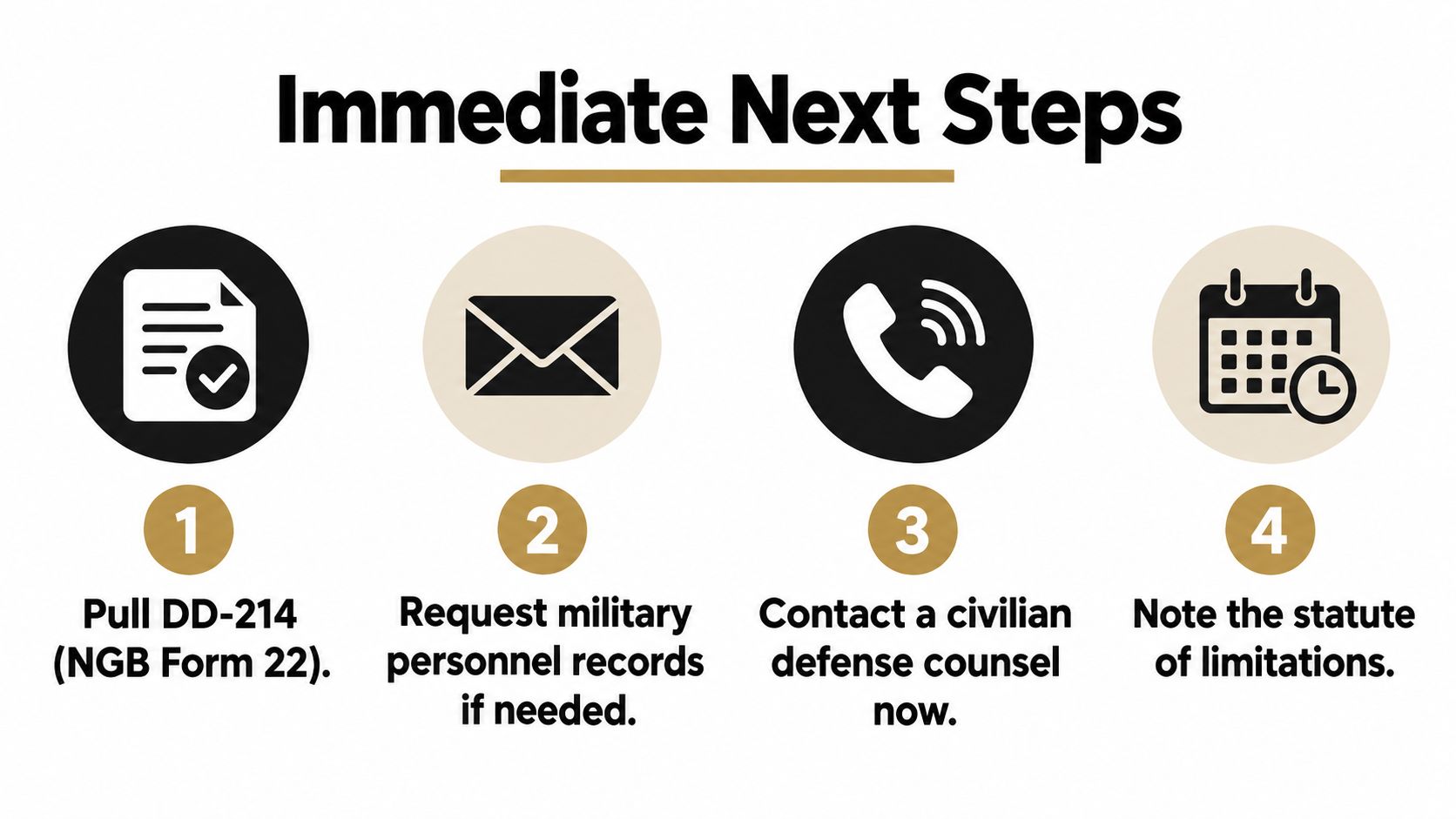
- Pull the DD-214 or applicable separation document. Confirm the characterization, narrative reason, separation authority, and dates.
- Request the military record. Obtain the personnel file, medical records, investigations, counseling statements, evaluations, and separation documents.
- Preserve favorable evidence. Save treatment records, witness statements, performance documents, and proof of rehabilitation.
- Pursue both tracks when appropriate. A VA character-of-discharge review addresses benefits. A military board application addresses the discharge record.
- Get counsel before filing a detailed statement. A careless admission or inconsistent explanation can damage every later proceeding.
Military-appointed counsel can provide important representation during an active separation process. Civilian military defense lawyers add independence from the command structure, experience across branches and proceedings, and the ability to remain involved after the service member leaves active duty. That continuity matters when one record affects both the separation and later upgrade or benefits litigation.
Compare actual experience, communication, strategy, and the lawyer’s willingness to review the complete record before promising an outcome.
The leverage point is early action. Before the separation decision, counsel may challenge the factual basis, expose investigation failures, present medical mitigation, and negotiate the characterization or narrative reason. After separation, counsel must repair the record through evidence and carefully chosen review channels.
Frequently Asked Questions About OTH Discharge Benefits
Can an OTH discharge block all VA benefits?
No. An OTH discharge does not automatically eliminate every VA service or benefit. The VA may conduct a separate character-of-discharge review, and certain targeted health services may remain available even when broader eligibility has not been established.
Can I receive VA disability compensation with an OTH discharge?
Possibly. The VA must determine whether your service qualifies for benefits under the circumstances. A service-connected condition, evidence explaining the misconduct, and a well-supported character-of-discharge presentation can be important.
Does a VA decision upgrade my DD-214?
No. A VA determination applies to VA benefits. It doesn’t change the military record. A discharge upgrade requires action through the appropriate military review board.
Should I wait for a discharge upgrade before applying for VA benefits?
No. Treat the VA review and military upgrade as separate tracks. Waiting for one to finish can delay access to a benefit that might be available through the other route.
Can an OTH affect a security clearance?
Yes, it can lead to closer scrutiny, especially when the underlying conduct involves substance use, criminal behavior, dishonesty, or unresolved reliability concerns. Complete and consistent disclosure is critical.
Is an OTH the same as a Bad Conduct Discharge?
No. An OTH is generally an administrative characterization. A Bad Conduct Discharge is punitive and results from a court-martial. The VA consequences can differ depending on the discharge and the underlying proceedings.
Do I need a lawyer immediately?
If separation action is pending, yes. If you already have an OTH, get counsel before submitting a detailed upgrade or benefits statement. The first written account often becomes the framework for every later decision.
If you’re facing an OTH discharge, pull your DD-214, request the complete record, preserve your medical and personnel evidence, and contact an experienced civilian military defense lawyer now. Don’t wait for the VA or a review board to discover the facts on its own. Your benefits, clearance, employment options, and reputation may depend on the record you build before someone else decides what your service means.