Yes, 98.3% of federal convictions and about 97% of non-federal convictions come from guilty pleas, and a military accused can sometimes challenge a plea bargain after accepting it. The viable grounds are narrow, usually involuntariness, ineffective assistance of counsel, or a government breach, not simple regret about the sentence or career consequences.
You may be sitting in a barracks room, at home with your spouse, or in a holding facility reading the plea agreement for the first time without the pressure of the courtroom around you. The military judge accepted your plea. The government dismissed other specifications. Your lawyer told you the agreement was a good result. Then you noticed the clause that could end your career, destroy your retirement plans, trigger an administrative separation, or affect your security clearance.
That panic is real. It also creates a dangerous temptation to call everyone involved and demand that the deal be undone. That usually doesn't work. The legal question isn't whether you now dislike the bargain. It's whether the plea was legally valid, whether your counsel performed competently, whether the government honored its promises, and whether the record preserves a path to relief.
Table of Contents
- Why the Phone Calls Start the Day After the Deal
- The Default Rule on Plea Appeal Waivers
- Grounds That Can Beat a Waiver in the Military
- UCMJ Pathways for Challenging a Plea After Sentencing
- Why Civilian Defense Counsel Changes the Math
- A Realistic Hypothetical After a Court-Martial Plea
- Common Mistakes and What to Do Right Now
- Frequently Asked Questions About Military Plea Appeals
- Can you appeal a plea bargain after a military judge accepts it?
- Can I withdraw my guilty plea after sentencing?
- Does signing an appeal waiver end my case?
- What happens if the government breaches the plea agreement?
- Can ineffective assistance of counsel undo a military plea?
- Does a bad stipulation of fact support an appeal?
- Should I contact civilian military defense counsel before sentencing?
- Will appealing a plea keep me out of confinement or prevent separation?
Why the Phone Calls Start the Day After the Deal
Staff Sergeant Reyes, a twelve-year E-6 at Fort Bragg, accepted a thirty-day confinement agreement after pleading guilty to wrongful use of a controlled substance. During negotiations, the deal felt like survival. The government dropped additional allegations, the sentence exposure became more predictable, and the courtroom pressure finally ended.
The next morning, Reyes read the agreement again. He focused on the administrative language that had seemed secondary during the hearing. The command could pursue a career-ending HRAP action, and the consequences could reach his retirement plans. He started calling his detailed defense counsel, then the trial counsel, then anyone who might explain how to reverse what had happened.
The answer came back flat: the military judge already accepted the plea.
That answer doesn't necessarily end the matter, but it changes the fight. A service member can't withdraw a plea just because the consequences became clearer after the colloquy. Courts distinguish post-plea regret from a legally defective plea. The timing matters because the record, deadlines, and available remedies begin moving immediately after acceptance and sentencing.
Practical rule: A bad feeling about a plea isn't an appellate issue. A specific defect in the plea process, the advice you received, or the government's performance may be.
The same pattern appears in cases involving Article 120, Article 112a, Article 128, and Article 134 allegations. The accused accepts a negotiated result, then discovers that a stipulation of fact carries damaging admissions, a waiver reaches more claims than expected, or a promised benefit doesn't appear in the written agreement.
The first task is to separate four different complaints:
- Regret: You accepted the agreement but now believe trial might have gone better.
- Misunderstanding: You didn't understand the charge, factual stipulation, sentence consequences, or waiver.
- Counsel failure: Your lawyer gave materially wrong advice, failed to investigate, or failed to explain a major consequence.
- Government breach: The prosecution or command failed to perform a material promise.
Only the last three may support a serious challenge. The rest of this article addresses what can be unwound, what evidence matters, and why an appellate lawyer should review the record before the post-trial process closes.
The Default Rule on Plea Appeal Waivers
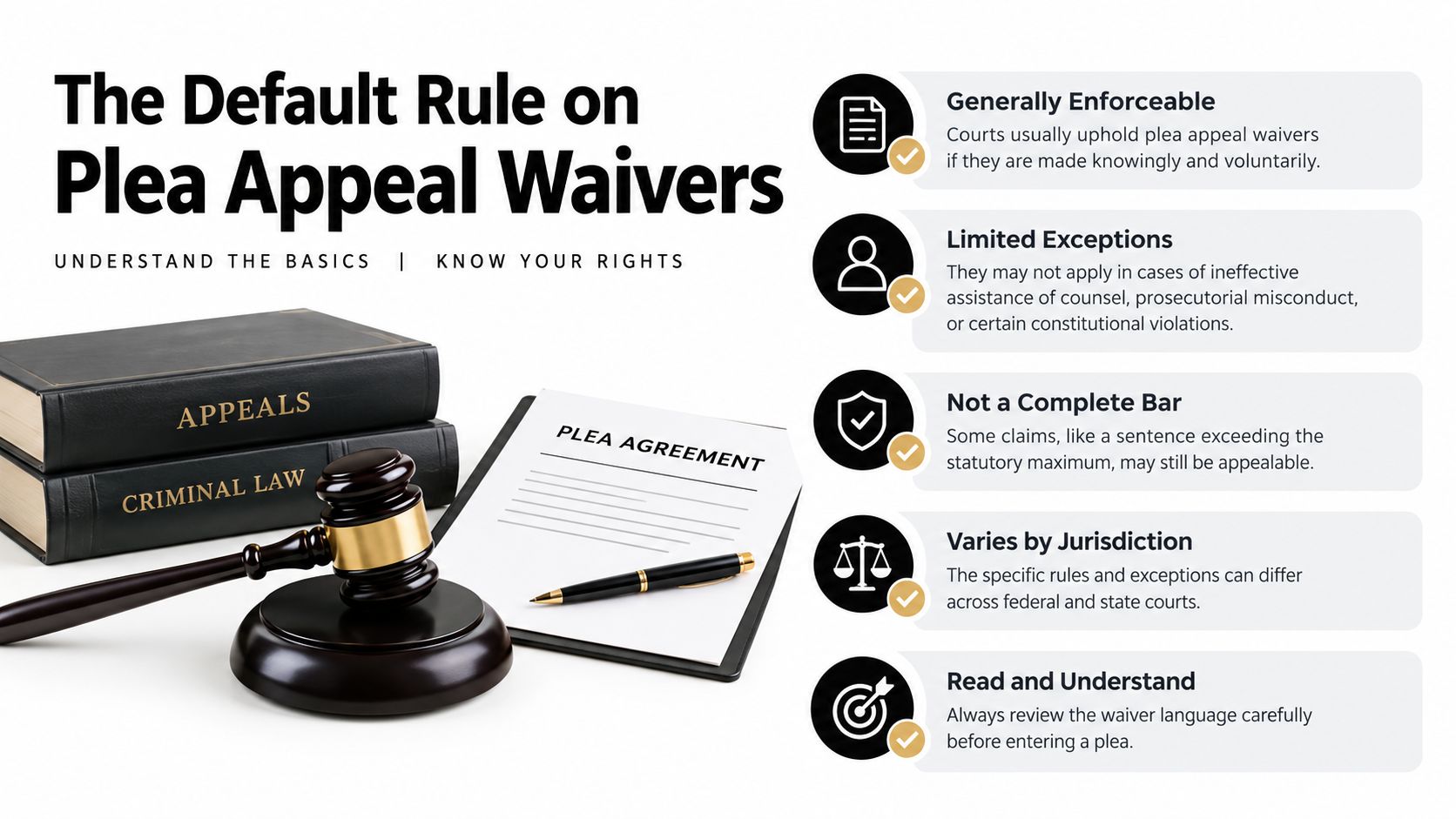
The baseline rule is unfavorable. A defendant who accepts a plea bargain generally gives up most appellate rights, and federal guidance recognizes that courts enforce appeal waivers when they were made knowingly and voluntarily. The Department of Justice discussion of plea agreements and sentencing appeal waivers also recognizes that some constitutional and statutory claims can survive a waiver.
The military system applies the same practical logic. The agreement, the providence inquiry, and the military judge's questions create the record that later courts read. A signed waiver helps the government, but it doesn't cure a plea that the accused didn't understand or that counsel obtained through materially deficient advice.
What the colloquy must establish
A competent military judge doesn't merely ask whether you signed the agreement. The judge should develop an individualized record showing that you understand the charge, the factual basis, the rights you're giving up, the possible punishment, and the material terms of the agreement.
The judge's questions should also expose whether you understand the role of counsel and the consequences of the appeal waiver. A reliable record usually shows:
- Understanding of the agreement: You read or reviewed the written terms and understood what the government promised.
- Understanding of the factual basis: You can explain why your conduct satisfies the charged offense rather than repeating words supplied by counsel.
- Understanding of surrendered rights: You know that a guilty plea gives up trial rights and can sharply restrict appellate review.
- Voluntariness: No one threatened, coerced, or improperly induced you to plead guilty.
- Satisfaction with counsel: You had the opportunity to ask questions and received advice before making the decision.
Boilerplate answers don't automatically invalidate a plea. But a record full of yes-or-no responses, no individualized inquiry, and no confirmation that the accused understood a damaging stipulation gives defense counsel something to investigate.
The Court of Appeals may start with the transcript because it provides the clearest contemporaneous evidence of what you knew. A later affidavit saying “I didn't understand” faces a difficult comparison if the transcript shows detailed answers. Conversely, a transcript that reveals confusion, hesitation, or an unanswered question can matter greatly.
Why the waiver isn't absolute
A valid waiver can block ordinary complaints about sentence severity and many trial errors. It doesn't necessarily block a claim that the plea itself was invalid, that counsel's deficient performance affected the decision to plead, or that the government failed to honor the bargain.
The scale of plea litigation explains why courts enforce these provisions so carefully. A 2024 Supreme Court filing citing federal and non-federal guilty-plea figures described guilty pleas as the source of 98.3% of federal convictions and about 97% of non-federal convictions. When negotiated pleas resolve the overwhelming majority of criminal cases, courts need finality. They also need a reliable method for identifying the pleas that were never valid in the first place.
Grounds That Can Beat a Waiver in the Military
Three theories consistently deserve serious analysis after a court-martial plea: involuntariness, ineffective assistance of counsel, and government breach. They overlap, but they require different proof and offer different remedies.
Involuntary or unknowing plea
An involuntary plea is not merely a plea made under emotional pressure. Every court-martial plea carries pressure. The issue is whether the pressure, misunderstanding, coercion, or misinformation deprived the decision of a genuine and informed choice.
Counsel should examine whether you understood:
- The elements of the offense.
- The conduct admitted in the stipulation of fact.
- The sentencing range and agreement limits.
- Administrative consequences that were material to the decision.
- Any appeal waiver or reservation of rights.
- The difference between accepting a sentence risk and accepting an admission of guilt.
The record includes the plea agreement, the stipulation, the transcript, emails, text messages, attorney notes, and any sworn statements from people who observed the advice process. The New York Court of Appeals discussion of voluntary, knowing, and intelligent appeal waivers illustrates the broader principle. A waiver must reflect an informed choice, not merely a signature.
Ineffective assistance of counsel
A claim under Strickland v. Washington, applied in military practice through cases such as United States v. Mazza, requires more than proving that counsel made a mistake. The defense must identify deficient performance and show a reasonable possibility that the error affected the plea decision or outcome.
Examples that can matter include a lawyer who:
- Misstates the meaning of a stipulation of fact.
- Fails to investigate a viable defense before recommending a plea.
- Doesn't explain a material administrative consequence.
- Advises that an appeal waiver is absolute when recognized exceptions may apply.
- Pressures an accused to accept without explaining the alternative.
- Fails to object when the government departs from an agreed promise.
A bare assertion that counsel “didn't fight” is weak. A sworn declaration identifying the advice, the documents reviewed, the questions asked, and the decision that would have changed with competent advice is far more useful. The government will compare that declaration against the transcript and counsel's records.
Government breach
A plea agreement is a contract with constitutional consequences. If the government makes a promise, it must perform that promise according to the agreement's language and the accused's reasonable understanding of the negotiated benefit.
A breach may involve a sentencing position, a dismissal, a recommendation, a letter, a transfer-related commitment, or conduct by government representatives that undermines the bargain. The agreement controls, but context matters when interpreting ambiguous language.
The Supreme Court's Santobello framework and military cases such as United States v. Smith guide the analysis. Available relief can include specific performance, sentence relief, or rejection of the plea. A serious breach argument may be stronger than a generalized attack on the waiver because it focuses on what the government did after receiving the guilty plea.
For issues involving command pressure or improper influence, counsel should separately examine unlawful command influence under the UCMJ. A command climate problem isn't automatically a plea defect, but evidence that command pressure affected the decision or later undermined the bargain can change the analysis.
| Ground | Legal standard | Burden and evidence | Realistic relief |
|---|---|---|---|
| Involuntary or unknowing plea | The plea was not a genuine, informed, and voluntary choice | Transcript, agreement, stipulation, affidavits, messages, and evidence of coercion or misunderstanding | Withdrawal of the plea or further proceedings |
| Ineffective assistance | Counsel performed deficiently and the error affected the plea decision or result | Specific advice failures, counsel files, expert review, and a credible explanation of a different decision | Plea withdrawal, new sentencing, or other appellate relief |
| Government breach | The government failed to perform a material promise or acted inconsistently with the bargain | Written agreement, post-plea conduct, correspondence, witnesses, and command records | Specific performance, sentence relief, or rejection of the plea |
The strongest claim is usually the one tied to objective evidence. A transcript contradiction, an unmistakable written promise, or a documented failure to investigate carries more weight than a vague assertion that the result feels unfair.
UCMJ Pathways for Challenging a Plea After Sentencing
A military plea challenge begins with the record created before and during the hearing. The written agreement and stipulation matter, but so do the providence inquiry, presentencing statements, objections, and any explanation of what the accused believed the government promised.
Start with the existing record
The first review should answer five questions:
- What did the agreement promise? Ignore oral assumptions until the written language is analyzed.
- What did the military judge ask? Look for confusion, unanswered questions, and unsupported conclusions.
- What did the accused admit? Compare the stipulation with the charged elements and the advice counsel gave.
- What objections were preserved? Identify issues raised before or during sentencing.
- What happened after acceptance? Collect evidence of breach, retaliation, inconsistent representations, or failure to perform.
The rules governing plea agreements make the exact language central. Rule for Courts-Martial 705 materials describe a plea agreement as a written arrangement that may limit sentencing outcomes, while requiring acceptance by the military judge before it takes effect. That makes every version of the agreement important, including drafts and email exchanges.
Move through the available review channels
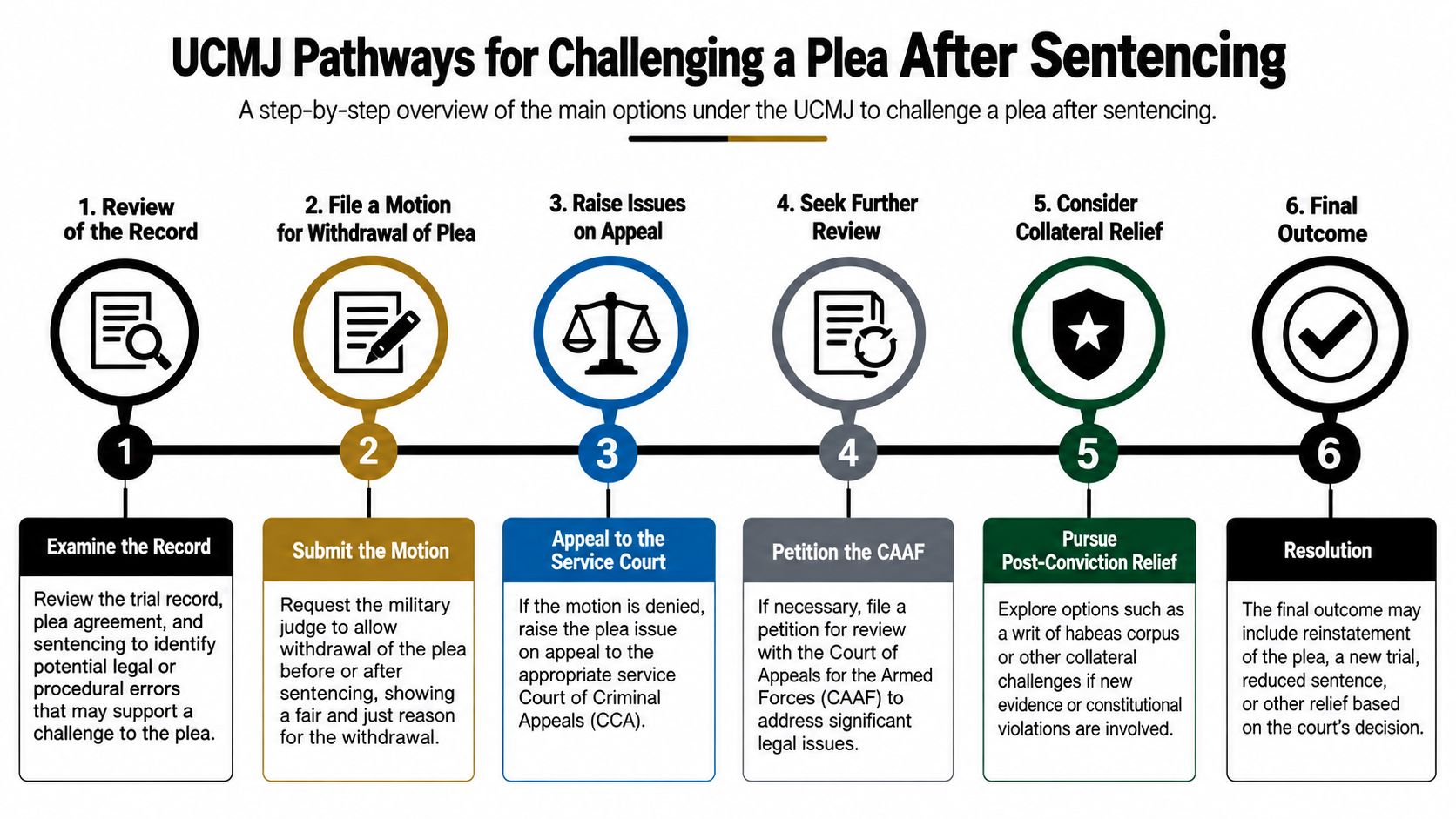
After sentencing, the defense may pursue several routes, depending on the findings, sentence, waiver language, and procedural posture:
- Post-trial submissions: Raise errors, explain misunderstandings, and document government nonperformance through the available post-trial process. Do this before the record is finalized.
- Court of Criminal Appeals review: Eligible cases receive service-level appellate review under Article 66. The court reviews the record and can address certain legal and factual issues, subject to jurisdiction and waiver limits.
- Further review by CAAF: The Court of Appeals for the Armed Forces may review qualifying issues, including selected petitions and matters it accepts.
- Extraordinary relief: Writ practice may be available in unusual circumstances, especially where ordinary appellate review cannot provide an adequate remedy.
- Article 69 review: Matters outside ordinary automatic review may be presented through the Judge Advocate General's review authority, subject to the governing rules and limitations.
- Collateral litigation: A later challenge may focus on ineffective assistance, newly discovered evidence, or a fundamental defect that the direct record cannot resolve.
The exact deadline depends on the type of case and filing. Don't rely on a general internet deadline or assume that a waiver eliminates the need to preserve an issue. A military appellate attorney should calculate the controlling dates from the convening action, record transmission, entry of judgment, and applicable rules.
Federal criminal procedure illustrates the basic distinction between withdrawal and appeal. Under Federal Rule of Criminal Procedure 11, withdrawal before sentencing requires a fair and just reason, while post-sentencing relief generally proceeds through direct appeal or collateral attack. Courts-martial use their own rules and authorities, but the strategic lesson is the same: the argument usually must attack the validity of the plea, the performance of counsel, or the government's compliance.
Why Civilian Defense Counsel Changes the Math
Your detailed defense counsel and the convening authority are not your appellate team. Neither is the staff judge advocate. They occupy different institutional roles, and the government actors who negotiated or defended the plea won't independently reconstruct every decision that may now be under attack.
Military defense counsel can provide excellent representation. The structural problem is continuity. A trial lawyer may be reassigned, a new lawyer may inherit the record, and an appellate office may evaluate the case through the existing file rather than through the history of every conversation that led to the plea.
A retained civilian court-martial attorney can spend the time needed to compare the agreement, draft versions, transcript, stipulation, discovery, counsel communications, and post-plea conduct. That review often identifies the underlying issue. It may show that the waiver is not the problem at all. The problem may be one sentence in the stipulation, one unexplained administrative consequence, or one promise the government failed to perform.
What independent review adds
Civilian counsel can also build an evidentiary record beyond the trial transcript. That may require:
- Interviews with former defense team members.
- Affidavits from family members or witnesses.
- Review of investigative files and digital communications.
- Analysis by sentencing or administrative experts.
- Examination of command statements after the plea.
- A focused motion rather than a broad complaint about unfairness.
The military defense lawyer resource on court-martial defense is one place families can identify civilian counsel for comparison. The important point isn't the directory. It's whether the lawyer regularly handles military pleas, appellate records, ineffective-assistance claims, and government-breach disputes.
A civilian lawyer can't promise that a plea will be withdrawn. The lawyer can identify whether the record contains a legally useful defect before the opportunity disappears.
Early involvement also protects your options. If the record is still being assembled, counsel may be able to seek clarification, enforce a promise, preserve a withdrawal position, or negotiate a correction before the government treats the case as permanently closed. Waiting until confinement begins or separation paperwork is complete often makes the practical options narrower.
A Realistic Hypothetical After a Court-Martial Plea
Consider a Staff Sergeant E-6 at Fort Bragg who pleads guilty to one specification of attempted distribution of a controlled substance under Article 112a. In exchange, the government dismisses three additional specifications and a BAH fraud charge. The agreement also includes an honest-service letter intended to support his post-conviction employment and transition.
Three weeks after sentencing, the unit commander makes public statements at command call that effectively label him a drug dealer. The SJA then refuses to issue the agreed letter, arguing that the command can't endorse someone convicted of drug conduct.
That is not merely a disappointed client problem. Counsel must compare the command's conduct and the refused letter with the agreement's exact language, the negotiations, and the military judge's understanding of the bargain.
The tactical response
A civilian lawyer could pursue several actions at once:
- Document the breach: Obtain the agreement, email history, draft letter, witness accounts, and any recording or written summary of the command remarks.
- Seek relief from the military judge: File an appropriate breach motion requesting specific performance, sentence relief, or another remedy authorized by the circumstances.
- Preserve the withdrawal position: Avoid taking a step that waives the argument that the government materially breached the bargain. The defense may request relief while preserving a position to withdraw the plea if performance is denied.
- Protect appellate rights: File the necessary notice and preserve the issue for Article 66 review rather than assuming negotiations will solve it.
- Reopen negotiations from evidence: Present the government with a documented breach and a defined remedy, not an emotional demand to “make it right.”
The public statements may or may not constitute a legal breach. The letter may or may not be enforceable as written. Those questions depend on the agreement and proof. The strategic mistake would be treating the dispute as a personnel complaint instead of a plea-enforcement problem.
The first weeks after sentencing often provide the clearest evidence of what happened. Witnesses still remember the command remarks, communications remain available, and the defense can identify the exact promise before the parties adopt conflicting narratives.
Common Mistakes and What to Do Right Now
Service members make predictable mistakes after accepting a plea:
- Signing without reading: Don't treat the agreement as paperwork your lawyer already handled. Read every waiver, stipulation, and collateral term.
- Posting online: Social media can create admissions, credibility problems, or evidence of inconsistency.
- Failing to speak up: If you don't understand a judge's question, say so. A silent transcript can make later confusion difficult to prove.
- Talking to investigators: Don't discuss the case with CID, NCIS, OSI, or CGIS without counsel. Review Article 31 rights and military questioning before answering.
- Missing a deadline: Post-trial and appellate clocks are unforgiving. Get the dates calculated from the actual record.
- Relying on the SJA: The SJA advises the government, not you. The same applies to trial counsel and command representatives.
- Waiting for separation paperwork: Administrative action can create consequences that are harder to challenge after the plea record closes.
Take these steps immediately:
- Preserve every version of the agreement, stipulation, email, text, and sentencing document.
- Write a sworn timeline of what counsel explained, what counsel omitted, and what you believed you were accepting.
- Identify the precise issue. Was it a misunderstanding, deficient advice, or breach?
- Stop discussing the case with investigators and command personnel except through counsel.
- Have an independent UCMJ lawyer review the record before the applicable post-trial or appellate deadline expires.
Frequently Asked Questions About Military Plea Appeals
Can you appeal a plea bargain after a military judge accepts it?
Sometimes. A valid plea and appeal waiver sharply restrict review, but a challenge may proceed if the plea was involuntary or unknowing, counsel was ineffective, or the government breached the agreement. Simple regret usually isn't enough.
Can I withdraw my guilty plea after sentencing?
Withdrawal is difficult after sentencing. The argument normally must identify a legal defect in the plea, such as coercion, misunderstanding, ineffective assistance, or a material government breach. The governing military rules and the procedural posture control the available remedy.
Does signing an appeal waiver end my case?
No, but it changes the analysis. A waiver can block ordinary challenges while leaving room for claims attacking the validity of the plea itself or certain claims that law doesn't permit the government to waive.
What happens if the government breaches the plea agreement?
The defense should preserve proof of the promise and the breach, then seek an appropriate remedy. Depending on the agreement and facts, the remedy may include specific performance, sentence relief, or rejection of the plea.
Can ineffective assistance of counsel undo a military plea?
It can, but the claim needs specificity and proof. You must identify what competent counsel should have done and explain how that failure affected your decision to plead or the result.
Does a bad stipulation of fact support an appeal?
Potentially. If the stipulation admits conduct that doesn't satisfy the offense, contains materially false facts, or reflects a misunderstanding caused by counsel, it may support a challenge. The transcript and advice record will matter.
Should I contact civilian military defense counsel before sentencing?
Yes, particularly if you don't understand the agreement, the waiver, or the stipulation. Independent review before the record is finalized can protect options that become harder to recover later.
Will appealing a plea keep me out of confinement or prevent separation?
Not automatically. An appeal doesn't erase the sentence or administrative process by itself. Counsel must separately assess deferment, sentence relief, separation consequences, and any request for immediate protection.
If you've already accepted a military plea bargain and now believe the agreement was misunderstood, counsel was ineffective, or the government broke its promise, preserve the record today. Gather the agreement, stipulation, transcript, messages, and post-sentencing documents, then contact an experienced civilian court-martial attorney before the applicable post-trial or appellate deadline closes. Your liberty, career, retirement, and reputation may depend on identifying the defect while the court still has a meaningful remedy available.