
You’re standing outside your commander’s office with a notification in your hand, trying to understand whether an Article 15 military proceeding is a warning, a conviction, or the beginning of the end of your career. You may be worried about losing rank, pay, promotion eligibility, clearance access, or even your freedom. Your family is asking what happens next, and nobody in the chain of command is giving you a straight answer.
An Article 15 isn’t a verdict. It’s a decision point. The alleged offense matters, but the outcome often turns on three other questions: which NJP track you’re being offered, what authority the commander has, and whether you accept, appeal, or demand trial by court-martial. Treat that choice casually, and you can create career damage that lasts long after the extra duty ends.
Table of Contents
- The Moment You Get Offered Article 15
- What Article 15 Actually Is Under the UCMJ
- Summarized vs Company vs Field Grade Article 15
- Your Rights at the Article 15 Hearing
- Accept, Appeal, or Demand Court-Martial
- Building a Real Mitigation Strategy
- How Article 15 Follows Your Career
- Why Civilian Military Defense Counsel Matters Now
- Common Article 15 Mistakes
- Frequently Asked Questions About Article 15 Military Proceedings
The Moment You Get Offered Article 15
The commander calls you in. The notification is read. You’re handed DA Form 2627, or the equivalent form used by your service, and told that you’re being considered for nonjudicial punishment. Your pulse rises. You start calculating what a reduction in rank would do to your household budget, whether forfeitures would affect rent, and whether a restriction period would interfere with your civilian responsibilities.
You may also hear reassuring language. “This is just administrative.” “It’ll be over quickly.” “You should accept it and move on.” Don’t make a decision because the room feels uncomfortable or because someone in authority wants the meeting finished.
Practical rule: Sign only to acknowledge receipt unless your lawyer has reviewed what you’re signing and explained the consequences.
The offense written on the form rarely determines the entire result by itself. The commander’s grade and authority, the specific Article 15 track, the evidence supporting the allegation, your prior record, and the punishment being considered all change the calculation. A summarized proceeding is not the same risk as a field-grade proceeding, even when the underlying allegation sounds similar.
Your next move should be controlled, not emotional:
- Preserve the paperwork. Keep every page, enclosure, rights advisement, and deadline.
- Stop explaining. Don’t give investigators or command a spontaneous account before receiving legal advice.
- Identify the track. Ask what type of NJP is being offered and who will impose it.
- Request counsel. Speak with defense counsel before deciding whether to accept the proceeding.
- Protect evidence. Save messages, schedules, medical records, names of witnesses, and documents that may disappear.
You’re not trying to win an argument in the commander’s office. You’re protecting the record that will control the next decision.
What Article 15 Actually Is Under the UCMJ
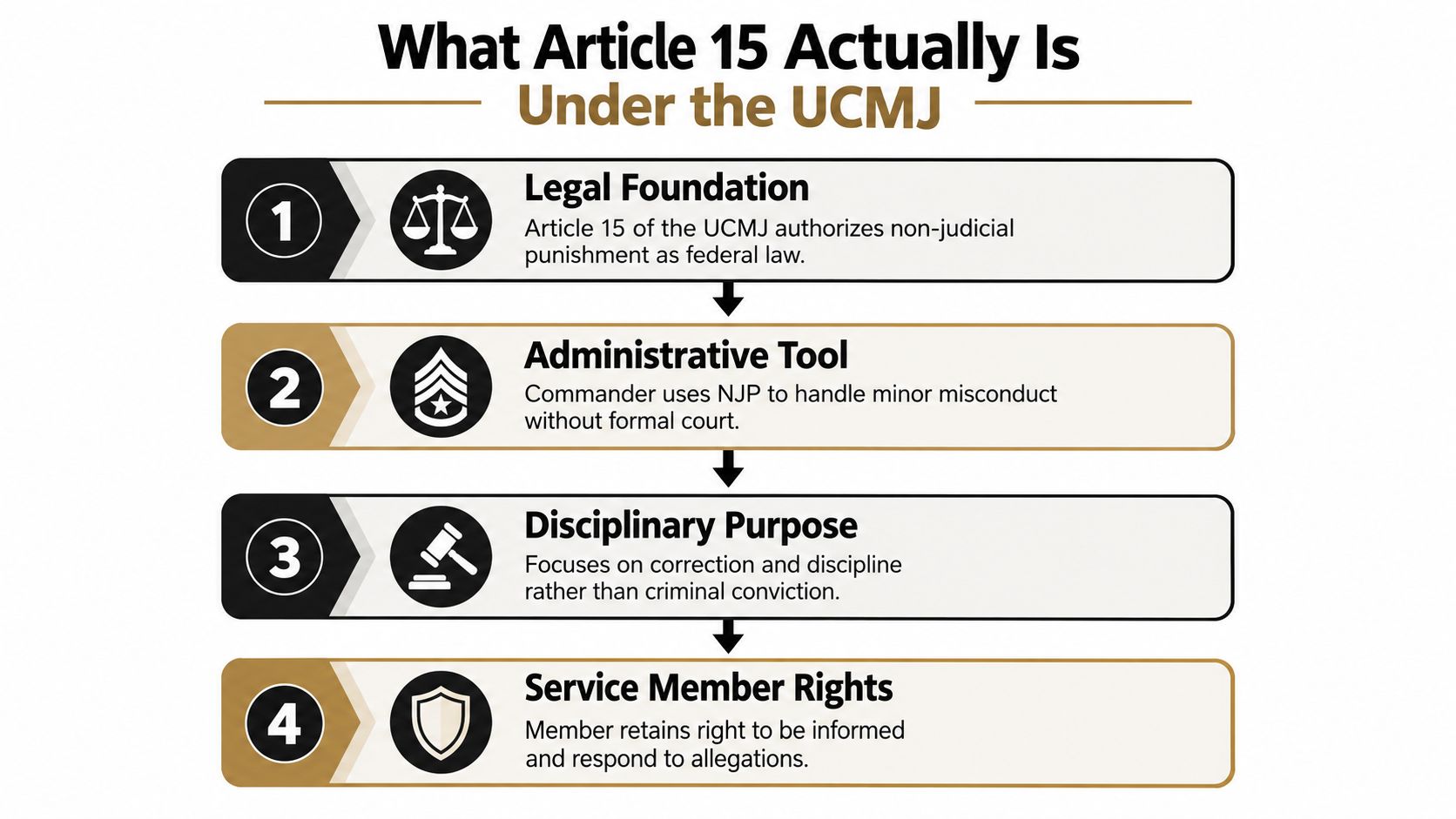
Article 15 of the Uniform Code of Military Justice authorizes nonjudicial punishment for minor offenses without sending every matter to a court-martial. The statutory authority appears in 10 U.S.C. § 815. NJP is faster and less formal than a trial, but it still gives the commander power to impose serious disciplinary consequences within defined limits.
The authority has deep roots. Scholarship on military justice traces commander-imposed summary punishment to the Articles of War adopted by the Continental Congress in 1775. The Army’s summary punishment became statutory in the 1916 Articles of War, and that authority carried into the modern UCMJ in 1950. Congress amended the UCMJ in 1962 to give commanders explicit statutory authority to use Article 15 for minor offenses rather than sending every case to court-martial. The historical development is documented in this military justice history from the National Security Law Journal.
The terminology changes by branch:
- Army and Air Force: Article 15 or NJP.
- Navy and Coast Guard: Captain’s mast.
- Marine Corps: Office hours.
The process is administrative, but that label doesn’t make it harmless. The commander must have authority over you, must notify you of the allegations, and must give you an opportunity to respond before punishment is imposed. You can present matters in defense and mitigation, and you may have representation through military defense counsel or a civilian attorney.
NJP also differs from a court-martial in a fundamental way. There’s no ordinary trial structure with a military judge deciding the case, formal discovery, and the government proving guilt beyond a reasonable doubt. That difference is precisely why the decision to accept or refuse Article 15 requires a deliberate review of the evidence and potential consequences.
Summarized vs Company vs Field Grade Article 15
The Article 15 track controls the ceiling. It tells you how much punishment the commander may impose, and those limits depend on command authority and your grade. Army University Press describes the three common Army tracks and their maximum punishments in its NJP overview.
| Punishment Type | Summarized | Company-Grade | Field-Grade |
|---|---|---|---|
| Extra duty | Up to 14 days | Up to 14 days | Up to 45 days |
| Restriction | Up to 14 days | Up to 14 days | Up to 45 days, or 60 days if imposed alone |
| Forfeiture of pay | Not listed in the cited Army summary | Seven days’ pay | Half a month’s pay for two months |
| Reduction in grade | Not listed in the cited Army summary | One grade for E-4 and below | One or more grades for E-4 and below, one grade for E-5 and E-6 |
| Other punishment | Reprimand may apply | Reprimand may apply | Reprimand, and other authorized limits |
A summarized Article 15 is the lightest Army track. It commonly addresses relatively minor misconduct and tops out at extra duty and/or restriction for 14 days, according to the Army University Press material cited above.
A company-grade Article 15 creates a larger career risk because it can include reduction for an E-4 or below and forfeiture of seven days’ pay. That punishment can affect promotion prospects and your standing within the unit even when the immediate financial loss appears manageable.
A field-grade Article 15 is where the decision becomes especially dangerous. The punishment can include reduction, significant forfeiture, and extended restriction or extra duty. Air Force materials also show how the ceiling scales when a colonel or lieutenant colonel acts against an E-1 through E-4. The listed possibilities include half pay per month for two months, 60 days of restriction, 45 days of extra duty, 30 days of correctional custody, a reprimand, and reduction to E-1, as reflected in Army University Press’s NJP reference.
Find out the track before you assess the allegation. A weak allegation paired with a severe track can demand a different defense strategy than a strong allegation paired with a limited one.
Your Rights at the Article 15 Hearing
Your first protection is notice. You should know what conduct is alleged, what UCMJ provision is involved, and what punishment the commander may impose. Read the rights advisement carefully. Don’t sign because the commander or first sergeant is waiting.
You also have the right to remain silent. An Article 15 setting feels informal, and that informality causes service members to talk too much. They try to explain intent, correct a minor detail, or prove they’re good people. Those statements can later appear in administrative or separation proceedings. For a deeper explanation of the privilege against self-incrimination, review Article 31 of the UCMJ.
The protections people waive under pressure
You can consult military defense counsel before deciding whether to accept NJP. You can also have a civilian attorney represent you, present evidence, request witnesses, make a personal appearance, and submit a written rebuttal or statement in defense and mitigation.
Those rights matter because the commander’s decision may be based on an incomplete investigation. A defense presentation can expose inconsistent accounts, missing records, unreliable timelines, or context that command never considered.
Use the available tools deliberately:
- Request witnesses early. Identify what each witness adds, not merely who likes you.
- Collect documents. Preserve duty schedules, messages, medical records, training records, and relevant orders.
- Prepare a written response. Address the allegation directly without adding unnecessary admissions.
- Consider a personal appearance. Your conduct, accountability, and preparation can affect how the commander evaluates mitigation.
- Ask about timing. A hearing may be rescheduled, and the commonly discussed 72-hour period for consulting counsel is not a deadline to answer the allegations. It’s a period for obtaining advice, not a reason to rush.
The right to respond is a powerful advantage. Use it before punishment is imposed, not after the damage has already been recorded.
Accept, Appeal, or Demand Court-Martial
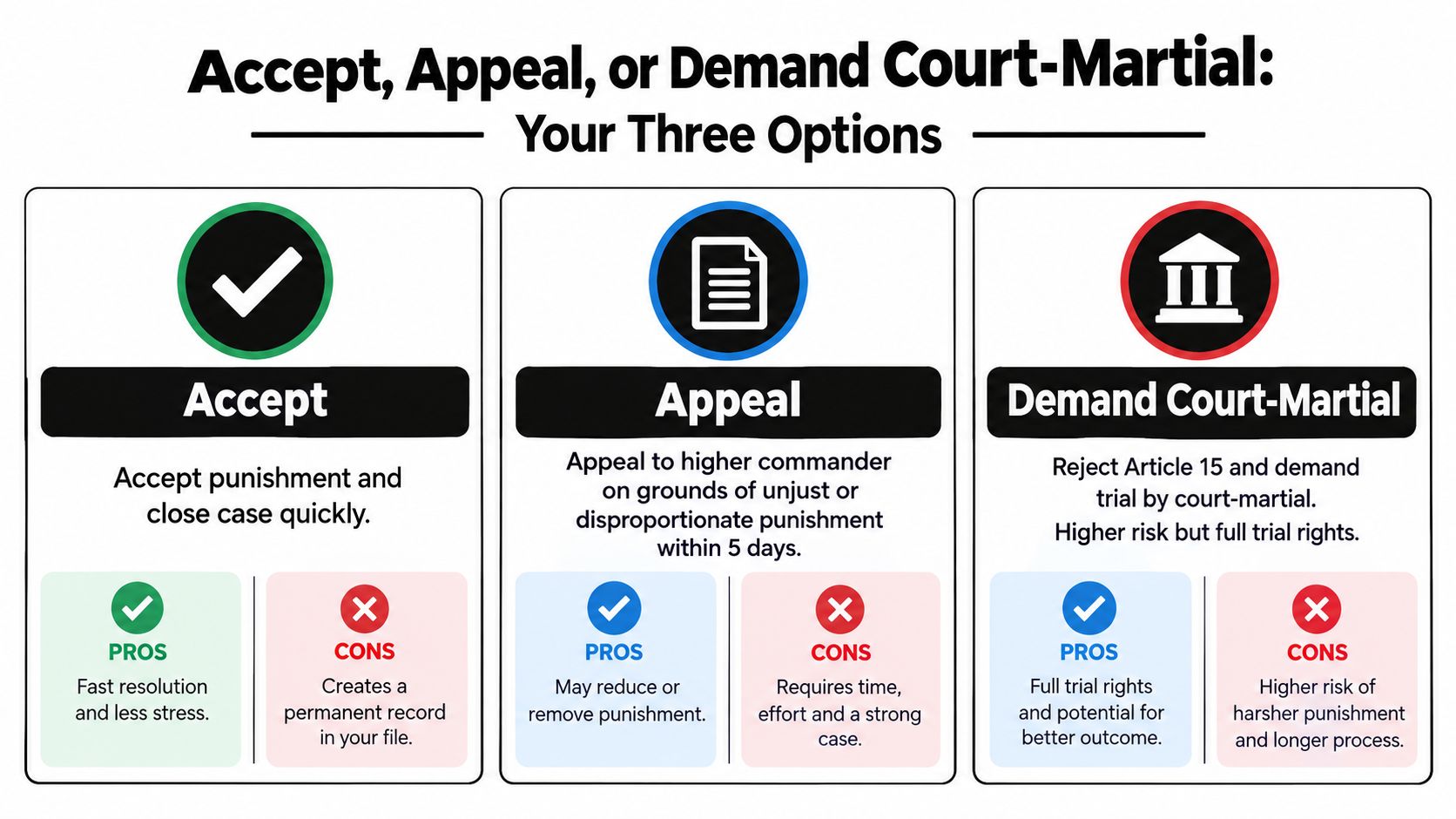
The choice at the notification stage often carries more strategic weight than the underlying allegation. You generally need to evaluate acceptance, appeal, and court-martial demand against the evidence, punishment ceiling, service record, and long-term career plans.
Accepting NJP
Acceptance can make sense when the evidence is strong, the proposed punishment is manageable, and a court-martial would expose you to substantially greater risk. It may also be reasonable when your defense lawyer has negotiated a reduced outcome or built a strong mitigation package.
But acceptance closes off the opportunity to force the government to litigate the allegation in a formal trial. You’re choosing controlled resolution over a full contest. That can be smart, but only after reviewing the record and the career consequences.
Appealing the punishment
An Article 15 appeal goes to the next superior authority. The appeal can challenge an unjust finding, excessive punishment, procedural error, or newly developed information. It isn’t a complete retrial, and it doesn’t automatically erase the original action.
The deadline is strict. The appeal must be submitted within 5 calendar days, not duty days, although a commander may extend the period for good cause. The deadline and its consequences are addressed in this Army Article 15 appeal guidance.
Demanding court-martial
Demanding trial shifts the case into a formal prosecution path. The government must prove the charge beyond a reasonable doubt, and the defense gains the protections and litigation tools associated with a court-martial. That path also carries conviction risk, additional exposure, and uncertainty.
Use a decision matrix, not instinct:
- Weak evidence: A demand may expose credibility defects and investigative gaps.
- Severe proposed punishment: A field-grade action or possible career-ending reduction deserves aggressive review.
- Strong record: Good evaluations, reliable witnesses, and documented service can support mitigation or trial strategy.
- Punitive-discharge exposure: Allegations that could grow into a court-martial or separation matter require immediate counsel.
A quick acceptance may feel safe because the room becomes quiet. That doesn’t mean it’s the best outcome. Read court-martial basics before deciding whether the formal process gives you a better strategic position.
Building a Real Mitigation Strategy
A junior service member facing a positive urinalysis can walk into the Article 15 hearing with nothing but an apology. Or that service member can arrive with a disciplined mitigation package that gives the commander a reason to impose less punishment.
The difference is preparation. The package should be built around facts the commander can verify:
- Character statements: Obtain statements from supervisors and peers who can describe duty performance, reliability, and leadership.
- Prior record: Document the absence of prior discipline rather than merely asserting it.
- Rehabilitation steps: Include proof of treatment, counseling, or other corrective action already underway.
- Personal context: Present documented family hardship, combat stress, or medical circumstances when they relate to the conduct.
- A concise statement: Prepare a short unsworn statement that accepts appropriate responsibility without rambling, blaming others, or making new damaging admissions.
The objective isn’t to manufacture sympathy. It’s to give the commander a complete record before punishment is selected. A commander deciding from an investigative summary may see misconduct. A carefully prepared submission may also show accountability, service value, corrective action, and a low risk of recurrence.
What counsel does with the packet
A defense lawyer should coordinate witnesses, remove irrelevant or harmful material, verify documents, and keep the presentation focused. Character evidence that contains exaggerations or accusations against the chain of command can hurt more than it helps.
Mitigation also protects the future record. A thoughtful submission can support an appeal, a later administrative response, or a records-correction request. The work done in the short window before the hearing often matters more than a last-minute emotional plea at the table.
How Article 15 Follows Your Career
The immediate punishment is only one part of the problem. The service record entry, filing decision, promotion impact, clearance review, special-duty eligibility, and possible separation consequences may matter longer than restriction or extra duty.
Start with the form. In the Army, DA Form 2627 records the action, while other services use their own documentation. Filing rules vary by the type of action and service. The table below captures the timeline categories commonly requiring review, but you must confirm the applicable regulation for your branch and grade before relying on it.
| Article 15 Type | Local File Duration | Promotion Flag Duration | Appeals Window |
|---|---|---|---|
| Summarized | Regulation-dependent | Regulation-dependent | Confirm with defense counsel and the applicable service regulation |
| Company-grade | Two years under the cited Army guidance | Regulation-dependent | Five calendar days |
| Field-grade | Longer than company-grade under applicable Army filing rules | Regulation-dependent | Five calendar days |
The word “local” doesn’t mean irrelevant. Command screening, promotion review, special-duty selection, and officer or enlisted commissioning decisions can expose the action to decision-makers who evaluate your overall record. A flag under AR 600-8-2 can delay promotion action, while an NJP can create questions during a security-clearance reinvestigation.
Special assignments can also become harder to obtain. Recruiting duty, drill sergeant duty, and other selective assignments depend on command confidence, record quality, and eligibility requirements. A single NJP can damage that profile even when the punishment itself is completed.
An NJP usually isn’t the sole basis for separation, but it can become supporting evidence in a broader misconduct or performance package. Preserve your notice, evidence, appeal, character letters, and final disposition. If the record later requires correction or discharge review, those documents may support a request through the appropriate Discharge Review Board, Board for Correction of Military Records, or Naval Discharge Review Board. Review this guide to Article 15 and military career effects while the documents are still available.
Reserve and Guard members need special attention. Army guidance states that all Reserve Component Soldiers may receive NJP while serving in a Title 10 duty status, which means the analysis can change depending on whether the member is mobilized, performing another Title 10 duty, or serving in a different status. Civilian employment and drilling obligations don’t eliminate the need to examine command authority and record treatment.
Why Civilian Military Defense Counsel Matters Now
Military-appointed defense counsel and Trial Defense Service attorneys can provide important representation, and they’re independent from the command imposing punishment. But a serious Article 15 may require more time, investigation, drafting, witness coordination, and long-term planning than an overloaded military office can provide.
A retained civilian military defense lawyer brings a different structure. Civilian counsel has no military career tied to the command ecosystem and can advise you to refuse NJP or demand court-martial without worrying about future assignments, ratings, or command relationships. Experienced court-martial attorneys also understand how an Article 15 record may affect separation, clearance review, promotion, and later records correction.
When outside counsel is justified
Hire civilian counsel immediately when any of these conditions exist:
- Sexual allegations: The Army’s FY25 military justice report states that the FY23 NDAA made sexual harassment a covered offense on 1 January 2025, and reports that overall OSTC case volume, including sexual harassment, increased 23 percent since FY24. Those figures appear in the FY25 Article 146a reports. Cases involving sexual misconduct may move into more formal pathways rather than remain a simple NJP matter.
- Drug allegations: Distribution allegations or a positive test combined with other evidence can create risks beyond the proposed punishment.
- Field-grade action: The punishment ceiling and career consequences justify a full evidence review.
- Separation signals: Any notice that command is considering separation changes the defense plan.
- Prior discipline: A second NJP can be used to support a pattern or performance narrative.
Counsel should preserve evidence, locate witnesses, challenge unsupported allegations, prepare written mitigation, and protect the record for an appeal or later review. If you’re evaluating broader legal practice support, resources on criminal defense digital marketing services can help explain how law firms present specialized defense services online, but your priority is finding counsel with actual military justice experience.
Don’t confuse a polished profile with a proven fit. Ask about courtroom experience, branch familiarity, communication, and who will personally handle your case.
Common Article 15 Mistakes
Most preventable damage comes from decisions made before the hearing. Service members try to be cooperative, assume the command has all the facts, or wait until the appeal deadline is nearly over.
Avoid these mistakes:
- Talking to investigators without counsel: A casual explanation can become an admission or create a credibility conflict.
- Signing without reading: A signature may acknowledge receipt, waive an option, or create confusion about what you understood.
- Accepting because the commander says it’s minor: The label doesn’t reveal the effect on promotion, clearance, or separation.
- Failing to identify witnesses: A witness who could challenge the timeline is useless if nobody requests that person in time.
- Submitting an emotional statement: Anger, sarcasm, and accusations against leadership often distract from the defense.
- Ignoring the punishment ceiling: You can’t evaluate risk until you know the track and commander authority.
- Waiting until appeal: Evidence preservation starts when the action is offered, not after punishment is announced.
- Assuming local filing means harmless: Local records can still affect command screening and future decisions.
- Treating Reserve or Guard status as a shield: Title 10 duty status can give the command NJP authority.
- Discussing the case on social media: Posts can create new evidence, undermine credibility, or expose private defense strategy.
Your first conversation should be with counsel, not the person who wants you to accept the paperwork. Tell your lawyer the facts plainly, preserve the original documents, and stop trying to manage the command’s perception through unscripted explanations.
Frequently Asked Questions About Article 15 Military Proceedings
Can I refuse an Article 15?
In many circumstances, you can refuse NJP and demand trial by court-martial. The right can depend on service, status, and circumstances, including whether you’re attached to or embarked on a vessel. Don’t assume refusal is automatically wise. Have counsel compare the evidence, punishment ceiling, and likely court-martial exposure.
What happens if I accept Article 15?
You receive an opportunity to respond before the commander decides whether misconduct occurred and what punishment is appropriate. You can present evidence, request witnesses, make a personal appearance, and submit matters in defense and mitigation. After punishment is imposed, you may appeal to the next superior authority.
Can I appeal an Article 15?
Yes, an eligible service member can appeal to the next superior authority. The appeal must be submitted within 5 calendar days, not duty days, although a commander may extend the period for good cause. Treat that deadline as immediate.
Will Article 15 send me to jail?
Article 15 is nonjudicial punishment, not a court-martial conviction. The punishment available depends on the commander’s authority, your grade, and the NJP track. The cited Article 15 authority includes restrictions on specific forms of punishment, so counsel must review the exact action and service regulation.
Can I refuse to answer investigators?
You have a right to remain silent when questioning may incriminate you. Invoke that right clearly and request counsel. Don’t attempt to negotiate an explanation after you’ve invoked your rights.
Does Article 15 create a criminal conviction?
NJP doesn’t create a civilian criminal conviction. It can still create a military disciplinary record and affect promotion, assignments, clearance review, retention, and later administrative proceedings.
Can Reserve and Guard members receive Article 15?
Army guidance states that Reserve Component Soldiers may receive NJP while serving in a Title 10 duty status. Your exact status matters, so a Reservist or Guard member should obtain advice before assuming civilian employment or drilling status resolves the issue.
Do I need a lawyer immediately?
Yes, if the allegation could affect rank, pay, clearance, promotion, retention, separation, or reputation. Military defense counsel may be available, but serious cases often justify consulting an experienced civilian UCMJ lawyer before you choose a track, sign a response, or let evidence disappear.
If you’ve been offered Article 15, under investigation, or warned that separation may follow, contact experienced military defense counsel now. Don’t wait for the hearing, the appeal deadline, or a command decision that can’t be undone. Preserve your documents, stop discussing the facts with investigators, and schedule a confidential case review with a civilian military defense lawyer who can evaluate whether to accept, appeal, or demand court-martial. Your rank, career, clearance, and freedom are too important to leave to an uninformed decision.