You’ve just left a court-martial, received an Article 15, learned that separation is on the table, or discovered an old discharge may block the future you planned. Your command may tell you to wait. A friend may say the Army appeal process is simple. Neither assumption is safe. The forum, deadline, form, and legal standard depend on what happened to you, and sending the right argument to the wrong Army authority can waste the time you can’t recover.
Army appeals aren’t one procedure. They’re four separate tracks: court-martial appellate review, Article 15 appeals, discharge review, and records correction. This guide gives you the map, the deadlines identified in Army rules, and the strategic decisions that matter before an appeal window closes.
Table of Contents
- When the Verdict Is In and Time Starts Running
- Understanding Which Army Appeal Track Applies to You
- How the Army Court-Martial Appeal Process Actually Works
- Strategic Grounds That Win Army Appeals
- Administrative Discharge and Nonjudicial Punishment Appeals
- Common Mistakes That Destroy an Army Appeal
- Mistake one, talking before getting counsel
- Mistake two, trusting the command to repair the record
- Mistake three, waiting for the perfect evidence
- Mistake four, choosing a forum by convenience
- Mistake five, treating “no evidence” as “no risk”
- Mistake six, filing without a theory
- Mistake seven, ignoring post-trial submissions
- Why Experienced Civilian Counsel Changes the Outcome and What to Do Now
When the Verdict Is In and Time Starts Running
The call often comes after the courtroom clears. A soldier has been convicted, the sentence announced, and the family is trying to determine whether confinement, a punitive discharge, or the end of a military career is permanent. Attention may still be fixed on testimony, the judge’s rulings, or counsel’s performance. Post-trial deadlines, however, are already determining which issues can be preserved.
Classify the action first. A court-martial conviction follows a different route from an Article 15. An administrative discharge requires a different form from a correction-board petition. An evaluation report has its own filing window, and missing that deadline can force the case into the more demanding records-correction process.
Practical rule: Identify the action being challenged, the authority that issued it, and the deadline that controls it before drafting an argument.
For a convicted soldier, the immediate tasks are record review, post-trial submissions, clemency requests when available, and preservation of assignments of error. As detailed in the court-martial ladder below, Article 66 can require automatic review by the Army Court of Criminal Appeals when the sentence reaches specified statutory thresholds. Do not assume the command’s silence means the case is over. The military justice framework, including the appellate structure, is addressed in the materials covering Article 66 review and the appellate structure/Vol.%20229%20-%20Issue%201/2021-Issue-1-CAAFs-Flawed-Approach-to-Plain-Error-Review.pdf?ver=SkIOyfcKJB3UYmxUkYmL4Q==).
That review operates through a statutory military justice system, not a favor from the command. Its history reaches from the UCMJ framework and earlier military appellate practice to the modern Army Court of Criminal Appeals. The Judicial Proceedings and military justice history materials provide background on that development.
The practical message is simple. Early action preserves choices. Delay turns choices into arguments about why the delay should be excused.
Understanding Which Army Appeal Track Applies to You
Start with the event, not the word “appeal.” Ask what decision harmed you and who made it. That answer usually identifies the forum.
Court-martial review
This track applies after a court-martial judgment. It addresses trial errors, legal insufficiency, factual insufficiency, sentencing problems, evidentiary rulings, ineffective assistance, and other issues preserved in the record or reviewable under the governing rules. The Army Court of Criminal Appeals serves as the service-level appellate court, and further review may be available through the Court of Appeals for the Armed Forces.
This isn’t the same as asking a commander to reconsider misconduct. It’s an appellate challenge to a criminal judgment and sentence.
Article 15 appeal
An Article 15, or nonjudicial punishment, is a command-imposed disciplinary action rather than a court-martial conviction. The appeal goes through the command structure under AR 27-10. The regulation says an appeal should be submitted within a reasonable time, but an appeal filed more than five calendar days after punishment is imposed is presumed untimely unless the superior commander excuses the delay. Read the current Army Regulation 27-10 military justice rules before assuming you have more time.
Discharge review
A discharge review challenges the character of a separation. Army materials generally direct a former service member separated for less than 15 years to begin with the Discharge Review Board using DD Form 293. A discharge older than that, or a request focused on correcting the military record, generally moves to the Army Board for Correction of Military Records using DD Form 149. The Army Review Boards Agency explains the discharge review and records-correction paths.
The issue may involve procedural error, inequity, disproportionate treatment, medical circumstances, service records, or new evidence. The board won’t treat every disagreement with a commander as a legal error.
Records correction
The Army Board for Correction of Military Records is the catch-all forum for older, missed, or otherwise unsuitable administrative claims. It can address records beyond a straightforward discharge-review request, including certain evaluation-related matters and alleged errors or injustices that require correction of the official record.
That forum has a federal timing gate. A correction request generally must be filed within three years after the applicant discovers the error or injustice, although the board may excuse an untimely filing in the interest of justice under 10 U.S.C. Chapter 79.
The most common strategic error is filing a persuasive argument in the wrong forum. Classification comes first.
How the Army Court-Martial Appeal Process Actually Works
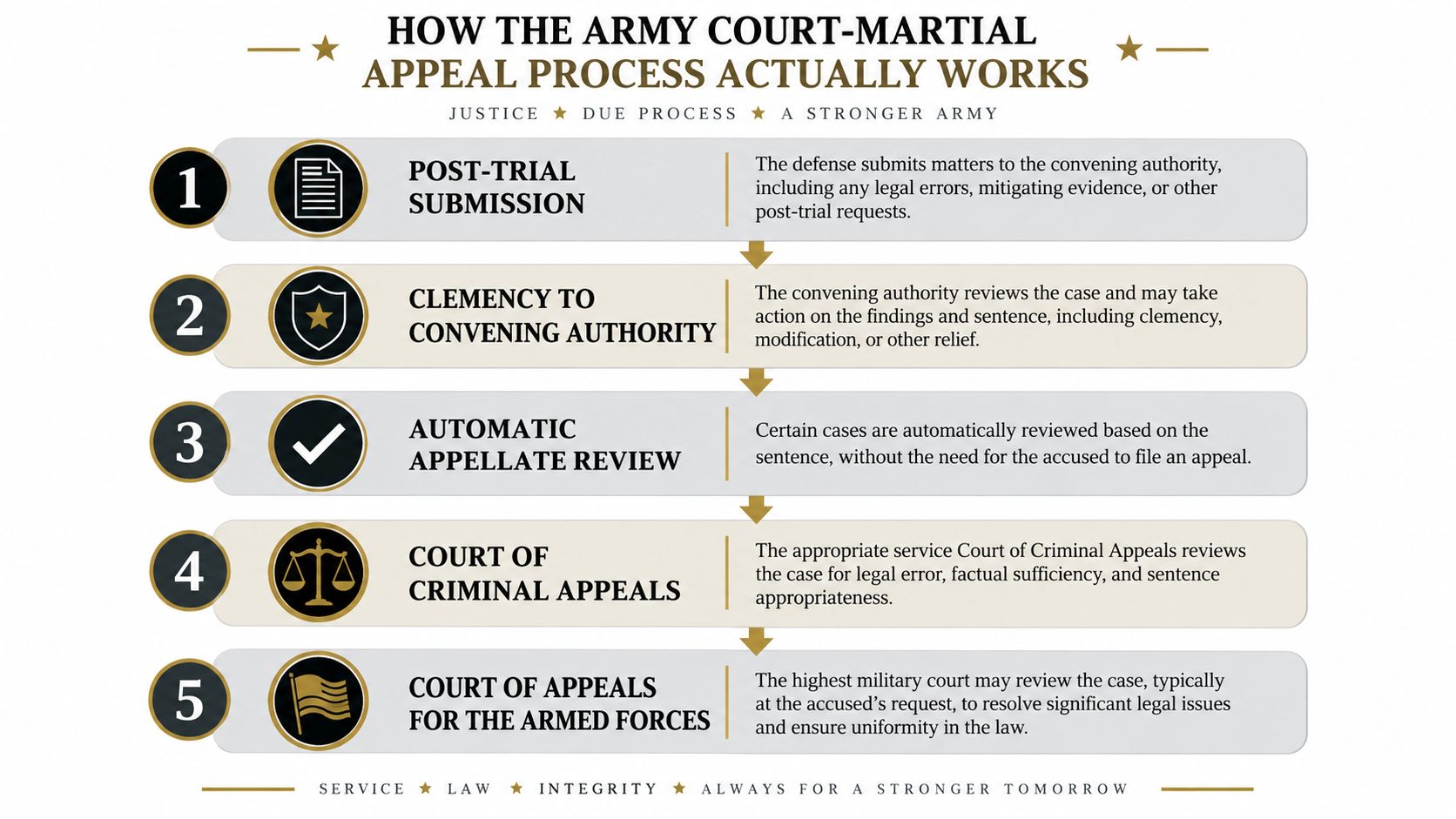
A guilty finding starts a legal timetable, not a waiting period. The defense must preserve the record, separate post-trial requests from appellate arguments, and identify the correct Army review path before deadlines close.
Step 1, preserve the post-trial record
Defense counsel should obtain and examine the record of trial, findings, sentence, rulings, exhibits, witness testimony, and post-trial processing documents. The goal is to locate errors while the record is available and address the resulting harm clearly in post-trial submissions and appellate filings.
Memory is not enough. The exact objection, ruling, instruction, exhibit, or omission can determine whether an appellate court reaches an issue and which standard of review applies. Counsel should also confirm that the record accurately reflects what occurred at trial.
Step 2, submit clemency and post-trial matters
Post-trial submissions address the sentence, procedural problems, mitigation, and other facts supporting relief. Clemency and appellate litigation serve different functions. Clemency asks the authorized decision-maker to reduce or modify the consequences. An appeal argues that the judgment or sentence cannot stand under the law.
Separate those arguments carefully. Mitigation may explain why punishment should be reduced, while an appellate claim challenges legal error. A poorly drafted submission can blur that distinction or make mitigation sound like an admission of liability.
Step 3, identify automatic Article 66 review
The Army Court of Criminal Appeals automatically reviews cases involving a death sentence, dismissal, punitive discharge, or confinement of two years or more. The threshold matters because review can occur even when the accused does not file a conventional appeal request.
The service court examines legal and factual issues within its authority. Counsel must connect each alleged mistake to prejudice or a legally defective result. A general claim that the trial was unfair will not replace a record-based argument identifying the ruling, omission, or error.
Step 4, file and brief before the Army Court of Criminal Appeals
For court-martial appeals under Article 56(d), UCMJ, the Army Court of Criminal Appeals Rules of Court require filing within 60 days after the judgment enters the record. The rules set a compressed briefing schedule. Trial counsel has 20 days to forward the appeal, government counsel has 20 days to file a supporting brief, the appellee has 20 days to answer, and the government has 7 days to reply under the Army Court of Criminal Appeals Rules of Court.
These deadlines control the work. Counsel must obtain the record, isolate preserved issues, research the governing law, and prepare a focused brief quickly. If depositions or sworn testimony form part of the evidentiary strategy, counsel can review how Ares handles depositions as a practical resource for organizing that work.
For a plain-language explanation of the underlying system, review these court-martial basics, then have counsel apply the rules to the actual record.
Step 5, seek further review
A decision from the Army Court of Criminal Appeals may support a petition to the Court of Appeals for the Armed Forces. Further review is not automatic after an adverse service-court ruling. The petition must give the higher court a reason to take the case, and counsel must track the applicable filing rules from the service-court decision.
Strategic Grounds That Win Army Appeals
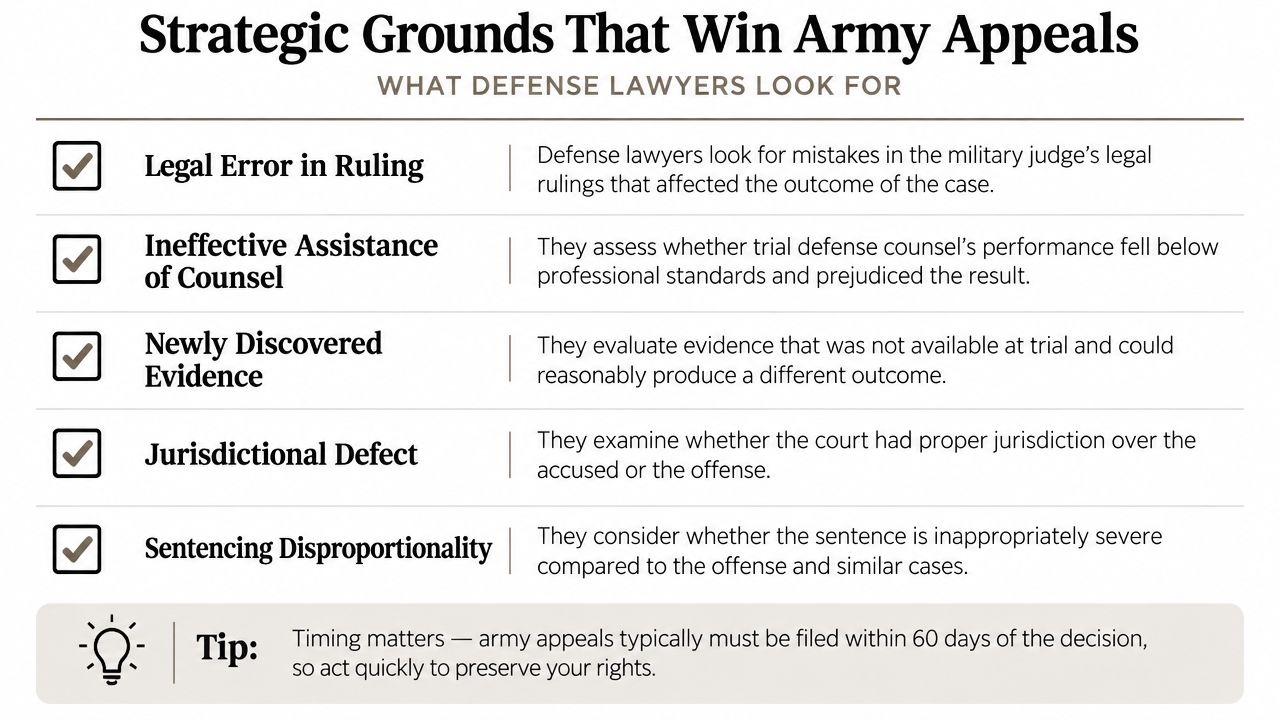
A strong Army appeal begins with a specific defect, not frustration about the result. Counsel must identify the legal error, point to the exact place it appears in the record, and show how it affected the findings or sentence.

Legal and factual insufficiency
The first question is whether the evidence supports every required element. The second is whether the findings remain supportable after reviewing the complete record. Problems often surface in conflicting testimony, missing corroboration, changed accounts, unreliable timelines, or proof that supports several explanations.
Credibility can decide the appeal. If the prosecution relied on one witness, compare every version of that account with messages, medical records, duty schedules, prior statements, and testimony from other witnesses. A contradiction that seemed minor at trial can become significant when the full record exposes a pattern.
Rulings and instructions
An evidentiary ruling may have excluded defense evidence, admitted damaging material, or restricted cross-examination. A jury instruction may have misstated the law or omitted an issue the members needed to decide. The brief should identify the ruling or instruction, the objection and preservation history, and the prejudice that followed.
The record carries more weight than outrage. Appellate judges need a clear legal route to relief, supported by citations to the transcript and exhibits.
Counsel performance
An ineffective-assistance claim requires more than dissatisfaction with trial strategy. Counsel must examine what the defense investigated, which leads were ignored, which witnesses were not called, what objections were omitted, and whether competent representation could have changed the result.
That work often extends beyond the trial transcript. It may require witness interviews, document collection, and reconstruction of decisions made before and during trial. Build that record before claiming that counsel’s performance caused prejudice.
Command influence and investigation defects
Unlawful command influence can affect charging decisions, witness conduct, plea discussions, sentencing, and the atmosphere surrounding the court-martial. Look for communications, pressure, unusual command involvement, inconsistent treatment, and incentives that shaped the process. Review this explanation of unlawful command influence and the UCMJ when command involvement is part of the case.
Investigative files also deserve close examination. CID, NCIS, OSI, and other agencies may omit contradictory leads, accept one account without testing it, fail to preserve digital evidence, or present uncertainty as certainty. The question is whether investigators tested the evidence fairly, not whether the report calls the investigation thorough.
Sentencing and post-trial processing
A sentence may be legally excessive, unsupported by the record, or influenced by improper information. Post-trial processing can create separate appellate issues if the defense lacked a meaningful chance to respond or required procedures were mishandled.
Army review data shows how selective higher review can be. In FY1999, the Army Court of Criminal Appeals reviewed 739 cases, and 312 were forwarded to the Court of Appeals for the Armed Forces, a forwarding rate of 42.2%, according to FY1999 Army Court of Criminal Appeals data. Those figures do not predict your result. They reinforce the practical rule: present the strongest preserved issue and explain its effect, rather than filing a catalogue of every complaint.
Administrative Discharge and Nonjudicial Punishment Appeals
Administrative cases punish delay differently from court-martial appeals. You need a decision matrix, not a generic “file an appeal” instruction.
| Situation | Correct Forum | Form and Deadline |
|---|---|---|
| Separation for less than 15 years | Discharge Review Board | DD Form 293, begin with the DRB under Army review guidance |
| Older discharge or broader record correction | Army Board for Correction of Military Records | DD Form 149, generally subject to the three-year records-correction rule, with possible interest-of-justice consideration |
| Evaluation report completed within the filing window | Applicable evaluation appeal process | Substantive OER, NCOER, and AER appeals generally must be submitted within three years of completion or the THRU date under Army evaluation-report appeal guidance |
| Evaluation appeal outside that window | ABCMR | Seek correction through the Army Board for Correction of Military Records, as described in Army evaluation appeal information |
| Article 15 punishment | Superior commander through the NJP appeal route | Submit within a reasonable time. More than five calendar days is presumed untimely unless the delay is excused under AR 27-10 |
The 15-year discharge fork is a starting rule, not a substitute for legal analysis. A DRB claim usually focuses on whether the discharge was improper or inequitable. An ABCMR petition asks the board to correct the record, which demands a disciplined explanation of the error or injustice and supporting evidence.
For an evaluation appeal, don’t submit a general complaint about leadership. Identify the inaccurate statement, explain why it’s inaccurate, connect it to contemporaneous records, and show why correction is justified. If the ordinary route is closed, counsel must build a separate argument for ABCMR jurisdiction and equitable relief.
Service members also face a practical problem when legal assistance is limited. Reporting has described soldiers in the disability-evaluation pipeline being left to manage paperwork, appeals, and clarifications with limited support, while Army materials require fast action on some appeals. That mismatch is discussed in reporting on legal services and the disability-evaluation process.
If your issue involves discharge characterization or separation consequences, review this Army administrative discharge guide and get advice before filing.
Common Mistakes That Destroy an Army Appeal
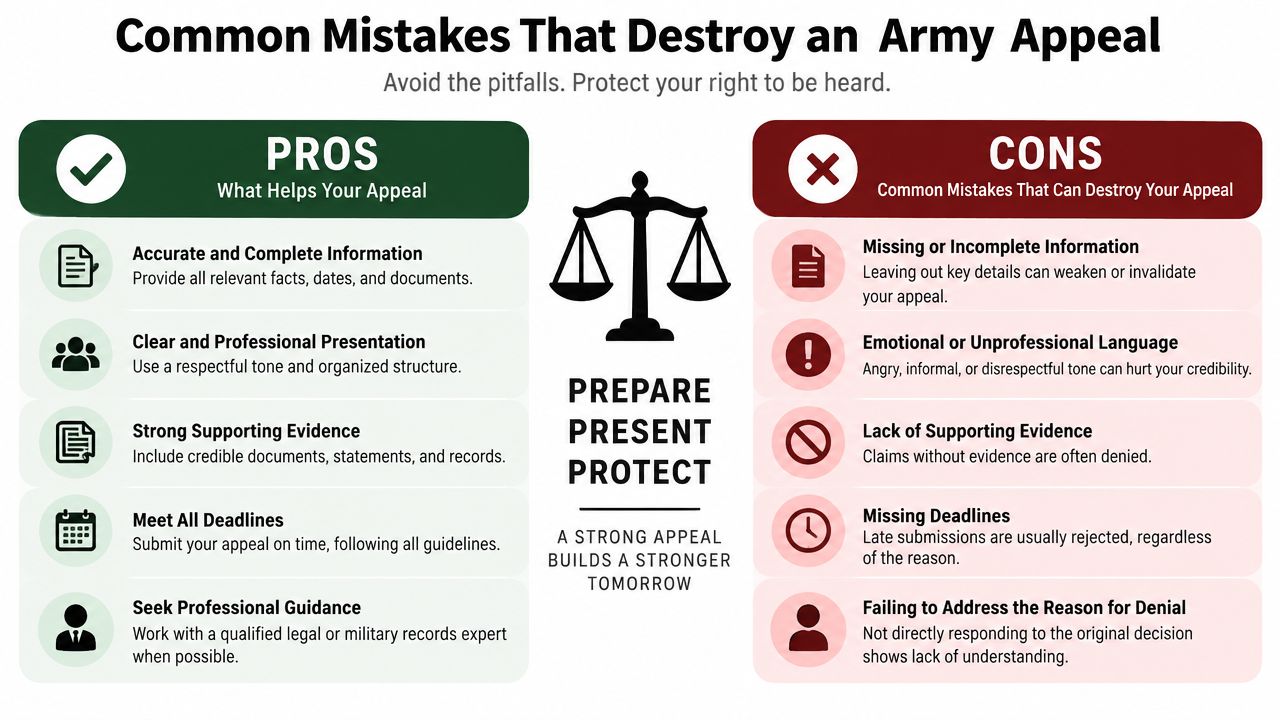
Most failed appeals don’t fail because the soldier lacked a compelling story. They fail because the story never becomes a timely, admissible, legally relevant claim.
Mistake one, talking before getting counsel
Investigators may present a conversation as routine, friendly, or administrative. Your words can still become evidence. Ask whether you’re suspected or accused, invoke your rights when appropriate, and contact a UCMJ lawyer before answering substantive questions.
Mistake two, trusting the command to repair the record
Commanders may listen, but they aren’t your appellate advocates. A promise that “this will get fixed” doesn’t stop a filing deadline or preserve an objection.
Mistake three, waiting for the perfect evidence
You can lose the chance to investigate while searching for a complete package. Preserve texts, emails, medical records, evaluations, orders, witness names, and prior statements immediately. Counsel can supplement a developing theory, but counsel can’t reconstruct deleted evidence easily.
Mistake four, choosing a forum by convenience
A discharge review, ABCMR petition, Article 15 appeal, and court-martial appeal have different purposes. Filing a polished petition in the wrong forum can leave the actual remedy untouched.
Mistake five, treating “no evidence” as “no risk”
Evidence may exist in investigative files, digital devices, witness accounts, medical records, command messages, or documents you haven’t seen. Investigations aren’t neutral just because an investigator asks questions politely.
Mistake six, filing without a theory
New documents don’t win by themselves. Explain what the evidence proves, why it was unavailable or overlooked, and how it changes the legal or equitable analysis.
Mistake seven, ignoring post-trial submissions
A soldier who focuses only on the verdict may miss the opportunity to address sentence, mitigation, procedural error, and clemency. The post-trial record can shape the issues later reviewed.
The correction is the same in every track: calendar the deadline, preserve the record, classify the forum, and get a lawyer to test the theory before filing.
Why Experienced Civilian Counsel Changes the Outcome and What to Do Now
Military-appointed counsel can provide essential representation, and every service member should use available defense rights. Serious appellate work may still justify independent civilian counsel who isn’t tied to the command structure and whose practice centers on military defense, court-martial litigation, and appeals.
The difference is strategic continuity. Experienced civilian military defense lawyers can examine the full record, challenge trial counsel’s assumptions, investigate witnesses, identify preservation problems, and build a coherent appellate theory. They can also coordinate the court-martial track with an administrative discharge, evaluation, clearance, or records-correction problem instead of treating each consequence as isolated.
No credential guarantees results, so interview counsel about the actual record, deadlines, conflicts, and proposed strategy.
Your immediate action checklist
- Preserve everything: Secure the record of trial, Article 15 paperwork, discharge documents, evaluations, medical records, messages, and witness information.
- Calendar every date: Write down the judgment date, punishment date, discharge date, evaluation THRU date, and any notice deadline.
- Stop informal explanations: Don’t discuss the case with investigators, command personnel, or potential witnesses without legal advice.
- Classify the track: Decide whether this is court-martial review, Article 15, discharge review, or records correction.
- Call counsel now: Bring the documents and deadlines to a civilian military defense lawyer who handles appeals, not just general military matters.
If you’re facing an Army appeal, discharge problem, Article 15, or court-martial conviction, don’t wait for the situation to clarify itself. Contact experienced court-martial attorneys or a UCMJ lawyer immediately, preserve every document, and get a deadline-driven strategy before your available remedy disappears. Your freedom, career, benefits, and reputation may depend on what you do next.