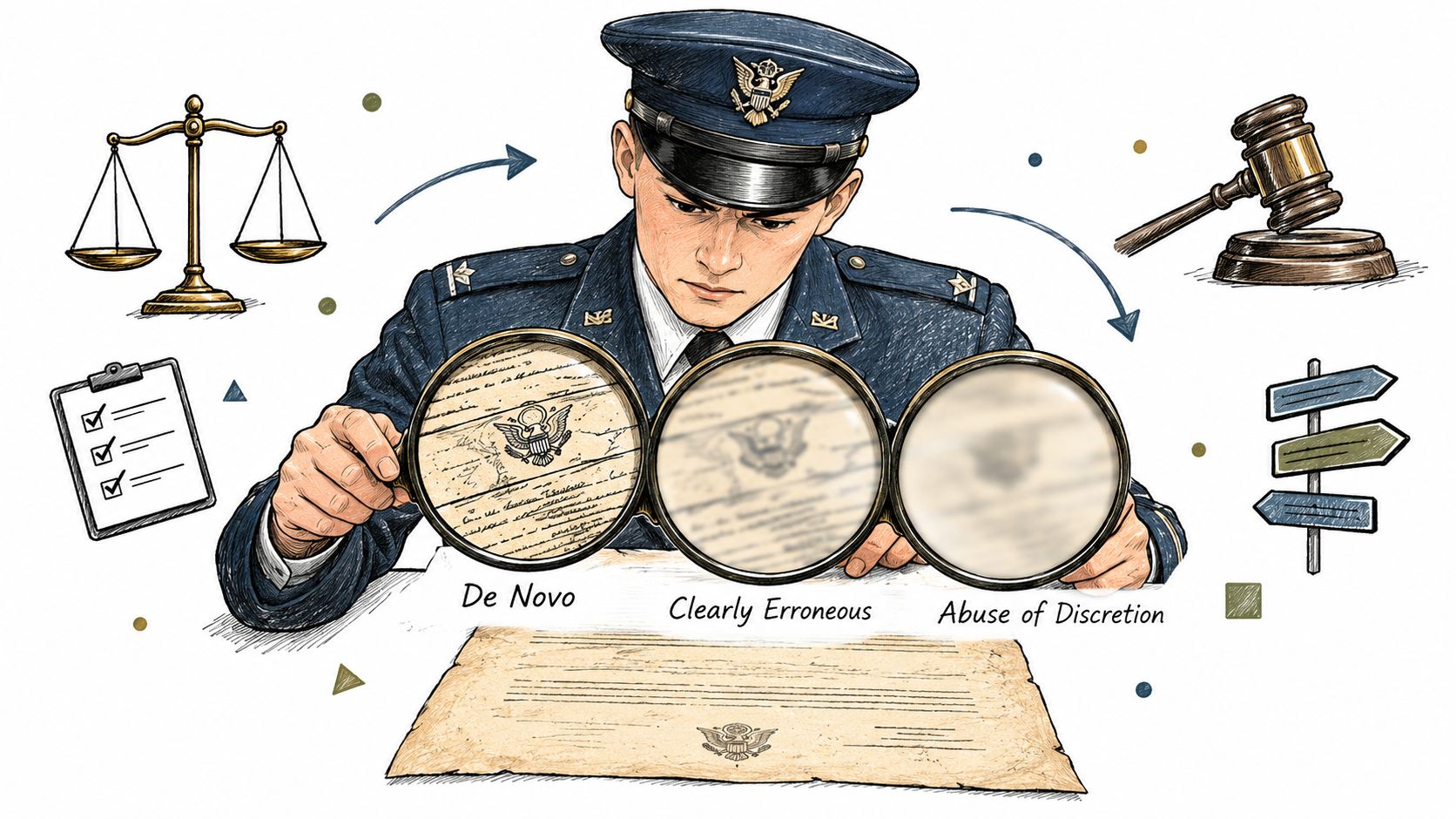
You’ve just received an unfavorable finding, a sentence that threatens your liberty or career, or a ruling that your trial counsel says can be “fixed on appeal.” That advice can be dangerously incomplete. Appellate review standards determine how much authority the appellate court gives the trial judge, how much of the record it will reconsider, and how difficult it will be to obtain relief.
For a service member, the issue is rarely just whether something went wrong. The issue is how the appellate court classifies what went wrong, whether counsel preserved it, and which level of deference controls. A strong factual complaint can fail under a deferential standard. A carefully preserved legal error can receive a fresh review.
Table of Contents
- Why the Standard of Review Decides Your Appeal Before the Merits
- The Three Core Standards Every Military Appeal Runs On
- Matching the Standard to the Issue in a Single Glance
- How UCMJ Appeals Apply These Standards in Practice
- Two Hypotheticals That Show Preservation in Action
- Briefing Moves That Force the Right Standard
- What Experienced Civilian Counsel Does Differently
- Your Next Move and Why Timing Controls the Outcome
- Common Mistakes That Weaken Military Appeals
- Why Civilian Defense Counsel Matters
- Frequently Asked Questions About Appellate Review Standards
- What are the three main appellate review standards?
- Can I challenge a military judge’s evidentiary ruling?
- What happens if my trial lawyer didn’t object?
- Can the Court of Criminal Appeals reweigh the evidence?
- Does an appeal retry my court-martial?
- Should I hire a lawyer before the first appellate filing?
- Can an appeal protect my military career?
- What should my family do first?
Why the Standard of Review Decides Your Appeal Before the Merits
Consider Staff Sergeant Ramirez. After a judge-alone contested court-martial, the military judge convicted him. His appellate counsel argued that the judge improperly admitted a contested confession. The brief framed the problem as a weight-of-the-evidence issue rather than a legal challenge to the ruling admitting the statement.
The Court of Criminal Appeals treated the issue as an evidentiary exercise of discretion. It applied abuse-of-discretion review, found no abuse, and affirmed. The court never had to decide whether the confession was reliable in the way Ramirez wanted. The framing controlled the lens, and the lens controlled the result.
That is how appeals often work. The appellate court doesn’t retry the case, call witnesses again, or substitute its preferred courtroom strategy for the trial lawyer’s decisions. It examines the existing record under a defined standard. The court-martial basics guide can help orient a family to the larger process, but appellate success depends on the precise ruling being challenged and the record supporting it.
The classification comes first
An appellate panel generally asks:
- What exactly did the trial court do?
- Was the ruling legal, factual, mixed, or discretionary?
- Did trial counsel preserve the objection?
- What standard follows from that classification?
- What must the appellant prove to obtain reversal?
Those questions can be more important than the emotional force of the underlying complaint. A service member may honestly believe the trial was unfair, but “unfair” isn’t itself a standard of review. The brief must identify a reviewable error and satisfy the burden attached to it.
Practical rule: The appellate court can only give you the review permitted by the issue you preserved and the way you present it.
The modern framework is structured around de novo review for legal questions, clear-error review for factual findings, and abuse-of-discretion review for discretionary rulings. The Supreme Court’s decision in Pierce v. Underwood, 487 U.S. 552 (1988), helped cement abuse-of-discretion terminology in modern appellate practice. A widely used appellate outline describes a broader continuum of standards, reinforcing that appellate scrutiny is a hierarchy rather than one universal test. (Georgetown’s appellate standards outline)
The Three Core Standards Every Military Appeal Runs On
De novo review
De novo means the appellate court considers the legal issue anew and gives the trial judge no controlling deference. This standard commonly applies to statutory interpretation, constitutional questions, interpretation of the UCMJ or Manual for Courts-Martial provisions, and other pure questions of law.
Suppose the dispute concerns whether an order was lawful for purposes of Article 92. The appellate court does not ask whether the military judge’s interpretation was reasonable. It independently decides the legal question.
That makes de novo review the most favorable setting for an appellant, but it doesn’t make victory automatic. The appellant still must identify the governing law, show what the trial court did wrong, and explain why the error mattered. A legal issue presented as a factual disagreement can lose the benefit of fresh review.
Clearly erroneous review
Factual findings receive more protection. Under the clearly erroneous standard, an appellate court won’t reverse merely because it might have evaluated the evidence differently. Reversal requires a record that leaves the reviewing court with a firm conviction that the trial court made a mistake.
Credibility findings are particularly difficult. If a military judge heard a witness testify, watched the witness respond under questioning, and resolved conflicting accounts, the appellate court will ordinarily respect that vantage point. A claim that a witness recanted, for example, must confront the exact testimony, surrounding circumstances, and the trial judge’s findings.
Abuse of discretion review
Abuse-of-discretion review covers decisions that give the trial judge legitimate choices. Evidentiary gatekeeping under Military Rule of Evidence 403, courtroom management, and many sentencing decisions fall within this category.
The question isn’t whether the appellate judges would have ruled differently. They ask whether the decision was arbitrary, legally erroneous, or outside the range of reasonable choices. Michigan appellate guidance describes the basic allocation as de novo for legal questions, clear error for factual determinations, and abuse of discretion for application of law to facts. (Michigan appellate benchbook on standards of review)
The practical difference is substantial. Legal questions get an independent answer. Factual findings receive protection. Discretionary rulings receive the heaviest deference.
Matching the Standard to the Issue in a Single Glance
The following matrix is a working tool, not a promise of outcome. “Reversal likelihood” describes the practical difficulty of obtaining relief, not a guaranteed result.
Appellate Review Standards at a Glance
| Issue Type | Standard of Review | Burden on Appellant | Reversal Likelihood |
|---|---|---|---|
| Legal interpretation | De novo | Show the trial court applied the law incorrectly | Highest relative opportunity for correction |
| Mixed law and fact | De novo for legal principles, clearly erroneous for factual findings | Separate the legal mistake from the factual dispute | Depends on which component controls |
| Discretionary ruling | Abuse of discretion | Show the ruling was arbitrary, legally erroneous, or outside reasonable choices | More difficult |
| Factual sufficiency under Article 66(d) | Independent factual evaluation with appropriate deference | Request review and make a specific showing of deficient proof | Fact dependent |
| Plain error under Article 59 | Error, plain or obvious error, and material prejudice | Prove every required element without relying on ordinary preservation | Lowest practical opportunity |
| Harmful versus harmless error | Prejudicial-effect analysis | Show the error affected a substantial right or the findings | Context dependent |
The mixed-law-and-fact row deserves special attention. A trial judge may apply the correct legal test but make a factual finding that the record can’t support. Or the judge may find facts reasonably but apply the wrong legal rule. Those are different appellate arguments, and they carry different burdens.
A defense lawyer deciding whether to brief an issue should identify the specific ruling, classify it, and locate the preservation point before writing the argument. Current federal appellate guidance similarly stresses explicit standards-of-review statements and record citations because generic allegations of “error” don’t tell the court what work it’s being asked to perform. (Ninth Circuit guide to standards of review)
How UCMJ Appeals Apply These Standards in Practice
Military appellate review adds rules that can change the analysis. The Court of Criminal Appeals and the Court of Appeals for the Armed Forces don’t treat every complaint as an ordinary preserved legal issue.
Article 66 factual sufficiency
Under Article 66(d)(1)(B), UCMJ, a Court of Criminal Appeals may conduct factual-sufficiency review only when the accused asks for it and makes a specific showing that the proof is deficient. Once that showing is made, the court may weigh the evidence and resolve controverted facts, while still giving appropriate deference to the trial court’s ability to see and hear witnesses and to military judge findings in the record. (Supreme Court appendix discussing Article 66(d)(1)(B))
That isn’t a second trial. It’s a distinctive statutory review authority. Counsel must identify the evidence that matters, explain why the finding is factually deficient, and address credibility rather than repeat the defense theory.
Legal sufficiency and plain error
Legal sufficiency review asks whether the evidence, viewed under the governing legal test, supports the findings. That analysis differs from factual sufficiency, where the service court can engage the evidence more directly.
Preservation also matters under Article 59, UCMJ. In military plain-error practice, the appellant bears the burden of proving that an error occurred, that it was plain or obvious, and that it materially prejudiced a substantial right. When the error is constitutional, the government may then have to show harmlessness beyond a reasonable doubt. (Armed Forces appellate digest on plain error)
A service member should understand the practical consequence: a court may recognize that a ruling was questionable and still affirm because counsel didn’t object, the error wasn’t obvious enough, or the prejudice wasn’t material. Trial counsel’s silence can change the entire appeal.
For a plain-English overview of the military justice system, review this guide to the UCMJ system and military justice. The key point is narrower here: the appellate court’s power depends on the statutory review being invoked and the record supporting it.
Two Hypotheticals That Show Preservation in Action
The difference between preserved error and plain error becomes clearer when the courtroom facts are otherwise identical.
The preserved objection
During cross-examination, trial counsel asks a leading question that improperly injects an accusation. Defense counsel objects immediately, states the legal basis, and asks the military judge to direct counsel to rephrase. The judge rules against the defense.
Counsel then renews the objection when the question is repeated and preserves the issue in a post-trial submission. On appeal, the brief identifies the ruling as a legal question involving the permissible scope of examination and supports the argument with the transcript, the objection, the ruling, and the resulting testimony.
The appellate court can evaluate the preserved issue under the appropriate standard rather than treating it as an unchallenged courtroom event. If the panel concludes the ruling applied the wrong legal principle, de novo review can provide a meaningful path to reversal.
The missed objection
In the second version, defense counsel notices the question but doesn’t object because trial counsel appears receptive to a quick answer. The witness answers, the government uses the answer in argument, and the defense raises the issue for the first time on appeal.
The question may still have been improper. That fact alone doesn’t restore ordinary review. The appellant now must satisfy the plain-error framework under Article 59, proving error, obviousness, and material prejudice.
If the appellate court concludes the question was improper but didn’t materially prejudice a substantial right, it can affirm. The same courtroom question produced a very different appellate posture because one lawyer created a record and the other didn’t.
Briefing Moves That Force the Right Standard
A strong appellate brief doesn’t merely announce a standard. It makes the classification difficult for the government to distort.
Start with the issue statement. If the argument concerns legal interpretation, phrase it as a legal question. Don’t write that the judge “got the evidence wrong” when the complaint is that the judge applied the wrong rule to the evidence. The wording should identify the ruling, the governing law, and the consequence.
Put preservation where the court can see it
The standard-of-review paragraph should appear early in the argument. It should cite controlling authority, acknowledge unfavorable facts, and explain why the government’s proposed characterization is wrong.
Place the trial objection and ruling citations near the top of the argument, not buried after several pages of background. If the issue arose during a bench conference, use the transcript and any available appendix material to show precisely what counsel said and what the military judge decided.
The first record citation should often be the objection, not the verdict.
Harmless-error arguments require the same discipline. Identify the element or finding affected, cite the testimony and exhibits that connect the error to that finding, and explain why the government can’t treat the error as isolated. A broad assertion that “the evidence was overwhelming” isn’t a substitute for analyzing the actual findings and the way the trial unfolded.
Don’t hide the fight in a footnote
A footnote can support an argument. It shouldn’t carry the argument that determines whether the court applies de novo review or plain error. Appellate judges and their staffs need to understand the requested standard before they reach the merits, because the standard determines how they read every later citation.
What Experienced Civilian Counsel Does Differently
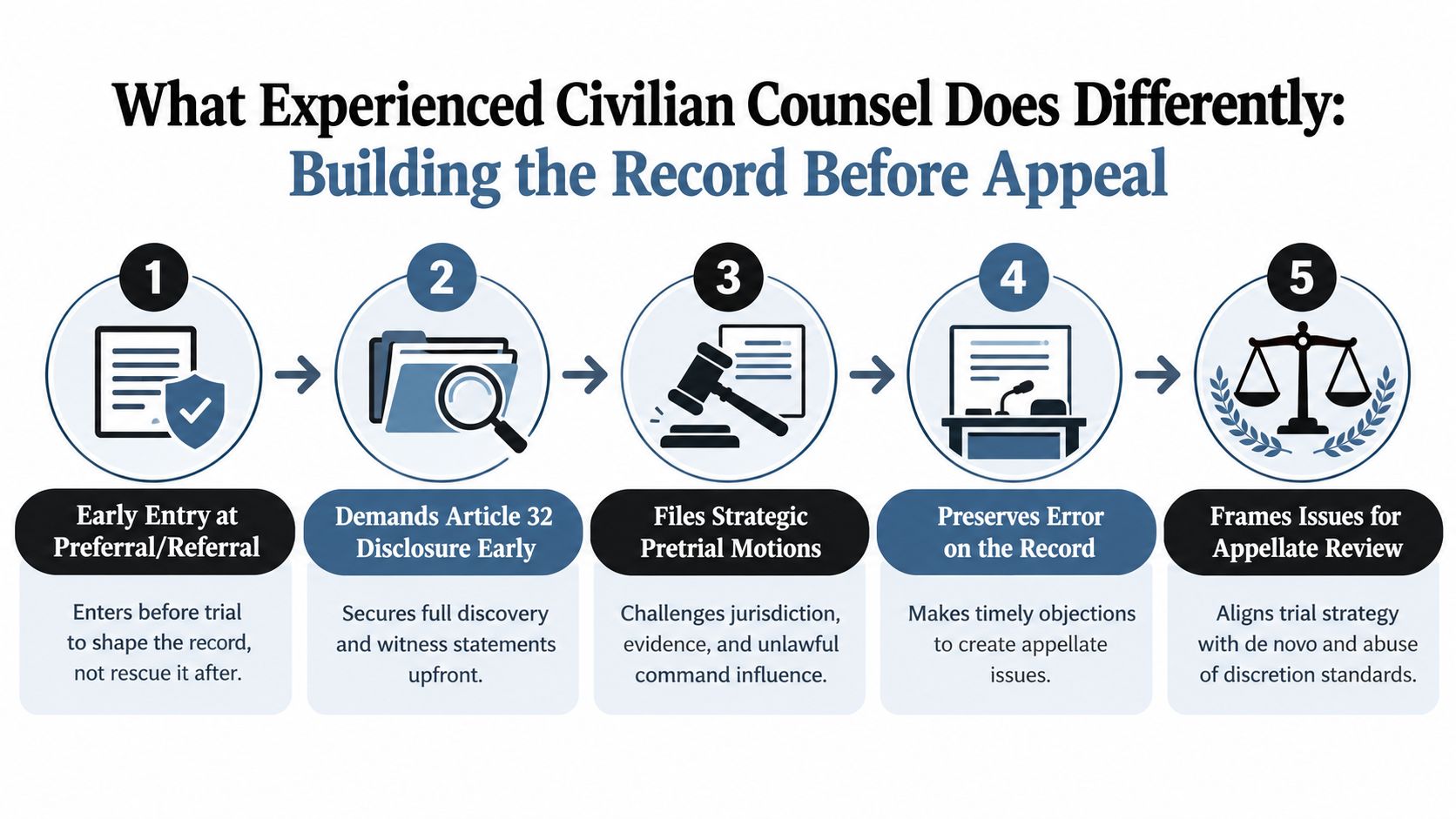
The appeals stage doesn’t routinely rescue a poorly developed trial record. The decisive work often happens at preferral or referral, when counsel can force the government to disclose evidence, litigate admissibility, and obtain rulings before the panel or military judge hears the case.
Experienced civilian military defense counsel demands Article 32 disclosure early, files focused motions to exclude or limit evidence, and raises issues involving jurisdiction, unlawful command influence, witness credibility, and expert testimony. Each motion gives the government a chance to defend admissibility in the trial court. Each ruling creates a record that can later be reviewed under a defined standard.
Counsel also examines witnesses with the transcript in mind. Documentary exhibits receive pinpoint references. Expert testimony receives targeted challenges, including challenges to methodology and reliability. The objective isn’t to manufacture objections. It’s to ensure that a legally significant problem doesn’t disappear because nobody made the military judge rule on it.
Why late entry is expensive
An appellate judge can’t reverse a trial lawyer’s unmade objection, missing proffer, or undeveloped factual record just because the later brief describes what counsel should have done. The record is usually closed, and the appellant may be asking for plain-error relief instead of ordinary review.
That is why hiring civilian counsel months after a guilty finding can cost more than legal fees. The client may have lost the opportunity to preserve the issue that would have received the most favorable review. A profile such as William E. Cassara’s military appellate defense lawyer page illustrates the kind of specialized appellate background families should investigate when comparing counsel.
Your Next Move and Why Timing Controls the Outcome
After a conviction or serious adverse ruling, don’t wait for paperwork to organize itself. The first task is to secure the record and identify deadlines before an initial appellate filing fixes the strategic frame.
Secure certified records. Obtain certified copies of the trial transcript, charge sheet, DD Form 458, exhibits, and written rulings on motions. If a ruling happened orally, locate the exact transcript pages and any written clarification.
Calendar the applicable window. Track the 60-day window under Article 67(c)(2) and the 30-day rule under Article 69 with counsel, using the governing orders and case posture to determine which deadline applies. A Court of Criminal Appeals filing can trigger a new 60-day clock to CAAF, so don’t assume the first deadline is the last one. Confirm these requirements with current counsel and the applicable rule.
Retain appellate counsel before the first filing. The initial Assignment of Errors establishes the frame that later briefing inherits. A lawyer who reviews the transcript before that filing can separate preserved legal issues from factual complaints and decide whether Article 66 factual-sufficiency review is available.
Prepare for parallel consequences. A conviction can create pressure from a personal consequences board, a clemency request, or an ROTC or medical discharge process while the appeal proceeds. Those actions may require different records, deadlines, and objectives. Treat them as related but not interchangeable.
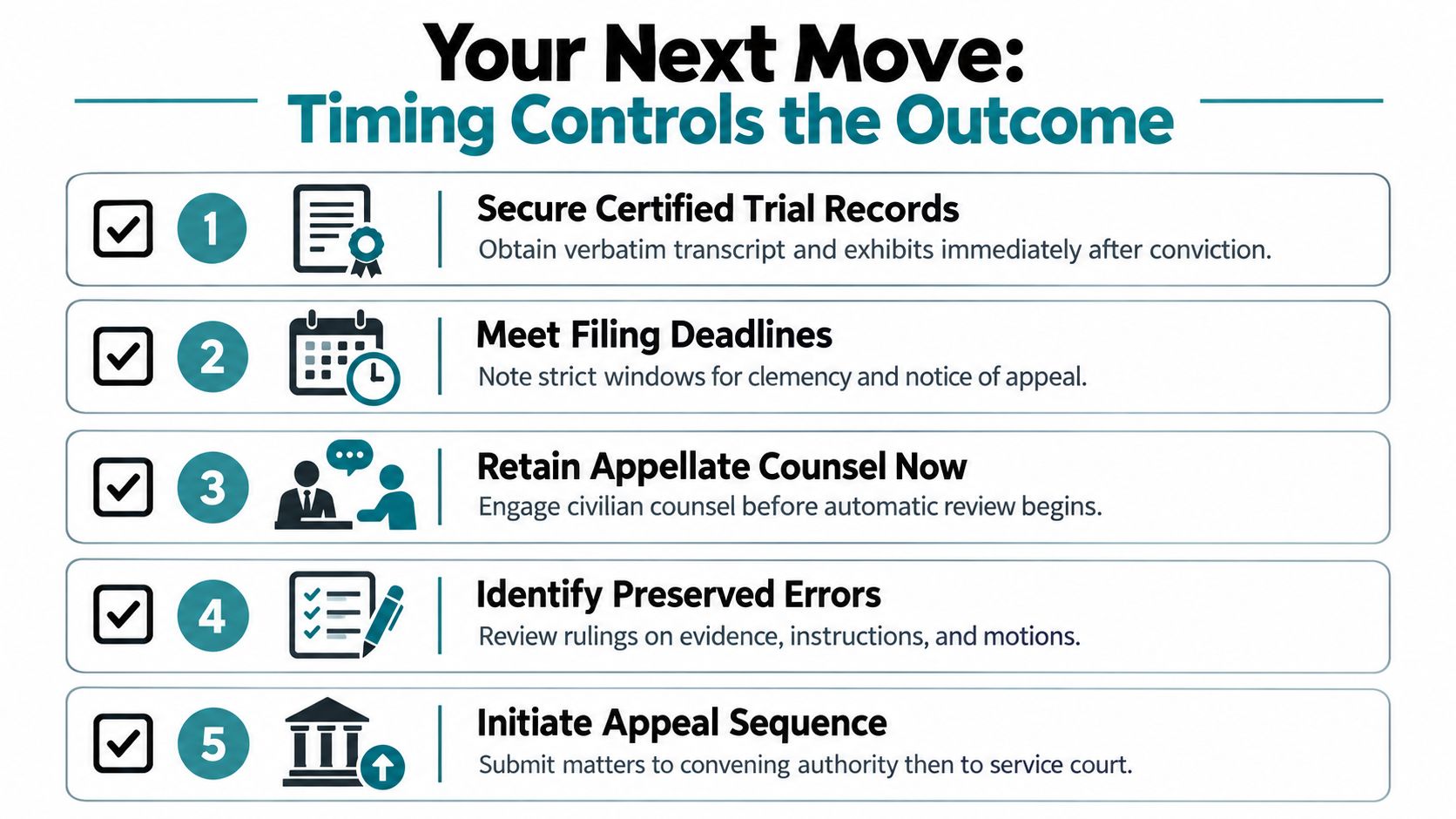
Timing isn’t clerical housekeeping. Early intervention can mean arguing preserved error under de novo review. Delay can leave the appellant asking for plain-error relief on a record that never developed the necessary objection, proffer, or factual showing.
Common Mistakes That Weaken Military Appeals
Service members and trial lawyers make predictable mistakes under pressure. Each one can narrow the appellate court’s options.
- Talking to investigators without counsel: Statements can create evidentiary and credibility problems that become difficult to repair later.
- Trusting command to “handle it”: Command decisions serve command objectives, not the accused’s appellate position.
- Waiting until the conviction to seek appellate advice: Late counsel may inherit a record with no preserved issue.
- Assuming there’s no evidence: Investigators may possess messages, digital records, witness accounts, or documents the accused hasn’t seen.
- Failing to object contemporaneously: Silence can move an issue from ordinary review into plain-error analysis.
- Arguing unfairness without identifying the ruling: Appellate courts need a legal issue, a record citation, and a remedy.
- Ignoring credibility conflicts: A court may defer to the trial judge’s resolution unless the record supports a clear error.
- Treating factual and legal sufficiency as identical: They ask different questions and require different presentations.
- Relying on generalized harmless-error arguments: Counsel must connect the error to a finding or substantial right.
- Missing a filing deadline: A strong issue is useless if counsel fails to preserve the right to present it.
The best response is not panic or silence. It’s a prompt record review by a lawyer who understands both the trial and appellate sides of military justice.
Why Civilian Defense Counsel Matters
Military-appointed counsel can be capable, committed, and experienced. The practical difference is that serious cases may require additional independent capacity, particularly when the matter involves complex evidence, multiple proceedings, a contested record, or appellate litigation.
A civilian UCMJ lawyer works outside the command structure. That independence allows counsel to evaluate the government’s theory without worrying about military assignments, command relationships, or institutional expectations. Civilian court-martial attorneys may also remain involved across investigation, trial, sentencing, clemency, and appeal, depending on the engagement.
The right comparison isn’t just “civilian versus military.” Ask concrete questions:
- Has the lawyer handled the relevant type of court-martial or appeal?
- Can the lawyer identify the exact preservation points in the record?
- Does the lawyer understand Article 66 and Article 67 review?
- Will the lawyer explain whether an issue receives de novo, clear-error, abuse-of-discretion, or plain-error review?
- Who will personally write and argue the brief?
- What happens to administrative or career consequences while the appeal is pending?
Experienced military defense lawyers look beyond the verdict. They examine discovery, motions, objections, witness testimony, exhibits, instructions, findings, sentencing, post-trial processing, and deadlines. That work can reveal an issue the trial team preserved, an issue that requires a factual-sufficiency showing, or an issue that is unlikely to survive plain-error review.
No attorney can guarantee reversal. A lawyer who promises an outcome without first reviewing the record is selling confidence instead of strategy.
Frequently Asked Questions About Appellate Review Standards
What are the three main appellate review standards?
The basic framework is de novo review for legal questions, clearly erroneous review for factual findings, and abuse-of-discretion review for discretionary rulings. Military appeals also involve UCMJ-specific review rules, including Article 66 factual-sufficiency review and Article 59 plain-error analysis.
Can I challenge a military judge’s evidentiary ruling?
Yes, but the standard depends on the ruling and preservation. Many evidentiary decisions receive abuse-of-discretion review, and the appellant must show more than a different reasonable choice. The record must support a conclusion that the ruling was arbitrary, legally erroneous, or outside the range of reasonable choices.
What happens if my trial lawyer didn’t object?
The issue may be reviewed for plain error rather than under the standard that would have applied after a timely objection. Under military practice, the appellant must show error, plain or obvious error, and material prejudice to a substantial right.
Can the Court of Criminal Appeals reweigh the evidence?
Under Article 66(d)(1)(B), UCMJ, the Court of Criminal Appeals may conduct factual-sufficiency review when the accused requests it and makes a specific showing of deficient proof. The court may weigh evidence and resolve controverted facts, while giving appropriate deference to the trial court’s opportunity to observe witnesses and to military judge factual findings.
Does an appeal retry my court-martial?
No. An appellate court reviews the trial record. It doesn’t ordinarily hear the witnesses again or allow the accused to rebuild a case that trial counsel failed to develop.
Should I hire a lawyer before the first appellate filing?
Yes, if you can do so. The first Assignment of Errors can determine which issues receive attention and how they’re classified. Counsel should review the transcript, rulings, charge sheet, findings, sentencing, and post-trial materials before that strategic frame is set.
Can an appeal protect my military career?
An appeal may affect the conviction or sentence, but career consequences can proceed on separate tracks. Clemency, administrative separation, ROTC action, medical discharge, clearance consequences, and other proceedings require separate evaluation and timely action.
What should my family do first?
Preserve every document, message, notice, transcript, and legal communication. Don’t discuss the facts publicly or with investigators without legal advice, and contact experienced civilian military defense counsel for a record and deadline review.
If you’re facing UCMJ charges, a court-martial conviction, or an appellate deadline, contact experienced civilian military defense counsel now. Secure the record, protect the filing window, and have a lawyer determine which issues were preserved before the government frames them for the appellate court. Waiting can convert a reviewable legal error into a plain-error argument with a far narrower path to relief.