You’re sitting in a commander’s office after a missed inspection, an incomplete log, or a failure to report a problem. Someone has told you the matter is “just paperwork,” but investigators are asking detailed questions and your chain of command is discussing Article 92 dereliction of duty. Your career, clearance, rank, pay, and freedom may all be at risk.
Dereliction of duties cases are dangerous because the alleged misconduct often looks ordinary at first. A missed watch, delayed report, uncompleted maintenance task, or failure to supervise can become a criminal charge when the government connects the omission to a known duty. The defense usually turns on details that generic explanations skip, especially what the duty was, how you supposedly knew about it, and whether the evidence proves willfulness, negligence, or culpable inefficiency.
Table of Contents
- What Dereliction of Duties Really Means
- The Three Elements the Government Must Prove
- Willful Versus Negligent Dereliction and Why Charging Matters
- How Dereliction Cases Get Investigated
- Penalties, Branch Differences, and Modern Charging Trends
- Defenses That Actually Work in Dereliction Cases
- Critical Mistakes That Destroy Dereliction Defense
- Why Civilian Military Defense Counsel Changes the Outcome
- Frequently Asked Questions About Dereliction of Duties
- What is dereliction of duty under Article 92
- Can I refuse to talk to CID, NCIS, OSI, or CGIS
- Will I go to jail for dereliction of duty
- Does the government need a written order
- Can negligence support a criminal charge
- What happens at an Article 32 hearing
- Do I need a lawyer immediately
- Can dereliction affect my career without a conviction
What Dereliction of Duties Really Means
Petty Officer Reyes, a 22-year-old electronics technician, was assigned to monitor equipment faults during a maintenance period. He noticed a warning and failed to report it before the next shift. The equipment later suffered additional damage, and the command began treating the missed report as more than a performance problem. Reyes now faces an Article 92 allegation that could affect his Navy career.
That scenario is common in structure, even when the details differ. A service member may be accused of failing to complete a safety check, account for equipment, report a known problem, supervise subordinates, maintain a required log, or perform a watchstanding responsibility. The government may characterize the failure as dereliction of duty, even where the member never intended harm.
Plainly stated, dereliction means failing to perform a duty imposed by a lawful order, regulation, standard operating procedure, position, training requirement, or recognized custom of the service. The duty can involve an affirmative act, such as making a report, or an omission, such as failing to inspect, notify, secure, or intervene.
Article 92 charges are not all the same
Article 92 contains multiple theories. Article 92(1) addresses violations of lawful general orders or regulations. Article 92(3) addresses dereliction in the performance of duties. This article focuses on the failure-to-perform variant under Article 92(3), where the government alleges that you had a duty and failed to perform it through willfulness, neglect, or culpable inefficiency.
The breadth of the word “duty” creates the first major danger. Prosecutors may rely on a written regulation, but they can also point to your billet, training, standing instructions, unit practice, or professional responsibility. That doesn’t mean every mistake is criminal. It does mean you shouldn’t assume that no signed order means no charge.
Read the distinction between order violations and duty failures in this Article 92 failure-to-obey guide, then get case-specific advice before giving an explanation to command or investigators.
Practical rule: Don’t argue about whether the event was “just a mistake” until counsel identifies the exact duty and the evidence supporting it.
The Three Elements the Government Must Prove
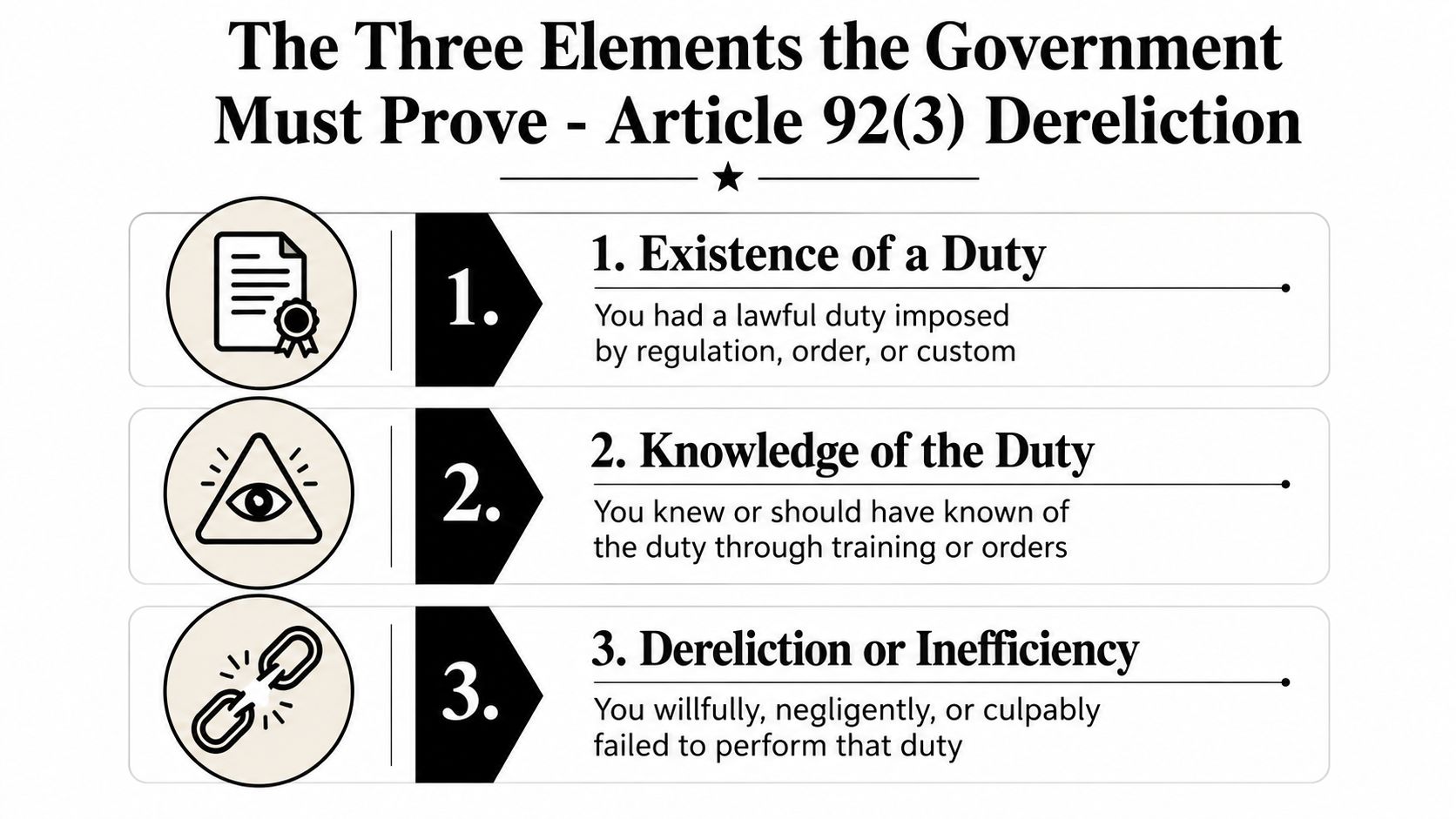
Article 92(3) dereliction rests on three prosecution elements. The government must prove that you had a duty, knew or reasonably should have known about it, and were derelict in performing it. The governing military justice materials describe the same structure and make clear that duties may arise from lawful sources beyond a single written order, as explained in the Manual for Courts-Martial discussion of Article 92.
First, a duty had to exist
The government must identify a real duty imposed on you. That source might be a regulation, general order, lawful command, standard operating procedure, qualification requirement, duty roster, or the nature of your position.
Suppose the specification alleges that you failed to inspect a vehicle before dispatch. Trial counsel may introduce an SOP, a signed training record, a roster, and testimony from a supervisor. The defense should ask whether the SOP applied to that vehicle, whether the accused was assigned the task, whether another person held the responsibility, and whether the alleged duty was clear enough to enforce criminally.
A vague expectation is not automatically a proven duty. Missing documents, conflicting versions of an SOP, informal task assignments, and inconsistent unit practice can create reasonable doubt.
Second, you knew or reasonably should have known
The government doesn’t always need direct proof that someone told you the duty at the exact moment. It may rely on actual knowledge, such as a signed training record or prior counseling, or constructive knowledge, meaning a reasonable service member in that role should have known.
That element makes training records and position history important. A defense lawyer will examine qualification dates, turnover notes, email traffic, counseling, duty descriptions, and whether you were new to the assignment. If supervisors gave conflicting directions, if the duty was never trained, or if the unit routinely handled it another way, the knowledge element may be weaker than the charge suggests.
Third, the performance was legally derelict
Finally, the government must prove the failure occurred through a recognized level of culpability. A missed task caused by an unavoidable equipment failure is different from a conscious decision to ignore a known requirement. A one-time oversight is different from sustained, culpable inefficiency.
Trial counsel typically stitches the case together with duty rosters, logs, electronic messages, witness accounts, inspection records, and statements attributed to the accused. Defense counsel should test every link. Who created the log? Was it completed contemporaneously? Did the witness see the event or hear about it later? Does the record prove a duty, knowledge, failure, and mental state, or only that something went wrong?
Willful Versus Negligent Dereliction and Why Charging Matters
Mens rea determines exposure. The same operational failure can be framed as willful dereliction, negligent dereliction, or culpable inefficiency, depending on what the command believes it can prove and what it wants the charge to communicate.
Willful dereliction involves a conscious disregard of a known duty. A sailor who knows a security check is required and deliberately skips it presents the government with its strongest willfulness theory. Negligent dereliction is different. It alleges that the service member failed to use the care expected under the circumstances. Culpable inefficiency generally concerns performance so deficient that it rises above ordinary inexperience or poor work.
The older punishment structure reflects the difference. The U.S. Code preserves Article 92 as a long-standing UCMJ offense, first enacted by Congress on May 5, 1950, and later carried into the U.S. Code as 10 U.S.C. § 892, as shown in the official statutory text.
| Mens Rea | Standard | Max Confinement | Max Punishment |
|---|---|---|---|
| Willful | Conscious disregard of a known duty | Six months | Reduction to E-1, forfeiture of all pay and allowances, and a bad-conduct discharge |
| Negligent | Failure to use required care | Three months | Reduction to E-1 and forfeiture of two-thirds pay per month for three months |
| Culpable inefficiency | Seriously deficient performance amounting to culpable misconduct | Depends on charged category and applicable framework | Exposure depends on the charged theory and sentencing rules |
The Marine Corps UCMJ materials identify the negligent or culpably inefficient ceiling as three months of confinement and forfeiture of two-thirds pay for three months, while willful dereliction carries the more severe traditional ceiling. The CAAF decision discussed in those materials confirms the negligent-dereliction ceiling.
The wording can change the case
A charge alleging that you intentionally ignored a known duty invites the government to pursue the highest culpability tier. If the evidence proves only confusion, inadequate training, or carelessness, the defense should attack the willfulness allegation rather than accept the government’s label.
The Article 32 preliminary hearing can matter here. Counsel can use the record to expose weak notice evidence, inconsistent witnesses, missing duty sources, and a mismatch between the facts and the charged mental state. A reduction from willful to negligent theory may materially change negotiation position and sentencing risk, even if the command refuses to dismiss the matter.
How Dereliction Cases Get Investigated
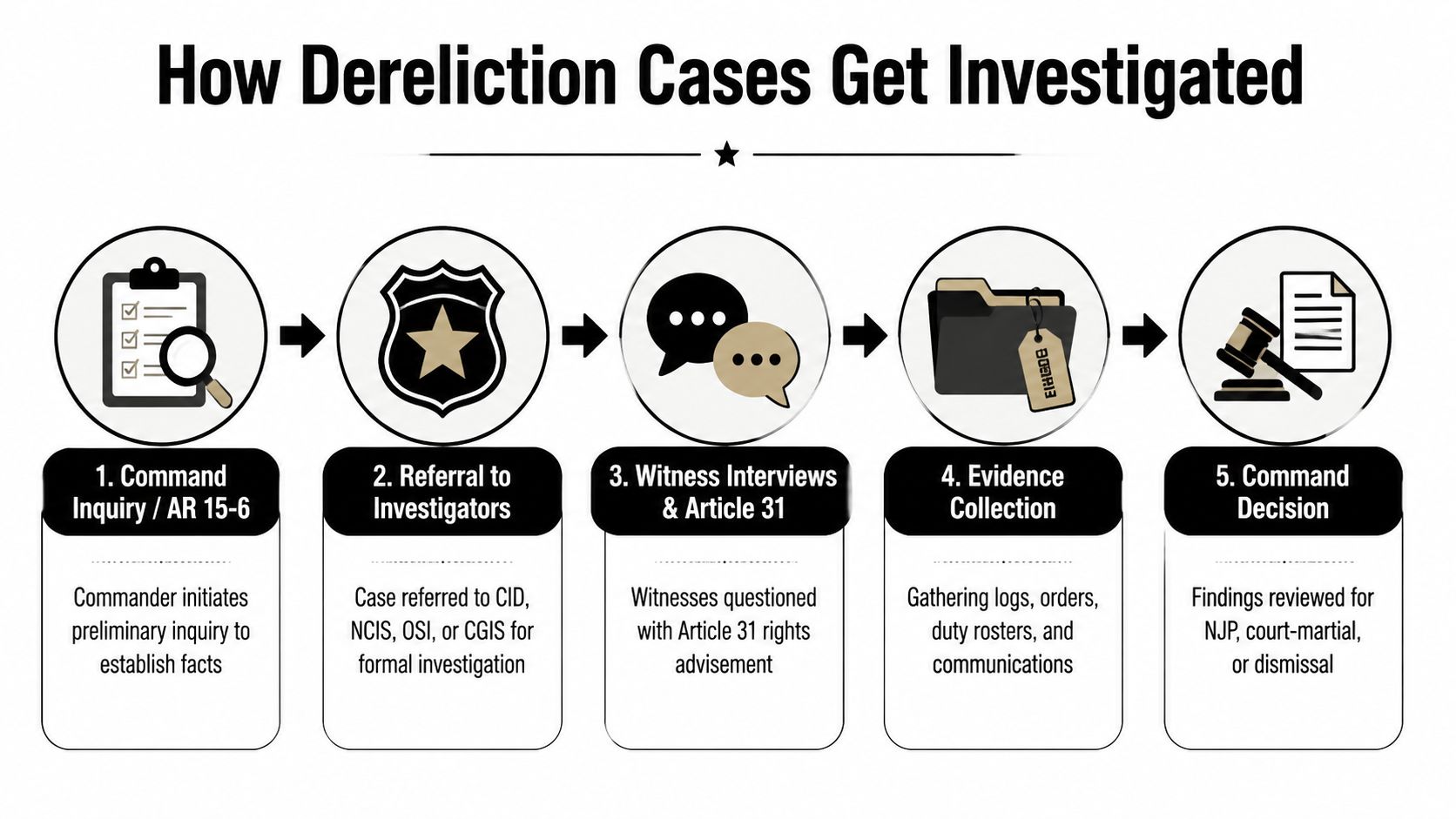
Dereliction investigations often begin with a supervisor, inspection discrepancy, incident report, or command concern. The command may conduct a preliminary inquiry or an Army AR 15-6 investigation before referring the matter to CID, NCIS, OSI, or CGIS. These processes may overlap, and an administrative inquiry can generate evidence later used in a criminal case.
The practical sequence
Command inquiry. The commander identifies an apparent failure and asks for facts. Treat this as potentially consequential, not casual counseling.
Investigator referral. CID, NCIS, OSI, or CGIS may assume control when the allegation appears criminal, involves significant risk, or requires formal investigative tools.
Witness interviews. Investigators question supervisors, peers, subordinates, and other people with access to the relevant events. Your rights under Article 31 matter. Invoke them clearly and request counsel before answering substantive questions.
Evidence collection. Investigators may gather orders, SOPs, duty rosters, maintenance records, messages, logs, video, training records, and electronic data. The defense should preserve relevant material before it disappears or gets interpreted without context.
Command decision. The matter may proceed toward nonjudicial punishment, administrative action, court-martial, or dismissal. The staff judge advocate often helps the commander evaluate evidence and disposition.
The mechanics of command-directed inquiries are addressed in this guide to AR 15-6 investigations. Early counsel involvement can narrow the alleged duty, correct a false timeline, and prevent an avoidable statement from becoming the centerpiece of the case.
Penalties, Branch Differences, and Modern Charging Trends
Punishment turns on the charged theory, date of the offense, harm, and forum. Historical Article 92 sentencing materials identify negligent dereliction with a maximum of reduction to E-1, forfeiture of two-thirds pay per month for three months, and three months of confinement. Willful dereliction traditionally carried reduction to E-1, forfeiture of all pay and allowances, six months of confinement, and a bad-conduct discharge. The exact charging theory matters because the government must prove a different mental state for willful and negligent conduct.
Death or grievous bodily harm can move the case into a substantially harsher sentencing category. Older official military justice materials described maximums of 18 months of confinement for negligent conduct and two years of confinement plus a dishonorable discharge for willful conduct when dereliction caused that harm. Post-2023 sentencing materials reorganized those categories, listing confinement ranges of 0 to 12 months for Category 1 and 1 to 36 months for Category 2 in cases involving death or grievous bodily harm. The military justice sentencing materials reflect that framework.
Branch labels and procedures differ, but the maximum punishment for an Article 92 dereliction offense comes from the UCMJ and applicable sentencing rules, not from a separate Army, Navy, Air Force, Marine Corps, or Coast Guard punishment schedule. Service-specific regulations can still affect the alleged duty, notice, reporting requirements, and the commander’s disposition decision. That distinction is practical: a branch regulation may define what you were expected to do, while the charging statute and sentencing framework control exposure.
Do not treat the case as minor because the allegation lacks intentional harm. A negligent theory can still threaten rank, pay, confinement, and a discharge. Prosecutors may also charge false official statements, property offenses, or broader misconduct theories arising from the same events. That creates a trade-off for the defense. Fighting the duty allegation alone may leave a damaging statement or recordkeeping theory untouched.
Public records show the offense remains active in 2026. One Army special court-martial at Fort Lee involved five specifications of dereliction alongside false official statement charges, as described in this Article 92 practice analysis. The charging document, alleged duty, and mental-state language deserve close review before anyone estimates punishment.
Defenses That Actually Work in Dereliction Cases
The strongest defense isn’t “nothing bad happened.” The stronger position is that the government can’t prove one or more required elements beyond a reasonable doubt.
Attack the duty source
Ask for the exact regulation, order, SOP, billet description, or custom the government relies on. Then examine whether it applied to you on that date, whether it was lawful, whether it assigned the task to you, and whether supervisors interpreted it consistently.
A duty that changes depending on which witness is speaking may be too vague to support a criminal conviction. Conflicting orders can also undermine the government’s claim that compliance was reasonably possible.
Attack notice and opportunity
Training records may show attendance, but attendance isn’t always proof that the member understood a particular task. Counsel should compare the training content with the duty alleged, identify language gaps, and establish whether you had the equipment, time, access, authority, and staffing needed to comply.
Legal impossibility and mistake of fact can matter. If you reasonably believed another person had responsibility, or if a system failure prevented performance, the government’s theory may collapse even if the outcome was serious.
Attack causation and culpability
A bad result doesn’t prove dereliction. The defense should identify alternative causes, including equipment failure, inadequate staffing, unclear supervision, prior maintenance problems, or a decision by another person. Then counsel should challenge the selected mens rea tier.
The objective isn’t to excuse every failure. It’s to force the government to prove the duty, notice, failure, and culpability separately.
Good military character evidence can also matter, especially where the allegation involves a single event rather than a sustained pattern. Inconsistent enforcement may support a selective prosecution or command influence argument, but those claims require evidence, not frustration. A defense lawyer should build that record through witness interviews, unit comparisons, documents, and careful review of the investigative history.
Critical Mistakes That Destroy Dereliction Defense
The first mistake is treating the allegation as a paperwork problem. A missing log or late report may become evidence of dereliction, but poor documentation alone doesn’t establish the duty, notice, opportunity, causation, or required mental state.
Mistakes that create avoidable evidence
Giving a detailed statement too early: Investigators may ask for your version before you’ve reviewed the regulation, emails, messages, training records, and logs. Invoke your rights and speak with counsel first.
Using the command’s language: Saying “it was all my fault” or describing your conduct as “negligent” can give investigators language supporting the mental state they need to prove.
Failing to identify the duty source: Don’t accept a general accusation such as “you were responsible.” Find the order, SOP, regulation, roster, or position requirement.
Assuming no intent means no case: Article 92(3) can be based on negligence. Your defense must address the government’s negligence theory, not only willfulness.
Waiting for formal charges: By then, witnesses may have settled on a common account, and electronic records or video may be harder to locate.
Deleting or altering material: Preserve messages, schedules, maintenance data, and relevant files. Don’t edit records or create retrospective explanations.
Ignoring resource failures: Document missing equipment, staffing problems, access restrictions, conflicting priorities, and supervisory decisions that affected your ability to perform.
Blaming everyone in writing: Angry messages can damage credibility and distract from the element-based defense. Give counsel the facts, then let counsel decide how to present them.
A disciplined response starts with a frozen timeline. Record when you received the task, who assigned it, what training you had, what obstacles existed, what you did, who witnessed it, and what happened afterward. Preserve personal communications separately from official records, and identify witnesses who can address notice, opportunity, causation, or the actual standard used in the unit.
Why Civilian Military Defense Counsel Changes the Outcome
Detailed military defense counsel can provide capable representation, but serious dereliction cases often require more time and independence than a command-driven system naturally provides. A civilian military defense lawyer isn’t part of your chain of command and can investigate without the same institutional pressures surrounding the unit.
The difference appears before trial. Experienced counsel will obtain and compare duty rosters, training records, electronic communications, maintenance logs, prior counseling, witness accounts, and similarly situated service members’ treatment. Counsel will ask whether the government can prove a particular duty, actual or constructive notice, a reasonable opportunity to comply, causation, and the selected mental state.
What civilian counsel should do
A strong lawyer should:
Build the timeline early: Interview witnesses while memories remain independent and collect records before the command frames the narrative.
Test the charge sheet: Look for vague specifications, duplicated theories, unsupported willfulness language, and factual gaps.
Evaluate disposition options: Explain the trade-offs among court-martial, nonjudicial punishment, administrative separation, and other career consequences without promising a result.
Work with military counsel: Civilian counsel supplements, rather than automatically replaces, the detailed defense team. Effective representation uses the strengths of both.
Prepare for litigation: If negotiation fails, counsel should preserve suppression issues, credibility contradictions, evidentiary objections, and element-based defenses for the appropriate hearing or trial.
The right lawyer should be candid about weaknesses. Ask who will personally perform the work, what Article 92 and court-martial experience the lawyer has, whether the lawyer knows your service’s regulations, how conflicts and fees are handled, and what the initial investigation will include. Provide every relevant order, message, evaluation, medical record, witness lead, and document.
The guide to court-martial defense lawyers explains how to identify civilian attorneys for comparison, but interview counsel directly and assess fit. In a serious case, bandwidth matters. A lawyer who understands the doctrine but doesn’t have time to investigate may leave the decisive facts undiscovered.
Your first consultation should produce a strategy, not a sales pitch.
If you’re under investigation, contact a qualified civilian military defense lawyer now. Don’t give investigators a detailed statement, sign a response, or accept a “quick fix” from command before counsel reviews the allegation. Early action can protect evidence, challenge the duty source, reduce the mens rea theory, and preserve options that disappear once the charge is framed.
Frequently Asked Questions About Dereliction of Duties
What is dereliction of duty under Article 92
It is an allegation that you had a military duty, knew or reasonably should have known about it, and failed to perform it through willfulness, negligence, or culpable inefficiency. The duty may arise from an order, regulation, SOP, training, position, or custom of the service.
Can I refuse to talk to CID, NCIS, OSI, or CGIS
You can invoke your Article 31 rights and request counsel before answering substantive questions. Don’t argue with the investigator or provide a partial explanation designed to “clear things up.” State that you want counsel and follow counsel’s advice.
Will I go to jail for dereliction of duty
Confinement is possible, but the exposure depends on the charged mental state, harm, offense date, sentencing framework, and forum. Traditional maximums included three months for negligent dereliction and six months for willful dereliction, while serious-harm cases can carry higher exposure under the applicable framework. The official Article 92 statute should be read with the current Manual for Courts-Martial and case-specific advice.
Does the government need a written order
No. A duty may come from a regulation, SOP, lawful command, training, custom of the service, or the nature of your billet. That flexibility also gives the defense an opening to challenge whether the alleged duty was sufficiently clear, properly imposed, and assigned.
Can negligence support a criminal charge
Yes. Article 92(3) expressly includes neglect. The defense must show why the conduct doesn’t meet the applicable negligence standard, or why the government can’t prove notice, opportunity, causation, or the alleged failure.
What happens at an Article 32 hearing
The hearing gives the defense an opportunity to examine the government’s basis for preferred charges and develop issues concerning duty, notice, witness credibility, evidence, and mental state. It can also create an advantage for dismissal, charge reduction, or a more favorable resolution, although the result depends on the record and the command’s decision.
Do I need a lawyer immediately
If investigators, command, or legal personnel have identified you as a subject or suspect, yes. Early advice can prevent damaging statements, preserve electronic evidence, and identify weaknesses before the government commits to a charging theory.
Can dereliction affect my career without a conviction
Yes. Administrative separation, adverse evaluations, loss of confidence, security clearance concerns, and other career effects can arise alongside or apart from a court-martial. A defense plan must address the criminal and administrative tracks together.
If you’re facing a dereliction of duties allegation, investigation, Article 15, administrative action, or court-martial referral, contact a civilian military defense lawyer immediately. Preserve your records, invoke your rights, and don’t let command define the duty or your intent before counsel has examined the evidence. Your career and freedom are too important to leave the first decisions to chance.