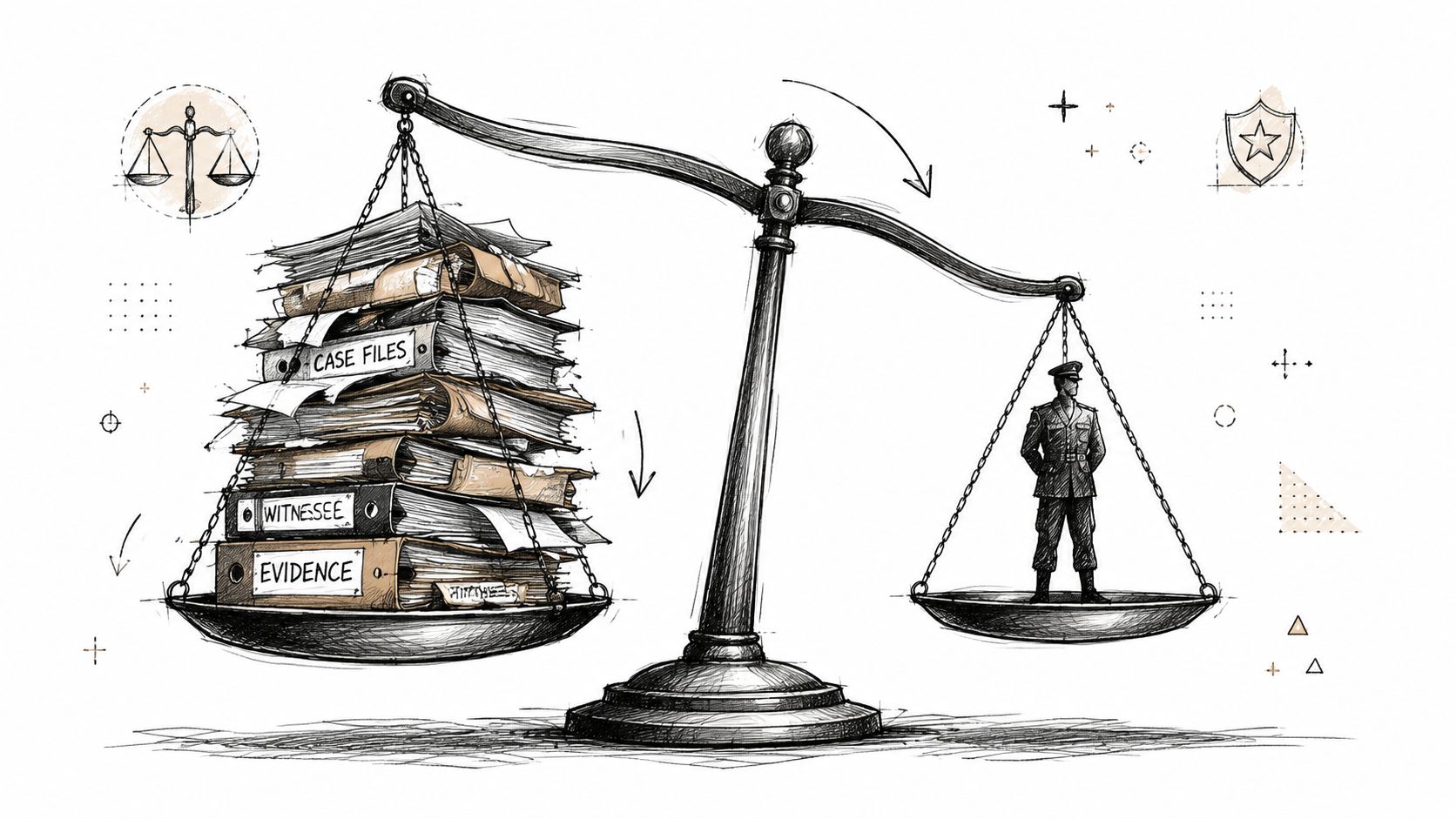
You’re sitting in a command office, being told that an allegation has been made. Someone wants your statement “so we can get the facts.” Your first instinct may be to explain, cooperate, and clear your name before the story gets worse. That instinct can damage your defense.
In a military investigation, who bears the burden of proof controls the entire fight. The government must build a legally sufficient case. You don’t have to prove your innocence because someone accused you. But careless statements, deleted messages, or casual conversations with coworkers can give investigators evidence they didn’t have before.
The consequences can reach far beyond a single charge. A UCMJ investigation may affect your freedom, rank, pay, security clearance, career, reputation, and family. Whether you’re facing CID, NCIS, OSI, CGIS, Article 15 proceedings, administrative separation, or a court-martial, you need to understand what the government must prove, what the defense must raise, and when each burden operates.
Table of Contents
- When the Government Comes for You
- What Bears the Burden Really Means in Court-Martial
- Two Standards That Decide Every Case
- How the Burden Moves During a Court-Martial
- Where Experienced Lawyers Attack the Government’s Case
- Bears the Burden on Appeal
- Your First 72 Hours Under Investigation
- Why Civilian Military Defense Counsel Changes the Equation
- Common Mistakes That Hand Over the Burden
- Frequently Asked Questions About Who Bears the Burden
- Who bears the burden in a court-martial?
- Can I refuse to talk to CID?
- What happens at an Article 32 hearing?
- Does the burden shift when I raise self-defense?
- Will I go to jail if I’m investigated?
- Is preponderance of the evidence the same as beyond a reasonable doubt?
- Do I need a lawyer immediately?
- Can an appeal fix a weak government case?
When the Government Comes for You
A staff sergeant at Fort Liberty is called to the staff judge advocate’s office after another soldier reports an alleged assault. The meeting is described as informal. The command wants to hear his side. CID wants a statement. His first sergeant says that cooperating will “make this easier.”
By the time he reaches the office, people in his unit have already changed how they treat him. Conversations stop when he walks into the room. A coworker asks whether he’s being charged. His chain of command has not convicted him, but its behavior suggests that it already has.
He starts talking. He explains the argument, fills in gaps nobody asked about, and tries to sound reasonable. Later, investigators use those details to challenge his timeline. A message to a coworker becomes a supposed admission. A nervous explanation becomes evidence of consciousness of guilt.
Practical rule: The moment you learn you may be a suspect, stop trying to manage the investigation yourself.
The central question isn’t whether the allegation feels unfair. It’s who bears the burden at each stage and what proof the government must present. In a criminal court-martial, the prosecution generally carries the burden of proving guilt beyond a reasonable doubt. That principle became a landmark common-law rule through Woolmington v. DPP, the 1935 decision associated with the “golden thread” requiring the prosecution to prove guilt, as discussed in this historical treatment of the burden of proof.
That protection is powerful, but it isn’t self-executing. The government may rely on statements you volunteered, incomplete digital records, pressured witnesses, or an investigation designed around one theory from the beginning. Investigations are often not neutral searches for every explanation. They frequently begin with an allegation and work backward.
Your job isn’t to persuade CID that you’re a good person. Your job is to protect your rights, preserve evidence, and prevent the government from converting your panic into proof.
What Bears the Burden Really Means in Court-Martial
The phrase bears the burden has two separate courtroom meanings. Confusing them leads service members to make bad decisions and leads lawyers to miss opportunities.
Production is the evidence gate
The burden of production requires a party to introduce enough evidence for an issue to remain in the case. If the prosecution charges an assault under Article 128, it must present evidence addressing the elements of the specific offense, including the required mental state. A defense lawyer may expose a missing element through cross-examination, a motion, or an objection.
Suppose the alleged victim never testifies and the remaining evidence doesn’t reliably establish what happened, who did it, or the accused’s required intent. The prosecutor may have witnesses who describe rumors, but rumors aren’t a substitute for competent proof. If the government rests without producing legally sufficient evidence on an element, the defense can attack the case before asking the panel to weigh competing stories.
The production burden can move. A party may introduce evidence that places an issue before the military judge or panel, and the opposing party may then have an opportunity to answer it. That movement doesn’t mean the accused has inherited the government’s ultimate obligation.
Persuasion stays with the government
The burden of persuasion is different. It requires the fact-finder to accept a proposition under the applicable standard of proof. In a contested criminal court-martial, the government generally keeps the persuasion burden on the charged offense. The defense doesn’t have to prove innocence merely because it presented an alternative explanation.
A prosecutor can satisfy production by presenting admissible evidence that permits a finding. The panel must still decide whether that evidence proves guilt beyond a reasonable doubt. A defense cross-examination can reveal that a witness guessed, changed accounts, or lacked a reliable basis for knowledge. That evidence may satisfy the defense’s tactical goal without shifting the ultimate burden.
For a plain-English comparison of how courts apply different evidentiary thresholds, review this discussion of evidence law differences for courts. For broader procedural orientation, the court-martial basics guide provides useful context.
The distinction matters because a case can fail before the fact-finder reaches the final question. If the government can’t produce legally adequate evidence, it may never get a fair chance to argue persuasion. If it does produce enough evidence, the defense must show why the proof still doesn’t satisfy the required standard.
Two Standards That Decide Every Case
The government doesn’t prove every military justice issue under the same threshold. The applicable standard can determine what happens when the evidence is close.
For civil disputes, the common standard is preponderance of the evidence, often described as greater than 50% confidence. In criminal cases, proof beyond a reasonable doubt is commonly explained in legal scholarship as roughly 90% to 95% confidence, although the law doesn’t reduce the standard to a mathematical formula. These figures help explain the distance between civil responsibility and criminal conviction, but a panel receives legal instructions, not a demand to calculate a percentage.
The practical contrast looks like this:
| Standard | Threshold | Typical Use | Example |
|---|---|---|---|
| Preponderance of the evidence | Greater than 50% confidence | Common civil threshold and certain military justice issues | The fact-finder decides an issue is more likely true than not |
| Beyond a reasonable doubt | Commonly glossed as roughly 90% to 95% confidence | Criminal guilt in contested courts-martial | The prosecution must prove every required element to the higher criminal standard |
The Manual for Courts-Martial provides that the prosecution bears the burden on factual issues necessary to decide a motion, generally by a preponderance of the evidence unless the Manual says otherwise. That rule is distinct from the criminal conviction standard. A military judge may resolve a preliminary factual issue under one threshold while the panel later applies beyond a reasonable doubt to guilt.
Why close cases become dangerous
A panel doesn’t acquit because the accused seems sympathetic. It acquits when the government fails to carry its required burden. If evidence remains in equipoise on an element that the prosecution must prove, the prosecution loses that issue. The same principle applies when the government offers a plausible story but cannot establish a required fact with reliable evidence.
Article 120 cases make this especially important. Consent, force, incapacity, knowledge, and surrounding circumstances can create sharply different proof questions depending on the specification. The label on the charge doesn’t answer who bears the burden. The elements and instructions do.
Mental responsibility and affirmative defenses can involve separate allocation rules. A finding such as not guilty by reason of lack of mental responsibility doesn’t arise because the accused appears distressed or has a diagnosis. Counsel must identify the governing rule, the evidence required to raise the issue, and the standard the fact-finder must apply.
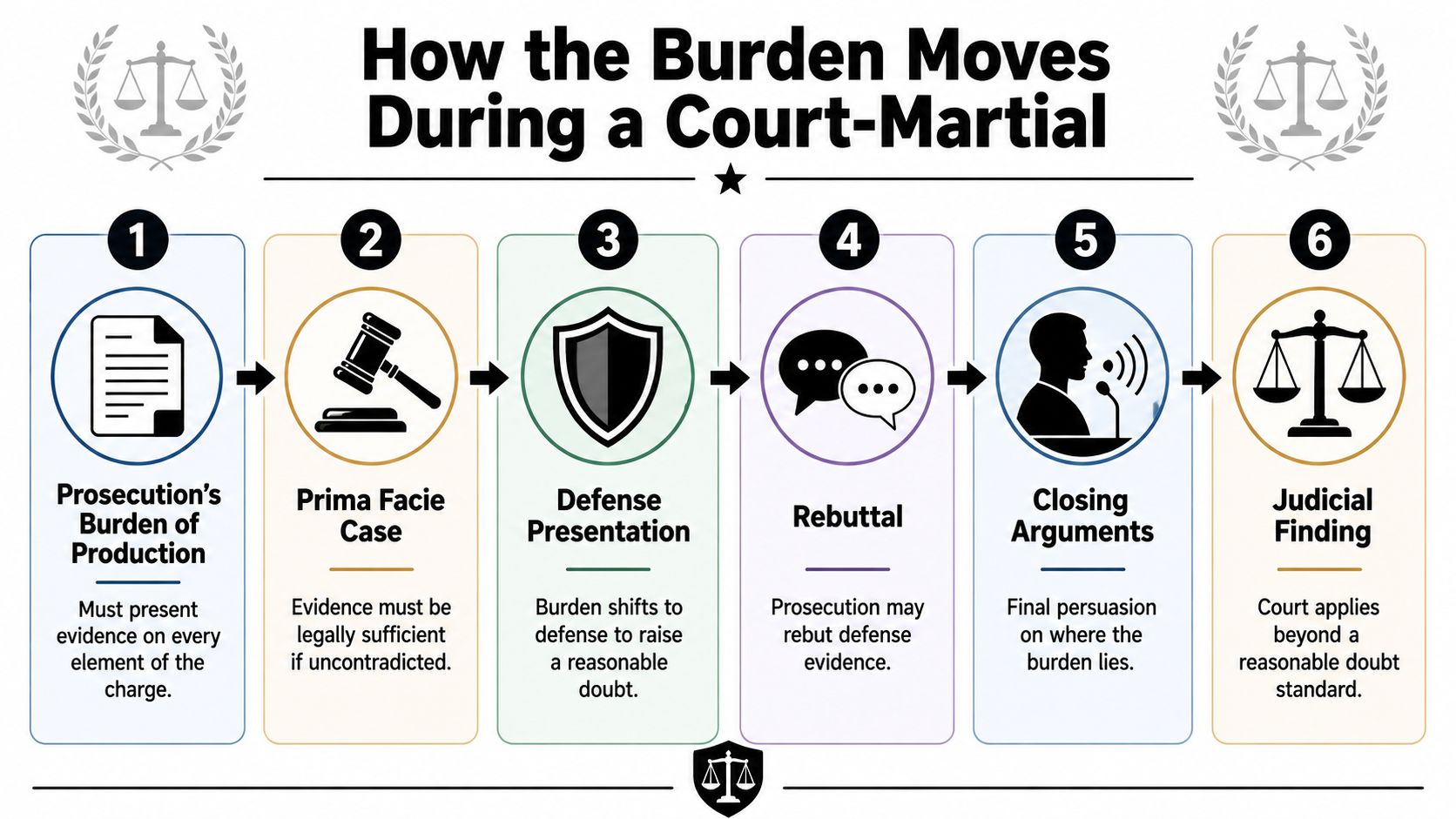
How the Burden Moves During a Court-Martial
A contested general court-martial develops through a sequence of proof decisions. The government starts with the charged specification. The defense then decides whether to contest the prosecution’s evidence directly, raise an affirmative defense, or do both.
The courtroom sequence
The prosecution presents its case. Trial counsel must introduce evidence addressing every element of every charged specification. A charge sheet alone isn’t proof. The government needs witnesses, documents, admissions, forensic evidence, or other admissible material that connects the evidence to each required element.
The military judge tests legal sufficiency. If the evidence is inadequate even when viewed in the government’s favor, the defense can seek relief. The question isn’t whether the defense has proved its alternative. The question is whether the government produced enough evidence to keep the issue alive.
The defense raises a qualifying issue. Self-defense, duress, mistake of fact, and lack of mental responsibility can require the defense to put forward enough evidence to place the issue in dispute. That is a limited production burden. It isn’t the same as proving the defense conclusively.
The government responds. Once an affirmative defense is properly raised, the prosecution may need to disprove it under the rule governing that defense. For most special defenses in courts-martial, the Manual requires the prosecution to prove beyond a reasonable doubt that the defense didn’t exist, subject to limited exceptions. The governing Manual provisions are available in the Rules for Courts-Martial reference.
The parties argue the evidence. Closing argument isn’t evidence. Counsel uses it to explain why the government did or didn’t satisfy production, why a defense was raised, and why persuasion remains with the party assigned by law.
The panel receives instructions. The military judge tells the panel which party bears each burden and which standard applies. A careful defense lawyer compares those instructions to the actual evidence and preserves objections when the government asks the panel to assume facts it never proved.
The most important point is that the ultimate burden of persuasion on the charged offense generally stays with the government. Raising a defense doesn’t erase the presumption of innocence. It creates a legal issue the prosecution must confront.
Where Experienced Lawyers Attack the Government’s Case
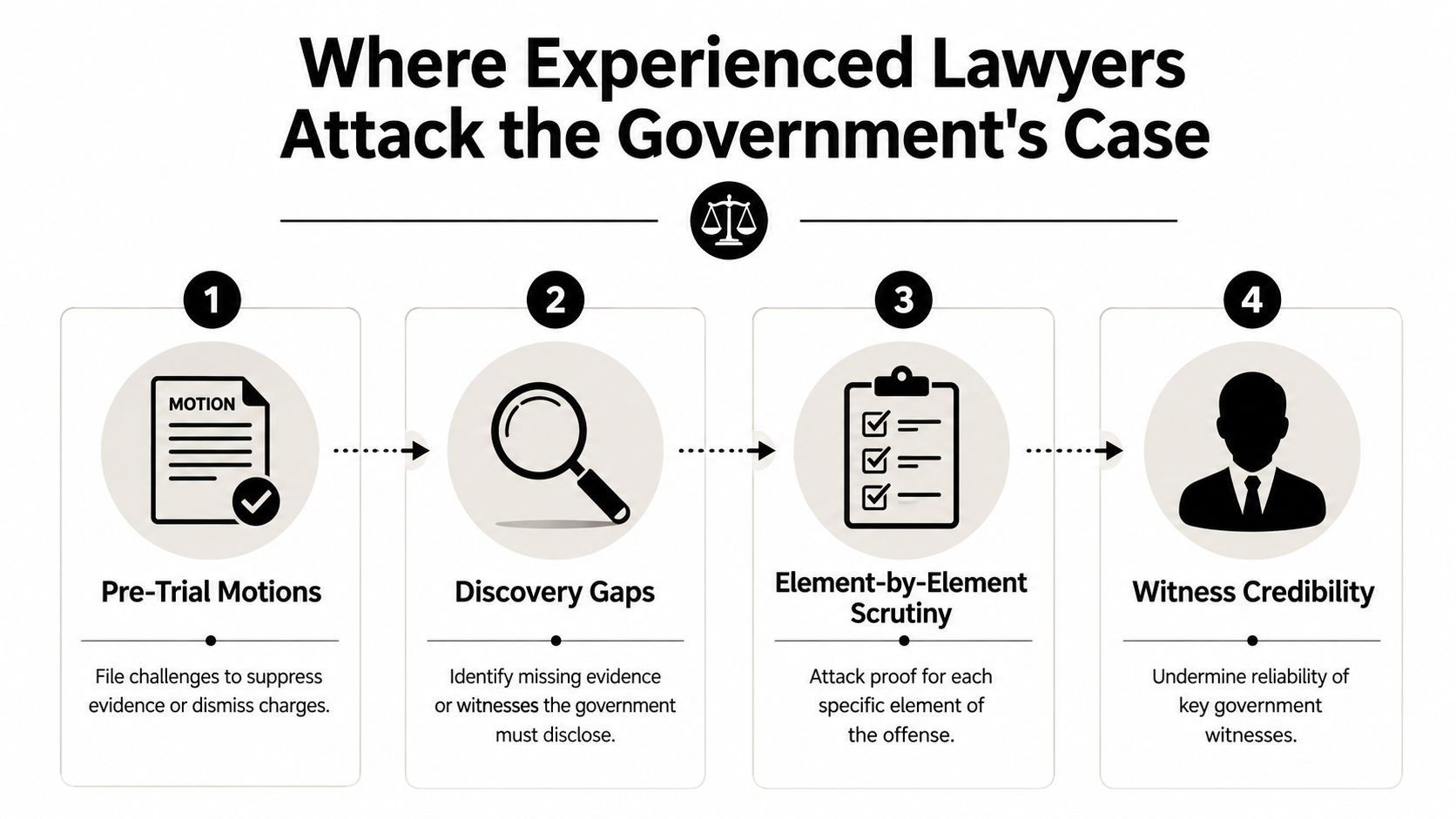
A high criminal standard doesn’t automatically produce an acquittal. Prosecutors win when they present a coherent narrative supported by admissible evidence, even if that evidence has weaknesses the defense never exposes.
Experienced civilian defense lawyers attack the proof before the panel hears closing argument. They ask whether the evidence exists, whether it is admissible, whether it is reliable, and whether it proves the precise element charged.
The proof points that deserve pressure
Chain of custody: Forensic evidence must be connected to the item collected, the person who handled it, and the testing process. Gaps don’t automatically end a case, but they can undermine reliability and admissibility.
Digital records: A screenshot isn’t the same as a complete message history. Counsel examines metadata, account ownership, extraction methods, missing messages, time settings, and whether the exhibit reflects the conversation fairly.
Identification procedures: Military Rule of Evidence 321 governs important identification issues. A witness who saw a person briefly, under stress or poor conditions, may sound confident while still being unreliable. The procedure used to obtain the identification matters.
Prior inconsistent statements: A witness’s first account may differ from later interviews, text messages, medical records, or testimony. The contradiction must be developed carefully. Accusing a witness of lying usually fails.
Expert evidence: DNA, digital forensics, toxicology, and mental-state opinions require qualified methods and competent interpretation. Under the principles associated with Daubert, counsel can challenge whether an expert’s methodology is reliable and properly applied.
Motions force clarity
Motions to suppress under Military Rules of Evidence 311 through 315 can require the government to defend how it obtained statements, searches, or other evidence. A motion to dismiss under R.C.M. 917 can test whether the prosecution presented legally sufficient evidence after its case.
The best burden argument often begins before trial counsel says the words “beyond a reasonable doubt.”
A government witness who cannot explain the collection process, a laboratory analyst who lacks a reliable foundation, or an investigator who ignored contradictory evidence can create a production problem. Cross-examination works when it is tied to an element or admissibility rule, not when it becomes a general attack on everyone involved.
Bears the Burden on Appeal
A conviction doesn’t end the burden analysis. It changes the forum. At the Army Court of Criminal Appeals, Navy-Marine Corps Court of Criminal Appeals, Air Force Court of Criminal Appeals, and Court of Appeals for the Armed Forces, appellate counsel examines whether the government met its legal obligations and whether the trial court applied the correct rules.
The precise review depends on the issue. Legal sufficiency under Article 66 asks whether, viewing the evidence in the required light, a rational fact-finder could have found the elements established under the applicable standard. Factual sufficiency involves a different inquiry into the weight and reliability of the evidence. Appellate counsel must identify the correct route rather than use “the evidence was weak” as a substitute for legal analysis.
| Court | Standard of Review | What the Appellant Must Show |
|---|---|---|
| Service Court of Criminal Appeals | Legal and, where authorized, factual review under Article 66 | The conviction lacks legally sufficient support or the factual record warrants relief under the applicable review |
| Court of Appeals for the Armed Forces | Review of specified legal issues and issues granted for review | An error or legal deficiency that falls within the court’s jurisdiction and warrants relief |
Preservation controls the record
A trial objection can become the foundation of an appellate burden argument. If defense counsel objected that the government failed to present evidence on an element, challenged an improper instruction, or moved for a finding of not guilty under R.C.M. 917, the appellate court has a clearer record of what happened and why it mattered.
Unpreserved issues can face forfeiture or waiver consequences. The distinction matters, and appellate counsel must assess the record rather than assume an appellate court will correct every mistake on its own.
That is why trial strategy and appellate strategy cannot be separated. A defense team that waits until appeal to identify a missing proof issue may find that no objection was made, no motion was filed, and no factual record supports the argument. A service member considering appellate counsel should also review the military appellate defense lawyer profile for William E. Cassara as an example of the specialized experience involved.
The government’s burden belongs in the record from the start. Counsel must identify the missing element, say so clearly, and preserve the issue when the court can still act.
Your First 72 Hours Under Investigation
The first three days aren’t about winning the case. They’re about preventing avoidable damage while counsel identifies what the government must prove.

Day one
Invoke your Article 31 rights if you’re suspected of an offense and investigators or command question you about it. Say clearly that you want to remain silent and want counsel. Don’t try to negotiate by offering a short explanation “off the record.” There is no reliable off-the-record conversation with investigators.
The Article 31 rights guide explains the protection in greater detail. Contact detailed military defense counsel or a civilian UCMJ lawyer before answering substantive questions.
Day two
Preserve evidence lawfully. Don’t delete messages, edit posts, reset devices, or ask someone else to change a record. Write a private timeline for counsel while memories remain fresh, identify witnesses who may have relevant firsthand knowledge, and save records that already belong to you.
Ask counsel about the status of the investigation and the identity of any Article 32 preliminary hearing officer if charges are being considered. If appropriate, request the convening authority’s referral letter and the CID report through established records procedures, including FOIA where applicable. A request doesn’t guarantee immediate access or production of every document, so don’t treat it as a substitute for discovery counsel.
Day three
With counsel, map the accusation onto the elements of the suspected offense. Identify what the government appears to possess and what remains unproved. Counsel should also examine whether facts support an affirmative defense that could place a limited production burden on the defense and require a government response.
Stay off social media. Don’t post about the allegation, investigators, witnesses, command, or your lawyer. Don’t contact the reporting witness to “clear things up,” and don’t recruit friends to coordinate accounts. Those actions can create new evidence and new allegations.
These steps protect the advantage discussed above. The government must produce evidence. You don’t help it satisfy that burden by filling gaps before counsel has tested whether the gaps matter.
Why Civilian Military Defense Counsel Changes the Equation
Detailed defense counsel can be capable, committed advocates. They also operate inside the military justice system, with assignments, caseloads, command relationships, and institutional limits that a retained civilian lawyer doesn’t share.
A privately retained civilian military defense attorney can change the burden analysis in practical ways. First, an independent team can investigate on a defense-driven timeline. That may include locating witnesses, reviewing digital records, testing the sequence of events, and identifying evidence the initial investigation ignored. The objective isn’t to create a story. It’s to determine whether the government’s story survives scrutiny.
Second, civilian counsel can retain qualified experts when technical proof matters. DNA interpretation, digital forensics, toxicology, and mental-state evidence can create production and persuasion issues that ordinary cross-examination won’t fully address. An expert may identify a limitation in the government’s testing or explain why an apparently strong exhibit doesn’t establish the element the prosecution needs.
Third, experienced court-martial attorneys can use the Article 32 process strategically. The hearing isn’t a trial, but it can expose weaknesses in probable-cause evidence, identify witness problems, and provide a basis for challenging referral or preparing for trial. Counsel who understands the burden at each stage doesn’t treat the hearing as a ceremonial step.
| Stage | Detailed Defense Counsel | Civilian Military Defense Counsel |
|---|---|---|
| Investigation | Advises on rights and prepares the assigned defense | Builds an independent investigation and develops defense evidence |
| Discovery | Reviews materials produced through the military process | Presses for missing records, witnesses, and technical information |
| Expert proof | Uses available military resources and referrals | Can evaluate and retain outside experts when strategically justified |
| Article 32 hearing | Represents the accused within assigned counsel resources | Uses the hearing to test probable cause and shape referral strategy |
| Trial | Provides courtroom representation | Brings specialized court-martial experience and independent case control |
The distinction isn’t that civilian counsel can guarantee an outcome. No ethical lawyer can promise that. The distinction is independence, depth, and the ability to build a defense without waiting for the government’s theory to dictate the investigation.
You should still speak with multiple lawyers and assess trial experience, communication, strategy, and fit.
If you’re weighing whether to fight or fold, get counsel before your first interview. A statement made without a lawyer can become the government’s production evidence, and an appellate court can’t erase every strategic mistake later.
Common Mistakes That Hand Over the Burden
Service members under investigation often believe cooperation will prove innocence. That approach can fail because investigators aren’t required to accept your explanation just because you offered it.
Talking to CID, NCIS, OSI, or CGIS without counsel: A voluntary interview gives investigators your words, phrasing, omissions, and emotional reactions. Invoke your rights instead.
Treating a command meeting as harmless: A first sergeant or commander may not use the same interview procedures as law enforcement, but your statements can still travel into the investigation.
Trying to repair the allegation directly: Don’t contact the reporting person or ask friends to intervene. Counsel should control communications that could affect witnesses or create allegations of retaliation.
Deleting or altering digital evidence: Removing messages or posts can create a separate problem and make favorable evidence harder to recover.
Assuming “there’s no evidence”: Evidence may include witnesses, location records, messages, access logs, medical records, or statements you made to someone you trusted.
Waiting for charges before hiring counsel: Early advice can prevent damaging statements and preserve investigative opportunities. Waiting often means the government’s narrative has already hardened.
Relying on reputation alone: Good evaluations and years of service don’t disprove an element. Counsel must connect favorable character evidence to the actual legal issues.
Ignoring administrative consequences: An investigation can affect separation, evaluations, assignments, clearance matters, and professional standing even when criminal charges don’t result.
Choosing a lawyer based only on comfort: You need someone willing to challenge evidence, confront command pressure, and explain the trade-offs of fighting, negotiating, or accepting an outcome.
Assuming truth wins without strategy: Truth matters, but the panel hears the evidence admitted under the rules. A defense lawyer must present the truth in a form that answers the elements and survives cross-examination.
Frequently Asked Questions About Who Bears the Burden
Who bears the burden in a court-martial?
The prosecution generally bears the burden of proving the charged offense beyond a reasonable doubt. The defense may carry a limited burden of production when raising an affirmative defense, but that doesn’t usually transfer the ultimate burden of persuasion on the offense.
Can I refuse to talk to CID?
You can invoke your Article 31 rights and request counsel when the required conditions exist. Don’t argue with investigators or offer a partial statement. State that you want to remain silent and want a lawyer, then follow counsel’s advice.
What happens at an Article 32 hearing?
An Article 32 preliminary hearing examines whether there is probable cause to believe an offense was committed and the accused committed it. It isn’t a trial, but defense counsel can use it to test evidence, identify weaknesses, and prepare challenges to referral and trial.
Does the burden shift when I raise self-defense?
A properly raised affirmative defense can place a limited burden of production on the defense. Once the issue is raised, the prosecution may have to disprove the defense under the governing Manual for Courts-Martial rule. The exact allocation depends on the defense and the applicable instructions.
Will I go to jail if I’m investigated?
An investigation alone doesn’t determine confinement. Pretrial confinement, trial, sentencing, and administrative outcomes depend on the allegations, evidence, command action, court decisions, and case-specific facts. Speak with counsel before making assumptions.
Is preponderance of the evidence the same as beyond a reasonable doubt?
No. Preponderance means more likely than not and is commonly described as greater than 50% confidence. Beyond a reasonable doubt is the substantially higher criminal standard, commonly explained as roughly 90% to 95% confidence for guilt, though it isn’t a mathematical test.
Do I need a lawyer immediately?
If investigators or command are asking about suspected misconduct, contact counsel immediately. Early counsel can protect your rights, preserve evidence, and identify the government’s proof before you provide information that fills its gaps.
Can an appeal fix a weak government case?
Sometimes, but appeal isn’t a second investigation. Appellate counsel must work with the trial record, and forfeiture or waiver may limit issues that weren’t properly raised. Burden arguments are strongest when trial counsel preserved them through objections, motions, and requests for appropriate findings.
If you’re under investigation, facing UCMJ charges, or being pushed toward an Article 15, administrative separation, or court-martial, don’t give a substantive statement before speaking with experienced military defense lawyers. Contact a civilian UCMJ lawyer or court-martial attorney now, preserve your records, stop discussing the case with coworkers, and get a clear assessment of what the government must prove. Your freedom, career, reputation, and future may depend on what you do before the first interview, not after the charges are filed.