
You’re sitting in your office when your commander hands you paperwork alleging an Article 92 violation under the Uniform Code of Military Justice. The order may have seemed routine. You may believe the matter can be explained away in a conversation. That assumption can cost you rank, pay, your career, and your freedom.
Article 92 looks simple because it concerns orders, regulations, and assigned duties. In practice, it gives the government several charging theories, each with different proof requirements and punishment exposure. The central question isn’t merely whether you failed to do what someone expected. It’s whether the government can prove that the order or duty was lawful, that you knew about it, and that your conduct fits the specific theory charged.
Table of Contents
- Why Article 92 Charges Catch Service Members Off Guard
- What Article 92 of the UCMJ Says
- Elements the Government Must Prove for Each Sub-Offense
- Maximum Punishment Exposure and How Charges Get Picked
- Investigation and Court-Martial Process Step by Step
- Defenses Mistakes and Why Civilian Counsel Wins These Cases
- What to Do Right Now and Answers to Common Questions
Why Article 92 Charges Catch Service Members Off Guard
A staff sergeant with a clean record is told that command is investigating a barracks incident. He remembers a broad discussion about maintaining order, but he never saw a written “party plan.” Nobody handed him a copy. He assumes he can explain that fact and move on.
Then he receives an Article 92 specification alleging that he violated a lawful order or regulation. His first instinct is to call the first-line supervisor, clarify the misunderstanding, and promise that it won’t happen again. That instinct is dangerous. A casual explanation can become the government’s most useful evidence about knowledge, intent, and what the service member understood at the time.
Article 92 is often used because it fits conduct that doesn’t sit neatly inside another punitive article. Command can frame the same underlying event as a regulation violation, failure to obey a direct order, or dereliction of duty. The chosen theory affects the elements, the evidence, the available defenses, and the pressure applied during negotiations.
The charge can affect you before trial
A charge can trigger adverse command attention before any verdict. It may affect duty assignments, promotion prospects, access to sensitive information, administrative actions, and how witnesses perceive you. An investigation can also produce statements, text messages, duty logs, policy acknowledgments, and command communications that later become central evidence.
That’s why the phrase “it’s only an Article 92” should set off alarms. The offense is foundational to the military discipline model. Article 92 was part of the UCMJ framework enacted by Congress on May 5, 1950, signed into law by President Harry S. Truman the next day, and later formally codified in the 1956 U.S. Code at 70A Stat. 68. The modern statutory text is available through the House Office of the Law Revision Counsel’s Article 92 provision.
Practical rule: Don’t explain the facts to command or investigators before you know the exact specification and have spoken with defense counsel.
Why the first response matters
The system rewards a clean theory of the case. If you allow investigators to define the order, the notice, and your state of mind before counsel intervenes, the government may build its entire file around your unguarded words.
Experienced military defense lawyers look at the charge as a proof problem, not a personality contest. They ask what order existed, who issued it, how it was communicated, whether it applied to you, and whether the alleged conduct violated it. Those questions often determine whether the case survives serious scrutiny.
What Article 92 of the UCMJ Says
Article 92 creates three separate offenses. It covers violating or failing to obey a lawful general order or regulation, failing to obey another lawful order, and being derelict in assigned duties. The government’s charging choice matters because each theory creates a different proof problem and a different defense strategy.
Violating a lawful general order or regulation
This clause applies to a rule governing a broader group, unit, installation, or category of personnel. The alleged violation might involve an installation regulation, command policy, or service-wide requirement. The government must still prove that the rule was lawful, applied to the accused, and was known to the accused.
A broad rule does not automatically control every person in every situation. Defense counsel should examine the issuing authority, the rule’s military purpose, its wording, effective date, distribution method, and any exception or conflict with another directive. An inconsistent command interpretation can weaken the prosecution’s claim that the accused violated a clear requirement.
Failing to obey another lawful order
This clause addresses a specific order rather than a general regulation. The order may be written or verbal. A supervisor might direct a service member to complete a task, report to a location, preserve equipment, or follow a safety procedure.
The order must be lawful and sufficiently clear. A vague expectation is not automatically a prosecutable order. Counsel should identify the exact words used, who heard them, when they were given, and whether the accused reasonably understood what compliance required. A dispute over wording, timing, or scope can become the central defense.
Dereliction in the performance of duties
Dereliction concerns a failure to perform an assigned duty. The allegation may be that the service member neglected the duty, performed it carelessly, or intentionally refused to perform it. The government must define the duty precisely enough to show what the accused was required to do.
A guard who fails to conduct an assigned inspection could face a dereliction theory. The defense should test whether the inspection requirement was communicated, whether the service member had the time and resources to perform it, and whether another order or emergency interfered. Those facts can separate a provable offense from a poorly supported accusation.
The Manual for Courts-Martial’s Article 92 provisions separates these theories and sets out their punishment structure. Command may select the clause that creates the most pressure, but the label does not eliminate the government’s burden to prove the correct elements.
| Clause | What It Covers | Typical Trigger |
|---|---|---|
| General order or regulation | A lawful rule applying to a broader group | Alleged violation of an installation, service, or command regulation |
| Other lawful order | A specific lawful directive | Alleged refusal or failure to follow a direct order |
| Dereliction of duty | Failure to perform an assigned duty | Alleged negligent or willful failure to carry out responsibilities |
Elements the Government Must Prove for Each Sub-Offense
The prosecution must prove every element beyond a reasonable doubt. Article 92 cases often turn on ordinary words that command treated as obvious, such as “lawful,” “known,” “duty,” and “willful.” Those words deserve aggressive scrutiny.
General order or regulation violation
The government generally must prove that:
- A lawful general order or regulation existed. Prosecutors may introduce the document, authenticated copies, testimony from the issuing authority, distribution records, or command acknowledgment materials.
- The accused had a duty to obey it. The rule must apply to the accused’s status, unit, location, assignment, or conduct.
- The accused knew about the order or regulation. Knowledge may be inferred from an acknowledgment, briefing, training record, direct communication, or surrounding circumstances.
- The accused violated the rule. The prosecution must connect the actual conduct to the specific language of the regulation.
The pressure point is often notice. A regulation buried in a digital repository is not automatically proof that a particular service member saw or understood it. Counsel should compare the written rule with the briefing materials, examine contradictory versions, and identify whether the command itself interpreted the rule inconsistently.
Failure to obey another lawful order
The prosecution must establish that:
- A specific order was given.
- The order was lawful.
- The accused knew about it.
- The accused failed to obey it.
A direct order case frequently becomes a credibility contest. The government may rely on the issuing witness, text messages, emails, duty logs, or testimony from people nearby. The defense should test whether the order changed, whether multiple leaders issued conflicting directions, and whether the alleged noncompliance resulted from confusion, inability, or a different reasonable interpretation.
The lawfulness inquiry also matters. An order must have a military purpose and come from an authorized source. A service member shouldn’t casually refuse an order because it seems unfair or inconvenient, but a defense lawyer must determine whether the order crossed a legal boundary.
Dereliction of duty
A dereliction specification requires a careful analysis of:
- The existence of a duty. The government must identify the source, such as an official assignment, regulation, standing operating procedure, or recognized duty tied to the accused’s position.
- The accused’s knowledge of that duty. The prosecution must show that the service member knew, or that the circumstances support the required mental state.
- A failure to perform the duty. The alleged omission must be connected to the defined responsibility.
- The required mental state. Negligent and willful dereliction are not interchangeable. The government must prove the charged level of fault.
The defense pressure points are practical. Was the duty reasonably defined? Did the accused have the authority, time, training, equipment, and information needed to perform it? Did an emergency, medical limitation, conflicting order, or communication failure make performance impossible?
The government doesn’t win because a duty sounds important. It wins only if it proves the duty, the breach, and the required mental state.
These theories look similar from a distance. They create different defense roadmaps at trial. A regulation case may turn on notice and applicability. A direct-order case may turn on wording and credibility. A dereliction case may turn on duty definition, feasibility, and fault.
Maximum Punishment Exposure and How Charges Get Picked
An Article 92 allegation can expose you to radically different punishment depending on the sub-offense selected. The Manual for Courts-Martial sets a graduated structure for general-order violations, other lawful orders, and dereliction. Use the current MCM, not an outdated internet summary, to assess the actual risk.
Violating a lawful general order or regulation carries maximum punishment of a dishonorable discharge, forfeiture of all pay and allowances, confinement for 2 years, and reduction to E-1, as stated in the 2024 Manual for Courts-Martial. A failure to obey another lawful order carries a bad-conduct discharge, forfeiture of all pay and allowances, confinement for 6 months, and reduction to E-1.
Dereliction has its own punishment structure. Negligent dereliction may result in confinement for 3 months and forfeiture of two-thirds pay per month for 3 months. Willful dereliction that causes death or grievous bodily harm may result in a bad-conduct discharge and 18 months of confinement.
| Clause | Offense | Max Confinement | Max Forfeitures | Discharge |
|---|---|---|---|---|
| General order or regulation | Violation of a lawful general order or regulation | 2 years | All pay and allowances | Dishonorable discharge |
| Other lawful order | Failure to obey another lawful order | 6 months | All pay and allowances | Bad-conduct discharge |
| Dereliction | Negligent dereliction | 3 months | Two-thirds pay per month for 3 months | No discharge listed for the ordinary negligent form |
| Dereliction involving death or grievous bodily harm | Willful dereliction | 18 months | Depends on the charged offense | Bad-conduct discharge |
The gap between 2 years and 6 months is a four-fold difference in maximum confinement. That gap can shape the charging decision, plea discussions, and confinement risk. Command may favor a general-regulation theory because it carries harsher exposure, while prosecutors may select the theory they believe the evidence can prove most effectively.
Charging is a strategic decision
The government may charge alternative theories from one event. The specifications might allege disobedience of a direct order, dereliction of duty, or conduct under another punitive article. The military justice punishment analysis explains why classification matters.
Do not negotiate based only on the headline allegation. Defense counsel must identify the proof behind each specification, the theory carrying the greatest exposure, and the facts supporting a lesser offense. Reducing a general-order violation to failure to obey another lawful order can materially change sentencing risk. A dereliction charge creates a different trial fight because the prosecution must prove the duty, the breach, and the required mental state. Experienced civilian counsel attacks that selection early, before the government turns the most damaging theory into the center of the case.
Investigation and Court-Martial Process Step by Step
Article 92 cases often begin informally and become formal before the accused understands the danger. The sequence below identifies the points where counsel must act.
Step 1, initial questioning and Article 31 rights
Investigators, command representatives, or law-enforcement agents may ask for an explanation. If you’re suspected of an offense, Article 31 rights matter. Don’t guess about whether you’re a suspect, and don’t assume a friendly conversation is harmless. Request counsel and preserve the right to remain silent.
A written waiver, recorded interview, or text exchange can become central evidence. Counsel should examine whether the warning was required, whether it was complete, whether the waiver was knowing and voluntary, and whether questioning continued after the service member invoked rights. The Article 31 rights guide provides background on this early protection.
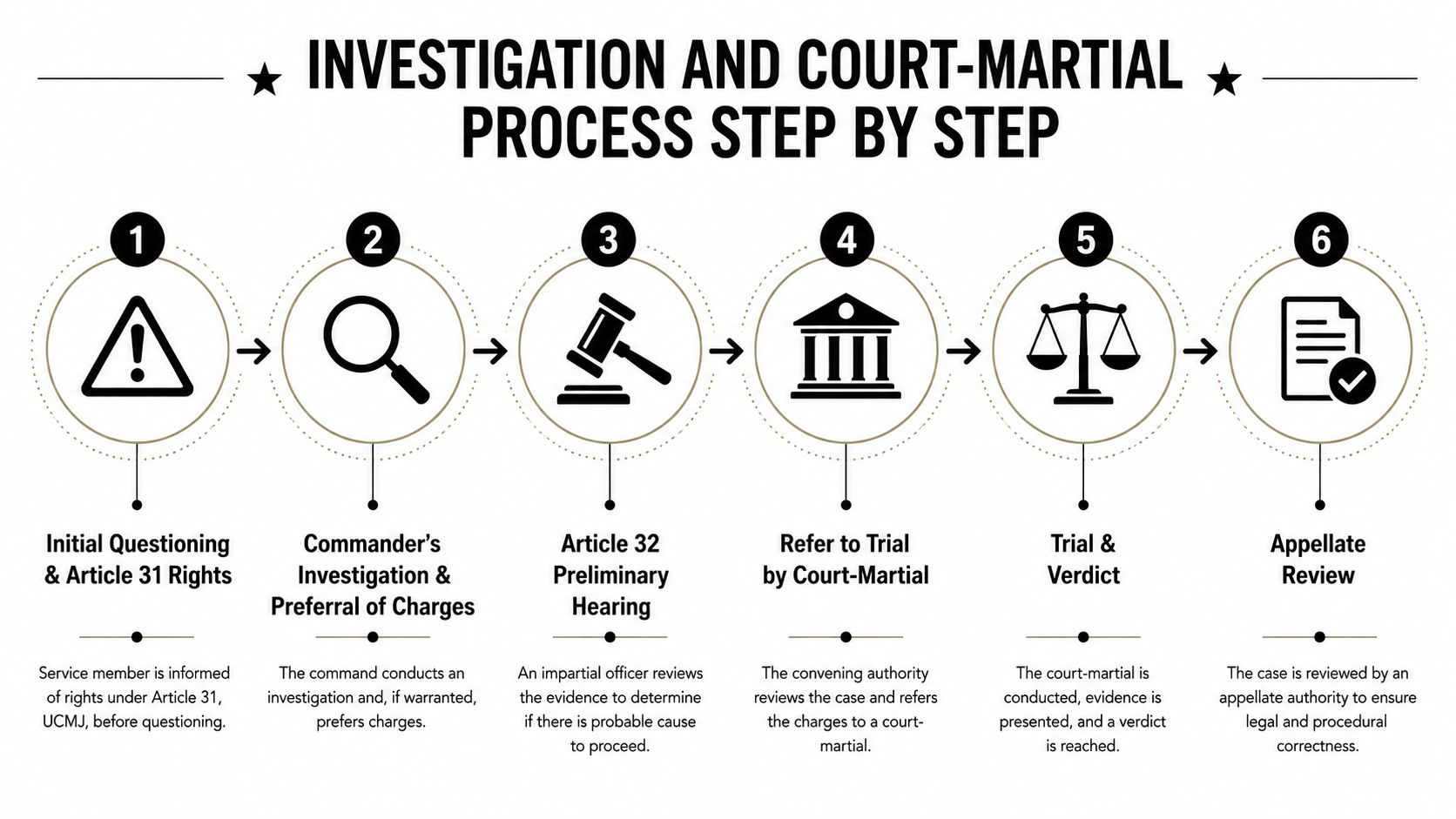
Step 2, command investigation and preferral
Command decides how to handle the allegation. Possible paths include informal action, nonjudicial punishment, administrative measures, or preferral of charges. Preferral formally places charges before a convening authority for further action.
At this stage, defense counsel should obtain the alleged order, regulation, witness statements, electronic communications, and investigative notes. Counsel should also preserve evidence that may disappear, including access logs, duty rosters, surveillance, messaging records, and medical or training documentation.
Step 3, Article 32 preliminary hearing
An Article 32 hearing tests probable cause and helps define the case before referral. The defense can use the hearing to expose missing witnesses, inconsistent accounts, weak notice evidence, and defects in the alleged order.
The hearing is not a mini-trial, but treating it as a formality is a mistake. Counsel should decide whether witness questioning advances the defense or gives the government a rehearsal.
Step 4, referral, arraignment, and motions
The convening authority may refer charges to a court-martial. At arraignment, the accused enters pleas, and the defense begins litigating motions. Important motions may address unlawful command influence, defective specifications, suppression of statements, improper searches, or discovery failures.
A discovery motion seeking the investigating officer’s notes can reveal differences between the final report and the underlying interviews. A written challenge to an Article 31 waiver can attack the admissibility of a damaging statement.
For a practical overview of the court-martial sequence, review these court-martial basics.
Step 5, trial and sentencing
At trial, the government must prove each element. The defense should force witnesses to identify the exact order, explain how the accused received notice, and distinguish assumption from personal knowledge.
If there is a conviction, sentencing preparation begins immediately. Mitigation should address the service member’s record, family responsibilities, medical history, duty performance, rehabilitative potential, and the actual circumstances behind the allegation. Waiting until sentencing to collect this material leaves counsel working with incomplete information.
Step 6, post-trial and appellate review
Post-trial work can include clemency submissions, record review, and appellate litigation. The defense should identify legal errors, evidentiary problems, unlawful influence, ineffective assistance, and sentencing defects.
A court-martial case doesn’t end when the panel announces a verdict. Decisions made before trial often determine what issues remain available afterward.
Defenses Mistakes and Why Civilian Counsel Wins These Cases
The most damaging Article 92 mistakes happen before the charge is formally preferred.
Talking to investigators without counsel. Your explanation may fill gaps in the government’s proof. Invoke your rights and obtain advice before answering substantive questions.
Signing a softened statement. Words such as “I should have known,” “everyone understood,” or “I probably missed it” can help prosecutors argue knowledge or negligence. Never sign a statement you haven’t reviewed with counsel.
Assuming a military-appointed lawyer is enough for every case. Assigned defense counsel can be capable and committed. A serious case may still require additional independent experience, resources, and strategic bandwidth.
Waiting until preferral. By that point, investigators may have interviewed witnesses, collected electronic evidence, and fixed the command’s preferred narrative.
Ignoring the actual order. Read the precise language. A defense may exist because the alleged order was vague, never became effective, applied to someone else, or conflicted with another directive.
Treating dereliction as automatic guilt. A missed task isn’t the end of the analysis. The government must prove the duty, the breach, and the required mental state.
Overlooking impossibility or lack of notice. Medical restrictions, unavailable equipment, contradictory instructions, or a communication breakdown may explain the alleged failure.
Failing to challenge credibility. Witnesses may remember a verbal order differently, repeat what others told them, or have a personal reason to shift blame. Those weaknesses matter.

Defense position: Attack the government’s chosen theory before arguing about punishment. If the order, notice, duty, or mental state fails, sentencing may never become the issue.
Civilian military defense lawyers bring independence from the chain of command. They can examine the case without worrying about command relationships, unit expectations, or institutional pressure. Experienced court-martial attorneys also know how to use civilian investigators, forensic consultants, electronic-data review, depositions, expert witnesses, and focused motions when those tools fit the case.
Military-appointed counsel may have substantial trial ability, but availability, assignment demands, and experience with a particular type of Article 92 litigation vary. Civilian counsel can add a dedicated strategic layer, especially when the case involves conflicting regulations, extensive digital evidence, senior witnesses, or serious discharge and confinement exposure.
Watch this practical discussion of how experienced counsel approach the military investigation phase.
Review experience, trial record, communication practices, and whether the lawyer has handled cases involving the specific Article 92 theory charged.
What to Do Right Now and Answers to Common Questions
What should I do after learning I’m under investigation? Stop discussing the facts with coworkers and command representatives. Preserve messages and documents, identify potential witnesses, and contact a UCMJ lawyer before an interview.
Should I cooperate with command? Cooperate with lawful administrative instructions, but don’t provide substantive answers about suspected misconduct without counsel. Politeness is not the same as surrendering your rights.
How does Article 92 differ from Articles 91 and 134? Article 92 focuses on lawful orders, regulations, and duties. Article 91 generally concerns disobedience or disrespect involving warrant officers, noncommissioned officers, or petty officers. Article 134 covers conduct fitting the broader conditions established under that article. The government’s choice depends on the facts and proof.
Can Article 92 charges be reduced or dismissed? Yes, depending on the evidence. Counsel may challenge lawfulness, notice, applicability, credibility, the duty definition, mental state, statements, and command influence. Negotiation may also produce a different offense or disposition, but never assume a favorable result without reviewing the file.
Will a conviction affect my future? It can affect rank, pay, continued service, discharge characterization, reputation, and civilian opportunities. The consequences depend on the findings, sentence, record, and later administrative decisions.
Do I need counsel immediately? Yes. Early advice can prevent damaging statements, preserve evidence, shape the investigation, and prepare you for an Article 32 hearing.
If you’re facing an Article 92 investigation, Article 15, administrative action, or court-martial, contact an experienced civilian UCMJ defense lawyer today. Don’t wait for preferral or an Article 32 date. Your rights, career, and freedom may turn on what you do before the government finishes building its case.
Call a qualified civilian military defense attorney now, provide the paperwork you received, and get a strategy before you answer another substantive question.