
You’re sitting in a barracks room or at a kitchen table, rereading messages from a lawyer who no longer returns calls. A hearing is approaching. Your command is moving forward. You’ve started wondering whether the person responsible for protecting your career and freedom is prepared to do it.
That doubt can be more dangerous than a difficult fact pattern. Firing your lawyer during a military investigation, court-martial, Article 15, or administrative separation is possible, but an unplanned switch can create delays, missed deadlines, incomplete discovery, and fee disputes. The right move is strategic, not emotional. Secure the next defense lawyer, protect the case file, and handle the transition through the proper military justice procedures.
Table of Contents
- Recognizing When It Is Time to Change Your Defense Attorney
- How to Terminate Your Attorney Without Derailing Your Case
- Military Justice Rules That Make Switching Counsel Different
- Managing Fees and Securing Your Case File After Termination
- Why Experienced Civilian Military Defense Counsel Matters
- Your Action Plan for Making the Switch Safely
Recognizing When It Is Time to Change Your Defense Attorney
A service member usually doesn’t lose confidence in counsel because of one unpleasant conversation. The concern grows through a pattern. Calls go unanswered, meetings produce no clear plan, investigators aren’t challenged, or the lawyer seems unfamiliar with the facts. Meanwhile, the government continues building its case.
Not every communication gap proves incompetence. Military cases move slowly, and some defense work happens behind the scenes. But silence becomes a serious problem when you can’t learn what deadlines exist, what decisions require your input, or what your lawyer has done to preserve evidence.

Red flags that justify a change
Look for conduct that affects preparation, not merely personality:
- No meaningful case assessment: Your lawyer can’t explain the allegations, likely evidence, defensive theories, or immediate risks in language you understand.
- Failure to investigate: Witnesses aren’t contacted, records aren’t requested, and obvious credibility problems remain unexplored.
- Missed obligations: The lawyer overlooks court filings, discovery requests, interviews, or other time-sensitive requirements.
- Insufficient trial experience: A lawyer who mainly handles administrative matters may not be ready for contested litigation, expert evidence, or difficult cross-examination.
- Fundamental strategic conflict: You and counsel disagree about whether to seek a negotiated resolution, challenge a confession, litigate suppression issues, or proceed to trial.
- Damaged trust: You no longer believe your lawyer is giving candid advice or protecting confidential information.
Practical rule: Don’t fire counsel merely because the news is bad. Consider a change when counsel’s performance, preparation, communication, or strategy prevents an informed defense.
Separate case friction from genuine failure
A strong defense lawyer may tell you something you don’t want to hear. The government may possess damaging evidence. A responsible attorney won’t promise an acquittal or pretend that every problem is easily fixed.
The better question is whether your lawyer has a reasoned plan. Ask what evidence matters, what remains unknown, which witnesses need attention, and what must happen before the next proceeding. If you get clear answers and see disciplined work, frustration may reflect the process rather than professional failure.
If you get evasions, unexplained inaction, or pressure to accept a strategy you don’t understand, act promptly. A client can discharge a lawyer at any time, with or without cause, while remaining responsible for legal services already performed. That principle appears in Rule 1.16 of the ABA Model Rules and related bar guidance. In military defense, timing determines whether the change protects the case or makes it harder to defend.
How to Terminate Your Attorney Without Derailing Your Case
The safest transition follows a strict order. Don’t send an angry termination email first and search for a replacement afterward. That approach can leave you without coordinated representation while the government keeps preparing.
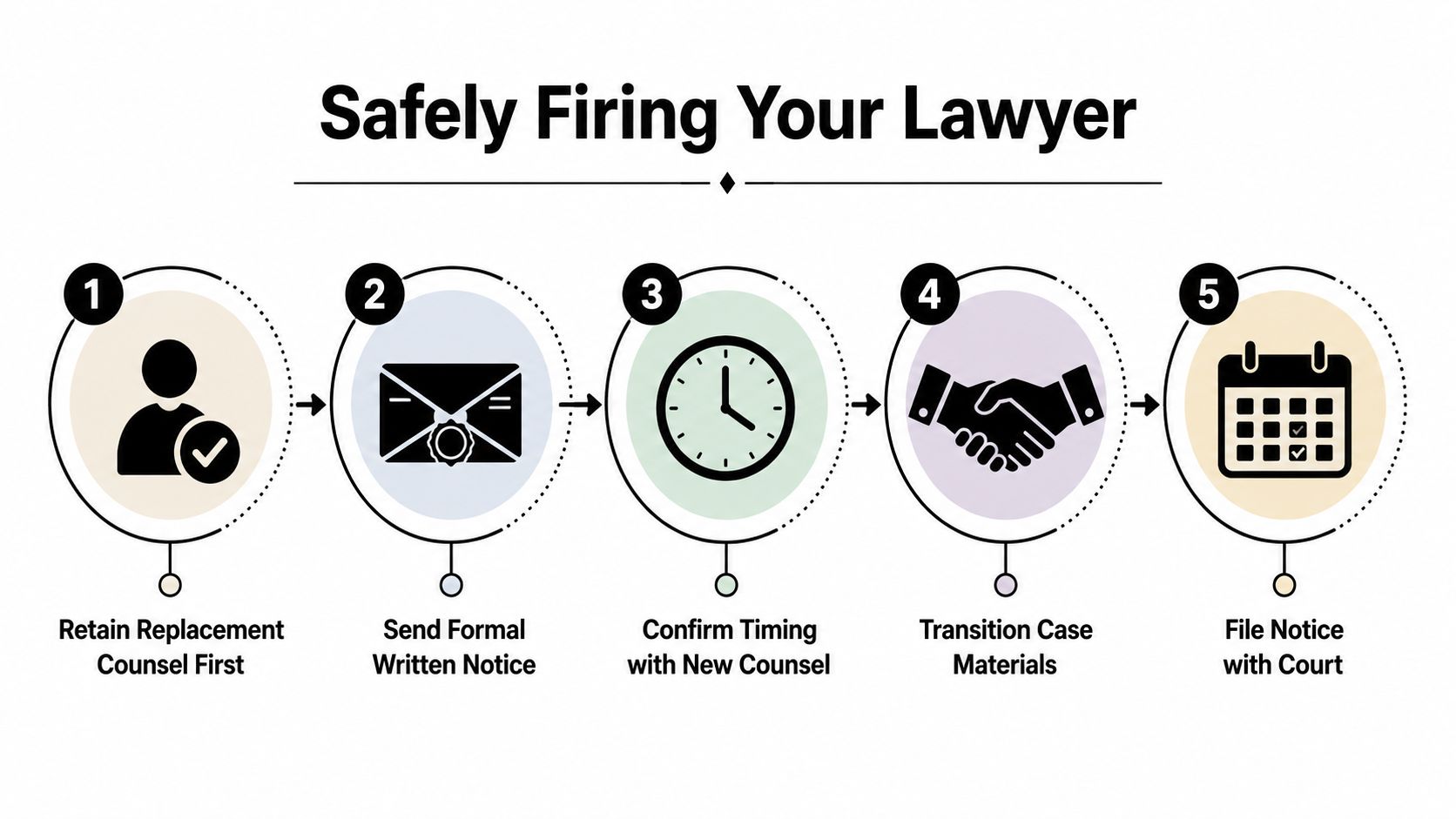
Step 1, retain replacement counsel first
Speak with experienced civilian military defense lawyers before terminating current counsel. Give the prospective lawyer the charge sheet or notification, investigation materials, court documents, correspondence, and a candid account of what has gone wrong.
The new lawyer should identify immediate deadlines and determine whether the case is at an investigation stage, referral stage, trial stage, or post-trial stage. If the matter is already scheduled, the replacement counsel needs to evaluate whether a transition request is realistic without harming your position.
Step 2, send written termination notice
Once replacement counsel is prepared to act, send a short written notice. State that you’re terminating the representation effective immediately or on the date coordinated with new counsel. Request the complete file, an itemized billing statement, a trust-account accounting where applicable, and confirmation of any upcoming deadlines or settings.
Avoid accusations in the letter. You’re creating a record, not arguing the case. Keep proof of delivery and copy your new lawyer.
Step 3, coordinate the military filing
Your new attorney must determine what substitution, appearance, withdrawal, or substitution-of-counsel filing is required. A client’s private decision to terminate counsel doesn’t automatically complete the court process.
The outgoing lawyer may need to seek withdrawal, and the military judge or other authority may control when the change becomes effective. The transition must protect your interests, particularly if a hearing, trial, or filing is close.
Step 4, transfer the case materials
Request the entire defense file in a usable format. That includes investigative records, discovery, motions, witness information, expert materials, correspondence, notes that belong in the client file, and relevant electronic communications.
Don’t assume the new lawyer has received everything from the government or the prior attorney. Compare the transferred materials against your own records and identify missing items immediately.
Step 5, confirm continuity
Ask new counsel to confirm representation status, upcoming dates, required client decisions, and communications with the court or command. You need a written transition plan, not a verbal assurance that someone will “get up to speed.”
The ABA’s Rule 1.16 guidance emphasizes reasonable steps to avoid foreseeable prejudice when representation ends, including notice, time for new counsel, and surrender of papers and property.
A short visual walkthrough can help organize the handoff:
Military Justice Rules That Make Switching Counsel Different
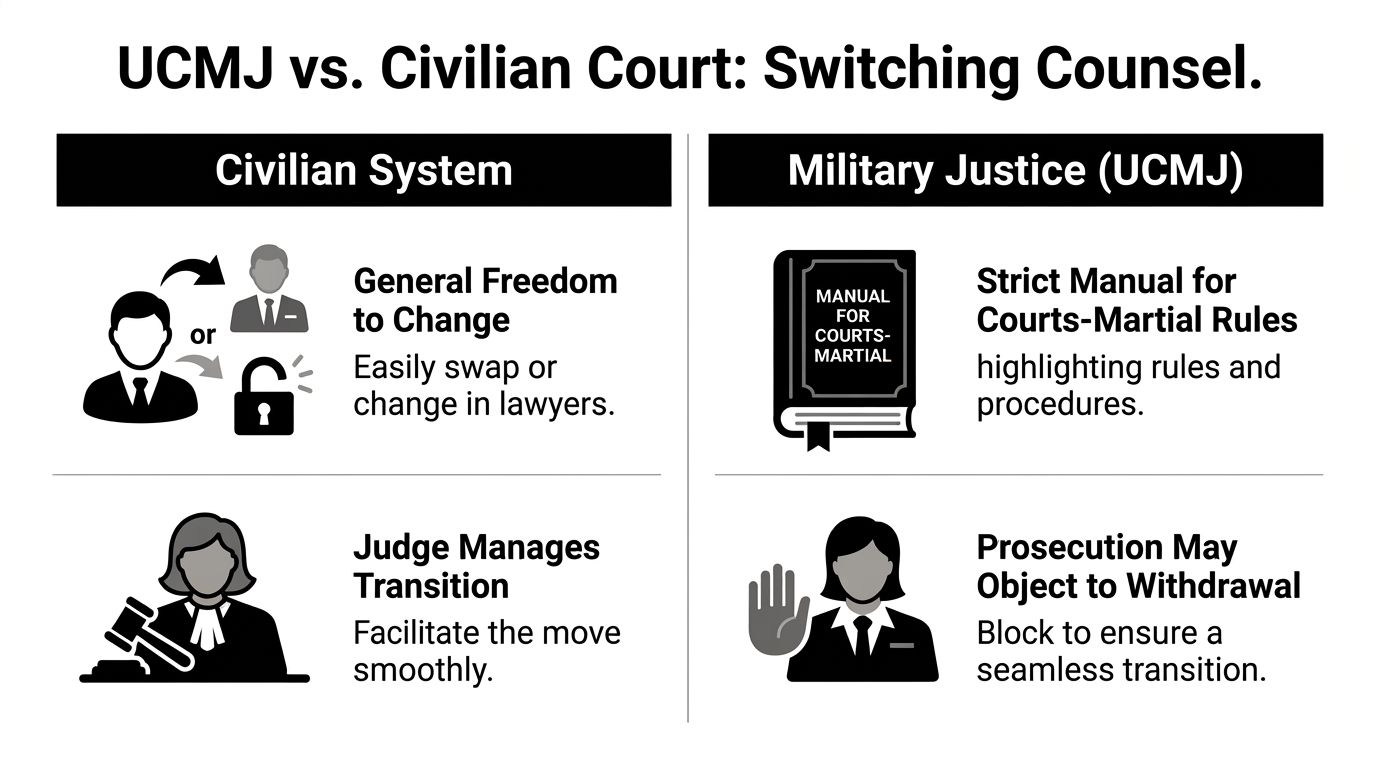
Civilian clients often think termination is complete when they send a letter. A court-martial doesn’t work that way. The Manual for Courts-Martial governs counsel withdrawal, and defense counsel generally can’t walk away from a pending military case.
Under the applicable military justice rules, counsel may be excused with the accused’s express consent or by the military judge after a withdrawal application showing good cause. That control exists because a last-minute departure can affect hearings, trial preparation, witness availability, and the accused’s right to effective representation. The military appellate digest discussing counsel withdrawal reflects this procedural constraint.
Detailed counsel and civilian counsel have different roles
An accused in a court-martial has a statutory right to detailed military counsel at government expense. The accused may also retain civilian counsel at personal expense and may request individual military counsel when that attorney is reasonably available. If civilian counsel represents the accused, detailed military counsel normally serves as associate counsel unless the accused asks to excuse that lawyer.
That structure creates a dynamic absent from ordinary civilian litigation. Your civilian attorney may lead the defense strategy, while detailed counsel remains involved unless properly excused. A replacement lawyer must understand how those roles interact and must communicate with all counsel clearly.
For a plain-English overview of the system, review this guide to the UCMJ system and military justice. Don’t treat a generic civilian substitution form as sufficient for a court-martial.
Post-trial timing can be unforgiving
Counsel changes after trial have their own risks. Following appellate action, the accused has 10 days after service of the convening authority’s action to tell the convening authority or the Judge Advocate General whether military appellate defense counsel is requested, whether civilian counsel has been retained or is being retained, both, or a waiver of counsel. That deadline appears in the governing statutory provision.
The strategic lesson is simple. A lawyer change must account for the procedural posture of the case, not just the quality of the relationship. A military judge may consider whether the proposed change creates delay, whether good cause exists, and whether the accused’s interests remain protected. The prosecution may object, but the judge decides under the applicable rules.
Managing Fees and Securing Your Case File After Termination
Firing your lawyer ends the relationship. It doesn’t erase work already performed or automatically eliminate fees. The governing engagement letter, retainer structure, jurisdiction, and type of representation matter.
The modern rule is that a client may terminate counsel while remaining liable for legal services already performed. A discharged lawyer’s recovery is generally limited to reasonable earned fees or quantum meruit, meaning the reasonable value of work completed, rather than the value of services never provided. Fracasse v. Brent, a historically important California Supreme Court decision, helped reinforce that principle, particularly in contingent-fee matters.
Unearned money is different from earned fees
A retainer can mean different things. It may be an advance deposited into a trust account and earned as work occurs, or it may be a true availability payment under an agreement. Don’t guess which one applies. Read the contract and demand an accounting showing:
- Work performed: Identify tasks, dates, time, and expenses.
- Funds held: Determine what remains in trust or has not yet been earned.
- Refund due: Unearned advance fees generally must be returned under applicable professional-conduct rules.
- Future claims: Ask whether the former lawyer asserts a lien or quantum meruit claim.
Contingency and hybrid arrangements require particular care. A lawyer discharged before the matter concludes may still assert a claim for the reasonable value of work performed, even though the lawyer won’t continue handling the case.
The file is essential defense property
The outgoing lawyer should transfer papers and property needed to protect your interests. In a military case, missing materials can include investigative interviews, digital evidence, discovery indexes, expert reports, witness contact information, and prior motion work.
Send a written file request with a reasonable delivery deadline coordinated with new counsel. If the lawyer refuses or delays, notify replacement counsel immediately. Don’t let a fee disagreement become an excuse for losing access to materials needed for a hearing or trial. Your new lawyer can address the fee dispute separately while protecting the defense timeline.
Why Experienced Civilian Military Defense Counsel Matters
Replacing counsel only helps if the replacement brings a stronger defense capability. A civilian lawyer who handles ordinary criminal cases may be competent yet unprepared for court-martial litigation, military discovery, command influence issues, Article 32 proceedings, military sentencing, or the career consequences of a conviction and adverse personnel action.
Detailed military counsel can provide valuable representation at government expense. But assigned counsel may be balancing an active military workload, changing assignments, and institutional obligations. A civilian defense attorney works outside the chain of command and can focus exclusively on your defense, subject to the professional duties that govern every attorney.
Experience changes the case review
An experienced court-martial attorney doesn’t just reread the accusation. The review should test:
- Chronology: Do the statements, records, and alleged events fit together?
- Credibility: Did witnesses change accounts, gain advantages, or receive information from others?
- Evidence integrity: Were digital records preserved, collected, authenticated, and interpreted correctly?
- Investigation quality: Did investigators pursue contrary evidence, or only the theory favored by command?
- Procedural safeguards: Were rights advisements, searches, interviews, and disclosures handled properly?
- Strategic posture: Is the best course litigation, negotiation, an administrative resolution, or a combination of defensive actions?
The government’s file is rarely the whole truth. Investigations often contain gaps, assumptions, delayed disclosures, and credibility conflicts. A lawyer who knows how to cross-examine the investigator, challenge the evidence, and present an alternative narrative can expose weaknesses that a hurried file review misses.
Read this practical guide to choosing a military defense lawyer before making the switch. Compare actual court-martial experience, trial work, communication practices, availability, and familiarity with the branch and procedural posture.
Independence is a strategic asset
A civilian attorney isn’t answerable to your commander, installation legal office, or military career system. That independence matters when the defense requires uncomfortable advice, aggressive investigation, or a challenge to the government’s preferred narrative.
Interview counsel directly and ask who will handle the case, what experience applies, and what the transition requires.
Your Action Plan for Making the Switch Safely
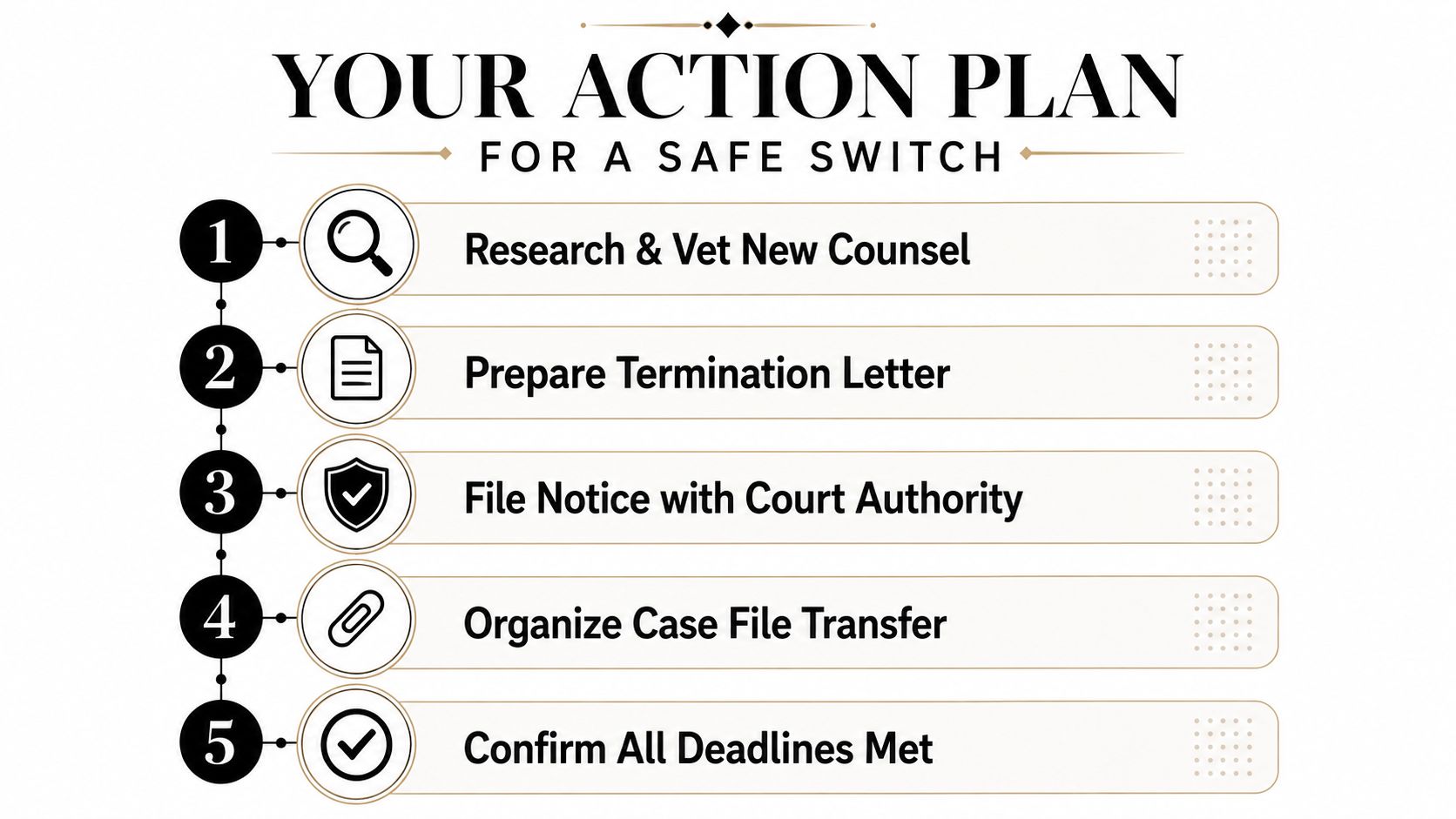
A safe change of counsel is controlled, documented, and fast enough to protect the defense. Use this sequence:
- Research and vet replacement counsel. Gather every document and explain the concerns without minimizing them.
- Confirm the procedural posture. Identify hearings, trial dates, appellate notices, investigation deadlines, and required filings.
- Review the fee agreement. Determine how earned fees, unearned funds, expenses, and potential quantum meruit claims will be handled.
- Prepare the termination letter. Keep it professional, written, specific about the effective date, and clear about the demand for the complete file and billing.
- Coordinate court notice. Let new counsel manage the appearance, substitution, withdrawal, or permission request required by the military judge or other authority.
- Preserve the record. Save emails, texts, billing statements, discovery receipts, and proof that you requested your materials.
- Confirm the next deadline. Don’t assume the transition pauses anything. Obtain written confirmation from new counsel about what must happen next.
Avoid the mistakes that cause the most damage:
- Firing before replacement is secured
- Relying on a phone call instead of written notice
- Waiting until the eve of a hearing
- Failing to request itemized billing
- Leaving missing discovery unidentified
- Assuming the outgoing lawyer can hold the file over a fee dispute
- Ignoring detailed counsel and military judge requirements
For a transition in an active investigation or court-martial, contact experienced court-martial defense lawyers immediately. If your current representation is failing, don’t wait for the problem to become irreversible. Speak with civilian military defense counsel now, secure a written transition plan, and protect your career, liberty, reputation, and case before the next deadline arrives.