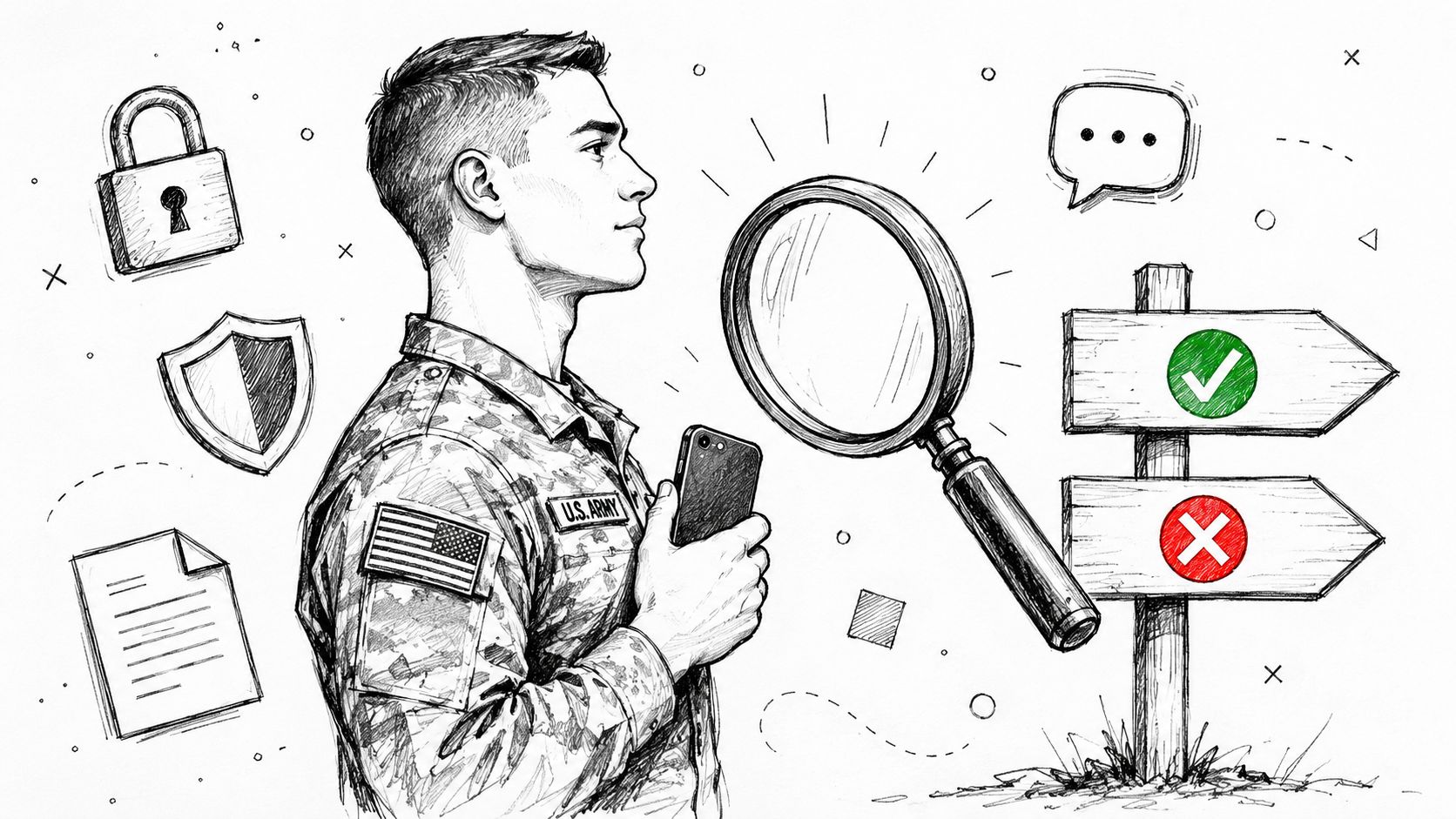
You're in a bad spot if someone in uniform just asked to see your phone, your room, your truck, or your laptop. That request can look casual. It isn't. The wrong answer can hand investigators evidence they never would've gotten on their own, and that evidence can end up in a court-martial, an Article 15, or an administrative separation packet.
Service members get burned because they think being polite helps. It usually helps the other side. If command, CID, NCIS, OSI, CGIS, or a local cop is standing in front of you asking for consent to search, they're trying to move the case from their burden to your mistake. Don't volunteer your career, your clearance, or your freedom because you want to look cooperative.
Table of Contents
- The Moment They Ask for Your Consent
- What Consent to Search Actually Means Under the Law
- Why Military Consent Searches Are Different
- How to Limit or Withdraw Your Consent
- Common Mistakes That Destroy Your Defense
- Why Civilian Military Defense Counsel Matters
- Frequently Asked Questions About Consent to Search
The Moment They Ask for Your Consent
A staff sergeant is in the barracks after midnight. An investigator knocks, says they're “just trying to clear something up,” and asks to look through the room and the phone. Or a junior sailor gets stopped off base, and the officer says they only need a “quick look” inside the vehicle. That moment is where people lose cases before the government ever files one.
The law treats consent to search as a serious waiver, not small talk. If you say yes, investigators may get access without a warrant or probable cause, and that can change what evidence survives later in court. If you say no, they may get mad. That is not your problem.
Practical rule: if you're being asked for consent, assume the person asking is looking for a shortcut around the warrant process.
The pressure feels bigger in the military because the person asking may outrank you, wear the same command patch, or be standing there with your supervisor watching. That's why this is a legal crossroads, not a courtesy. A bad decision in 15 seconds can produce screenshots, messages, photos, call logs, location data, or room contents that become the backbone of a case.
If you're already in that situation, stop treating it like a conversation. Treat it like evidence collection. The safest move is to slow the encounter down, avoid volunteering details, and get counsel involved before you agree to anything. For a related issue on warning rights during questioning, see Article 31 rights in the UCMJ.
What Consent to Search Actually Means Under the Law
A consent search is one of the classic Fourth Amendment exceptions. If a person with actual or apparent authority voluntarily consents, officers can search without a warrant and without probable cause. The government still has a burden, because the prosecution must prove the consent was voluntary under the totality of the circumstances. That standard is flexible on paper and ruthless in practice. See the Fourth Amendment consent-search discussion from Cornell Law School's legal encyclopedia, which explains the doctrine's place in constitutional law. Cornell's consent-search summary
Voluntariness is the fight
Courts look at age, education, custody status, intoxication, weapons present, and whether the person was told they could refuse. That means consent is not just a yes-or-no checkbox. It's a pressure test. If the environment is heavy, the consent may be attackable later, but only if the defense can show the pressure and the limits of what was said.
For military field conditions, the safest mindset is simple. If the search would matter in a case, don't assume a casual yes is harmless. Once valid consent is given, investigators can search the authorized property, vehicle, or device without separate reasonable suspicion or probable cause, but only within the scope and intensity authorized. Training guidance for consent searches stresses exactly that point, including the need to define the reason, object, and extent of the search, and to stop if consent is withdrawn. Consent search guidance for scope and withdrawal
Digital devices make the risk worse
Phones and laptops are where people get trapped. A person may think they're allowing a quick check of one folder or one account, then investigators start looking at older messages, photos, or cloud-linked data. That's why privacy advocates warn that consent-to-search language is often stretched in digital cases, especially when officers use high-pressure encounters to bypass warrants. The Electronic Frontier Foundation's overview of so-called consent searches focuses on that real-world gap between legal theory and smartphone reality, and it also explains why scope warnings and refusal rights matter. EFF discussion of digital consent searches
If you want a practical way to think about the digital side, read a current background-check and consent-form resource like Digital Footprint Check 2026 legal guide. The point isn't branding. The point is that written permission, digital access, and scope limits all matter in the modern evidence fight.
Why Military Consent Searches Are Different
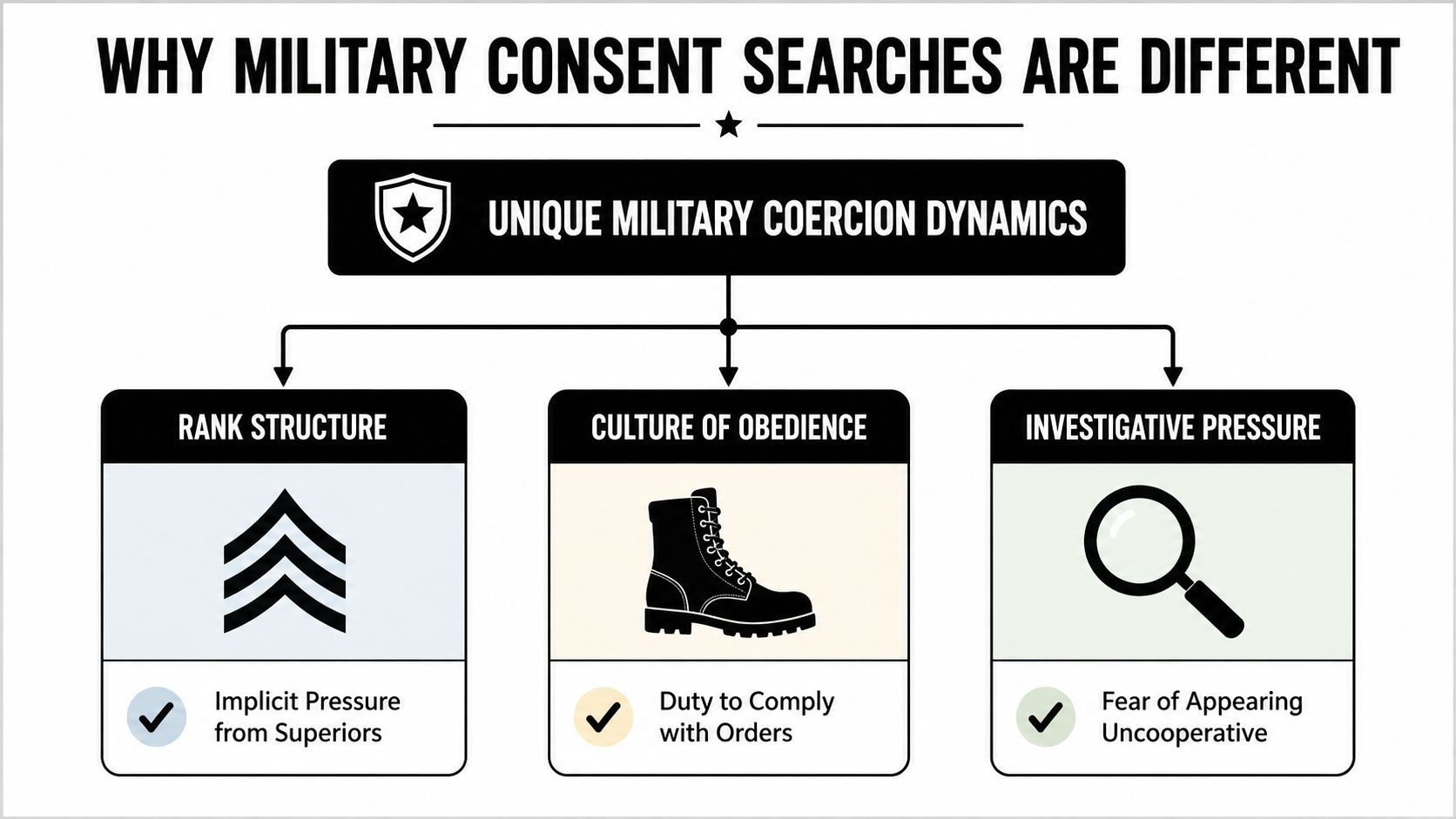
Military consent cases are not just civilian cases with different uniforms. Rank changes the room. A first class petty officer, a platoon sergeant, or a commander asking for permission to search brings a different kind of pressure than a random street encounter. Service members know how quickly “voluntary” can feel like “expected.”
Rank, obedience, and fear of looking difficult
The legal test says consent must be voluntary. The lived reality says many people comply because they don't want to look disobedient, unhelpful, or suspicious. That gap matters. The Duke Center for Justice Lab has said consent searches are often experienced as a survival tactic rather than a free choice, and it has also highlighted the racial imbalance and low yield problem in those searches. That's a serious challenge to the clean story investigators sometimes tell later. Duke Center for Justice Lab on consent searches
The public explanation of these cases often ignores the command climate. In a barracks, motor pool, flight line, shipboard environment, or station-house setting, refusal can feel risky even when the law says you can say no. That's why consent collected in military settings can be attacked as coerced if the facts support it. The legal doctrine doesn't disappear. The pressure does.
A service member doesn't need to prove they were ordered to consent. If the environment made refusal feel impossible, that pressure belongs in the defense file.
Digital searches are the modern target
Investigators know phones are better than room searches. Phones show texts, photos, social media, cloud data, and timelines. The shift is obvious in military cases, where a quick consent request can become a broad data harvest if the member doesn't limit the scope immediately. For command-driven matters, see the overview of CID, NCIS, OSI, and CGIS roles in this investigative-agency guide.
The clearest way to think about the military environment is this. Civilian law asks whether the consent was voluntary. Military reality asks whether the person felt they had any real choice. Those are not the same question, and defense lawyers know it.
How to Limit or Withdraw Your Consent
You do not have to hand over a blank check. Narrow the search. Ask what they want. Pull back consent if you already gave it. This is how it works in practice, and the scope of the request often decides whether the search stays defensible or turns into a fight later.
Use exact words, not awkward explanations
If an investigator asks for your phone, say, “I do not consent to a search of my phone.” If you are willing to allow a narrow look, say, “You can look at my call log, but not my photos or messages.” If someone asks to search your room, say, “You may enter only to look at the desk area,” or whatever narrow area you choose. Precision matters because a broad yes can be treated as broad permission.
If you need to revoke consent, say it plainly. “I withdraw my consent.” Do not explain, negotiate, or apologize. Once consent is withdrawn, the search must stop at that point. Consent is a live tactical decision, and your words control the fight.
Keep it calm and document it
Do not argue about the law at the door. Do not lecture the investigator. State the limit, repeat it if needed, and write down the basics afterward. Record the time, place, who was present, and what you said. If you can, send that note to your lawyer immediately.
A written memory beats a vague recollection every time. If your phone is in play, tell the person asking that you want to speak with counsel before agreeing to any device access. If they keep pressing, repeat the refusal.

Common Mistakes That Destroy Your Defense
The same mistakes show up again and again. They're predictable, and they're costly. Investigators count on them because service members are tired, stressed, and trying to keep their lives from collapsing in public.
The usual self-inflicted wounds
- Talking too much. Every extra sentence creates a new fact for the government to use.
- Guessing or lying. If you're wrong, you've given them a credibility problem and a statement problem.
- Consenting under pressure. A stressed yes can become evidence the defense has to fight later.
- Signing without reading. Paperwork can expand what the government says you allowed.
A lot of people also make the mistake of assuming there's “nothing there,” so consent doesn't matter. That mindset is dangerous. Search cases are built on what investigators find, not what they promise they're looking for. If they ask to search your phone, your room, or your vehicle, they're fishing for something usable.
Another bad habit is trusting command to “handle it fairly.” Command isn't your defense team. It's part of the system that may be gathering evidence against you. If you're under scrutiny, waiting to see what happens is how people lose their bargaining position.
Bottom line: if they're asking for consent, they're already building a case. Your job is to stop helping them build it.
Why Civilian Military Defense Counsel Matters
Military-appointed counsel can do solid work, but serious consent-search cases often need a lawyer whose only job is your case. That matters when the government's evidence came from a phone, a vehicle, a room search, or a tight encounter where everyone in the chain says the consent was voluntary. A civilian UCMJ lawyer can move fast, focus narrowly, and challenge the search from the first client call.
What experienced defense counsel looks for
A seasoned defense lawyer will attack the facts behind the consent. Was the service member boxed in, watched by superiors, or told there was no real choice? Did the search go past the words used? Did investigators keep going after consent was withdrawn? Did they reach into data the person never authorized? Those are the pressure points that decide whether the evidence stands or falls.
Civilian counsel also has the independence to tell you bluntly what the case risk really is. That matters because once consent-based evidence is in the record, your strategy must be built on the actual facts of the case. If you want a starting point for finding counsel, the Military Justice Guide explains what to ask when you compare civilian military defense attorneys.
Why timing matters
Delay helps the government. Early counsel can preserve texts, timeline details, witness names, and the exact words used when the request came in. It can also pin down whether consent was limited or whether investigators stretched it. That work gets harder after memories fade and the paper trail goes cold.
A lawyer who knows the military investigation phase can also spot pressure points before the government hardens its position. See how experienced counsel win cases during the military investigation phase for a closer look at that process. If evidence came from a consent search, you need someone who knows how to break that evidence apart before it becomes your problem at court-martial.
Frequently Asked Questions About Consent to Search
Can I refuse to consent to a search?
Yes. A valid consent search is voluntary, so you can say no. Keep it short and don't explain yourself into a corner.
What if I already said yes and changed my mind?
You can withdraw consent. Say, “I withdraw my consent.” After that, the search must stop at that point.
Do investigators have to tell me I can refuse?
The legal test looks at the whole situation, including whether you were told you could refuse. They do not always say it, and that omission can matter later.
Can command ask to search my room or phone?
Yes, they can ask. That doesn't mean you have to agree. If the request is tied to a criminal investigation, talk to counsel before you hand over access.
What should I do if they want my phone?
Do not open it just to be polite. State your limit or refusal, and get a lawyer involved immediately.
Will a consent search kill my case?
Not always, but it can create the evidence the government needs to keep going. That's why the first answer matters so much.
How do I find a military defense lawyer fast?
Use the Military Justice Guide to prepare your questions, then contact a civilian military defense attorney who handles court-martial and investigation work. Don't wait for charges to drop before you get help.
If you're being asked to consent to a search right now, stop talking and call counsel immediately. Your career, your clearance, and your freedom can turn on one sentence, one tap, or one signature.