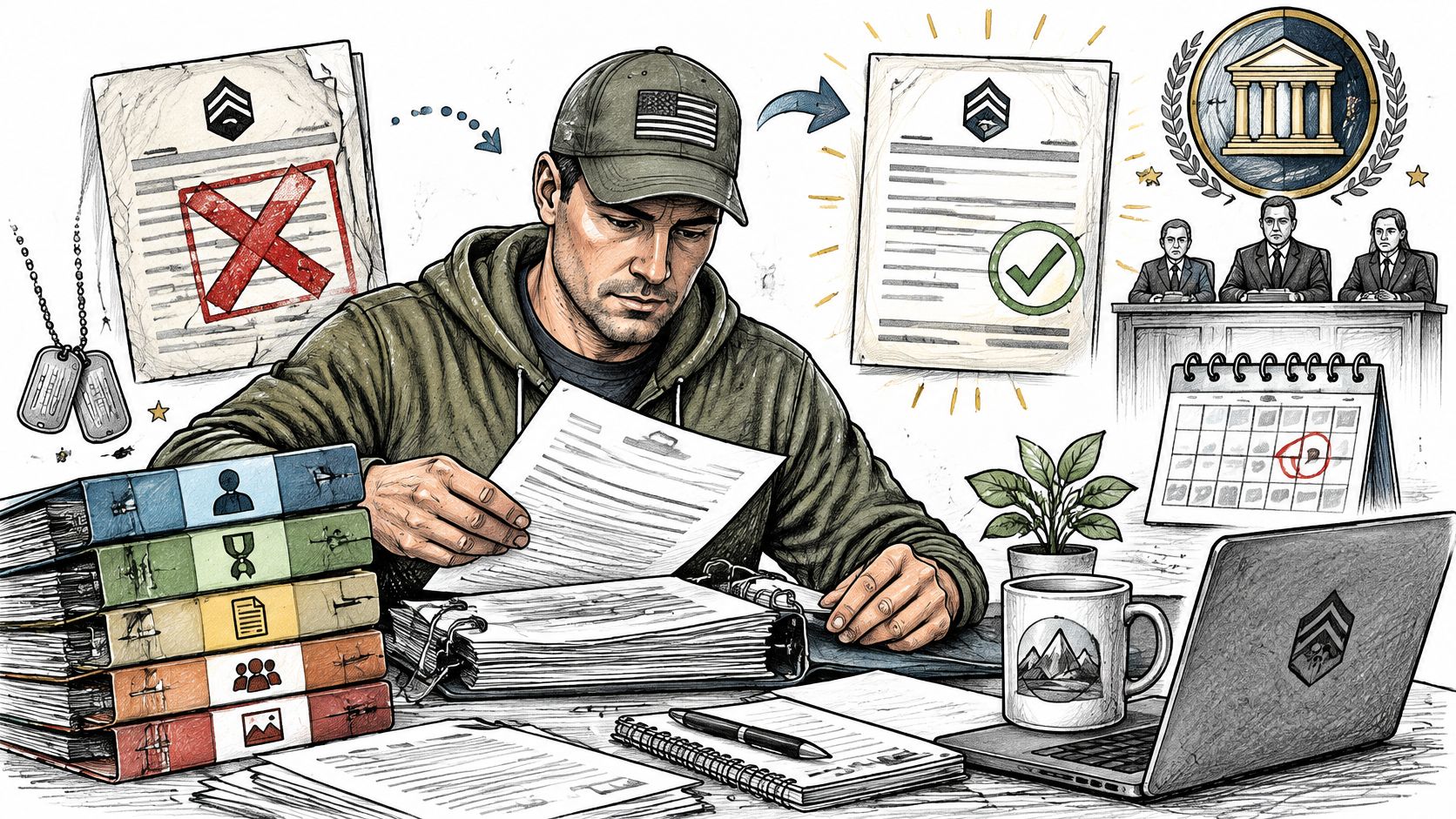
The Department of Defense granted relief in 824 of 851 proactively reviewed Don’t Ask, Don’t Tell discharge cases, a 96.8% rate, according to its Don’t Ask, Don’t Tell resources. That was a narrowly defined review, not the odds for an ordinary other-than-honorable discharge application. The distinction matters: the reason for your discharge, the board you choose, and the evidence you submit determine what relief is possible.
If you’re trying to upgrade a discharge from other than honorable, start with the deadline, not an apology letter. You’re dealing with two separate decisions: whether your military department should correct your record and whether VA can provide benefits now. A strong strategy addresses both without confusing them.
Table of Contents
- Pick the Right Board and Deadline
- How to File the Upgrade Packet
- Evidence and Arguments Boards Credit
- VA Benefits You Can Seek Now
- Mistakes That Get Requests Denied
- When to Hire Counsel and What to Do This Week
Pick the Right Board and Deadline
The Discharge Review Board filing window generally closes 15 years after separation, while correction-board applications generally face a three-year period from discovery of the error or injustice, subject to an interest-of-justice waiver, according to the National Archives military-records correction guide. Those clocks serve different purposes. Don’t assume that a correction board’s waiver authority extends a discharge review board’s jurisdiction.
An OTH characterization can complicate employment screening, benefits applications, and security-clearance reviews. It does not improve just because you’ve stayed out of trouble since separation. Your first job is choosing the decision-maker authorized to provide the correction you need.
Where an OTH upgrade request actually goes
| Route | Use it when | Clock | What changes | Form |
|---|---|---|---|---|
| Discharge Review Board | Administrative OTH, characterization or narrative | Within the separation-based filing window described above | Characterization and narrative reason | DD Form 293 |
| BCMR or BCNR | DRB window closed, or a broader record error | Discovery-based period described above, waivable in the interest of justice | DD-214, narrative, and other military records | DD Form 149 |
| Presidential pardon | Narrow court-martial conviction issues | No fixed military board deadline | Federal legal consequences; not an automatic DD-214 rewrite | DOJ pardon application |
The Discharge Review Board, or DRB, handles many challenges to administrative discharge characterization and the reason for separation. Its central questions are propriety, whether the discharge involved a legal or procedural error, and equity, whether the result was unfair considering the record.
A Board for Correction of Military Records, or BCMR, has a broader records-correction role. The Navy and Marine Corps use the Board for Correction of Naval Records, or BCNR. Don’t send a Navy case to an Army board or assume every requested correction belongs before a DRB.
Read the record before choosing the remedy
Pull your DD-214 and identify the separation date, characterization, narrative reason, and separation authority. Read those entries together. A request to improve characterization may leave a damaging or inaccurate narrative untouched unless you expressly challenge it.
If you’re still serving and separation isn’t final, your immediate problem is defending the administrative separation board process, not preparing a future upgrade application. Preserve objections and favorable evidence while the underlying case is still live.
First filing rule: Match the forum to your separation date and requested correction before spending weeks writing your personal statement.
A pardon isn’t a substitute for records correction. Neither is a VA benefits application. Choose the route that can change the document or decision causing the problem.
How to File the Upgrade Packet
A board application isn’t a place to unload every frustration you’ve carried since separation. It’s a request for a defined correction supported by organized evidence. Build it so a reviewer can follow your argument without reconstructing your military history.
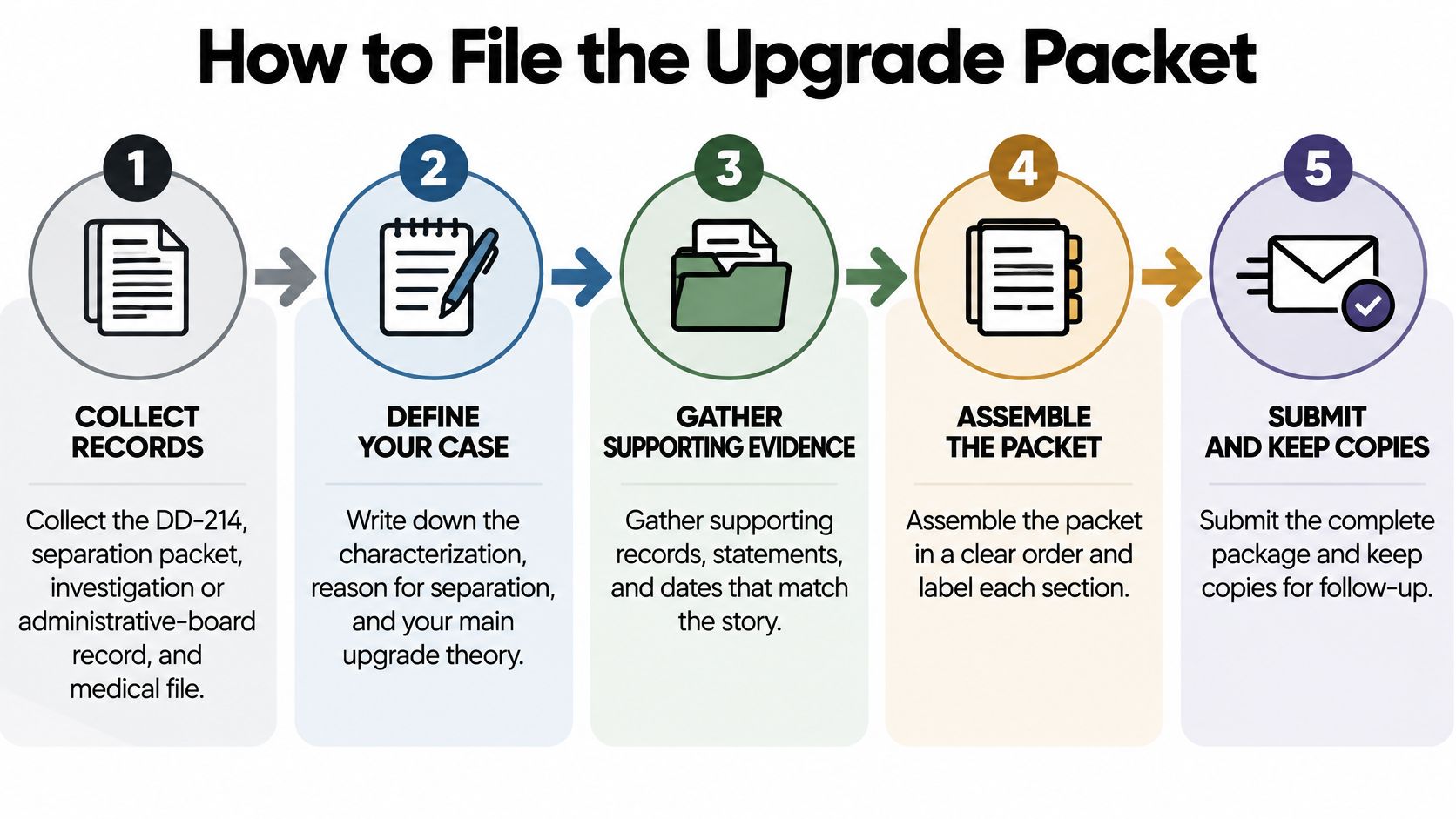
Use this workflow to keep the application organized.
Build the record and the argument
Collect the underlying file. Obtain your DD-214, separation packet, investigation, administrative-board proceedings, service treatment records, and relevant personnel records. Include documents that hurt your position. Counsel needs to understand the government’s strongest evidence, not just your best exhibits.
Confirm jurisdiction and identify missing records. Select the service board using the applicable filing clock and the relief sought. Request missing material immediately, keep proof of those requests, and don’t assume requesting records suspends a filing deadline.
Write a chronology around a defensible theory. Identify what happened, what command knew, what process occurred, and why the result should change. Use propriety when you can identify a meaningful legal defect. Use equity when the complete service history and mitigating circumstances support a different result. Some cases support both.
The Veterans Law Review discussion of discharge-upgrade practice explains why the forum, supporting records, and a specific error or injustice matter. Generalized hardship doesn’t replace that analysis.
Complete the correct form and specify the remedy. Use DD Form 293 for the DRB route or DD Form 149 for correction-board relief. State whether you seek Honorable, General under honorable conditions, a narrative-reason correction, or another authorized change. Attach a brief, exhibit index, and clearly labeled supporting records. Follow the receiving board’s current submission instructions.
Choose and prepare the review format. Where a documentary review or personal appearance is available, make a deliberate choice. A hearing can help explain a difficult timeline or credibility issue, but an unprepared appearance can expose contradictions. Prepare direct answers to the hardest facts rather than planning to read the entire brief aloud.
Submit, track, and plan for the wait
- Keep a complete submission copy and calendar follow-ups. Save the packet exactly as filed, delivery confirmation, acknowledgment, and subsequent correspondence. Update your contact information and respond promptly to board requests.
The Army Discharge Review Board took an average of 34 months to adjudicate liberal-consideration cases in 2024, according to Military Times. That’s a reason to build a separate care, employment, and financial plan, not a prediction of your own processing time.
Don’t organize your family’s survival around a hoped-for decision date.
The result may be full relief, partial relief, or denial. If the board denies the application or grants less than requested, have counsel analyze its written reasoning before choosing reconsideration, correction-board review, or potential litigation. Refiling the same argument without addressing the decision isn’t a strategy.
Evidence and Arguments Boards Credit
Liberal consideration isn’t an automatic upgrade. The Government Accountability Office found that DoD boards applied liberal-consideration standards in 21,817 cases from January 2018 through March 2024, with upgrade percentages across the boards ranging from 18% to 49%. The cases included 10,237 Army, 9,941 Navy, and 1,639 Air Force cases.
Those cases involved potential connections between misconduct and mental-health conditions, traumatic brain injury, or sexual assault. The spread in outcomes doesn’t establish your personal odds. It shows why identifying a qualifying issue is only the beginning of the argument.
Build a connection, not a document pile
A useful evidence package connects the condition, event, or procedural defect to the conduct and the requested correction.
- Contemporaneous treatment records. Identify symptoms, treatment requests, diagnoses, medication changes, and duty restrictions near the relevant events.
- A focused clinician opinion. Ask the clinician to explain how the documented condition could relate to the specific misconduct, including limitations in the available information.
- Command-knowledge evidence. Include emails, referrals, counseling records, or statements showing what leaders knew and how they responded.
- Witness statements. Favor concrete observations over character slogans. A witness should describe what they personally observed and distinguish observation from assumption.
- Post-service evidence. Document treatment, employment, education, rehabilitation, and responsible conduct without pretending they erase the original events.
- An honest personal statement. Address adverse facts directly. Unsupported denial can damage an otherwise credible mitigation case.
Use this checklist to test whether the argument and exhibits fit together.

Separate a meaningful defect from an unhappy outcome
A propriety argument might concern defective notice, a materially flawed board process, or denial of applicable counsel rights. Name the governing requirement, show what happened, and explain why the defect mattered. A typo that affected nothing isn’t the same as losing a meaningful opportunity to defend yourself.
An equity argument might focus on disproportionate characterization, overlooked mitigation, or a narrative reason that overstates the supported conduct. Counsel should compare the actual evidence with the conclusions command adopted. An investigative summary isn’t a substitute for examining the underlying statements and exhibits.
Say the record documents an AWOL period alongside untreated PTSD, repeated requests for treatment, and a refusal to provide care. That application gives the board a concrete mitigation theory to evaluate. A short apology with no records asks the board to supply the missing connection itself.
The strongest draft identifies the error or injustice, explains the causal connection, and requests an exact correction.
If you’ve already been denied, address the board’s actual reasons. New material should answer an identified evidentiary gap, not merely make the packet thicker.
VA Benefits You Can Seek Now
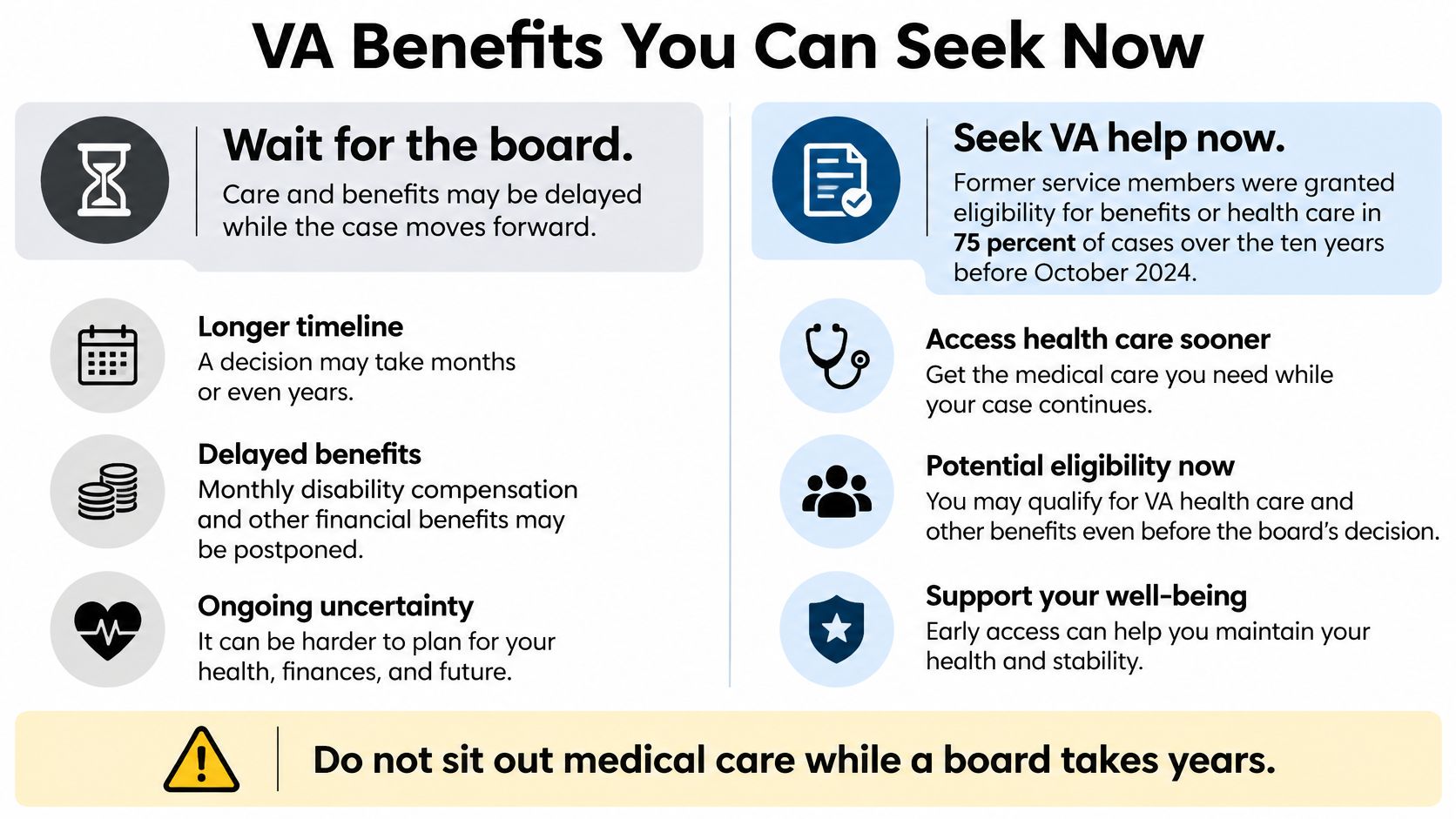
Don’t wait for a military board before asking VA what assistance is available. In October 2024, VA reported that over the preceding 10 years, it had granted eligibility for benefits or health care to 75% of former service members with OTH discharges, more than 57,000 individuals. Those were eligibility decisions, not military discharge upgrades.
A favorable VA character-of-discharge determination doesn’t change your DD-214, restore military status, or direct a service board to grant relief. VA evaluates eligibility for particular benefits and services. Your military department evaluates changes to its records.
COD review versus a real discharge upgrade
| Question | VA character-of-discharge review | Military discharge upgrade |
|---|---|---|
| Does the DD-214 change? | No | Yes, if record-changing relief is granted |
| Who decides? | Department of Veterans Affairs | Service DRB or BCMR/BCNR |
| What can you get? | Eligibility for specified VA benefits or health care | New characterization, narrative reason, or other record correction |
| Does a win bind the other side? | No | No; VA and service boards make separate decisions |
| Can you file both? | Yes, in parallel | Yes, in parallel |
The VA character-of-discharge eligibility guidance explains that basic eligibility for most benefits generally requires honorable service or service under honorable conditions, while less favorable discharges may receive an individualized determination. Don’t assume a favorable COD decision establishes entitlement to every program. Ask VA to evaluate the specific care or benefit you need.
These parallel processes serve different needs.
Identify barriers before promising benefits
Serious statutory and regulatory issues can include:
- Court-martial and officer-separation grounds. Discharge by sentence of a general court-martial or an officer’s resignation for the good of the service.
- Service-avoidance grounds. Desertion and certain conscientious-objector separations.
- Extended unauthorized absence. An OTH issued because of continuous AWOL of at least 180 days, identified in VA’s discharge-determination rule announcement.
- Avoiding general court-martial. Accepting an OTH in lieu of trial by general court-martial.
- Misconduct grounds. Willful and persistent misconduct or offenses involving moral turpitude, subject to applicable exceptions.
The exact ground and any exception require individual analysis. Don’t treat every item as legally interchangeable.
Also identify every distinct period of service. VA’s discharge-review guidance notes that an earlier honorable period may establish eligibility even when a later period was less favorable.
For a practical explanation of benefits after an other-than-honorable discharge, separate the benefit you need from the document you need corrected. A civilian employer reviewing the DD-214 itself presents a different problem from a VA eligibility decision.
Mistakes That Get Requests Denied
The most expensive mistake isn’t poor wording. It’s filing an application that never gives the board a supported reason to act. A hardship story can explain urgency, but it can’t supply missing evidence or cure a jurisdictional problem.
Replace these filing habits
- Waiting until the deadline is close. Calendar the separation-based deadline immediately and request missing records while there’s time to review them.
- Alleging unfairness without identifying an injustice. State what decision was wrong, why it was wrong, and what correction would fix it.
- Submitting an unsupported hardship essay. Attach exhibits that establish the relevant facts rather than asking the reviewer to accept conclusions.
- Requesting characterization relief only. Examine whether the narrative reason also needs correction and request that relief expressly when justified.
- Treating a VA award letter as binding on the military. Use it for what it proves, not as an order directing a service board.
- Dumping unindexed medical records. Identify the relevant entries and obtain a reasoned clinician explanation of causation where the theory requires it.
- Declining a hearing without evaluating its value. Decide with counsel whether testimony can resolve a material credibility or factual issue.
- Filing with the wrong service board. Confirm the receiving office, form, jurisdiction, and current submission instructions before sending anything.
- Invoking liberal consideration without a supporting connection. Explain the relevant mental-health, TBI, or sexual-assault theory instead of using the phrase as a slogan.
- Promising that an upgrade opens every benefit. Have counsel assess the VA barriers listed in the benefits discussion before advising your family what to expect.
Run a pre-submission check
Read the packet as if you know nothing about the case. Can you locate the requested relief immediately? Does every important factual assertion identify its supporting exhibit? Are dates consistent across the form, statement, medical history, and witness accounts?
The VA character-of-discharge factsheet describes review of the facts and circumstances surrounding separation and supporting evidence. That practical lesson matters when preparing parallel applications: preserve the underlying records and don’t create inconsistent accounts for different decision-makers.
Before submission: Confirm the right form, right board, filing deadline, requested relief, readable chronology, complete exhibit index, and retained copy.
Don’t hide a bad fact by leaving out a page. Address it, explain what the evidence supports, and distinguish accountability from agreement with an excessive characterization. Credibility is much harder to repair than formatting.
When to Hire Counsel and What to Do This Week
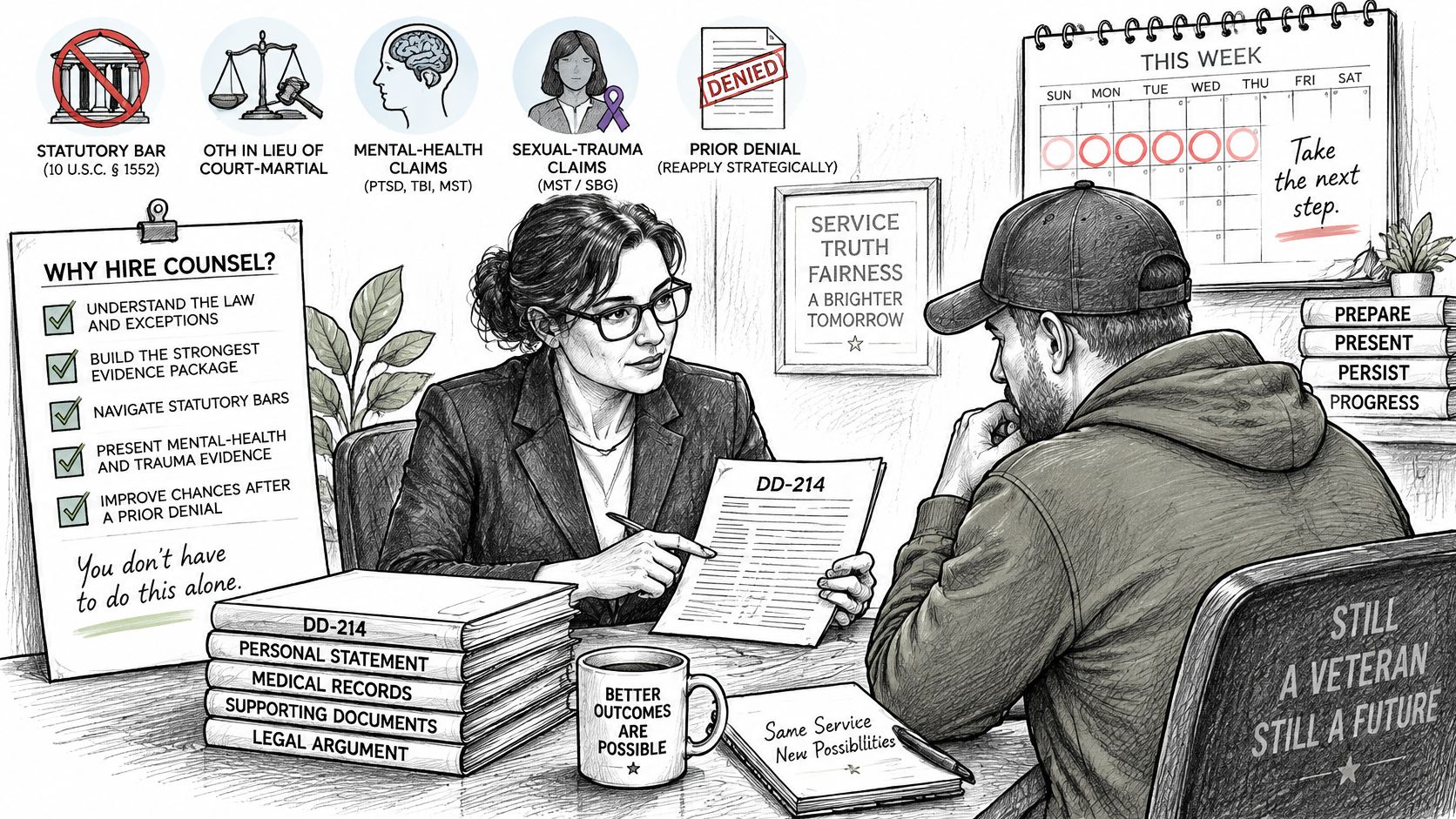
Hire counsel before filing when the paperwork includes a potential benefits bar, an OTH accepted in lieu of court-martial, a difficult mental-health or sexual-trauma theory, a prior denial, or a related clearance problem. These aren’t situations where a polished personal statement substitutes for legal analysis. A mistaken concession can affect more than the upgrade request.
Counsel should help turn your records into a tested argument, not just complete the application form.
Know what you’re hiring a lawyer to do
Military-appointed defense counsel can provide skilled representation in matters within their assignments. Don’t assume, however, that the counsel available during an investigation or separation will remain available for a later records-correction case. Ask about the scope of representation instead of relying on assumptions.
Civilian military defense lawyers are independent of command and can be retained for a defined upgrade representation. That independence matters, but it’s not enough by itself. You need someone who understands both the original military process and the board that will now examine it.
Experienced court-martial attorneys can identify weaknesses in witness accounts, unsupported investigative conclusions, and the consequences of admissions. Discharge-upgrade work also requires administrative-board knowledge, careful medical-nexus development, and an organized written record. A lawyer’s trial reputation doesn’t automatically establish competence in all those areas.
Use our guidance on selecting a military defense lawyer to compare relevant experience rather than advertising language. We give special weight to attorneys demonstrating 18 or more years of military law practice, but longevity isn’t a substitute for a sound case-specific plan.
When comparing court-martial lawyers, we emphasize sustained military justice experience, court-martial focus, teaching and writing credibility, leadership in defense organizations, and a track record handling similar cases.
Ask concrete questions during consultations
- Relevant board experience. What discharge-upgrade and correction-board matters has the lawyer handled, and how do those compare with your separation?
- Responsibility for the brief. Who reviews the full record, develops the theory, and writes the submission?
- Medical evidence. How will counsel determine whether a clinician opinion is needed and whether the available records support one?
- Hearing representation. Does the proposed engagement include preparation and attendance if a personal appearance is available?
- Coordination. How will the lawyer keep the military-board application consistent with the VA claim and any clearance response?
- Scope and cost. What work is included, what requires a separate agreement, and who handles a denial?
Don’t hire a lawyer who guarantees an upgrade before reviewing the separation packet. A responsible assessment identifies adverse facts, missing records, and realistic remedies.
Use the same scrutiny when evaluating general information about representation.
Questions veterans and spouses ask
Can I upgrade an OTH discharge myself?
Yes. Self-filing is an option, but a contested record, prior denial, or complicated mitigation theory makes professional review especially valuable.
Does good conduct after separation guarantee relief?
No. Rehabilitation supports an equity argument, but the board still needs a persuasive reason to change the military record.
Do I need a new diagnosis before contacting counsel?
No. Bring the records you have. Counsel can identify whether medical development would answer a genuine evidentiary gap.
Should I admit misconduct in my statement?
Don’t make unnecessary admissions or deny documented facts reflexively. Have counsel evaluate the record and any related legal exposure before finalizing the statement.
Can my spouse help prepare the application?
Yes. A spouse can organize records and describe personally observed symptoms or events. They shouldn’t speculate about diagnoses or events they didn’t witness.
What should I bring to the consultation?
Bring the DD-214, separation paperwork, prior decisions, relevant medical records, and a short chronology. Identify any pending VA claim or clearance action.
Take action before another week disappears
This week, locate your separation date, identify the applicable filing clock, and request the missing file. If you’re near a deadline, seek immediate advice about preserving your application rather than waiting for a perfect record.
Compare candidates and speak with more than one attorney. Credentials don’t guarantee outcomes; the consultation should reveal whether the lawyer understands your documents, can explain a viable theory, and communicates clearly.
Schedule a civilian military defense consultation this week with your DD-214 and separation date in hand. If records are missing, a benefits bar may apply, or an investigation drove a narrative you never understood, get advice before mailing DD Form 293 or DD Form 149. Ask counsel to identify the live deadline, the strongest supported correction, and the evidence needed to pursue it. Your next filing should protect your position, not merely tell your story.