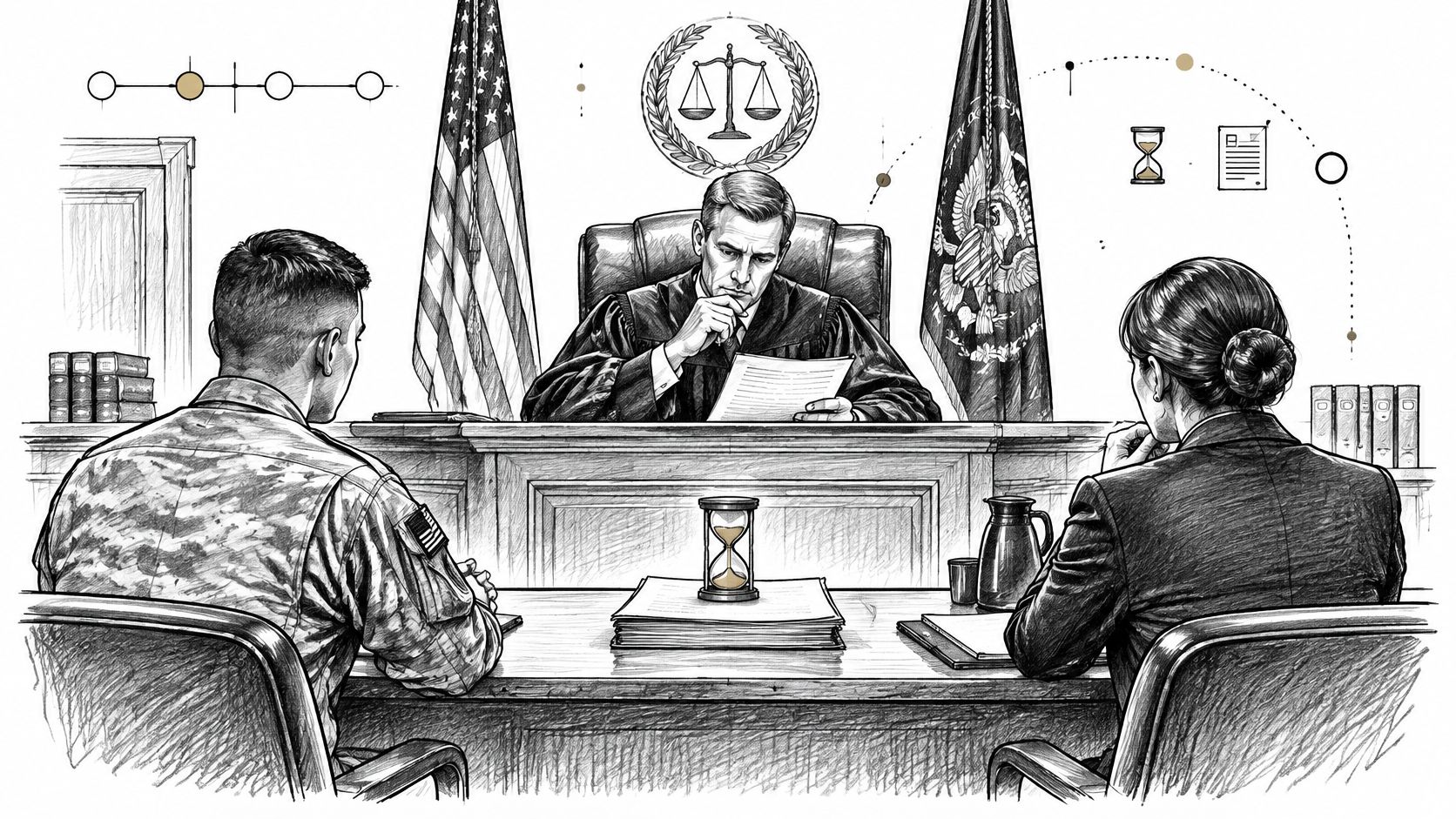
Taken under advisement means the decision-maker is still considering the matter. It is not granted, denied, or a promise of when the order will issue.
You’ve left the hearing, your spouse wants an answer, and the docket offers language that sounds important without telling you whether you won. Meanwhile, you still have a formation to attend, a no-contact order to follow, and questions about whether someone from command can ask you about the case.
Don’t turn an undecided motion into a decision in your own mind. Your career, freedom, and reputation require a plan for the waiting period, not a prediction based on the judge’s silence.
Table of Contents
- What Taken Under Advisement Actually Means
- Where the Phrase Lands and What Comes Back
- Two Clocks That Do Not Stop
- What You Can Say While You Wait
- Mistakes That Wreck the Waiting Period
- Call Civilian Counsel Before the Order
- Quick Answers on Taken Under Advisement
What Taken Under Advisement Actually Means
The military judge finishes hearing argument and says the motion is taken under advisement. One family hears hope. Another hears disaster. Neither reaction tells you what the judge will do.
Taken under advisement describes deliberation, not an outcome. Cambridge Dictionary defines the expression as considering advice or information carefully, including a court considering a case without announcing when it will rule.
The important word is considering. The judge may have heard testimony, reviewed exhibits, and questioned counsel sharply without deciding the motion. Advisement means careful consideration, not everyday advice and not an informal promise.
What common docket words actually decide
Read the verb before drawing a conclusion. Then read the rest of the order, including any separate filing requirement.
| Docket language | What it means | What it does not mean | Immediate check |
|---|---|---|---|
| Taken under advisement | Matter received and held for careful decision | Not granted, denied, or a deadline | Read the same order for any separate due date |
| Granted or denied | Operative ruling on that motion | Not still pending on that issue | Have counsel identify appeal or reconsideration deadlines triggered by that order |
| Sustained or overruled | Ruling on an objection | Not the verdict or sentence | Preserve the objection and ruling in the record |
| Submitted for decision | Expected briefing and evidence are in | Not a disposition | Watch for a written order or more briefing |
These distinctions matter because a ruling has a defined scope. Granting an evidentiary motion doesn’t necessarily dismiss a charge. Denying a motion doesn’t establish guilt. Sustaining an objection doesn’t tell you the eventual sentence.
The same discipline applies outside a courtroom. A commander, board, or administrative decision-maker may take a request under advisement without approving the requested relief. Identify who is deciding, what request is pending, and what document will communicate the actual decision.

Record the status without predicting the result
Save the exact docket entry rather than paraphrasing it in a family text. Keep the motion, any hearing notice, and the accompanying order together so counsel can distinguish what remains pending from what the judge already resolved.
Practical rule: Log taken under advisement as received for evaluation. Don’t log it as a win, a loss, or permission to stop complying.
Ask counsel a precise question: What remains undecided, and what must we still do before the ruling? That produces a useful answer. Asking whether the judge’s expression looked favorable usually doesn’t.
Where the Phrase Lands and What Comes Back
A military judge may reserve a decision on a motion to suppress a statement, a challenge to a charging or referral defect, or a motion in limine concerning damaging evidence. The same issue can arise during disputes over instructions or requests to reconsider an earlier ruling.
The subject changes. The procedural distinction doesn’t: holding a motion for decision is different from granting relief.
A federal bankruptcy memorandum in In re Young illustrates that sequence, describing a motion taken under advisement after a hearing and resolving it through a later decision. This is a procedural illustration, not a rule governing your court-martial.
Identify exactly what the judge reserved
Your lawyer should separate the pending question from any ruling already announced. A judge can resolve one issue orally, reserve another, and require additional briefing on a third. A short docket description may not capture those distinctions.
An oral ruling from the bench can have immediate operative effect. Don’t assume nothing counts until a written document appears, and don’t assume a later written order will necessarily restart a deadline. Counsel must identify what the judge ordered and which procedural rule controls.
For the broader sequence of hearings and motions, our court-martial basics guide provides context. Your immediate task is narrower: understand the status of this motion within that sequence.
When the decision arrives, counsel should classify the result carefully:
- Granted in full: Determine exactly what relief the judge authorized and whether any further implementation is required.
- Granted in part: Identify what evidence or argument remains available to the government.
- Denied: Prepare the next permitted response and adjust the trial plan.
- Deferred or conditional: Identify the event that will resolve the issue and every restriction that remains effective.
Partial relief deserves particular attention. Excluding one statement may leave other statements, witnesses, or physical evidence available. Winning a motion is useful only if the defense understands what the ruling removes from the government’s case.
A pending motion doesn’t erase a separate obligation
A federal civil order concerning a motion to dismiss took the motion under advisement while requiring the plaintiff to file an amended complaint by a separate deadline. The order warned that failure to amend would result in the motion being granted and the case dismissed.
That example exposes the dangerous assumption: the pending decision and the required filing were separate obligations. Waiting on the former didn’t excuse ignoring the latter.
Apply that distinction to military life. Say the judge is considering suppression on Friday. Unless competent authority changes the applicable requirements, you still comply with a no-contact order and report for Monday formation. A pending motion isn’t a stay of everything connected to your case.
Nor does deliberation change the applicable burden of proof. Counsel still has to identify the governing legal standard and show how the record satisfies it. The judge’s need for more time doesn’t repair missing testimony or establish that either side carried its burden.
Prepare the next filing before the decision arrives
Experienced defense lawyers use the waiting period to assess the record, not to read meaning into silence. The useful questions concern evidence and procedural options:
- Missing material: Are recordings, interview notes, or relevant messages absent from the motion record?
- Credibility conflicts: Did a witness’s testimony differ from an earlier account in a way that matters to the motion?
- Preservation: Did counsel clearly state the objection and requested relief?
- Further briefing: Did the judge authorize or request another submission?
Don’t send the judge an unsolicited explanation yourself. Counsel should decide whether supplementation is permitted, necessary, and strategically sound.
Consider a suppression motion involving an interview. While the judge deliberates, the accused texts a witness to explain what really happened. That message creates a separate evidentiary problem whether the original motion succeeds or fails. If admissible, it may become the government’s next exhibit.
The defense must prepare for the ruling without giving the government something new to use.
Two Clocks That Do Not Stop
| Clock | Starts when | Known interval | What it does not do |
|---|---|---|---|
| Judge’s deliberation | The matter is taken under advisement or submitted | No national must-rule-now deadline; the In re Thomason decision records an 8-day interval, December 13, 2021, to December 21, 2021, and separately applies a 14-day reconsideration period | Does not predict grant or denial |
| Party notice of delay | Prolonged submission in a court that permits notice | More than 90 days under the Eastern District of Oklahoma’s local rules | Does not decide the motion or bind every military judge |
| Reconsideration | Entry of the later operative order in the cited bankruptcy matter | The Civil Rule 59(e) period applied in that ruling | Does not run from the advisement entry |
| Military side constraints | Existing command or court order, or applicable administrative process | The governing order or process controls | Advisement alone doesn’t pause a flag, separation action, or protective order |
Distinguish waiting time from response time
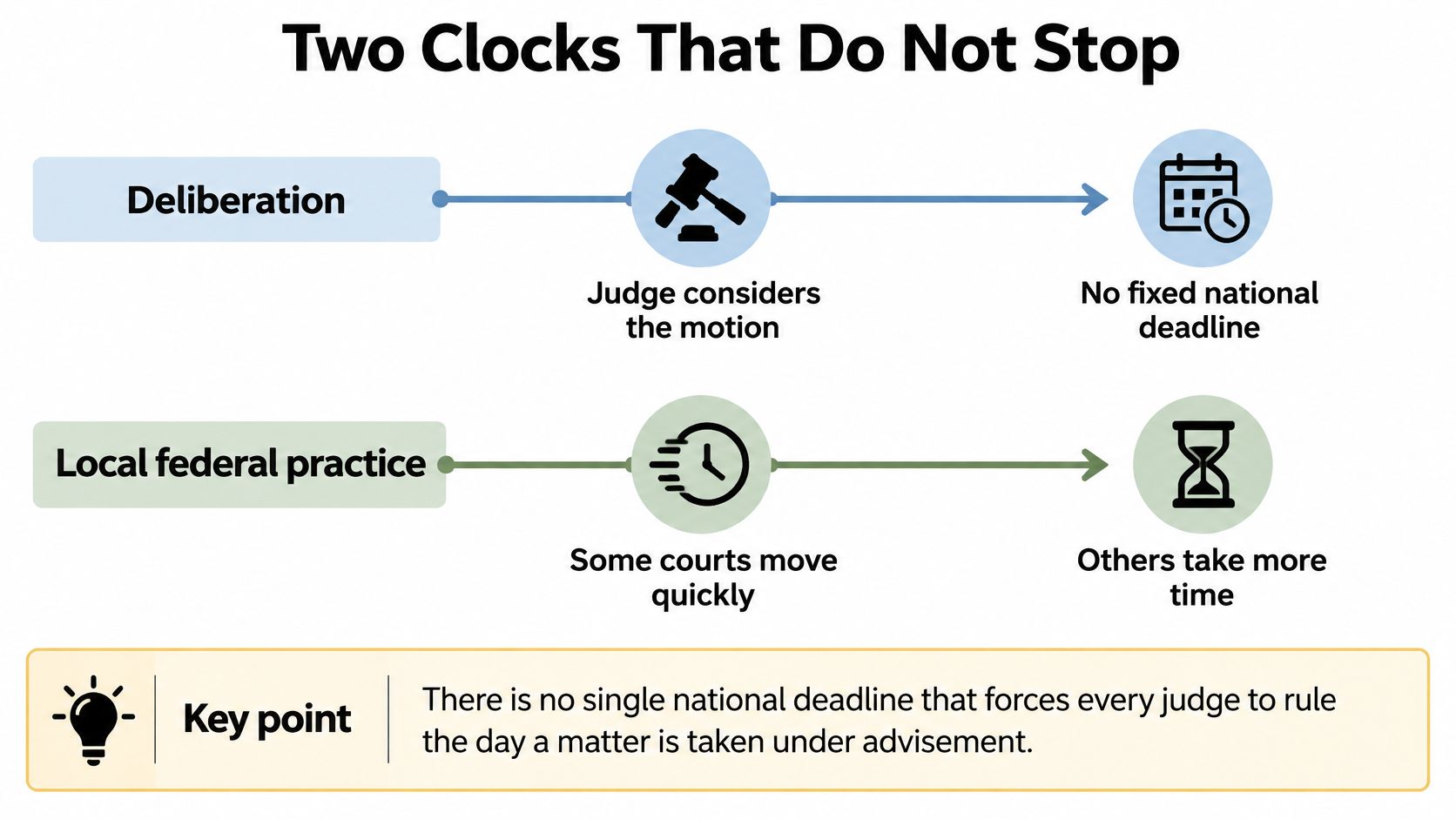
There’s no single national deadline requiring every judge to rule immediately after taking a matter under advisement. The federal examples show different mechanisms: a court may decide promptly, while a local rule may permit a formal notice identifying an unresolved matter.
The Oklahoma notice procedure is not a court-martial entitlement. It requires identification of the undecided matter and its submission date; it doesn’t grant the motion or guarantee an immediate decision. Don’t quote a federal district court’s local procedure as though it controls a military judge.
The other clock concerns what a party must do after an operative ruling. In the bankruptcy example, the reconsideration period related to the later order, not the earlier advisement status. Military motions, reconsideration, and appeals require their own analysis under the applicable military rules.
Run a same-day deadline audit
Keep a deadline sheet separate from your notes about how the hearing went. Include the responsible person, required action, triggering event, and source document.
- Copy every express date: Include supplemental briefing, document production, and response requirements.
- Identify continuing restrictions: Include no-contact requirements, military protective orders, and conditions on liberty.
- Track parallel proceedings: Ask whether separation processing or another administrative action requires a separate response.
- Confirm the trigger: Have counsel identify whether announcement, entry, service, or another event starts the relevant period.
A judge’s deliberation time and your response time are different clocks. Your calendar must distinguish them.
These authorities establish no fixed military deadline for the reserved ruling. Ask counsel for the expected timing, any appropriate status request, and the dates the court set. Don’t begin an appeal calculation from an advisement line merely because it appears on the docket.
What You Can Say While You Wait
Don’t discuss the facts with your commander or investigators while the motion is pending without advice from defense counsel. A status update is different from a statement about the alleged offense.
Military precedent in United States v. Phillips addresses Article 31(b), UCMJ, protections requiring covered questioners to explain the accusation and rights against self-incrimination before seeking statements. Statements obtained in violation may be excluded, but that doesn’t make every unwarned conversation protected.
Separate logistics from evidence
Asking when a ruling is expected concerns procedure. Explaining why you contacted a witness, what you meant in a message, or why an investigator misunderstood you concerns evidence.
The person asking may be a commander, first sergeant, or an agent from CID, NCIS, OSI, or CGIS. A friend passing along questions can also draw you into a substantive conversation, even though the legal analysis of that exchange may differ.
Don’t use the person’s friendly tone to decide whether answering is safe. Counsel needs to assess who asked, whether you were suspected, whether the statement was volunteered, and what offense the questions concerned.
Our Article 31 guide explains the rights framework. The immediate recommendation is simpler: decline to discuss the allegations, request counsel clearly, and tell your lawyer about the contact.
Keep your family from creating another statement
Volunteered explanations, social posts, and late-night messages can become evidence. The absence of a rights warning doesn’t create blanket immunity for what you choose to say.
- Preserve notices: Save messages requesting interviews or explanations, including who sent them and what they asked.
- Route substantive contacts through counsel: Don’t negotiate the scope of an interview yourself.
- Keep spouses out of statement drafting: A well-intended family explanation can introduce factual claims the defense hasn’t evaluated.
- Preserve existing material: Don’t delete messages or edit posts to improve how the case looks.
Requesting counsel or remaining silent doesn’t automatically stop administrative processing or every separate deadline. Those consequences require case-specific advice, not an assumption that invoking rights pauses the entire system.
Family boundary: Help organize documents and appointments. Don’t contact witnesses, publish the defense theory, or offer an explanation on the service member’s behalf.
Mistakes That Wreck the Waiting Period
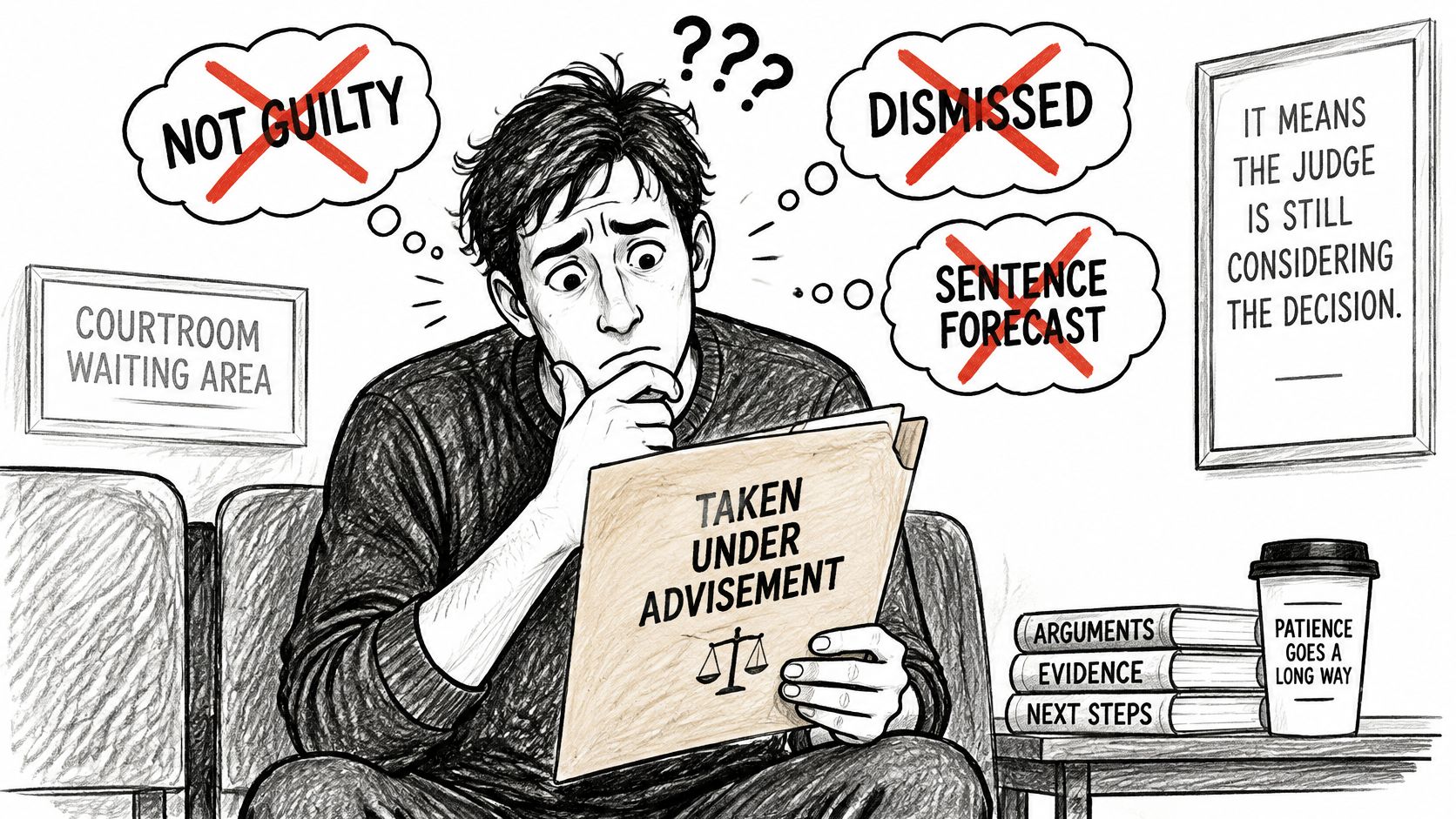
The false win is dangerous: someone tells the family the judge didn’t deny the motion, so things must be going well. That conclusion can lead directly to a missed filing or an avoidable message.
The judge hasn’t given you a result. Don’t behave as though you have one.
Conduct that creates preventable damage
- Treating advisement as acquittal, dismissal, or a sentence forecast. You make career and family decisions around relief the judge hasn’t ordered.
- Missing a conditional filing date in the same order. You risk losing an opportunity to respond or triggering an expressly stated consequence.
- Trusting command to handle the pending motion. You mistake command activity for defense representation and leave required work unassigned.
- Texting witnesses or posting online. You create statements, disputed explanations, or apparent efforts to influence someone.
- Assuming there’s no evidence because no ruling has issued. You underestimate the government’s available proof and prepare for the wrong case.
- Leaving an objection unstated because the judge reserved a decision. You risk an inadequate record or an issue that wasn’t properly preserved.
- Counting an appeal or reconsideration period from the advisement entry. You use the wrong triggering event and risk a missed filing.
- Treating unexplained silence from counsel as strategy. You leave uncertainty about who is monitoring the docket, preparing a response, and communicating the result.
Don’t confuse silence with a defense plan
A communication gap doesn’t prove your lawyer is ineffective or overloaded. It does mean you need a clear answer about responsibility and next steps.
Ask for a status update that identifies the pending issue, remaining work, and who will notify you when the judge rules. Keep the answer with your case documents so your family isn’t relying on secondhand interpretations.
The waiting period is when the record can still grow. Too often, the service member is the person growing it through messages, explanations, and attempts to straighten things out.
Call Civilian Counsel Before the Order
If you’re under investigation, facing preferral, or waiting on a consequential motion, don’t postpone the representation decision until the ruling arrives. An adverse order is a poor time to begin explaining the entire case to a new lawyer.
Detailed military defense counsel can be skilled and committed advocates. Civilian representation isn’t automatically better, and military counsel aren’t prosecution counsel merely because they serve within the military justice system.
Choose relevant experience, not a label
The useful comparison concerns focused experience, availability, investigation, and trial judgment. Ask who will review the record, develop the motions, question witnesses, and communicate with you when a decision requires action.
Civilian court-martial attorneys operate outside the military chain of command and can work alongside detailed counsel. The value of that arrangement depends on the lawyer’s actual qualifications and the team’s division of responsibility, not the word civilian on a website.
A capable UCMJ lawyer should discuss specific vulnerabilities in the government’s case: incomplete interviews, inconsistent accounts, missing records, disputed consent, or gaps between an investigator’s conclusion and the underlying evidence. Confidence without a record-based strategy isn’t enough.
Bring the documents that determine the next move
Prepare for the consultation with:
- The exact language: Bring the docket entry, motion, hearing notes, and accompanying order.
- The live deadlines: Identify every required filing and continuing restriction.
- New contacts: Explain whether anyone has questioned you since the hearing.
- The stakes: Discuss potential effects on rank, confinement exposure, separation, and retirement.
- The contingency question: Ask what counsel would do if the motion were denied.
Comparing consultations helps you evaluate strategy, communication, relevant experience, and fit.
When comparing lawyers, give weight to sustained military law experience and a primary focus on military criminal defense rather than general practice. Those are useful screening factors, not guarantees of a result.
Your career, freedom, and reputation matter before the judge issues the order, not only afterward.
Quick Answers on Taken Under Advisement
Does taken under advisement mean the motion was granted?
No. The judge is holding the matter for decision. Read the entire entry and any accompanying order for separate rulings, conditions, or filing requirements.
Don’t tell family members the motion succeeded unless counsel can identify the operative relief.
Can I talk to my commander about the case while the motion is pending?
Don’t discuss the facts without defense counsel’s advice. Questions about scheduling differ from questions about the offense, witnesses, or messages.
Continue handling required military duties, but don’t turn a routine command interaction into an explanation of the allegations.
Can I refuse to talk to CID or NCIS?
You may decline to make a statement about suspected misconduct and request counsel. State your decision clearly rather than trying to answer only the questions you consider harmless.
Tell your lawyer about later contacts. Don’t assume an informal follow-up conversation carries less risk than a scheduled interview.
How long until the judge rules?
There’s no fixed military ruling deadline established by these authorities. Ask counsel about the judge’s stated schedule, outstanding submissions, and an appropriate status inquiry.
The length of the wait isn’t a reliable forecast of whether you’ll win. Prepare for either result.
Do deadlines stop while a matter is under advisement?
No automatic pause occurs. Existing filing obligations, protective orders, and applicable administrative requirements need separate attention.
If relief from a deadline or restriction is necessary, have counsel determine how to request it. Don’t create your own extension.
Do I need a lawyer now?
Yes, obtain defense advice now if you’re under investigation, facing charges, or awaiting a consequential ruling. If you already have detailed counsel, discuss whether adding civilian counsel would strengthen preparation and communication.
Before choosing, compare relevant experience and the proposed strategy, not promises.
If your matter has been taken under advisement, gather the docket entry, the complete order, and every outstanding notice today. Contact defense counsel before you make another statement or miss a filing, and compare civilian military defense lawyers now rather than after an adverse ruling. The judge is considering the motion. You still need to protect the case.