One phone call can change the trajectory of your life in uniform.
It starts fast. Your First Sergeant tells you to report in. CID, NCIS, OSI, or CGIS wants an interview. A commander suddenly goes cold. Somebody says the words UCMJ Article 93 – Cruelty and Maltreatment, and now a leadership issue has turned into a criminal case.
If you’re in that position, stop trying to “clear things up” on your own. An Article 93 accusation is not a paperwork problem. It is a direct attack on your judgment, your authority, and your fitness to lead. From this point forward, every text, every phone call, every explanation, and every interview can help your defense or hand the government what it needs.
Table of Contents
- Your Career Is on the Line The Moment You Are Accused
- Decoding UCMJ Article 93 Cruelty and Maltreatment
- What the Government Must Prove and How We Fight Back
- The Real-World Consequences Punishments and Sentencing
- Navigating the Investigation and Court-Martial Process
- Why Your Appointed Military Lawyer Is a Gamble You Cannot Afford
- Critical Mistakes and Urgent Questions Answered
Your Career Is on the Line The Moment You Are Accused
A lot of Article 93 cases begin with a routine day that suddenly isn’t routine anymore. You’re at PT, in the office, or back in the barracks when your phone lights up. Your stomach drops before anyone says why. You already know this won’t be good.
What that first call usually means
The accusation usually sounds simple at first. Someone says you were too harsh. Somebody claims you humiliated a junior service member. A training correction, a dressing-down, an order, a joke, a punishment detail, or a pattern of verbal conduct gets reframed as abuse of authority.
That is why these cases are dangerous. The allegation often arrives wrapped in ordinary military life. People lead hard. Units train under stress. Tempers flare. Standards get enforced. Prosecutors know that. They also know a court-martial panel may react strongly if they think a superior used rank to crush a subordinate.
Practical rule: The command is not calling you in to hear your side because it cares about fairness. It is trying to control the problem, build a record, and protect itself.
By the time you hear about the complaint, others may already be talking. Witnesses may be interviewed before you know the details. Screenshots may be circulating. Supervisors may start distancing themselves. You can be treated like a leadership failure long before anyone proves a crime.
Your first job is damage control
Your first instinct will be to explain. That instinct hurts people every day.
Do these things immediately:
- Stop talking about the facts: Not to investigators, not to command, not to friends, not to the alleged victim, and not by text.
- Preserve everything: Keep messages, emails, call logs, rosters, counseling records, duty schedules, and training documents.
- Get counsel fast: Delay gives the government time to frame the story first.
- Assume your communications will be reviewed: Because they might be.
If you handle the first few days badly, you may spend the next year trying to undo the damage. If you handle them correctly, you give your defense lawyer room to work.
Decoding UCMJ Article 93 Cruelty and Maltreatment
UCMJ Article 93 – Cruelty and Maltreatment is not a general rule against being rude, short-tempered, or unpopular. It is a law aimed at abuse of authority over a subordinate. That distinction matters.
Article 93 has been part of the UCMJ since the code took effect on August 10, 1956, when Congress codified it as 10 U.S.C. § 893. The statutory text remains focused on one core offense: a person subject to the chapter who is guilty of cruelty toward, or oppression or maltreatment of, a person subject to his orders may be punished as a court-martial directs, as reflected in the current federal text of 10 U.S.C. § 893.
What the law actually targets
In plain English, Article 93 is about misuse of military power.
Three words drive most cases:
- Cruelty means conduct that is abusive and capable of causing suffering.
- Oppression means using authority in an unjust, heavy-handed, or tyrannical way.
- Maltreatment is the broad bucket. It covers abusive, unwarranted, or unnecessary conduct toward someone under your authority.
That doesn’t mean every hard order is criminal. The military is not a corporate office. Leaders can assign difficult work, impose standards, and require unpleasant duties. The line is crossed when the conduct stops serving a lawful military purpose and starts looking like domination, humiliation, punishment for its own sake, or personal abuse.
Who counts as subject to your orders
This situation often blindsides people.
Many service members think Article 93 only applies to direct subordinates in their rating chain or immediate chain of command. That’s wrong. The phrase subject to your orders can reach much farther in military life.
That can include people in settings such as:
- Training environments
- Work details
- Temporary tasking
- Drill or instructional settings
- Any duty relationship where lawful orders must be obeyed
A sergeant dealing with trainees, an NCO running a detail, or a supervisor controlling daily tasks may be exposed even without a formal rating relationship.
Article 93 cases are really authority cases. If the government can frame the relationship as superior and subordinate, it can try to turn bad judgment into a criminal charge.
That’s why “I wasn’t technically in their chain” is not enough. Sometimes it helps. Sometimes it doesn’t. What matters is the actual duty relationship, the context, and whether the government can persuade a judge or panel that your authority placed that person under your control.
What the Government Must Prove and How We Fight Back
An accusation is not a conviction. The government still has to prove the case. In Article 93 litigation, that usually means prosecutors have to win two fights at once. First, they must prove the alleged victim was subject to your orders. Second, they must prove your conduct was cruel, oppressive, or amounted to maltreatment.
Article 93 is a status-and-control offense, not just a conduct offense. The government must show the alleged victim was subject to the accused’s orders and that the accused acted in a cruel, oppressive, or maltreating way. That relationship can extend beyond a direct chain of command to settings where duty requires obedience to lawful orders, as explained in this Article 93 discussion of status and control.
The two pressure points in every Article 93 case
The first pressure point is the relationship itself.
Was this person under your lawful authority in the way the government claims? Or was the relationship looser, more informal, more lateral, or more complicated than the charge sheet suggests? In many cases, prosecutors flatten a messy workplace or training environment into a clean superior-subordinate narrative because it plays better in court.
The second pressure point is the meaning of the conduct.
A strong defense often turns on context that investigators ignored:
- What was happening immediately before the incident
- Whether the order or correction had a real training or mission purpose
- How others in the unit behaved in similar situations
- Whether witnesses are quoting words accurately or selectively
- Whether the allegation grew over time after command involvement
Where prosecutors often overreach
Article 93 cases are vulnerable when the government relies too heavily on subjective feelings and too little on full context. A subordinate may feel humiliated. That does not automatically make the conduct criminal. Hard leadership, direct correction, raised voices, ugly language, and unpopular decisions are not all the same thing.
Good defense work attacks the government’s framing.
Sometimes the issue is intent. The accused was trying to enforce standards, maintain safety, or keep order in a chaotic setting. Sometimes the issue is selective reporting. Witnesses remember the sharp words but omit the disobedience, the safety issue, or the repeated misconduct that triggered the confrontation. Sometimes the issue is command climate. A command under pressure may overcharge because nobody wants to appear soft on allegations involving subordinates.
A serious defense starts during the investigation, not after preferral. If you want to understand why early intervention matters, read this guide on how experienced counsel win cases during the military investigation phase.
Good Article 93 defenses don’t rely on outrage. They rebuild the missing context, expose shortcuts in the investigation, and force the government to prove the relationship and the abuse, not just imply them.
The prosecution’s version is usually simple because simple stories convict. The defense wins by showing the truth was more complicated than the charge sheet.
The Real-World Consequences Punishments and Sentencing
People often focus on whether they can “beat the charge.” Fair enough. But you also need to understand what you’re risking if you don’t.
The maximum punishment commonly cited for Article 93 is severe: dishonorable discharge, forfeiture of all pay and allowances, confinement for up to 3 years, and reduction to E-1, as summarized in the Court of Appeals for the Armed Forces digest on Article 93. That same authority also reflects that courts apply an objective standard and do not require proof of actual physical or mental injury.
The official punishment is only the start
Those are the formal penalties. The practical fallout can hit just as hard.
An Article 93 conviction can wreck:
| Consequence | What it can mean |
|---|---|
| Military career | Promotion dies, trust evaporates, and retention becomes unrealistic |
| Reputation | You are branded as a leader who abused subordinates |
| Clearance and future work | Sensitive positions and many post-service jobs become much harder to keep or obtain |
| Family stability | Income, housing, and long-term planning can collapse under the pressure |
A lot of service members also underestimate what the accusation alone can do. Relief for cause, loss of leadership duties, bad evaluations, damaged peer support, and administrative action can arrive before a verdict.
How sentencing decisions are shaped
Sentencing in a court-martial is not mechanical. The government will try to turn the allegation into a broader character story. It will argue you weren’t just wrong in one moment. It will argue you abused trust, rank, and responsibility.
That’s why the defense must build mitigation early, not at the last minute. Strong sentencing work can involve:
- Service records that show the full picture
- Witnesses who can speak credibly about leadership and duty performance
- Evidence that the incident was isolated, misunderstood, or distorted
- Proof that the government exaggerated the conduct
If you wait until trial week to think about sentencing, you are already behind. In military justice, punishment evidence is part of the fight from the beginning.
Navigating the Investigation and Court-Martial Process
The military justice process rewards preparation and punishes delay. If you treat it like a misunderstanding that will sort itself out, you give the government room to shape the case while you react late.
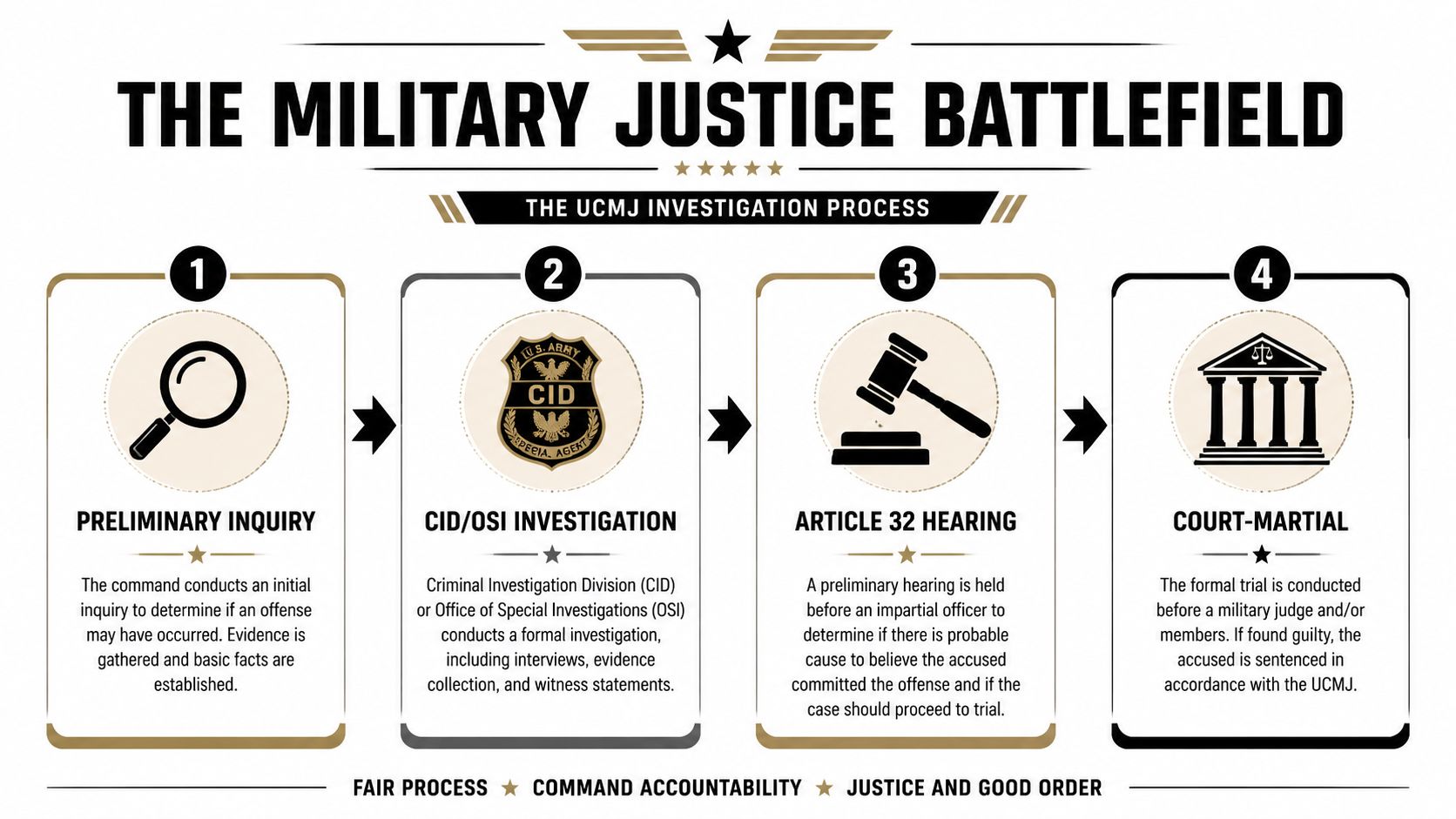
Step 1 The investigation
This stage is where many defendants hurt themselves the most.
CID, NCIS, OSI, or CGIS may contact you directly. Command may encourage cooperation. Somebody may tell you this is your chance to explain. It isn’t. It is the government’s chance to lock you into statements before you know the evidence.
Your priorities are simple:
- Invoke your rights clearly
- Do not consent casually to searches
- Do not try to contact witnesses or the accuser
- Get experienced counsel involved immediately
For a plain-English breakdown of the agencies and how they operate, review this guide on CID, NCIS, OSI, and CGIS investigations.
Step 2 Charges and preferral
At this point the command formalizes the accusation. By then, the paperwork often makes the case sound cleaner and stronger than it really is. The alleged facts are trimmed down. Ambiguity disappears. The government starts presenting theory as fact.
This is when your lawyer should be stress-testing every part of the case. Not with wishful thinking. With records, timeline analysis, witness interviews, digital evidence review, and command context.
The charge sheet is not the truth. It is the government’s first polished sales document.
Step 3 The Article 32 hearing
This is a major opportunity if your defense team knows how to use it.
The Article 32 process gives the defense a meaningful chance to examine the government’s theory, challenge weak evidence, and expose holes before trial. A lazy defense treats it like a formality. A serious defense uses it to pin down witnesses, preserve testimony, and force prosecutors to show what they have.
Key questions at this stage include:
- Is the order relationship really supported?
- Are witness accounts consistent?
- Did investigators ignore favorable evidence?
- Is command pressure driving the case?
Step 4 Motions trial and sentencing
Before trial, strong counsel should look hard at suppression issues, statement issues, unlawful command influence concerns, and evidentiary flaws. The goal is not just to argue innocence. The goal is to shrink, weaken, and destabilize the government’s proof before members ever hear it.
Trial itself is about disciplined execution. Cross-examination, theme, witness order, and credibility are everything in a case built around authority and perception. If the case reaches sentencing, the defense has to present a coherent human story, not a last-minute plea for mercy.
Why Your Appointed Military Lawyer Is a Gamble You Cannot Afford
You will likely be offered appointed military defense counsel. Some are smart. Some work hard. Some care deeply. None of that changes the structural problem.
Good intentions are not a defense strategy
Appointed counsel often face crushing caseloads, limited time, and institutional constraints. Some are very junior. Some have little contested trial experience. Many are learning on active cases with clients who cannot afford a learning curve.
That matters in Article 93 cases because these prosecutions are often won or lost on nuance. Context, command practice, witness motive, and evidentiary framing decide outcomes. A lawyer who has only handled a handful of contested courts-martial is not in the same position as a civilian military defense attorney who has spent years focused on military justice.
Here is the practical difference:
| Appointed military counsel | Experienced civilian military defense counsel |
|---|---|
| Works inside the same system | Answers only to the client |
| May have limited trial reps | Can bring focused court-martial experience |
| Caseload may dictate pace | Can push independent case strategy |
| Institutional limits may shape choices | Can challenge command decisions aggressively |
What independent civilian counsel changes
Civilian counsel brings distance from command and a different level of strategic pressure. That can mean independent investigation, faster witness outreach, tighter motion practice, stronger cross-examination planning, and blunt advice unfiltered by military bureaucracy.
If you’re comparing options, use a disciplined process. This guide on how to choose the right military defense lawyer is a good starting point.
A short video can also help frame the decision:
You do not hire civilian counsel because appointed counsel is automatically bad. You hire civilian counsel because high-stakes cases demand maximum experience, independence, and attention. If your liberty, discharge, and future are exposed, “good enough” is a dangerous standard.
Critical Mistakes and Urgent Questions Answered
When people panic, they do predictable things. Prosecutors love predictable things.
The technical threshold in Article 93 cases is proof of real harm or a reasonable likelihood of harm under an objective standard, and many charging theories rely on mental rather than physical injury. Practitioner guidance also notes that conduct such as assault, improper punishment, verbal abuse, threats, sexual harassment, hazing, or coercive sexual conduct can qualify when it results in or could reasonably cause physical or mental suffering, as discussed in this Article 93 analysis of harm and objective standards.
Mistakes that bury strong defenses
The biggest self-inflicted errors are usually these:
- Talking to investigators because you think honesty will save you: It usually gives the government admissions, inconsistencies, and sound bites.
- Trying to contact the accuser or friendly witnesses: That can be spun as pressure, retaliation, or witness tampering.
- Deleting messages or cleaning up your phone: Even if your motive was embarrassment, it can look like consciousness of guilt.
- Assuming no physical contact means no criminal exposure: Article 93 allegations often focus on humiliation, threats, verbal abuse, and mental suffering.
- Trusting command to be fair: Command’s priorities are mission, discipline, and institutional protection.
- Waiting to hire a lawyer until charges are preferred: By then, key evidence may already be framed against you.
- Thinking “it was just tough training” ends the issue: Lawful training is a defense theme, not an automatic shield.
If you’re under investigation, silence is not weakness. It is discipline.
FAQ about UCMJ Article 93 – Cruelty and Maltreatment
Can tough training be charged as maltreatment
Yes. If the government claims the conduct was abusive, unnecessary, or unrelated to a lawful military purpose, it may try to charge it that way. Context is everything.
Can they make an Article 93 case without physical injury
Yes. These cases often focus on conduct that allegedly caused or could reasonably cause mental suffering.
Does it matter if the subordinate never complained at the time
Not as much as people think. Delayed reporting does not kill the case by itself. It does, however, create issues for credibility, motive, memory, and inconsistency that a sharp defense can exploit.
Can I refuse to talk to CID NCIS OSI or CGIS
Yes. You have rights, and you should use them. You should invoke them clearly and speak with counsel first.
What if I was not in the person’s direct chain of command
That can help, but it is not the end of the issue. The real question is whether the government can prove the person was subject to your orders because of the duty relationship.
Will I go to jail if I’m convicted
Confinement is on the table in an Article 93 case. Do not assume this is only about paperwork, rank, or a discharge characterization.
Do I need a lawyer immediately
Yes. Early action can affect interviews, evidence preservation, witness handling, command messaging, and the overall trajectory of the case.
Can this be handled with an Article 15 instead of a court-martial
Sometimes commands resolve misconduct short of trial. Sometimes they do not. You should never bet your future on the hope that command will downshift the case voluntarily.
If you are under investigation for UCMJ Article 93 – Cruelty and Maltreatment, move now. Don’t talk your way into charges. Don’t guess. Don’t assume command will sort it out fairly.
Get experienced military defense counsel involved immediately. If you need to compare serious civilian options, use this guide to choosing a military defense lawyer to identify attorneys who focus on court-martial and military justice defense. Your career, your freedom, and your name are on the line.