The call usually comes at the worst time. Your First Sergeant says you need to report now. CID, NCIS, OSI, or CGIS wants to talk. Or a supervisor tells you, in that careful voice, that “this is just a misunderstanding” and you should clear it up fast.
That is when people ruin their own cases.
They delete messages. They text a friend to get stories straight. They tell a witness to stay out of it. They try to explain themselves to investigators. They assume the actual issue is the original accusation. Sometimes it is. But just as often, the government decides the easier case is UCMJ Article 134 Obstruction of Justice.
If you’re in that window right now, stop trying to fix this alone. Start thinking like someone under active scrutiny. The system is not waiting for you to calm down. It is collecting statements, screenshots, command input, phone records, and witness accounts. Every move you make after first contact can help the government build intent.
Table of Contents
- The Moment Your Career Is Put on the Line
- The Government’s Case What Prosecutors Must Prove
- How Service Members Accidentally Commit Obstruction
- Strategic Defense How We Dismantle an Obstruction Case
- Fatal Misconceptions That Can Destroy Your Career
- Why Your Appointed Military Lawyer May Not Be Enough
- Frequently Asked Questions About Article 134 Charges
- Can I refuse to talk to CID, NCIS, OSI, or CGIS?
- Can deleting texts or social media lead to an obstruction charge?
- What if the underlying case goes nowhere?
- Is lying to a supervisor the same as obstruction?
- Can I be charged before formal charges exist in the main case?
- Do I need a civilian military defense lawyer immediately?
The Moment Your Career Is Put on the Line
When the contact comes
A lot of obstruction cases start with panic, not planning.
You get a text from someone in your unit asking what happened. A friend says investigators called. Your spouse asks why command is suddenly involved. Then your brain does what stressed people do. It starts solving problems fast and badly.
You tell yourself you’re just cleaning up confusion. You delete a few texts because they “look bad.” You call the other person and say, “Don’t make this bigger than it is.” You send one stupid message asking what they’re going to say. From your point of view, you’re trying to survive the day. From the government’s point of view, you just created a fresh allegation.
Practical rule: The first bad decision in a military investigation is usually made before charges exist. That is why early legal advice matters more than late courtroom speeches.
The danger with UCMJ Article 134 Obstruction of Justice is that it turns stress reactions into criminal evidence. Investigators don’t need your behavior to look complex. They need it to look deliberate. A deleted thread. A warning to a witness. A misleading explanation. A request that someone stay quiet. That is enough to start building a theory.
What you need to do in the first hour
Your first job is not to explain. Your first job is to stop creating evidence.
Do this immediately:
- Stop contacting witnesses: If someone could be interviewed, don’t text, call, DM, or send messages through mutual friends.
- Preserve your devices: Don’t delete, reset, wipe, swap, or “clean up” anything.
- Say less to command: Be respectful. Be professional. Don’t give a narrative without counsel.
- Get counsel involved now: The investigation phase is where strong cases are prevented, not just defended later.
If you still think this is something you can “talk through,” you are underestimating the moment. Once the command and investigators think you tried to shape testimony or hide evidence, the case changes. It stops being only about what happened. It becomes about whether they can paint you as someone who tried to manipulate the system.
That accusation can hit your freedom, clearance, reputation, and career all at once.
The Government’s Case What Prosecutors Must Prove
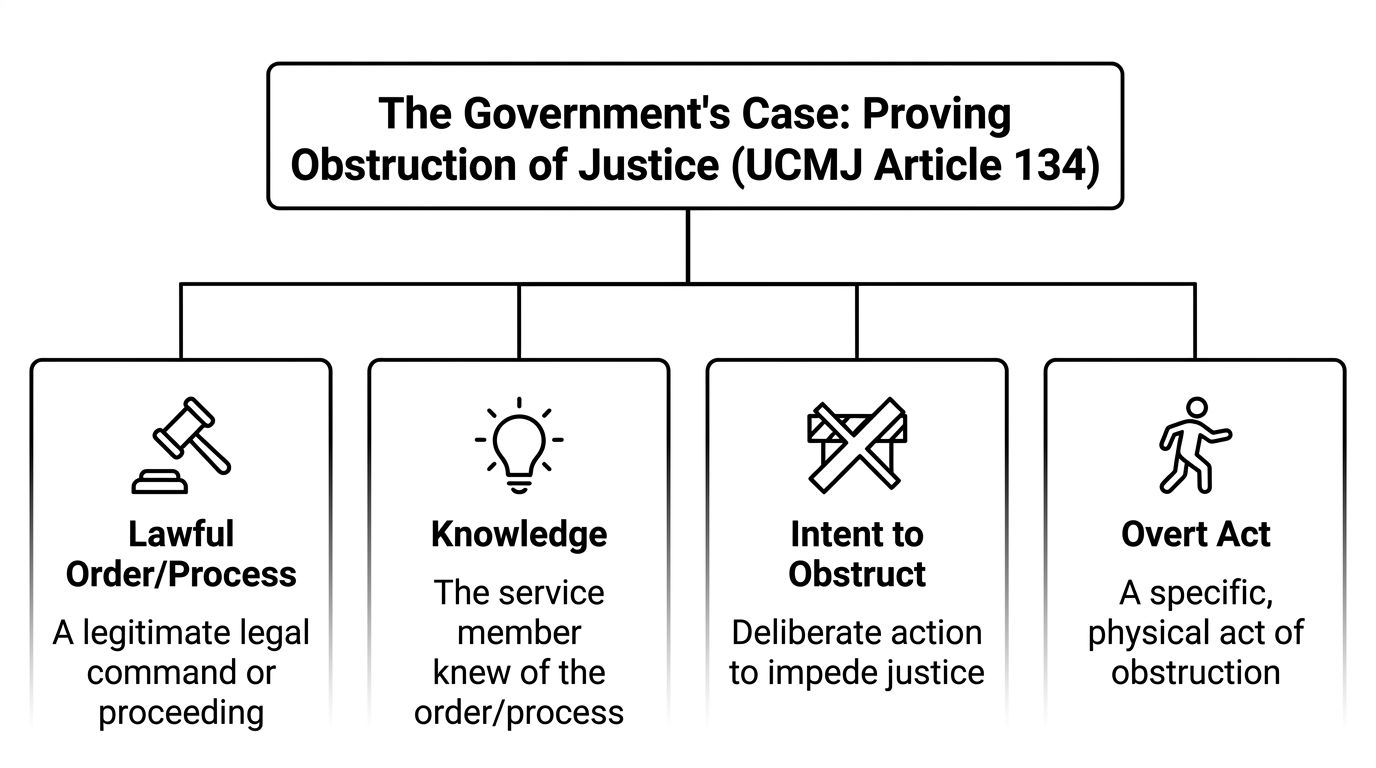
Prosecutors win these cases by making ordinary panic look deliberate. Your defense starts by forcing them to prove intent, not just bad timing, ugly texts, or a poor decision made under stress.
Under the Manual for Courts-Martial, the offense carries a maximum punishment of dishonorable discharge, forfeiture of all pay and allowances, and confinement for 5 years, as outlined in the MCM discussion summarized by the Court of Appeals for the Armed Forces digest. Treat this charge like a direct threat to your freedom, clearance, and military future.
If you need context on how investigators, commanders, and prosecutors move a case through the system, read this guide to the UCMJ system and military justice. Then focus on the part that decides whether this charge survives. Proof.
The four elements in plain English
A wrongful act
The government must identify a specific act and tie it to you with evidence. That usually means a message, a call, a meeting, a deletion, a threat, a lie, or an instruction to someone else. Prosecutors will not present your conduct in a neutral way. They will frame it as interference from the start.
A link to actual or expected criminal proceedings
The government must show you had reason to believe criminal proceedings were pending or about to happen. This is one of the traps in Article 134. Charges do not need to exist yet. If the government can argue you saw the investigation coming and acted because of it, they will try to fit your conduct into this element.
Specific intent to obstruct
This is the center of the fight. Prosecutors must prove you acted to influence, impede, or obstruct the due administration of military justice. Outcome matters less than intent. If nothing was hidden, no witness changed a statement, and the investigation continued anyway, the government can still charge obstruction if it claims your purpose was to interfere.
That is why early defense work matters. The strategy is to kill the intent theory before it hardens into a command narrative.
Service impact
The government must also prove the conduct was prejudicial to good order and discipline or service-discrediting under the circumstances. In practice, this gives prosecutors room to argue that private conduct became a military problem once it touched an investigation, a witness, or command attention.
Where the government’s case is usually weak
The government’s theory often sounds stronger than its evidence.
A text saying “don’t say anything” may be portrayed as witness tampering. Sometimes it is. Sometimes it is panic, loyalty, or a clumsy attempt to avoid drama. A deleted thread may look sinister. It may also reflect embarrassment, relationship fallout, or routine cleanup unrelated to any expected proceeding. The legal issue is not whether the conduct looks bad. The legal issue is whether the government can prove the purpose behind it.
That is the counter-intuitive trap in UCMJ Article 134 Obstruction of Justice. People focus on whether they blocked the case. Prosecutors focus on what they can argue you meant to do.
Your job is to stop helping them. Force them to prove each element with evidence, attack intent early, and shut down every assumption before charges are preferred.
How Service Members Accidentally Commit Obstruction
You get a call that someone is talking to investigators. Your first instinct is to clean up the mess. You delete a thread, call a friend, or soften a statement because you think you are preventing a misunderstanding. That decision is how many obstruction cases start.

The trap is not the result. The trap is intent.
If investigators from CID, NCIS, OSI, or CGIS are already involved, assume every call, text, deletion, and “helpful” conversation will be framed in the worst possible light. Read this breakdown of CID, NCIS, OSI, and CGIS investigations before you speak to anyone.
Deleting the phone data
A service member has an off-duty incident. Rumors spread. He scrolls through angry texts, location data, and sloppy messages that look bad out of context. He deletes the thread because he wants the drama gone.
That move gives the government a clean story. They will argue he expected trouble and removed evidence before investigators could see it. They do not need your decision to be smart. They need it to look deliberate.
That is why deleting data after an incident is dangerous even when the content seems trivial to you.
Talking to the witness
Another service member hears that a friend may be interviewed. She calls and says, “Stay out of it,” or “Just tell them you do not remember.” She thinks she is containing chaos. Trial counsel hears witness influence.
The wording matters. So does the timing. A panicked call made after you learn investigators are asking questions can become the centerpiece of the case.
Do not try to manage witnesses. Do not coach memory. Do not suggest silence.
Trying to protect a friend
A third service member gives a half-true answer because he wants to protect someone in the unit. He trims the timeline, omits a detail, or claims he cannot remember a fact he plainly remembers. Later, phones, cameras, gate logs, or another witness fill the gap.
Now you have a separate problem. The government stops treating you as a bystander and starts treating you as someone who acted to interfere.
Good intentions make this worse, not better. They hand prosecutors a motive they can explain in one sentence.
The counter-intuitive mistake
Service members usually focus on outcome. They tell themselves no investigation was blocked, no witness changed testimony, and no case disappeared. That mindset gets people charged.
Article 134 obstruction cases often turn on what the government says you were trying to do before charges are ever preferred. That is the window where people do the most damage to themselves. They keep texting. They keep calling. They keep fixing facts that were already bad enough.
Stop doing that.
If you think an allegation is forming, preserve the phone, stop discussing facts with anyone involved, and get defense counsel in place immediately. The smartest move is usually the one that feels least satisfying in the moment. Say nothing, change nothing, and let your lawyer control the response.
Strategic Defense How We Dismantle an Obstruction Case
The government wants this charge to feel obvious. Our job is to make it hard, specific, and fragile.
The most effective defense work often happens before preferral, when the command is still deciding how to frame the case. That is why it pays to get educated on how experienced counsel win cases during the military investigation phase before they gamble on “waiting to see what happens.”
Intent is the weak point
A key defense strategy is to negate specific intent by showing a legitimate reason for the action, or to challenge whether you had reason to believe criminal proceedings were imminent, as explained in this discussion of Article 134 obstruction defenses. That is not academic. That is where cases are won.
If you deleted messages because you routinely clear your phone, that matters. If you contacted someone for reasons unrelated to testimony, that matters. If the government is guessing about what you knew and when you knew it, that matters a lot.
I don’t let prosecutors hide a weak intent theory behind dramatic language. I force them to commit to a timeline, a motive, and a factual basis for every assumption.
Attack the timeline and the assumptions
An obstruction case often depends on stacked inferences:
- They assume knowledge: You must have known an investigation was coming.
- They assume purpose: You must have acted to block it.
- They assume meaning: Your words must have been a threat, warning, or coaching effort.
- They assume impact: Your conduct must have prejudiced discipline or discredited the service.
Break those assumptions apart and the case starts losing shape.
A seasoned civilian military defense lawyer will compare phone records, witness timing, command notifications, screenshots, and investigative notes. Look for sloppy sequence errors. Look for witnesses who changed wording after speaking with investigators. Look for commands that treated rumor as proof. Look for agents who wrote conclusions first and gathered context later.
Here is the kind of material to have in hand before the government gets comfortable:
| Focus area | What to test |
|---|---|
| Communications | Exact wording, timing, and who initiated contact |
| Knowledge | What you actually knew about any pending or imminent proceeding |
| Device activity | Whether deletion, reset, or changes were intentional or routine |
| Witness accounts | Inconsistencies, motive to shift blame, pressure from command |
| Context | Innocent reasons for the act the government calls wrongful |
This is also where cross-examination starts long before trial. Investigators often summarize rather than quote. Witnesses often paraphrase rather than remember. Commands often overstate what “everyone knew.”
A short explanation of courtroom pressure points can help here:
Force the government to prove a real theory
I don’t defend these cases by begging for mercy. The defense approach is to make the government prove what it usually cannot prove cleanly.
If the prosecution’s theory depends on reading your mind, we make them show the jury the evidence instead of the accusation.
That means challenging the credibility of the complaining witness, testing whether the act was wrongful, and exposing when “imminent proceedings” is just hindsight dressed up as certainty. If the government cannot show a deliberate effort to obstruct military justice, the charge should not survive.
Fatal Misconceptions That Can Destroy Your Career
People lose Article 134 cases because they believe rules that are flatly wrong.
The biggest one is this. Actual obstruction is not required. The Manual states that “Actual obstruction of justice is not an element of this offense,” meaning a failed attempt can still support conviction if the wrongful act was done with obstructive intent, as stated in the JSC Article 134 obstruction text.
The myths that get people charged
“Nothing happened, so they can’t charge me.”
Wrong. Failure doesn’t save you. If the government thinks you tried to obstruct, that can be enough.“I was just asking someone not to get involved.”
Prosecutors hear witness influence. Your casual language becomes their exhibit.“If I tell investigators my side, this goes away.”
Maybe. More often, you lock yourself into details before you know the evidence.“Command will be fair if I cooperate.”
Command is not your defense team. Command is managing mission, optics, and discipline.“There is no physical evidence.”
Phones, screenshots, metadata, call logs, and witness testimony are evidence. Plenty of obstruction cases are built on words and timing.“Deleting social media isn’t the same as destroying evidence.”
That argument usually collapses fast once investigators subpoena records or recover content.
What to do instead
Use a crisis rule set.
- Stop all cleanup behavior. Don’t edit, delete, hide, coach, or compare stories.
- Assume every contact matters. Friends, roommates, spouses, supervisors, and exes can all become witnesses.
- Get a lawyer before your next conversation. Not after the interview. Before it.
- Preserve context. Save messages, timelines, and names of people who can explain innocent reasons for what happened.
- Stay disciplined with command. Professional. Respectful. Minimal.
Your case can get worse without a single new crime. It only takes one panicked decision that prosecutors can frame as intent.
Why Your Appointed Military Lawyer May Not Be Enough
Free is not the same as sufficient
Detailed defense counsel can be skilled, hardworking, and committed. That still doesn’t answer the primary question. Is appointed counsel enough for a high-risk UCMJ Article 134 Obstruction of Justice case that may turn on digital evidence, witness pressure, and precharge intervention with command?
Often, no.
This is not a personal criticism of JAG defense attorneys. It is a structural reality. They work inside a system with heavy caseloads, limited control over time, and institutional constraints you should take seriously. If your case needs immediate independent investigation, aggressive witness development, strategic engagement before preferral, and a lawyer whose only job is protecting one client, you may need more than the free option.
Independence matters
Civilian military defense lawyers bring something the system cannot appoint. Independence.
An experienced civilian court-martial attorney is not rotating to another billet. He is not balancing your case against a stack of others assigned that week. He is not relying on the same institutional ecosystem that generated the charge. He answers to you.
That matters when the case is politically sensitive, command-driven, or built on assumptions that need to be challenged hard and early. The strongest defense is usually not a better closing argument. It is earlier action, sharper investigation, and a lawyer who has handled these crisis decisions repeatedly.
If your rank, retirement, clearance, or liberty is exposed, choosing counsel is not an administrative detail. It is the central decision.
Frequently Asked Questions About Article 134 Charges
Can I refuse to talk to CID, NCIS, OSI, or CGIS?
Yes. You should get legal advice before any interview. Silence is usually safer than a rushed explanation.
Can deleting texts or social media lead to an obstruction charge?
Yes. It can, especially if investigators argue you acted after realizing scrutiny was coming.
What if the underlying case goes nowhere?
An obstruction allegation can still stand on its own if the government claims your conduct was aimed at interfering with military justice.
Is lying to a supervisor the same as obstruction?
Not automatically. But if the government believes the statement was part of an effort to impede an investigation, it can become part of an obstruction theory.
Can I be charged before formal charges exist in the main case?
Yes. Conduct before preferral can still be used if prosecutors say proceedings were pending or imminent.
Do I need a civilian military defense lawyer immediately?
If you think investigators are circling, yes. Early action gives your defense the best chance to shape the record before the government hardens its theory.
If you’re under investigation, think you may have contacted a witness, deleted messages, or made a statement you now regret, move now.
Do not wait for preferral. Do not wait for command to “see the whole picture.” Do not assume a failed attempt protects you. Your career can be wrecked before the case ever reaches trial.
Speak with an experienced civilian UCMJ lawyer immediately. If you need a starting point to compare qualified counsel, use this guide to choosing a military defense lawyer to identify civilian military defense lawyers with dedicated court-martial experience. Then make calls today. Your record, your rank, and your future are on the line.