
Your phone buzzes. It’s your first sergeant, your chief, or an investigator asking you to “come in and clear this up.” Maybe it started with a text in the middle of a breakup, a barracks argument, a post that someone screenshotted, or a joke that landed badly. Now people are using words like “threat,” “CID,” “court-martial,” and “Article 134.”
You need to understand one thing immediately. UCMJ Article 134 Communicating Threats is not a paperwork problem. It can end your career, wreck your clearance, and put confinement on the table. If you’re being accused, the worst move is treating this like a misunderstanding that will sort itself out.
The government doesn’t need your side to be fair. It needs your words, your texts, your social media, and your mistakes. That’s why your defense starts now, not when charges are preferred.
Table of Contents
- What is UCMJ Article 134 Communicating Threats
- The Government’s Playbook What Prosecutors Must Prove
- Real-World Scenarios Where Threats Are Charged
- The Investigation and Court-Martial Process
- Common Defenses and Case-Winning Strategies
- Critical Mistakes That Can Wreck Your Case
- Why an Experienced Civilian Military Defense Lawyer Is Not Optional
- Frequently Asked Questions About Threat Charges
What is UCMJ Article 134 Communicating Threats
You send an angry text after a breakup, a barracks fight, or a command blowup. A screenshot gets handed to NCIS, CID, or your command. By the time you hear the words “Article 134 communicating threats,” the military is no longer treating this as trash talk. It is building a criminal case that can put your rank, your pay, your clearance, and your future on the line.
What the charge means in plain English
Article 134 communicating threats is the General Article version of a threat case. The allegation is that you communicated words that expressed a present determination or intent to wrongfully injure someone’s person, property, or reputation, either now or later. The message can be spoken, typed, posted, forwarded, or delivered through someone else. Investigators do not read the words in a vacuum. They will stack the message next to the argument that came before it, the reaction that followed it, your past messages, witness statements, and anything else they think makes the statement look serious.
The punishment exposure is severe. A conviction can bring a dishonorable discharge, total forfeitures, and years of confinement under this offense.
The four hurdles the government must clear
The government still has to prove four elements beyond a reasonable doubt:
- A threatening communication existed. The prosecution must show you communicated language expressing a present determination or intent to wrongfully injure another person’s person, property, or reputation, now or in the future.
- Someone received it. The communication had to be made known either to the targeted person or to a third person.
- It was wrongful. This is often the pressure point in the case.
- It affected the military enough to qualify under Article 134. Under the circumstances, the conduct had to prejudice good order and discipline or be service-discrediting.
Miss one element, and the case should fail.
The most common mistake is that accused service members get fixated on one question: “I didn’t really mean it, so I’m fine, right?” Wrong. That is too simple, and it leaves a lot of defense ground unused. The better approach is to attack the charge piece by piece, with special attention to wrongfulness. In these cases, the primary dispute is often not whether harsh words were used. The core issue is whether the government can prove you sent them for the purpose of making a threat, knew they would be taken as a threat, or were reckless about that risk.
That distinction matters. Purpose, knowledge, and recklessness are not the same thing, and lazy lawyering blurs them together. A strong defense does the opposite. It separates them, forces the government to choose its theory, and exposes the gap between an ugly message and a criminally wrongful threat.
The Government’s Playbook What Prosecutors Must Prove
Your prosecutor is going to simplify this case on purpose. They will frame it as a straight line. You got angry, you sent the words, someone saw them, and the command had to respond. That pitch is built to sound inevitable.
It is not.
The pressure point is wrongfulness, and too many defense lawyers handle it sloppily. They argue, “My client did not mean it.” That is not enough. You need a tighter, more aggressive approach. Force the government to prove whether you acted with purpose, knowledge, or recklessness, because those are different theories and prosecutors often blur them together when the facts are weak.
The Manual for Courts-Martial states that a communication is wrongful only if it was sent “for the purpose of issuing a threat, with the knowledge that the communication would be viewed as a threat, or acted recklessly with regard to whether the communication would be viewed as a threat.” That language gives the defense room to work, if your lawyer knows how to use it.

Purpose knowledge and recklessness are not the same
These mental states need to be separated early and attacked one by one.
- Purpose means the prosecution claims you meant to issue a threat.
- Knowledge means it claims you knew the words would be understood as a threat.
- Recklessness means it claims you ignored a substantial risk that the words would be taken that way.
Recklessness is where prosecutors go when intent is hard to prove. That is also where a strong defense can do damage. Angry language, crude language, drunken language, and immature language are not automatically criminal threats. The government still has to prove your message crossed the line into wrongful communication under one of those mental states.
Your mental state is often the central point of contention.
That fight is won with facts, not slogans. Get the full text thread. Get the earlier messages. Get the deleted messages if they can be recovered. Get the tone, slang, prior banter, emojis, timing, and the history between the people involved. A single screenshot almost always helps the government. The full exchange often helps the defense.
Use that evidence hard:
- Context: Was this part of a mutual argument, sarcasm, venting, post-breakup drama, or exaggerated trash talk?
- Audience: Did the recipient know your speech patterns, jokes, or habit of saying stupid things you did not carry out?
- Timing: Did the message come in the middle of a chaotic back-and-forth where both sides were escalating?
- Preservation: Did investigators save the full conversation, or just the worst line they wanted to show command?
The MCM also makes another point that matters. The recipient’s reaction can be part of the context, but it does not decide any element of the offense by itself. Fear does not prove wrongfulness. Outrage does not prove purpose. A later statement saying, “I took it seriously,” does not erase the need to prove what was in your mind when you sent it.
That is the opening you use. Do not let the case collapse into a vague argument about “intent.” Make the government commit to purpose, knowledge, or recklessness, then force it to prove that theory with the full context in view. If your lawyer is not pressing that distinction, your defense is leaving one of the best attack points untouched.
Real-World Scenarios Where Threats Are Charged
Service members don’t set out to commit “communicating threats.” They get dragged into it through emotion, stress, alcohol, jealousy, command friction, or digital stupidity. The military then freezes the worst moment and builds a case around it.
The breakup text chain
A service member sends a string of messages after a breakup. One line says something like, “You’ll regret this,” or “I’m coming for you.” Investigators seize the screenshots, ignore the rest of the exchange, and frame the message as criminal menace.
What makes this dangerous is the format. Texts look permanent and clean in exhibits. Trial counsel loves screenshots. The defense has to recover the full thread, timing, deleted context, prior banter, and whether both sides were escalating.
The private post that stopped being private
Someone vents in a “private” group chat or on social media about a superior, coworker, or ex-partner. A screenshot gets forwarded. Command gets involved. Suddenly a post made in anger becomes an allegation that you threatened a person’s safety, property, or reputation.
The trap here is false privacy. Once one member forwards the post, your audience expands instantly. Investigators will also compare the post against later comments, emojis, direct messages, and witness statements to argue a broader threatening pattern.
The barracks or workplace blowup
A verbal fight in the barracks, shop, motor pool, office, or parking lot gets loud. Someone later says you threatened to beat them up, wreck their property, or destroy their career. These cases often turn on witness credibility, partial recollection, and whether words were accompanied by gestures, movement, or intervening events.
Three facts usually drive these cases:
- People remember conflict badly. Especially after drinking, group tension, or command involvement.
- Witnesses clean up their stories later. They remove their own role and sharpen yours.
- Command pressure changes narratives. Once leadership labels something a threat, people tend to align with that frame.
If any of these scenarios sounds familiar, stop trying to explain it informally. Start protecting it legally.
The Investigation and Court-Martial Process
Threat cases often move faster than accused service members expect. Command sees possible danger, investigators move early, and your statements can become the spine of the prosecution before you realize how serious this is.
Here is the basic process you’re likely facing.
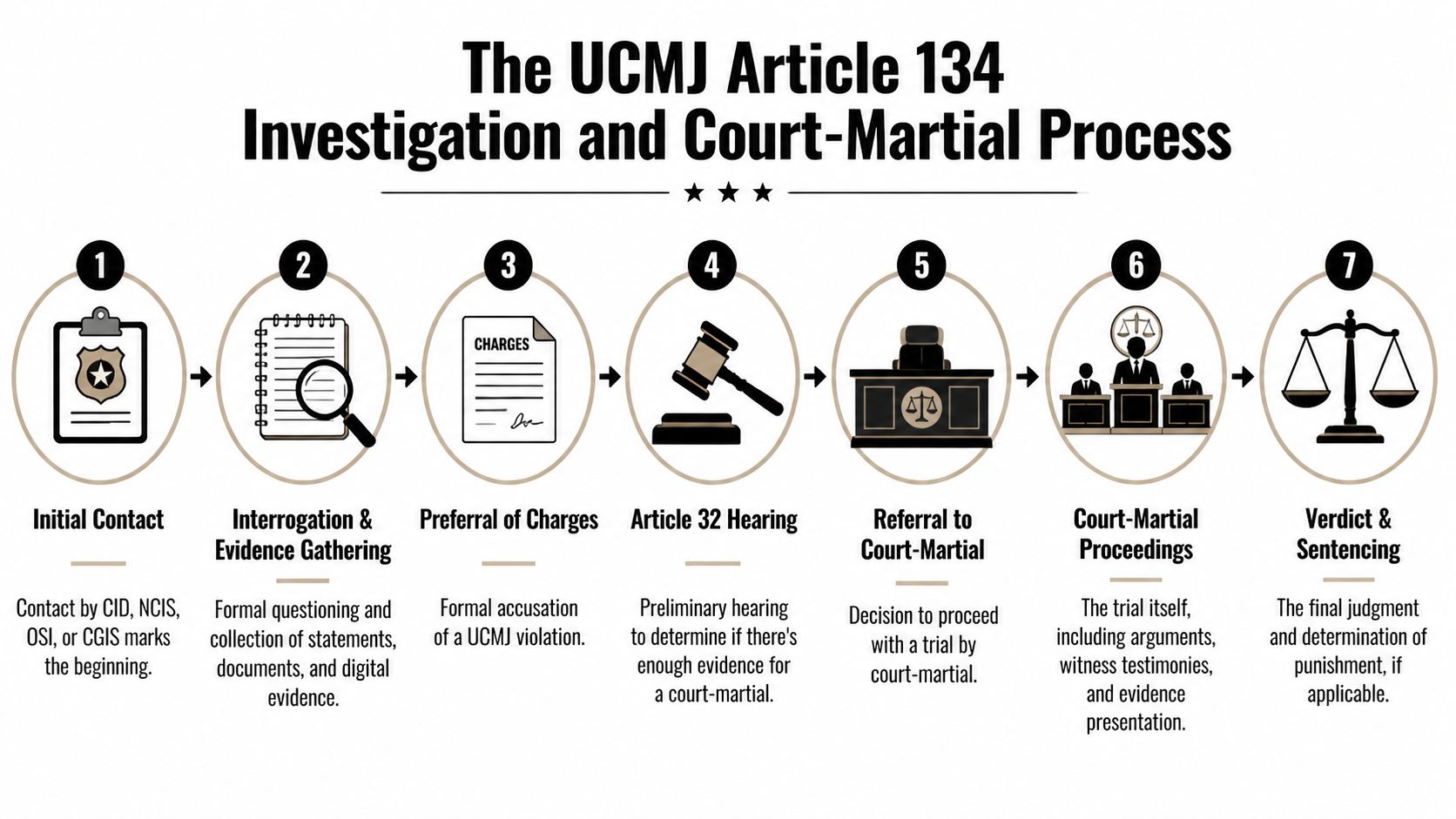
What usually happens next
Article 134 is not some obscure back shelf charge. Under the punitive articles reference describing Article 134 usage, Article 134 was consolidated in the 2019 reforms with over 54 other offenses under the General Article, and Article 134 specifications appeared in approximately 15-20% of special and general courts-martial annually before 2021. That tells you exactly how command and prosecutors treat this article. They use it often.
You’ll usually see a sequence like this:
- Initial contact by CID, NCIS, OSI, or CGIS. They may act casual. It is not casual.
- Interrogation and evidence gathering. They collect screenshots, phones, witnesses, command statements, and your words if you give them any.
- Preferral of charges. The accusation becomes formal.
- Article 32 hearing. This is a screening stage, not a friendly review.
- Referral to court-martial. The command decision hardens.
- Trial. Witnesses, digital evidence, and your judgment go under a microscope.
- Verdict and sentencing. If convicted, punishment can reach deep into your rank, record, pay, and liberty.
For a broader overview of how these stages work, review this guide on court-martial basics for service members.
Here’s a useful overview before you go any farther:
What you should be doing at each stage
Your job is not to persuade investigators that you’re a good person. Your job is to avoid feeding the file.
- At contact: invoke your rights and stop talking.
- During evidence collection: preserve your own evidence immediately. Screenshots, full threads, call logs, names of witnesses, and timeline notes.
- At preferral: stop thinking this will just “stay at the unit level.”
- At Article 32: identify weak witnesses, missing context, and overcharged theories.
- Before trial: build the case around context, mental state, credibility, and service impact.
The military justice system rewards early, organized defense work. It punishes delay.
If you wait until charges are on paper, you’ve already handed the government a head start.
Common Defenses and Case-Winning Strategies
A threat case is often far more fragile than it looks. Prosecutors like clean screenshots and simplified narratives. Defense lawyers win by making the facts messy again, because real life is messy.
Attack the mental state
This is the first place I’d look in many UCMJ Article 134 Communicating Threats cases. If the government cannot prove purpose, knowledge, or recklessness cleanly, it has a problem.
Defense themes that often matter:
- Heat-of-the-moment language: angry words are not automatically criminal threats.
- Sarcasm or hyperbole: crude language can be stupid without being wrongful.
- Ambiguity: if the wording can reasonably mean more than one thing, that matters.
- Mutual escalation: one-sided prosecution narratives collapse when both people were saying reckless things.
- Fragmented exhibits: partial screenshots are dangerous, but they are also vulnerable.

A seasoned civilian defense lawyer will also examine how investigators collected the communication. Did they preserve the original device? Did they miss surrounding messages? Did a witness paraphrase instead of quote? Those details can decide the case.
Attack communication context and military nexus
Not every ugly statement supports a valid conviction under Article 134. Some cases are overcharged because command wants to send a message.
You should be looking at issues like these:
- Was the statement communicated? Saying something into the void is different from making it known to the target or a third person.
- Was it conditional or vague? Conditional language can weaken the government’s theory, depending on the facts.
- Was it obvious exaggeration? People vent. The government still has to prove criminal wrongfulness.
- Was the military connection strong enough? If the government cannot show a real tie to good order, discipline, or service discredit, the theory weakens.
- Did witnesses coordinate their accounts? Similar wording in statements can signal contamination, not truth.
A good defense does not argue “my client is nice.” It argues “the government cannot prove this charge the way the law requires.”
If you want to understand how serious defense teams work these cases before charges harden, read this breakdown on how experienced counsel win cases during the military investigation phase.
The point is simple. Don’t concede the case because the message looks bad in isolation. Isolated evidence is exactly what the government wants.
Critical Mistakes That Can Wreck Your Case
Most accused service members do more damage in the first few days than investigators do. They panic, they talk, they delete, they text apologies, and they walk straight into preventable admissions.
Five errors that hand the government evidence
Talking to investigators without counsel
This is the biggest unforced error. Investigators are trained to make you think silence looks guilty. It doesn’t. Rambling looks guilty.Trying to “clear it up” with command
Command is not your defense team. Statements to leadership often become exhibits or lead to more witnesses.Deleting messages or posts
That can be framed as consciousness of guilt or obstruction. Preserve evidence. Don’t destroy it.Contacting the accuser
Even a polite apology can be twisted into admission, intimidation, or witness interference. Stay away.Waiting because “there’s no real evidence”
Threat cases are often built from screenshots, paraphrases, and context pulled from multiple sources. You may not know what they have until it’s too late.Discussing the case with coworkers or friends in the unit
Loose talk creates new witnesses. Someone always reports it.Posting online about being falsely accused
That post can become another exhibit, another motive theory, or another charge.
A blunt rule. If you’re under investigation, your normal instincts are dangerous. Replace them with disciplined silence and fast legal action.
Why an Experienced Civilian Military Defense Lawyer Is Not Optional
Free military counsel matters, and many appointed lawyers work hard. But hard work is not the same thing as the right fit for a threat case that may turn on digital evidence, witness breakdown, and aggressive mental-state litigation.
Independence matters
A civilian military defense lawyer is independent from the command structure that surrounds the case. That matters more than people admit. Threat allegations often trigger command fear, force protection concerns, and fast judgment. Independent counsel can push back without worrying about office culture, internal politics, or crushing assigned caseloads.
Civilian court-martial attorneys also tend to approach the case earlier and more aggressively. They’re often hired to intervene before charges, not just react after the machine is already moving.
Serious cases need trial strategy early
The best time to shape a communicating-threats defense is during the investigation. You want someone who sees where the recklessness argument is going, who knows how to force production of full digital threads, and who isn’t impressed by a dramatic screenshot.
You also want someone who can tell you the truth. Some cases should be fought hard. Some should be positioned for resolution. Some need a parallel strategy for administrative separation, adverse paperwork, or clearance fallout.
If you’re comparing options, start with this guide on how to choose the right military defense lawyer.
This is not about prestige. It’s about survival. Your career, discharge characterization, and liberty deserve a lawyer who treats this like the crisis it is.
Frequently Asked Questions About Threat Charges
Below are common questions from service members and families dealing with UCMJ Article 134 Communicating Threats.
| Question | Answer |
|---|---|
| Can I refuse to talk to CID, NCIS, OSI, or CGIS? | Yes. You should invoke your rights and ask for a lawyer. “Clearing things up” without counsel is how people hand the government admissions. |
| Can a text message really become a court-martial case? | Absolutely. Texts are easy to screenshot, forward, and misunderstand. Digital evidence is often the core of these prosecutions. |
| What if I didn’t actually intend to hurt anyone? | That helps, but it is not the end of the analysis. The government may argue purpose, knowledge, or recklessness. A real defense digs into which theory they are using and why it fails. |
| Does it matter if the other person says they were scared? | It matters as context, but it does not control the elements of the offense. Their reaction is not the whole case. |
| Will I go to jail? | Confinement is on the table in a serious case. That doesn’t mean it will happen, but you would be reckless to assume it won’t. |
| Can I be punished even without a court-martial conviction? | Yes. Command can pursue other adverse action, including administrative consequences, while the case is pending or after it ends. |
| Should I save my messages and screenshots? | Yes. Preserve everything. Full threads often help the defense more than isolated screenshots help the government. Do not alter them. |
| Do I need a lawyer now or after charges are filed? | Now. Early intervention can change witness handling, evidence preservation, command messaging, and charging decisions. Waiting is a mistake. |
If your case involves a phone, a screenshot, an angry argument, or a witness with an agenda, the details matter more than your command will admit.
A threat allegation can start as a text and end as a discharge. That’s why these cases need strategy, not optimism.
If you’re under investigation for UCMJ Article 134 Communicating Threats, act like the stakes are real because they are. Stop talking. Preserve evidence. Stay away from the accuser. Get experienced counsel involved before the government finishes building its version of your story.
Do not wait for charges to “see what happens.” Your career is on the line now.