You were living a normal military day. Then CID, NCIS, OSI, or CGIS called, showed up, or told your command they needed to “ask a few questions.” Since that moment, everything feels unstable. Your phone matters. Your texts matter. Your memories matter. Your career, clearance, rank, family, and freedom all feel exposed.
If you’re facing UCMJ Article 120 Aggravated Sexual Assault, treat this as a criminal emergency. Not a misunderstanding. Not an HR problem. Not something you can smooth over by being polite and cooperative. The system has already started moving, and if you handle the next few steps badly, you can hand the government the evidence it needs.
Table of Contents
- Your Life Just Changed The Knock on the Door
- Deconstructing UCMJ Article 120 Aggravated Sexual Assault
- What the Government Must Prove and The Penalties You Face
- The Investigation and Court-Martial Process Step by Step
- Critical Mistakes That Will Destroy Your Case Before It Starts
- Building a Winning Defense Common Strategies That Work
- Why Your Appointed Military Lawyer Is Not Enough
- UCMJ Article 120 FAQ
- Do I have to talk to CID NCIS OSI or CGIS
- Will I go to jail while I wait for trial
- What is an Article 32 hearing
- The accuser consented so how can I still be charged
- Will I go to prison if convicted
- Should I hire a civilian military defense lawyer immediately
- What should I do tonight if I was just accused
Your Life Just Changed The Knock on the Door
It usually starts with a small lie. “You’re not under arrest.” “We just want to hear your side.” “This is your chance to clear this up.”
That’s how service members walk into interviews that wreck their cases.
Maybe the agents caught you outside the barracks. Maybe they called your shop. Maybe they came to your house while your spouse was standing there trying to read the room. They’ll often sound calm. Professional. Reasonable. That tone is deliberate. They want words, not a fight. They want admissions, inconsistencies, guesses, apologies, and text-message explanations they can later frame as guilt.
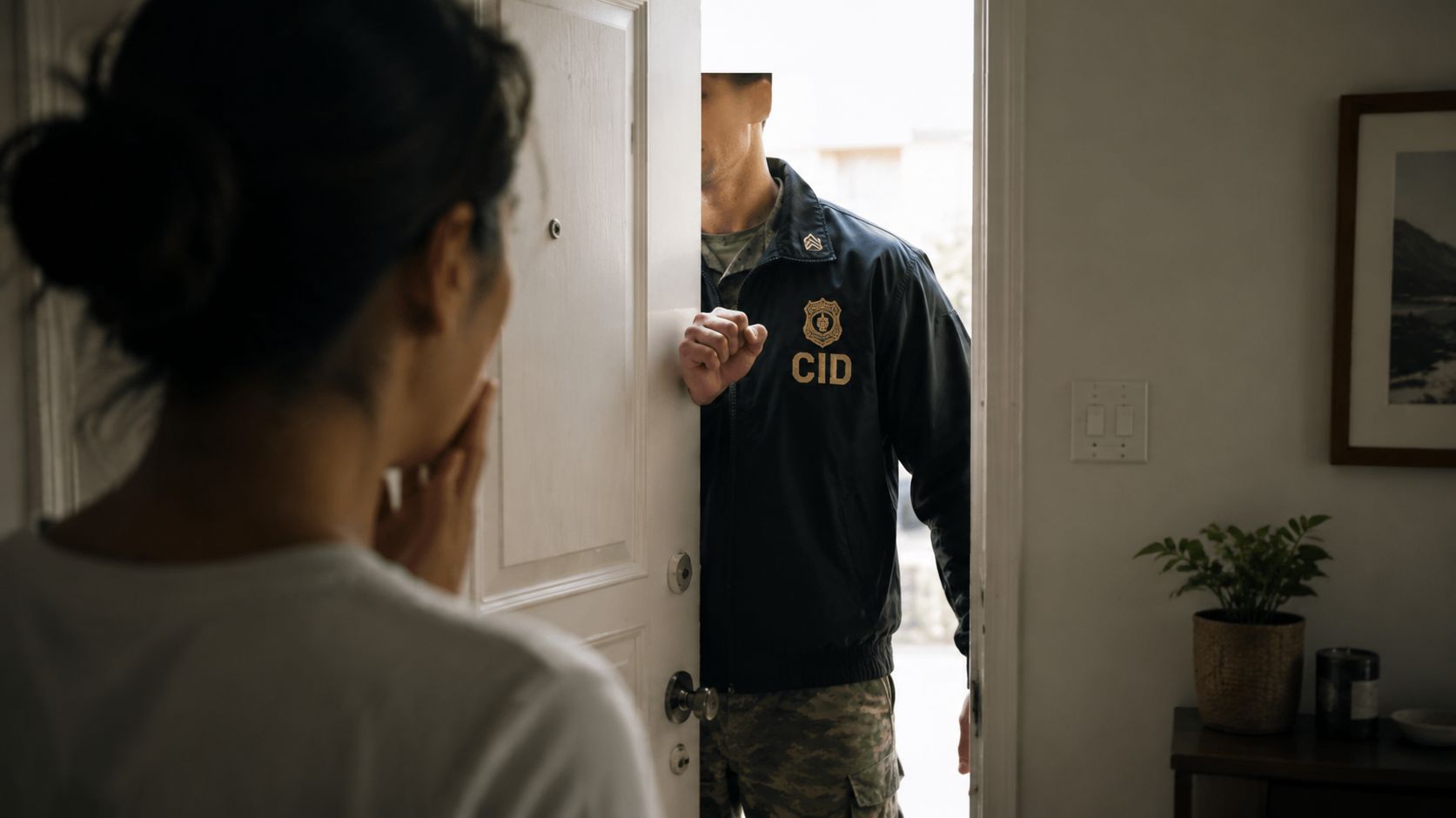
The Department of Defense reported 8,195 reports of sexual assault in FY2024, down from 8,515 in FY2023, and that SAPR framework covers serious offenses under Articles 80, 120, and 125, which is why these allegations sit inside a large, active enforcement system rather than a one-off command problem (DoD FY2024 Annual Report on Sexual Assault in the Military).
What that first contact really means
When investigators contact you, you’re not entering a truth-seeking conversation. You’re entering a file-building process. Their job is to collect evidence that supports prosecution. If your statement helps them, they keep it. If your statement hurts you, they keep that too.
Your command is not going to pause the machine while you figure things out. Restriction orders, no-contact orders, loss of access, rumors in the unit, and career damage can start fast. If the allegation involves alcohol, messages, a ride-share timeline, a hotel key log, or a barracks camera, the evidence window is already closing.
Practical rule: If agents want to talk, your first move is silence and counsel.
If you’re in that investigation window right now, study how strong lawyers attack the case early during the military investigation phase. Early defense work often decides whether the government builds momentum or starts running into walls.
Your mission right now
Do these things immediately:
- Say nothing substantive: Ask for a lawyer. Then stop talking.
- Preserve evidence: Keep texts, photos, call logs, rides, receipts, and social media intact.
- Identify witnesses: Write down names before memories fade.
- Stay disciplined: No angry messages, no cleanup, no “just checking in” with the accuser.
Panic is normal. Bad decisions are optional.
Deconstructing UCMJ Article 120 Aggravated Sexual Assault
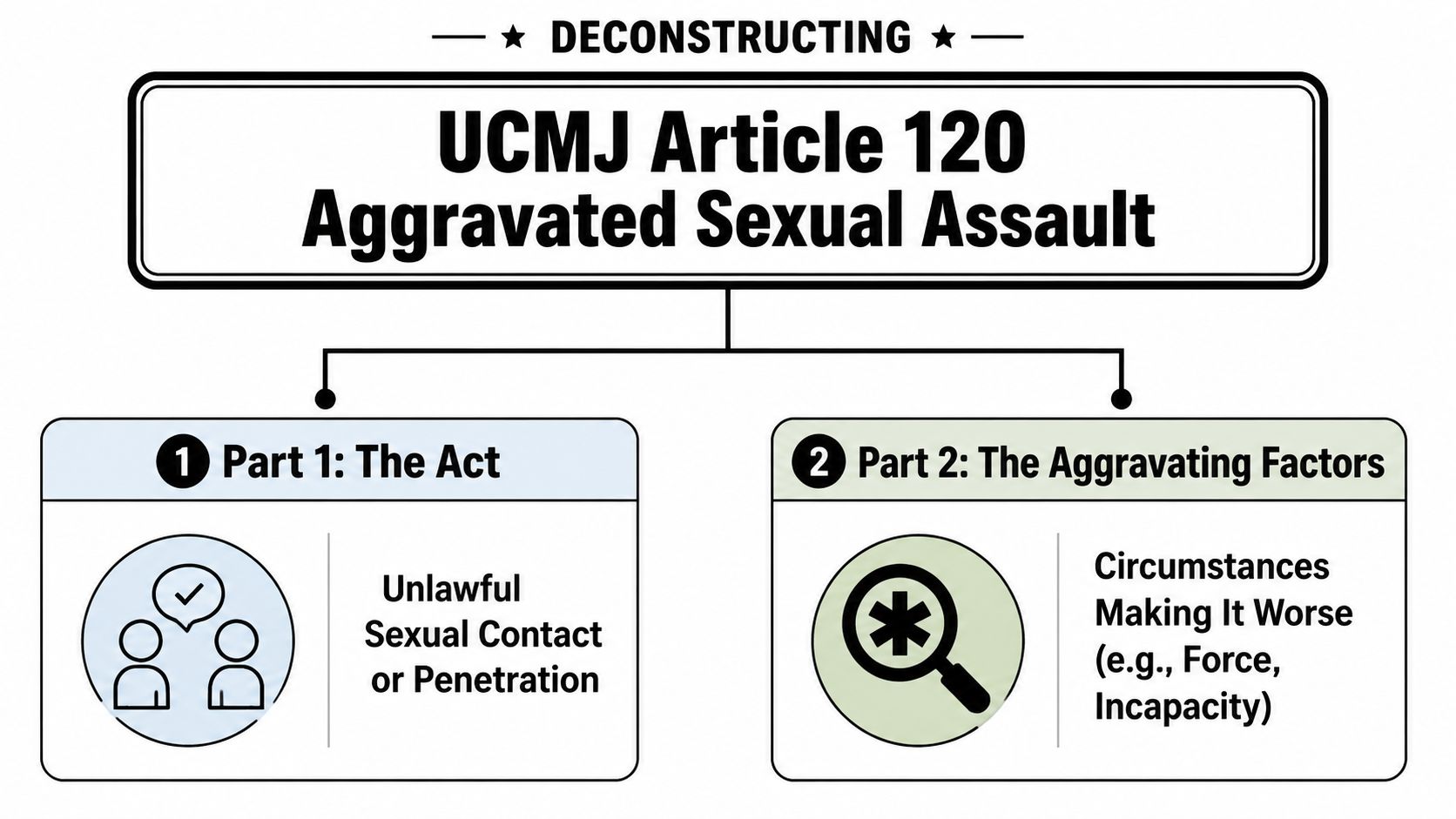
Most service members hear the charge and immediately think the government has some giant, unbeatable legal weapon. It doesn’t. It has a set of elements. Your defense starts by breaking those elements apart and forcing the prosecution to prove each one.
What this charge really means
For older versions of Article 120, the phrase UCMJ Article 120 Aggravated Sexual Assault generally refers to a felony-level sexual-act offense paired with a specific aggravating circumstance. In plain English, the government isn’t just alleging sexual conduct. It’s alleging sexual conduct plus a legally significant condition that makes the charge more serious.
That condition is often where the case lives or dies.
A practical way to think about it is this:
| Core issue | What the government tries to prove |
|---|---|
| The act | A sexual act occurred |
| The aggravator | The complainant was substantially incapacitated or otherwise substantially incapable of declining participation under the older Article 120 framework |
Under the pre-2019 structure discussed in military appellate digest materials, the government had to prove a sexual act plus substantial incapacity or substantial inability to decline participation, and consent was not an element of the offense but an affirmative defense (Article 120 digest summary).
Why incapacity cases are the real battlefield
That legal framework changes everything. A lot of people walk into these cases thinking the whole trial is about whether someone later said “I didn’t consent.” That’s too simplistic. In many aggravated sexual assault cases under the older statute, the decisive fight is whether the complainant was legally incapacitated.
That’s why these cases turn on details such as:
- Alcohol and drug evidence: What was consumed, when, and in what sequence.
- Observed behavior: Walking, texting, using phones, talking coherently, making plans.
- Memory versus capacity: A person can have gaps in memory without being legally incapacitated at the time.
- Your knowledge: What you saw, heard, and reasonably understood in the moment.
The defense doesn’t win these cases with speeches. It wins them with timelines, contradictions, and proof that the legal standard wasn’t met.
If the government has an intoxication theory, your lawyer should be digging into every message, timestamp, witness account, and surveillance angle available. “Drank a lot” is not the same thing as “incapable of consenting.” That distinction matters more than almost anything else in this type of case.
What the Government Must Prove and The Penalties You Face
Your case will turn on elements, not outrage. If your lawyer cannot recite the government’s burden from memory and attack each part of it with facts, records, and witness impeachment, you are already behind.
The government still has to prove the charge. That sounds obvious. In practice, many service members panic, start explaining, and hand prosecutors the missing pieces. Do not do that. Force them to build the case themselves, then break it apart piece by piece.
What trial counsel must actually prove
Under the older aggravated sexual assault framework, the prosecution has to prove the required sexual act and the specific legal condition that made the act criminal under the charged theory. In many cases, that means proving substantial incapacity or substantial inability to decline participation, plus proving facts that tie you to that condition in a way a panel or military judge will accept beyond a reasonable doubt.
That burden creates pressure points for the defense. A serious defense does not argue in generalities. It attacks proof.
Ask these questions early:
- What is the exact theory of guilt? Incapacity, bodily harm, or another charged theory changes the entire defense plan.
- What evidence proves condition at the time? Not hours later. Not the next morning. At the time.
- Who observed functioning? Witnesses who saw walking, talking, texting, planning, or making choices matter.
- What did you know, and what could you reasonably perceive? The government’s case weakens fast if its theory depends on mind reading.
- Where are the contradictions? First statements, NCIS or CID interviews, medical notes, texts, and social media often do not match.
That is the war plan. Identify the element that is hardest to prove, then build the case around destroying it. If the government cannot prove incapacity, knowledge, timing, or credibility, the charge does not survive just because the accusation sounds ugly.
Penalties that can wreck your career and your freedom
If you are charged under the older aggravated sexual assault provision, the exposure is severe. Under 10 U.S.C. § 920, the maximum punishment for aggravated sexual assault under subsection (c) is dishonorable discharge, forfeiture of all pay and allowances, and 30 years of confinement. Related offenses also carry heavy exposure. Aggravated sexual contact under subsection (e) carries up to 20 years, and abusive sexual contact under subsections (h) and (i) carries up to 7 years (10 U.S.C. § 920 codification reference).
Read that again. Thirty years. A dishonorable discharge. Total forfeitures.
This is not just a legal problem. It is a full-system threat to your life. A conviction can end your military career, strip benefits, destroy a clearance, block civilian employment, and put you on a sex offender path depending on the offense and jurisdiction.
Use this quick reference:
| Offense reference | Maximum punishment |
|---|---|
| Aggravated sexual assault | Dishonorable discharge, forfeiture of all pay and allowances, 30 years confinement |
| Aggravated sexual contact | Dishonorable discharge, forfeiture of all pay and allowances, 20 years confinement |
| Abusive sexual contact | Dishonorable discharge, forfeiture, 7 years confinement |
There is another trap here. The offense date can change the entire sentencing framework. For more recent cases, military sentencing rules may operate very differently from what service members expect, especially in judge-alone proceedings. If nobody has pinned down the exact date range, charged version of Article 120, and applicable sentencing rules, your defense is not organized yet.
Your lawyer should answer three questions immediately. Which version of the statute applies. What the maximum punishment is for each specification. Whether your case falls into a sentencing structure that changes trial and negotiation strategy. If you need a plain-English overview of how these cases fit into the broader system, review these court-martial basics.
One final point. Exposure creates influence. Prosecutors use these penalty ceilings to pressure pleas, cooperation, and bad decisions. Do not let the number alone scare you into surrender. Let it force discipline. Get the charging theory nailed down, get the date analysis done, and get a defense strategy built around the elements the government is most likely to miss.
The Investigation and Court-Martial Process Step by Step
You need a map. Not a vague overview. A map.
The process below is the path most serious military sex offense cases follow. The details vary by branch and command, but the strategic pressure points stay the same.
To orient yourself, this timeline helps.
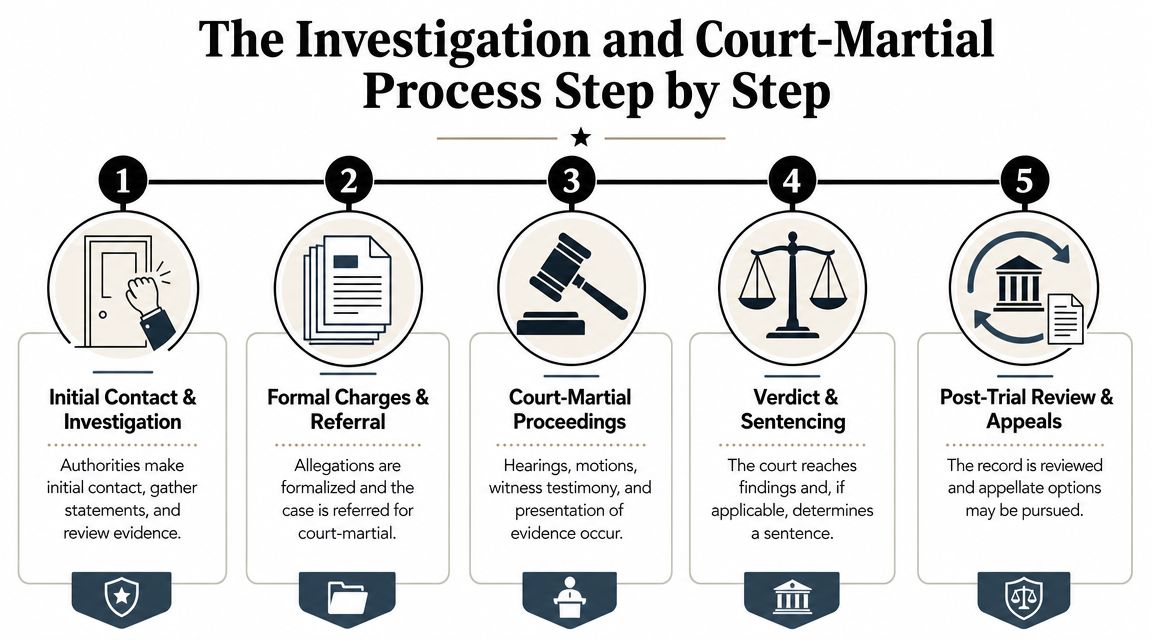
Five stages you need to understand
Initial contact and investigation
Investigators gather statements, phone data, surveillance, medical records, and witness accounts. At this stage, service members do the most damage to themselves by talking. You may also face no-contact orders or restrictions that feel administrative but shape the case immediately.Preferral of charges
This is when formal accusations are signed and pushed into the court-martial pipeline. Once charges are preferred, the command is no longer “looking into it.” The case has hardened.Article 32 preliminary hearing
This is a critical testing ground. The government shows part of its case, and the defense gets a chance to challenge evidence, expose weak witnesses, and lock in testimony. A bad government presentation here can become powerful trial ammunition.
A broader overview of this path appears in this guide to court-martial basics, but for Article 120 cases you need a more aggressive, evidence-focused approach than a generic summary provides.
Referral to court-martial
The convening authority decides whether the case goes forward to trial and at what level. This stage often turns on how the record looks after the preliminary hearing and what the defense has already surfaced.Trial, verdict, and sentencing
At trial, witness credibility becomes central. Motions matter. Cross-examination matters more. If the government gets a conviction, sentencing becomes its own fight.
Here is a useful visual explanation of how the process unfolds in practice.
What should be happening behind the scenes
While the command and investigators move their file forward, your lawyer should be doing very specific work:
- Securing digital evidence quickly
- Interviewing defense witnesses before stories drift
- Building a clean chronology
- Finding inconsistency points
- Identifying suppression and admissibility issues
- Preparing for Article 32 as a real fight, not a formality
The Article 32 hearing is not where you sit quietly and hope. It is where a prepared defense starts punching holes in the case on the record.
A service member who waits passively through these stages usually arrives at trial with less evidence, fewer options, and a prosecution that has had months to shape the narrative.
Critical Mistakes That Will Destroy Your Case Before It Starts
This is the section you need to follow with discipline. Most Article 120 cases are not ruined by some dramatic courtroom moment. They’re ruined in bedrooms, parking lots, offices, and phone calls before the case even gets moving.
Mistakes that come up over and over
Talking to investigators to “explain what happened”
This is the classic self-inflicted wound. People think truth sounds obvious when they say it out loud. Under pressure, it doesn’t. You guess at times, soften language, volunteer details, or make partial admissions that prosecutors later build around.Consenting to searches of your phone or room
Your devices are not neutral containers. They hold fragments. Half-jokes. Drunk texts. Deleted drafts. Contacts. Search history. Investigators don’t need your life story. They need enough digital material to make you look bad.Believing cooperation will make command protect you
Command is not your defense team. Command is managing mission, optics, discipline, and risk. Those interests do not line up neatly with your freedom.Deleting messages or cleaning up accounts
This screams consciousness of guilt, even when panic drove it. Worse, it can wipe out evidence that helps you, such as flirtation, planning, or normal post-encounter communication.Contacting the accuser
Even a message that seems harmless can become the government’s favorite exhibit. “Can we talk?” can be framed as pressure. “I’m sorry this happened” can be framed as admission. Silence protects you. Messaging doesn’t.Talking to buddies, your chain, or your ex about the facts
If you say it, assume it can be repeated. Friendly listeners become government witnesses all the time.Waiting until after charges to get serious counsel
By then, the government may already have your statement, your phone, your texts, your command climate, and a polished theory of guilt.
Use this simple command checklist:
| Bad instinct | Better move |
|---|---|
| Explain | Ask for counsel |
| Delete | Preserve |
| Call the accuser | Stop all contact |
| Trust command | Build defense independently |
| Wait | Act immediately |
Hard truth: “I can clear this up myself” is one of the most expensive thoughts an accused service member can have.
If you do nothing else today, stop creating evidence against yourself.
Building a Winning Defense Common Strategies That Work
A winning defense is not a bag of generic arguments. It is a theory tied to facts, documents, witnesses, and a timeline the military judge or panel can trust.
The defense theory must fit the facts
Sometimes the right defense is direct factual innocence. Sometimes it’s consent. Sometimes it’s mistake of fact as to consent. In many UCMJ Article 120 Aggravated Sexual Assault cases, the strongest line of attack is narrower and more technical. The complainant may have been drinking, but the government still has to prove legal incapacity, not just impairment.
Military guidance on Article 120 makes that distinction central. Sexual assault may be charged when the other person is incapable of consenting due to impairment by drugs or intoxicants, and “incapable of consenting” means being unable to appraise the nature of the conduct. The practical question is whether the impairment rose to legal incapacity, plus what the accused knew or reasonably should have known (Article 120 rape and sexual assault guidance).
That is where disciplined defense work matters.
A strong lawyer may build around points like these:
- Capacity evidence: coherent texting, walking, planning, using apps, making choices
- Context evidence: who initiated contact, who suggested moving locations, what happened after
- Knowledge evidence: whether anything you observed would signal incapacity
- Credibility evidence: inconsistent retellings, motive, missing details, timeline errors
How strong defenses are actually built
Here is what a real defense approach often looks like in practice.
A service member meets someone after drinking. They exchange messages before meeting, during the evening, and after the encounter. The accusation comes later and focuses on intoxication. The defense doesn’t answer that accusation with outrage. It answers with evidence.
It may line up:
- Text timestamps showing coherent communication.
- Video or witness observations showing normal movement and interaction.
- Location data and receipts showing ordered, purposeful behavior.
- Post-event conduct inconsistent with immediate nonconsensual framing.
- Cross-examination themes that separate memory gaps from incapacity.
That kind of defense is not glamorous. It is methodical. It attacks the legal element that matters.
A good defense lawyer doesn’t argue “drunk people can consent” as a slogan. The lawyer proves this complainant retained the ability to appraise the situation, and that you had no reason to think otherwise.
Other common defense strategies may include challenging forensic handling, exposing tunnel vision in the investigation, excluding unreliable statements, and showing that witnesses are reconstructing events instead of describing what they observed.
As a starting point for interviews, not as a substitute for asking hard questions.
Why Your Appointed Military Lawyer Is Not Enough
You are entitled to appointed military defense counsel. That right matters. Use it. But don’t confuse “assigned” with “sufficient.”
Free counsel is not the same as fully prepared counsel
A serious UCMJ Article 120 Aggravated Sexual Assault case demands deep trial judgment, aggressive investigation, and the ability to push back hard against a prosecution that already knows the institutional stakes.
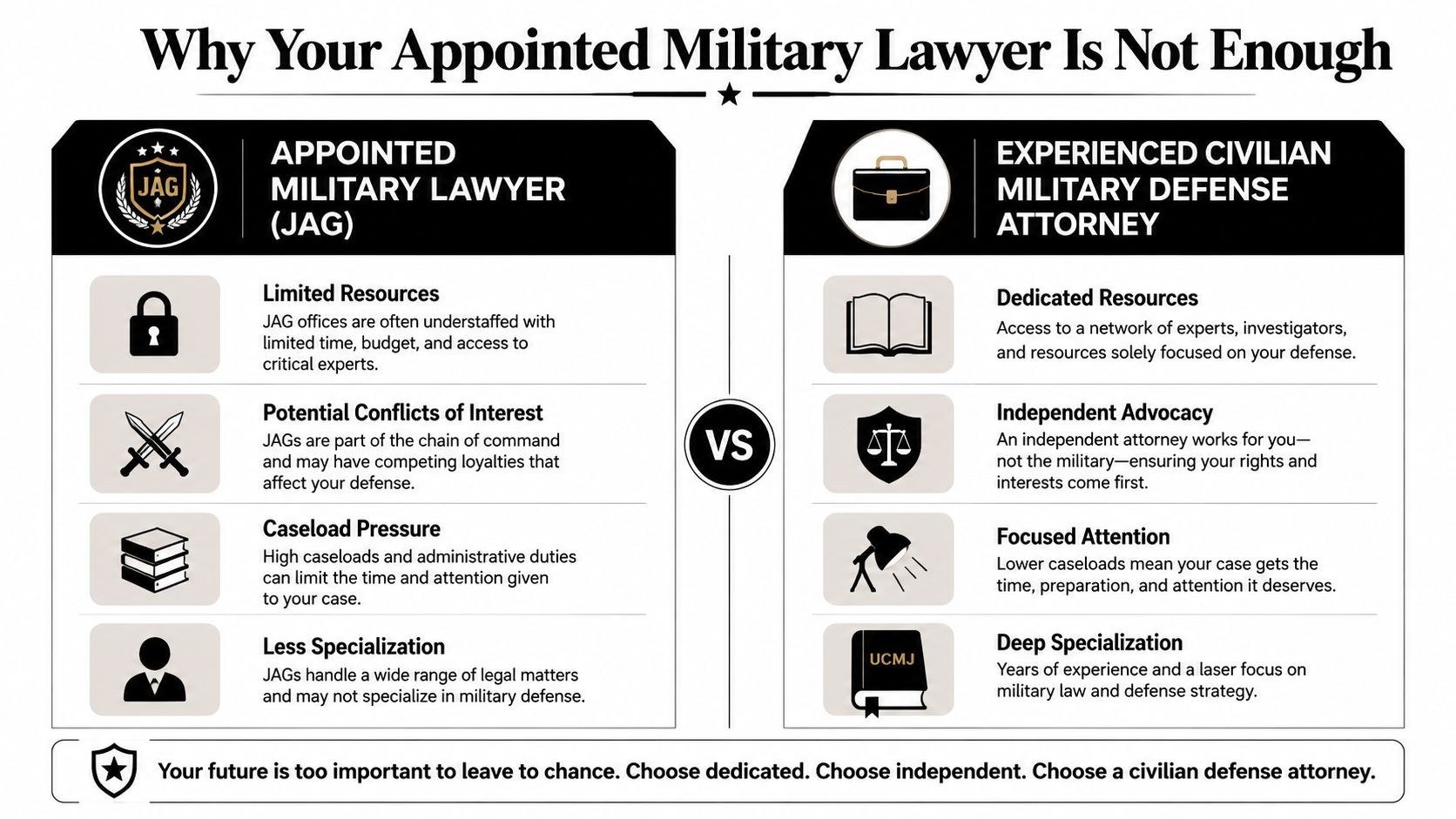
Some appointed lawyers are smart and dedicated. Many work hard. The problem is structural. They often carry heavy caseloads, rotate frequently, and may not have handled a large volume of contested Article 120 trials. A civilian military defense attorney who focuses on these cases brings a different level of specialization, independence, and urgency.
This matters for practical reasons:
- Experience concentration: Repeated Article 120 litigation sharpens cross-examination and motion practice.
- Independent posture: Civilian counsel answers to you, not to a military office structure.
- Resource control: Civilian teams often move faster on investigators, experts, and evidence collection.
- Strategic continuity: Your lawyer isn’t rotating out of the practice area while your life is on fire.
If you’re weighing options, use a practical framework for choosing the right military defense lawyer. Ask how many Article 120 cases the lawyer has tried. Ask how they attack intoxication-based allegations. Ask what they do in the first week. Ask who handles witness interviews. Ask who will stand next to you in court.
The wrong lawyer can be sincere and still lose.
UCMJ Article 120 FAQ
Do I have to talk to CID NCIS OSI or CGIS
No.
Say this: “I am invoking my right to remain silent. I want a lawyer.” Then stop. Do not explain. Do not deny. Do not try to sound cooperative. Investigators are trained to turn casual conversation into evidence. Your first win in this case is giving them nothing.
Will I go to jail while I wait for trial
Possible. Not automatic.
Some service members stay out of confinement and deal with restrictions, supervision, or no-contact orders. Others are pushed into pretrial confinement fast if command believes there is a risk of flight, obstruction, or further misconduct. Your defense response has to start immediately, because early facts and early advocacy often shape what command does next.
What is an Article 32 hearing
It is the government’s first real test.
A good defense uses the hearing to pin down witnesses, expose weak spots, and gather testimony that can be used later if the story changes. A bad defense treats it like a formality and wastes one of the few chances to attack the case before trial. You cannot afford the second approach.
The accuser consented so how can I still be charged
Because the government may argue the accuser could not legally consent.
That fight usually turns on capacity, intoxication, memory, timing, communications, and witness observations. If the allegation involves alcohol, the case often becomes a battle over what the complainant said, did, understood, and remembered. “They agreed” is not enough by itself. You need evidence that proves capacity and undermines the government’s theory.
Will I go to prison if convicted
You need to treat prison as a real possibility.
For offenses committed after Dec. 27, 2023, judge-alone sentencing uses set ranges. Rape falls in Category 4 with 120 to 240 months. Sexual assault falls in Category 3 with 30 to 120 months, as noted earlier in this article. Older aggravated sexual assault cases also carry severe punishment, including confinement, a punitive discharge, and lifetime consequences that follow you long after the sentence ends.
Should I hire a civilian military defense lawyer immediately
Yes.
Delay helps the government secure statements, shape witness accounts, and lock your command into a narrative before your side is organized. Early defense work means preserving texts, getting ahead of phone extractions, identifying favorable witnesses, and stopping preventable mistakes. Speed matters.
What should I do tonight if I was just accused
Do four things.
Stop talking about the facts with anyone except your lawyer. Preserve your phone, messages, social media, photos, location data, and call logs. Write down the timeline while it is still fresh, including names, places, alcohol consumption, rides, room entries, and every communication you can remember. Then get counsel involved tonight, not next week.
If you are under investigation for UCMJ Article 120 Aggravated Sexual Assault, treat the next 24 hours like a fight for your career and your freedom.
Stay silent. Preserve evidence. Get control of the timeline before CID, NCIS, OSI, CGIS, and your command build one for you. Fear does not help. A plan does.