You get the call, or the knock. CID, NCIS, OSI, or CGIS wants to “talk.” Command suddenly goes cold. Your phone matters. Your texts matter. People you know are being interviewed. If the allegation involves a child, the system stops treating this like a personnel problem and starts treating it like a career-ending, freedom-threatening prosecution.
If you’re facing UCMJ Article 120b Sexual Abuse of a Child, you need to understand one thing immediately. This is not the kind of accusation you can “clear up” with a calm statement and good military bearing. These cases are built fast, pushed hard, and judged harshly. Early mistakes become trial exhibits.
You need a crisis plan from day one. That means silence, discipline, and a defense strategy built by someone who knows how to tear apart a child-sex-offense case in the military system.
Table of Contents
- The Accusation and What UCMJ Article 120b Actually Means
- The Government’s Case and How They Prove Sexual Abuse
- The Investigation Phase Your Rights and Critical Mistakes
- The Consequences Potential Penalties and Career-Ending Stakes
- Building Your Defense Common Strategies and Evidence Issues
- Why Your Appointed Military Lawyer Is Not Enough
- Critical Questions for Service Members Facing Article 120b Charges
The Accusation and What UCMJ Article 120b Actually Means
When investigators show up, most service members think the same thing. “If I explain this, they’ll see it’s a misunderstanding.” That instinct ruins cases.
UCMJ Article 120b Sexual Abuse of a Child sits inside the military’s own child-sex-offense framework. It is not some vague morality rule. It is a specific federal military statute aimed at conduct involving minors. Under 10 U.S.C. § 920b, Article 120b separately covers rape of a child, sexual assault of a child, and sexual abuse of a child. The statute applies to child-victim offenses under 16, and for the sexual-assault subsection it draws a bright line at 12.
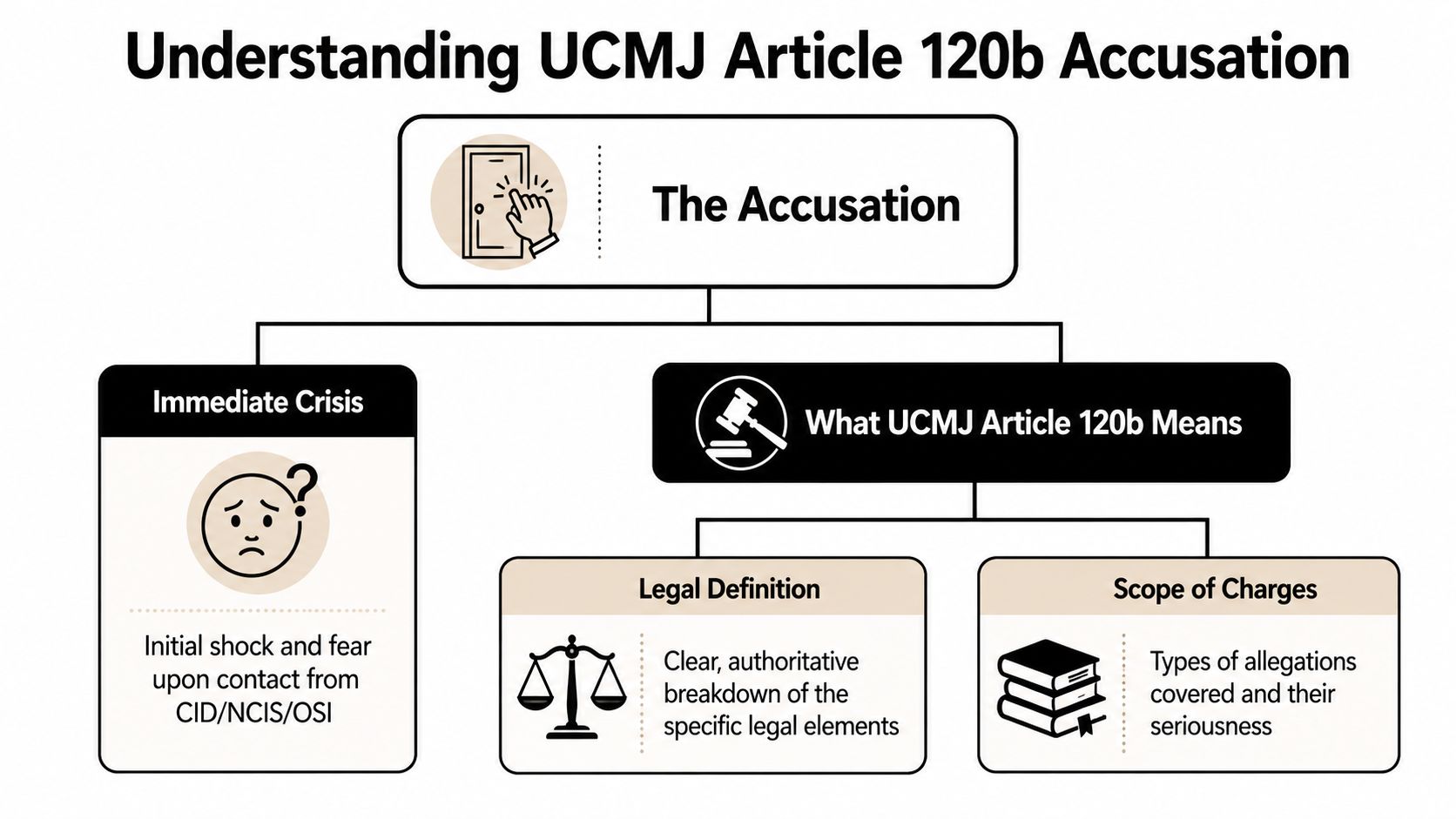
What the statute covers
That distinction matters because service members often hear “Article 120b” and assume every allegation means the same thing. It doesn’t.
Here is the simple version:
| Offense category | Core point |
|---|---|
| Rape of a child | The most severe child-sex offense under Article 120b |
| Sexual assault of a child | A separate offense involving a sexual act, with the statutory age line noted above |
| Sexual abuse of a child | A different offense focused on statutorily defined lewd acts |
If command or investigators use broad language like “inappropriate conduct with a minor,” don’t accept that framing. You need the exact allegation, the exact theory, and the exact words in the charge language.
Why the wording matters immediately
The government benefits when you’re confused. Confusion makes people talk. Talking gives investigators new statements, new admissions, and new inconsistencies to work with.
Practical rule: Your first job is not to explain. Your first job is to identify the precise accusation and stop feeding the case.
That means asking your lawyer to pin down:
- Which subsection applies
- Whether the allegation is act-based, language-based, or both
- What age the government claims
- What evidence they say supports it
You are not defending your character in the abstract. You are defending against a narrowly defined criminal accusation. That is a very different fight.
The Government’s Case and How They Prove Sexual Abuse
Article 120b(c) cases often sound broader than they are. Prosecutors may describe behavior as disturbing, inappropriate, or immoral. That language can influence command. It does not replace the elements they must prove in court.
Lewd act is the center of the fight
Under Article 120b(c), sexual abuse of a child is built around the narrower concept of a lewd act. The Court of Appeals for the Armed Forces digest explains that a lewd act includes sexual contact with a child and can also include certain indecent language, but only when that language is used with a specific intent to abuse, humiliate, degrade, or sexually gratify a person, as summarized in the CAAF digest on Article 120b(c).
That means the government is not done just because a text looks crude or a conversation sounds ugly. In a real prosecution, they must connect the act or words to the required sexual or abusive purpose.
Good defense work starts here.
Where the prosecution is vulnerable
These cases should be viewed through two lenses.
First, what happened. Second, why the government claims it happened.
Those are not the same question.
A prosecutor may have:
- a statement from a child,
- a parent who is outraged,
- a digital thread that looks bad out of context,
- and an investigator who already decided what the story is.
That still leaves major openings for the defense.
Common pressure points include:
- Context problems: Words pulled from a longer exchange often lose meaning.
- Intent problems: Vulgar language is not automatically a statutorily prohibited lewd act.
- Interpretation disputes: Touching may be described one way by the government and very differently by the defense.
- Memory and reporting issues: A later retelling can change details that matter to intent.
The prosecution has to prove more than “this looked bad.” In an Article 120b(c) case, bad optics are not enough.
This is why experienced court-martial attorneys attack the mens rea issue early. If the government can’t prove the required intent, the case gets much harder for them.
The Investigation Phase Your Rights and Critical Mistakes
The investigation phase is where service members lose cases they could have defended. Not at trial. Not at sentencing. At the beginning.
What usually happens first
The sequence is familiar. Investigators make contact. They say they want your side. They imply cooperation helps. Command may issue verbal guidance, a no-contact order, or other restrictions. Your unit starts reacting before you even know what the evidence is.
The safest move is also the simplest.
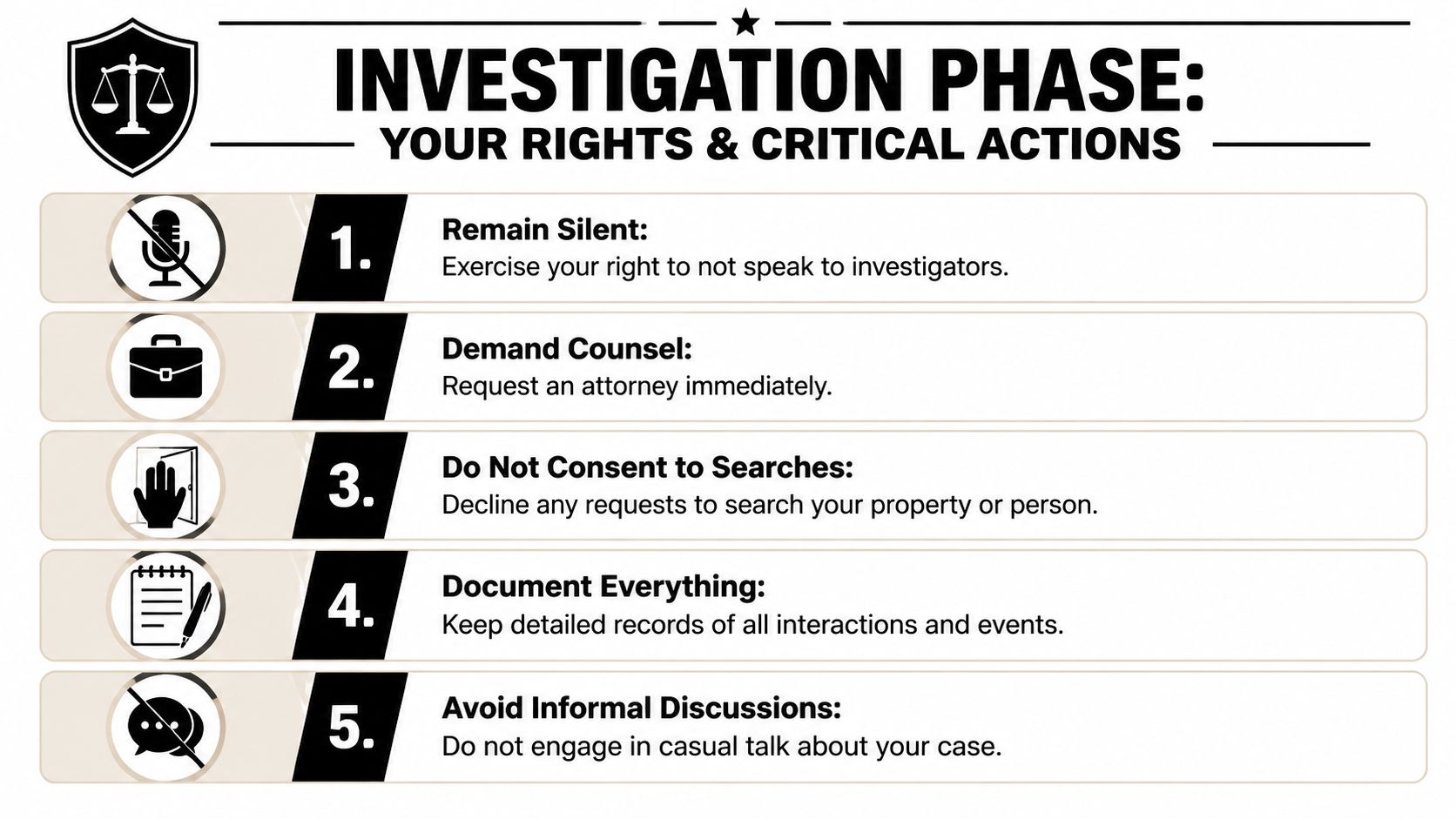
Say this and stop talking: “I want a lawyer.”
If you’re trying to understand who may be investigating you and how those agencies operate, review this breakdown of CID, NCIS, OSI, and CGIS investigations.
A short explanation of the process helps, but only if it changes your behavior.
Initial contact
Investigators may sound casual. It isn’t casual.Request for a statement
This is the trap. They want admissions, inconsistencies, and reactions.Search requests
They may ask for your phone, device, room, car, or consent to look through accounts.Command restrictions
You may be told not to contact people, not to go certain places, or not to discuss the matter.
Here is a useful overview of the investigative pressure you’re likely facing:
The mistakes that bury people
Most accused service members don’t get crushed by one dramatic confession. They get crushed by a series of bad decisions.
Trying to “clear it up”
Investigators are not interviewing you to help you. They are collecting proof.Consenting to searches
Once you hand over access voluntarily, your defense gets harder.Texting the accuser or family
Even apology-free contact can be portrayed as pressure, consciousness of guilt, or witness interference.Talking to buddies, NCOs, or supervisors
Those conversations turn into statements. Assume nothing is private.Deleting messages or files
That creates a fresh problem and makes you look guilty even if you weren’t.Trusting command to be neutral
Command is managing risk to the unit. You are managing risk to your freedom.
Say less. Preserve everything. Let a UCMJ lawyer control contact with investigators.
Write down dates, names, and every interaction while your memory is fresh. Then stop freelancing.
The Consequences Potential Penalties and Career-Ending Stakes
If you’ve been accused under Article 120b, stop minimizing this. The punishment range alone should tell you what kind of fight you’re in.
What punishment can look like
The penalties tied to Article 120b are among the harshest in military justice. A conviction for rape of a child can carry life imprisonment without parole. Sexual assault of a child can carry up to 30 years of confinement. Sexual abuse of a child can carry up to 20 years, as described in this Article 120b penalties summary.
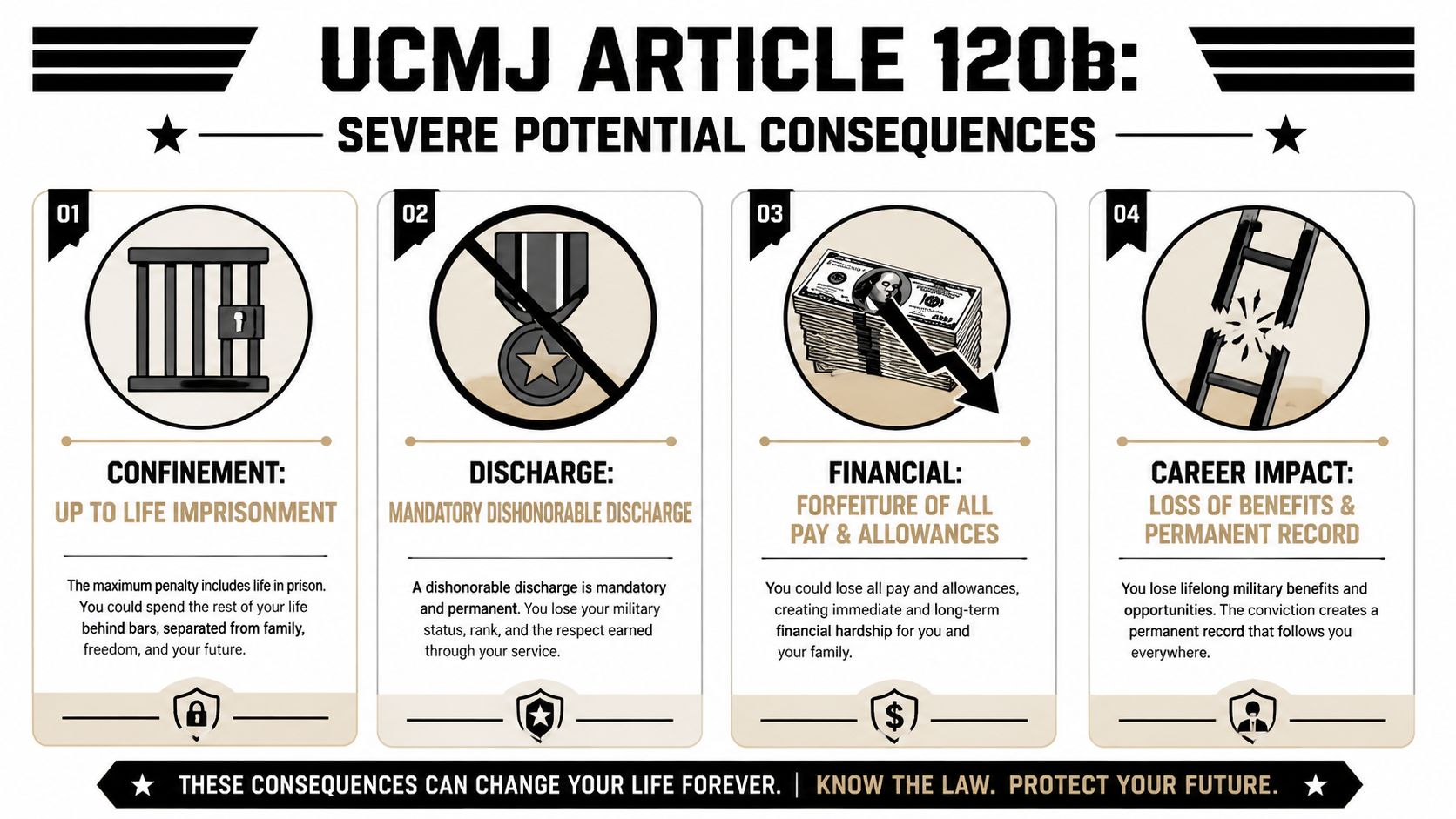
For the most serious offenses, punitive separation is commonly described as mandatory dishonorable discharge or dismissal, and a conviction can also bring total forfeitures of pay and allowances.
That means this case is not just about confinement. It is about losing your military identity, income, future benefits, and the ability to say you served honorably.
What happens even before trial ends
Even before a conviction, Article 120b allegations can wreck your life.
Expect pressure in areas like:
| Area | Real-world impact |
|---|---|
| Career | Loss of trust, lost positions, stalled advancement |
| Family | Restricted contact, stress inside the home, public stigma |
| Reputation | Rumors spread faster than facts in military units |
| Mental state | Isolation and panic lead people to make bad decisions |
A lot of accused service members focus only on “Will I go to jail?” That question is too narrow.
You should also be asking:
- What paper trail is being created right now?
- What digital evidence exists and who controls it?
- What command actions are setting conditions for separation or confinement?
- What decisions today will hurt me at trial?
These cases can take your freedom. They can also destroy everything around your freedom long before a panel returns findings.
Building Your Defense Common Strategies and Evidence Issues
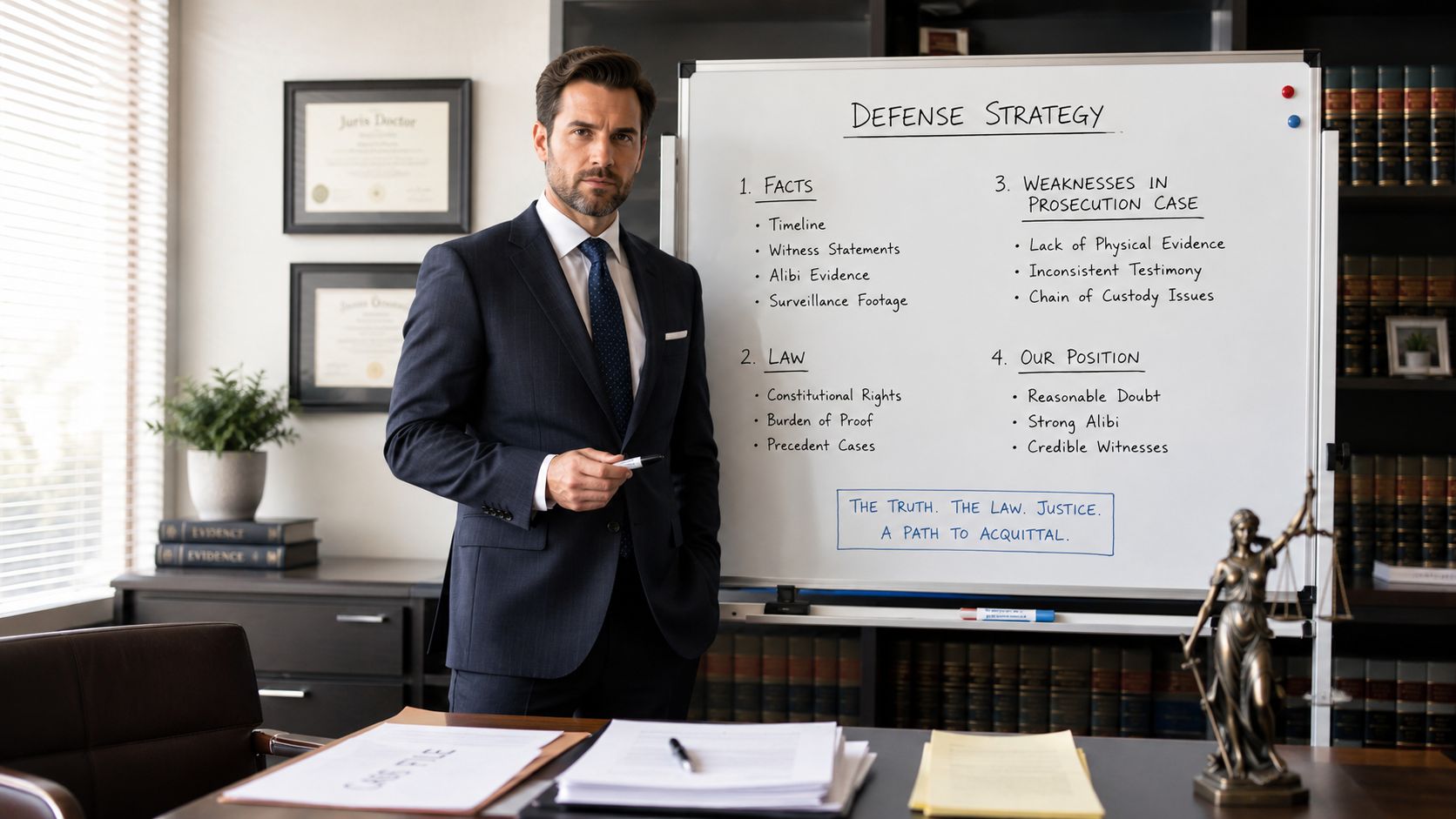
You do not win an Article 120b case by indignation. You win by forcing the government to prove each part of the accusation with reliable evidence and by exposing every weak link in the chain.
How strong defenses are actually built
Every serious defense starts with reconstruction.
Get the full timeline. Get every message. Get every prior statement. Find out who first reported what, to whom, and how the story changed after each retelling. Article 120b cases often turn on interpretation, suggestion, and sequencing.
Good defense work usually includes:
Timeline reconstruction
Dates matter. Gaps matter. Contradictions matter more than people think.Digital evidence review
Texts, apps, metadata, screenshots, and account access issues can change the shape of the case.Witness pressure analysis
Parents, relatives, friends, and command can shape narratives without realizing it.Interview-method scrutiny
If a child interview was poorly conducted, the reliability of the account becomes a live issue.
For a related look at how specialized sexual-offense defense strategy has changed in the military system, read this discussion of Article 120 UCMJ defense in the era of Special Trial Counsel.
Evidence problems to look for immediately
These are not abstract law-school issues. These are trial issues.
Defense focus: The government’s story has to survive cross-examination, document review, digital analysis, and common sense. Many don’t.
Look hard at:
Inconsistent statements
If accounts shift in meaningful ways, credibility becomes a battlefield.Missing corroboration
Sometimes the government has accusation but little support.Loaded language by investigators
Investigators can shape testimony through the way they ask questions.Alternative explanations
Context can transform how a panel sees words, behavior, or contact.Tunnel vision
Once agents decide you’re the target, exculpatory facts often get ignored or minimized.
Then interview lawyers yourself and test their command of Article 120b strategy.
Why Your Appointed Military Lawyer Is Not Enough
Your detailed defense counsel may be smart, ethical, and hardworking. That still does not mean appointed counsel alone is enough for a child-sex-offense case.
The structural problem
Military defense counsel work inside the same larger institution prosecuting you. I am not saying they are dishonest. I am saying the system is not built around giving one accused service member unlimited time, unlimited investigation, and unlimited strategic bandwidth.
Article 120b cases demand aggressive, sustained, defense-driven work. That means independent fact development, expert consultation when needed, repeated witness analysis, and immediate strategic control. Appointed counsel often carry heavy caseloads and rotate through assignments on institutional timelines, not yours.
That matters when your life is being picked apart by investigators who do this every day.
What civilian court-martial attorneys add
A strong civilian military defense lawyer brings independence. That matters more than most service members realize.
The right civilian counsel can give you:
Singular focus
Your case is not one of many office files. It is the file.Trial perspective
Seasoned civilian court-martial attorneys often evaluate cases from the first interview as if the panel were already seated.Outside pressure resistance
Independence from command culture changes how advice is given and how hard strategic positions are pushed.Team-based preparation
Serious firms can coordinate investigators, experts, and document review in a way that matches the stakes.
If you’re evaluating options, use a concrete screening process like the one outlined in this guide to selecting a military defense lawyer.
Do not hire on personality alone. Ask direct questions. Have you handled Article 120b cases? How do you attack lewd-act intent allegations? How do you deal with child interview issues? What is your first move if CID already has the phone?
A serious case requires serious counsel. Free is not the same as sufficient.
Critical Questions for Service Members Facing Article 120b Charges
FAQ
Can I refuse to talk to CID, NCIS, OSI, or CGIS?
Yes. You should invoke your rights and ask for a lawyer. Silence is not a sign of guilt. It is basic survival.
Should I give a statement if I’m innocent?
No. Innocent people make damaging statements every day. Stress, bad memory, poor wording, and investigator tactics create evidence where none existed before.
What if command says cooperating will help me?
Command does not decide guilt at trial, and “cooperation” often means giving the government more material to use against you. Be respectful. Be silent.
Do I need a lawyer before charges are preferred?
Yes. The investigation stage is when the record starts forming. By the time charges appear, you may already have handed the government half its case.
Will this definitely go to court-martial?
Not every investigation becomes a conviction, and not every allegation is equally strong. But you should prepare as if the government intends to push hard. That mindset produces better decisions.
Can I talk to my spouse or family about what happened?
You need to be careful. Family support matters, but repeated discussion creates risks. Keep detailed legal discussions with your lawyer.
What should I preserve right now?
Preserve messages, call logs, social media history, photos, travel records, names of witnesses, and a written timeline for your lawyer. Preserve. Don’t edit.
How do I choose between military-appointed counsel and civilian counsel?
Use both if you can, but don’t assume appointed counsel alone is enough for an Article 120b case. Interview civilian military defense lawyers immediately and compare strategy, not salesmanship.
If you are under investigation or already charged with UCMJ Article 120b Sexual Abuse of a Child, act now.
Do not talk to investigators. Do not consent to searches. Do not text your way into a prosecution. Get a lawyer who knows this terrain, knows how the government builds these cases, and knows how to dismantle them.
Your career is on the line. Your freedom may be on the line. Waiting is not a strategy.