
You get the call. Your first sergeant says CID, NCIS, OSI, or CGIS wants to “talk.” Your phone starts buzzing. Someone in the unit already heard. Your spouse asks what happened. You’re sitting there trying to convince yourself this is a misunderstanding.
It isn’t.
If you’re facing a UCMJ Article 120 Abusive Sexual Contact allegation, your career, your clearance, your rank, and your freedom are all in play. The biggest mistake is simple. Good service members think honesty alone will save them. It won’t. Investigators are building a case. Command is protecting itself. Prosecutors are already thinking about how to frame your words.
The fight starts before charges are preferred. That is where smart defense work changes outcomes.
Table of Contents
- Your Career on the Line The Moment They Call Your Name
- Defining UCMJ Article 120 Abusive Sexual Contact
- The Path from Accusation to Court-Martial
- Punishments and Lifelong Consequences
- How We Win Attacking the Government’s Case
- Critical Mistakes That Will Destroy Your Case
- Why Your Appointed Military Lawyer Is Not Enough
- FAQ
- Can I refuse to talk to CID NCIS OSI or CGIS
- Will command start separation action before I’m convicted
- Does abusive sexual contact mean there had to be penetration
- What if I believed the contact was consensual
- Can this hurt my security clearance even before trial
- Should I save old texts and social media messages
- Is the Article 32 hearing worth fighting hard
- Do I need civilian counsel if I already have a military lawyer
- Take Action Before the Government Gets Further Ahead
Your Career on the Line The Moment They Call Your Name
The call usually sounds harmless. “We just need your side.” “You’re not under arrest.” “Help us clear this up.” Service members hear that and walk into the interview thinking cooperation will make this go away.
That decision destroys cases.
This pattern repeats over and over. A service member walks into an interview room believing the truth will carry the day. Two hours later, investigators have a statement full of guesses, timeline errors, badly phrased explanations, and one damaging phrase they can repeat at trial. The service member leaves thinking he helped himself. He didn’t. He gave the government a script.
What you do in the first 24 hours
Your first move is not explanation. Your first move is control.
- Invoke your rights: If investigators want to question you, say you want a lawyer and then stop talking.
- Preserve evidence: Save texts, call logs, social media messages, rideshare history, photos, videos, and location data.
- Tell no one details: Not your squad leader. Not your roommate. Not your ex. Not your buddy who “knows how these cases work.”
- Get civilian military defense counsel involved immediately: Early strategy matters more than late courtroom theatrics.
Practical rule: The government would love to interview you before you understand the allegation. Don’t give them that advantage.
The system is not built to give you the benefit of the doubt. In sexual misconduct cases, early assumptions harden fast. Command hears an allegation and starts worrying about headlines, unit climate, and whether someone will accuse them of not taking it seriously. That pressure rolls downhill onto you.
If you remember one thing from this article, remember this. The moment they call your name, you are already behind unless you stop talking and start defending.
Defining UCMJ Article 120 Abusive Sexual Contact
UCMJ Article 120 Abusive Sexual Contact is not a minor charge. It sits lower than rape, sexual assault, and aggravated sexual contact in the Article 120 structure, but it can still wreck your life. You need to know what the government must prove, because these cases are often charged broadly and explained poorly.
What the government is really alleging
Under Article 120(d), abusive sexual contact means committing or causing sexual contact without consent, or when the other person is incapable of consenting. The government must prove intentional touching of areas such as the genitals, anus, groin, breast, inner thigh, or buttocks, or causing someone to touch those areas, with intent to abuse, humiliate, harass, degrade, or gratify sexual desire, as reflected in the Article 120 digest discussing United States v. Armstrong.
That last point matters. This offense does not require penetration. That is one major distinction between abusive sexual contact and sexual assault.
Armstrong also matters because it confirms “touching” is read broadly. The law doesn’t get narrow just because the setting was professional or the contact was indirect. If investigators think the contact fits the statute, they will charge aggressively.
The offense levels matter
Congress built Article 120 as a tiered system. That matters because prosecutors often charge high first and sort it out later. You need to know where abusive sexual contact fits in the hierarchy and why charge selection can become a battleground.
| Offense | Core Element | Maximum Confinement |
|---|---|---|
| Abusive sexual contact | Sexual contact without consent, or when the person cannot consent | 7 years |
| Aggravated sexual contact | More serious sexual contact offense with aggravating circumstances | 20 years |
| Sexual assault | Sexual act without consent or under prohibited circumstances | 30 years |
| Rape | Most severe Article 120 sexual act offense | Life imprisonment |
The current Article 120 framework and maximum punishments are discussed in this explanation of abusive sexual contact under the UCMJ.
Here’s what that means in plain English. If the allegation involves touching rather than penetration, the government may still overreach in how it charges the case. That creates room for a defense lawyer to attack the theory, challenge the elements, and force the prosecution to justify why it picked a more serious charge.
The label on the charge sheet is not the final truth of the case. It’s the government’s opening position.
Three issues usually decide these cases early:
- Consent: Did the other person agree through words or conduct?
- Capacity: Was the person asleep, unconscious, unaware, or too impaired to consent?
- Intent: Was the contact intentional and for a prohibited purpose, or is the government stretching facts to fit a sexual narrative?
If you don’t understand those three issues, you cannot defend yourself intelligently. And if your lawyer doesn’t attack them early, you’re already losing ground.
The Path from Accusation to Court-Martial
Most service members have no idea how quickly this machine moves. By the time you realize the allegation is serious, investigators may already have interviewed witnesses, pulled messages, and briefed command. Delay helps them, not you.
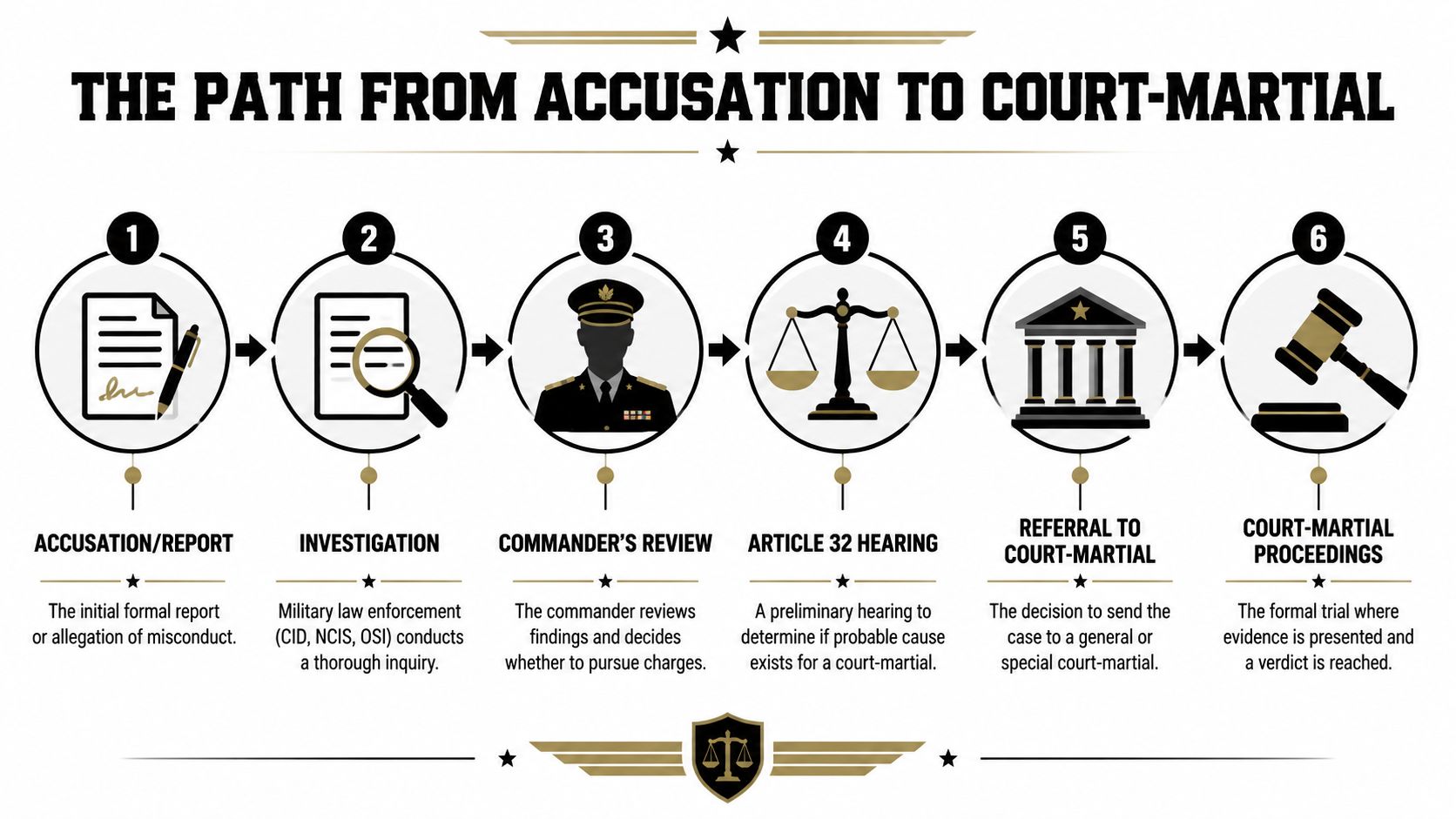
How the process usually unfolds
An accusation gets reported
Someone makes a complaint. It may go through command, law enforcement, or a sexual assault reporting channel. Once that happens, you should assume the allegation will be treated as a career-threatening event.Investigators start building the file
CID, NCIS, OSI, or CGIS begin interviews, collect digital evidence, and lock in statements. If you need a quick primer on those agencies, review this guide on CID, NCIS, OSI, and CGIS.Command reviews the case under pressure
The military’s current zero-tolerance climate often requires commanders to process service members for involuntary discharge based on allegations alone, even before a conviction, as discussed in this analysis of military sexual assault defense under Article 120.Charges may be preferred
The government turns the allegation into formal accusations under the UCMJ. By then, every bad statement and every missing piece of defense evidence starts to hurt.Article 32 hearing
This is a major strategic point. A skilled court-martial attorney uses it to expose holes, challenge witness credibility, and preserve issues for later motions and trial.Referral and court-martial
If the case is referred, the fight becomes fully public and far more dangerous. But the groundwork was laid much earlier.
Where the battlefield is shaped early
The most important part of this timeline is not the final trial. It’s everything before preferral.
That’s where we identify favorable witnesses before command talks to them. That’s where we preserve digital communications before they disappear. That’s where we stop a client from making a disastrous statement. That’s where the defense starts forcing the government to confront facts that don’t fit its narrative.
A smart defense team asks questions early that investigators often avoid:
- What exactly was said before and after the alleged contact?
- Who saw the parties together, and in what condition?
- What texts, photos, or app records show mutual planning, flirting, or voluntary contact?
- Did investigators ignore inconsistent statements because they liked the accusation better than the evidence?
The military process looks orderly on paper. In practice, it’s driven by pressure, speed, and institutional fear. If you wait until the charge sheet arrives, the government has already shaped the story.
Punishments and Lifelong Consequences
A conviction for UCMJ Article 120 Abusive Sexual Contact is not just a sentencing problem. It’s a life problem.
The maximum punishment can include up to 7 years of confinement, a punitive discharge, and total forfeitures under the current framework for abusive sexual contact, as noted earlier in the article. That alone should get your attention.

The sentence is only the start
The damage keeps going after court.
A conviction can cost you your military career, your veteran identity, future employment options, and your reputation with every licensing board, employer, and background investigator who looks at your record. If sex offender registration applies, that follows you long after the uniform is gone.
People fixate on jail time because it’s easy to picture. They should be thinking just as hard about what happens when they try to build a civilian life with this kind of record attached to them.
A lot of service members can survive a bad evaluation, an Article 15, or even a career setback. Very few can absorb a sex offense conviction and come out intact.
Why clearance holders are in special danger
If you hold a security clearance, you have another front in this war. An allegation itself can trigger reporting. A conviction can shut the door on large parts of your military and civilian future.
According to this discussion of Article 120 consequences and security clearance fallout, sexual misconduct allegations trigger mandatory reporting and result in clearance denial or revocation in 70-80% of cases, and Article 120 convictions account for 15% of all military clearance suspensions.
That matters whether you work in intelligence, cyber, aviation, special operations, nuclear fields, or any job where access is everything. Lose the clearance, and the case can end your career even before the sentence does.
Here’s the blunt truth. In many cases, the fight is not only about avoiding confinement. It’s about preventing a professional death sentence.
How We Win Attacking the Government’s Case
Good defense in an Article 120 case is not passive. We do not sit around waiting for discovery and hoping the facts save the client. Attack. Force the government to defend its own shortcuts, assumptions, and blind spots.
If you want to understand why the investigation phase matters so much, read this breakdown of how experienced counsel win cases during the military investigation phase.
Consent fights are evidence fights
The government likes clean narratives. Real life is messy. That mess often helps the defense.
Article 120 cases often turn on mistake of fact as to consent. That defense requires showing a reasonable belief that the other person communicated agreement. According to this review of Article 120 defense strategy and motion practice, that affirmative defense succeeds in about 30% of litigated cases, and pretrial motions to suppress tainted statements under MRE 403 can be critical.
That means consent is not argued with slogans. It is argued with records, context, timing, witness accounts, and contradictions.
What to look for immediately
- Messages before the encounter: Flirtation, planning, invitations, or mutual pursuit.
- Messages after the encounter: Regret is not the same thing as non-consent. Silence is not proof either. Context matters.
- Timeline fractures: Small changes in the accuser’s sequence of events can become major credibility problems.
- Behavior evidence: How both parties acted before, during, and after the alleged contact can support reasonable belief.
Defense perspective: Juries and military judges don’t decide these cases in a vacuum. They decide them from the evidence trail people leave behind.
Bad investigations create real openings
Investigators routinely act like they are neutral fact finders. Often they are building around an accusation, not testing it.
That gives us openings.
Sometimes agents ask leading questions and lock witnesses into statements that sound polished but aren’t reliable. Sometimes they ignore inconsistent accounts. Sometimes they pressure a client into “just explaining” and then act shocked when the explanation isn’t perfect. Sometimes command pressure infects the entire process.
Three recurring pressure points matter:
Suppression issues
If statements were obtained unfairly or in a distorted setting, pretrial motions can cut them out or limit their value.Credibility erosion
Compare every version of every story. Interview notes, text messages, sworn statements, and testimony often do not line up.Alternative interpretation
The government may frame a contact as sexual and criminal when the evidence supports misunderstanding, ambiguity, or lack of criminal intent.
The strongest Article 120 defense is usually built before the case ever reaches trial. By the time the government realizes the story is weaker than it first looked, the defense should already have the records, witnesses, and motion strategy in place.
Critical Mistakes That Will Destroy Your Case
When people panic, they do stupid things. In UCMJ Article 120 Abusive Sexual Contact cases, stupid things become exhibits.
The errors that hand the government a conviction
Talking to investigators without counsel
This is the worst move by far. You will not outtalk trained agents in a sexual misconduct investigation.Trying to “clear it up” with the accuser
That can be spun as intimidation, witness tampering, or consciousness of guilt. Leave the accuser alone.Deleting texts, photos, or apps
That doesn’t make the problem disappear. It can create an obstruction issue and destroy evidence that may actually help you.Trusting command to protect you
Your commander is not your defense lawyer. Command is balancing mission, optics, and institutional pressure.Assuming there is “no evidence”
Your own words, digital history, witness impressions, and timeline gaps are evidence. These cases are often built from fragments.Waiting to hire counsel
Delay lets the government collect and frame evidence first. Early defense work shapes the battlefield. Late defense work tries to survive it.Confiding in friends or coworkers
Those people become witnesses. Loose conversations become sworn statements.Posting online
Investigators search social media. Prosecutors love public comments that sound bitter, arrogant, or inconsistent.
Here’s the standard I give clients. If the action creates a record, sends a message, or gives someone a story about you, assume the government will eventually see it.
The safest pattern is simple. Say little. Preserve everything. Let your lawyer decide what gets disclosed, when, and why.
Why Your Appointed Military Lawyer Is Not Enough
Most appointed military defense counsel work hard. That’s not the issue. The issue is bandwidth, depth, and independence.
You need independence and focus
Article 120 cases are complex. The law is tiered. The consequences vary. And because abusive sexual contact does not carry the same mandatory discharge result as rape or sexual assault, case outcomes can turn heavily on negotiation skill, motion practice, and trial strategy, as discussed in this explanation of how to choose the right military defense lawyer.
That is where experienced civilian military defense lawyers matter.
A civilian lawyer is not answering to command. A civilian lawyer is not learning your case while juggling a stack of others inside the same system. A civilian lawyer can push harder, investigate faster, and build a customized strategy around your facts instead of your file number.
You do not need a cheerleader. You need a court-martial attorney who knows how to dismantle an Article 120 prosecution before it hardens into a conviction.
FAQ
Can I refuse to talk to CID NCIS OSI or CGIS
Yes. Invoke your rights and ask for a lawyer. That is the right move.
Will command start separation action before I’m convicted
It can happen. In the current climate, commands may begin processing based on allegations alone, as covered earlier.
Does abusive sexual contact mean there had to be penetration
No. That is one of the key distinctions between abusive sexual contact and sexual assault.
What if I believed the contact was consensual
That may support a mistake of fact as to consent defense. But it must be built with evidence, not just asserted after the fact.
Can this hurt my security clearance even before trial
Yes. Clearance problems can begin with the allegation itself because reporting and adjudicative review may start early.
Should I save old texts and social media messages
Yes. Preserve everything. Do not edit, delete, or curate. Your lawyer needs the full record.
Is the Article 32 hearing worth fighting hard
Absolutely. It is an early chance to test the government’s theory, expose weaknesses, and shape the case.
Do I need civilian counsel if I already have a military lawyer
In a serious Article 120 case, you should strongly consider it. The stakes are too high to treat this like a routine personnel problem.
Take Action Before the Government Gets Further Ahead
If you are under investigation for UCMJ Article 120 Abusive Sexual Contact, stop trying to manage this yourself.
Do not talk to investigators. Do not contact the accuser. Do not delete anything. Do not assume command will be fair. Get an experienced civilian military defense lawyer involved now, while evidence can still be preserved, witnesses can still be found, and the government’s story is still vulnerable.
Your career is on the line. Your freedom may be next.
The worst time to get serious about your defense is after charges are preferred. The right time is today.