
You receive a notice that your security clearance may be suspended or revoked. Your supervisor stops assigning you sensitive work. A pending promotion becomes uncertain, and your family starts asking whether you’ll lose your job or be separated from the service. You may not know what triggered the action, what evidence the government has, or how quickly you need to respond.
That uncertainty is dangerous, but it isn’t the same as defeat. Security clearance revocation is a winnable adjudicative fight, not an automatic career ending event. The government is evaluating whether you remain eligible to handle protected information, and your response must address the specific risk concerns with evidence, candor, and documented mitigation.
Table of Contents
- When Your Clearance Is on the Line
- What Security Clearance Revocation Really Means
- Why Clearances Get Revoked Under the 13 Guidelines
- How the Revocation and Appeals Process Actually Works
- Common Mistakes That Cost Service Members Their Clearance
- Mistake one is speaking before getting advice
- Mistake two is trusting command to solve it informally
- Mistake three is hiding or minimizing financial problems
- Mistake four is ignoring the response deadline
- Mistake five is submitting a bare character letter
- Mistake six is posting sensitive information online
- Why Civilian Military Defense Counsel Changes the Outcome
- Your Defense Plan and Next Steps to Protect Your Career
When Your Clearance Is on the Line
A clearance problem often begins without fanfare. A financial issue appears in a report, an investigation uncovers an omission on the SF-86, a foreign contact raises questions, or command receives information about alleged misconduct. Then the notice arrives, sometimes before you’ve had a meaningful chance to explain yourself.
Your first instinct may be to call your supervisor, send a long explanation to the security manager, or cooperate immediately with an investigator. Slow down. The first account you give can shape every later decision, and an unprepared statement can create inconsistencies that become more damaging than the original allegation.
The consequences can be immediate. A suspension may prevent you from performing your current duties, entering a facility, or accessing protected systems. Your employer or command may remove you from the position, reassign you, or begin separate administrative action. Clearance eligibility, actual access, and employment are connected, but they aren’t identical.
Practical rule: Treat the first notice as a deadline problem, an evidence problem, and a career problem at the same time.
Security clearance revocation is a national-security determination, not a criminal conviction. That distinction matters, but it doesn’t make the process harmless. Federal precedent generally recognizes no property or liberty interest in access to classified information, and reviewing bodies usually won’t re-weigh the underlying national-security judgment. They may examine notice and procedure, while the practical defense centers on rehabilitation, debt resolution, accurate reporting, and proof that the concern won’t recur. Federal clearance review limits and mitigation considerations
The next 30 to 60 days can determine whether you preserve eligibility, lose access temporarily, or face a final adverse decision. Those figures come from common response and appeal windows described in the applicable procedures, not from a universal deadline. Your exact notice controls, so obtain counsel before you assume the clock works the same way for every service member, civilian employee, or contractor.
What Security Clearance Revocation Really Means
Security clearance revocation means the government has made a formal determination that you no longer meet the standard for eligibility. It isn’t a finding that you committed espionage, betrayed the United States, or committed a crime. It means adjudicators believe unresolved concerns create an unacceptable risk involving reliability, judgment, candor, vulnerability, or protection of sensitive information.
Suspension is different. Under Department of Defense due-process rules, the government can suspend clearance or access when derogatory information surfaces, before the final revocation decision. Suspension is an interim measure while the matter moves through review. A final revocation follows adjudication and the opportunity to contest the proposed action. Government accountability discussion of suspension and due process
Loss of access is broader and can happen for administrative reasons. Someone may lose access because the assignment no longer requires it, because a need-to-know disappears, or because facility privileges are withdrawn. That doesn’t always mean the government has formally revoked clearance eligibility.
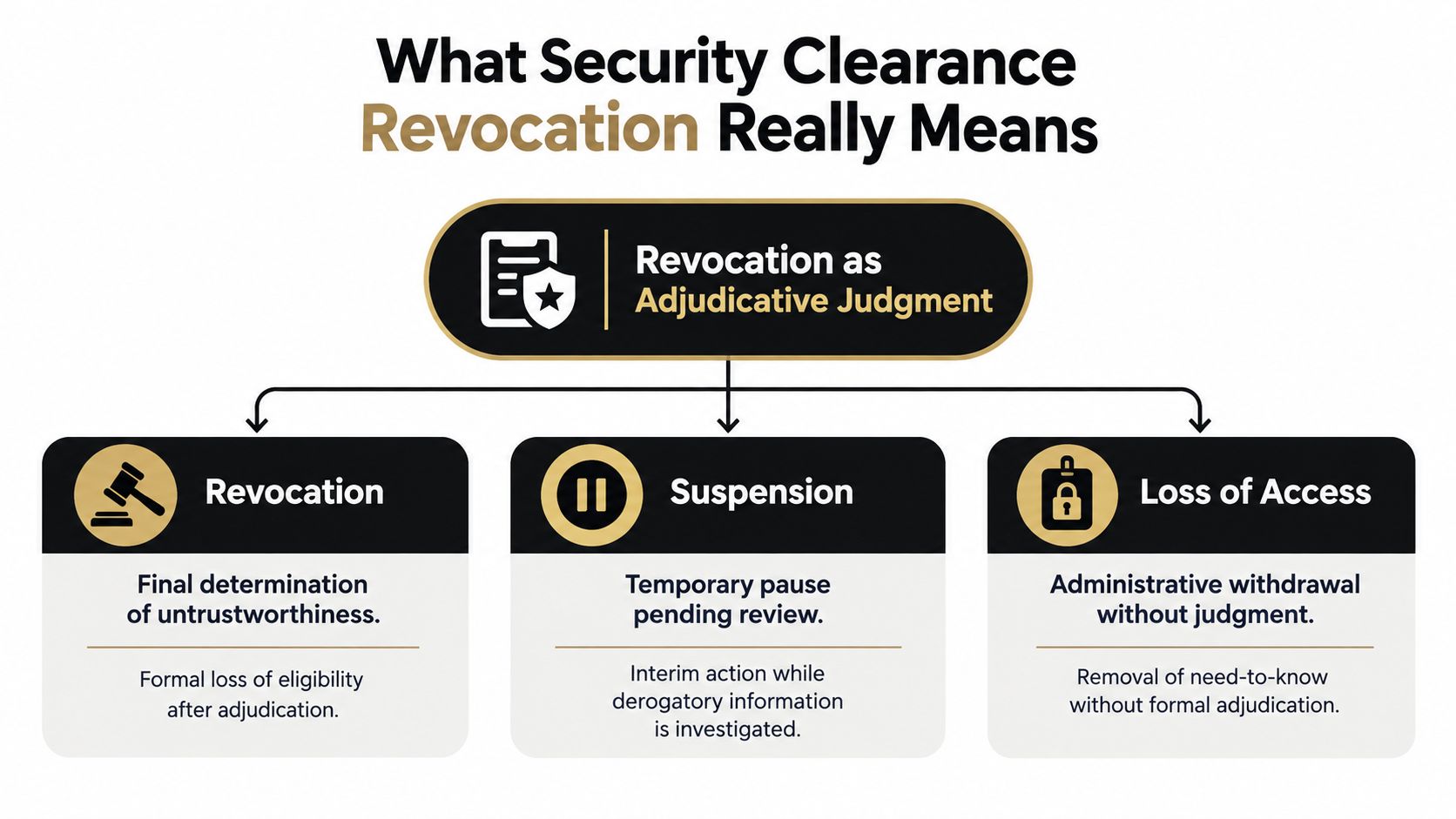
Eligibility, access, and employment are separate
Think of the system as three connected doors:
- Eligibility: The government decides whether you may be trusted with classified information.
- Access: Your employer or command grants access based on mission, authorization, and need-to-know.
- Employment: Your organization decides whether it can retain you in a role that requires that eligibility and access.
A revocation can affect all three, but the employment consequence depends on your position, contract, agency, and applicable procedures. Recent public reporting on political clearance removals shows why public commentary often confuses these categories. Coverage of clearance rescissions and related access and employment consequences
Revocations remain unusual relative to the size of the clearance system. The Department of Defense Consolidated Adjudications Facility closed 836,461 cases in fiscal year 2021 and recorded 1,810 “Denied Revoked” outcomes, about 0.22% of adjudicated cases. The same reporting described 3,793 DoD denials or revocations in fiscal year 2020 and 1,421 by a little more than halfway through fiscal year 2021, showing that annual totals can shift substantially. Clearance denial and revocation data summarized with government reporting
The individual impact is still severe. Oppenheimer’s clearance was revoked on June 29, 1954, after the Atomic Energy Commission voted 4 to 1 on character and security grounds. His case remains famous because it showed how a clearance decision can become a defining professional and national-security event, even when the underlying facts and fairness of the process remain disputed. Historical account of Oppenheimer’s clearance revocation
For organizations evaluating personnel screening more broadly, you can also browse government screening solutions to understand how identity and background screening fits into public-sector risk management.
Why Clearances Get Revoked Under the 13 Guidelines
Adjudicators don’t need a sensational allegation to raise a security concern. They apply 13 adjudicative guidelines, examining whether the facts indicate a broader risk pattern and whether the concern is likely to continue. The relevant categories include financial considerations, personal conduct, criminal conduct, drug involvement, alcohol consumption, foreign influence, foreign preference, psychological conditions, sexual behavior, allegiance, security violations, outside activities, and misuse of information technology systems. Navy security training describing the adjudicative guidelines and major risk categories
The practical mistake is to focus only on the triggering event. Adjudicators may care just as much about what happened afterward. Did you report it? Did you dispute it forthrightly? Did you resolve the debt? Did you complete treatment? Did you change the behavior? Did you minimize the problem or blame everyone else?

Financial and personal conduct concerns
Financial considerations are often the most practical danger. Unpaid debts, judgments, delinquent accounts, tax problems, and poor financial judgment can suggest vulnerability to pressure. The government doesn’t need to prove that you sold secrets. It may argue that financial stress creates an exploitable condition.
Personal conduct can make a manageable issue much worse. An inaccurate SF-86 answer, a misleading interview response, or an omission after you knew disclosure was required can become an independent concern. The government may view the concealment as more serious than the original financial or personal problem.
Conduct, substances, and criminal issues
Drug involvement, alcohol consumption, criminal conduct, and security violations often overlap. A single event may raise questions about judgment, but repeated conduct, failure to disclose, or disregard for reporting requirements can create a stronger pattern.
Protected information issues receive especially serious attention. Mishandling classified or sensitive material, using information technology systems improperly, or violating security procedures can trigger concerns about judgment and reliability. The defense must separate accidental mistakes, training failures, ambiguous instructions, and deliberate misconduct instead of treating every allegation as identical.
Foreign ties and other categories
Foreign influence and foreign preference don’t automatically establish disloyalty. The question is whether relationships, obligations, assets, travel, or preferences create a realistic risk of pressure or divided commitments. Likewise, mental health treatment isn’t automatically disqualifying. The government evaluates the specific concern, its effect on reliability, and evidence of responsible treatment or stability.
The strongest mitigation doesn’t say, “Nothing happened.” It says, “Here is exactly what happened, here is what I did afterward, and here is why the concern won’t recur.”
A strong response addresses both the facts and the risk logic. That means debt records, repayment documentation, treatment completion, reporting history, corrected forms, character evidence, and a credible explanation of changed behavior. The goal isn’t to make the file emotionally sympathetic. The goal is to make continued eligibility a rational decision.
How the Revocation and Appeals Process Actually Works
The process varies by agency and status, but the sequence is recognizable. Under federal procedures, you should expect written notice of the concern, an opportunity to respond, access to relevant investigative material, the ability to use counsel at your own expense, a written final decision, and an appeal opportunity in applicable cases. Federal personnel suitability and security program procedures
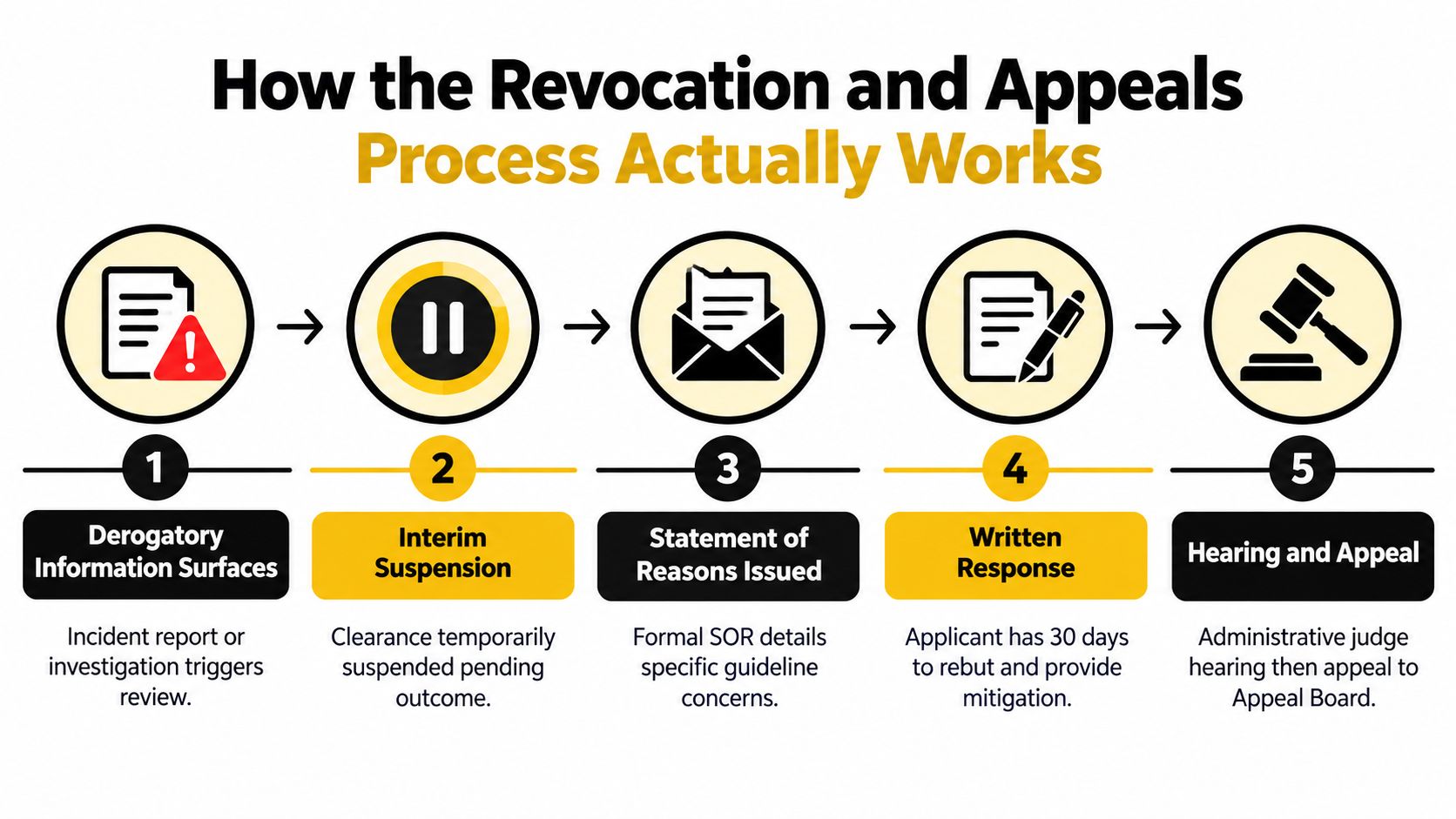
Step 1. Derogatory information surfaces
The process may start with an incident report, investigation, financial information, criminal case, security violation, or command referral. The government may impose an interim suspension before deciding whether to revoke eligibility.
Your first task is preservation. Save the notice, envelopes, emails, investigative paperwork, debt records, court documents, treatment records, and prior reporting communications. Don’t delete texts or social media posts, and don’t contact witnesses to coordinate stories.
Step 2. Interim suspension takes effect
A suspension can remove your ability to perform sensitive duties while the final decision remains unresolved. It isn’t automatically the end of the case, but it can create immediate employment and assignment consequences.
Ask what was suspended, who made the decision, what duties you can still perform, and whether a separate access or employment action is underway. Those distinctions affect both your immediate strategy and your later appeal.
Step 3. The Statement of Reasons arrives
The Statement of Reasons identifies the guideline concerns and the factual allegations supporting them. Read every paragraph closely. Identify what is admitted, what is inaccurate, what is missing, and what the government appears to infer rather than prove.
Don’t answer with a general character letter and don’t write an emotional narrative. A useful response matches each allegation to evidence, explanation, mitigation, and a specific reason the concern is unlikely to recur.
Step 4. You submit the written response
Many federal processes provide a limited response window, and the flowchart commonly associated with this procedure identifies 30 days for rebuttal. Your notice controls. Army personnel face a compressed structure in which the recipient has 60 days to appeal the Counterintelligence and Security Agency’s intent to revoke, the government is expected to decide the appeal in about 60 to 90 days, and a denied appeal carries another 60-day appeal window. Army security clearance revocation appeal guidance
DCSA reforms effective December 8, 2024 added virtual personal appearances and revised appeals procedures for military servicemembers, civilian employees, and contractors. That change can improve logistics, but it doesn’t reduce the need for a disciplined factual presentation.
| Stage | What Happens | Your Action and Deadline |
|---|---|---|
| Derogatory information | A report, investigation, or incident triggers review | Preserve every document and identify the controlling notice |
| Interim suspension | Access or eligibility may be paused while review continues | Ask what duties and privileges changed, then obtain counsel |
| Statement of Reasons | The government identifies guideline concerns and supporting facts | Calendar the response deadline immediately |
| Written response | You answer the allegations and submit mitigation | Provide a precise, documented rebuttal within the deadline |
| Hearing and appeal | The matter may proceed to a hearing, final decision, or appeal | Prepare testimony, exhibits, and procedural objections with counsel |
Step 5. Hearing, final decision, and appeal
Depending on the forum, you may request a hearing, submit written arguments, or appeal to a higher panel or board. A hearing isn’t a chance to repeat your frustration. It is an evidence exercise. The decision-maker will assess credibility, documentation, consistency, and whether the government’s concern remains current.
Use the administrative separation boards resource if your clearance issue is tied to a separate administrative separation action. The clearance case and the separation case may influence each other, but they are not interchangeable. Build a coordinated strategy rather than assuming one favorable result will automatically fix the other.
For a visual overview of the process, watch this explainer before your first legal consultation:
Common Mistakes That Cost Service Members Their Clearance
Most people don’t lose their clearance because they lacked a perfect past. They lose ground because they handle the response badly. They talk before they understand the allegation, submit unsupported explanations, miss deadlines, or treat a financial problem as private when the adjudicator is evaluating disclosure and judgment.
The correct URL for the assigned visual is shown above exactly as provided in the publishing brief. Before publication, verify the asset path because image delivery errors can prevent the graphic from loading.
Mistake one is speaking before getting advice
Investigators may sound helpful, professional, and routine. That doesn’t make an interview harmless. If you’re asked about debt, foreign contacts, drug use, an alleged security violation, or an SF-86 discrepancy, get legal advice before answering substantive questions.
Mistake two is trusting command to solve it informally
Command may want to help, but commanders don’t control every adjudicative decision. A supervisor’s assurance that “this will go away” doesn’t stop a formal review, preserve your deadline, or create a mitigation record.
Mistake three is hiding or minimizing financial problems
Unpaid debt is already a concern. Concealment, denial, or inconsistent explanations can add personal-conduct and candor concerns. Gather account statements, payment agreements, court records, tax documents, and proof of current compliance. A promise to pay is weaker than documented action.
Mistake four is ignoring the response deadline
A late or incomplete response can forfeit valuable procedural opportunities. Don’t wait until the final days to request records, obtain declarations, or build a financial history. Counsel needs time to test the allegations and organize exhibits.
Mistake five is submitting a bare character letter
A letter saying you’re honest and dependable doesn’t answer a specific allegation. Useful character evidence explains what the writer knows, how long they’ve known you, and what changed after the incident.
Mistake six is posting sensitive information online
Social media can create new security concerns, expose protected information, or contradict your written account. Preserve potentially relevant material, avoid discussing the case publicly, and follow operational security requirements. For related compelled-statement issues, review the Article 31 rights guide before speaking with investigators.
Experienced counsel also looks for government weaknesses:
- Incomplete investigation: The file may omit favorable witnesses, corrective action, or context.
- Credibility gaps: Dates, interviews, financial records, and reports may conflict.
- Overbroad conclusions: The government may treat one mistake as proof of a permanent pattern.
- Missing rehabilitation: The record may not include treatment, repayment, reporting, or changed conduct.
- Procedural defects: Notice, access to materials, or response opportunities may be inadequate.
Why Civilian Military Defense Counsel Changes the Outcome
Military-appointed counsel can provide valuable representation, especially when a service member faces a UCMJ investigation, Article 15, administrative separation, or court-martial. But clearance cases often demand sustained work outside the normal rhythm of a unit legal office. The attorney must develop a mitigation record, coordinate collateral cases, obtain documents, challenge inaccurate facts, and present your rehabilitation in a way an adjudicator can use.
Independence matters. Civilian military defense lawyers don’t work inside your chain of command, and they can evaluate command statements, investigative methods, and administrative pressure without worrying about the unit’s preferred outcome. That independence is especially important when the same facts may support a clearance action, a reprimand, a separation recommendation, or UCMJ charges.
The experience gap is practical, not theoretical. A seasoned UCMJ lawyer or court-martial attorney knows how a poorly worded admission can spread across agencies, how credibility problems develop, and how to build one coherent defense across multiple proceedings. Counsel should also understand the relevant adjudicative forum, not just general military law.
Hire counsel at suspension or receipt of the Statement of Reasons, not after final denial. Early representation can shape what you say, what evidence you preserve, how you address debt, and whether treatment or reporting decisions create useful documentation.
You can compare attorneys through guidance on selecting a military defense lawyer. Speak with multiple lawyers, ask about clearance work and trial experience, and choose someone who can explain the strategy without promising an outcome.
Your Defense Plan and Next Steps to Protect Your Career
Start with a written defense file. Use separate folders for the notice, investigative material, financial records, medical or counseling documentation, employment records, character evidence, and every deadline. Make a chronology that includes the triggering event, when you learned about it, what you reported, what corrective action you took, and what remains unresolved.
Then address the risk directly:
- Financial remediation: Identify every debt or judgment, confirm balances, establish realistic repayment arrangements, and preserve proof of payment or compliance.
- Candor correction: Compare the allegations with your SF-86, interview answers, prior reports, and emails. Explain discrepancies precisely instead of offering broad denials.
- Incident reporting: Document when you reported the issue, to whom, and what instructions you received.
- Treatment and counseling: If substance use, mental health, or behavioral concerns are involved, follow professional recommendations and preserve completion records.
- Character evidence: Obtain focused declarations from people with firsthand knowledge of your conduct and rehabilitation.
- Operational security: Stop public discussion of sensitive facts, protect documents, and follow all reporting requirements.
Your response must do more than argue that the government is wrong. It should show why the concern is not current, why your conduct is reliable now, and why recurrence is unlikely. If the facts are disputed, identify the exact dispute and support it with records, witness statements, or procedural objections.
Revocation is not always the final event. Suspension, access loss, eligibility determination, employment action, administrative separation, and UCMJ proceedings may move on different tracks. A coordinated defense can prevent one incomplete investigation from controlling every outcome.
If you’ve received a suspension notice, Statement of Reasons, or appeal decision, contact experienced civilian defense counsel immediately. Don’t give investigators a new statement, miss a response deadline, or assume command can repair the damage after the fact. Your clearance, assignment, income, and military career may depend on the evidence assembled before the government makes its final decision.