You’re at a general court-martial. The military judge excludes a defense witness after trial counsel argues that the testimony would create unfair prejudice under Mil. R. Evid. 403. The judge rules from the bench. The prosecutor looks satisfied. Your defense counsel returns to the table, visibly frustrated, because the ruling appears to remove a critical part of your case.
That moment can feel like the verdict has already been written. It hasn’t, but the next sixty seconds matter. The defense must preserve the objection, identify the legal test the judge used, make an offer of proof, and force the record to show why the ruling was made. On appeal, the fight may not be whether the witness mattered. It may be whether the judge applied the correct law and exercised judgment within lawful limits.
The abuse of discretion standard is difficult to overcome. It isn’t a second trial, and it doesn’t let an appellate court replace a reasonable trial ruling with its preferred answer. But it has real openings, especially when a discretionary decision contains a legal mistake, relies on facts outside the record, or ignores a required consideration.
Table of Contents
- The Moment a Discretionary Ruling Becomes the Whole Case
- What the Abuse of Discretion Standard Actually Means
- How Abuse of Discretion Compares to De Novo and Clear Error Review
- The Four Triggers That Open an Abuse of Discretion Attack
- Real Examples From Military and Civilian Courts
- How Defense Counsel Preserve and Frame the Issue on Appeal
- Why Abuse of Discretion Is Hard to Beat but Not Impossible
- What Service Members Should Do Right Now and Common Mistakes
The Moment a Discretionary Ruling Becomes the Whole Case
The witness had been prepared for days. The testimony wasn’t offered to repeat the accused’s story. It was offered to challenge the reliability of the government’s central witness, expose a missing investigative step, and explain why an apparently damaging statement had another meaning.
Trial counsel objected under Mil. R. Evid. 403. The government argued that the testimony would confuse the panel and create unfair prejudice. The military judge asked a few questions, announced that the danger of unfair prejudice substantially outweighed the probative value, and excluded the witness.
That ruling may be lawful. It may also contain the opening an appellate lawyer needs.
The first question isn’t whether the judge reached the outcome the defense wanted. Under the abuse of discretion standard, appellate courts generally defer to discretionary choices that fall within a range of reasonable, principled outcomes. The reviewing court tests whether the ruling rested on the record, whether the judge considered the relevant factors, and whether irrelevant or impermissible considerations affected the decision. The Ninth Circuit’s definitions of appellate standards describe that distinction in practical terms.
The fight moves from the witness to the reasoning
A defense lawyer who merely says, “The judge should have admitted the witness,” is asking for the wrong kind of review. The stronger argument is that the judge used the wrong legal framework, treated speculation as fact, ignored the testimony’s specific probative value, or gave an unreasonable explanation for excluding it.
That distinction controls the appeal. A discretionary ruling can swallow the merits of a charge, but the record can also reveal that the ruling was never protected discretion in the first place. Military defense lawyers look for that transition immediately.
Practical rule: Don’t argue only that the ruling hurt your case. Show exactly how the judge’s reasoning departed from the law or the evidence.
What the Abuse of Discretion Standard Actually Means
In plain English, the abuse of discretion standard asks whether the decision-maker made a permissible judgment call or crossed a legal boundary. The appellate court usually won’t ask, “Would we have made the same choice?” It asks whether the ruling was arbitrary, unreasonable, unsupported by the record, or based on an incorrect understanding of the law.
That makes the standard highly deferential. The Cornell Legal Information Institute’s explanation of abuse of discretion states that appellate review applies to discretionary rulings and is not a de novo reconsideration of the issue.
The test has layers
A sound discretionary ruling generally requires four things:
- The correct legal rule. The judge must identify and apply the governing statute, rule, or precedent.
- A supported factual foundation. The relevant factual assumptions must appear in the record.
- Consideration of the right factors. The judge must weigh matters the law makes relevant and avoid matters the law excludes.
- A rational result. The ruling must remain within the range of reasonable outcomes.
A failure at the first step can change the entire standard of review. If a military judge applies the wrong legal rule, the appellate court may review that legal question independently rather than defer to the discretionary label attached to the ruling. If the judge makes a factual finding without record support, the defense attacks the foundation of the decision rather than merely its outcome.
The standard doesn’t authorize an appellate court to reweigh every fact or substitute its preferred result. It protects reasonable judgment, not careless reasoning. The Michigan courts’ appellate guidance identifies legal error within a discretionary ruling as a recurring basis for reversal.
Military justice adds another layer of deference
In a court-martial, the service court of criminal appeals reviews the record under its statutory authority, including Article 66, UCMJ. Further review by the Court of Appeals for the Armed Forces is narrower. That means the defense must identify the precise layer of the ruling that is vulnerable.
The standard is a shield for the trial judge, not a sword for the government. It protects a ruling grounded in law and evidence. It does not protect a decision based on an incorrect legal principle, a mandatory factor the judge ignored, or facts no witness ever placed before the court.
How Abuse of Discretion Compares to De Novo and Clear Error Review
Appellate strategy begins with classification. Call the issue the wrong thing, and you may hand the government the deference it wants.
| Standard | What It Reviews | What Appellant Must Show | Deference Level |
|---|---|---|---|
| De novo review | A legal question | The lower court used the wrong legal rule or reached the wrong legal conclusion | Low |
| Clear-error review | Factual findings | The reviewing court is left with a firm conviction that the finding is mistaken | Significant |
| Abuse of discretion review | A discretionary judgment call | The ruling was outside reasonable alternatives, unsupported, legally mistaken, or irrationally applied | High |
De novo review gives the appellate court a clean legal question
Suppose the military judge interprets a statute or decides what legal test governs admissibility. That is a legal question. The appellate court can review it without accepting the trial judge’s interpretation merely because the judge made the ruling first.
This is why experienced court-martial attorneys separate the legal premise from the final judgment. “The judge abused discretion” may be true, but “the judge applied the wrong legal standard” can be stronger.
Clear error concerns what happened
Factual findings receive their own protection. The appellate court generally won’t disturb them just because another conclusion is plausible. The defense must show that the finding lacks support or that the record makes the finding untenable.
Abuse of discretion governs the choice itself
The balancing decision often remains deferential. A Mil. R. Evid. 403 ruling may involve legal interpretation, factual findings, and judgment. The appellate court can review each layer differently, applying de novo review to the legal question, clear-error review to factual findings, and abuse-of-discretion review to the ultimate balance.
That layered approach is the point. Your lawyer shouldn’t accept the government’s characterization of the entire ruling as discretionary. The appeal may turn on which part of the ruling receives which standard.
The Four Triggers That Open an Abuse of Discretion Attack
The Court of Appeals for the Armed Forces has described several ways a military judge abuses discretion. In military justice, a ruling can be attacked when it rests on unsupported findings, incorrect legal principles, a clearly unreasonable application of correct principles, or ignored important facts. The CAAF digest on discretionary rulings captures those core triggers.
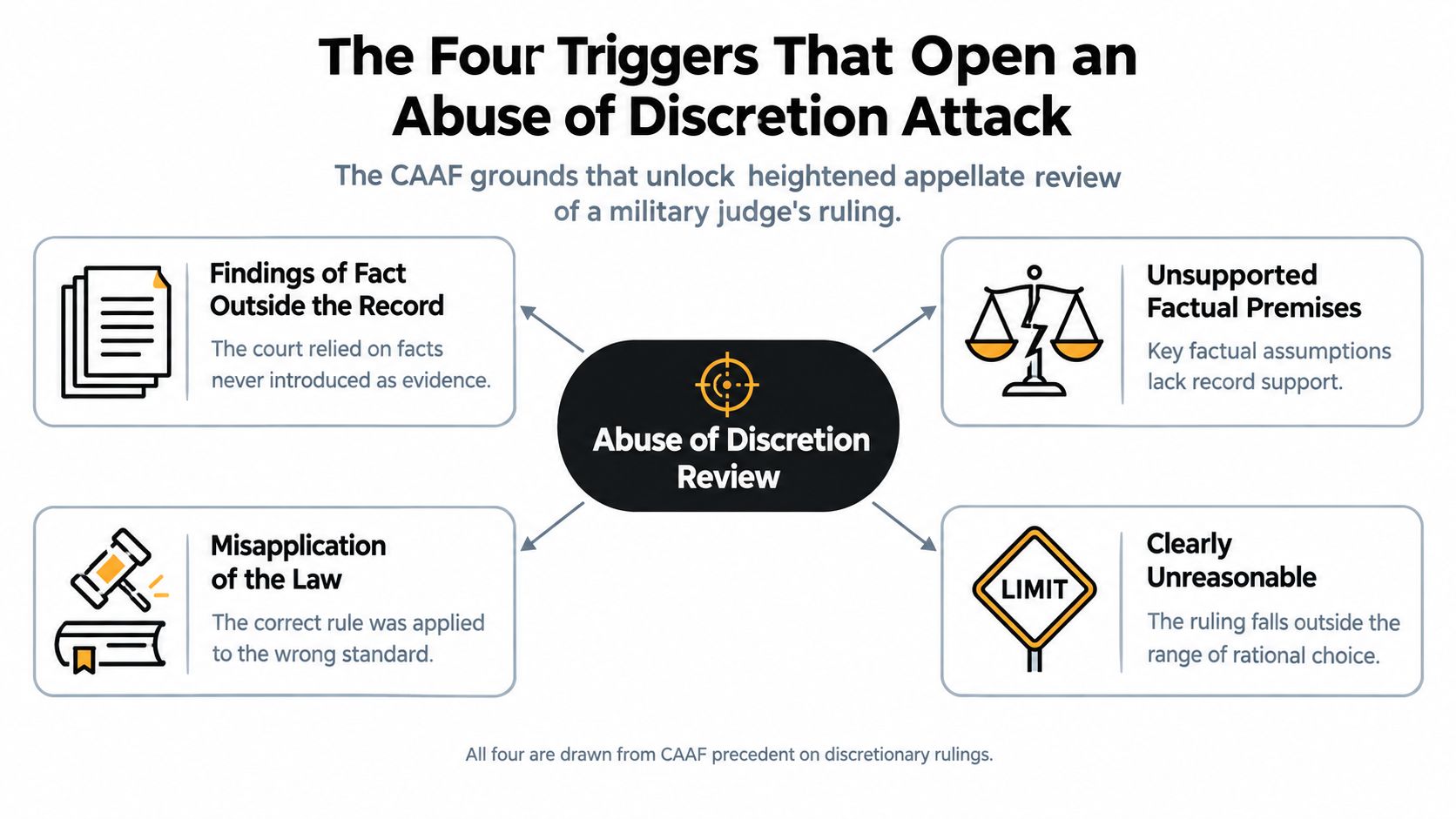
Findings outside the record
A judge can’t base a ruling on a fact that never entered evidence. If the ruling assumes that a witness was unavailable, a document was authenticated, or an accused understood an investigative warning when the record doesn’t support that assumption, the defense should identify the exact gap.
Unsupported factual premises
This is narrower than disagreeing with the judge. The question is whether a critical premise has evidentiary support. A judge may reasonably choose between competing facts, but the judge can’t build the ruling on speculation.
Misapplication of the law
A military judge may cite the correct rule and still apply it incorrectly. Examples include using the wrong burden, treating a mandatory factor as optional, or applying a balancing test without addressing the elements the rule requires.
This is often the best opening because legal error can strip away deference to the legal question. Defense counsel should also assess whether the ruling implicates unlawful command influence and the UCMJ, particularly when command pressure affects the decision-making environment.
Clearly unreasonable weighing
A judge can consider the right factors and still reach a result outside rational choice. That argument requires more than showing that another judge might have balanced the factors differently. It requires showing that the ruling doesn’t logically follow from the record.
Each trigger needs its own record support. Don’t draft a brief that labels the ruling “an abuse of discretion” and stops there. Identify the trigger, cite the evidence, and explain why that trigger changes the appellate analysis.
Real Examples From Military and Civilian Courts
The standard appears in evidence disputes, sentencing decisions, continuances, discovery rulings, and suppression litigation. The setting changes, but the appellate question remains disciplined: did the decision-maker act within the lawful range?
| Issue Area | Military Example | Civilian Parallel |
|---|---|---|
| Evidence | A military judge admits contested hearsay after weighing admissibility and prejudice | A federal appellate court reviews evidentiary gatekeeping under the abuse-of-discretion framework |
| Sentencing | A judge restricts an accused’s unsworn statement or evaluates sentencing considerations | A federal court reviews a sentencing disparity decision for reasonableness and discretionary error |
| Motions | A continuance is denied during trial despite a defense claim of inadequate preparation | A civil or criminal court reviews a discovery sanction or scheduling decision |
| Suppression | A judge excludes statements after finding that an Article 31(b) advisement failed to inform the accused adequately | A federal court reviews a suppression ruling for legal and factual defects embedded in the judgment |
A military judge who admits hearsay over a Mil. R. Evid. 403 objection may be upheld if the record shows the judge understood the rule, considered the evidence’s probative value, assessed the danger of unfair prejudice, and reached a rational result. The defense wins only by isolating a defect, such as an incorrect legal test or a factual assumption with no support.
A sentencing ruling can present the same problem. If the judge limits an unsworn statement, the defense must show what the judge prevented the accused from presenting and why the restriction was legally improper. A continuance dispute requires the record to show the reason for the request, the prejudice from denial, and the judge’s explanation.
The civilian comparison helps, but don’t lose sight of the military record. In a court-martial, the military judge often sits as the fact finder. That makes contemporaneous record development especially important. The appellate court needs a clear basis to distinguish a permissible judgment from a ruling that rested on unsupported facts or incorrect law.
How Defense Counsel Preserve and Frame the Issue on Appeal
An appellate issue starts at trial. A defense team that waits until the record is closed has already surrendered control over the most important evidence, the judge’s reasoning.
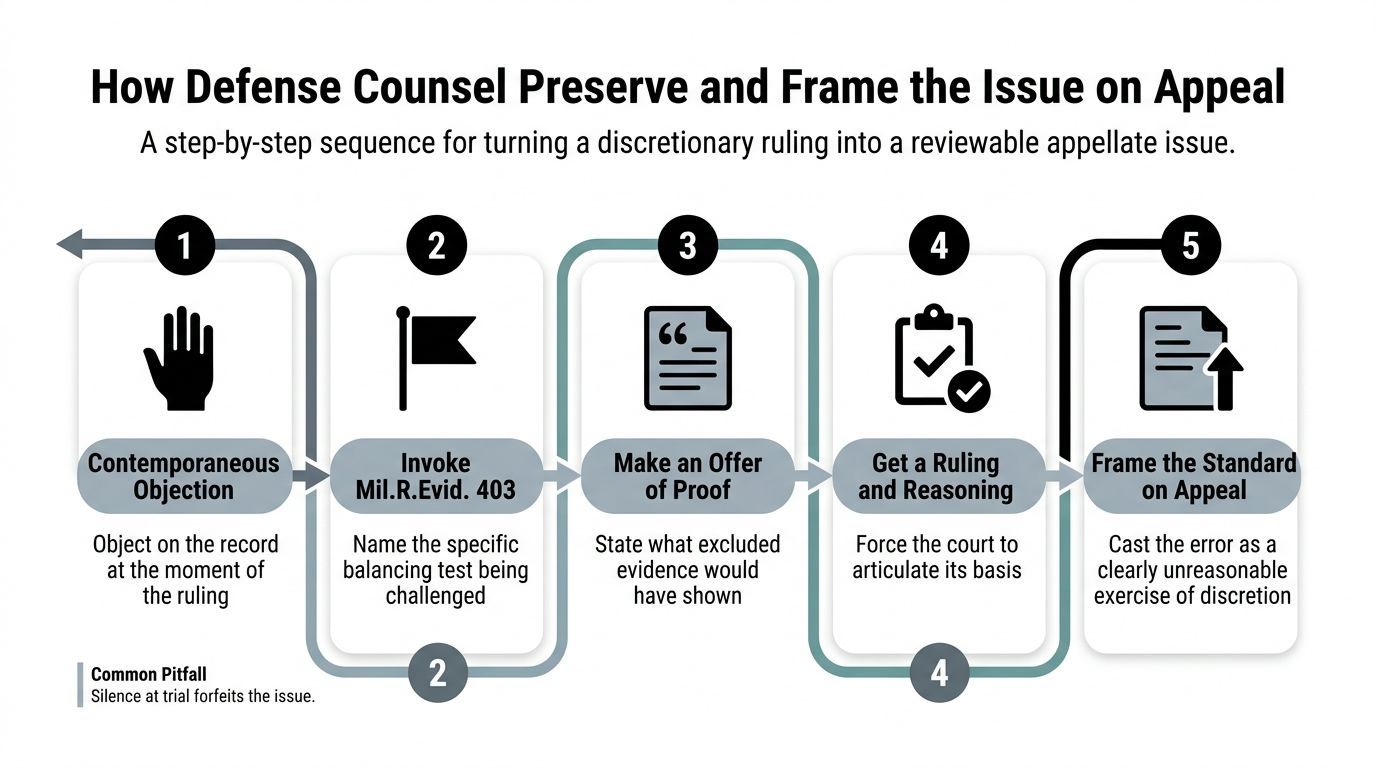
Step 1, object when the ruling occurs
State the objection clearly and contemporaneously. If the issue involves Mil. R. Evid. 403, say so. A general protest doesn’t necessarily preserve the specific legal argument you later want to make.
Step 2, name the challenged test
Tell the military judge what must be balanced and what the government has failed to establish. This gives the judge an opportunity to correct the error and gives the appellate court a usable record.
Step 3, make an offer of proof
If evidence is excluded, state what the witness would say, identify the foundation, and explain the relevance. Without that proffer, the appellate court may be unable to measure prejudice.
Step 4, obtain the reasoning
Ask the judge to explain the ruling when the explanation is unclear. The transcript should show which facts the judge accepted, which factors the judge considered, and which legal rule controlled.
Step 5, frame the assignment of error precisely
Don’t rely on a bare assertion that the judge abused discretion. Tie the argument to one of the recognized triggers and connect every important proposition to the record. The military investigations resource on developing a defense record is relevant because the investigation often supplies the documents, statements, and omissions that later support or defeat an appellate claim.
Record discipline matters: If the transcript doesn’t show the error, the appellate brief usually can’t create it.
A strong assignment of error may argue that the judge applied the wrong legal standard, relied on a factual premise unsupported by the evidence, or reached a conclusion no reasonable application of the governing factors could support. Those are different arguments. Treating them as one makes the brief easier to reject.
Why Abuse of Discretion Is Hard to Beat but Not Impossible
Appellate courts don’t reverse because a trial judge made a debatable choice. They reverse when the choice leaves the zone of lawful discretion.
That zone narrows when legal error sits inside the ruling. A judge who applies the wrong evidentiary rule hasn’t just exercised discretion poorly. The judge has used the wrong legal tool. The appellate court can address that legal mistake independently, then examine whether the remaining judgment survives.
The same reasoning applies to factual premises. If the decision depends on a finding unsupported by the trial record, deference can’t repair the missing foundation. The defense should identify the exact testimony, exhibit, or procedural event that contradicts the premise.
The real appellate pressure points
Look closely at:
- Authority: Did the judge or decision-maker have delegated authority to make the ruling?
- Legal framework: Was the governing statute, rule, or precedent correctly identified?
- Mandatory factors: Did the ruling address each factor the law requires?
- Record support: Did the judge rely on admitted evidence rather than assumption?
- Explanation: Does the reasoning connect the facts to the result?
- Rational limits: Does the outcome remain within reasonable alternatives?
The standard isn’t “almost impossible to win.” It is hard to win without a developed record. The government benefits when the defense treats every adverse ruling as a disagreement rather than diagnosing the legal defect.
What Service Members Should Do Right Now and Common Mistakes
If you’re facing a court-martial, investigation, Article 15, administrative separation, or an appellate issue, act before the record hardens. Your first job isn’t to argue harder. It’s to stop making the record worse.
Your immediate checklist
- Ask counsel what standard applies. Don’t accept “the judge has discretion” as the end of the discussion. Ask whether the legal issue receives de novo review and whether the factual premise is supported.
- Put objections on the record. State the rule, the ground, and the requested relief.
- Make the proffer. Explain what excluded evidence would establish and why it matters.
- Request reasoning. A silent ruling gives the appellate court less to examine.
- Preserve the documents. Keep motions, exhibits, investigative materials, and rulings organized for appellate counsel.
Avoid these mistakes:
- Talking to investigators without counsel: CID, NCIS, OSI, and CGIS investigations are not neutral conversations.
- Assuming no evidence means no case: Investigators may have statements, digital records, witnesses, or command documentation you haven’t seen.
- Inviting the error: If the defense agrees to a limitation or proposes the procedure, appellate relief becomes harder.
- Withdrawing a motion casually: Waiving or withdrawing an issue can eliminate the argument later.
- Using vague objections: “That’s unfair” doesn’t identify the legal defect.
- Waiting until appeal to find counsel: Appellate lawyers need the trial record before it is finalized.
A qualified court-martial defense lawyer can evaluate the ruling, the transcript, and the preservation history before the available options narrow.
Your best appellate argument is usually built before the judge announces the ruling.
If you’re under investigation or already facing an adverse discretionary ruling, contact experienced civilian military defense counsel now. Don’t wait for the record to close, the appeal deadline to approach, or command to decide what happens to your career. A lawyer who understands the abuse of discretion standard can attack the legal framework, factual foundation, and preservation problems before those defects become permanent.