
Your phone holds two numbers that matter tonight: the sexual assault response coordinator and your first sergeant. Somebody handed you the phrase “you have options” and walked away.
Options is the right word and a useless briefing. Restricted vs unrestricted reporting usually gets explained as a support-services question, as though both roads end in the same room with a different door. They don’t. One keeps command and law enforcement out and starts a clock on physical evidence. The other notifies your commander, opens a criminal investigation, and pulls in the alleged offender, the witnesses, and every record around you.
It cuts both ways, too. If somebody has named you in an allegation, their reporting decision is what determines whether your career and your liberty come under a microscope this month or never. Neither side gets a second run at the first 72 hours.
Table of Contents
- Restricted and Unrestricted Reporting Compared at a Glance
- Who Qualifies and Which Path Fits Your Case
- What an Unrestricted Report Sets in Motion
- The Evidence Clock on a Restricted Report
- Mistakes That Close Off Your Options
- Restricted Reporting Questions Answered
- Speak With Civilian Defense Counsel Before You Report
Restricted and Unrestricted Reporting Compared at a Glance
Both paths start with a disclosure to a trained professional. They split the instant that disclosure is written down. A restricted report lets an eligible service member or adult dependent get medical care, counseling, and advocacy without a named notification to command and without a criminal investigation. An unrestricted report notifies the relevant commander and hands the allegation to investigators, which is also when the person named as the offender has statements, devices, and duty records pulled into a case file.
The differences line up row by row.
Restricted vs unrestricted reporting side by side
| Feature | Restricted report | Unrestricted report |
|---|---|---|
| Who receives the report | SARC, SAPR victim advocate or healthcare provider; chaplain or Special Victims’ Counsel in appropriate cases | SARC, victim advocate, healthcare personnel, command or law enforcement |
| Command notified | Informed that an assault occurred, without victim or offender identifying details | Yes, the relevant commander is notified |
| Formal criminal investigation | Not started by the report | Generally started by a Military Criminal Investigative Organization when the victim or subject is a service member |
| Medical care, counseling and advocacy | Yes | Yes |
| Protective orders | No command-directed protective measures from the report | Military or civilian protective orders available |
| Forensic exam evidence | Held; destroyed after five years if the report is not converted | Collected for the official investigation |
| Can the choice change later | Yes, a restricted report can be converted at any time | Not applicable |
Where the Two Paths Actually Diverge
Who receives the report decides whether the file stays limited. The restricted list is short on purpose: the SARC, a SAPR victim advocate, or a healthcare provider, with chaplain communications and Special Victims’ Counsel or Victims’ Legal Counsel protection available in appropriate circumstances. Give the same facts to command, law enforcement, or someone in the unit who then reports them, and you are off that list.
Command notification is the fork. Under a restricted report the command learns an assault occurred, without the names of the victim and the alleged offender. Under an unrestricted report the relevant commander is notified, the file is no longer anonymous, and the alleged offender is identified to the people who control duty, liberty, and administrative action.
A formal investigation generally follows only the unrestricted route. When the victim, the subject, or both are service members, a Military Criminal Investigative Organization opens the case. Interviews and evidence collection start, and the subject can be asked for a statement long before any charge exists. The restricted path holds that machinery off.
Protective orders, command-directed no-contact measures, and administrative action are unrestricted tools. Care is available on both paths. Both reporting pathways can deliver healthcare, counseling, advocacy, crisis intervention, and safety planning. What changes is confidentiality, and how far the investigation reaches into the life of the person accused as well as the person reporting.
Forensic evidence follows its own clock. Under a restricted report the exam evidence is preserved rather than routed into a criminal case, and that preservation has a deadline. Under an unrestricted report the exam feeds the investigation from day one, so biological evidence is in the case file instead of sitting in storage.
Restricted reports still enter department statistics. Designated officials transmit incident data to the Sexual Assault Prevention and Response Office, so those reports show up in the numbers while names stay out, as the Congressional Research Service analysis of military sexual assault reporting explains. An unrestricted report puts a name on an investigative file. A restricted report does not.
One option stays open. A restricted report can become unrestricted at any time. An unrestricted report cannot be converted back.
The question worth putting to anyone facing this decision, whether reporting or accused: what needs protection right now, and what needs to be investigated before statements and physical evidence move? Answer those two before the report is written down. That answer picks the channel.
Who Qualifies and Which Path Fits Your Case
Eligibility is where people get blindsided. Service members and adult dependents can use both options. Civilian victims generally can use only unrestricted reporting unless a specific exception applies. That one rule decides a lot of cases before anyone discusses strategy.
Restricted reporting eligibility by case
| Reporting person or case | Restricted report | Condition or limit |
|---|---|---|
| Active-duty service member | Available | Confidential only through designated channels |
| Adult dependent eligible for military medical care | Available | Same channels; unavailable if an exception applies |
| Civilian victim | Generally not available | Unrestricted reporting only, unless an exception applies |
| Domestic-abuse victim | Available to adult victims eligible for care at a military treatment facility | Confidentiality limited to designated domestic-abuse professionals |
| Child abuse or neglect | Not available | Restricted option does not apply |
| Serious and imminent threat to health or safety | Not available | Military may have to make an unrestricted report |
Domestic-abuse allegations carry their own gate. Military OneSource Family Advocacy Program guidance for Naval Station Everett states restricted reporting is available only to adult victims who are eligible to receive medical services at a military treatment facility, and confidentiality attaches to a defined group: domestic-abuse victim advocates, Family Advocacy Program clinicians and healthcare providers. Child abuse or neglect is excluded outright, and a serious and imminent threat to health or safety closes the restricted door because the military may have to file an unrestricted report.
Provider duties also vary by state, and some state laws require medical providers to report suspected domestic abuse to law enforcement regardless of what the victim wants. Ask the professional in front of you what their reporting duty is before you disclose anything.
Four Situations and the Verdict for Each
Active-duty member, assaulted three days ago, needs care and time to think. Restricted reporting gets you medical care and a forensic exam without command notification, and it buys the thinking time. The verdict comes with a condition: the decision now has an evidence deadline attached to it.
Adult dependent in a domestic-abuse situation, no immediate danger. Confirm eligibility first. Adult, eligible for care at a military treatment facility, speaking to one of the designated professionals. If any of those three fails, you’re on the unrestricted path whether you planned to be or not.
Civilian victim. Plan for an investigation from the first call. The useful question shifts from “how do I keep this quiet” to “who is my advocate, and what will law enforcement do first.”
Victim who fears immediate danger. Restricted reporting may not be available, and that isn’t bureaucracy for its own sake. An unrestricted report plus a protective order and a written safety plan is the safer sequence, and an advocate can build it with you.
The line that matters: restricted reporting protects the report, not the outcome.
If you’re the accused, read this part twice. Your exposure begins with the investigation, not the trial. By the time a charge appears, the statements, the orders and the interviews have already happened, and that’s where these cases are usually won or lost.
Before the first call, write four things down: the incident type, your status and age, whether anyone is in immediate danger, and the name and job title of the person you’re about to speak with. Then ask which of the three matters most this week, medical safety, confidentiality or accountability, and build the plan around that one.
What an Unrestricted Report Sets in Motion
A specialist takes an unrestricted sexual assault report on a Tuesday. By the end of the week the alleged offender can already be under a no-contact order, flagged, pulled off sensitive duties, and facing a call from investigators that sounds like routine scheduling. The report is the switch that starts that sequence. Command and the military criminal investigative organization then move on their own timetable.
The stages look like this.
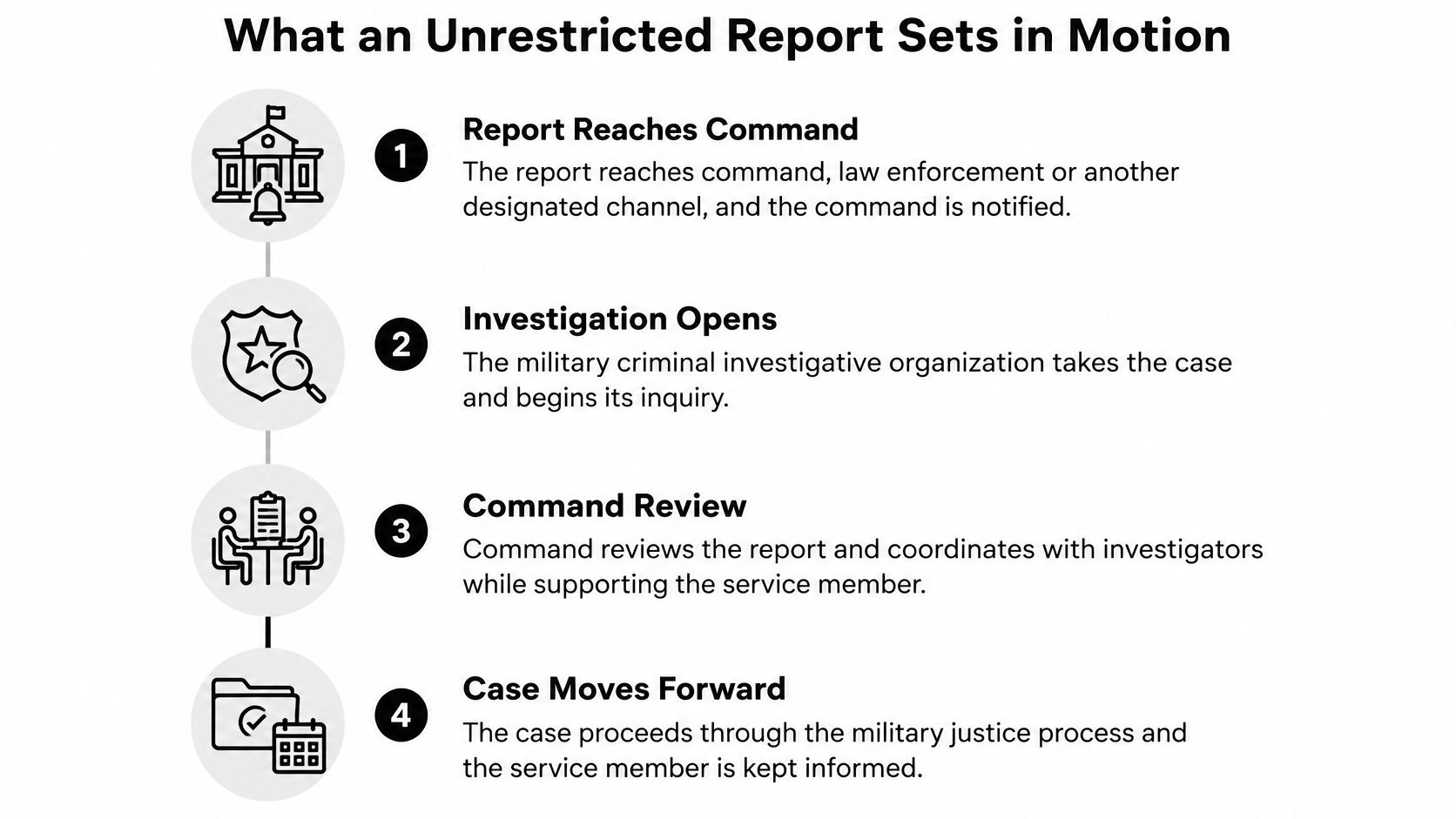
- The report reaches command, law enforcement, or another designated channel, and the command is notified. If you reported, ask who now has your name and who does not. If you are the accused, your name is already in a system you cannot see.
- The military criminal investigative organization opens the case. CID, NCIS, OSI, or CGIS, depending on the branch. The accused person’s useful question at this point is narrow: has anyone read me my rights?
- Investigators contact the alleged offender and the witnesses. The call sounds friendly. It is not. Whatever is said becomes evidence and will be set next to later statements, including anything given in an interview room under oath.
- Command weighs protective measures. Military protective orders, no-contact orders, and civilian protective orders sit here. In a domestic-abuse matter the steps are named outright, and Military OneSource’s domestic abuse reporting guidance states that Family Advocacy Program personnel notify both law enforcement and command, that the investigation includes contacting the alleged abuser, and that command can issue a Military Protective Order or No Contact Order.
- Administrative action runs alongside the criminal process. Flags, removal from sensitive duties, a security clearance review, and in some cases separation paperwork. Command does not have to wait for a court-martial to act.
The confidential side is smaller than many people expect. The Department of Defense names the confidential channels as the SARC, the SAPR victim advocate, and healthcare personnel, plus chaplain and Special Victims’ Counsel communications in appropriate circumstances, as this Military OneSource emergency assistance guidance for Fairchild Air Force Base sets out. Talk outside those channels is not protected. That is why the reporting choice changes evidence preservation, who gets interviewed, which orders issue, and how exposed the accused becomes, not only which services the reporting person receives.
The charge that usually anchors these cases is UCMJ Article 120 sexual assault, and its sentencing exposure runs well past anything an administrative action can impose.
For a plain walkthrough of how an unrestricted report travels through the military justice system, this is worth eight minutes.
Place yourself on that timeline before the next interview. At step three, do not give a statement without counsel. The comparison between that first call and every later account is already underway.
The Evidence Clock on a Restricted Report
A restricted report buys time. It doesn’t buy forever.
Evidence collected during a sexual-assault forensic examination under a restricted report is destroyed after five years if the report has not been converted, according to Military OneSource emergency assistance guidance for Torii Station. That single sentence should reframe the entire decision. What you’re choosing isn’t confidentiality versus investigation. It’s confidentiality with an expiration date on the physical proof.
The physical evidence starts in a room like this one.
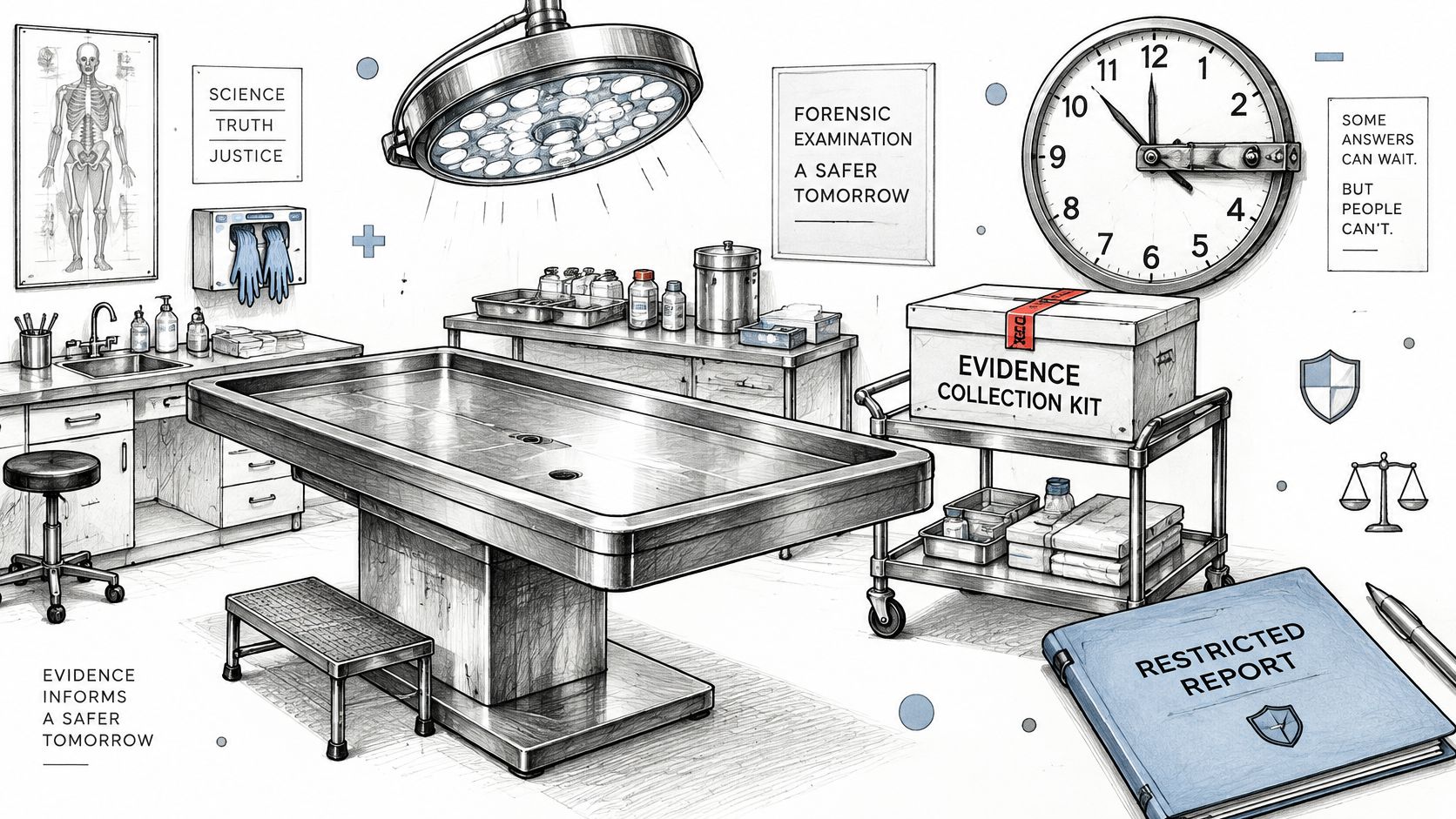
Conversion stays available at any time, and converting enables an investigation with command and law enforcement involvement. So the work is managing the interval.
- Record the date of the forensic examination. Not the date of the incident. The clock is tied to the exam, and people routinely misremember the wrong one.
- Get the storage deadline in writing from the SARC or the installation. Ask who physically holds the kit, where it sits, and when it’s destroyed. A verbal answer isn’t good enough for a five-year question.
- Decide whether future investigative eligibility matters to you. Converting in year four is legally possible and practically harder than converting in month one.
- Ask what could trigger action outside your report. Independent facts, a separate report by someone else, a command inquiry. Confidentiality here is conditional, never absolute.
Treat the exam date as the start of a timer, not the end of a crisis.
From the defense side, that interval is the case. When a report converts a year or two later, the government will use the gap to test memory, question how evidence was handled, and attack consistency. A later report needs a plan for explaining the delay, not an apology for it. The same gap cuts at the victim’s credibility in a courtroom, which is exactly why the timing decision deserves a lawyer’s input while the decision is still open.
Deadlines get administered locally by installation and by service. Verify yours in writing. Do not rely on a number someone said out loud in a hallway.
Mistakes That Close Off Your Options
The most damaging mistake is the one that sounds harmless: assuming a restricted report is secret from everyone. It isn’t. Confidentiality runs through named channels, and one disclosure outside them can end the protection you believed you had.
- Assuming a restricted report is secret everywhere. It’s protected only through designated channels. Fix: ask who is authorized before you say a word.
- Telling a supervisor, a friend or the commander’s staff informally first. An informal disclosure can move the matter into command channels and out of your control. Fix: pick the channel before the story leaves your mouth.
- Talking to investigators without counsel. If you’re the accused, Article 31 rights under the UCMJ are what stand between a friendly fifteen-minute conversation and a statement that follows you for a decade. Invoke them clearly and politely, then stop.
- Trusting command to handle it. Commands rotate, deployments intervene, and good intentions don’t survive a change of command. Fix: get the safety plan and protective measures in writing and keep copies.
- Waiting past the forensic evidence date. The window doesn’t reopen because life got complicated. Fix: calendar the deadline with a reminder months ahead of it.
- Believing there’s no evidence. A credible allegation can rest on witness statements, texts, medical records, gate logs and the accused’s own words. Fix: assume a file is being built whether or not a kit exists.
- Choosing a path on services alone. Both tracks deliver care, so that comparison tells you nothing. Fix: decide on notification and investigative reach first, then accept every service offered.
Ask before you answer: the only bad time to ask who is authorized to keep your report confidential is after you’ve already told someone.
The patterns repeat often enough to fit on one card.
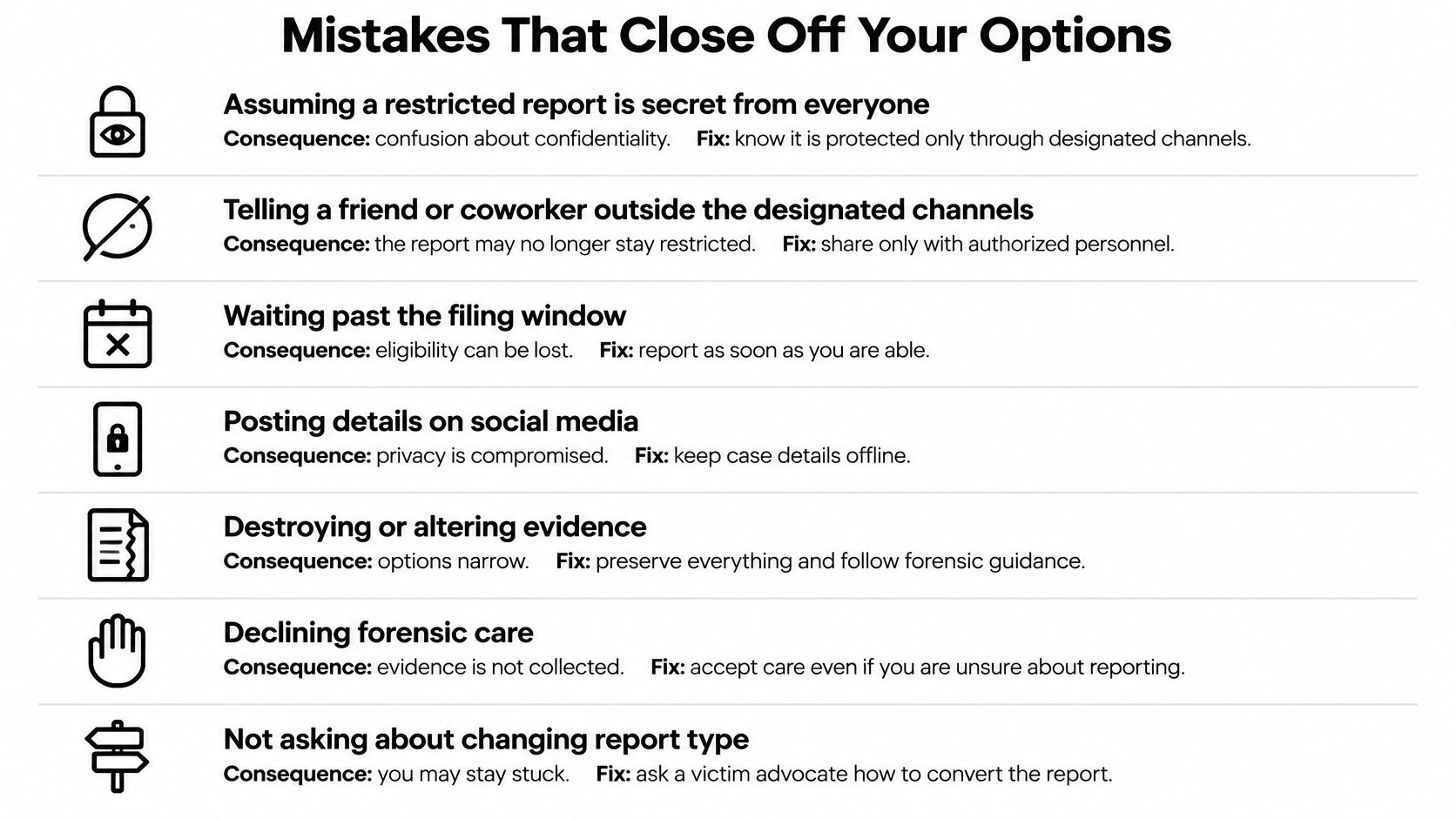
None of this is undoable in reverse. A statement given on Tuesday is on the record on Friday, and a kit destroyed in year five doesn’t come back when you change your mind.
Restricted Reporting Questions Answered
Does a restricted report start an investigation?
No. It’s built to avoid exactly that: you get medical care, counseling and advocacy through a designated channel while command and law enforcement stay out. You can convert to an unrestricted report at any time, and the conversion does start the investigation. Talk to an advocate or counsel before you convert.
Can I still get medical care and counseling without an investigation?
Yes, if you’re eligible and you use a designated channel. Both reporting paths provide healthcare, counseling, advocacy and safety planning. What changes is whether the report triggers command notification and investigative authorities. Ask for care first; nobody has to settle the reporting question at the clinic door.
Can I refuse to talk to CID or NCIS?
If you’re the accused, yes. You have the right to remain silent and to request counsel, and you should invoke both plainly instead of explaining why. Say you want a lawyer, then stop talking. Call civilian defense counsel before the next interview, not after it.
What happens at an Article 32 hearing?
It’s a pretrial investigative hearing, not a trial. The government presents evidence, the defense can cross-examine witnesses and test the case, and weaknesses in the government’s theory often surface there. Treat it as the first honest look at what the prosecution has.
Do I need a lawyer immediately?
If you’re under investigation, or someone has filed an unrestricted report naming you, yes. The first interview and the first records usually set the direction of the case, and both happen early. Waiting for charges means waiting until the most useful window has already closed.
Speak With Civilian Defense Counsel Before You Report
Military-appointed defense counsel are competent, and they’re free. They also work inside the command structure, carry heavy caseloads, and answer to a chain that includes the convening authority in your case. Civilian defense counsel works for one client.
On the victim side, Special Victims’ Counsel or Victims’ Legal Counsel fill a real role, and it isn’t the same role as a defense lawyer representing an accused service member. Don’t confuse the two when you’re choosing who to call.
What Independence Buys You
- No command interest in the outcome. Your lawyer’s evaluation of the case doesn’t have to survive a supervisor’s opinion.
- Trial experience on the specific charge. Article 120 litigation, forensic evidence and expert witnesses are their own discipline.
- Availability before charges exist. Counsel can be involved at the first interview, when the useful moves are still available.
No service member should sit through a first CID or NCIS interview without counsel, and no one should convert or file a report without understanding the evidence timeline first. The decisions made in the first days usually decide the case, and that’s true on both sides of the allegation.
If you’re comparing lawyers now, how to select a military defense lawyer sets out the questions worth putting to each one.
If you’re under investigation, or you’re facing a reporting decision you never asked to make, the next 72 hours matter more than the next 72 weeks. Call civilian defense counsel before you give a statement, before you convert a report, and before a forensic evidence deadline turns into a decision someone else makes for you.
Bring four things to the first call: the incident date, the exam date if there was one, your status, and the names of everyone you’ve already spoken to. That’s enough for a lawyer to tell you what’s still fixable and what has already hardened into evidence.
Your career and your liberty are both on the table, and both are far easier to protect on day three than on day three hundred. Set up a consultation today.