You’re sitting across from a command representative, staring at a charge sheet that could change your freedom, career, security clearance, and family’s financial stability. The allegations may have started with an NCIS interview, a unit complaint, or a report that looked incomplete when you first heard about it. Now the Marine Corps court martial process is moving, and every decision has consequences.
A Marine Corps court martial is a federal-style criminal proceeding governed by the Uniform Code of Military Justice and the Manual for Courts-Martial. The MCM supplies the Rules for Courts-Martial, Military Rules of Evidence, and punitive articles, and the current 2024 edition was updated by Executive Order 14130. The official Marine Corps publication explains the MCM’s controlling role.
You’re also dealing with a system in which commanders, staff judge advocate offices, prosecutors, and investigators operate within the military structure that produced the accusation. That doesn’t mean the government always has a strong case. It means you need to identify weaknesses before the government turns an unfinished investigation into a formal prosecution.
Table of Contents
- What You Are Facing Right Now
- The Three Types of Marine Corps Courts-Martial
- How a Marine Corps Court-Martial Actually Moves
- Your Rights as the Accused Marine
- Where Government Cases Break Under Pressure
- Detailed Counsel vs Civilian Military Defense Lawyer
- Choosing the Right Civilian UCMJ Defense Lawyer
- Frequently Asked Questions From Marines and Families
- Can I choose my own lawyer at a summary court-martial?
- How long does a general court-martial take?
- Does a guilty plea end the case cleanly?
- What does Article 58a confinement mean?
- How does a civilian attorney get onto my Marine case?
- Can a bad-conduct discharge be upgraded later?
- How can family members get updates?
What You Are Facing Right Now
The day charges are preferred is often less dramatic than people expect. A commander signs the charge sheet. The allegations become formal. Trial counsel begin organizing witnesses and exhibits. The accused Marine may still be working, attending formations, and answering routine messages while facing the possibility of confinement or a punitive discharge.
That ordinary appearance is misleading. The case has entered a phase where delay helps the government more than it helps you. Witness memories harden. Digital evidence gets interpreted through a prosecution theory. Unit gossip becomes background information for investigators. A Marine who keeps explaining the situation to coworkers can create statements the government later uses as admissions.
The chain of command matters
The convening authority decides whether charges move forward. The staff judge advocate advises command. Trial counsel prosecute the case. Those people have different legal roles, but they operate inside the military justice environment created by the command.
You should assume the investigation is not neutral. NCIS, command investigators, and witnesses may have reached preliminary conclusions before you ever see the evidence. That doesn’t make every conclusion admissible or accurate. It means your defense must test the timeline, motives, reports, collection methods, and legal authority behind each important piece of evidence.
The Navy-Marine Corps system also has greater public docket visibility than older court-martial practices. The Navy-Marine Corps filings and records portal covers courts-martial referred on or after December 23, 2020, and provides a way to monitor filings and docket activity. That visibility can help families, reporters, and counsel track proceedings, but a docket entry doesn’t tell you whether the government’s evidence is reliable.
The workload is real
Marine Corps military justice offices have long tracked cases through recurring reports. In FY 2015, the Marine Corps litigated 131 general courts-martial and 211 special courts-martial to findings, for 342 tried cases reaching findings. At a point during that fiscal year, about 130 courts-martial and 20 Article 32 preliminary hearings were pending. The Marine Corps SJA reports provide that historical disposition data.
That pipeline affects how quickly lawyers investigate and how aggressively command seeks a disposition. Your case isn’t handled in a vacuum. The practical answer is to preserve evidence, stop unnecessary talking, and obtain counsel before the prosecution theory becomes fixed.
Practical rule: Treat the first interview, the first notification, and the first charge as separate legal events. Each requires a separate decision, not an emotional reaction.
The Three Types of Marine Corps Courts-Martial
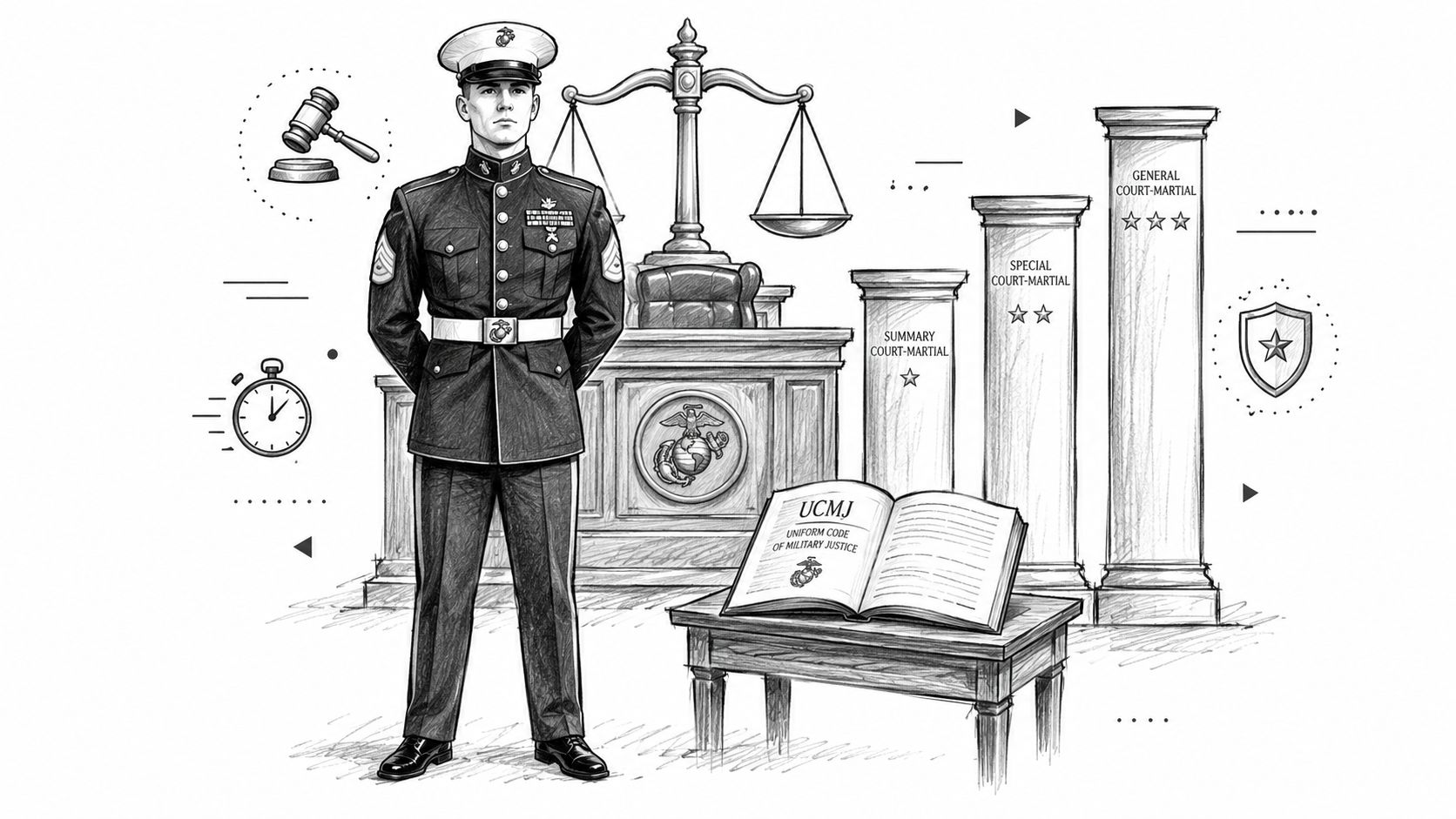
The type of court-martial determines the range of punishment, the decision-maker, and the level of preparation required. Don’t evaluate your case by the title of the allegation alone. First determine whether command is pursuing a summary, special, or general court-martial.
Summary court-martial
A summary court-martial is the lowest formal court-martial tier. One active-duty commissioned officer serves as the trier of fact and law. There’s no military judge, and the proceeding is designed for less serious offenses and limited punishment.
A summary court-martial can’t impose the same exposure associated with a special or general court-martial. The maximum confinement is one month, and the proceeding has limited appeal mechanisms. That doesn’t make it harmless. A conviction can affect promotion, retention, administrative separation, evaluations, and later command decisions.
The practical issue is often whether command is using a summary forum as a substitute for proper fact development. You still need advice before deciding whether to accept the proceeding, contest it, or pursue another disposition.
Special court-martial
A special court-martial may involve a military judge and members, or a military judge sitting alone when permitted. It can impose serious punishment, including a bad-conduct discharge under the applicable sentencing structure.
The 2024 MCM states that, except for punishments prohibited by statute, a special court-martial may adjudge up to one year of confinement and forfeiture of up to two-thirds pay per month, but it can’t impose death, a dishonorable discharge, or dismissal. The 2024 supplemental MCM materials state those broader sentencing limits.
The exact ceiling can depend on the court composition and referral posture. A special court-martial consisting of a military judge alone has narrower limits under the MCM and can’t adjudge a bad-conduct discharge, confinement for more than six months, or forfeiture of pay for more than six months under the specified Article 16 provision. The 2023 MCM addresses those judge-alone limits%20(2023_09_15).pdf?ver=DYv_dgnVlSTjgwUwpO2piQ==).
General court-martial
A general court-martial handles the most serious allegations. The case can involve a military judge and members, or a military judge alone when legally available and chosen. The possible punishment can include lengthy confinement and the most severe punitive discharges, depending on the offense and applicable law.
The difference between a special and general court-martial isn’t academic. It changes discovery demands, expert needs, witness preparation, sentencing exposure, appellate consequences, and the amount of time required to litigate motions properly.
| Tier | Deciding Body | Max Confinement | Max Punitive Discharge | Military Judge Required |
|---|---|---|---|---|
| Summary | One commissioned officer | One month | Limited punishment, no punitive discharge equivalent to a general court-martial sentence | No |
| Special | Judge and members, or judge alone when permitted | Generally up to one year, subject to court composition and offense limits | Bad-conduct discharge may be available, but not dishonorable discharge or dismissal | Depends on forum |
| General | Military judge and members, or judge alone when permitted | Offense-specific and potentially extensive | Punitive discharges can include dishonorable discharge, depending on the case | Depends on forum |
The Marine Corps Court Martial you’re facing should be evaluated by maximum authorized punishment, not by what someone informally promises will happen.
How a Marine Corps Court-Martial Actually Moves
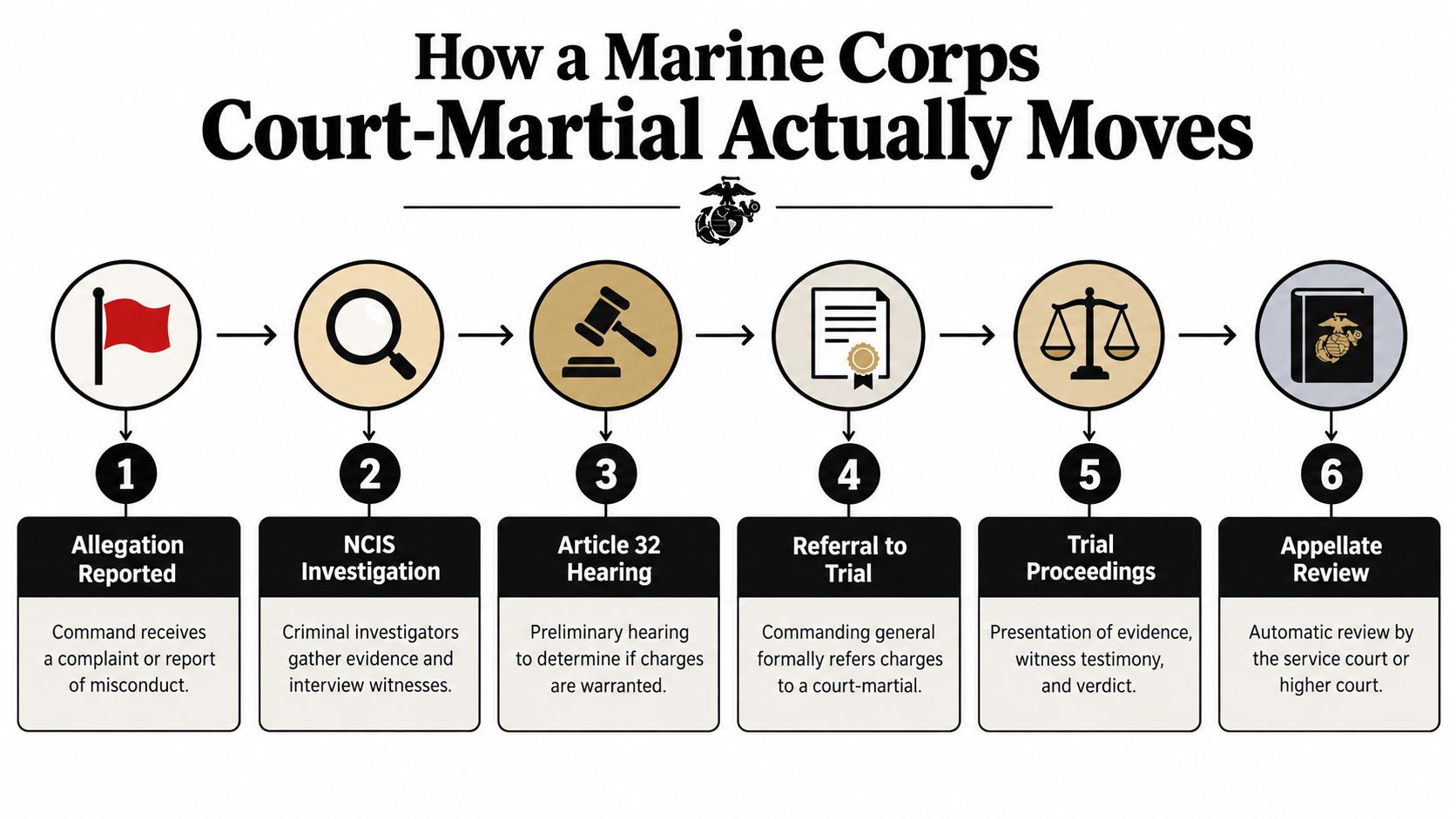
A case usually begins with an allegation, complaint, investigative report, or command referral from a criminal investigative organization. The commander decides what action to take while investigators and prosecutors build the government’s file. You need to run a defense investigation at the same time.
The early investigation
NCIS may interview the accused, witnesses, alleged victims, and potential experts. Command may collect messages, access records, medical information, photographs, urinalysis materials, or other evidence. Article 31 rights warnings matter whenever the person questioning you suspects you of an offense and seeks information from you.
An Article 32 preliminary hearing follows in cases requiring that procedure. The hearing is not a trial, but it can expose weak testimony, missing evidence, investigative gaps, and credibility problems. The hearing officer makes recommendations about probable cause and disposition. The convening authority then decides whether to refer charges.
A staff judge advocate provides required legal advice before referral. Once charges are preferred and referred, the case is docketed with the appropriate Navy-Marine Corps military court structure. That’s when a defense lawyer should already understand the evidence, not begin learning who the witnesses are.
Litigation before trial
After referral, the defense receives discovery and evaluates whether the government complied with disclosure obligations. Counsel may file motions involving statements, searches, expert evidence, witness testimony, authentication, jurisdiction, unlawful command influence, and other legal defects.
The Article 39(a) session handles many pretrial matters before the merits phase. Some motions can eliminate evidence or specifications. Others preserve issues for appeal. A Marine who pleads guilty without understanding those issues may surrender advantages that can’t be recovered later.
Routine cases may move from referral to trial in weeks or months. Complex felony-level cases often take longer because counsel must review extensive records, interview witnesses, obtain experts, and litigate disputed evidence. The practical pipeline, including recurring disposition tracking and Article 32 activity, is reflected in the FY2015 annual military justice report.
Trial and review
At trial, the parties select members if the case proceeds before a panel. The government presents evidence first, the defense cross-examines witnesses, and the defense may present evidence when strategically appropriate. The judge gives instructions based on the law and the evidence, and sentencing follows a guilty finding under the Military Judges’ Benchbook and governing rules.
Post-trial rights can involve review under Articles 60 and 62, service appellate review, and potential review by the Court of Appeals for the Armed Forces. A civilian court-martial attorney should identify preservation issues before trial ends because appellate litigation often depends on objections and motions made earlier.
For a plain-language overview of the general framework, review the court-martial basics guide.
Your Rights as the Accused Marine
Your rights are tools. They don’t protect you automatically. You preserve and enforce them through clear requests, timely objections, motions, and counsel’s investigation.
Silence and counsel
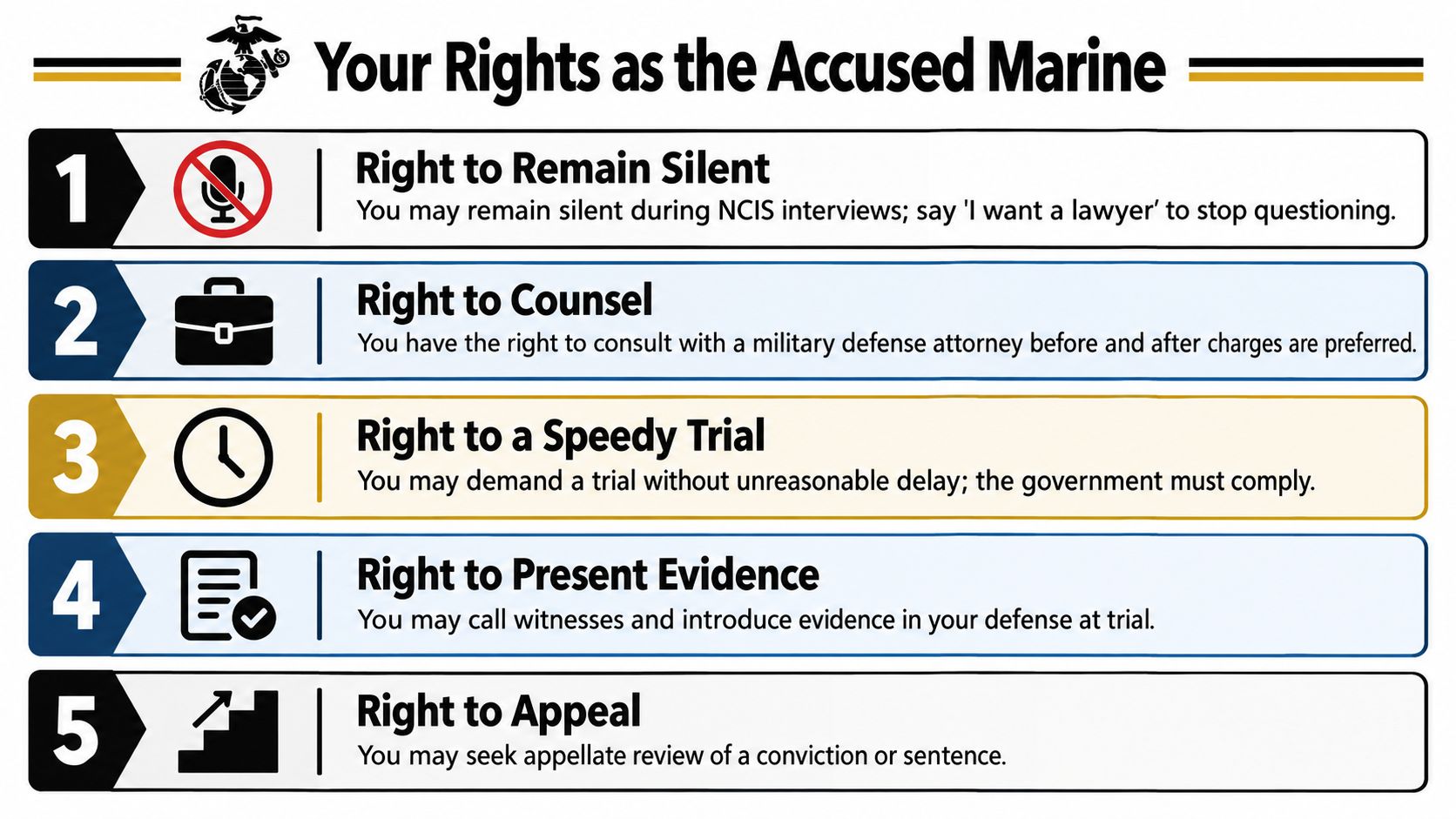
You can refuse to answer investigative questions when Article 31 protections apply. Say that you want a lawyer and stop explaining. Don’t try to negotiate by giving “just enough” information to make the interview go away. Investigators can use partial explanations, inconsistencies, and emotional reactions as evidence.
You have the right to consult military defense counsel before and after charges are preferred. You may also seek civilian representation. Counsel can advise you about whether to make a statement, whether to submit matters at an Article 32 hearing, and how to respond to command pressure.
Hearing and trial rights
At an Article 32 hearing, you may have counsel, receive notice of the charges, review the government’s evidence subject to governing rules, attend the hearing, cross-examine witnesses within the applicable limits, and present evidence or witnesses. The hearing gives the defense an opportunity to learn how the government’s case sounds under questioning.
You may have the right to a speedy trial under Article 10, although speedy-trial analysis depends on the specific delay and circumstances. You can request a military judge alone or trial by members when the law permits. Capital charges carry special rules.
The defense can seek witnesses and documents through compulsory process. In some cases, counsel may use a subpoena for a witness who works in the media, including a television reporter, but the witness’s privilege and the content sought still matter. You also have discovery rights and appellate rights.
The right to remain silent is only useful if you use it before making damaging statements. This explanation of Article 31 of the UCMJ addresses the warning requirement and why the timing of counsel matters.
A waiver can be express or implied by conduct, depending on the right and the circumstances. Don’t assume that silence about a procedural problem preserves it. Tell counsel what happened, document dates and requests, and let counsel decide whether to litigate the issue.
Where Government Cases Break Under Pressure
A Marine doesn’t win because the Marine is telling the truth. The defense wins when the government can’t prove every required element with admissible, reliable evidence.
That distinction matters in credibility cases. The government may present a confident witness whose account changed over time, who has a personal conflict with the accused, or who received a benefit from cooperating. A seasoned defense lawyer looks for the motive to exaggerate, the opportunity to observe, the first version of the story, and the reason later details appeared.
The evidence may not survive scrutiny
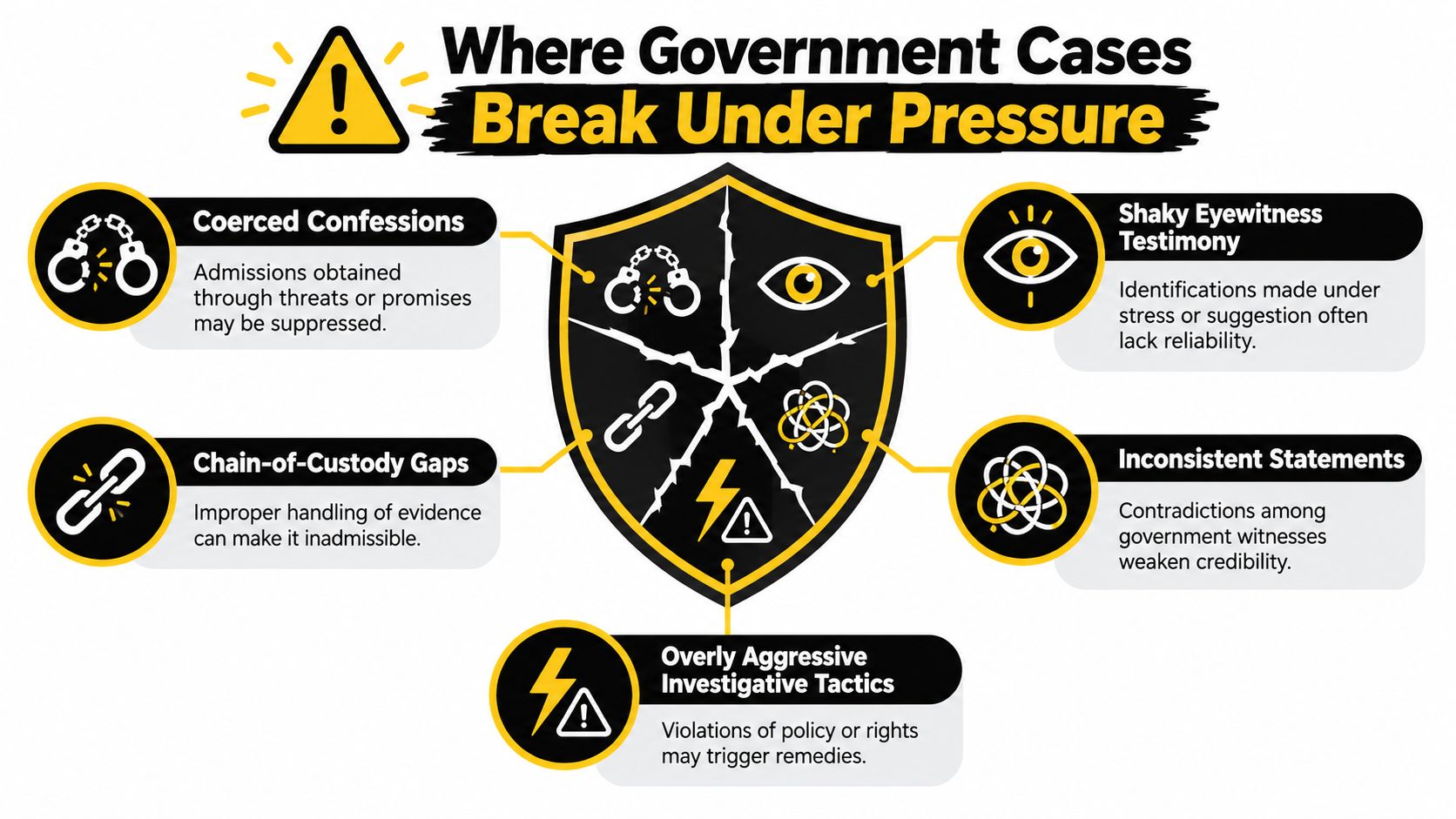
NCIS interviews can produce leading questions, pressure, implied promises, or incomplete recordings. A statement may look powerful in a report but weaken when counsel examines the exact wording, sequence, breaks, and surrounding circumstances.
Digital evidence creates different problems. Investigators must identify who collected it, when it was collected, how it was preserved, whether it was altered, and who can authenticate it. A screenshot without reliable context may not establish authorship, timing, or completeness.
Other recurring pressure points include:
- Reporting timelines: Compare the first report, later interviews, medical records, messages, and command notes for changes that affect reliability.
- Unit relationships: A tight clique can create shared assumptions, coordinated accounts, or pressure to support the command’s preferred narrative.
- Forensic testing: Urine and blood evidence requires attention to collection, labeling, storage, laboratory procedures, interpretation, and alternative explanations.
- Polygraph use: A polygraph isn’t a substitute for admissible proof, and investigative reliance on it may reveal how investigators formed their theory.
- Search authority: Examine whether the search was properly authorized, whether the scope was exceeded, and whether the evidence resulted from an unlawful search.
- Article 31 compliance: A rights violation can affect whether statements are admissible and may expose broader investigative misconduct.
Command decisions can create litigation issues
A commander may refer charges after receiving advice from the staff judge advocate. That decision is not automatically improper, but the defense should examine whether command influence affected witness handling, charging choices, plea negotiations, or the treatment of comparable cases.
The Article 32 hearing can expose a rushed investigation. A witness who sounded certain in a written report may struggle with dates and details under questioning. A digital exhibit may lack a complete extraction. A forensic conclusion may rest on assumptions rather than validated interpretation.
The defense question isn’t only “Did the event happen?” It’s “Can the government prove what happened, through admissible evidence, beyond a reasonable doubt?”
Credibility is often the center of gravity. You don’t attack a witness by calling the person a liar. You attack the account with prior inconsistent statements, motive, bias, missing corroboration, implausible timing, and contradictions that matter to the charged elements.
Detailed Counsel vs Civilian Military Defense Lawyer
Marine defense counsel are often capable and committed. The issue is not whether military lawyers care. The issue is whether the assigned lawyer has the time, independence, and contested-trial experience your case requires.
A detailed counsel works within the military system and may carry a significant caseload. A Trial Defense Service attorney is government-appointed and provides representation without a fee to the accused. An Individual Military Counsel may be requested, but approval and availability are not guaranteed.
| Factor | Detailed Counsel | Military-Appointed | Civilian UCMJ Lawyer |
|---|---|---|---|
| Courtroom experience | Varies by lawyer and assignment | Varies by office and workload | You can verify the lawyer’s actual trial record |
| Caseload and availability | Controlled by military assignment | Controlled by office workload | Dedicated by private agreement |
| Independence | Serves within the military structure | Independent of command in representation, but part of the military system | Accountable solely to the client |
| Investigative network | Primarily military resources | Primarily military resources | Can build civilian investigator and expert support |
| Article 32 and motions | Must litigate when appropriate | Must litigate when appropriate | Retained specifically to develop and fight the case |
| Trial posture | Depends on facts and counsel | Depends on facts and counsel | Can advise without command career considerations |
The right choice depends on exposure. A minor case may not justify outside counsel. A special or general court-martial involving confinement, a bad-conduct discharge, a dishonorable discharge, or a career-ending conviction deserves an honest comparison of experience and resources.
A lawyer’s academic path doesn’t answer that question by itself. Someone researching how to earn a law degree remotely may learn useful background about legal education, but a Marine facing trial needs proof of courtroom performance, military justice training, and current UCMJ practice.
Ask one direct question: “How many contested courts-martial have you personally tried, and what part of my case would you attack first?”
Choosing the Right Civilian UCMJ Defense Lawyer
Call before preferral if you can. Early counsel can help you avoid damaging statements, preserve messages and location data, identify witnesses before they coordinate accounts, and prepare for an Article 32 hearing. Waiting until trial is scheduled often means the defense inherits a record shaped entirely by the government.
Verify the lawyer, not the advertisement
Start with the lawyer’s state bar status and disciplinary history. Then ask for specific military justice credentials:
- Trial record: Confirm experience in contested special and general courts-martial, not only plea agreements or administrative matters.
- Military justice training: Ask whether the lawyer completed JAG training or has equivalent sustained UCMJ practice.
- Case responsibility: Determine whether the lawyer personally handled the motions, examinations, negotiations, and trial.
- Former prosecutor history: Former prosecutors can become excellent defense lawyers, but a government résumé alone doesn’t prove defense judgment.
- Conflicts: Ask whether the firm has represented witnesses, alleged victims, command personnel, or other accused people connected to your case.
- Communication: Establish who answers urgent questions and how quickly the lawyer reviews new evidence.
The court-martial defense lawyer resource can help you begin a broader search, but you still have to interview counsel yourself. No directory, ranking, or testimonial replaces a conflict check and a detailed conversation about your facts.
Understand fees and logistics
Civilian counsel commonly work under a retainer and written engagement agreement. The fee depends on the forum, charges, travel, investigation, experts, motions, trial length, and appellate needs. Don’t rely on a verbal estimate. Ask what the initial retainer covers, how replenishment works, whether investigators and experts are separate, and what happens if the case resolves before trial.
Location matters, but it shouldn’t control the decision. A lawyer may need access to a Marine installation, Navy-Marine docket site, witnesses in other states, and records held by military agencies. Ask how counsel handles base access, secure communications, travel, and evidence transfer.
Red flags include guaranteed outcomes, vague trial claims, pressure to sign before receiving an agreement, refusal to explain who will try the case, and advice that starts with a plea before counsel has reviewed discovery.
Frequently Asked Questions From Marines and Families
Can I choose my own lawyer at a summary court-martial?
Your options depend on the governing rules and the proceeding’s circumstances. Speak with military defense counsel before accepting a summary court-martial or making statements. Don’t assume the lower forum makes legal advice unnecessary.
How long does a general court-martial take?
There’s no fixed timeline. Routine cases may take weeks to months from referral to trial, while complex felony-level charges can take longer because discovery, experts, witnesses, and motions require additional preparation.
Does a guilty plea end the case cleanly?
No. A guilty plea can resolve the merits without a contested trial, but sentencing, confinement, punitive discharge, federal conviction consequences, and appellate issues remain. Plead only after counsel explains the factual and legal consequences.
What does Article 58a confinement mean?
Article 58a concerns forfeitures and the treatment of pay during confinement. The exact financial and confinement consequences depend on the sentence and applicable law. Ask counsel to explain the sentence in writing.
How does a civilian attorney get onto my Marine case?
Civilian counsel must meet applicable qualification and admission requirements for representation in the military proceeding. Your lawyer should handle the credentialing process and confirm approval before appearing.
Can a bad-conduct discharge be upgraded later?
A later review may be possible, but an upgrade isn’t automatic and shouldn’t be your trial strategy. Build the strongest defense before findings and sentencing.
How can family members get updates?
The accused controls attorney communications and privacy decisions. Families can help by preserving records, identifying witnesses, and supporting counsel’s requests, but they shouldn’t contact witnesses or investigators independently.
If you’re under NCIS investigation, facing Article 32 proceedings, or looking at a Marine Corps court martial, contact an experienced civilian UCMJ lawyer before you make another statement or sign another document. Bring every notice, charge sheet, investigative message, and court document to the consultation. Early action gives counsel time to protect evidence, challenge defects, prepare witnesses, and make decisions that may determine whether you keep your freedom and career.