A court-martial closing argument is not the place to improvise, and it’s not where sloppy lawyering gets forgiven. If your career, clearance, retirement, or freedom is on the line, the last few minutes before findings may be the most expensive minutes in the entire case. A weak closing leaves the government’s version of events sitting there unchallenged, while a sharp one pulls the evidence back into a single, disciplined story the members or judge can follow.
That’s why an example of closing statement in a military case has to be more than generic speaking advice. In a court-martial, the closing has to stay inside the record, respect the burden of proof, and still hit hard enough to change minds. The difference between a polished speech and a real defense closing often comes down to whether counsel knows how to turn testimony, exhibits, credibility problems, and reasonable doubt into a final decision request.
Table of Contents
- The Final Minutes That Decide Your Future
- What a Closing Statement Actually Is in Military Court
- The Anatomy of a Winning Court-Martial Closing Argument
- Real Closing Statement Examples for Common UCMJ Scenarios
- Adjusting Your Closing for Judge Versus Panel Trials
- Closing Argument Mistakes That Destroy Cases
- Why Civilian Defense Counsel Changes the Closing Argument
- Frequently Asked Questions About Court-Martial Closing Statements
- Can the accused speak during closing argument
- Can counsel bring up new facts in closing
- What should I be doing while the closing is delivered
- Does the judge or panel really listen to the closing
- What if my lawyer sounds disorganized
- Is sentencing closing as important as findings closing
- Do I need a lawyer immediately
The Final Minutes That Decide Your Future
The panel has heard the witnesses. The judge has ruled on the objections. The smoke from the government’s case has started to settle, and now everyone in the room is waiting to hear whether the defense can turn scattered pieces into a coherent whole. That is the moment where a closing statement either becomes the case or wastes the case.
Why this moment matters so much
In legal and persuasive settings, the closing statement is the final argument before a decision-maker. Its job is to summarize the evidence, restate the main points, and end with a clear call to action. Guidance on conclusions also stresses that the close is not the place for new arguments, because the final job is to synthesize what has already been shown and explain what it means for the verdict or sentence, not to spring surprises on the fact-finder (Scribbr’s research paper conclusion guidance).
That principle matters in court-martial practice more than many realize. When the defense closes well, it gives the panel or military judge a clean route back through the evidence. When it closes badly, it leaves the government’s narrative intact and hands the fact-finder an easy way to say, “I remember the witnesses, but I don’t remember why I should doubt them.”
Practical rule: the closing is not a victory lap. It is the final, disciplined request for the verdict you want.
The strongest closings do one more thing. They tell the decision-maker what to do next. In a contested findings case, that means acquit. In sentencing, it means limit the punishment and preserve the service member’s future as far as the law allows. That final ask must be clear enough that nobody in the room wonders what counsel wants.
What experienced defense counsel is really doing
A battle-tested defense lawyer is not reciting testimony back at the panel. The lawyer is selecting the handful of facts that matter, tying them to the defense theory, and calling out the government’s weak spots without overreaching. That is where a closing becomes strategic. It sharpens the record instead of cluttering it.
For service members and families, the consequence is simple. The closing can be the last chance to force the room to see the case through the right lens. Miss that moment, and even a case with real holes can feel convincing because the defense never gave the fact-finder a better story.
What a Closing Statement Actually Is in Military Court
A military closing statement is a legal argument, not a speech contest. It is built from the record, limited by the rules of advocacy, and shaped by the burden the government has to carry. That is the first thing service members need to understand if they are trying to judge whether their counsel is prepared.
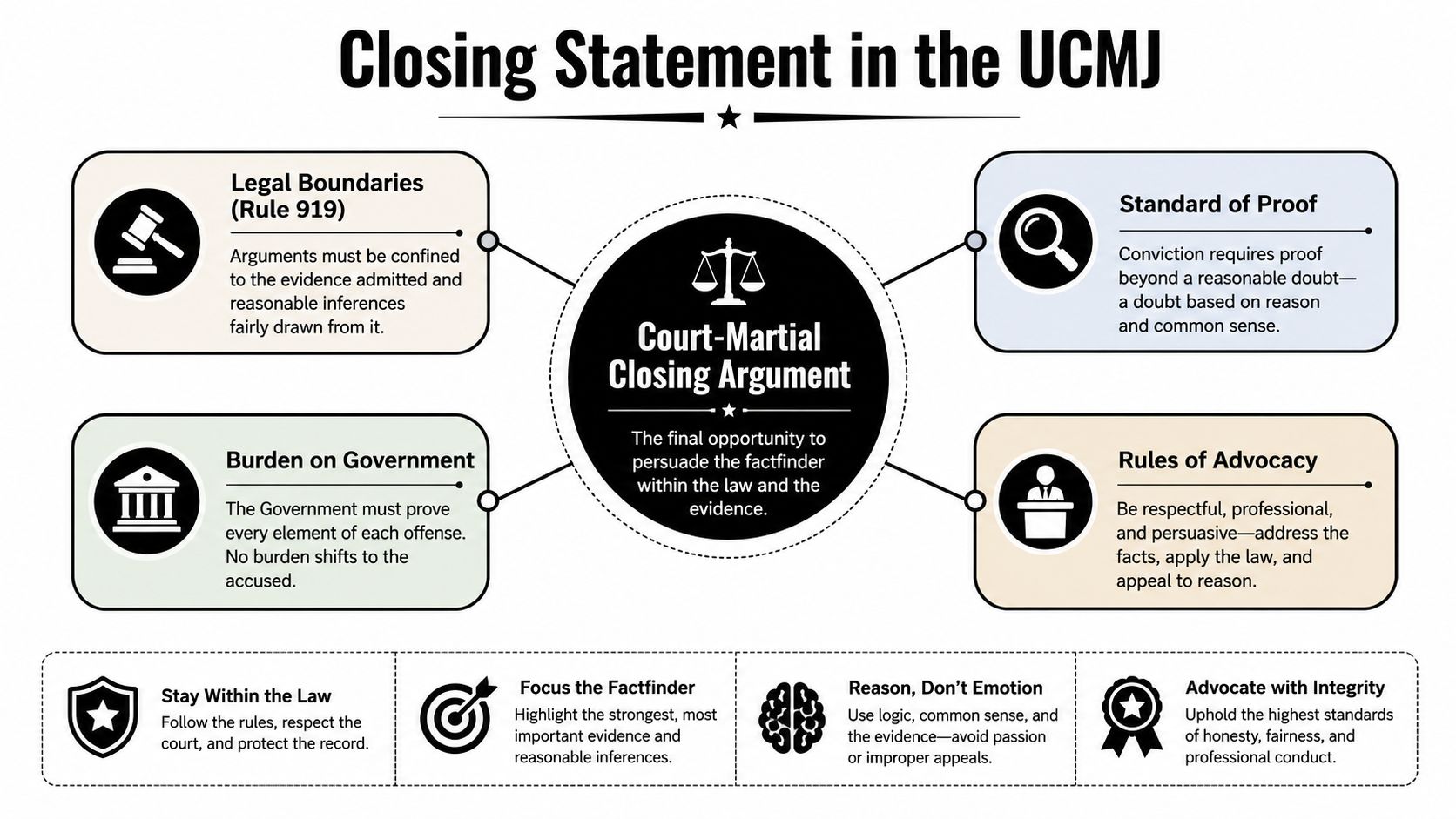
The basic military-law frame is straightforward. A proper closing argument restates the thesis, summarizes the key supporting points, addresses counterarguments without introducing new evidence, and ends with a clear request for the result the defense wants. Instructional guidance on closing arguments also warns that new facts should not appear at the end, because jurors or members may view that as less credible and harder to verify (Study.com’s closing statements lesson).
Findings closing and sentencing closing are not the same
A findings closing argues whether the government proved the charge. A sentencing closing argues what punishment, if any, is appropriate after guilt is decided. They sound similar to civilians, but they do different jobs in the courtroom.
Findings closings focus on the evidence, the elements, reasonable doubt, and credibility. Sentencing closings focus on mitigation, responsibility, rehabilitation, impact on the accused’s family, and the practical consequences of punishment. Mixing those two phases is a mistake because it blurs the legal purpose of each one.
For a broader primer on court-martial structure, the basics are laid out in this court-martial overview. The key point is simple. If the closing is supposed to answer a legal question, it has to stay disciplined enough to answer that question directly.
The boundary that matters most
One of the clearest legal limits is this, the defense does not get to smuggle in fresh evidence during closing. The closing should work with what the witnesses said, what the exhibits show, and what the judge allowed into the record. That is why strong military closings are tight, controlled, and anchored to admissible proof.
The best closings also begin with a theme. In practice, that theme might be “the government cannot meet its burden,” “the witness is not reliable enough to convict,” or “the evidence supports a lesser result than the government wants.” Whatever the theme, it has to be plain, repeatable, and tied to the admitted record.
The Anatomy of a Winning Court-Martial Closing Argument
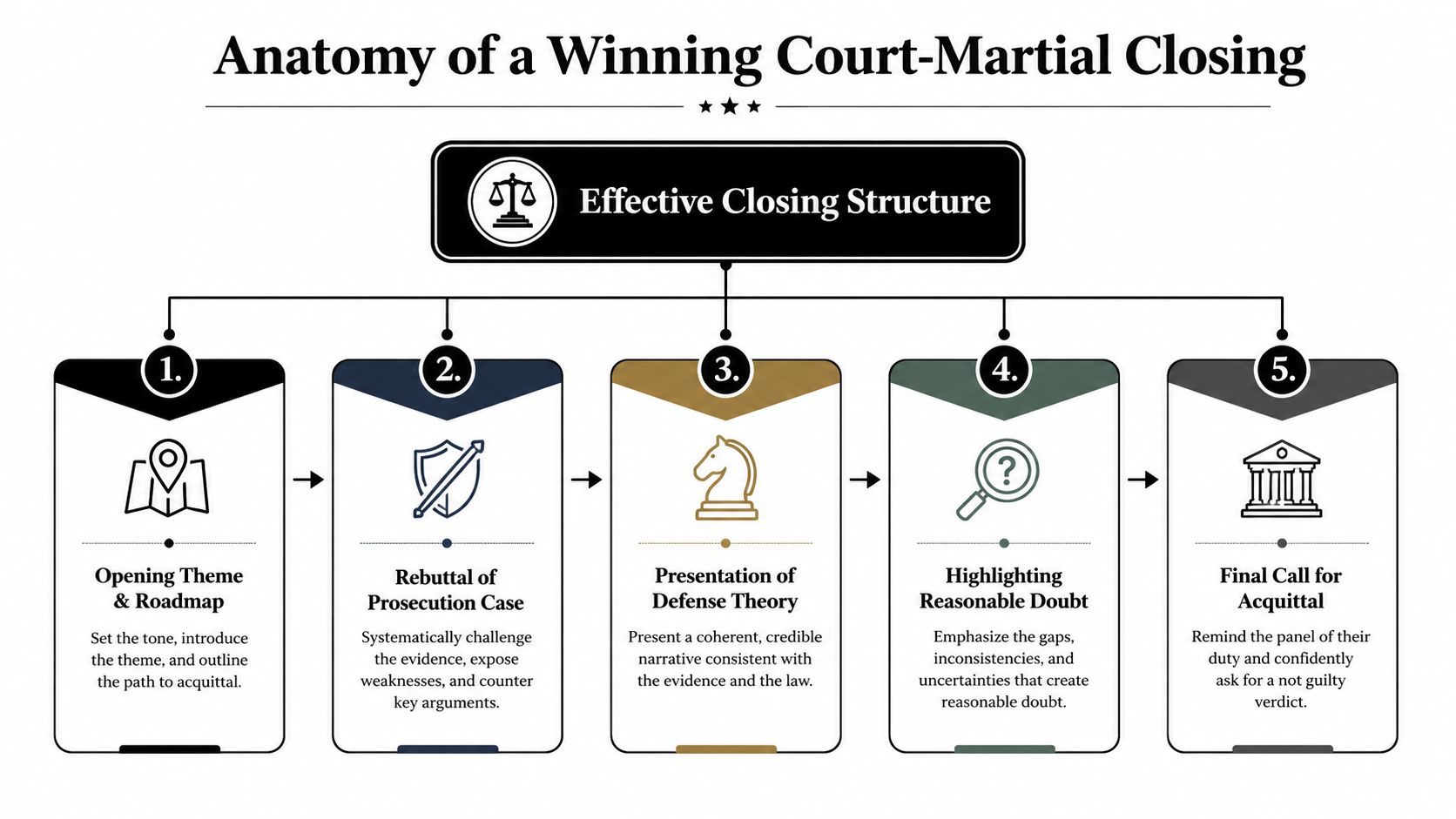
A strong court-martial closing doesn’t wander. It opens with the theme, moves through the evidence in a controlled order, meets the government’s best point head-on, and lands on a clear decision request. That structure matters because the fact-finder needs a map, not a monologue.
Start with the theory, not the transcript
The first move is a clear theory of the case. That is not a summary of every witness. It is the defense’s answer to the question, “What really happened, and why doesn’t the government’s story hold up?”
A good opening line in a military closing might sound like this.
“The evidence in this case does not prove guilt beyond a reasonable doubt. It proves conflict, confusion, and a rushed investigation, but it does not prove the charge.”
That kind of statement tells the panel where to place the evidence before they get lost in the details. It also keeps counsel from sounding like they are reading a transcript with enthusiasm.
Use the evidence to reinforce, not repeat
Once the theme is set, the closing should select only the evidence that advances it. Repetition kills momentum. Smart counsel doesn’t rehash every witness. Smart counsel pulls out the few moments that exposed uncertainty, contradiction, or bias.
A strong defense closing often uses brief signposts like these:
- Credibility problem, because the witness changed the story.
- Missing proof, because the government never filled a gap in the timeline.
- Reasonable inference, because the defense version fits the record better.
- Government overreach, because the charge is broader than the proof.
The best closings sound inevitable by the end because they make the decision feel like a logical result, not an emotional leap.
End with a clean ask
The last sentence has to be a decision request. In a findings case, that means asking for not guilty. In a sentencing case, it means asking for restraint, proportionality, and a sentence that does not wipe out the member’s future more than the law requires.
For tactical context on how experienced counsel builds advantage early, see this discussion of military investigation strategy. The connection is simple. Good closings are usually built long before closing day.
Real Closing Statement Examples for Common UCMJ Scenarios
The best example of closing statement material is not a lecture. It’s a pattern you can recognize, adapt, and pressure-test against your own case. The language changes depending on whether the defense is fighting findings, defending a mixed case, or arguing sentencing.
Contested findings case
“In this courtroom, the government asked you to convict based on a story that does not stay consistent from one witness to the next. The timeline breaks, the memory shifts, and the physical evidence does not fill the gaps. You are not here to guess, and you are not here to punish suspicion. You are here to decide whether the government proved every element beyond a reasonable doubt, and it did not.”
Why this works, it stays inside the record and goes straight at the burden. It does not claim innocence by slogan. It explains why the proof falls short.
Mixed case with strategic concessions
“The defense is not asking you to ignore what happened. We are asking you to separate emotion from proof. Some conduct may have been poor judgment, but poor judgment is not proof of the charged offense. The government still had the burden to prove the elements it chose to allege, and the evidence does not carry that burden.”
That kind of closing can be powerful when total denial is unrealistic. It gives the fact-finder a legally safe off-ramp without surrendering the whole case.
Sentencing closing aimed at preserving the member’s future
“If you decide to impose punishment, the sentence should reflect the person in front of you, not just the charge on the paper. This is a service member with a life outside this courtroom, a family that will absorb the consequences, and a career that can still mean something after this case. Ask for a sentence that holds the member accountable without needlessly destroying the future that can still be built.”
That language is measured. It does not beg. It frames punishment in human and military terms the panel can understand.
A few practical lines that actually work
- “The government’s theory asks you to fill in gaps the evidence never closed.”
- “The record supports doubt, not certainty.”
- “You do not convict because a story sounds complete, you convict because the proof is complete.”
- “If the case leaves you uneasy, that unease is reasonable doubt.”
Those lines matter because they are short enough to remember and strong enough to carry weight in the room. They work best when they fit the evidence, not when they are slapped onto every case like a template.
Adjusting Your Closing for Judge Versus Panel Trials
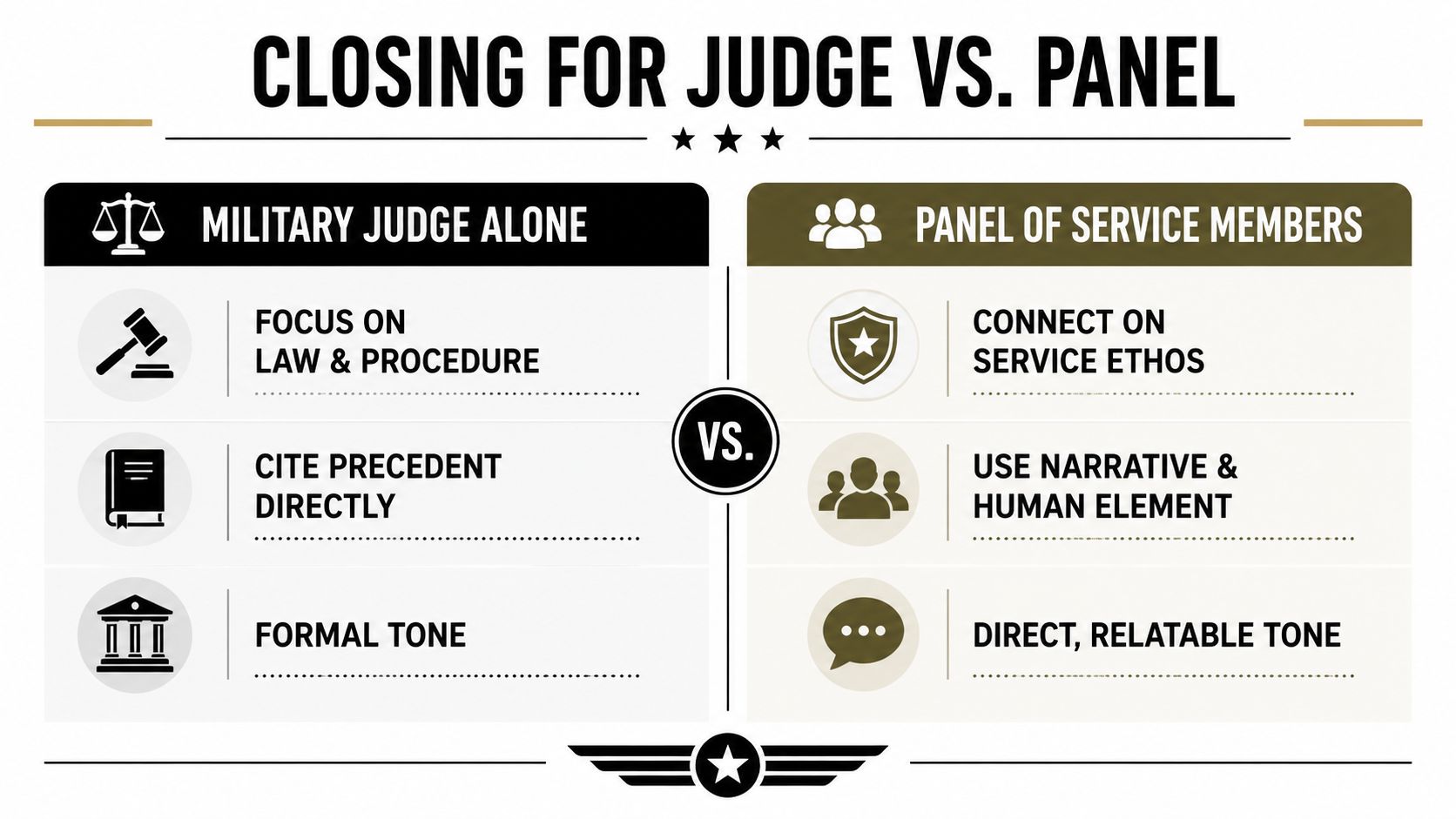
A military judge and a panel of members do not listen the same way. A judge wants precision, legal control, and clean use of the record. A panel often responds more directly to narrative, fairness, and whether counsel sounds believable in the room.
When the fact-finder is a military judge
With a judge-alone trial, the closing should be lean and legally organized. Judges do not need theater. They need a precise theory, accurate record citations, and a disciplined path through the elements.
That means the lawyer should:
- Use tighter legal language
- Move quickly through undisputed points
- Focus on the burden and element-by-element proof
- Avoid exaggeration that can damage credibility
A judge can spot fluff instantly. Overstating weakens the defense faster in judge-alone cases than many lawyers realize.
When the fact-finder is a panel
With members, the closing needs more human texture. The legal points still matter, but the story has to make sense to people who may not live in military justice every day. The defense has to sound direct, honest, and respectful of service culture without pandering.
That usually means:
- More emphasis on plain language
- Clear moral framing around fairness and proof
- Sharper attention to witness credibility
- A structure the members can follow without taking notes on every sentence
Many generic closings fall apart. They are either too stiff for members or too loose for a judge.
The tactical difference that matters
Judge-alone closings are about precision. Panel closings are about persuasion with discipline. Both still need to stay inside the record, but the delivery changes because the audience changes.
Experienced court-martial attorneys read the room before they close. They know when to slow down, when to cut a point short, and when to land the final request without another paragraph of excess. That is not style for its own sake. It is courtroom survival.
Closing Argument Mistakes That Destroy Cases
Most closings do not fail because the lawyer had nothing to say. They fail because counsel said too much, said it wrong, or missed the point the fact-finder cared about. A clean closing can rescue a hard case. A sloppy one can sink a winnable one.
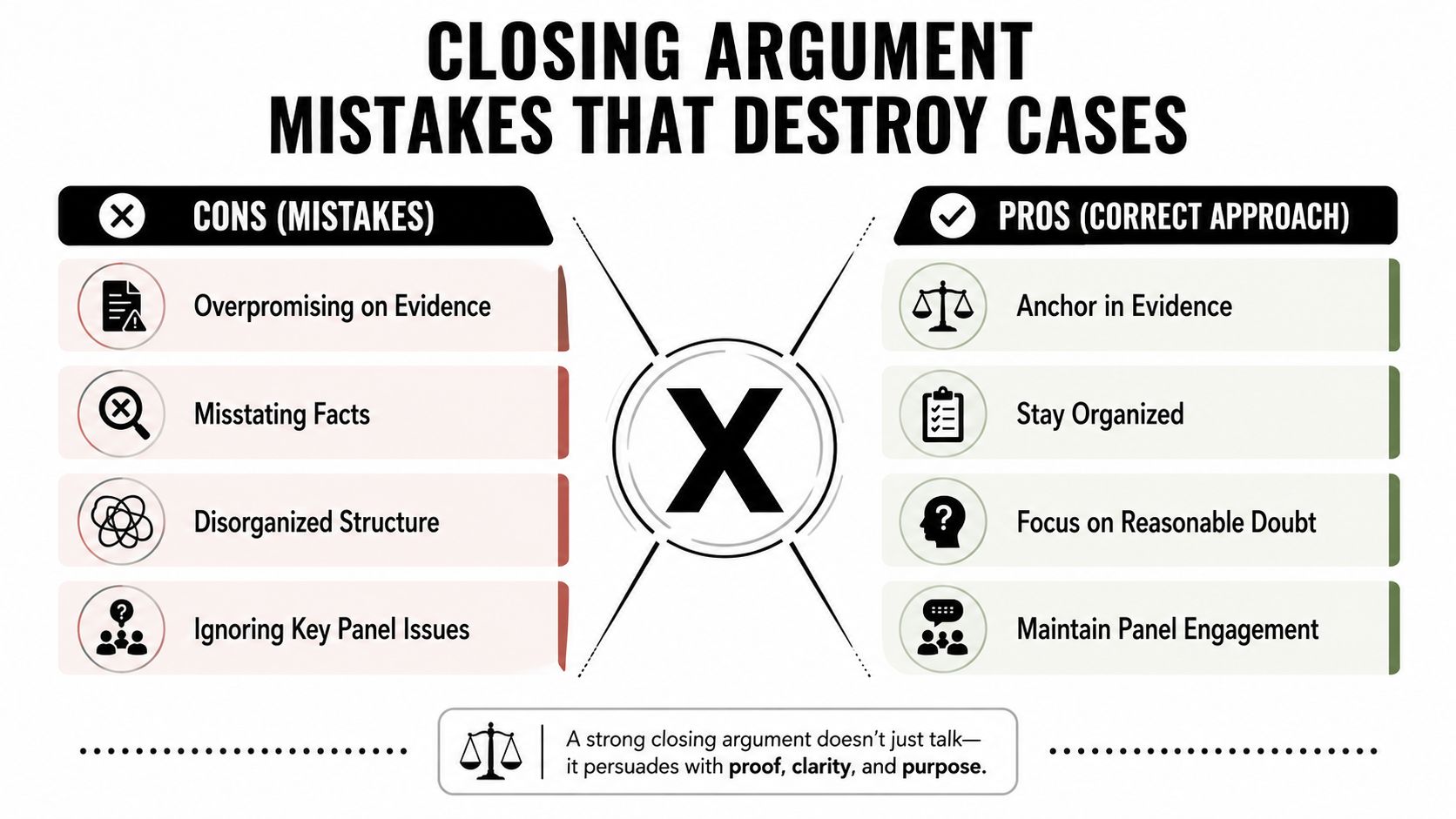
The mistakes that hurt most
- Overpromising on proof, because the panel notices when counsel claims too much and then cannot support it.
- Misstating facts, because one wrong claim can poison the rest of the argument.
- Disorganized structure, because the fact-finder tunes out when the closing feels like a pile of thoughts.
- Ignoring the government’s strongest point, because silence on the hardest issue can look like surrender.
- Arguing outside the record, because that invites distrust and can undermine counsel’s credibility.
- Getting emotional without purpose, because anger rarely helps the defense unless it is carefully controlled.
Each of these mistakes does the same basic damage. It shifts attention away from the weakness in the government’s case and onto the weakness in the defense presentation.
What strong counsel does instead
Good trial lawyers stay in the lane of the evidence. They confront the toughest government point rather than stepping around it. They keep the closing organized enough that the panel can remember it after a long day. And they know when a restrained point is stronger than a dramatic one.
That discipline is especially important in military justice, where credibility is a major part of the fight. If the panel thinks the defense is stretching, the closing loses force immediately.
The key lesson is simple. The closing should make the defense look more reliable than the government, not more theatrical.
Why Civilian Defense Counsel Changes the Closing Argument
A closing argument is where experience shows. That’s because the lawyer has to do several hard things at once, legal precision, narrative control, credibility management, and live adjustment to the room. In serious cases, that is exactly where civilian military defense counsel tends to separate itself from routine representation.
Independence and repetition matter
Military-appointed counsel can be skilled, but they work inside the system and carry the burden of broader caseloads and institutional limits. A civilian military defense lawyer whose practice is focused on court-martial work can usually devote more time to shaping the theory, stress-testing the closing, and rehearsing the delivery until it’s tight.
That independence matters in the final argument. The lawyer does not answer to command. The lawyer answers to the client and to the record.
Closing is where trial experience shows up
A good closing is part legal analysis, part courtroom instinct. It takes judgment to know which point the panel will remember, which government witness needs to be confronted directly, and which phrase will sound persuasive versus arrogant.
That’s why clients facing charges often need a lawyer who lives in this world, not someone who only visits it occasionally. The experience gap is often easiest to see at the end of the case, when there’s no room left to recover from a weak delivery.
For a more direct view of how civilian specialists approach this work, review this court-martial defense counsel resource. The bottom line is plain. You want a lawyer who treats the closing as a strategic weapon, not a speech assignment.
Frequently Asked Questions About Court-Martial Closing Statements
Can the accused speak during closing argument
Usually no, the closing is counsel’s argument, not the accused’s personal statement. If the accused has something to say, that usually belongs in a different phase, especially sentencing or an unsworn statement where permitted.
Can counsel bring up new facts in closing
No. The closing should stay tied to the admitted record. New evidence at that stage risks credibility and can give the government a reason to object or attack the argument as unfair.
What should I be doing while the closing is delivered
Stay focused, quiet, and ready. Watch the panel, watch the judge, and do not react to every line. If you have counsel, trust the structure they built and let them finish the argument without visible interference.
Does the judge or panel really listen to the closing
Yes, and they often remember it better than people think. Closing is the last organized summary they hear before deliberating, which is why structure and clarity matter so much.
What if my lawyer sounds disorganized
That’s a warning sign. A closing should feel controlled, not improvised. If the argument meanders, misses the government’s strongest point, or sounds like a reheated transcript, it’s fair to question whether the defense is maximizing the moment.
Is sentencing closing as important as findings closing
Absolutely. If guilt has already been decided, sentencing closing may be the last meaningful chance to protect rank, retirement, confinement exposure, and family stability. It needs the same discipline, even if the tone changes.
Do I need a lawyer immediately
Yes. Waiting until the last minute is a bad gamble. The closing argument is only as strong as the case theory, witness preparation, and evidence work that came before it.
If you’re under investigation, facing charges, or waiting to see whether your case will go to court-martial, do not let the closing stage become the first time you take the defense seriously. The right civilian military defense lawyer can shape the theory early, protect the record, and deliver a closing that gives your case its best chance.