
You do not need more legal theory right now. You need to know whether the person you hire can keep you out of a bad outcome when the command is already leaning forward, investigators are asking questions, and your future is on the line. Too many service members pick a lawyer like they are buying insurance, then learn too late that the lawyer had the license but not the fight, not the trial scars, and not the military judgment to handle a court-martial, an Article 15, or a clearance-killing investigation.
Defense attorney requirements are not about a résumé, they are about survival. If you are under investigation, facing charges, or even hearing rumors that an investigation is starting, you need to know what a qualified defense lawyer must bring to your case, what red flags to reject immediately, and what questions to ask before you sign anything.
Table of Contents
- Why Defense Attorney Requirements Matter Before You Ever Need One
- The Formal Licensing Floor Every Defense Attorney Must Meet
- Military Justice Experience That Actually Translates in Court
- Clearances, Ethics, and Conflict Issues Unique to Military Clients
- Red Flags and Mistakes That Get Service Members the Wrong Lawyer
- How to Verify Credentials and the Questions to Ask Before Signing
- Why Early Retention of Qualified Civilian Counsel Changes the Outcome
Why Defense Attorney Requirements Matter Before You Ever Need One
A lot of good service members make one expensive mistake. They wait until the command has already made up its mind, then they start shopping for counsel like the choice is just about price or personality. That is how people end up with a lawyer who is technically allowed to practice, but not built for the fight in front of them.
The military justice system punishes delay. Evidence gets shaped early, witnesses get locked into stories, and investigators don't pause because you're still trying to figure out whether the lawyer your buddy recommended has ever tried a contested court-martial. The right question is not “Is this person a lawyer?” It's “Can this person defend my case, with its facts, its command climate, and its collateral consequences?”
Practical rule: hire for the case you have, not the website you saw.
That mindset changes everything. A lawyer defending a routine misdemeanor in civilian court may still be the wrong pick for an Article 120 allegation, a separation board, or a clearance-sensitive investigation. The system cares about licensure, yes, but it also rewards speed, experience, and command-aware strategy.
Military families feel this pressure hardest. A spouse sees the career risk before the service member does, and that's often because the consequences travel beyond the courtroom. A bad lawyer can cost rank, retirement, benefits, and reputation. That's why defense attorney requirements should be treated like a tactical checklist, not a formality.
The rest comes down to three things. First, the lawyer must be legally qualified to practice. Second, they need actual courtroom and military-justice experience. Third, they have to be independent enough to challenge the government without fear or favors. If any one of those pieces is missing, you're not getting strong defense counsel. You're getting a risk.
The Formal Licensing Floor Every Defense Attorney Must Meet
A service member does not need a polished sales pitch. You need a lawyer who is legally allowed to stand between you and the government. That starts with a bachelor's degree, moves through an accredited Juris Doctor, and ends with a state bar exam and licensure, which is the baseline the U.S. Bureau of Labor Statistics describes for lawyers. Career guides also note that applicants usually need to take the LSAT before law school, and that bar admission can include additional ethics testing.

What the license proves
A license proves one thing, and only one thing. The lawyer is legally allowed to practice in that jurisdiction. It does not prove they know how to defend a service member, handle a military investigation, or read a command climate correctly. A licensed generalist can still be the wrong lawyer for a criminal case, especially where military discipline, security clearance issues, and collateral consequences collide.
That's why the licensing floor matters, but it does not answer the question. The BLS reports that lawyers had a median annual wage of $151,160 in May 2024 and notes that lawyers typically need a law degree and state license source. Those are broad profession-wide facts, not a guarantee of competence in a court-martial. In this field, the license gets a lawyer into the room. Experience determines whether they deserve to stay there.
What to verify fast
You can usually confirm the basics in minutes:
- Bar admission: check the state bar website and confirm the lawyer is active and in good standing.
- Discipline history: look for public disciplinary actions, suspensions, or reprimands.
- Ethics testing: ask whether they passed the MPRE, which one public defender guide says is required in all U.S. jurisdictions except Wisconsin and Puerto Rico source.
- Law school path: confirm they completed an accredited J.D. after undergraduate study, not some shortcut or nontraditional credential that does not qualify them in your jurisdiction.
For military cases, state licensure is still the floor, because federal and military practice draw from that licensing system. You still need a lawyer who understands how that licensing connects to military justice, because a clean bar card does not tell you whether the person can handle an Article 32, a mitigation package, or contested findings with the stakes you are facing. Read more in a guide to the UCMJ system and military justice.
The cleanest takeaway is simple. Admission means legal permission. It does not mean operational readiness.
Military Justice Experience That Actually Translates in Court
The biggest mistake service members make is assuming that all criminal lawyers are interchangeable. They aren't. A lawyer who has never stood in a contested military proceeding can sound polished and still be dangerous for your case. The work demands familiarity with military procedure, command pressure, and the way collateral consequences follow long after the verdict.
The difference shows up in the details. A real military defense lawyer should be able to talk plainly about court-martial trials, Article 32 hearings, separation boards, sentencing evidence, and post-trial damage control. If they can't explain how those pieces fit together, they're not ready for a serious military case.
The UCMJ system punishes sloppy preparation. That means you should look for counsel who has handled contested findings, sentencing, and mitigation, not someone who only advertises “military law” because they once touched a related file.
Experience that actually counts
The best proxy for readiness is not a slogan. It is repeated courtroom exposure. Public defense standards commonly cite a ceiling of no more than 150 felony cases per attorney per year, 400 misdemeanor cases per attorney per year, and 25 appeals per year, and they stress that counsel must have enough time, resources, knowledge, and continuing familiarity with criminal law and procedure before taking a matter source. That is a useful warning sign for military clients too. If a lawyer's docket is too crowded, your case becomes another file, not a mission.
For serious cases, experience thresholds matter even more. NLADA death-penalty standards call for at least five years of litigation experience, lead-counsel status in no fewer than nine completed jury trials of serious and complex cases, and prior experience in at least one death-penalty case source. You don't need a capital-case lawyer for every court-martial, but you should understand the logic. High-stakes defense rewards people who have already absorbed pressure, procedure, and evidentiary combat.
What to ask about military cases
Ask direct questions:
- How many contested court-martial trials have you led?
- Have you handled Article 32 hearings personally?
- Have you defended Article 120, 128, 134, or other charged offenses like this before?
- Do you have real sentencing and mitigation experience?
- Have you worked appellate or post-trial issues when the trial result wasn't the end of the story?
A lawyer who can't answer those questions cleanly is telling you something. Listen.
If a lawyer talks only about being “familiar” with military law, keep moving. Familiar is not the same as battle-tested.
Clearances, Ethics, and Conflict Issues Unique to Military Clients
Military clients live with risks that civilian defendants often never see. A criminal charge can become a security clearance problem, and a clearance problem can become a career-ending problem even if the court case doesn't go the way the government wants. That is why a military defense lawyer has to understand the collateral path, not just the charge sheet.
Clearance-sensitive defense requires discipline. The wrong communication strategy, the wrong disclosure, or the wrong approach to investigators can damage a service member long before the case reaches trial. A lawyer who doesn't understand how command action, personnel records, and security review processes interact is working blind.
Ethics matter just as much. A defense lawyer should be independent from the command, not cozy with it. If the lawyer has a close relationship with the local trial counsel, convening authority, military judge, or a former chain of command, that doesn't automatically disqualify them, but it should trigger hard questions. You need to know whether they can fight without hesitation when the room is full of people they used to work beside.
The California Bar's indigent defense guidance emphasizes that qualified defense counsel must have jurisdiction admission, criminal-law familiarity, continuing legal education, and for more demanding matters, specific litigation experience and extra training source. That lines up with what military clients need, because license status alone is a weak proxy for defense quality.
Conflict traps that sink representation
Watch for these problems:
- Dual representation: one firm trying to represent co-accused service members in the same case. That is usually a disaster.
- Former-JAG conflicts: a lawyer who is too close to the same installation, command culture, or personnel involved in your matter.
- Insider familiarity: a lawyer who knows everyone in the building and thinks that counts as an advantage.
- Clearance blind spots: a lawyer who treats your TS/SCI or other sensitive status like it's irrelevant.
Bottom line: independence is not a luxury in military defense. It is a requirement.
If your case touches clearance, polygraph history, or command reporting, demand a lawyer who can explain the downstream risks in plain English. If they wave it off, they're not protecting your career. They're protecting their comfort.
Red Flags and Mistakes That Get Service Members the Wrong Lawyer
The worst hiring decisions usually happen when people are scared and rushed. That's when they pick the first name they hear from a senior NCO, a battle buddy, or a command contact who means well but isn't paying the price if the case goes bad. You cannot outsource this decision.

Mistakes that cost people cases
- Choosing based on rank or recommendation: seniority is not trial skill.
- Assuming JAG detail means loyalty: a detailed military lawyer can work hard, but they're still part of the system.
- Waiting until charges are preferred: the earliest investigative decisions matter most.
- Hiring the cheapest generalist: cheap is expensive when the outcome follows you for years.
- Believing a flashy website: polished branding doesn't equal courtroom wins.
- Ignoring appellate and discharge work: not every victory happens at trial.
- Signing before review: if the lawyer wants money before they've examined the facts, that's a warning.
The red flags are usually obvious once you know to look. If a lawyer has no actual court-martial trials as lead counsel, can't explain their strategy without jargon, or promises an outcome, stop the conversation. Lawyers can predict risk. They can't promise results.
The common thread is simple. People keep asking the wrong question. They ask whether the lawyer is “a real lawyer,” when the key question is whether the lawyer is the right lawyer for a military case with real consequences. That difference matters more than many learn until it's too late.
How to Verify Credentials and the Questions to Ask Before Signing
Trust has to be earned fast. Charm does nothing for you in a court-martial. Proof does.
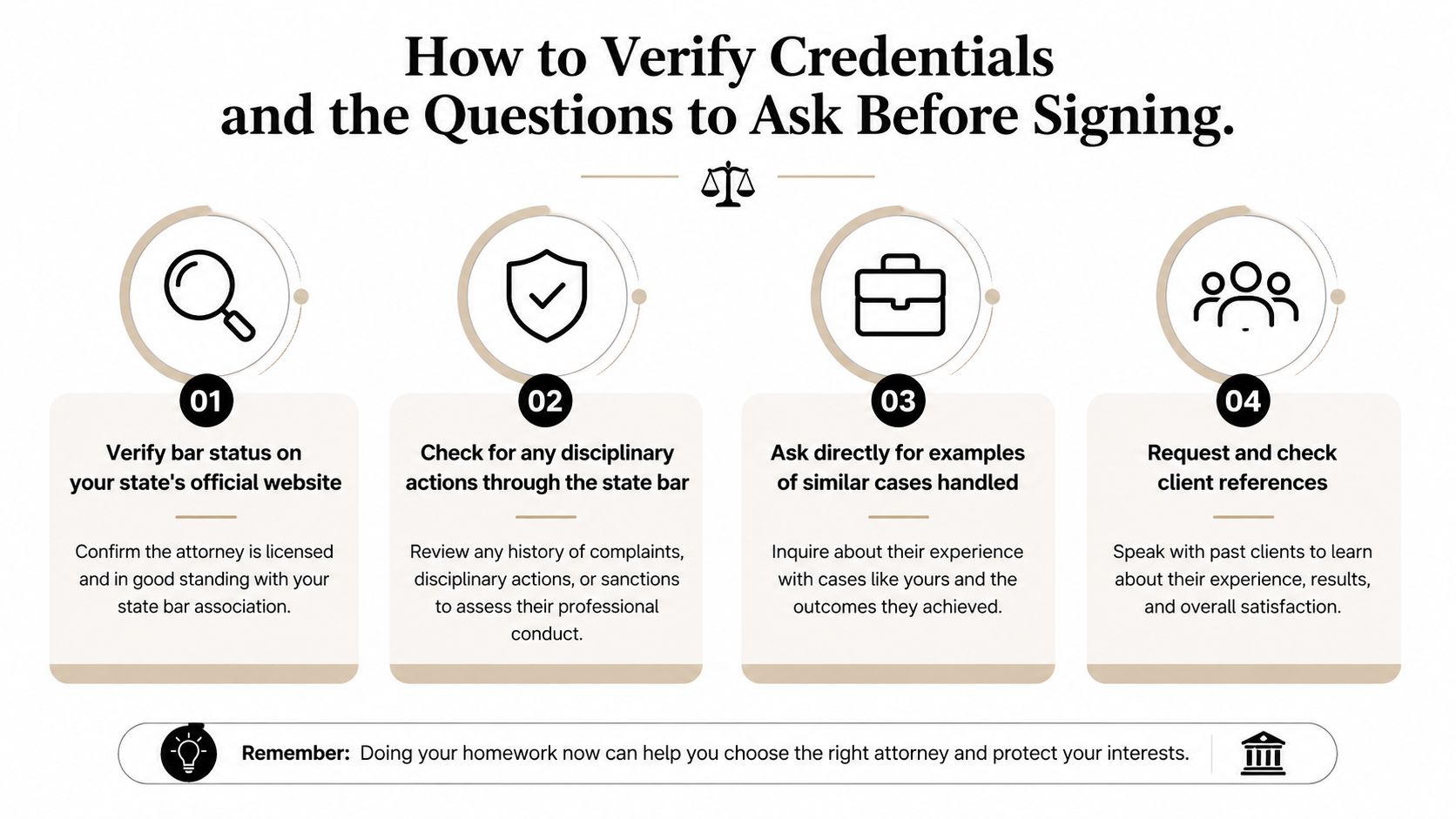
Start with the public record. Check the lawyer's bar status on the state bar's official site, then read the discipline history yourself. After that, make the lawyer name specific military or criminal cases they have handled, and force concrete answers. You want facts, not labels, and you want them without hesitation.
The questions you ask should pressure-test real experience:
- How many contested court-martial trials have you led in the last five years?
- What part of your practice is military defense, not just general criminal work?
- Have you handled this exact charge before?
- Who will do the work if I hire your firm?
- How do you approach investigations differently from negotiations?
Do not accept vague comfort language. A lawyer who cannot explain the difference between screening facts, shaping the investigation, and preparing for litigation is not giving you a serious answer. If you want a broader view of how firms compare on military justice work, trial handling, teaching, and authored analysis, review the court-martial defense lawyer comparison page and compare the names against the questions above.
What a good fee agreement should make clear
The engagement letter should tell you exactly who is responsible for the case, who will staff it, what work is included, how you will communicate, and what happens if the matter shifts from investigation to litigation. If the firm will not put those points in writing, keep looking.
A serious agreement also shows you whether the lawyer is prepared to work the case from day one. That matters because early decisions shape the defense long before a courtroom hearing. If you are still in the investigative phase, read how strong counsel handles the military investigation phase and compare that approach to what the lawyer is promising you.
It should not push you to sign before the facts are reviewed. It should not hide who is doing the work. And it should never let polished branding stand in for trial depth.
Ask for substance, then verify it. If the answers stay vague, the lawyer is not being careful with your case.
Why Early Retention of Qualified Civilian Counsel Changes the Outcome
The first days of an investigation are where the case gets shaped. Investigators are not neutral, evidence is often incomplete, and credibility gets set before you ever sit in a hearing room. If you wait until charges are already preferred, you have already surrendered the best window to control the facts, the narrative, and the damage.
Retain civilian counsel at the start, not after the problem hardens. Military-appointed counsel may be competent, but independent civilian counsel gives you distance from command pressure and more freedom to build a defense without worrying about the institutional chain around it. Early retention also lets the lawyer get ahead of interviews, preserve evidence, and start forcing disciplined choices before the government locks in its theory. If your case is still in the investigative phase, read how experienced counsel win cases during the military investigation phase and compare that approach to what the lawyer is promising you.
Do not talk to investigators without counsel. Do not assume command will “handle it.” Do not let time turn a manageable problem into a career-ending one.
If you are under investigation, facing an Article 15, or already looking at charges, act now. Get a lawyer who knows the military system, has real trial experience, and understands what is at stake beyond the courtroom. Talk to more than one lawyer, then choose the lawyer who can explain your case clearly, answer direct questions without games, and show you exactly what they will do in the first days of representation.