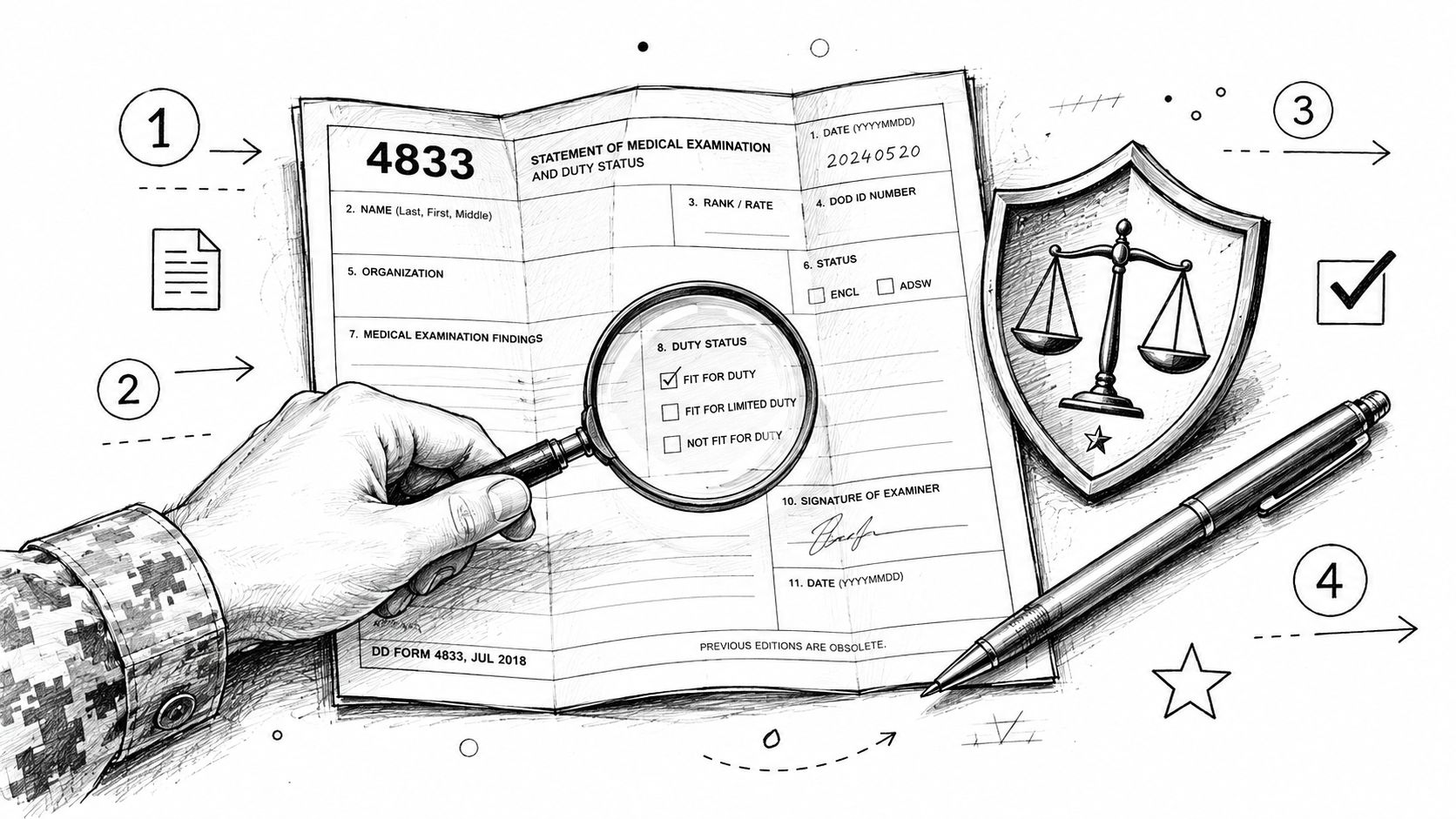
Your phone buzzes. First sergeant wants to see you. Then somebody says the words DA Form 4833.
That moment hits hard because you know this isn’t casual counseling. You start thinking about your security clearance, your rank, your next promotion board, your family, and whether command has already decided who you are before you’ve said a word. That panic is extremely common. The fear is justified.
Most soldiers make the same mistake right here. They treat the form like routine paperwork. It isn’t. A DA Form 4833 can become the written version of your case that follows you long after the investigation cools off. If the narrative is sloppy, unfair, or flat-out wrong, that bad version of events can keep resurfacing when command looks at separation, when a board reviews your file, or when you try years later to fix your record.
If this form is being created in your case, you need to think like you’re already defending your future record, not just today’s accusation. That’s how careers are saved.
Table of Contents
- That Sinking Feeling When You Hear DA Form 4833
- What a DA Form 4833 Actually Is and Is Not
- A Tactical Guide to Reading the Form
- How This Form Becomes a Permanent Weapon Against You
- Devastating Mistakes Soldiers Make with a DA Form 4833
- Why Your Appointed Military Lawyer Is Not Enough
- Frequently Asked Questions About DA Form 4833
- Take Action Before This Record Hardens Against You
That Sinking Feeling When You Hear DA Form 4833
A lot of soldiers first hear about a DA Form 4833 in a cramped office with a commander, first sergeant, CID agent, or MP nearby. Nobody explains much. They just act like the machine is moving and you’re expected to keep up. You leave that conversation wondering whether you should explain yourself, apologize, deny everything, or keep quiet.
Here’s the answer. Slow down and stop talking.
When command starts building paper, they’re not doing it for your benefit. They’re building a file. That file can shape how people above your commander see you, often without ever meeting you. One short narrative can turn into the Army’s version of who you are.
Practical rule: The first bad draft of your story often becomes the version the system keeps.
Many service members are convinced they can clean things up later. They thought they could wait until the separation board. Or the GOMOR response. Or the appeal. That’s backwards. By then, the record already exists, and people keep treating it like the starting point.
If you’re hearing about a DA Form 4833 now, your job isn’t to win an argument in the hallway. Your job is to protect the record before it calcifies. Get the paperwork. Identify what investigation this came from. Stop volunteering facts. Start thinking like every sentence on that form could be read again years from now by somebody deciding whether you deserve another chance.
What a DA Form 4833 Actually Is and Is Not
A DA Form 4833 is the Army’s command record showing what disciplinary or administrative action was taken after a CID or Military Police investigation. The form’s title says it plainly: Commander’s Report of Disciplinary or Administrative Action. It gives command one standardized document to summarize the allegation, identify the soldier, and record what the unit did in response.
That standard format is the danger. A typed Army form carries institutional credibility, even when the underlying facts are weak, incomplete, or slanted. Future decision-makers often treat it like a clean summary of what happened. Your problem is that the summary usually comes from the government’s side first.
The form is tied to CID and MP investigations. It is not the form used to close out a 15-6. That distinction matters because it tells you the case entered a law enforcement track, not a routine command inquiry. If investigators or command want your statement, protect yourself before you give them one. Start with your Article 31 rights under the UCMJ, then stop talking until you know the stakes.
Here is the point soldiers need drilled into their heads. DA Form 4833 is not just paperwork to satisfy an admin requirement. It is a durable government record that follows the case long after the conversation in the command office ends.
It also does not mean the Army proved anything.
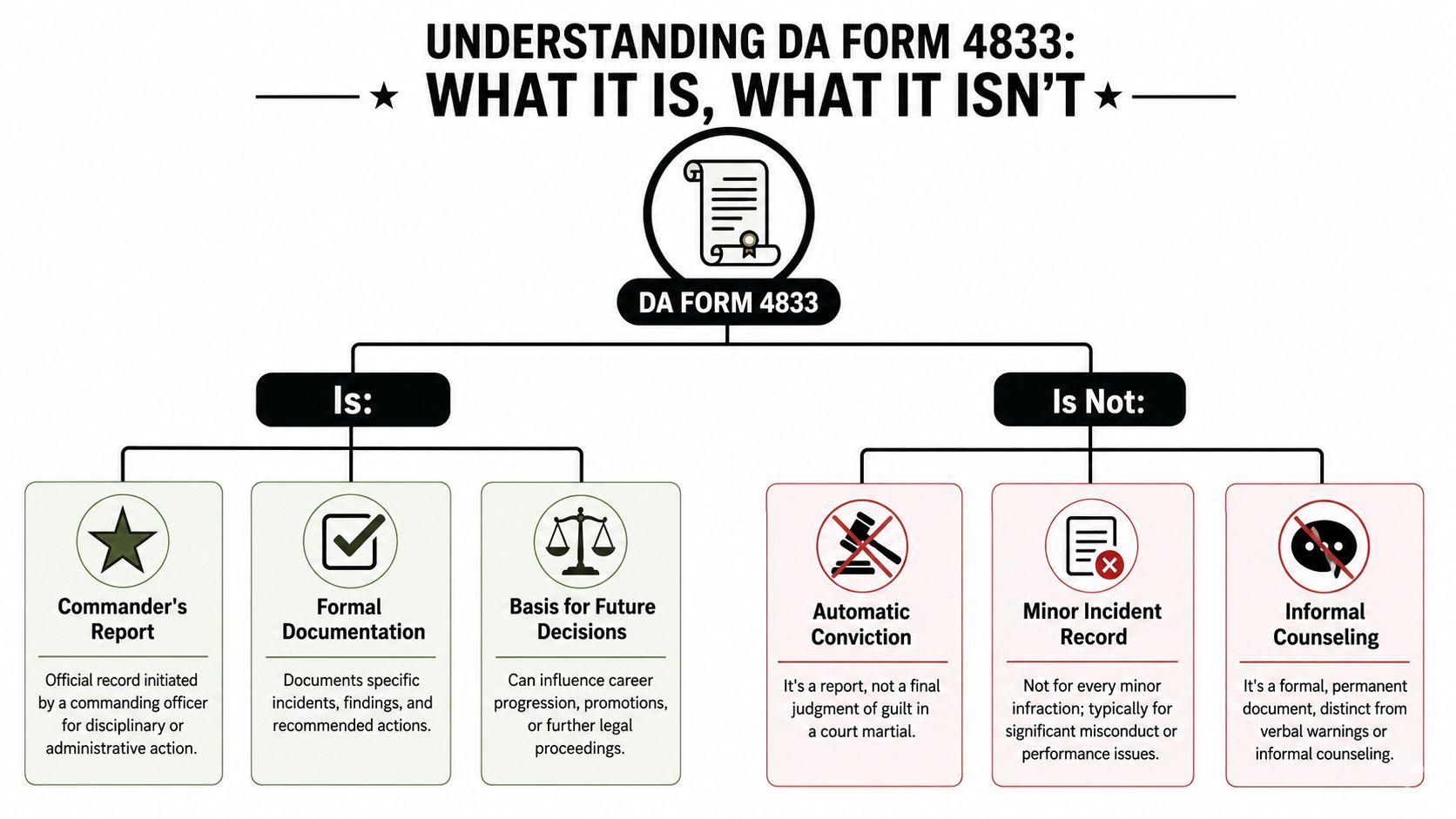
A DA Form 4833 is not a conviction, not a court-martial finding, and not a ruling by a neutral judge. It does not mean the evidence holds up under pressure. It means command chose to memorialize its response in a form that can be reused later, often against you.
Use this framework:
| What it is | What it isn’t |
|---|---|
| A command record tied to a CID or MP investigation | A final judgment of guilt |
| A written government version of the event | A neutral account |
| A document later readers may rely on | A harmless admin note |
| A starting point for future adverse action | Your full defense |
That last point is where soldiers get blindsided. They assume they can fix the story later. They usually cannot. Once this form exists, commanders, separation authorities, and records reviewers may treat it as the baseline version of events. If the wording is wrong, incomplete, or unfair, you need to start countering it early, while the facts, witnesses, and timeline are still within reach.
A Tactical Guide to Reading the Form
Read it like government evidence
Stop looking at the DA Form 4833 like an HR form. Read it like an exhibit the government hopes nobody challenges.
Every block on that form tells you what command wants future readers to believe. The goal isn’t just to document an event. The goal is to create a neat, digestible official record that makes later action easier. Separation authority reads it. Board members read it. Appellate reviewers may read it with no live witnesses in front of them.
That means your reaction should be disciplined. Get a copy. Read every line. Compare it to the investigation, counseling statements, sworn statements, text messages, and any timeline you can build. Don’t focus only on dramatic accusations. Small wording choices can be just as damaging.
A single conclusory phrase can do more damage than a stack of weak evidence if nobody challenges it.
The blocks that matter most
Some parts of the form deserve more attention than others.
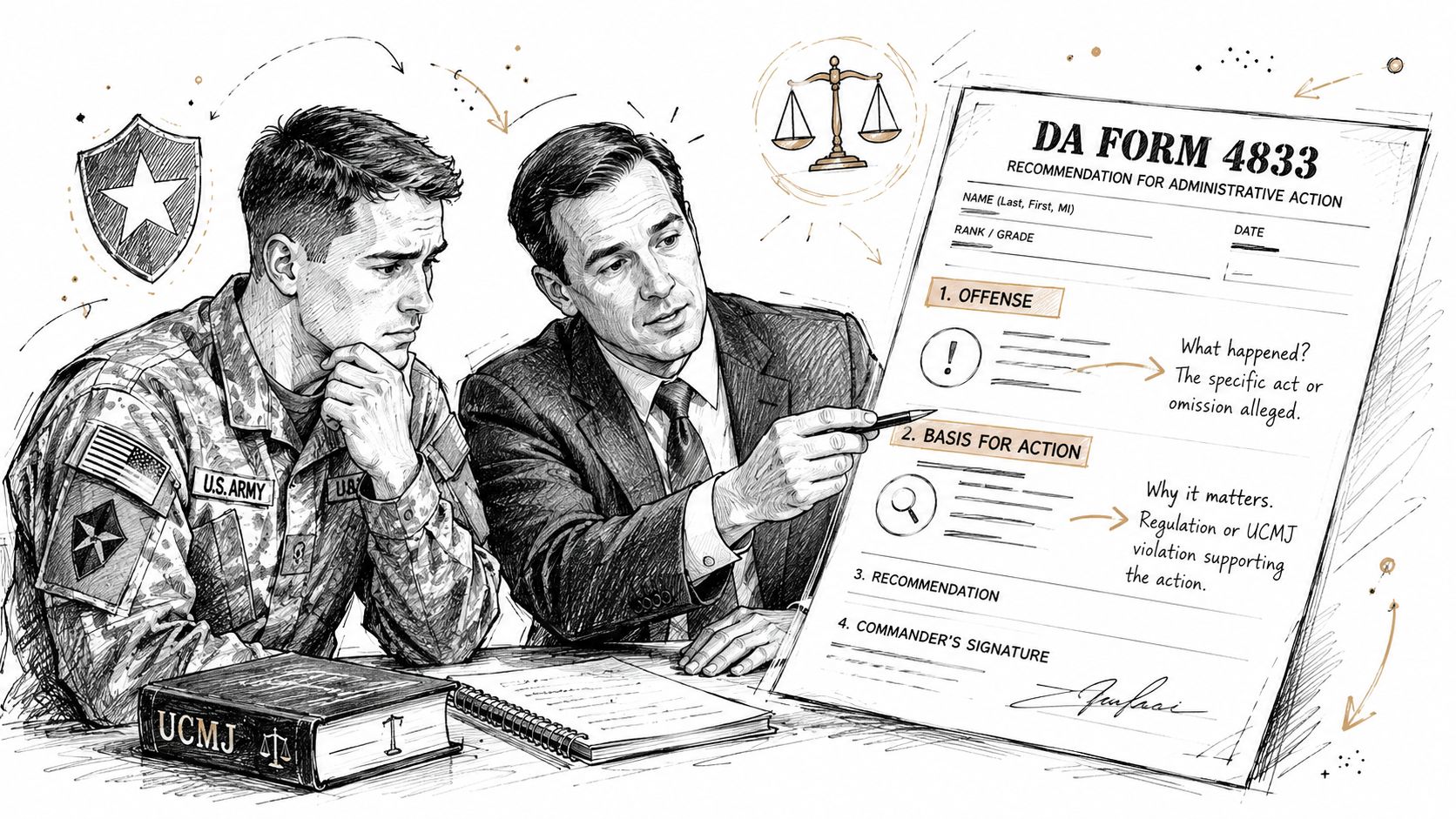
Offense entry
At this point, command labels the conduct. The wording matters. Broad or loaded language can make a weak case look stronger than it is. If the offense description overstates what happened, leaves out context, or merges separate events into one ugly summary, that needs to be addressed immediately.
Ask yourself:
- Is the offense description specific: Does it identify actual conduct, or does it lean on vague accusations?
- Does it match the evidence: If the statements are mixed, incomplete, or contradictory, the form shouldn’t read like guilt is settled.
- Does it hide defenses: Mistaken identity, credibility problems, and missing context often disappear in one-line summaries.
Basis for action
This block is often where the most trouble starts. Commanders sometimes write conclusions instead of facts. They state what they believe happened without showing how they got there. That’s dangerous because later readers may never see the weakness underneath.
Look for language that sounds final without support. Phrases that collapse allegation, investigation, and conclusion into one sentence are red flags. If the basis section ignores favorable evidence, witness bias, timeline problems, or investigative gaps, your rebuttal needs to attack that directly.
Action taken
This section tells future readers what command did with the case. It can shape how serious the matter looks later, even if the underlying proof was weak. A person reviewing your file years from now may not know the context. They may just see that command took action and assume the facts were solid.
Watch for anything that suggests acceptance, admission, or uncontested findings. If action was taken for reasons unrelated to actual guilt, such as expediency, pressure, or command climate, your defense file should preserve that context now while it still exists.
Your job is review and rebuttal
The commander fills out the DA Form 4833. You don’t. This is not your confession, and it is not your chance to pour your heart out in a sloppy handwritten explanation.
Your role is narrower and more important. Review. Identify inaccuracies. Build a rebuttal that is factual, disciplined, and aimed at the long game.
A useful first-pass checklist looks like this:
- Verify identifiers. Names, dates of birth, incident dates, and other identifying details matter. Errors here can signal deeper sloppiness.
- Compare narratives. Match the form against the actual investigative record.
- Flag conclusions dressed as facts. Separate observed facts from command opinion.
- Preserve favorable evidence. Screenshots, witness names, timeline notes, and contradictory statements need to be saved before they disappear.
- Draft for future boards. Write with the understanding that someone years from now may read only this paper and your rebuttal.
If you’re under pressure to explain yourself verbally, don’t freelance. Calmly say you want counsel before making any statement.
How This Form Becomes a Permanent Weapon Against You
Why the narrative matters more than people think
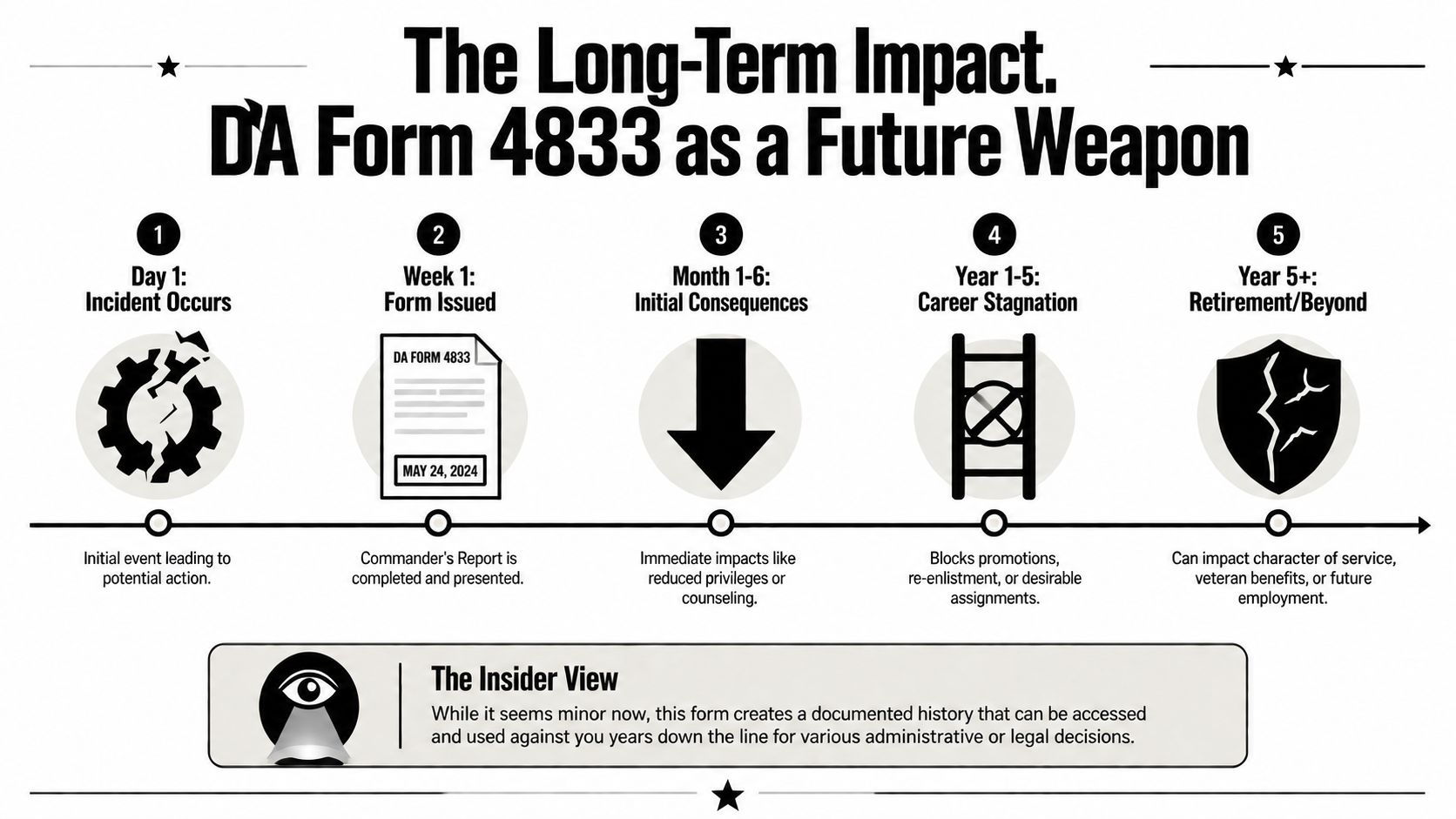
You get accused. Command closes the loop on paper. Months or years later, a board, a reviewer, or a new commander pulls the file and sees one clean government summary sitting there like settled history. That is how DA Form 4833 hurts people long after the original case went cold.
Most articles waste space explaining the boxes. The main fight is over the story the form locks into your record. Once that story sits there without a disciplined response, future decision-makers often treat it as reliable enough to act on. They were not in the room. They do not know the pressure, the shortcuts, the witness problems, or the missing facts. They see official paperwork and move on.
That is why this form becomes a weapon.
A bad narrative on a DA Form 4833 can follow you into separation action, adverse paperwork, promotion problems, clearance issues, and later record-correction fights. If the form paints you as dishonest, dangerous, reckless, or unwilling to follow orders, that framing can keep showing up in places where the stakes are even higher than the original incident.
Hard truth: The form may outlive the people who wrote it. Your response has to outlive them too.
The BCMR trap
The danger gets worse when you try to fix your record later. In correction cases, a DA Form 4833 can become one of the few documents a board focuses on, especially if the rest of the file is thin, missing context, or poorly organized. That problem shows up in this Army BCMR case material.
Read that for what it means, not just what it says. A future board may know nothing about your command climate, the weak investigation, the witness with an agenda, or the evidence nobody preserved. They may see the DA Form 4833, your personnel record, and whatever rebuttal you managed to get into the file. If your side is vague or emotional, the government’s version wins by default.
That is why your response must be built for the long war, not just today’s meeting with command.
Soldiers lose these fights when they write like they are begging for mercy instead of proving error. Future boards care about contradictions, missing facts, unsupported conclusions, and records that show unfairness in a way they can act on. If the case is already moving, study how experienced counsel fight during the military investigation phase because early pressure can shape what ends up in the permanent file.
A strong response to a DA Form 4833 does three jobs at once:
- Attacks factual errors with dates, documents, names, and specific contradictions.
- Exposes what command left out such as witness bias, inconsistent statements, missing evidence, or timeline gaps.
- Builds a future board record that supports a later claim of error or injustice.
Miss that chance, and the Army’s version becomes the official memory of what happened. That is the trap.
Devastating Mistakes Soldiers Make with a DA Form 4833
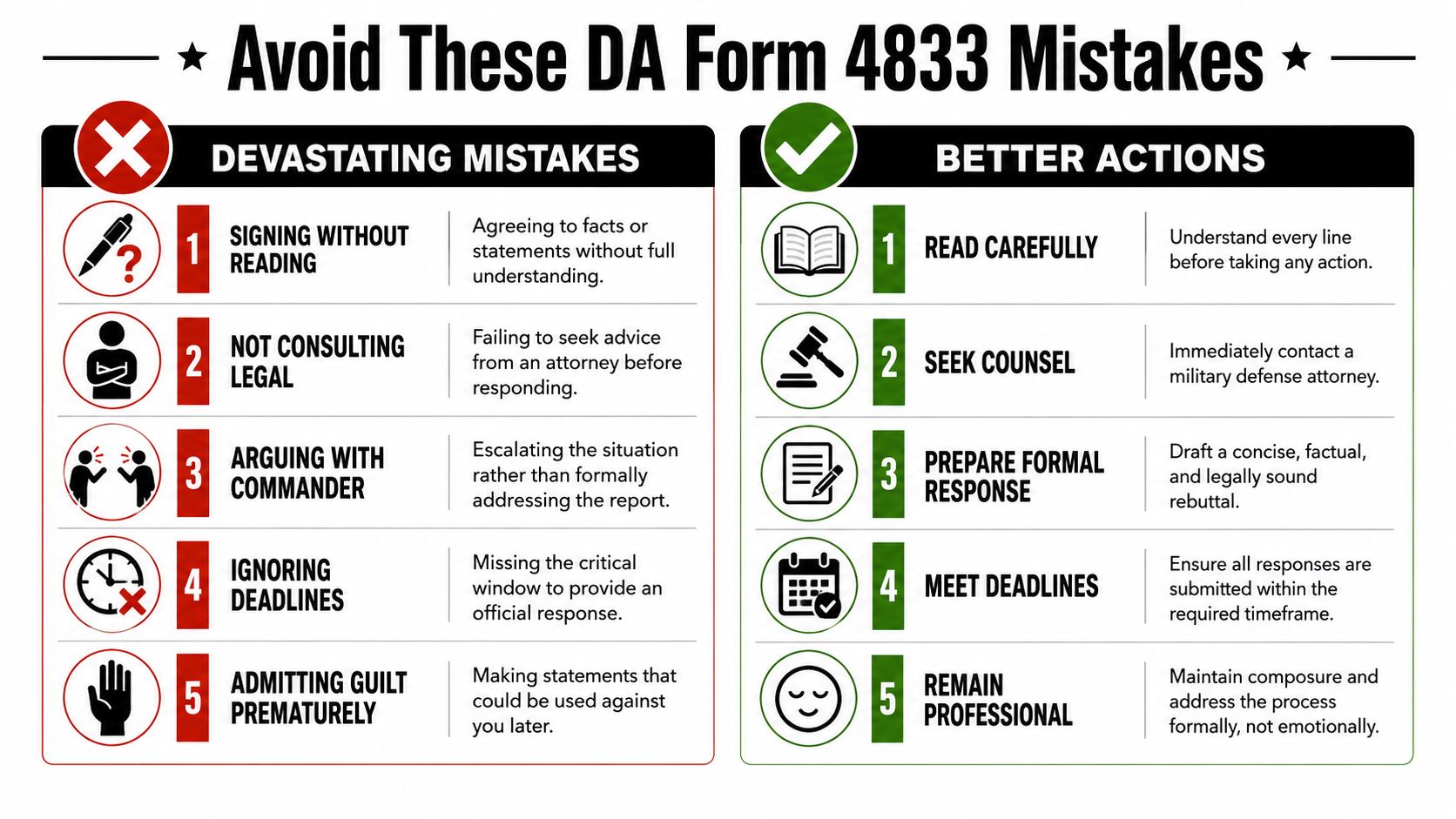
Five mistakes that wreck good defenses
Solid defenses get crippled by bad instincts. If DA Form 4833 is in play, avoid these errors.
Treating it like routine paperwork
This is how people get blindsided later. The form looks administrative, so they assume it has limited impact. Wrong. Treat it like a permanent government exhibit.Writing your own rebuttal without legal review
Smart people do this all the time and still hurt themselves. They include admissions they didn’t realize were admissions, or they argue emotion instead of facts. A bad rebuttal gives the government more material.Trying to explain everything to command before seeing the evidence
Command isn’t your therapist. Casual explanations can lock you into details before you know what investigators have, what witnesses said, or where the timeline really breaks.Believing innocence will sort it out automatically
It won’t. The system does not wake up every morning looking for ways to protect the accused. If your side isn’t built and preserved, incomplete evidence can harden into accepted truth.Waiting too long to get help
Delay is deadly in military cases. Witnesses drift. Phones change. Screenshots vanish. Memory softens. Command paperwork keeps moving.
Some other mistakes show up often and deserve quick mention:
- Signing without reading carefully
- Arguing emotionally with the commander
- Ignoring suspense dates
- Assuming there is no risk because there hasn’t been a court-martial referral
- Confusing cooperation with surrender
The safest move is usually the least dramatic one. Say less, get records, and build your response with counsel.
Why Your Appointed Military Lawyer Is Not Enough
Independence changes the fight
If you’re facing a DA Form 4833 issue, you’ll likely have access to appointed military counsel at some stage. Use them. But don’t fool yourself into thinking that is always enough when your career, retirement, and record are on the line.
A seasoned civilian military defense lawyer brings one advantage that changes everything. Independence. Civilian counsel works for you. Not the command. Not the office. Not a rating chain. That matters when strategy requires pushing hard, challenging assumptions, and refusing to accept the convenient government version of events.
Appointed counsel can be capable and dedicated. Many are. But the structure around them is still the structure around them. A civilian lawyer doesn’t have to worry about office politics, future assignments, or how aggressive resistance will be received inside the system.
Experience and bandwidth matter
The next difference is experience. A battle-tested civilian attorney may have handled these cases across installations, commands, and branches. That matters because DA Form 4833 problems rarely live alone. They show up next to CID investigations, Article 15 decisions, adverse separation actions, GOMOR fights, and later record correction issues.
Then there’s bandwidth. Appointed defense counsel often carry heavy caseloads. That’s reality. A private lawyer you hire has to justify every dollar by focusing on your case, digging into the paperwork, and helping build a defense file that works now and later.
If you’re evaluating options, be deliberate about it. Compare trial background, military justice depth, and actual strategy, not just personality. This guide on how to choose a military defense lawyer is a useful place to start.
Here’s the blunt version:
| Appointed counsel | Experienced civilian counsel |
|---|---|
| Helpful, but constrained by workload and system realities | Independent and focused on your interests alone |
| May be early in military justice practice | Often brings long-term, installation-wide experience |
| Usually reactive to case flow | Can build a proactive record strategy immediately |
When the paper trail itself is the battlefield, independence and experience aren’t luxuries. They’re an advantage.
Frequently Asked Questions About DA Form 4833
Do I have to sign the DA Form 4833
Maybe you may be asked to acknowledge receipt, but don’t treat any signature lightly. Read first. Get advice first. Never assume a signature is harmless.
Does a DA Form 4833 mean I will get a GOMOR
No. It doesn’t automatically mean a GOMOR is coming. But it can become part of the paper foundation for later adverse action, so you need to respond as if future consequences are very real.
Can this form affect my security clearance
It can. Anything that creates an official misconduct narrative can create follow-on problems for trust, judgment, and reliability issues in later reviews.
How long do I have to respond
That depends on what command gives you and what other action is tied to the form. Don’t guess. Ask for the suspense in writing and get counsel involved immediately.
Will this show up on a civilian background check
Not in the simple way many soldiers fear, but the smarter question is different. Could this record affect discharge characterization, future military paperwork, federal employment issues, or later reviews that matter to your life after service? Yes.
Should I talk to CID or MPs to clear things up
Not without legal advice. Trying to clear things up is one of the fastest ways to give investigators the last missing piece they needed.
Can I beat this if the form already exists
Yes, sometimes. But the fight is harder once the record is created. At that point, the goal is to attack inaccuracies fast and preserve a strong rebuttal for every future proceeding.
Take Action Before This Record Hardens Against You
If a DA Form 4833 is being created in your case, this is not the time to stay calm in the passive sense. Stay controlled, yes. Stay quiet, yes. But act.
Get the paperwork. Protect your phone and messages. Stop explaining yourself to command and investigators. Build a rebuttal that works not just for today, but for the separation board, the security review, and the records fight that may come years later.
In these critical moments, strong military defense lawyers, court-martial attorneys, and a serious UCMJ lawyer earn their keep. Early action matters because once bad language gets into the file, later boards often treat it like established history.
If you’re under investigation or your command is using a DA Form 4833 against you, get experienced civilian counsel involved now. Don’t wait until the deadline is tomorrow and the record is already poisoned. Your career is on the line, your reputation is on the line, and in some cases your freedom is on the line. If you need help finding qualified civilian defense counsel, start by reviewing options.