You’ve just been told that an Article 32 UCMJ preliminary hearing is coming. Maybe a commander handed you paperwork. Maybe investigators have already taken statements, seized devices, or interviewed people you work with. You’re trying to understand whether this is a routine administrative step or the beginning of a court-martial that could damage your freedom, career, clearance, family life, and reputation.
Treat it as a fight, not paperwork. Article 32 is not a trial, but it can influence which charges move forward, whether the case is referred to a general court-martial, what weaknesses enter the record, and how much influence your defense has later. The hearing officer’s recommendation doesn’t bind the convening authority, but a carefully built record can still affect referral strategy and preserve objections for litigation.
Table of Contents
- You Just Learned About an Article 32 Hearing and Need the Truth
- What Article 32 of the UCMJ Actually Says Now
- The Four Determinations That Drive Every Hearing
- How the Hearing Unfolds From Notice to Recommendation
- Your Rights as the Accused and What Counsel Does With Them
- Smart Defense Strategies and Mistakes That Destroy Cases
- Why Civilian Military Defense Counsel Changes the Outcome
- Prepare Now and Contact a Civilian UCMJ Lawyer
You Just Learned About an Article 32 Hearing and Need the Truth
The notification arrives, and your stomach drops. You may not know what the allegations are based on, who has accused you, or what evidence the government claims to possess. Someone may tell you that an Article 32 hearing is “just a formality” because the government has already decided what it wants to do.
That advice is dangerous.
An Article 32 preliminary hearing is a required pre-referral screening step for charges headed to a general court-martial, unless the accused waives the hearing. The hearing officer examines probable cause, jurisdiction, the form of the charges, and disposition. The Army Criminal Law Deskbook’s explanation of Article 32 preliminary hearings describes the hearing as a limited process, with an advisory result that doesn’t control the convening authority.
The modern hearing is narrower than the old investigation. Congress rewrote Article 32 through the National Defense Authorization Act for Fiscal Year 2014. That law was signed on December 26, 2013, and the revised process took effect on December 26, 2014. The Military Justice Act of 2016 then made further amendments in Pub. L. No. 114-328, § 5203(a)-(d), 130 Stat. 2000, 2905–06, meaning Article 32 changed twice within about three years. The Joint Service Committee’s UCMJ amendments materials document that shift.
The harmless-formality myth
The hearing won’t decide guilt. It can still expose inconsistent testimony, defective specifications, jurisdictional problems, missing forensic work, and investigative shortcuts. It can also create a recorded account that matters when a witness later changes the story.
The government doesn’t need to prove the case beyond a reasonable doubt at this stage. It must establish probable cause, a lower threshold. That doesn’t mean the government gets a free pass. A defense lawyer who prepares early can force the prosecution to confront weaknesses before referral, rather than waiting until the case has acquired institutional momentum.
Practical rule: Never waive or coast through Article 32 because someone calls it routine. Make that decision only after counsel evaluates the evidence, witnesses, charges, and referral consequences.
What Article 32 of the UCMJ Actually Says Now
The current Article 32 framework requires a preliminary hearing before charges can be referred to a general court-martial, unless the accused waives the hearing. The hearing isn’t a second trial. It’s a controlled examination of whether the government has a legally sufficient case to send forward.
The Defense Advisory Committee on Investigation, Prosecution, and Administration of Military Justice materials describe the hearing’s limited purpose. The preliminary hearing officer, or PHO, focuses on four determinations:
- Whether there’s probable cause to believe an offense was committed and the accused committed it.
- Whether the charges and specifications properly state an offense.
- Whether the court-martial has jurisdiction over the accused and the alleged offense.
- What disposition the PHO should recommend.
The post-2014 process replaced the older “thorough and impartial investigation” model with a narrower preliminary hearing focused on screening. The revised hearing isn’t designed to conduct broad discovery or recreate the government’s entire investigation. Congress characterized the new process as a limited pre-referral review, and updated court-martial rules implemented the change in 2015.

What changed for the accused
The old process gave the defense a broader investigative platform. The current process still permits meaningful participation, but live testimony and discovery are more constrained. A victim can’t be forced to testify at the preliminary hearing. If the victim declines, the victim is treated as unavailable for that hearing. The hearing must be recorded, and a victim may request a copy of the recording under Rule 32 of the Manual for Courts-Martial.
The PHO’s recommendation is advisory. The convening authority can still refer charges even when the PHO recommends a different disposition. That limitation is precisely why counsel must build a persuasive record instead of assuming the PHO alone can end the case.
In plain English, Article 32 orders the PHO to ask whether the charges are legally recognizable, whether military jurisdiction exists, whether probable cause supports the allegations, and what should happen next. Your defense should answer each question with evidence, objections, and a practical recommendation.
The Four Determinations That Drive Every Hearing
The four Article 32 determinations aren’t boxes to check. Each creates a distinct defense target, and experienced counsel organizes the hearing around those targets rather than trying to win the entire case in one sitting.
| Determination | What the PHO Must Find | Defense Target |
|---|---|---|
| Probable cause | A reasonable basis to believe the offense occurred and the accused committed it | Contradictory accounts, missing evidence, unreliable identification, investigative gaps |
| Form of charges | The specifications state an offense and give adequate notice | Vague language, missing elements, incorrect theory, defective wording |
| Jurisdiction | The UCMJ and court-martial have authority over the accused and offense | Status problems, offense coverage, timing issues, location or jurisdiction gaps |
| Disposition | A recommendation about referral, dismissal, reduction, or another appropriate action | A record that gives the convening authority a rational basis to narrow or stop the case |
Probable cause is low, not meaningless
Probable cause doesn’t require proof beyond a reasonable doubt. It does require more than an accusation with no supporting basis. Cross-examination should test what the witness knows, what the investigation failed to verify, and whether the government’s timeline can survive scrutiny.
A weak witness may still get the government past probable cause. That doesn’t make the testimony harmless. A recorded inconsistency can become valuable impeachment material later, especially when the witness changes key details at trial.
Charge form and jurisdiction create technical pressure points
A specification must describe an offense under the UCMJ. If the wording doesn’t identify the required conduct, fails to give adequate notice, or relies on a legally unsupported theory, counsel should raise the defect instead of treating it as clerical.
Jurisdiction deserves the same attention. The defense should examine the accused’s military status, the alleged conduct, the applicable offense, and the relevant timeframe. A strong disposition recommendation can then explain why a defect, evidentiary weakness, or disproportionate charge makes referral inappropriate.
The best Article 32 result may be dismissal. It may also be reduced charges, a different forum, or a report that preserves a clean challenge for later litigation.
How the Hearing Unfolds From Notice to Recommendation
The process begins when the accused receives notice of the charges and preliminary hearing. The hearing officer is detailed by the convening authority. That officer isn’t the accused’s advocate, and the defense should never assume the PHO will discover weaknesses without targeted preparation.
Step 1 starts with counsel and the packet
The accused has a five-day counsel window identified in the governing process. Use it immediately. Counsel should obtain the charge sheet, supporting documents, investigative materials, command memoranda, witness information, and any available digital or forensic evidence.
Before the hearing, the PHO handles preliminary matters on the record. Those matters may include scheduling, witness availability, requests for evidence, defense objections, and the scope of testimony. If the government amends specifications or a key witness becomes unavailable, counsel should assess whether the defense needs additional time.
Step 2 is the government presentation
The government presents its witnesses and evidence within the limited Article 32 scope. The defense can cross-examine witnesses, challenge the government’s theory, and expose gaps in the proof. A victim can’t be compelled to testify, so the government may rely on other witnesses, statements, records, or investigative evidence.
The hearing is recorded. That record matters. A witness who gives one account at Article 32 and another later may create a credibility problem the defense can use in motions, negotiations, or trial cross-examination.
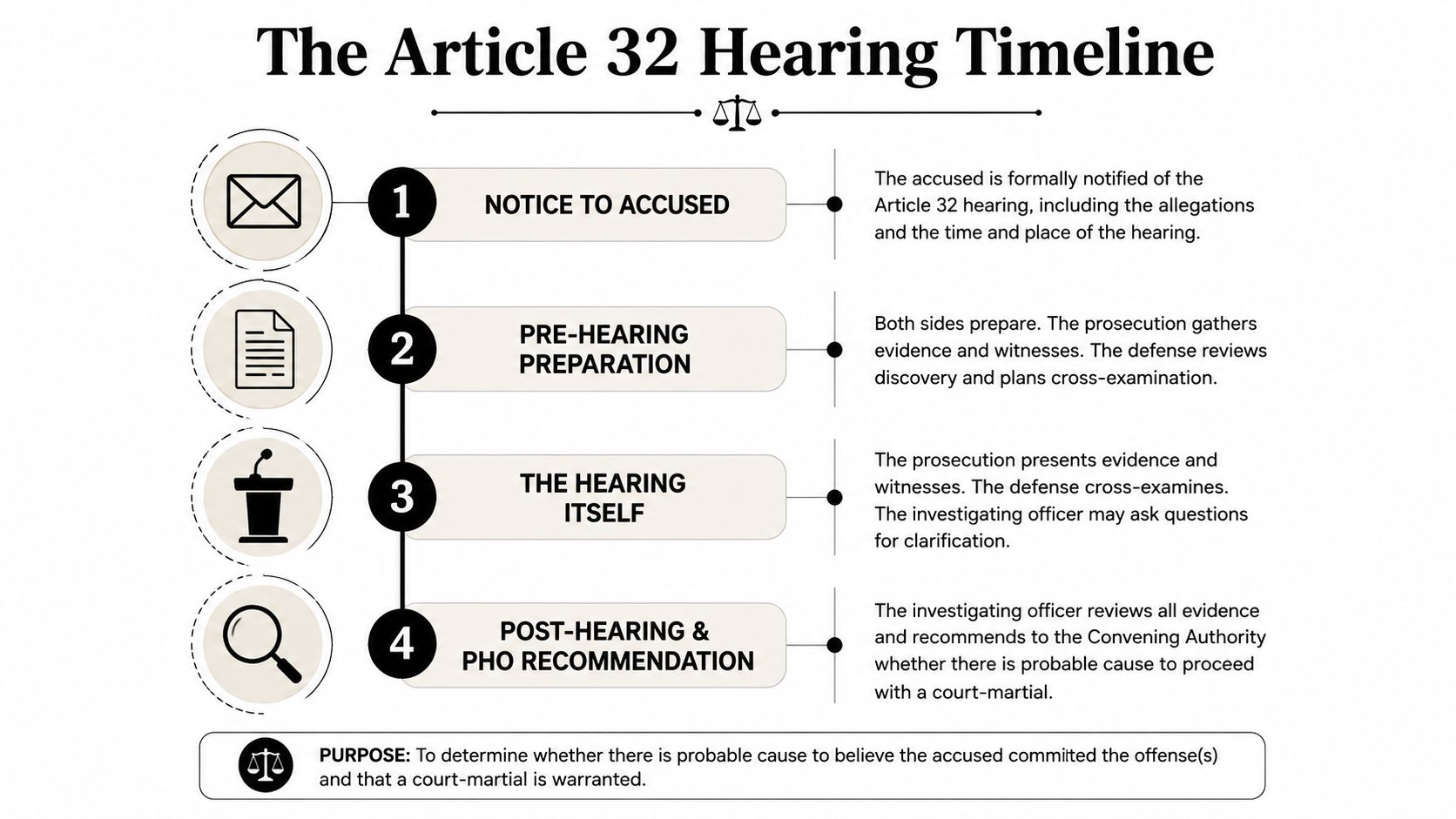
Step 3 gives the defense a controlled opportunity to respond
Defense counsel may present witnesses, documents, mitigation, and arguments aimed at the four determinations. That doesn’t mean calling every favorable person or submitting every document. The defense must decide what helps the referral decision and what merely gives the government additional material.
After argument, the PHO prepares a written recommendation addressing the evidence, reasonable grounds, jurisdiction, charge sufficiency, and disposition. The convening authority reviews that recommendation and decides whether to dismiss, modify, or refer charges, including referral to an appropriate court-martial forum or another disposition.
For a broader explanation of how the military justice process fits together, review these court-martial basics. Don’t rely on a generic timeline to predict your case. Witness volume, charge complexity, evidence access, and command decisions can change the path.
Your Rights as the Accused and What Counsel Does With Them
Your rights at Article 32 aren’t ceremonial. They’re tools. If you don’t use them deliberately, the government controls the narrative before a judge or panel ever hears the case.
You have the right to know the charges, consult qualified counsel, participate in the hearing, cross-examine government witnesses, present evidence, remain silent, seek witness attendance through the PHO, and receive a written recommendation. Counsel turns those rights into concrete preparation.
Rights become preparation tasks
A serious defense team should build an outline for every government witness, identify contradictions before questioning begins, and request witnesses whose testimony affects probable cause or disposition. Documentary evidence may include messages, location records, medical material, duty records, and other admissible or potentially relevant information.
The right to remain silent is especially important. An accused’s statement can become the government’s strongest evidence if it contains admissions, unnecessary explanations, or contradictions. A carefully considered unsworn statement may help in some cases, but it should never be improvised.
The Article 31 UCMJ resource explains why questioning and warning issues deserve early attention. If investigators or command obtained statements improperly, counsel should preserve the facts and develop the issue for later litigation.
Defense position: The hearing isn’t the place to tell your entire life story. It’s the place to make the government prove that its charges, jurisdiction, evidence, and requested disposition deserve to move forward.

Use the video below as a general orientation, not as a substitute for case-specific advice.
Smart Defense Strategies and Mistakes That Destroy Cases
Consider a service member facing allegations of sexual assault and possession of controlled substances. The government’s file looks intimidating. There are witness statements, a seized phone, a laboratory issue, and command pressure to move quickly.
The case may still have serious weaknesses. But those weaknesses disappear if the defense waits until trial to investigate.
What poor preparation looks like
The accused assumes the Article 32 hearing will reveal everything. Counsel doesn’t seek targeted digital discovery, doesn’t consult a forensic expert, and doesn’t subpoena a supervisor who saw the parties together before the alleged incident. The accused then makes an unsworn statement without rehearsing the boundaries, waives objections, and accepts the PHO’s description of the case without building a competing record.
That sequence gives the government momentum. It also risks turning an incomplete investigation into a polished referral package.
| Accused’s Mistake | Defense Strategy |
|---|---|
| Treating Article 32 as a formality | Identify the four determinations and prepare a specific challenge to each |
| Failing to investigate before the hearing | Build a pre-hearing plan for witnesses, records, digital evidence, and forensic issues |
| Skipping digital or forensic review | Consult qualified experts and test collection, preservation, interpretation, and chain-of-custody issues |
| Ignoring favorable witnesses | Request attendance through the PHO when testimony bears on probable cause or disposition |
| Making an unprepared statement | Decide with counsel whether silence, testimony, or a calibrated unsworn statement best protects the case |
| Waiving objections | Put defects and procedural problems on the record for later motions |
| Accepting the government’s framing | Use cross-examination and documents to present a precise alternative theory |
The strategic objective
The objective isn’t theatrical cross-examination. It’s controlled damage to the government’s referral theory. A witness who can’t explain a timeline, a laboratory process that leaves unanswered questions, or a specification that doesn’t match the alleged conduct can change the practical conversation.
Counsel should also approach the convening authority’s decision strategically. A recommendation for dismissal or reduced charges must give decision-makers a defensible reason to act. That means connecting the evidence problems to the legal determinations and showing why referral creates unnecessary risk.
The Military Justice Review Panel’s comprehensive review flagged the narrow discovery framework as a weakness and recommended reasonable discovery while retaining victim protections. That reinforces the practical point: don’t assume the existing hearing will supply everything the defense needs. Request what matters, investigate what you can, and preserve what the government refuses to provide.
Why Civilian Military Defense Counsel Changes the Outcome
Military-appointed defense counsel and Trial Defense Service lawyers perform essential work. They know the system, understand military procedure, and often handle difficult cases under intense conditions. The issue isn’t personal loyalty or competence. The issue is strategic independence, available bandwidth, and specialized focus.
A civilian military defense lawyer doesn’t sit inside the command structure that initiated or supported the investigation. Civilian counsel can build a defense team around the case, including private investigators, medical professionals, digital-forensics consultants, and other experts when appropriate. That independence also changes negotiation dynamics before referral.
The practical difference
A military defense lawyer may carry several competing duties and work within assignment and resource limits. A civilian lawyer’s practice can be dedicated to court-martial defense, high-stakes investigations, and trial preparation. You should ask about actual Article 32 experience, cross-examination, felony litigation, expert use, and results in cases with comparable evidence problems.
Civilian counsel can also challenge the government’s narrative without worrying about future military assignments or command relationships. That doesn’t guarantee a result. It does give the defense a separate professional base from which to investigate and negotiate.
The same principle applies to how you evaluate any professional service. Clear authority, specific experience, and evidence of substantive work matter more than polished claims. A resource on content strategy for St. Petersburg businesses offers a useful analogy. Good decisions depend on relevant information presented clearly, not on vague promises.

Choose counsel based on the person who will control the defense narrative, investigate the facts, protect the record, and confront the government’s theory. In a serious case, that choice is strategic, not cosmetic.
Prepare Now and Contact a Civilian UCMJ Lawyer
Start within the first day after notification. Don’t wait for the hearing date to become urgent.
Your immediate preparation checklist
- Preserve communications: Keep texts, emails, photos, direct messages, call records, and social media content. Don’t edit, delete, or forward material casually.
- Write a private account: Record dates, locations, people present, conversations, and what you remember while the facts are fresh. Give it to counsel, not command.
- Collect the packet: Obtain the Article 32 notice, charge sheet, supporting documents, command memoranda, and correspondence referring to the allegations.
- Identify witnesses: List supervisors, coworkers, friends, medical personnel, and anyone who can address the events, timeline, credibility, or context.
- Gather service records: Assemble awards, evaluations, duty history, training records, and character references for counsel to assess.
- Stop discussing the case: Don’t explain yourself to investigators, command, coworkers, friends, or social media followers. Discuss the matter with counsel.
If you need a broader explanation of defense representation, review these court-martial defense lawyers. Then ask a lawyer to assess your facts rather than relying on a general internet answer.
Questions accused service members ask
Should I testify at Article 32
Usually, an accused should not testify without a specific legal reason and careful preparation. Testimony is recorded and can create admissions or inconsistencies that the government may use later. Your counsel should compare the value of your account against the risks before making that decision.
How long does referral take
There isn’t one reliable timeline for every case. The process depends on the charges, evidence, witness availability, requests for additional preparation, amendments, and the convening authority’s review. Ask counsel to identify the next decision points in your case instead of relying on a generic estimate.
What happens if the PHO recommends dismissal
The PHO may recommend dismissal or another disposition, but the recommendation doesn’t bind the convening authority. The government may still refer charges, modify them, seek another disposition, or take additional action within the governing rules. Counsel should respond quickly with a written strategy addressing the recommendation and referral risk.
Can I waive the hearing
Yes, an accused may waive Article 32, but waiver gives up an opportunity to test the government’s evidence within the preliminary hearing process. Waiver can sometimes serve a deliberate negotiation or disclosure strategy. It should never happen because preparation feels difficult.
Does the hearing use a preponderance standard
No. The Article 32 standard is probable cause, not proof beyond a reasonable doubt. Probable cause is a lower screening threshold, but the PHO still evaluates whether the alleged offense, jurisdiction, evidence, and disposition support moving forward.
Can I keep military counsel and hire civilian counsel
Discuss the arrangement with both lawyers. Civilian counsel may work alongside assigned military counsel, subject to the applicable rules and representation decisions. The important point is to establish one coordinated strategy, clear responsibility, and a consistent position before the hearing.
Article 32 is where an incomplete government case can either be exposed or strengthened. Don’t give investigators, command, or the PHO an uncontested narrative. Bring the notification letter, charge sheet, and complete packet to the first call. Your career, freedom, and future deserve immediate legal attention.
If you’ve received Article 32 notice or believe a general court-martial referral is coming, contact experienced civilian military defense counsel today. Don’t wait for the hearing date, the next interview, or the referral decision. Have a lawyer review the charges, evidence, witnesses, and waiver decision before the government’s version becomes the official record.