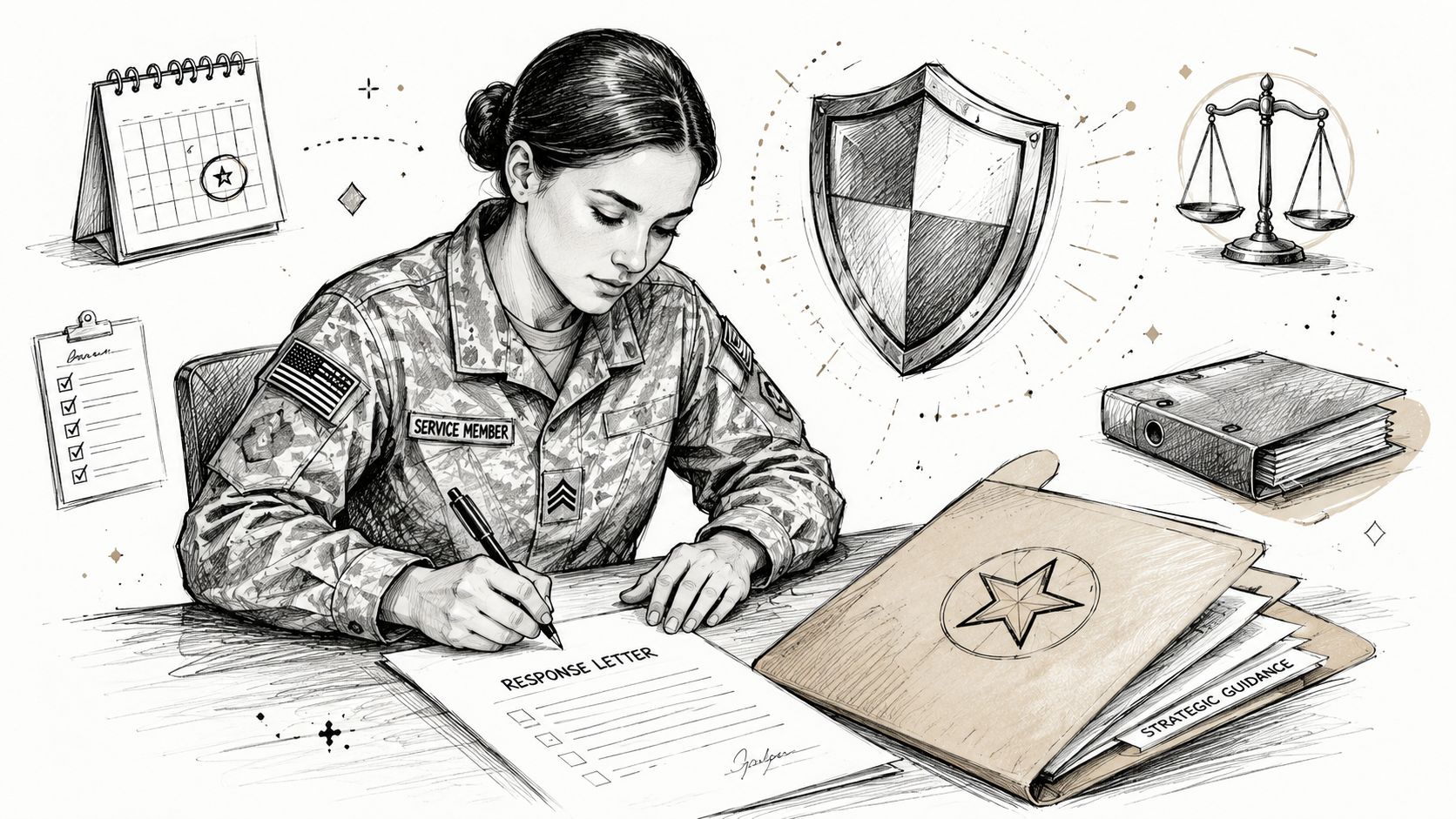
You’re handed a manila folder by your NCOIC. Inside is an Article 15 notification, a list of alleged offenses, possible punishment, and a hearing date that may arrive before you’ve processed what happened. Your career, promotion prospects, security clearance, reputation, and future assignments can all be affected by how you respond in the next few days.
An Article 15 response isn’t a routine counseling exercise. Article 15 of the UCMJ is the statutory authority for nonjudicial punishment, and the modern system took its present form when the UCMJ became effective in 1950. Congress amended Article 15 in 1962 to reduce courts-martial for minor offenses, making NJP a central command-level discipline process rather than a criminal conviction proceeding. Army University Press explains the history and structure of NJP.
The process is common, but “common” doesn’t mean harmless. Your first decision can affect the punishment imposed today and the government’s view of you tomorrow. Treat the paperwork as the opening move in a broader career defense strategy.
Table of Contents
- What Happens When You Receive Article 15 Paperwork
- Deciding Whether to Accept or Refuse Nonjudicial Punishment
- Building a Mitigation Packet That Commanders Take Seriously
- Critical Mistakes That Destroy Your Leverage
- Protecting Against Downstream Consequences and Appeals
- Why Civilian Defense Counsel Changes the Outcome
- Article 15 Response Frequently Asked Questions
- Can I refuse to talk to investigators?
- Do I need a lawyer immediately?
- Is an Article 15 a criminal conviction?
- Can I demand trial by court-martial?
- What can I present at an Article 15 hearing?
- How long do I have to appeal?
- Can an Article 15 lead to separation?
- Should I accept NJP if the evidence is strong?
What Happens When You Receive Article 15 Paperwork
The first mistake is emotional. The second is talking before you understand your rights.
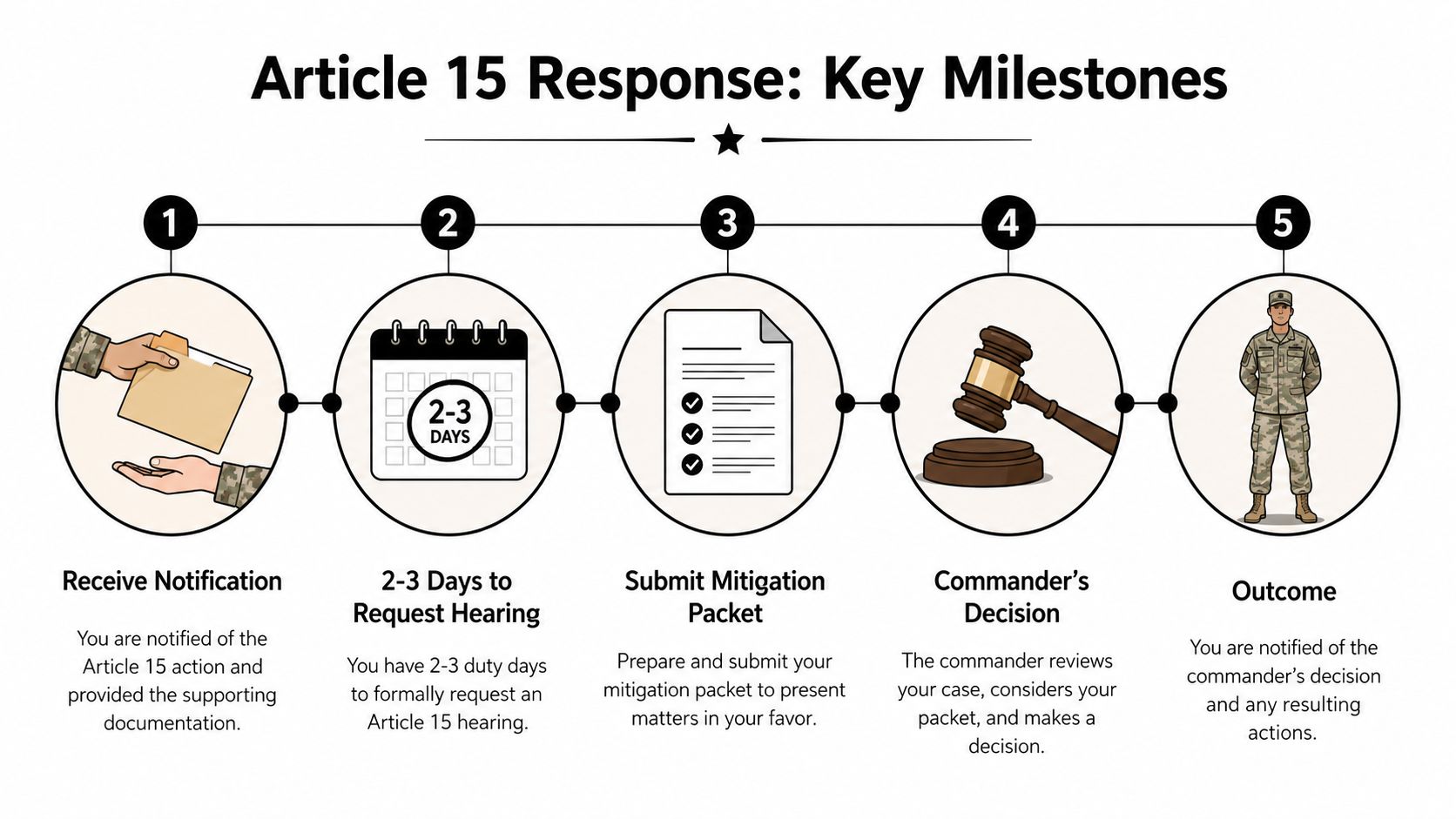
Read every page carefully. Identify the alleged offenses, the commander’s authority, the type of proceeding, the maximum punishment listed, and the date by which you must respond. The paperwork should address your right to consult counsel, your right to demand trial by court-martial instead of accepting NJP, and your right to present matters in defense, extenuation, and mitigation.
You can also request witnesses and submit written or oral matters. You have the right to review the adverse evidence considered in the proceeding. Those rights matter only if you use them deliberately.
Your first decisions
Do these things immediately:
- Preserve the paperwork: Photograph or copy every page, including attachments, endorsements, and deadlines.
- Request counsel: Speak with defense counsel before making admissions, signing elections, or explaining the incident to your chain of command.
- Review the evidence: Ask what adverse evidence the commander intends to consider and compare it with the specifications.
- Build a timeline: Write down dates, locations, names, communications, and witnesses while your memory is fresh.
- Protect communications: Don’t discuss the allegations in group chats, social media, or casual conversations with coworkers.
The Army framework generally treats 48 hours as a reasonable period for counsel review and preparation, according to the Army Article 15 guidance. That isn’t permission to wait. It’s a warning that the available preparation window may be short.
You can use a plain checklist to track documents, deadlines, witnesses, and unresolved questions. The same discipline used in any reliable response quality setup tutorial applies here, but the legal record must be reviewed by counsel, not managed like an ordinary administrative project.
For background on the process, review what an NJP is in the military. Then stop explaining yourself to anyone who doesn’t represent you. Your commander may already have a narrative. Your job is to test that narrative, identify errors, and create a record that supports your position.
Why the first hours matter
An Article 15 can lead to punishment, adverse evaluations, loss of trust, or later administrative action. A careless statement can also become evidence in another proceeding. Don’t submit a rushed apology, sign a waiver you don’t understand, or assume the commander has already made the final decision.
The proper sequence is simple: get the allegations, identify the rights, obtain the evidence, consult counsel, then choose a response. Panic is understandable. Acting without a plan is optional.
Deciding Whether to Accept or Refuse Nonjudicial Punishment
You have a fundamental election to make. You may accept Article 15 proceedings, or, when authorized, demand trial by court-martial in lieu of NJP. Don’t make that choice based on fear of appearing disloyal. Make it based on evidence, punishment exposure, procedural defects, and long-term consequences.
NJP has punishment limits that vary by type and commander authority. Summarized proceedings may include up to 14 days of extra duty and/or restriction. Company-grade punishment may include seven days’ forfeiture of pay, while field-grade punishment may include forfeiture of up to half a month’s pay for two months, restriction or extra duty for up to 45 to 60 days, and reduction when authorized. The Manual for Courts-Martial punishment provisions identify the applicable ceilings and restrictions.
The maximum NJP punishment is only one part of the calculation. A court-martial exposes you to a formal criminal prosecution and potentially more serious consequences, while an Article 15 is not itself a criminal conviction. But refusing NJP doesn’t erase the allegations. It moves the dispute into a more formal process where the government must prove its case under the rules governing trial.
Decision matrix
| Factor | Accept Article 15 | Refuse and demand court-martial |
|---|---|---|
| Evidence | The evidence is strong, complete, and likely admissible | The allegation is fabricated, inconsistent, or poorly supported |
| Punishment | The likely NJP punishment is manageable | The available NJP punishment threatens your grade, pay, or career |
| Process | You need a controlled forum to present mitigation | The command lacks authority or has committed a serious procedural violation |
| Record | You want to avoid a court-martial conviction | You need to contest liability rather than merely reduce punishment |
| Strategy | Counsel believes mitigation can materially change the outcome | Counsel identifies a defensible case worth litigating |
Questions counsel should answer
Before you elect, require clear answers to these questions:
- What exactly must the government prove for each specification?
- Does the evidence establish every required element?
- Are the witnesses consistent, available, and credible?
- Did investigators or command violate your rights?
- Is the commander authorized to impose the proposed proceeding and punishment?
- What happens if you accept and the command later considers separation or other adverse action?
You’re entitled to consult counsel before making the election. Use that consultation for analysis, not reassurance. An experienced UCMJ lawyer should identify the strongest defense, the realistic punishment range, and the risks on both sides.
Strategic rule: Never accept NJP solely because someone tells you it’s “just paperwork.” The decision can shape the record that follows you.
Building a Mitigation Packet That Commanders Take Seriously
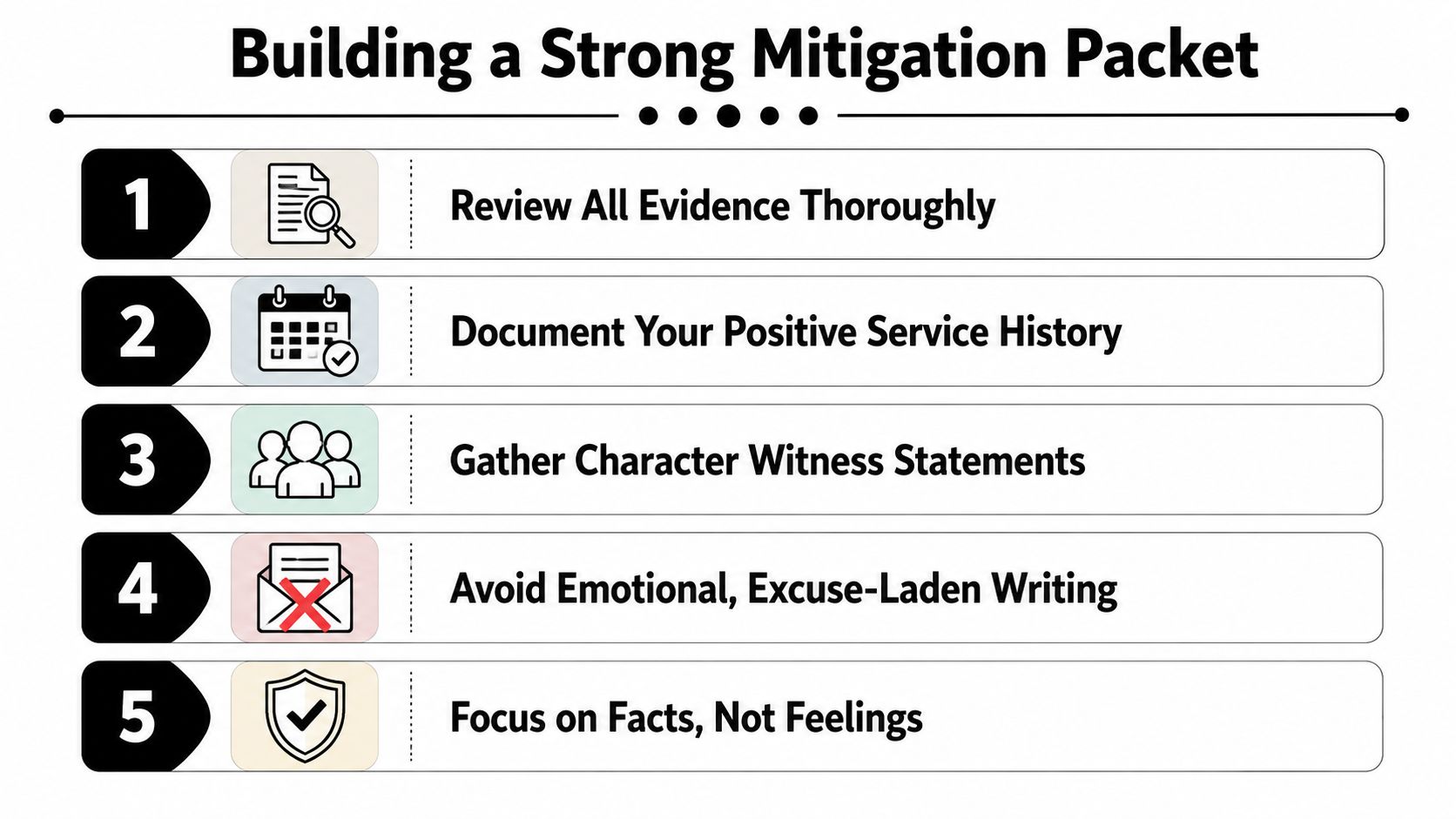
A mitigation packet isn’t a plea for sympathy. It’s an organized evidentiary presentation showing why the commander should impose less punishment, choose a less damaging option, or recognize that the alleged conduct doesn’t justify the requested result.
Start with a short personal statement. If responsibility is appropriate, acknowledge the specific conduct without making unnecessary admissions. Don’t blame everyone else, exaggerate hardship, or write several pages of emotion. Explain what happened, what you learned, what corrective action you’ve taken, and why continued service matters.
Assemble proof, not promises
A strong packet usually contains:
- A focused statement: Address the allegation and the requested relief. Avoid broad claims that you’re a “good Soldier” without supporting facts.
- Character statements: Ask supervisors, senior NCOs, officers, community leaders, or other credible witnesses to describe your duty performance and reliability.
- Service records: Include relevant evaluations, awards, deployment history, qualifications, and documented accomplishments.
- Extenuating evidence: Provide records supporting medical concerns, family emergencies, financial hardship, or other circumstances connected to the event.
- A corrective-action plan: Show concrete steps, such as treatment, counseling, training, restitution, or a change in supervision.
Mitigation argues for reduced punishment despite the offense. Extenuation explains circumstances surrounding the offense that may reduce the commander’s assessment of culpability. Defense matters challenge the allegation itself. Keep those categories separate so the commander can understand exactly what you’re asking.
Sequence matters. Put a concise cover memorandum first, followed by the personal statement, witness statements, records, and supporting exhibits. Label exhibits clearly and remove irrelevant material. A commander shouldn’t have to search through a disorganized packet to find your strongest evidence.
Request witnesses when their testimony can answer a disputed factual question or explain a material circumstance. A witness who merely says you’re a good person may add little. A witness who can explain your performance, the timeline, supervision, or the conditions surrounding the incident may matter substantially.
Use the same care when preparing a written rebuttal to adverse information. Guidance on writing strong GOMOR rebuttals can help you understand the importance of factual organization, supporting exhibits, and narrowly framed requests, even though an Article 15 packet is a different proceeding.
A short packet with credible proof beats a long packet filled with excuses. Submit it on time, retain a complete copy, and make sure counsel reviews every sentence before it reaches the commander.
Critical Mistakes That Destroy Your Leverage
Most weak Article 15 responses fail before the commander evaluates the evidence. Service members surrender advantage through rushed writing, casual admissions, and missed deadlines.
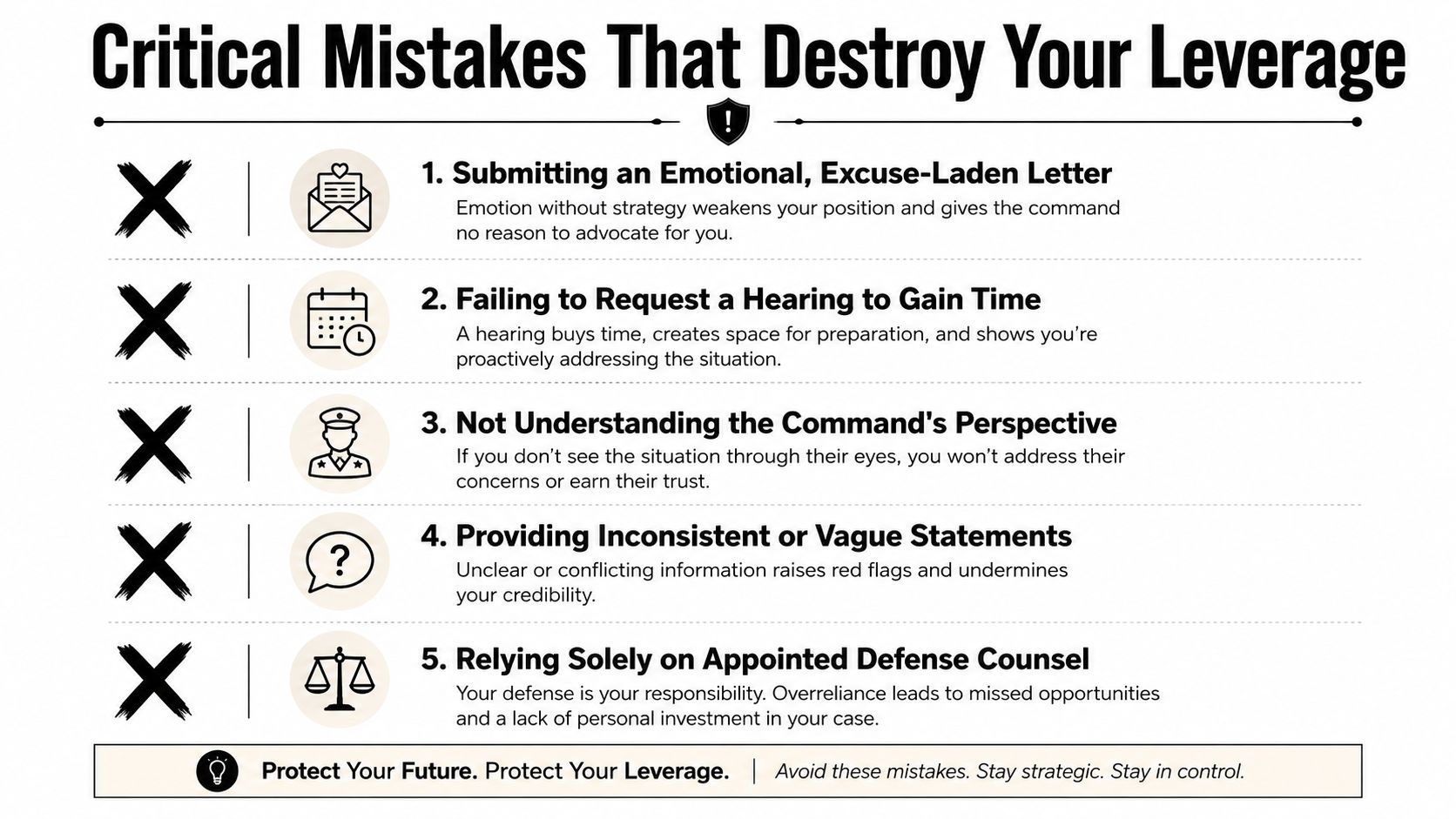
The five most common errors
- Submitting an emotional, excuse-laden letter: A commander needs facts and a defensible request. Anger, self-pity, and accusations against everyone involved make the packet harder to trust.
- Failing to request a hearing to gain time: A hearing gives you an opportunity to present witnesses and matters in defense, extenuation, or mitigation. Declining that opportunity without legal advice can leave the command’s record unanswered.
- Not understanding the command’s perspective: If your packet ignores mission impact, standards, leadership responsibilities, and documented harm, it won’t answer the question the commander must decide.
- Providing inconsistent or vague statements: Changing dates, minimizing obvious facts, or using broad denials invites credibility attacks. Write a precise timeline and flag uncertainty instead of guessing.
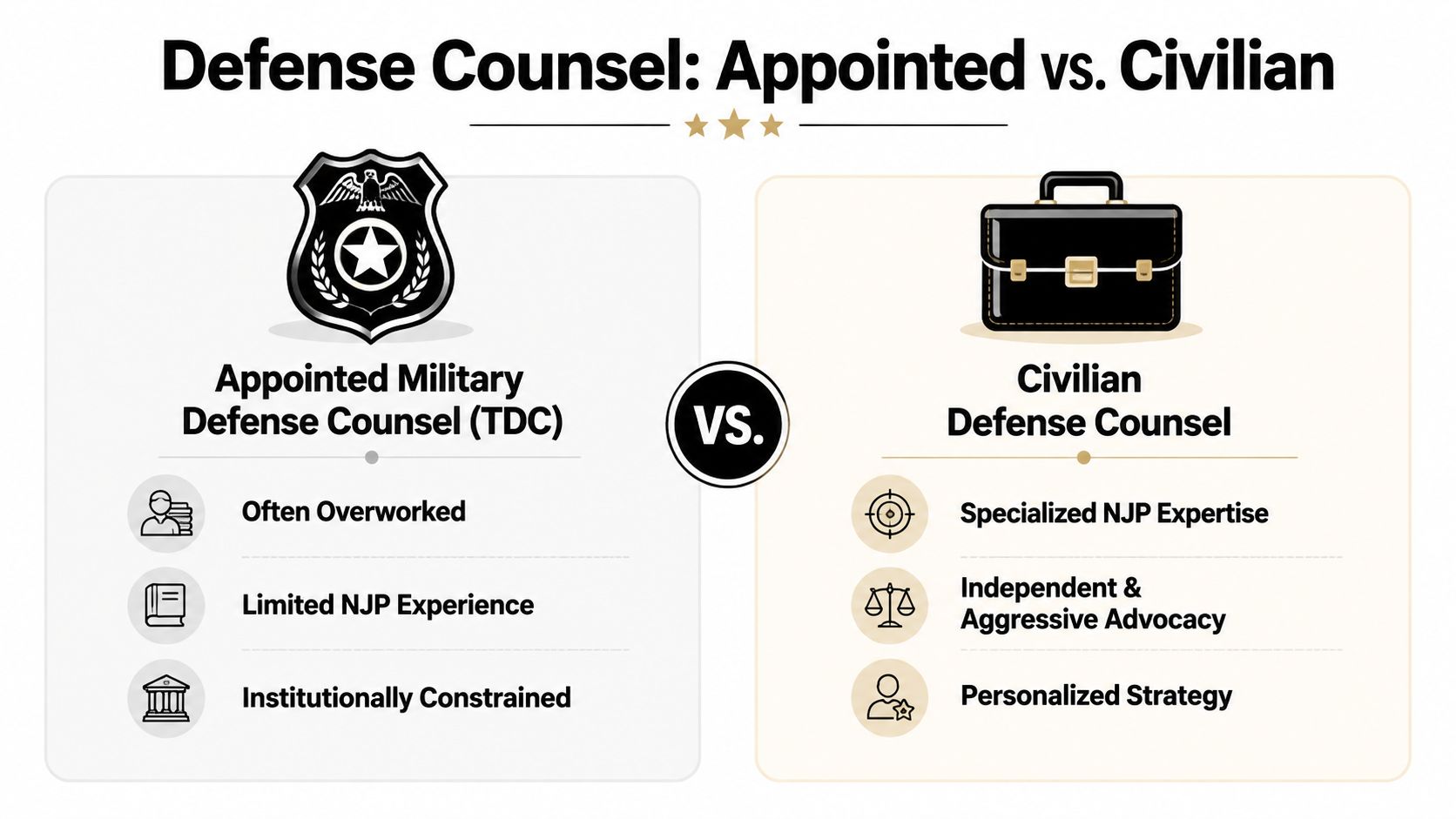
- Relying solely on appointed defense counsel: Military defense counsel can be valuable, but availability and experience vary. A serious career decision deserves a deliberate assessment of whether additional civilian counsel is warranted.
Missing a deadline can cost you a meaningful opportunity to respond. Signing a form doesn’t necessarily mean you’ve admitted every allegation, but you must understand precisely what you’re signing and what election or waiver it records.
Don’t assume a minor offense stays minor. A written admission may later appear in an administrative separation file, evaluation dispute, clearance review, or other personnel action. Don’t create future evidence against yourself to make today’s paperwork easier.
The best response is usually the least dramatic one. It is precise, supported, timely, and designed for the next decision as well as this one.
Protecting Against Downstream Consequences and Appeals
An Article 15 response should address more than the immediate punishment. The record may influence how command views later incidents, whether administrators consider separation, and how a reviewing authority evaluates your conduct.
Historical data illustrates the risk. In a GAO sample, 32% of service members who received Article 15 later received another adverse action or were referred to court-martial. The branch figures were 13% for the Air Force, 32% for the Marine Corps, 38% for the Army, and 48% for the Navy. These figures come from the Government Accountability Office report on military discipline. They don’t predict your result, but they show why the first response must protect against repeat adverse action.
Article 15 use is also widespread. In FY15, the U.S. Court of Appeals for the Armed Forces reported 26,699 active-duty NJP cases, while Marine Corps data listed 33,708 Article 15 cases, a rate of 68.60 per 1,000 and a 10.40% increase over the prior period. The same annual report listed 862 general and special courts-martial. The FY15 annual report provides those figures.
| Consequence | Trigger | Impact on career |
|---|---|---|
| Later adverse action | A new allegation after the Article 15 record | Command may view the new event in light of prior discipline |
| Administrative separation consideration | Service-specific rules and command recommendations | Continued service, characterization, and benefits may be placed at risk |
| Appeal | Unjust or disproportionate punishment or procedural error | A missed deadline can eliminate review |
| Future credibility problem | Inconsistent statements or unsupported explanations | Decision-makers may discount later defenses |
The appeal deadline is short. Under the Manual for Courts-Martial, an appeal should be submitted within 5 days, or the right is waived absent good cause. Army guidance similarly treats an appeal submitted more than 5 calendar days after punishment as untimely unless the superior commander finds good cause. Army Regulation 27-10 contains the cited appeal guidance.
Preserve objections during the initial proceeding. Identify missing evidence, unavailable witnesses, improper procedure, excessive punishment, and factual errors. Maintain a clean index of submissions and dates. A structured record, similar to the organization used in a DocsBot CSV log export, can help track what was submitted and when, but it doesn’t replace legal analysis.
Why Civilian Defense Counsel Changes the Outcome
Appointed military defense counsel and civilian military defense lawyers serve different roles. A trial defense counsel may provide essential representation at no cost, understand local procedures, and help you make immediate elections. You should use that resource.
The question is whether your situation needs additional depth. An Article 15 involving disputed facts, potential separation, a security clearance, promotion consequences, or a serious allegation deserves counsel who can work independently and focus exclusively on your long-term position.
The practical difference
Civilian court-martial attorneys can offer:
- Independence: Civilian counsel isn’t part of the installation’s command or legal structure.
- Continuity: You can often reach counsel outside duty hours and maintain consistent representation through related administrative actions.
- Specialization: Lawyers who regularly handle UCMJ matters know how commanders evaluate evidence, credibility, mitigation, and punishment.
- Preparation time: Civilian counsel can help build timelines, interview witnesses, analyze records, and prepare a focused packet.
- Long-range planning: The response can account for appeals, separation, clearance concerns, and later boards instead of treating NJP as an isolated event.
That doesn’t mean civilian counsel guarantees a particular result. No lawyer can promise that. It means you’re adding an advocate whose professional focus is defense strategy rather than accepting the first available administrative resolution.
The guide to choosing a military defense lawyer can help you assess experience, communication, branch familiarity, trial background, and whether the attorney handles the kind of action you’re facing.
Speak with more than one lawyer if time permits. Ask what they see as the strongest defense, what risks they identify, and what they would do before the hearing.
Article 15 Response Frequently Asked Questions
Can I refuse to talk to investigators?
You generally have the right to remain silent during a criminal investigation, but the correct response depends on who is questioning you, whether the interview is voluntary, and whether command or law enforcement has given you rights advisement. Don’t guess. State that you want counsel and get legal advice before answering substantive questions.
Do I need a lawyer immediately?
Yes, consult counsel immediately. The election, evidence review, witness requests, mitigation packet, and appeal clock can all move quickly. Waiting until the hearing date leaves counsel fewer options.
Is an Article 15 a criminal conviction?
No. NJP is a command-level disciplinary process, not a court-martial conviction. That distinction doesn’t make it harmless. The record can still affect evaluations, assignments, promotion, separation decisions, and future credibility.
Can I demand trial by court-martial?
When the law and your status authorize that election, you may demand trial by court-martial in lieu of NJP. The choice carries its own risks, including formal prosecution exposure. Have counsel evaluate the evidence and consequences before you elect.
What can I present at an Article 15 hearing?
You may present matters in defense, extenuation, and mitigation, orally or in writing. You may also request witnesses and review adverse evidence. Use those rights to address both liability and punishment.
How long do I have to appeal?
The Manual for Courts-Martial states that an appeal should be submitted within 5 days, absent good cause. Army guidance uses the same short deadline. Treat the punishment date as the start of an urgent legal deadline, not an administrative detail.
Can an Article 15 lead to separation?
It can contribute to later administrative action, depending on the applicable service rules and the surrounding record. The Article 15 response should therefore avoid unnecessary admissions and preserve favorable evidence for any later proceeding.
Should I accept NJP if the evidence is strong?
Possibly, but don’t decide on that fact alone. Compare the likely NJP punishment, the strength of mitigation, the risk of court-martial, the effect on your record, and any procedural defenses. A qualified UCMJ lawyer should help you make that calculation.
If you’ve received Article 15 paperwork, don’t sign, explain, or submit a rushed statement before speaking with defense counsel. Gather every page, preserve the evidence, identify the deadline, and contact an experienced military defense lawyer or court-martial attorney today. Your first response may affect the punishment, the appeal, and the career decisions that follow.