You’re a staff sergeant, a consensual encounter happened off post, and now a former partner has reported it to your command. Investigators are asking questions, your chain of command is watching, and someone keeps saying “Article 125” as though the old sodomy statute still controls every case.
That confusion can cost you. Article 125 of the UCMJ has changed substantially, and the correct analysis depends on when the alleged conduct occurred, what conduct the government claims happened, whether force or protected-person rules are involved, and whether an old conviction may qualify for presidential relief. A charge can affect your career, liberty, clearance, discharge status, reputation, and future employment. You need the law applied to your facts, not a recycled summary from an outdated website.
Table of Contents
- Why Article 125 Still Trips People Up
- What Article 125 Actually Says Today
- The Three Eras of Article 125 History
- Penalties and Maximum Punishment
- Real Scenarios That End in Article 125 Charges
- Defenses That Actually Win Article 125 Cases
- The 2024 Pardon and Cleaning Up Old Convictions
- What to Do If Article 125 Is Involved
- Common Mistakes That Damage Article 125 Defenses
- Why Civilian Defense Counsel Matters
- Frequently asked questions about Article 125
- Can consensual adult sex still be charged under Article 125?
- Can I refuse to talk to CID, NCIS, OSI, or CGIS?
- What happens at an Article 32 hearing?
- Will I go to jail?
- Does an old Article 125 conviction disappear after the 2024 pardon?
- How long can child-related Article 125 conduct be prosecuted?
- Do I need a lawyer immediately?
Why Article 125 Still Trips People Up
Article 125 is difficult because people use one label for several different legal regimes. The original provision criminalized “unnatural carnal copulation” in broad terms. Later court decisions, Manual for Courts-Martial changes, statutory amendments, repeal, and clemency altered what prosecutors can charge and what former service members can do about old convictions.
The historical language matters, but it doesn’t automatically answer a current investigation. Before the repeal, the statute covered conduct involving another person of either sex and conduct involving an animal. It also stated that penetration, however slight, completed the offense. The former statute remained in Title 10 until Congress repealed it through the Military Justice Act of 2016, with the repeal taking effect on January 1, 2019. The archived statutory text for former Article 125 shows why old charging documents and older legal advice can mislead readers today.
The first question is the date
Your lawyer must identify the alleged date of conduct before evaluating the charge. A private, consensual encounter between adults may raise a different issue from an allegation involving force, a child, an animal, coercive authority, or another protected circumstance.
A former conviction also requires separate treatment. The Department of Veterans Affairs explains that the old provision was repealed as part of modern military justice reform, but convictions and their consequences could remain afterward. That means an old case may now be primarily about correction of records, discharge consequences, registry issues, benefits, or employment disclosures.
Practical rule: Never accept the sentence “Article 125 is gone” as the end of the analysis. Ask which version applied, what the conviction actually covered, and what records still follow you.
A current specification can still threaten a career even when the underlying conduct would not be criminal in ordinary civilian life. Investigations are not neutral, command decisions often precede a full evidence review, and credibility disputes frequently determine whether a case survives. Call a military defense lawyer before giving investigators a statement, signing a written response, or discussing the facts with people in your unit.
What Article 125 Actually Says Today
Current Article 125 analysis starts with the charge, the alleged conduct, and the applicable version of the Manual for Courts-Martial. It doesn’t start with a search result that repeats the old phrase “unnatural carnal copulation.”
The Army’s Criminal Law Deskbook explains that sodomy under Article 125 was repealed in December 2013 and that the current text addresses bestiality and forcible sodomy. That distinction matters because consensual adult conduct isn’t analyzed the same way as conduct involving force, lack of consent, a child, or an animal. The Army Criminal Law Deskbook discussion of sexual offenses is useful for identifying the modern framework, but your defense counsel still must compare the alleged date and specification against the governing law.
What trial counsel must identify
A viable prosecution generally turns on threshold questions such as:
- The alleged act: What specific sexual conduct does the specification identify?
- The person involved: Was the other person an adult, a child, a service member, or someone in a legally protected category?
- Force or lack of consent: Does the government allege force, incapacity, coercion, or another circumstance that changes the offense?
- Animal-related conduct: Is the allegation bestiality rather than a human sexual offense?
- Timing: Did the conduct occur under the former statute or the current statutory structure?
The charge sheet must allege facts that support the offense. A vague reference to “Article 125” isn’t enough for a defense lawyer to assess exposure. Counsel should examine the specification, bill of particulars if applicable, investigative reports, digital evidence, medical records, witness statements, and the government’s theory of liability.
Don’t confuse neighboring offenses
Some conduct may fit another UCMJ article rather than Article 125. A case involving indecent conduct, abuse of authority, kidnapping, assaultive behavior, or conduct prejudicial to good order and discipline may require analysis under a different provision. That doesn’t mean prosecutors can freely substitute labels, and it doesn’t mean an Article 125 allegation automatically proves another offense.
Read the charge carefully. Identify every element. Then force the government to prove the exact theory it chose. For related issues involving conduct charged under Article 134, review this plain-English guide to UCMJ Article 134 and indecent conduct.
The Three Eras of Article 125 History
The date of the alleged conduct can change the legal answer. Treat Article 125 as a timeline, not a single permanent rule.
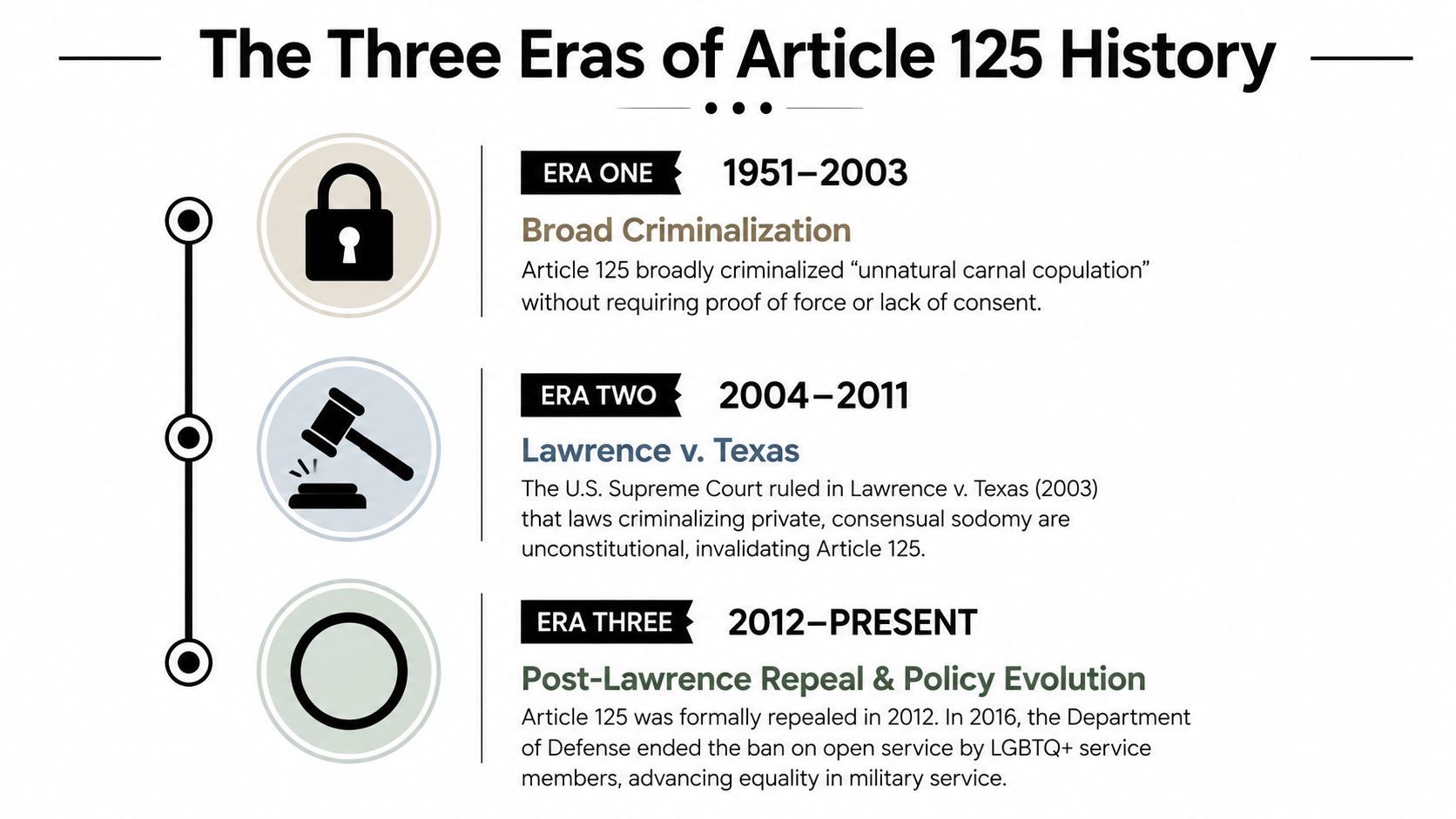
Era One, 1951 through 2003
The UCMJ was enacted on May 5, 1950, and Article 125 became part of that system. For decades, the provision criminalized sodomy using broad language. It covered “unnatural carnal copulation” with another person of the same or opposite sex, or with an animal, and penetration, however slight, was enough to complete the offense.
Congress had moved a specific sodomy offense into the Articles of War in 1920. Before that, military authorities handled the conduct under a general catch-all provision. Older cases therefore may reflect a legal environment far removed from current military justice.
Era Two, 2004 through 2018
This period brought constitutional pressure and changing Manual language. The Supreme Court’s decision in Lawrence v. Texas invalidated criminal punishment for private, consensual adult sodomy under civilian law, and military prosecutors and courts had to confront the effect of that ruling on Article 125.
The government continued to pursue cases involving force, minors, animals, or circumstances that made the conduct materially different from private adult intimacy. A lawyer reviewing an older file must separate the underlying conduct from the legal theory used at trial.
Era Three, 2019 to the present
The repeal of the former sodomy offense became effective on January 1, 2019. The current framework no longer treats consensual adult sodomy as a general punishable offense, while Article 125 remains relevant to conduct such as bestiality and forcible sodomy. Congress also changed the role of Article 125 in other areas. The Military Justice Review Panel’s 2024 assessment notes that Congress migrated kidnapping from Article 134 to Article 125 without substantive element changes, confirming that the article is not frozen in its historical form.
For a closed file, the practical question is whether the conviction involved qualifying consensual adult conduct and whether the record still produces consequences. For a pending file, the question is whether the charged conduct fits a current offense and whether the prosecution can prove each element under the correct law.
Penalties and Maximum Punishment
Punishment depends on the specific offense, the applicable Manual provisions, the charging theory, and the forum. Don’t let anyone give you one universal “Article 125 sentence” without first identifying the alleged conduct and governing law.
The former statute stated that an accused could be punished “as a court-martial may direct.” It didn’t establish one fixed confinement term in the statutory text. The pre-2019 statutory language for Article 125 confirms that older cases require their own punishment analysis.
Maximum punishment chart for Article 125 offenses
| Offense | Maximum Confinement | Maximum Discharge | Forfeitures | Sex Offender Registration |
|---|---|---|---|---|
| Former consensual adult sodomy conviction | Depends on the governing historical law and sentence | Depends on the sentence and forum | Depends on the sentence | Requires individualized review of the conviction and applicable registry rules |
| Current forcible sodomy allegation | Must be calculated under the applicable current Manual provisions | Depends on the charged offense and sentence | May include forfeiture as authorized by law | Requires individualized review |
| Current bestiality allegation | Must be calculated under the applicable current Manual provisions | Depends on the charged offense and sentence | May include forfeiture as authorized by law | Requires individualized review |
| Child-related conduct charged under former Article 125 | Requires historical and statutory-limitations analysis | Depends on the sentence | Depends on the sentence | Requires individualized review |
A dishonorable discharge is different from a bad-conduct discharge. Both can damage civilian employment, veterans’ benefits, and reputation, but the legal effects depend on the sentence and later administrative action. Some cases produce no punitive discharge, while others create long-term consequences beyond confinement or pay loss.
Registration also requires careful review. A conviction can trigger scrutiny under federal sex-offender registration laws, including the Adam Walsh Act and SORNA, even when the sentence doesn’t include confinement. State registry rules may differ, and a pardon doesn’t automatically answer every state or federal records question.
The sentencing forum matters. Panel composition, military judge sentencing, jurisdictional limits, prior offenses, aggravating evidence, victim impact evidence, and the exact findings all affect exposure. Defense counsel should attack improper sentencing assumptions before trial, not after the sentence is announced.
Real Scenarios That End in Article 125 Charges
The same phrase can describe very different investigations. A disciplined defense lawyer studies the facts that moved a command from rumor to specification.
A barracks-party allegation may begin with a witness describing a sexual encounter and a digital message that appears to confirm timing. A single Snapchat timestamp can become central evidence, but timestamps require authentication, context, and proof that the account, device, and message belong to the accused. Deleted messages, altered screenshots, missing metadata, and inconsistent forwarding histories can create reasonable doubt.
A relationship between a sergeant and a junior soldier may look consensual at first. Months later, the junior soldier may describe pressure tied to rank, evaluations, housing, leave, or work assignments. The legal issue then shifts from the label “affair” to authority, coercion, consent, and credibility.
What changes the case
A command-directed mental-health evaluation can produce statements that investigators later treat as admissions. The defense must determine who ordered the evaluation, what warnings were given, what disclosures were required, and whether the government obtained protected information improperly.
Digital stings create another trap. An accused may believe the online partner is an adult, while investigators claim the communication proves an intent involving a child. The defense must examine the account’s representations, the messages, the undercover conduct, the accused’s actual belief, and whether an honest and reasonable mistake-of-age defense applies.
The Court of Appeals for the Armed Forces digest identifies a separate timing issue. Congress’s 2016 amendments to Article 43 reduced the limitation period for sodomy with a child charged under Article 125 to five years, citing United States v. McPherson. That question can determine whether the case is actionable before the parties ever reach the merits.
The charge label is not the case. The date, elements, evidence, and government theory are the case.
Defenses That Actually Win Article 125 Cases
Strong defenses are built around missing elements and unreliable proof. “The encounter was consensual” may be important, but it won’t carry the case unless counsel ties consent to the government’s exact theory and challenges every fact the prosecution uses to negate it.
Force and incapacity
When the government alleges force, examine what force occurred, when it occurred, and whether the evidence proves more than an argument, awkwardness, intoxication, or a relationship breakdown. Voluntary-intoxication evidence may help show that the alleged victim was too impaired to resist, but impairment analysis is fact-specific and must be anchored in witness accounts, messages, medical evidence, videos, and timing.
Military-specific coercion issues require special care. Rank disparity may affect how a factfinder evaluates consent, but rank alone doesn’t resolve every case. Counsel should identify actual orders, threats, promised benefits, adverse actions, supervision, evaluations, and communications.
Statements and credibility
A command-directed interrogation can raise serious Fifth Amendment and Military Rules of Evidence issues. Counsel should investigate whether investigators used compelled statements, derivative evidence, or improperly obtained mental-health information. A motion under Mil. R. Evid. 305 may be decisive, but only if the defense develops the factual record early.
Credibility is often the center of gravity. Prior false allegations may support impeachment under Mil. R. Evid. 608 when the rules permit it, but counsel must distinguish a proven false report from a prior allegation that was merely unsubstantiated. The defense should preserve contradictory accounts, motive evidence, changes in story, delayed reporting explanations, and communications with third parties.
For a focused explanation of compelled statements and Article 31 rights, read this guide to Article 31 of the UCMJ.
Honest mistake of age
In an undercover operation, the accused’s belief about age may become an affirmative defense. The evidence can include profile information, direct statements, photographs, conversation history, and the government’s own conduct. Don’t assume an undercover label ends the inquiry. Prosecutors still have to prove the offense and defeat any legally recognized defense.
The 2024 Pardon and Cleaning Up Old Convictions
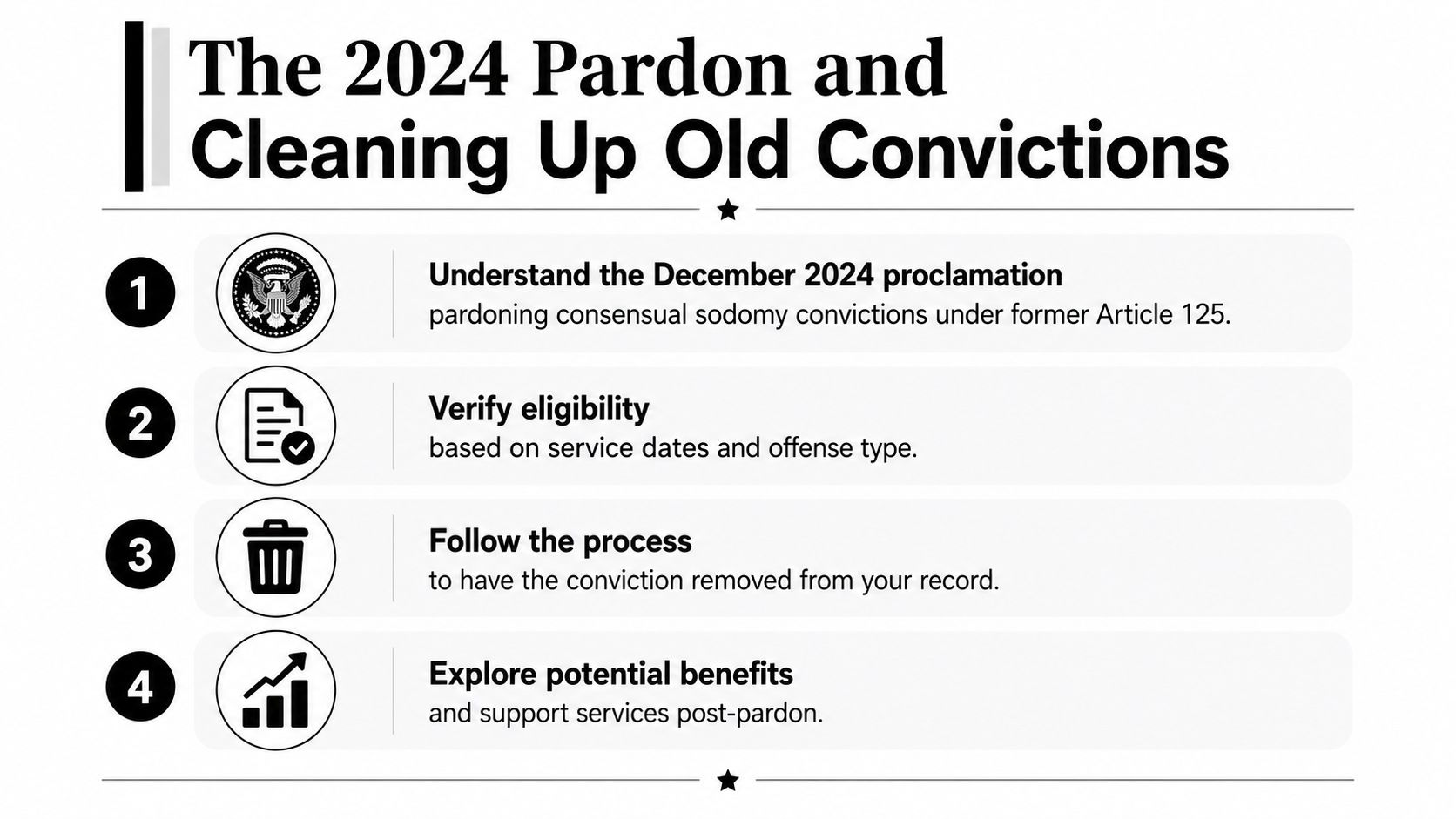
President Biden issued a full and unconditional pardon on June 26, 2024, for qualifying former Article 125 convictions involving consensual, private conduct with adults age 18 or older. The Department of Veterans Affairs explains that the pardon reaches qualifying convictions from May 31, 1951 through December 26, 2013, and extends to related attempts, conspiracies, and solicitations under Articles 80 through 82.
A pardon is powerful, but it isn’t the same as automatic erasure. It may relieve the legal effects of the conviction while leaving records that still require correction, explanation, sealing, discharge review, or state-level action. The right question is not “Was I pardoned?” Ask which agency has each record and what relief that agency can provide.
Build a records-correction file
Start with the court-martial record, promulgating order, appellate decisions, discharge paperwork, and any registry correspondence. Then determine whether the conviction qualifies under the proclamation and request documentation showing the pardon status.
A discharge upgrade may require a separate petition. This guide to upgrading a military discharge can help you identify the type of review involved, but counsel should tailor the filing to your record and the relief you need.
Use this checklist:
- Gather the core file: Obtain the court-martial transcripts, findings, sentence, promulgating order, and discharge documents.
- Verify eligibility: Confirm that the conviction involved qualifying consensual private conduct between adults and falls within the proclamation’s covered period.
- Track pardon documentation: Request or preserve the pardon certificate and supporting correspondence.
- Seek record correction: Consider the appropriate correction board, discharge review process, VA review, and state-level relief.
- Check collateral records: Review registry entries, background-check databases, licensing disclosures, immigration or visa forms, and federal employment records.
State sex-offender registry systems may not update automatically. A state licensing board may ask about the conviction even after pardon relief. Foreign governments may use their own visa questions and databases. A pardon also doesn’t automatically resolve a separate state conviction or guarantee that every unsealed NCIC entry disappears.
Use the embedded video as a starting point for understanding the pardon process, then obtain advice on your specific records.
What to Do If Article 125 Is Involved
Step 1, stop creating evidence
Don’t explain the encounter to investigators, friends in your unit, or your chain of command. Preserve your phone, messages, location data, photographs, and social-media accounts. Don’t delete anything, alter anything, or ask another person to change a statement.
Step 2, identify the legal era
Write down the alleged date, location, people involved, and exact conduct investigators mentioned. Your lawyer needs those facts to determine whether the government is relying on former Article 125, current Article 125, another UCMJ article, or an administrative theory.
Step 3, secure the documents
Request or preserve the rights advisement, search authorization, seizure paperwork, investigative interview recordings, medical records, and charge sheet. Evidence often exists in fragments. The defense must find missing context before the government presents a polished narrative.
Step 4, challenge the theory
Your lawyer should test jurisdiction, limitations, notice, consent, force, protected-person status, authentication, hearsay, unlawful command influence, and the reliability of digital evidence. If the prosecution’s chosen article doesn’t fit the facts, force that problem into the litigation.
Step 5, plan for collateral consequences
A negotiated resolution, trial defense, discharge strategy, records petition, or appeal may each require different decisions. Don’t trade a favorable administrative result for a punitive consequence you didn’t understand.
Common Mistakes That Damage Article 125 Defenses
- Talking to investigators: A casual conversation can become a recorded admission. Invoke your rights and contact counsel.
- Trusting command assurances: Commanders may say the matter will be handled informally. That promise doesn’t bind investigators or prosecutors.
- Waiting for formal charges: Early counsel can influence searches, interviews, preservation, witnesses, and the defense narrative.
- Assuming no evidence exists: Phones, cloud accounts, access logs, rideshare records, photographs, and third-party messages may already be in government hands.
- Deleting messages: Deletion can create a separate credibility and evidence problem. Preserve the device exactly as it is.
- Contacting the complainant: Even a well-intended apology can look like pressure, witness tampering, or consciousness of guilt.
- Discussing facts in group chats: Other service members can screenshot, forward, or misinterpret your statements.
- Accepting the old statute as current law: The government must charge conduct under the law that applies to the alleged date and facts.
- Ignoring administrative action: A GOMOR, suspension, evaluation, restriction, or separation packet can damage your career even without a court-martial conviction.
- Choosing counsel by convenience: The lawyer must understand military investigations, Article 32 litigation, evidentiary motions, sentencing, and collateral records consequences.
Why Civilian Defense Counsel Matters
Military-appointed counsel can provide capable representation, and you should speak with appointed defense counsel as soon as you’re entitled to one. The difference is that a civilian military defense lawyer works outside your chain of command and can often bring a focused, independent practice built around serious UCMJ litigation.
Experience matters most when the case is messy. A lawyer who regularly handles court-martial trials knows how investigators build timelines, how commands package credibility evidence, how digital exhibits get authenticated, and which motions can change the government’s advantage. A general civilian lawyer may be excellent in another field and still lack the military procedure your case requires.
Look for a UCMJ lawyer or court-martial attorney who can answer direct questions:
- Trial record: How often does the lawyer litigate contested courts-martial and evidentiary motions?
- Branch experience: Has counsel handled cases involving your service, status, location, and investigative agency?
- Independence: Can the lawyer advise you without command relationships or institutional pressure?
- Strategy: Can counsel explain the government’s likely theory, the weak points, and the risks of each decision?
- Collateral relief: Does the practice handle discharge upgrades, appeals, records correction, and registry consequences when those issues arise?
You can compare civilian firms by practice focus and geography, which presents attorney profiles and credibility information for people evaluating military defense counsel. Treat any directory as a starting point, then interview lawyers directly about your facts.
Your lawyer should be able to tell you what the government must prove, what evidence supports each element, and what you must stop doing today.
Frequently asked questions about Article 125
Can consensual adult sex still be charged under Article 125?
Consensual private sexual conduct between adults generally isn’t treated as the old punishable sodomy offense under current military law. The answer can change if the allegation involves force, a child, an animal, coercive circumstances, or conduct charged under another UCMJ article. The alleged date remains critical.
Can I refuse to talk to CID, NCIS, OSI, or CGIS?
You can assert your rights. Don’t guess at the wording, answer questions informally, or assume your cooperation will end the investigation. Request counsel and follow counsel’s advice before making any statement.
What happens at an Article 32 hearing?
An Article 32 preliminary hearing examines whether probable cause supports the charges and whether the case should proceed. It can also expose weaknesses in witness accounts, investigative methods, jurisdiction, digital evidence, and charging theory. Your lawyer should prepare for it as litigation, not as a routine meeting.
Will I go to jail?
You may face confinement if convicted of an offense that authorizes it, but the answer depends on the charged offense, alleged facts, findings, forum, sentencing rules, and available defenses. No lawyer can responsibly predict confinement without reviewing the charge sheet and evidence.
Does an old Article 125 conviction disappear after the 2024 pardon?
Not automatically. The pardon may provide relief for qualifying convictions, but military, federal, state, registry, licensing, and background-check records may require separate action. Obtain the file and pursue the appropriate correction or review process.
How long can child-related Article 125 conduct be prosecuted?
The limitation period requires date-specific analysis. The Court of Appeals for the Armed Forces digest explains that Congress’s 2016 amendments to Article 43 reduced the limitation period for sodomy with a child charged under Article 125 to five years. Counsel must determine which rule applies to the alleged conduct and charging history.
Do I need a lawyer immediately?
Yes, if investigators have contacted you, your command has mentioned Article 125, you’ve received a rights advisement, or you face separation or adverse administrative action. Early decisions affect evidence, statements, witnesses, searches, and future negotiating power.
If Article 125 is part of your investigation, charge sheet, court-martial history, discharge record, or registry problem, contact an experienced civilian military defense lawyer now. Don’t give investigators a statement, delete evidence, contact the complainant, or sign administrative paperwork before counsel reviews the situation. Your career, freedom, and future records may depend on what you do before the government finishes building its case.