
Your first instinct will be to calm yourself down and call this a paperwork problem. It isn’t. If your commander wants to read you rights, hand you a packet, or tell you they’re considering Article 15 nonjudicial punishment, your pay, rank, reputation, clearance, and future assignments may all be in play.
Most service members in that moment do the wrong thing. They talk too much. They try to “be honest.” They trust that cooperation will earn mercy. Then they find out the process was never built to protect them. It was built to let command move fast.
You need to think like someone protecting a career, not like someone begging for understanding.
Table of Contents
- Your Commander Wants to See You Now
- What Article 15 Nonjudicial Punishment Actually Is
- The Three Levels of NJP and Their Punishments
- The NJP Process from Notification to Appeal
- Strategic Defense Why Accepting NJP Can Be a Trap
- The Career Consequences Your Command Won’t Mention
- Civilian Defense Counsel vs Appointed Military Lawyer
- FAQ Your Next Move Is Critical
Your Commander Wants to See You Now
You’re called in with almost no warning. First sergeant is serious. The room feels smaller than usual. Somebody starts reading rights, sliding paper across a desk, and using calm language that hides the danger. They may act like this is routine. For you, it isn’t.

That moment scrambles people. Good troops who can handle combat, field problems, deployments, and family stress suddenly start trying to “fix” the accusation with explanations. They volunteer context no one asked for. They think if they sound respectful, command will see they’re not a bad person. That instinct wrecks cases.
What your command sees
Your command is usually focused on discipline, speed, and control. They want a neat answer, not your full life story. If the allegation grew out of a command inquiry or one of the many fact-finding processes that can shape later punishment, you should understand how those investigations can snowball by reading about military 15-6 investigations.
What you should see
You should see a legal fork in the road. Even when Article 15 nonjudicial punishment is described as “minor,” the decision points are not minor.
- Your pay may be hit: even short-term forfeitures sting.
- Your rank may be targeted: that can change your career trajectory fast.
- Your record may be marked: that follows you inside the system.
- Your silence matters: once you talk, you can’t pull the words back.
Practical rule: If command says they just want your side, assume they’re gathering proof, not offering help.
Fear is normal here. So is confusion. But panic is a luxury you can’t afford. Slow down, stop talking, and start making decisions like the government is building a case against you, because it usually is.
What Article 15 Nonjudicial Punishment Actually Is
Article 15 nonjudicial punishment is command discipline under 10 U.S.C. § 815. It is not the same thing as a court-martial conviction. That distinction matters. But a lot of service members hear “not criminal” and make the dangerous mistake of treating it like harmless administrative counseling. It isn’t.
Think of it this way. A court-martial is a criminal trial. An Article 15 is closer to command-run discipline with legal consequences built in. It is faster, less formal, and easier for command to use. That is exactly why it can be dangerous. Speed helps command. It rarely helps the accused.
Why the military uses it so often
Historically, commanders have used NJP constantly. Between 1973 and 1978, Article 15 non-judicial punishments were imposed at an annual rate of approximately 353,000 cases, representing a frequency of 165 per 1,000 total force strength, making it the primary disciplinary tool in the U.S. military, according to a GAO review of military discipline data.
That tells you something important. This system was not built for rare emergencies. It was built to be used over and over.
What it is, and what it is not
Here’s the clean version:
| Article 15 nonjudicial punishment | Court-martial |
|---|---|
| Command-driven discipline | Judicial proceeding |
| Lower procedural protection | Full criminal process |
| Faster result | Slower, more formal |
| Not a civilian criminal conviction | Criminal conviction can result |
| Still carries serious military consequences | Carries even broader legal consequences |
Command likes Article 15 because it avoids the burden of a trial. You should never confuse command convenience with fairness to you.
The real issue
The question isn’t whether NJP is “better” than court-martial in the abstract. That’s amateur thinking. The critical question is whether accepting this process helps your long-term interests or walks you into damage that could have been avoided.
If you treat Article 15 nonjudicial punishment like a simple slap on the wrist, you’re already behind.
The Three Levels of NJP and Their Punishments
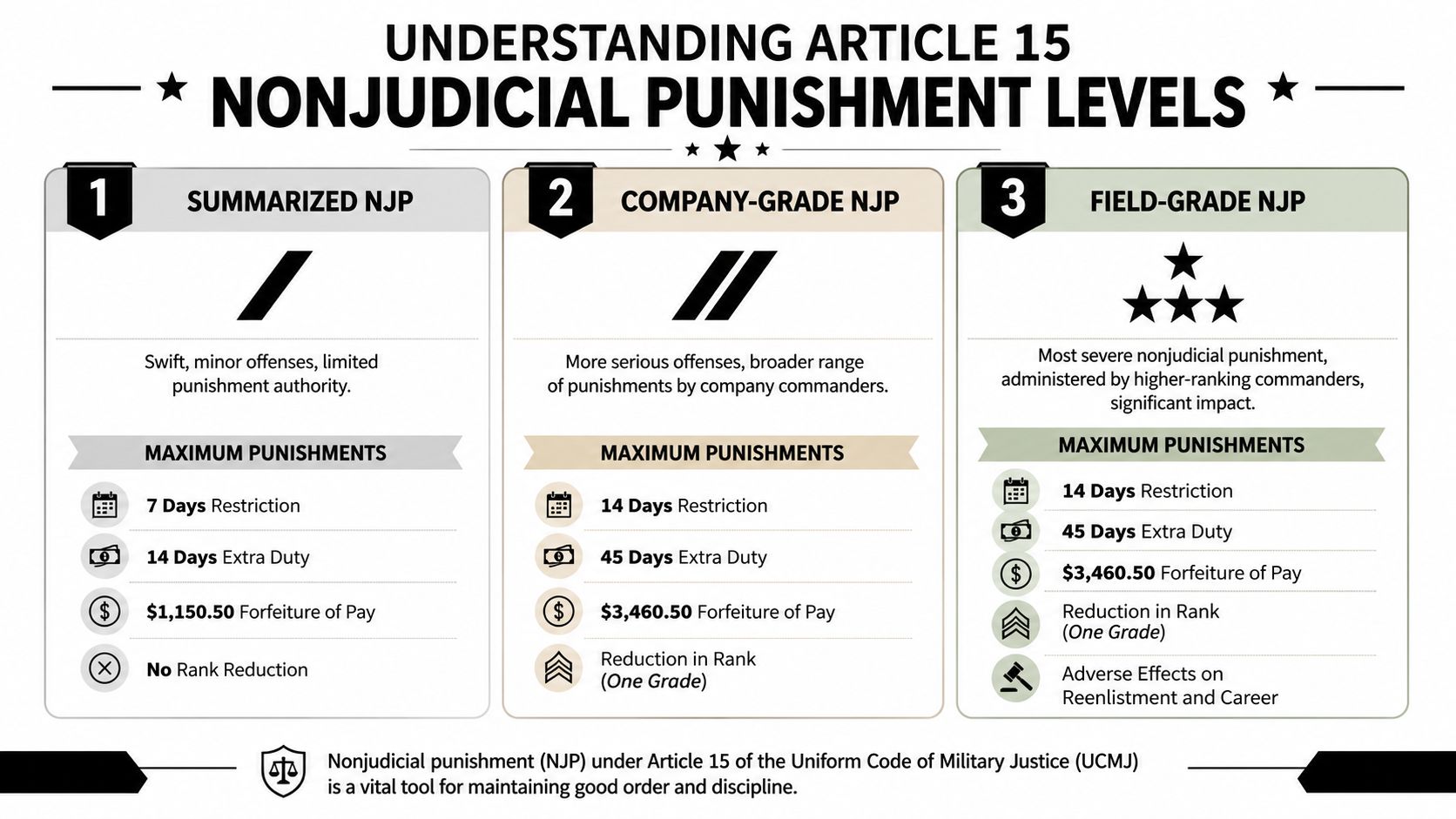
Your commander says “it’s just an Article 15,” and that phrase gets people hurt. The label matters less than the level. A summarized case and a field-grade case can lead to very different outcomes in pay, rank, reputation, and future assignments.
Why the level matters immediately
The level of NJP defines the commander’s punishment power. It also tells you how much pressure you are under to protect rank, stop a bad statement, and get legal advice before you make the election decision. If command is pushing this as routine, assume the opposite. Routine for them can still be expensive for you.
Start with one basic rule. Punishment authority rises with the level of NJP. Under 10 U.S.C. § 815, summarized, company-grade, and field-grade proceedings do not carry the same exposure. That difference is the whole strategic issue.
Summarized NJP is the lowest level, but calling it minor is a mistake. For the Army, summarized Article 15 punishment is limited to measures such as extra duties, restriction, or an oral reprimand, and it does not include reduction in grade, according to Army Regulation 27-10. That still leaves you with a record of discipline and a command narrative about your judgment. If you talk carelessly before the hearing, you make their case for them. Protect yourself early by understanding your Article 31 UCMJ right to remain silent during military questioning.
Company-grade NJP is where junior enlisted service members start losing things they assumed were safe. A company-grade officer can impose tighter punishment than summarized NJP, including forfeitures and, in some cases, reduction for enlisted personnel within that commander’s authority, as described in Part V of the Manual for Courts-Martial%20(20241220).pdf). This is often the point where a service member accepts NJP to “get it over with” and then realizes the actual hit was to pay, rank, evaluations, and promotability.
Field-grade NJP is the danger zone. A field-grade commander has far broader punishment authority under Article 15, including heavier forfeitures, longer restriction or extra duty, and greater rank consequences for enlisted personnel, under the same statutory punishment limits in Article 15. Under these conditions, one poor decision can swiftly derail an NCO or junior enlisted member’s career. The paperwork may say “nonjudicial.” The practical result can still shape promotion boards, special duty opportunities, reenlistment, and how your command talks about you behind closed doors.
Quick comparison of risk
Summarized
- Best description: lower-level punishment with limited formal penalties
- Key danger: you underestimate the record it creates
- What stands out: no reduction in grade under Army summarized procedures
Company-grade
- Best description: command discipline with meaningful impact on pay and junior enlisted rank
- Key danger: service members accept it before measuring the cost
- What stands out: more punishment authority and more career fallout than the name suggests
Field-grade
- Best description: the hardest-hitting form of NJP
- Key danger: immediate financial loss, rank damage, and long-term career harm
- What stands out: the commander has enough authority here to change your military future in one hearing
If you are facing company-grade or field-grade NJP, stop treating this as a paperwork event. Treat it like a career decision. That is what it is.
The NJP Process from Notification to Appeal
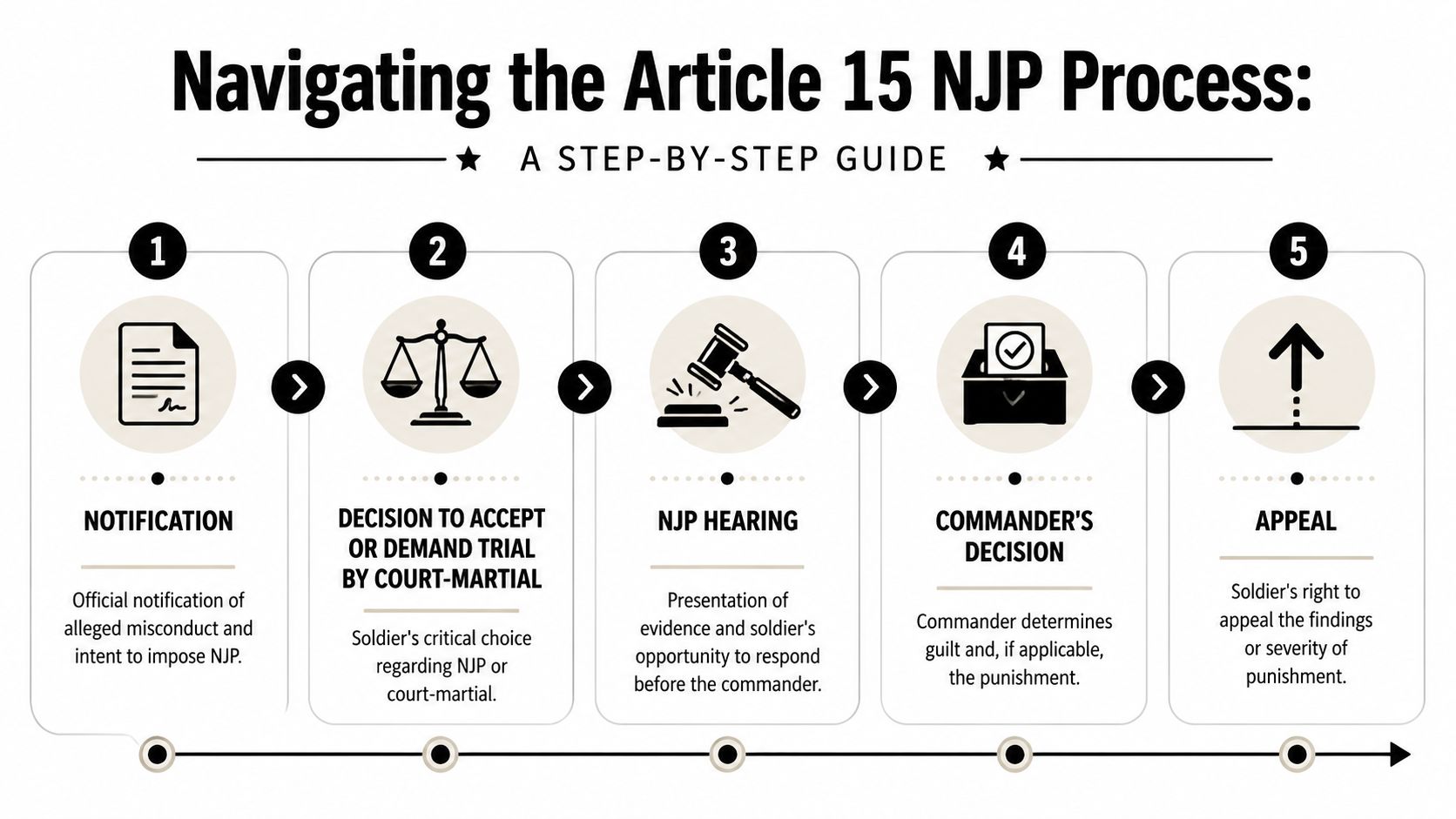
The process feels informal until you realize every stage is a trap for the unprepared. Treat each step as a decision point.
A visual overview helps before you deal with the details.
Step 1 through Step 3
Step 1 is notification. You’re told the allegation and that command is considering NJP. During this step, many people start giving “background” statements that become admissions. If you need a quick refresher on your right against self-incrimination, read about Article 31 of the UCMJ.
Step 2 is the election decision. In some cases, you can refuse NJP and demand trial by court-martial. In some cases, you can’t. The right to refuse NJP and demand a court-martial is explicitly barred for service members “attached to or embarked in a vessel,” a statutory exception that strips many of their primary defensive option. The burden of proof is only a “preponderance of the evidence” (51%), far lower than “beyond a reasonable doubt,” under the text of 10 U.S.C. § 815.
That lower standard matters more than most service members realize. At NJP, command doesn’t need the kind of proof required to convict you at trial.
A lot of readers do better with a quick visual and practical walk-through, so this short video is worth your time:
Step 3 is preparation for the hearing, during which strategy replaces emotion.
- Gather documents: texts, screenshots, orders, sign-in logs, medical records, duty rosters.
- Identify witnesses: not just friends, but people who can directly contradict the allegation or give context.
- Decide your posture: deny, explain, mitigate, or challenge punishment scope.
- Get advice early: waiting until the hearing date is how people forfeit an advantage.
Step 4 and Step 5
Step 4 is the hearing and the commander’s decision. Don’t expect a courtroom. Expect a command proceeding where the commander reviews what they believe happened and what punishment to impose if they find the allegation supported.
Step 5 is appeal. Yes, you can appeal. No, you should not assume appeal will magically fix weak choices made earlier.
The best appeal often starts before the hearing, with a clean record, disciplined silence, and a defense theory that was built early.
What should you be thinking at each point?
- At notification: stop talking.
- At election: measure the risk of NJP against the risk of trial.
- At preparation: build evidence, not excuses.
- At hearing: stay controlled and strategic.
- At appeal: attack unfairness, disproportionality, and procedural sloppiness.
If you drift through the process hoping command will “be fair,” you are handing your future to people whose job is not to protect it.
Strategic Defense Why Accepting NJP Can Be a Trap
Your commander offers Article 15, and the room pressure is obvious. Take the hit, keep it quiet, show accountability, move on. That pitch sounds responsible. It also gets service members burned every week.
Accepting NJP is not a paperwork choice. It is a career choice. In some cases, it is the decision that decides whether you keep your rank, your promotion path, your clearance prospects, or your shot at staying in long enough to retire.
Why solid troops walk into bad Article 15 outcomes
Good service members are trained to comply, explain themselves, and trust the chain of command to sort things out. Those habits help the mission. They are terrible instincts when you are the target.
Here is how people talk themselves into a bad result:
- “If I cooperate, command will see I’m being honest.” Command may see that. They may still punish you.
- “It’s only NJP, so fighting it will make me look worse.” Wrong. Using your rights is not misconduct.
- “I can tell my side better than a lawyer can.” Not under stress, and not if the facts are messy.
- “I don’t want to disrespect the commander.” Respect has nothing to do with whether you protect yourself.
- “They probably can’t prove much.” You do not know that until someone tests the case, the witnesses, and the paperwork.
That last point matters more than people realize. A weak case can look strong inside the command because nobody has forced it into the open.
What to examine before accepting NJP
The right starting point is not “Should you just take it?” It is risk.
I examine the allegation itself, the quality of the statements, the timing, the motive of witnesses, gaps in the chain of events, prior inconsistent versions, missing evidence, and whether command is trying to solve a leadership problem by calling it misconduct. Also weigh what matters most to you. Rank. Promotion board timing. Reenlistment. Clearance. Special duty. Future civilian licensing.
For an NCO, the rank issue can make the answer sharp fast. Reduction from E-6 to E-5, or E-5 to E-4, is not a temporary bruise. It can disrupt NCO status, trigger follow-on administrative trouble, and put you on a path that is hard to reverse even if the command later acts like the case was minor. If your record keeps sliding after an NJP, you may end up needing help with a military discharge upgrade after Article 15 damage.
That is why “accept it and move on” is bad advice unless someone has done the hard analysis first.
The cheap decision at the front end often becomes the expensive decision later.
The real trap
The trap is not just punishment. The trap is giving up one’s advantage too early.
Once you accept NJP without a defense theory, you often lose the best chance to force command to confront weak proof, overcharging, witness problems, and disproportionate punishment. You also make it easier for the file to tell a one-sided story about your judgment and reliability. Command may call it an opportunity to handle things locally. You should treat it as a moment that can follow you into evaluations, retention decisions, and separation processing.
Sometimes accepting NJP is the right move. But it is only the right move after you compare two risks with a clear head. What can command really prove, and what can this do to your career if you hand them an easy win?
A smart defense is calculated. Fight when the evidence is thin, the punishment risk is career-altering, or the command theory does not hold up. Negotiate and mitigate when the facts are bad but the damage can still be contained. Blind acceptance is not maturity. It is surrender with a professional-sounding label.
The Career Consequences Your Command Won’t Mention
The phrase you’ll hear is some version of “It’s not a conviction” or “It’ll go away.” That statement is incomplete at best and misleading at worst.
The two-year myth
Yes, there is a removal point that lulls people into complacency. An Article 15 finding of guilty is filed in the service member’s military records but is automatically removed after exactly two years, according to the Indiana National Guard Article 15 fact sheet.
Many people stop reading there. That’s a mistake.
While an Article 15 is removed from a military personnel file after two years, the finding can persist in databases like the Defense Clearance and Investigations Index (DCII) and be used by adjudicators to challenge the “trustworthiness” and “reliability” required for a security clearance, according to the Army Trial Defense Service guidance on Article 15 consequences.
So no, the issue does not vanish because a filing rule changes.
What this means for your real life
If your MOS, billet, or post-service plan depends on a clearance, an Article 15 can become a future employment problem wearing a military label. The same goes for specialized assignments, leadership opportunities, and federal hiring.
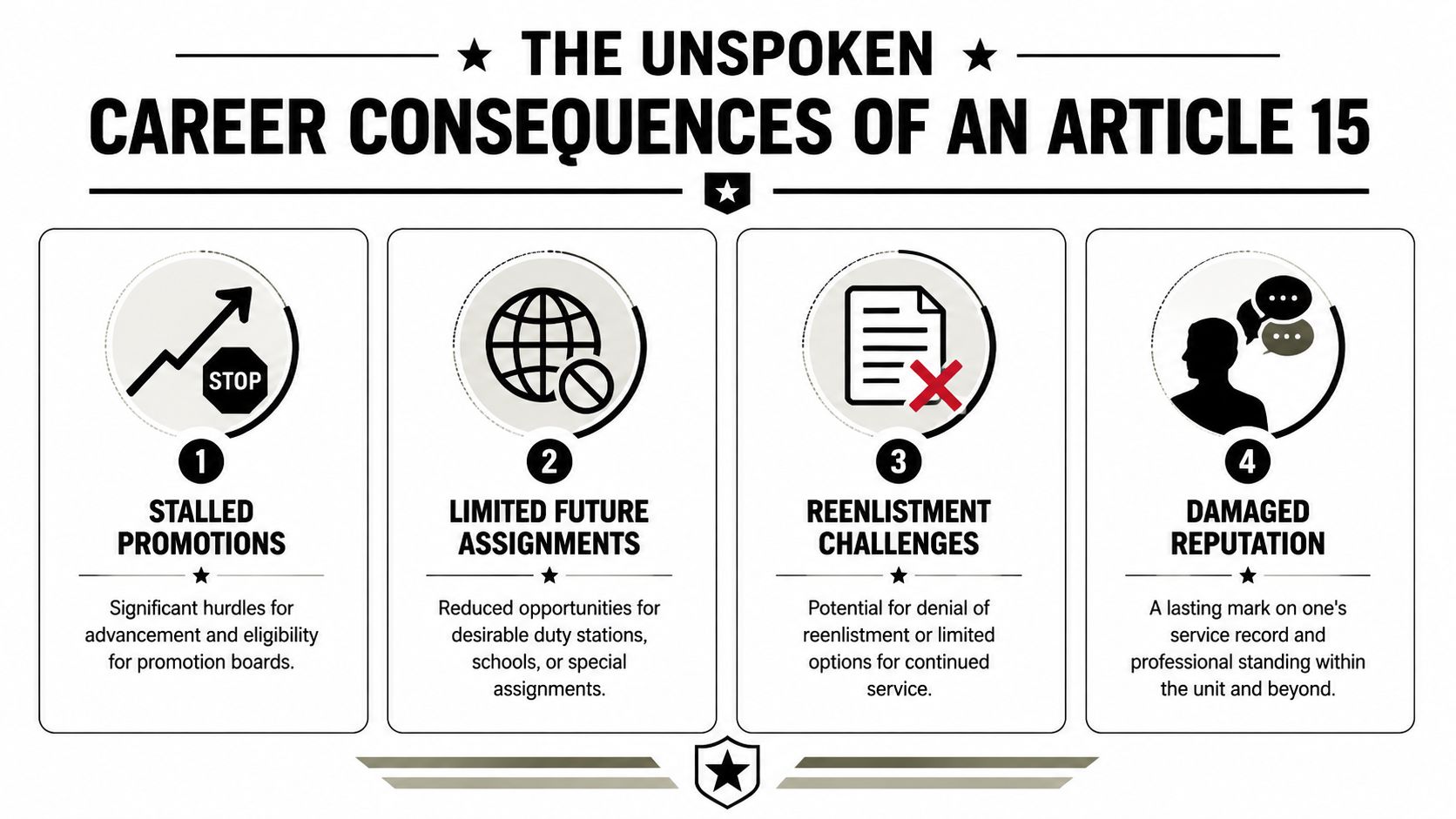
Here’s the practical fallout command often doesn’t spell out:
- Promotion drag: boards and leaders notice derogatory history, even when you think the matter is “old.”
- Assignment limits: schools, special duties, and sensitive roles become harder to secure.
- Reenlistment friction: rank loss or perceived reliability issues can close doors.
- Civilian crossover damage: defense contractor and federal pathways can narrow if a clearance issue follows you.
If you’re already dealing with an adverse service record and thinking long-term, you may also need to understand the separate process for upgrading a military discharge.
Your command may view Article 15 as a quick fix for unit discipline. You have to live with the aftershocks when the unit has already moved on.
This is why strategy matters at the front end. A bad Article 15 decision doesn’t just cost a few weekends or a little pay. It can alter how the institution labels your judgment and reliability long after the hearing is over.
Civilian Defense Counsel vs Appointed Military Lawyer
Appointed military counsel matters. Many work hard and care a great deal. But you need to think clearly about the structural differences.
A detailed military lawyer is free. That helps. But that lawyer is often younger, carrying a heavy caseload, and working inside the same larger military system that is processing your case. Even when they do excellent work, they may not have the time, trial depth, or independence your situation demands.
A seasoned civilian military defense lawyer brings something different.
- Independent judgment: no command relationship, no institutional pressure, no need to preserve office politics.
- Broader perspective: many civilian court-martial attorneys have handled years of military justice cases across installations and branches.
- More time on your case: that matters when evidence needs to be gathered fast.
- Sharper strategic analysis: especially when the choice is accept NJP, demand trial, or build mitigation that protects rank and future options.
This is not about disrespecting military defense counsel. It’s about recognizing that your career may be worth more than a one-size-fits-all response.
If your case threatens rank, clearance, deployment status, special duty eligibility, or a future in federal service, you should at least consult an experienced civilian UCMJ lawyer before making an election. You can use military counsel, civilian counsel, or both. But walking into Article 15 nonjudicial punishment alone is usually a bad decision.
FAQ Your Next Move Is Critical
Should I make a statement
Usually, no. Not before you get legal advice. People think they’re clarifying facts. They usually give command extra proof.
Can I refuse the Article 15
Sometimes, yes. Sometimes, no. As covered earlier, vessel status can take that choice away. The election decision is strategic, not emotional.
Can I appeal
Yes. But appeal is not a reset button. Strong appeals usually come from cases that were handled intelligently from the start.
Do I need a lawyer now
Yes, if you’ve been notified, questioned, handed paperwork, or told command is considering punishment. Early action gives your lawyer room to shape the case before command locks in a narrative.
Will this affect my career even if I stay in
Very possibly. Rank, assignments, reenlistment posture, and credibility can all take a hit.
Will this show up like a civilian criminal conviction
No, not as a standard civilian criminal conviction. But that does not mean it is harmless or invisible inside military and federal systems.
If you are under investigation, facing Article 15 nonjudicial punishment, or trying to decide whether to accept NJP or demand court-martial, move now. Do not wait for command to “see your side.” Do not make a statement because you think silence looks bad. Silence is protection. Strategy is protection.
Your career is on the line. Your clearance may be on the line. In some cases, your future civilian employment is on the line.
Talk to experienced military defense lawyers and court-martial attorneys before you choose a path. If you need a place to start comparing independent civilian counsel, use this guide to choosing a military defense lawyer to identify attorneys focused on military justice and UCMJ defense. Then pick up the phone and get specific advice about your facts, your rank, your branch, and your risk.