
CID, NCIS, OSI, or CGIS usually don’t arrive with sirens. They show up calm. They sound polite. They say they’re “just trying to clear something up.” You’re standing there half-thinking this is fixable if you just explain it well enough.
That instinct gets people charged under Article 107 UCMJ.
You might have lied. You might have guessed. You might have filled in a blank because you felt pressure, got flustered, or thought the actual issue was something else. It doesn’t take much for the government to turn one statement into a separate offense and use it to make you look dishonest in everything else. That’s the danger. The interview isn’t a conversation. It’s evidence collection.
If you’ve just been read your rights, your problem isn’t only the original allegation. Your immediate risk is that investigators will bait you into making a statement they can package as false, official, and intentional. That’s how careers get wrecked fast.
Table of Contents
- The Knock on the Door Your Rights Are Under Attack
- What Is Article 107 UCMJ Really
- The Career-Ending Consequences of an Article 107 Conviction
- Strategic Insight How We Dismantle an Article 107 Case
- Five Critical Mistakes That Will Destroy Your Defense
- Why Your Appointed Military Lawyer Is Not Enough
- Your Questions Answered and Your Next Move
The Knock on the Door Your Rights Are Under Attack
It usually starts like this. A knock. A phone call. A supervisor tells you to report somewhere. Then an investigator sits you down and acts relaxed. “You’re not in trouble.” “We just want your side.” “If you didn’t do anything wrong, this is your chance to clear it up.”
That’s theater.
Investigators know stressed people talk too much. They know service members are trained to answer questions, respect authority, and cooperate. They use that. They count on you thinking silence looks guilty. It doesn’t. Talking without a plan is what hurts you.
The setup investigators use
A false official statement case often grows out of a so-called minor conversation. You think you’re explaining a timeline. They hear inconsistency. You think you’re correcting a misunderstanding. They hear a changing story. You think you’re being helpful. They’re deciding whether you just gave them a second charge.
Here’s the problem. Once they suspect dishonesty, every detail starts getting viewed through that lens:
- Small wording changes become “proof” you were hiding something.
- Memory gaps get treated like deliberate omissions.
- Attempts to soften facts get framed as deception.
- Casual conversations can become official evidence.
Practical rule: If an investigator wants to talk, you are already inside their case analysis.
Most service members also don’t understand how your rights work in this moment. Rights only protect you if you use them. Saying “I want a lawyer” is using them. Trying to outtalk a trained investigator is surrendering them in practice. If you need a refresher on your silence rights, start with this plain-English guide to Article 31 of the UCMJ.
What you should do in the first hour
When agents contact you, your first job is not persuasion. It’s damage control.
Use this sequence:
- Ask whether you are suspected of an offense.
- Invoke your right to remain silent.
- Ask for a lawyer.
- Stop explaining.
- Stop texting others about the case.
That last one matters. People ruin defensible cases by trying to coordinate stories, apologize, vent, or ask witnesses what they said. Investigators love those messages.
The government’s playbook is simple. Get you talking early, lock in your words, compare them against later evidence, then argue you lied on purpose.
If that knock already happened, don’t panic. Panic causes the next bad decision. The case can still be fought. But the fight gets harder every time you try to “clear it up” on your own.
What Is Article 107 UCMJ Really
Article 107 UCMJ is the military’s false statement law. It was enacted as part of the 1950 overhaul that created the modern military justice system and is codified at 10 U.S.C. § 907. In plain English, it punishes official lies made with intent to deceive.
It covers two different categories of misconduct. First, making a false official statement. Second, signing a false official document. Those sound simple. In practice, they aren’t. The fight is almost never about whether the government can say a statement was wrong. The primary dispute is what kind of statement it was, what you knew when you made it, and why you said it.
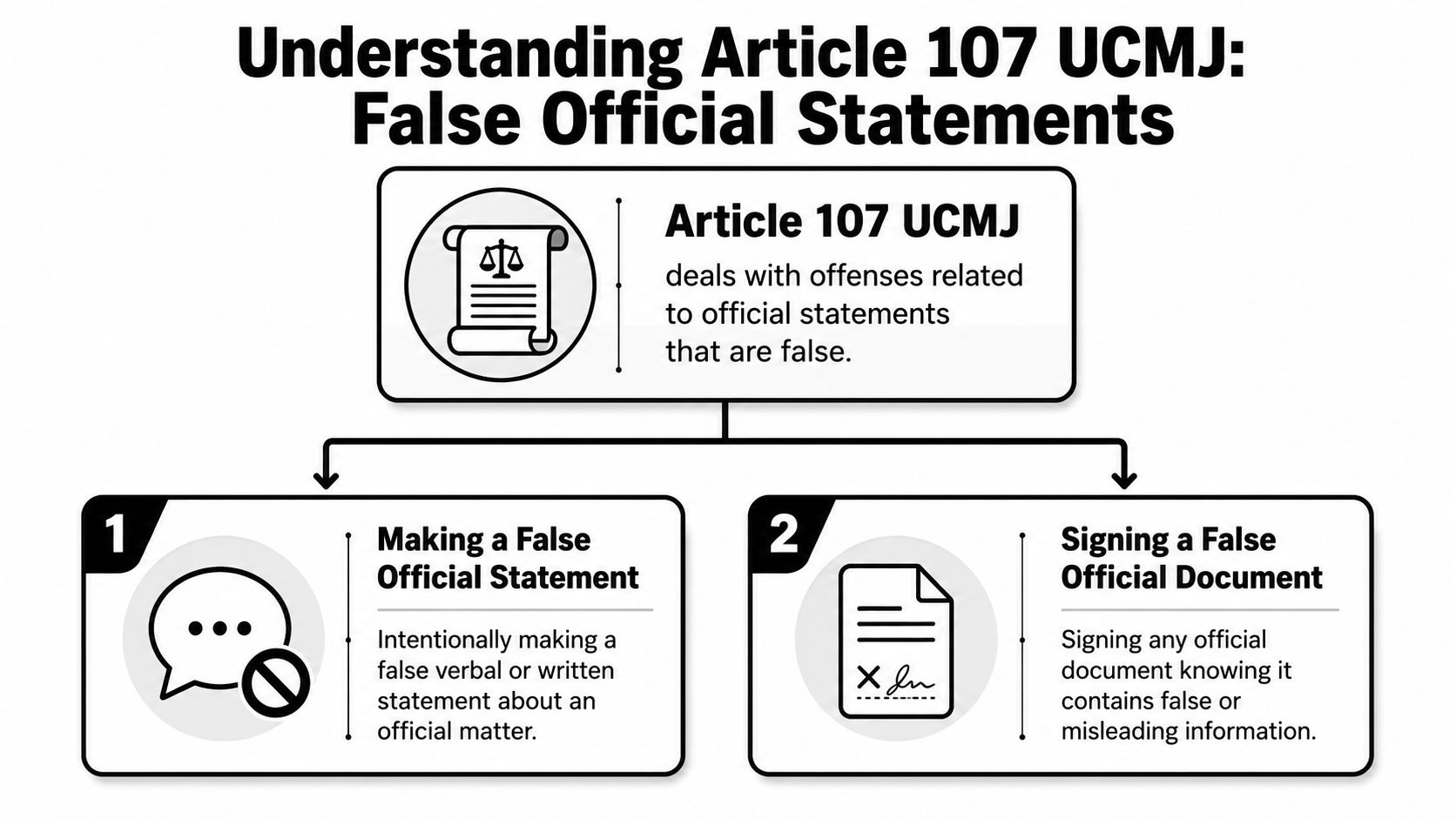
The law in plain English
If you sign an official form you know is false, you can be charged.
If you make an official statement you know is false, and you mean to mislead, you can be charged.
That can happen in writing. It can happen out loud. It can happen during an interview that feels informal. A lot of people hear “official statement” and think sworn testimony or paperwork. That’s too narrow. In military practice, the label “official” reaches much farther than many anticipate.
What the government has to prove
To convict, the prosecution has to prove specific things beyond a reasonable doubt. A practical way to look at it is this:
- You made or signed the statement or document. If they can’t tie the words or document to you cleanly, that matters.
- The statement was false. Not misleading in a vague sense. False.
- You knew it was false when you made it. Bad memory and bad judgment are not the same as knowledge.
- You intended to deceive. This is the heartbeat of the case.
A commonly used legal description of a materially false statement is one that has a natural tendency to influence an official government function, as discussed in this overview of Article 107 false official statements. But don’t get lost in that phrase yet. In actual defense work, the intent issue is usually where the case lives or dies.
Here’s what “knowing” and “intent” mean in practice:
| Issue | What the government wants to argue | What the defense looks for |
|---|---|---|
| Wrong fact | You said something inaccurate | Was it confusion, stress, or bad memory? |
| Timing | You changed details later | Did later records refresh your memory? |
| Motive | You had reason to avoid blame | Pressure isn’t proof of deliberate lying |
| Context | You spoke during an inquiry | Was it clearly official, or ambiguous? |
If you’re facing Article 107 UCMJ, stop thinking like a person trying to “explain.” Start thinking like a target in a proof case. Every word now matters.
The Career-Ending Consequences of an Article 107 Conviction
You tell yourself it was one bad answer, one sloppy form, one interview that got out of hand. The government sees something else. It sees a lie charge it can use to strip rank, money, clearance, and credibility in one shot.
Article 107 carries punishment severe enough to break a career fast. A conviction can bring a dishonorable discharge, total forfeitures, reduction to E-1, and years of confinement. As noted earlier, the maximum exposure is far beyond what many service members expect from a so-called statement case.

What punishment really means in real life
Jail gets your attention. It should.
But plenty of service members get tunnel vision on confinement and miss the rest of the blast radius. If you lose your rank and pay, your family feels it immediately. If you get a dishonorable discharge, that follows you into job applications, clearance forms, and professional licensing boards. Every future interview starts with a credibility problem.
That is why it helps to stop asking only, “Can I beat the charge?” Ask what happens if the government gets to label you a liar on the record.
The fallout usually keeps going after the case ends
Command pressure does not stop at the verdict. A conviction often triggers a second wave of damage that can be just as serious as the sentence itself.
Common consequences include:
- Administrative separation action that pushes you out even if the criminal case is over
- Security clearance suspension or loss, which can wreck both your military path and your civilian options
- Licensing trouble in fields where honesty is part of the screening process
- Hiring problems because integrity offenses are hard to explain and easy for employers to reject
Benefits become a family crisis fast. If separation is on the table, read this breakdown of how an other than honorable discharge can affect benefits. You need to know what is at risk before command starts talking about “administrative options.”
Why this charge punches above its weight
Article 107 gives the government a theme. Once prosecutors convince a commander, panel, or separation board that you lied in an official setting, they will use that accusation to poison everything else. Your explanations sound weaker. Your paperwork looks suspicious. Even a decent defense can get buried under the label.
That is the primary danger here.
And this charge has two pressure points the government still has to prove. It must show you meant to deceive, and it must show the statement was actually official under a definition broader than many people realize, but not limitless. If either point is weak, the case is weaker than command wants you to believe.
Strategic Insight How We Dismantle an Article 107 Case
CID calls you in. They act casual. You answer one sloppy question with one sloppy sentence, and now the government says you lied in an official matter. That is how Article 107 cases get built. Fast, dirty, and around themes that sound stronger than the proof.
I do not start by arguing about your character. A strong defense starts by attacking the two places these cases usually break. First, the government has to prove you meant to deceive. Second, it has to prove the statement was actually official. Command often acts like both points are automatic. They are not.

The Fight Over Intent
A wrong statement is not enough. The government needs more than an inconsistency, a bad memory, or a panicked answer. It needs proof that you were trying to mislead.
That point gets missed all the time. The Manual for Courts-Martial position described in this analysis of intent versus materiality under Article 107 is that materiality is not required for conviction. Fine. That still does not save the government from proving deliberate deception.
Weaknesses in cases frequently surface. People under stress misspeak. They answer the question they thought they heard. They use shorthand. They try to be brief and end up being unclear. Some remember events in fragments, especially after no sleep, alcohol, injury, fear, or command pressure.
Look for facts like these:
- Ambiguous questions. If the wording was loose, the answer can be easily misunderstood.
- Chaotic timing. Fast events produce bad recall and mixed-up sequences.
- Stress and fatigue. Panic wrecks precision.
- Language problems. Word choice matters, especially if English is not your first language.
- Half-answers. Incomplete does not automatically mean intentionally false.
A good defense gives the panel a better explanation than “he lied.”
Here is a common example. A service member says, “I wasn’t there.” Later, investigators learn he was outside the room but not inside when the assault started. The government calls that a lie because the words changed. Get the exact question, the exact answer, the tone of the interview, whether it was recorded, and whether the agent pushed him into a yes-or-no shortcut. That is how you attack intent. You pin down details the government hoped nobody would examine.
The video below gives broader context on how these cases unfold in the military system.
The official statement fight is broader, and still beatable
The government also loves to stretch the word “official.” Many service members assume Article 107 only covers sworn paperwork, signed forms, or testimony. That is wrong, and investigators count on that mistake.
The definition can reach informal conversations tied to military duties or military investigations. That is why a hallway talk, a phone call, or a “just help us clear this up” interview can become the backbone of a charge. But broad is not unlimited. The government still has to connect the statement to an official function, not just slap the label on any conversation that helps its case.
That fight matters early. If the statement came out in an off-duty setting, through a vague chain of reporting, or in a conversation with no clear official purpose, I press that point hard. If the government cannot prove the setting was official, the charge weakens fast.
How I pressure the case early
You do not beat an Article 107 case with speeches about honor. You beat it by forcing the government to prove each word, each question, and each inference.
My first moves are usually these:
- Lock down the exact language. Request recordings, notes, reports, drafts, and every summary.
- Build the timeline. Timing shows whether a statement was a lie, a correction, or confusion.
- Examine the interviewer. Agents paraphrase, simplify, and sometimes clean up their own bad questions.
- Compare every version carefully. Differences matter, but differences alone do not prove deception.
- Stop further damage. No follow-up statement, no apology letter, no “clarification” unless it fits the defense plan.
Most Article 107 cases depend on inference. That is good for the government only if the defense stays passive. I do the opposite. I force them to prove intent. I force them to prove the statement was official. If they cannot do both, the clean little “you lied” story starts falling apart.
Five Critical Mistakes That Will Destroy Your Defense
You get called in, they say they just want to clear a few things up, and you start talking because silence feels dangerous. That is how a manageable problem turns into a charge the government can sell as a lie.
Article 107 cases are won and lost early. The government wants extra statements, extra screenshots, extra witnesses, and extra inconsistencies. Your job is to stop feeding them. My job is to attack the two weak spots they often struggle to prove: that you meant to deceive, and that the statement was actually official in the first place.
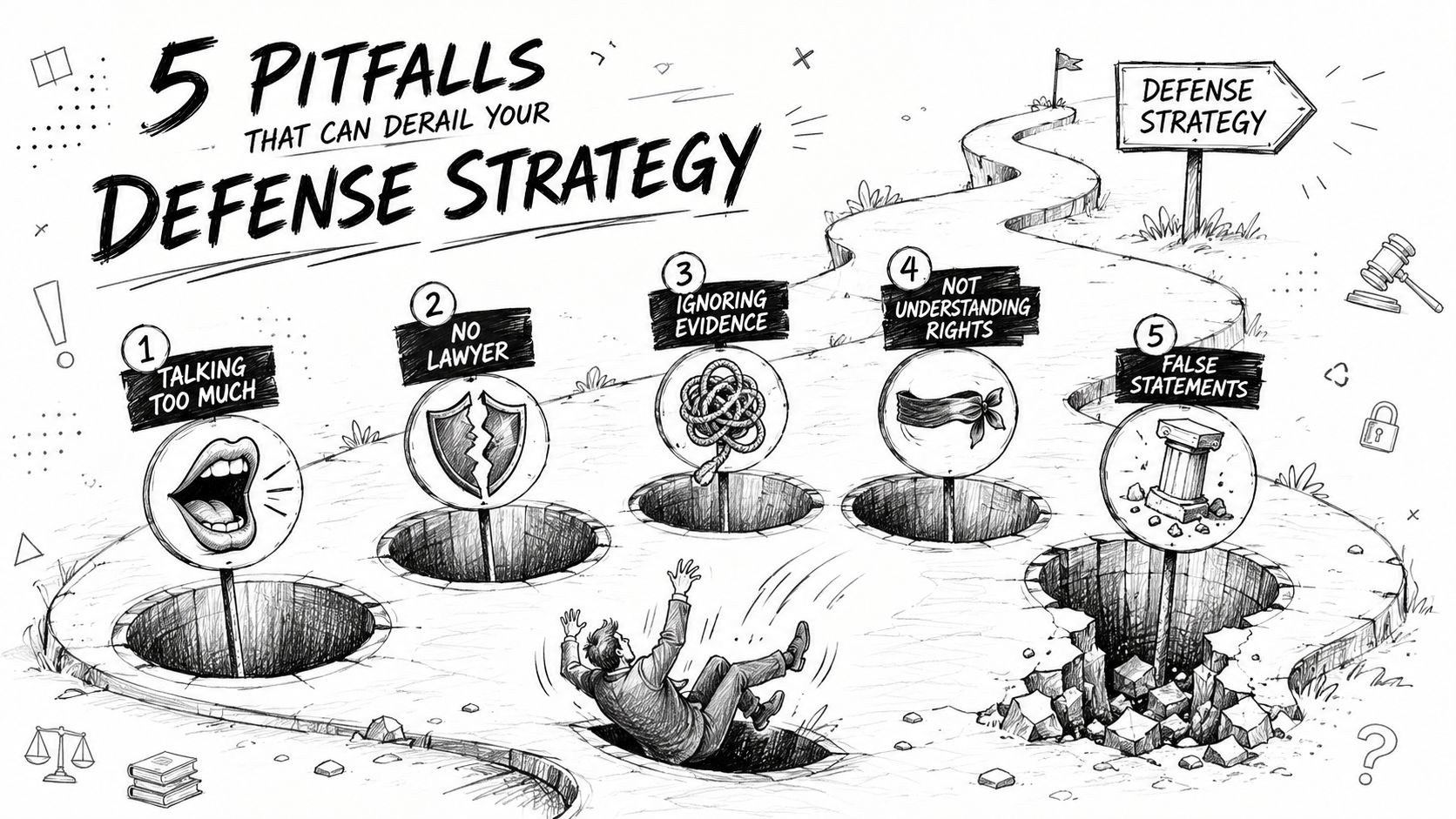
Mistakes that come up over and over
Talking to investigators because you think silence looks bad
Silence protects you. Talking gives the government raw material. Agents are trained to turn a loose answer, a bad estimate, or a nervous correction into proof that you lied on purpose.Trying to explain your way out of it
This mistake destroys good defenses. People under stress guess at times, dates, wording, and sequence. Then the government lines up version one, version two, and version three and argues the changes show intent to deceive, when the underlying problem was panic and sloppy questioning.Assuming every conversation counts the same
It does not. Some statements are official. Some are not. If you start blurting things out to supervisors, investigators, or anyone gathering facts for command action, you make the government’s “official statement” argument easier. If the setting was casual, off-duty, or disconnected from an actual military function, that issue needs to be protected early, not buried under more talking.Deleting texts, emails, or messages
Stop. Do not clean up your phone. Do not ask other people to delete anything either. Even if the messages are embarrassing, deletion lets the government argue consciousness of guilt instead of focusing on whether they can prove a false official statement.Waiting too long to get the right lawyer involved
The investigation stage is where cases harden. Witnesses get interviewed. Reports get written. Bad summaries become “facts.” If you are still deciding who should defend you, read this guide on how to choose a military defense lawyer and make the call before your record gets boxed in by paperwork.Talking to friends, coworkers, or witnesses about the facts
Those people are not part of your defense team. They can be interviewed. They can hand over texts. They can misquote you and still sound believable on paper.Agreeing to a polygraph because you think the truth will save you
Polygraphs are pressure tools. They are used to get admissions, lock you into details, and create new statements the government can mine later. Never walk into one without a defense plan.
One sentence wrecks careers in these cases: “I thought I could fix it myself.”
If you already made one of these mistakes, the case is not over. It means you stop talking, preserve everything, and get disciplined about every next move. The government still has to prove intent to deceive. The government still has to prove the statement was official. Do not make those points easier for them.
Why Your Appointed Military Lawyer Is Not Enough
Let me be fair first. Some appointed military defense counsel are smart, hardworking, and courageous. Many care a great deal about their clients.
That still doesn’t mean appointed counsel is enough for a serious Article 107 UCMJ case.
Free counsel and independent counsel are not the same thing
A military-appointed lawyer works inside the same institution that is investigating, charging, funding, and processing your case. Even when that lawyer is doing everything possible for you, the system around them is still the system trying to convict or separate you.
An experienced civilian military defense lawyer brings different value:
| Appointed military counsel | Experienced civilian defense counsel |
|---|---|
| Part of the military system | Independent from command |
| Often rotating caseloads | Can devote focused attention to your case |
| Varying trial experience | Often chosen specifically for court-martial work |
| Limited by duty station demands | Can work across installations and branches |
The difference isn’t just résumé language. It’s strategic freedom. A seasoned civilian lawyer can push back harder, move faster, and give you advice that isn’t shaped by assignment turnover, office load, or institutional caution.
You don’t hire civilian counsel because appointed counsel is bad. You hire civilian counsel because the stakes are too high for a one-layer defense.
The decision point that can change everything
Article 107 cases can proceed in different directions. They may go down an administrative path, including Article 15, letters of reprimand, or separation action, or they may go to a full court-martial, as outlined in this explanation of administrative action versus court-martial in Article 107 cases.
That choice can decide your future.
Sometimes the right move is to fight for no statement, no admission, and no easy paperwork win for the government. Sometimes the right move is to shape the case away from court-martial and toward damage control. Sometimes accepting a quick administrative outcome is a trap that creates long-term fallout worse than the client understands.
If you’re weighing that choice, read this practical guide on how to choose a military defense lawyer. Then talk to someone who handles these decisions routinely, not occasionally.
Your Questions Answered and Your Next Move
A lot of Article 107 cases turn on two points service members miss. Did you actually mean to deceive, and was the statement really official in the first place? Investigators act like those points are automatic. They are not. That is where weak cases get exposed, or where a bad interview hands the government what it was missing.
FAQ
Can I refuse to talk to CID, NCIS, OSI, or CGIS?
Yes. Do it. Ask for a lawyer and stop talking. The fastest way to strengthen an Article 107 case is to keep explaining yourself after rights advisement.
If I tell the truth now, will that fix it?
Usually no. A second statement often gives the government a cleaner theory of intent to deceive. It also lets them argue you knew the first version was false. Do not try to repair this on your own.
Can I be convicted if it’s just their word against mine?
Yes. But those cases are often beatable because intent and context matter. If the wording was vague, rushed, misunderstood, or pulled out of a casual conversation that never should have counted as official, the government has a problem.
Should I take a polygraph?
No, unless your defense lawyer has a specific reason and a plan. Polygraphs are investigation tools. They are built to help agents, not you.
Will I go to jail for Article 107 UCMJ?
You can. You can also lose rank, pay, promotions, your clearance, and your future in uniform. Early decisions shape how bad this gets.
Do I need a lawyer immediately?
Yes. In false statement cases, the damage usually happens before charges, not after. The government tries to lock in your words, your texts, and your explanations long before anyone gets near a courtroom.
Your next move
Do three things now.
First, stop talking about the facts with anyone except a lawyer. That includes your chain of command, your coworkers, your spouse over text, and your buddy in the barracks. Every retelling creates a new exhibit.
Second, preserve anything that helps show confusion, mistake, poor wording, or lack of intent. Save messages, emails, timelines, screenshots, duty notes, and names of witnesses. If the statement came up in an informal setting, document that too. The line between casual and official is broader than it should be, but it still matters.
Third, get a civilian military defense lawyer involved early. If you need a place to start comparing serious military defense lawyers, court-martial attorneys, and experienced UCMJ counsel, use this guide to choosing a military defense lawyer and start making calls today.
If you are under investigation for Article 107 UCMJ, waiting helps the government. Act before they turn a bad moment into a career-ending record.