You open your email or get called into the office. A packet gets slid across the desk. It says separation. Your first instinct is to think this is paperwork, a command scare tactic, or a problem that can be fixed later.
That thinking gets people discharged.
If you’re dealing with AR 135-178, you’re not dealing with a harmless admin issue. You’re dealing with the rulebook the Army uses to remove enlisted soldiers from service. That can mean loss of your military career, damage to your record, pressure on your family, and long-term fallout when employers ask why your service ended the way it did. If misconduct allegations are in the background, the danger is even worse because administrative separation often moves alongside, or right behind, criminal exposure.
You need to think like your command is building a file, because that’s exactly what they’re doing. You also need to understand something most soldiers miss. A separation case is never just about the stated allegation. It’s about whether the Army can justify keeping you. That’s why timing, evidence, and legal strategy matter from day one.
Table of Contents
- Your Career Is on the Line What AR 135-178 Means for You
- What Is Army Regulation 135-178
- The Chapters That Can End Your Army Career
- The Separation Board Process What to Expect
- How a Defense Lawyer Fights a Separation Board
- Critical Mistakes That Will Cost You Your Career
- Frequently Asked Questions About AR 135-178
Your Career Is on the Line What AR 135-178 Means for You
You need to read the notice carefully and act fast. AR 135-178, effective 6 June 2025, governs administrative separations specifically for Army National Guard/Army National Guard of the United States and U.S. Army Reserve enlisted Soldiers not serving on active duty, implementing DoDI 1332.14 and establishing policies for their orderly separation, as stated in the current Army publication for AR 135-178.

That sentence sounds sterile. In real life, it means the Army has a formal process to push you out, and once that machine starts moving, it doesn’t slow down because you’re overwhelmed, embarrassed, or hoping your unit will “take care of you.”
If you’re Guard or Reserve, don’t assume distance from active duty protects you. It doesn’t. If anything, many part-time soldiers underestimate the danger because they’re juggling a civilian job, family, drill obligations, and a command packet they don’t fully understand. That’s how deadlines get missed and rights get waived.
What this means right now
You need to treat a proposed separation like a legal emergency.
- Your record is being shaped now: Every counseling, memo, statement, and response can become part of the file.
- Your silence can hurt you: Not because you must talk, but because failing to respond strategically lets the government define the story.
- Your future can change fast: Characterization of service follows you into civilian life, benefit questions, and background reviews.
Practical rule: If you’ve been notified under AR 135-178, stop treating this like office paperwork. Treat it like a case.
You also need to understand the difference between being informed and being defended. Reading general guidance helps. It doesn’t replace case strategy. If you need a primer on the broader process, review this guide to Army administrative discharge defense and then get specific advice about your packet, your chapter, and your evidence.
What Is Army Regulation 135-178
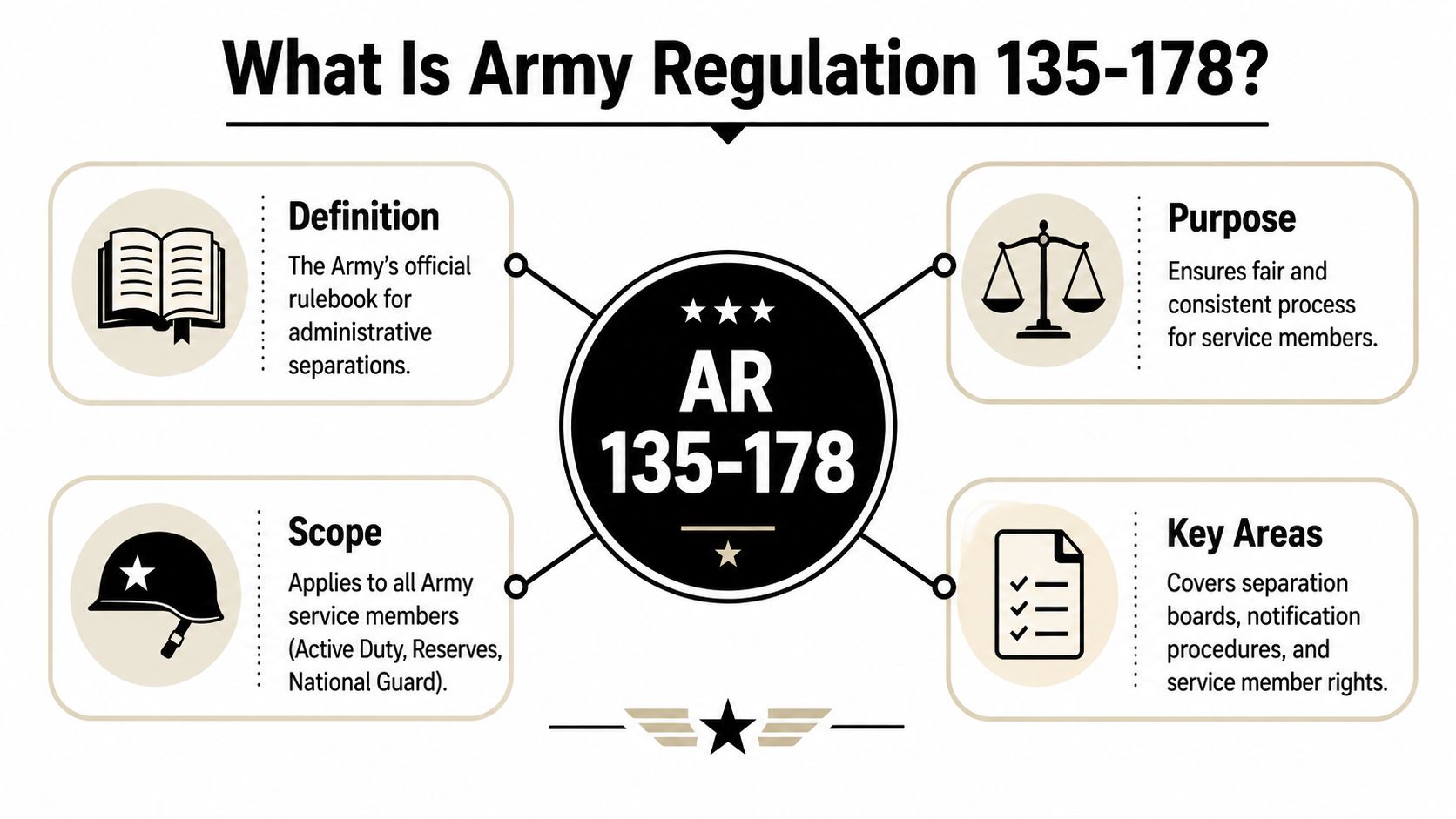
AR 135-178 is the Army’s administrative separation regulation for enlisted personnel. It is the formal framework commanders use when they decide a soldier should no longer remain in service for reasons that don’t require a punitive discharge from a court-martial.
The official title is Enlisted Administrative Separations. It is identified as the primary U.S. Army regulation for separating Army National Guard, U.S. Army Reserve, and active-duty enlisted personnel, and it was last updated on November 7, 2022, according to the regulatory reference summary for AR 135-178.
Administrative does not mean minor
Here, soldiers get burned. They hear “administrative” and assume it means low stakes. Wrong.
An administrative separation can still end your Army career, stain your service record, and affect what benefits or opportunities you keep. It is different from a punitive discharge imposed by a court-martial, such as a Bad-Conduct Discharge or Dishonorable Discharge. But from a practical standpoint, it can still hit hard enough to alter the rest of your life.
Think of it this way:
| Issue | Administrative separation under AR 135-178 | Punitive discharge from court-martial |
|---|---|---|
| Source | Command-driven personnel process | Criminal proceeding |
| Main purpose | Remove a soldier from service | Punish criminal misconduct |
| Risk | Loss of career and adverse characterization | Criminal conviction plus punitive discharge |
| Defense need | Immediate and strategic | Immediate and strategic |
What the command is trying to do
The command is not running a therapy session. It is trying to justify removal under the regulation.
AR 135-178 covers multiple grounds for separation, including misconduct, body composition failures, mental health-related issues, and entry-level status matters in the broader regulation summary. The point isn’t just to document a problem. The point is to build a legally supportable basis to separate you while preserving the Army’s position if the case gets reviewed.
Administrative separation is where the Army translates command dissatisfaction into official action.
A good defense starts by reading the packet the same way the government does. What chapter are they using. What facts are they relying on. What paperwork is missing. What timelines were ignored. What assumptions are they making about your value to the service.
Those questions decide whether this case is manageable, winnable, or already slipping away.
The Chapters That Can End Your Army Career
You can lose this case before the board even starts if you misread the chapter. The chapter is the command’s theory of removal. It tells you what they plan to prove, what characterization they may chase, and where your defense has to hit first.
That matters even more after recent NDAA changes shifted charging decisions and prosecutorial discretion in serious cases. Commands still use AR 135-178 to remove soldiers when a criminal case is not filed, gets reduced, or never reaches a courtroom. If you focus only on whether you are facing court-martial, you miss the main fight. Separation can become the fallback weapon.
Chapter 12 misconduct
Chapter 12 is the chapter that ends careers fast. It gives the Army several paths to label you unfit for continued service. Under AR 135-178, Chapter 12 covers minor disciplinary infractions, pattern of misconduct, commission of a serious offense, abuse of illegal drugs, and civil conviction, as reflected in the Indiana National Guard misconduct separation material summarizing Chapter 12.
A smart defense starts by forcing the command to commit to one theory and proving why the facts do not support it. Commands like flexibility. Defense lawyers should hate it. The same set of facts can be repackaged from “isolated mistakes” into a “pattern,” or from an allegation into a “serious offense” theory that supports a harsher characterization.
Short service does not protect you. If you have less than 180 days of continuous active service, a Chapter 12 discharge is typically uncharacterized unless an Other Than Honorable discharge is warranted, as noted earlier in that Chapter 12 source. Soldiers early in their careers often underestimate this risk and hand the command an easy file.
If your packet cites Chapter 12, study the theory of the case before you say a word. Then get counsel who knows how to attack administrative separation evidence and board strategy in a military administrative separation board case.
Performance and standards cases
Some chapters attack your future value to the service rather than accusing you of misconduct. That does not make them safer. It changes the defense.
Common pressure points include:
- Unsatisfactory performance: The Army argues your duty performance, reliability, or potential does not justify retention.
- Body composition failure: AR 135-178 includes Chapter 16 for failure to meet Army body composition standards. The process is administrative, but the consequences still matter because the service can characterize the discharge as General or Entry-Level if the soldier fails remediation timelines, according to the body composition standards separation document.
- Entry-level issues: Commands use early-service deficiencies to push out soldiers before they build a record strong enough to resist separation.
These cases are often paper-heavy. Counseling statements, NCO comments, weigh-in records, and rehabilitation efforts decide whether the file looks fair or rushed. A weak packet can be beaten. A sloppy response can make it look stronger than it is.
Why characterization matters
Retention is only one objective. Characterization is the second fight, and sometimes it is the fight that matters most.
| Characterization | What it signals |
|---|---|
| Honorable | The best result if separation cannot be stopped |
| General | A negative mark that can affect benefits and civilian opportunities |
| Other Than Honorable | Serious damage to your record, reputation, and future options |
| Uncharacterized | Common in entry-level cases, but still a result that deserves a defense |
The command is not just deciding whether you stay in uniform. It is deciding what follows you after you leave.
In AR 135-178 cases, you defend two targets at once. Your career now, and your record after separation.
The Separation Board Process What to Expect
Most service members are rattled because they don’t know the sequence. Once you understand the board process, the panic becomes planning.
Early in the process, focus on rights, deadlines, and elections. Later, the fight shifts to evidence, witness credibility, and whether the record supports separation.
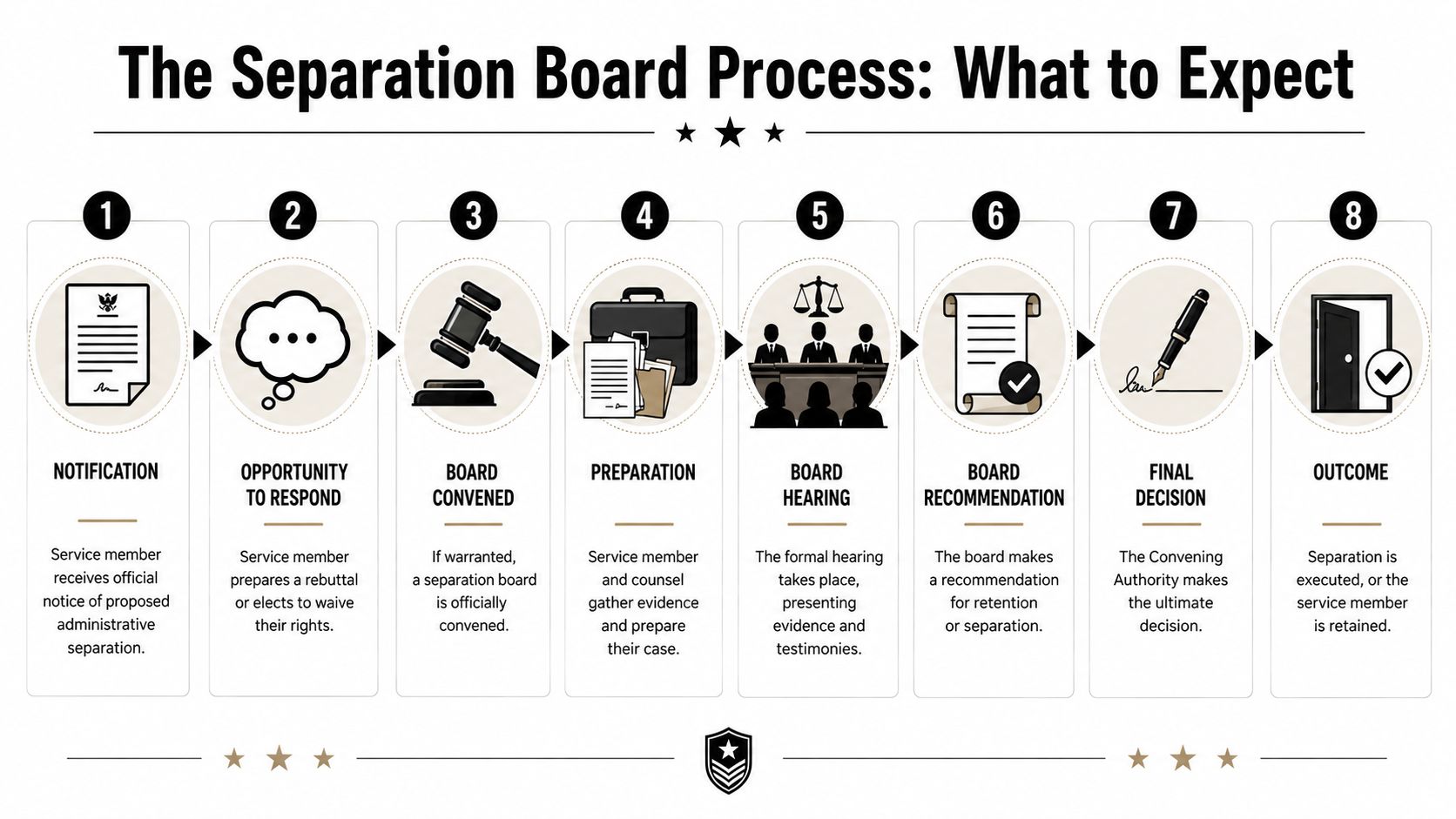
Step 1 to Step 3 the opening moves
Notification arrives.
This is the government’s opening shot. The notice should tell you the basis for separation and what rights you have. Read every line. Then read the attachments.You decide how to respond.
At this point, people make reckless choices. They waive rights, submit a rushed statement, or rely on hallway advice from someone who has never defended a board case.If eligible, a board may be elected or convened.
Whether you should demand a board depends on the facts, your service record, and the risk of a bad characterization. That is a strategy call, not a pride call.
If you want a fuller breakdown of the hearing mechanics, this guide to administrative separation boards in the military is worth reviewing before you decide anything final.
A visual overview helps when the packet feels like chaos:
Step 4 to Step 6 the board fight
By the time the board is coming, your case should already be organized.
- Preparation: Gather evaluations, counseling records, awards, treatment documents where appropriate, witness statements, and anything that undercuts the government’s theory.
- Hearing: The government presents its case. Your side presents evidence, challenges weak documents, cross-examines witnesses, and argues for retention or a better characterization.
- Recommendation: The board makes a recommendation based on the record it heard, not the rumors floating around the unit.
This isn’t informal. It is a legal proceeding with real consequences.
The board hearing is often the first place the government case gets tested by people who weren’t in your chain of command.
Step 7 and Step 8 the final decision
After the board acts, the case goes up for final decision. Under AR 135-178, the Separation Authority for Army Reserve soldiers is a delegated role that must ensure a Board of Review decision is both proper and equitable before denying relief, according to the USAR separation authority memorandum.
Those words matter. Proper means legally sound. Equitable means fair. A defense lawyer should build the record with both in mind.
That final stage decides whether separation is executed, whether relief is possible, and whether your full enlistment history helps save you or gets buried under the allegation of the moment.
How a Defense Lawyer Fights a Separation Board
A strong lawyer doesn’t show up and beg for mercy. A strong lawyer attacks the case from several angles at once.
The file is never as clean as the government claims
Most separation packets look stronger on first read than they do under pressure. That’s because commands often rely on assumptions, incomplete paperwork, vague counseling language, weak witness accounts, or a one-sided version of the soldier’s record.
A real defense digs into issues like these:
- Procedural defects: Missing notices, flawed elections, unsupported recommendations, or skipped steps.
- Credibility problems: Witnesses with motives, inconsistent accounts, or command exaggeration.
- Record imbalance: The packet highlights bad facts and buries good service, improvement, treatment, or context.
- Equity arguments: Even where the Army has some basis to act, separation may still be unfair on the full record.
This is also where the “whole soldier” case matters. You don’t defend only against the allegation. You defend the value of retention, the context of the event, and the fairness of the outcome.
The overlooked NDAA angle
Most online discussions of AR 135-178 miss the most important modern strategic issue. The 2022 NDAA shifted prosecutorial discretion for serious offenses to military lawyers, and that change directly affects separation strategy because case-filing decisions by lawyers often trigger or shape later administrative action, especially for Guard and Reserve members, as discussed in this UNC law publication on the NDAA shift.
That means a smart defense lawyer isn’t looking only at the separation packet. He or she is looking upstream.
If a serious allegation is being reviewed, the charging decision, declination decision, or legal framing by military attorneys can affect:
- whether the command pushes an adverse chapter,
- how the government describes the underlying conduct,
- what evidence migrates from a criminal inquiry into an administrative case,
- and what influence is available before the board ever meets.
That’s why the best time to hire counsel is usually before the separation board, and often before the separation packet exists. If you’re still in the investigation phase, review this guide on winning cases during the military investigation phase and start thinking several moves ahead.
A separation case can be won or lost long before the board members enter the room.
Critical Mistakes That Will Cost You Your Career
Service members in crisis don’t usually fail because they don’t care. They fail because they react emotionally, trust the wrong people, and underestimate the system.
AR 135-178 also gives commanders a framework to justify separation by documenting that the cost of keeping a substandard soldier, including pay, administration, and morale, outweighs the soldier’s potential, as described in this discussion of enlisted administrative separations. That should tell you how the Army is thinking. This is not just about whether someone likes you. It’s about whether the file supports removing you as an operational and administrative decision.

What service members get wrong
Here are the mistakes that come up over and over:
- Ignoring the notice: Hoping the issue fades out is a fantasy. Deadlines keep moving even if you freeze.
- Waiving rights too fast: Fear makes soldiers surrender hearings, statements, and options they later wish they had used.
- Talking too much: Explanations given to command, investigators, or “helpful” NCOs often become evidence.
- Relying on peer advice: Your barracks lawyer, drill buddy, or retired uncle isn’t defending your board.
- Showing up unprepared: If you don’t organize witnesses, records, and a theory of the case, the government fills the vacuum.
- Assuming honesty is enough: Truth matters. Strategy decides whether truth gets heard, framed correctly, and believed.
If you don’t build your case, the government will build it for you.
Why civilian defense counsel matters
Appointed military counsel can be capable and committed. But serious separation cases often require more than basic representation.
A seasoned civilian military defense lawyer brings advantages that matter:
| Issue | Appointed military counsel | Experienced civilian counsel |
|---|---|---|
| Independence from command | Limited by military structure | Fully independent |
| Case load pressure | Often heavy | Typically more controlled |
| Long-term board and trial exposure | Varies widely | Often deeper in high-stakes defense work |
| Strategic continuity | Can shift with assignments | More stable through the life of the case |
That independence matters most when the command’s story is wrong, incomplete, or strategically vulnerable. You need someone whose only job is protecting you.
Frequently Asked Questions About AR 135-178
FAQ
Can I be separated under AR 135-178 without a court-martial?
Yes. That’s the point of the regulation. Administrative separation is separate from a court-martial, even though the underlying facts may overlap.
Is an administrative discharge less serious than a punitive discharge?
Legally, they’re different. Practically, an adverse administrative discharge can still damage your career, benefits, and civilian opportunities.
What if my case involves misconduct and a criminal investigation?
Treat that as a high-risk situation immediately. Statements, evidence, and timing can affect both the criminal side and the separation side.
Can I fight for retention and also fight for a better characterization?
Yes. Good defense strategy usually addresses both. If retention isn’t realistic, protecting characterization becomes critical.
Do I need a lawyer before the board is scheduled?
Yes. Waiting until the hearing is close wastes time that should have been used to shape the file, preserve evidence, and challenge the government’s framing.
Can the Army use a pattern of conduct against me even if no single event seems huge?
Yes. Under Chapter 12, pattern allegations are one of the recognized misconduct categories.
If I’m close to retirement, should I assume the system will protect me?
No. Never assume that. If retirement issues are in play, the case needs immediate and highly specific legal analysis.
How should I act right now if I just got notice?
Keep your mouth shut until you’ve had legal advice, preserve documents, identify witnesses, and stop making casual statements to people in uniform.
If you’re facing AR 135-178, this is not the time to wait, hope, or trust that common sense will carry the day. It won’t. The system rewards preparation, credibility, and hard legal strategy.
If you’re under investigation, proposed for separation, or trying to decide whether to elect a board, get help now. Your career is on the line, your record is being written in real time, and early mistakes are hard to fix later.
Then start making calls. The right move today can save your military future.