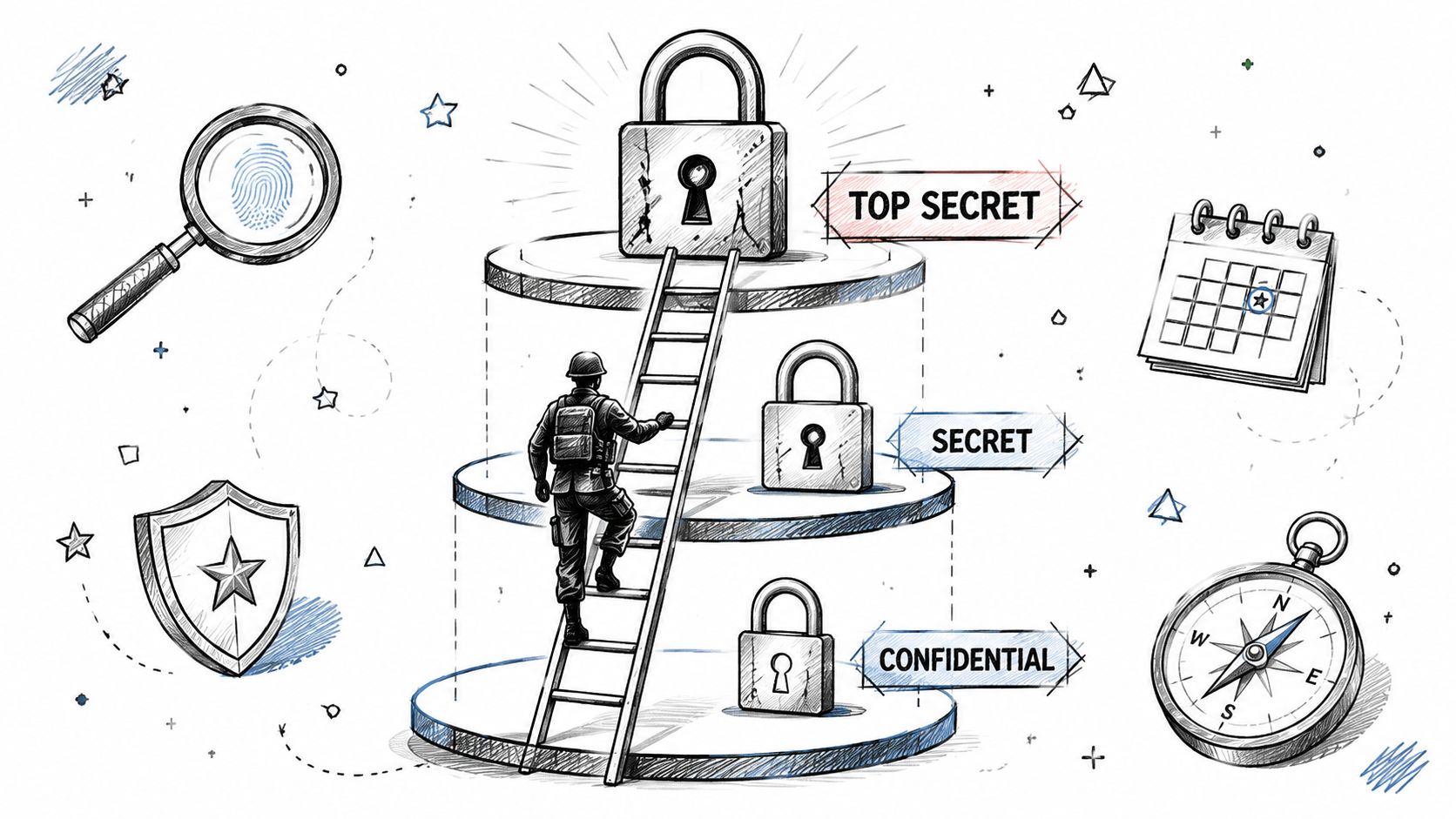
Your phone buzzes. Your platoon sergeant tells you the commander wants to see you. You walk in expecting some routine paperwork, and instead you hear the words nobody wants to hear: there’s a problem with your security clearance.
That moment hits hard because you already know what’s tied to that clearance. Your job. Your promotion path. Your reputation. In some units, your entire usefulness to the mission. If your access gets suspended, command may act like this is just an administrative issue. It isn’t. It can trigger investigations, kill assignments, and push you toward separation long before you understand what happened.
If you’re searching what are the levels of security clearances, you may think you’re looking for a simple chart. You’re not. You’re trying to figure out how much danger you’re in, what the government can do to you, and how fast you need to respond. That’s the right instinct. The clearance system is not built to protect you. It is built to screen you, monitor you, and remove you if decision-makers decide you’re a risk.
Table of Contents
- Your Clearance Is Your Career And It Is Always at Risk
- The Three Tiers of Security Clearances Explained
- Beyond Top Secret Understanding SCI and SAPs
- How the Government Decides Your Fate The Investigation Process
- The New Threat Continuous Evaluation and Your Private Life
- Critical Mistakes That Will Cost You Your Clearance
- Why You Must Act Now to Protect Your Military Career
- Frequently Asked Questions About Security Clearances
- Can I lose my clearance over debt?
- Can I refuse to talk to CID, NCIS, OSI, or CGIS if my clearance is involved?
- Is Top Secret higher than TS-SCI?
- What is a Statement of Reasons
- Can my spouse’s conduct affect my clearance?
- Will one bad incident automatically end my military career?
- Do I need a lawyer before I get formal paperwork?
Your Clearance Is Your Career And It Is Always at Risk
A security clearance is not a trophy. It is not a badge of honor that, once earned, stays with you because you worked hard. It is a revocable privilege, and the government can start pulling at that thread fast.
The same pattern repeats over and over. A service member has one ugly weekend. Maybe a domestic argument got loud enough for law enforcement to show up. Maybe there was a DWI stop. Maybe they fell behind on bills during a bad divorce and thought they’d fix it unnoticed. Then command gets word. Security managers get involved. Investigators start asking questions. Suddenly the issue isn’t just the incident. The issue becomes judgment, honesty, reporting, reliability, and whether you can still be trusted.
That is how small personal problems become professional disasters.
What the command usually won’t say clearly
Command often treats clearance trouble like an HR problem. It isn’t. A clearance review can collide with:
- Administrative action that blocks assignments, schools, or retention
- UCMJ exposure if the underlying conduct leads to military charges
- Investigator interviews by CID, NCIS, OSI, or CGIS
- Reputation damage that follows you even if no criminal conviction happens
Practical rule: The moment your clearance is questioned, act like every statement you make can affect both your career and a possible military justice case.
Families feel this too. A suspended clearance can mean lost special duties, stalled advancement, and immediate uncertainty at home. If you support classified missions, losing access may make command view you as expendable. That’s the ugly truth.
The Three Tiers of Security Clearances Explained
The answer to what are the levels of security clearances starts with three federal tiers. That part is simple. The consequences are not.
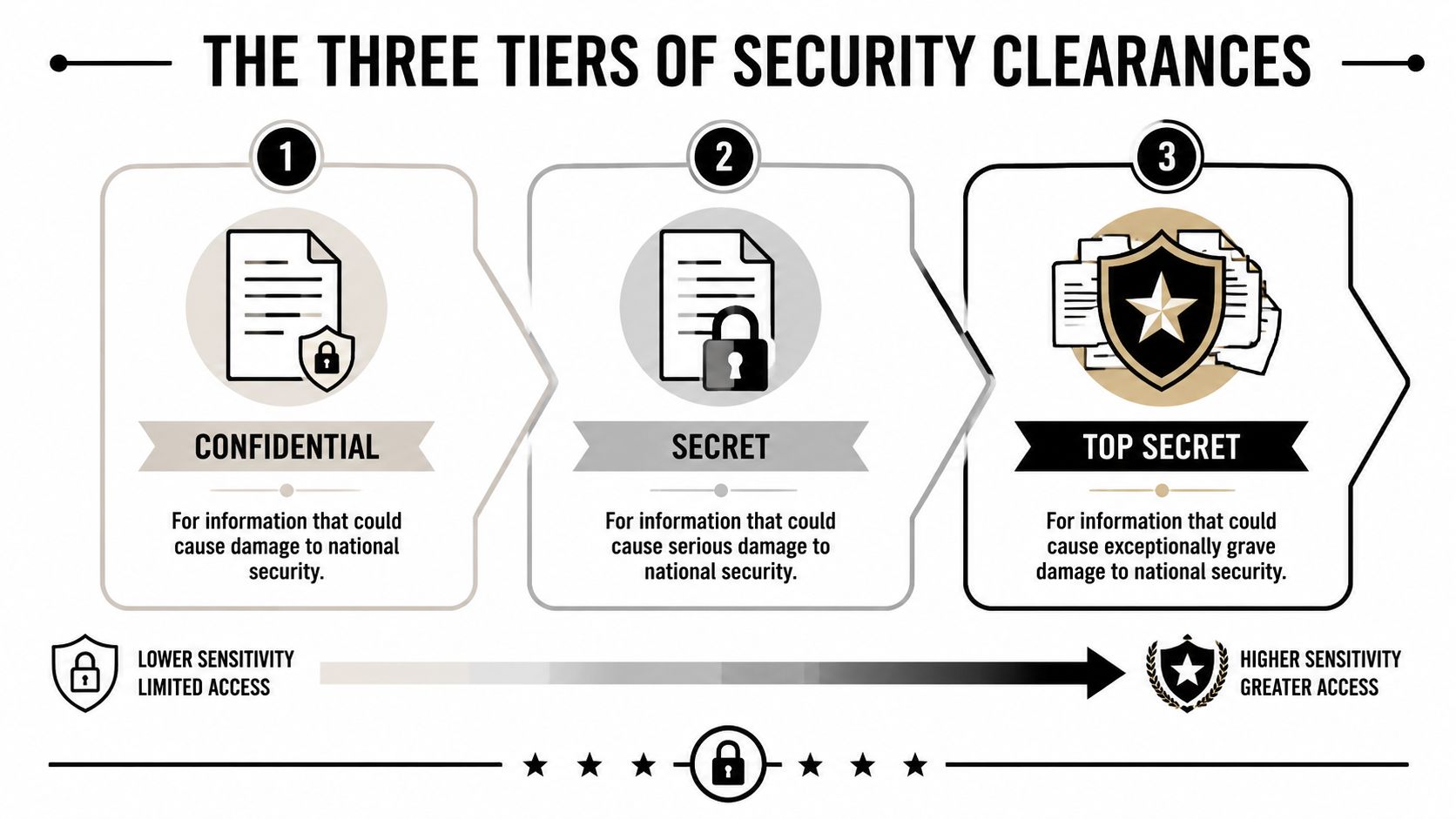
The United States uses a three-tier system: Confidential, Secret, and Top Secret. According to this security clearance reference guide, approximately 60% of active clearances are Secret, 20% are Confidential, and 20% are Top Secret. Those levels track the damage unauthorized disclosure could cause to national security.
What each level actually means
Confidential is the lowest of the three. It covers information that could cause damage to national security if disclosed without authorization.
Secret is the workhorse clearance in the system. It covers information that could cause serious damage if exposed.
Top Secret is the highest standard clearance level. It covers information that could cause exceptionally grave damage to national security if disclosed.
That’s not abstract language. It tells you how the government views risk. The higher the level, the more scrutiny you face, the less tolerance you get, and the more aggressively the government will examine your life.
A quick visual helps before the details get dense.
Security Clearance Levels at a Glance
| Level | Potential Damage to National Security | Typical Access | Periodic Reinvestigation (Traditional) |
|---|---|---|---|
| Confidential | Damage | Lower-level classified information tied to national security work | Every 15 years |
| Secret | Serious damage | Detailed military operations, sensitive intelligence, and mission-critical material | Every 10 years |
| Top Secret | Exceptionally grave damage | Covert operations, advanced weapons information, and the most sensitive national security material | Every 5 years |
Here is the practical takeaway.
- Confidential holders still face scrutiny, but the investigation is lighter.
- Secret holders make up most of the cleared population, which means many service members professionally operate at this level.
- Top Secret holders face the deepest background review and the tightest watch because the consequences of a mistake are viewed as catastrophic.
If you hold a higher level, your private life matters more than you think. Not morally. Bureaucratically. That distinction matters.
Beyond Top Secret Understanding SCI and SAPs
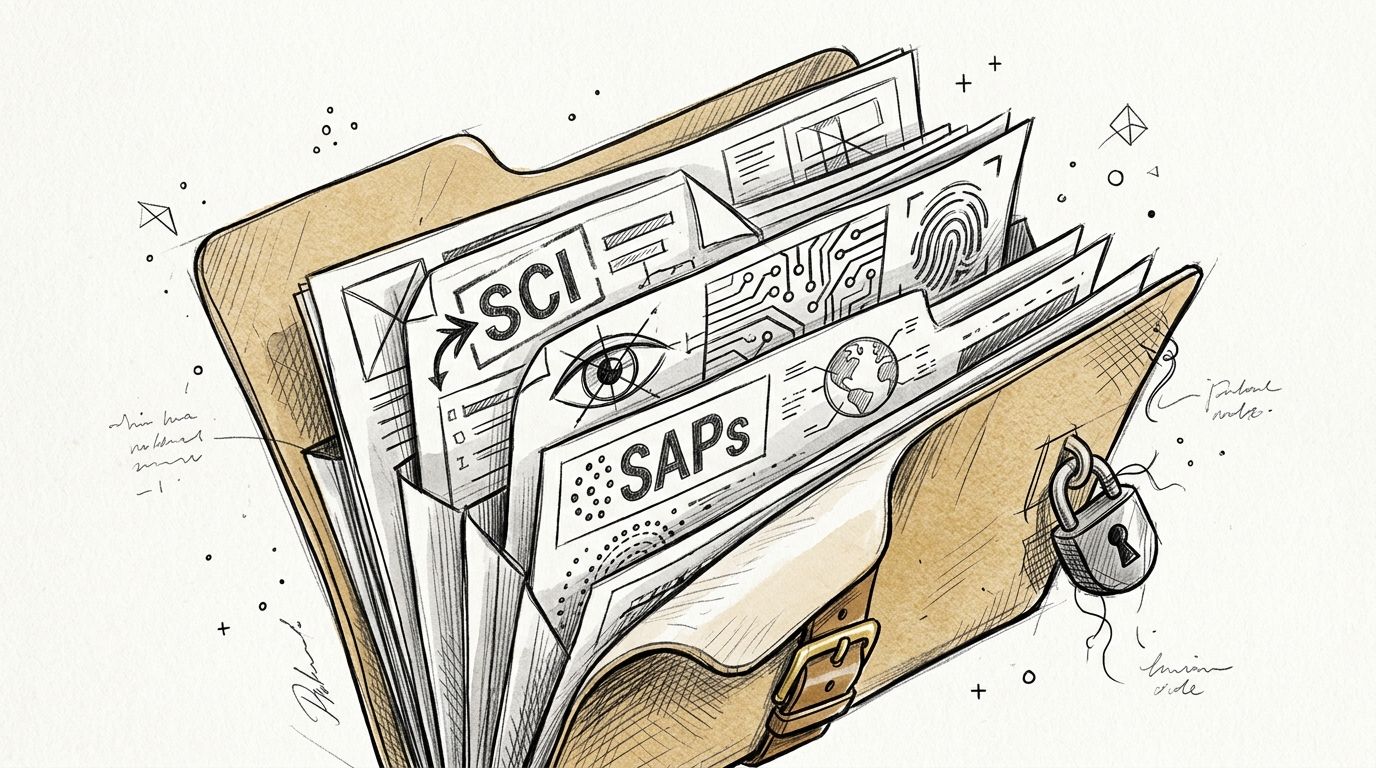
A lot of people get this wrong. SCI and SAP are not “above Top Secret” in the way junior troops often talk about it in the barracks. They are added layers of access control.
SCI is not a higher clearance
According to this federal vetting overview from GoGovernment, Sensitive Compartmented Information (SCI) is added to a Top Secret clearance to allow access to specific intelligence sources and methods, and it often comes with polygraph requirements that lower tiers do not carry.
That matters because people casually say they have “TS/SCI” as if it’s one clearance. It isn’t. It’s a Top Secret clearance plus compartmented access. You still need a valid need-to-know, and that need-to-know can disappear even if your base clearance remains intact.
Why SAPs change the risk
Special Access Programs (SAPs) are where compartmentation gets even tighter. If you work around covert programs, sensitive capabilities, or highly restricted defense activities, ordinary clearance language stops being enough. Access gets narrowed to the smallest possible group, and mistakes are judged harshly.
A few blunt realities apply here:
- More access means more exposure. More reporting duties, more monitoring, more chances to get flagged.
- Polygraphs and extra interviews matter. They create additional places where inconsistency can hurt you.
- Need-to-know is separate from status. You can keep a clearance and still lose access to the work that made your position valuable.
There are also parallel systems outside the standard federal tiers. The Department of Energy uses Q and L clearances rather than the ordinary Confidential, Secret, and Top Secret labels. That alone should tell you the system is more complicated than most online explainers admit.
The biggest mistake is treating access like a status symbol. It’s a control mechanism. The government gives it in layers and takes it back in layers.
How the Government Decides Your Fate The Investigation Process
Your commander tells you the clearance issue is probably routine. Then an investigator starts asking about your debts, an old relationship, a police contact you thought was minor, and answers you gave on a form months ago. That is how careers start to come apart on paper, before anyone gives you a fair chance to explain.
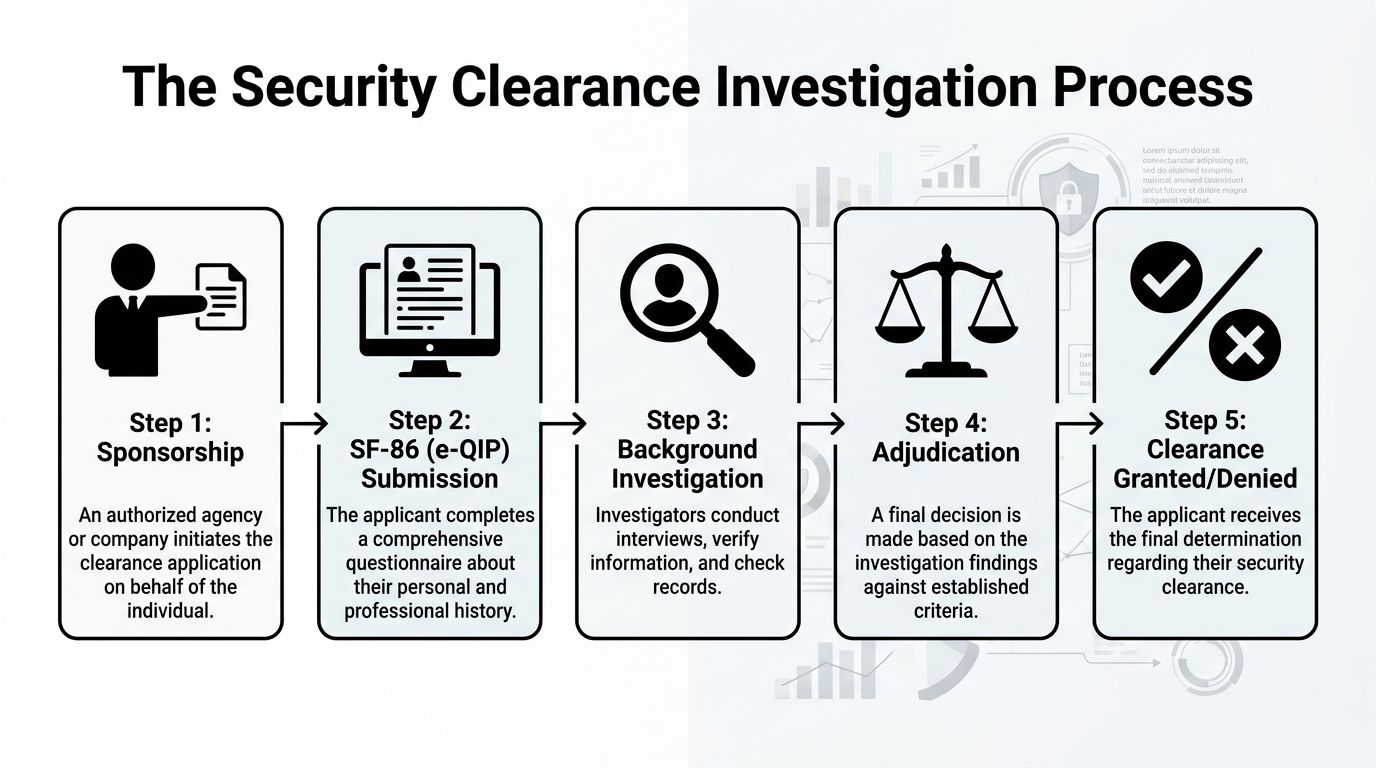
It starts with sponsorship, then your file becomes the case against you
You do not apply for a security clearance on your own. A position requiring access triggers the process. Then you complete e-QIP and give the government a detailed record of your finances, foreign contacts, travel, living history, conduct, and past mistakes.
That form matters more than many service members realize.
One sloppy answer can be framed as dishonesty. One omission can become a separate problem from the underlying event. Under the current system, the government is not just checking whether you ever made a mistake. It is checking whether your paperwork, your records, and other people’s statements line up cleanly enough to trust you with access.
Investigators are hunting for risk, leverage, and inconsistency
The investigation is built to test reliability. Records get pulled. References get interviewed. Statements get compared. Patterns get flagged. What hurts people is rarely one dramatic event. It is a cluster of smaller issues that together make you look careless, compromised, or easy to pressure.
Common pressure points include:
- Foreign influence
- Foreign preference
- Financial problems
- Personal conduct
- Criminal issues
- Drug or alcohol concerns
Pay attention to that list. Those categories are broad enough to absorb everyday life problems, and broad enough to let minor facts carry major consequences later under Continuous Evaluation.
If the underlying issue overlaps with a criminal or command investigation, the risk multiplies fast. A bad statement in one setting can damage you in another. Before speaking to military agents, read this guide to CID, NCIS, OSI, and CGIS investigations.
Adjudication is where the government decides whether your judgment can be trusted
After the investigation, adjudicators review the file under the government’s 13 adjudicative guidelines, published by the Director of National Intelligence in the Security Executive Agent Directive 4 guidelines. Those guidelines cover issues such as allegiance to the United States, foreign influence, foreign preference, sexual behavior, personal conduct, and financial considerations.
Do not make the mistake of treating this like a simple pass or fail review. It is a risk call, and risk calls are subjective. The adjudicator does not need proof that you are disloyal. The government only needs enough concern to conclude you are a security problem.
That is why early strategy matters.
A defense lawyer reviewing a clearance case looks for things the system will not fix for you:
- Inconsistent statements that need explanation before they harden into a credibility finding
- Missing context that makes ordinary bad facts look worse than they are
- Mitigation evidence such as counseling, repayment efforts, treatment, or command support
- Spillover risk into UCMJ action, separation processing, lost assignments, or stalled promotion
The hard truth is simple. By the time the government tells you there is a clearance problem, it has already started building a record. If you wait until that record is complete, you are fighting their version of your life instead of your own.
The New Threat Continuous Evaluation and Your Private Life
Most online guides are already outdated the minute they mention only reinvestigations every few years. That old rhythm gave people false comfort. They thought they had time to fix problems before the next review.
They don’t.
The old waiting game is over
The traditional model tied scrutiny to scheduled reinvestigations. Under Trusted Workforce 2.0, that model is being replaced by continuous vetting across clearance levels, as noted in this Coursera overview of security clearances. The dangerous part for service members is what that means in practice.
The post-2022 rollout of Continuous Evaluation (CE) created a system where minor legal or life events can trigger automatic alerts. According to this discussion of clearance types and CE, CE caused over 12,000 clearance delays in 2024 due to unreported events, and the same source explains that issues such as a DWI or domestic dispute can jeopardize a service member’s clearance.
That should get your attention.
What this means in real life
The government doesn’t need to wait years to discover trouble anymore. If your records reflect something reportable and you stayed silent, the issue becomes two problems at once. The event itself, and your failure to report it.
Common examples include:
- A DWI arrest
- A domestic incident, even if you think it was “just an argument”
- A sudden financial collapse
- Problematic public behavior that draws official attention
- Any life event you were supposed to report but didn’t
Hard truth: Under CE, the cover-up can become more dangerous than the incident.
Young service members often face consequences. They think, “It’s minor. I’ll handle it myself.” That instinct is exactly what gets people flagged as dishonest or unreliable.
If your clearance supports a military billet, CE can also create pressure from command before the facts are sorted out. A legal issue that starts off-post can end with security consequences, command scrutiny, and possible UCMJ exposure all at once. That is why fast, strategic lawyering matters. Not after the letter arrives. Before.
Critical Mistakes That Will Cost You Your Clearance
Most clearance cases are not lost in one dramatic moment. They are lost through a series of small, stupid decisions made under stress.
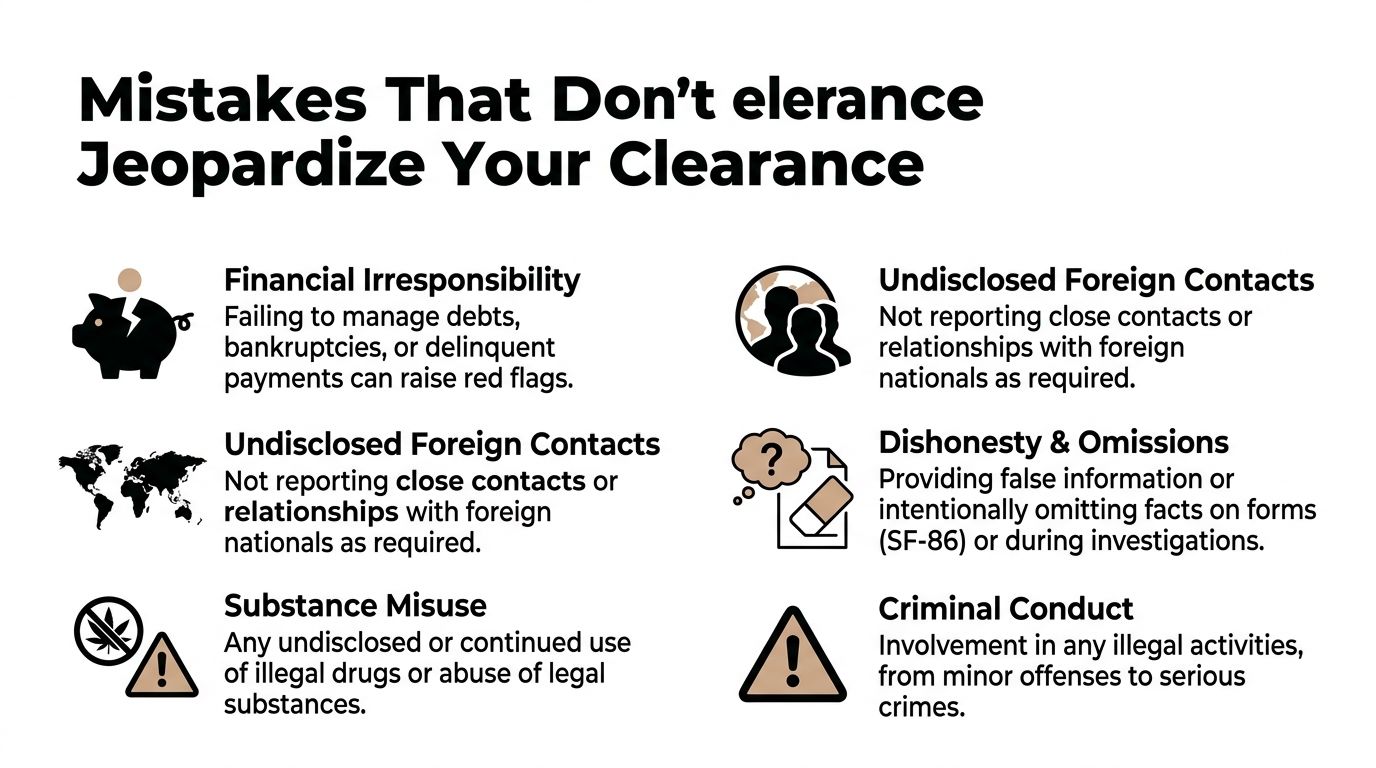
The fastest ways to damage your own case
Lying on the SF-86: If you omit facts because you think they look bad, you hand the government a dishonesty issue. In clearance work, dishonesty often scares adjudicators more than the underlying misconduct.
Talking too freely to investigators: People think cooperation earns mercy. Sometimes it just gives investigators cleaner admissions. That risk gets even worse if the facts overlap with substance allegations, as seen in many Article 112a wrongful use cases.
Trying to “explain it away” without preparation: Unplanned explanations create contradictions. Contradictions create credibility problems. Credibility problems kill cases.
Failing to self-report: Under CE, silence is dangerous. If reporting was required, the government can treat your failure to report as a character problem.
Assuming command is looking out for you: Command is looking at mission impact, risk, and optics. That is not the same thing as protecting your future.
Treating financial trouble like a private matter: Debt, delinquency, and instability can be framed as judgment and vulnerability concerns.
Ignoring spouse or family fallout: Foreign ties, domestic disputes, and messy household issues can spill into your file whether you think that’s fair or not.
Waiting for official paperwork before getting help: By the time a Statement of Reasons or revocation notice lands, the government has already been building its narrative.
Most service members don’t lose clearance fights because they had the worst facts. They lose because they made the government’s job easier.
The system punishes panic. It also punishes pride. If you think you can freestyle your way through security interviews, you are gambling with your career.
Why You Must Act Now to Protect Your Military Career
A clearance problem is never “just paperwork.” It is a pressure point that can lead to suspension, loss of assignment, administrative action, and in the right set of facts, a court-martial or separation fight.
Even under the old model, Top Secret demanded scrutiny every 5 years, as this federal security clearance summary notes. That alone should tell you the government has always viewed clearance eligibility as something fragile, temporary, and subject to constant review. CE just made that pressure more immediate.
Civilian counsel is different for a reason
Military-appointed counsel can be good lawyers. Some are excellent. But clearance trouble often sits at the intersection of command action, administrative law, investigations, and military justice. You need someone whose loyalty is to you alone and who is not inside the same institution that is judging you.
That matters when your case starts drifting toward discharge consequences. If your access issues are already affecting retention, assignment, or command confidence, learn how those cases can turn into Army administrative discharge problems.
Here is my recommendation. If your clearance is under review, if investigators have contacted you, or if command has raised concerns tied to your private life, get civilian advice immediately. Not next month. Not after you “see how it plays out.”
Your career can collapse unnoticed while you are still telling yourself it’s manageable.
Frequently Asked Questions About Security Clearances
Can I lose my clearance over debt?
Yes. Not every debt problem is fatal, but unmanaged financial trouble can be framed as poor judgment, unreliability, or vulnerability to pressure. The debt is one issue. Hiding it or ignoring it is usually worse.
Can I refuse to talk to CID, NCIS, OSI, or CGIS if my clearance is involved?
You need legal advice before you speak. If the facts overlap with possible criminal exposure, talking casually can damage both your clearance position and your UCMJ defense.
Is Top Secret higher than TS-SCI?
No. Top Secret is the highest standard clearance level. SCI is compartmented access added to Top Secret for specific intelligence information.
What is a Statement of Reasons
A Statement of Reasons, often called an SOR, is the government’s formal explanation of why it thinks you should be denied or lose clearance eligibility. If you receive one, treat it as a legal crisis, not an administrative annoyance.
Can my spouse’s conduct affect my clearance?
It can. Foreign contacts, financial chaos, domestic disturbances, and household credibility problems can all become part of the government’s risk analysis.
Will one bad incident automatically end my military career?
Not automatically. But one incident can start a chain reaction. Security review, command action, law enforcement interest, and adverse administrative steps can all move fast if you handle the early stage badly.
Do I need a lawyer before I get formal paperwork?
Yes, if there is already contact from command, security managers, or investigators. Early action gives your lawyer room to shape the record before the government hardens its position.
If you are under investigation, facing clearance suspension, or dealing with command pressure tied to your private life, act now. Waiting is not a strategy. Silence without a plan is not a strategy. Hoping command “understands” is not a strategy.
Talk to experienced civilian military defense counsel immediately. If you need help comparing serious options, use this guide to choosing a military defense lawyer to identify attorneys focused on court-martial, investigations, and career-threatening military cases. Your clearance is tied to your future. Protect it before the system decides you no longer deserve one.