Your phone is gone. Your First Sergeant says report now. CID wants “just a quick statement.” Your spouse is texting because someone from the unit called the house. You haven’t been charged yet, but you already feel the floor dropping out from under you.
That feeling is justified.
If you’re dealing with an Army criminal investigation, suspected UCMJ charges, an Article 15 decision, or a court-martial referral, this is the moment that decides whether you protect yourself or help the government build its case. Most soldiers lose ground in the first conversations, the first consent search, the first text they delete, or the first week they tell themselves this will probably blow over.
It usually doesn’t.
Army court martial defense is not about giving a clean explanation and hoping command sees your good character. It’s about making disciplined decisions under pressure, preserving evidence, shutting down bad statements, and forcing the government to prove what it claims. The system is built to move cases forward. It is not built to save your career, your clearance, your retirement, or your name.
Free advice can be the most expensive advice in your life if it comes late, comes from the wrong person, or comes from someone who answers to the same institution that is prosecuting you.
Table of Contents
- The Knock on the Door Your World Just Changed
- Understanding the Battlefield Types of Courts-Martial
- The Court-Martial Process From Investigation to Appeal
- Your Rights and Defenses Are Not Automatic
- Common Mistakes That End Careers and Cost Freedom
- Why Your Assigned Military Lawyer May Not Be Enough
- Your Next Move Finding and Hiring the Right Civilian Counsel
The Knock on the Door Your World Just Changed
It usually starts small.
A soldier gets told to come to the company office. Another gets pulled from training and escorted to CID. Someone else notices the mood shift first. Platoon leadership stops joking. The phone gets seized. A roommate says investigators came by asking questions. By the time the target realizes what’s happening, the government already has a theory and is collecting facts to support it.
That’s where you are now. You may not know the exact allegation. You may only know that somebody said something, your command is acting strange, or investigators want “your side.” You may be thinking that staying calm, being respectful, and explaining the misunderstanding will fix this.
That instinct can wreck you.
CID, command, and prosecutors are not calling because they’re undecided and waiting for your wisdom. They’re testing you, locking you into statements, comparing your words against digital evidence, and looking for inconsistencies they can frame as consciousness of guilt. Even innocent people talk themselves into trouble because stress makes memory messy and military culture trains soldiers to answer questions from authority figures.
Practical rule: The first battle in army court martial defense is silence. Not panic, not anger, not a heroic explanation. Silence, then counsel.
The next day or two matter more than most soldiers understand. This is when devices get searched, witnesses get lined up, screenshots get circulated, and command forms early opinions that can shape everything that follows.
If you’re under scrutiny right now, act like the fight has already started. Because it has.
Understanding the Battlefield Types of Courts-Martial
Command offers you a “smaller” forum, tells you it can be handled fast, and hints that cooperation will make this easier. Slow down. The name of the forum tells you how much punishment is on the table, but it also tells you how aggressively the government plans to press its advantage.
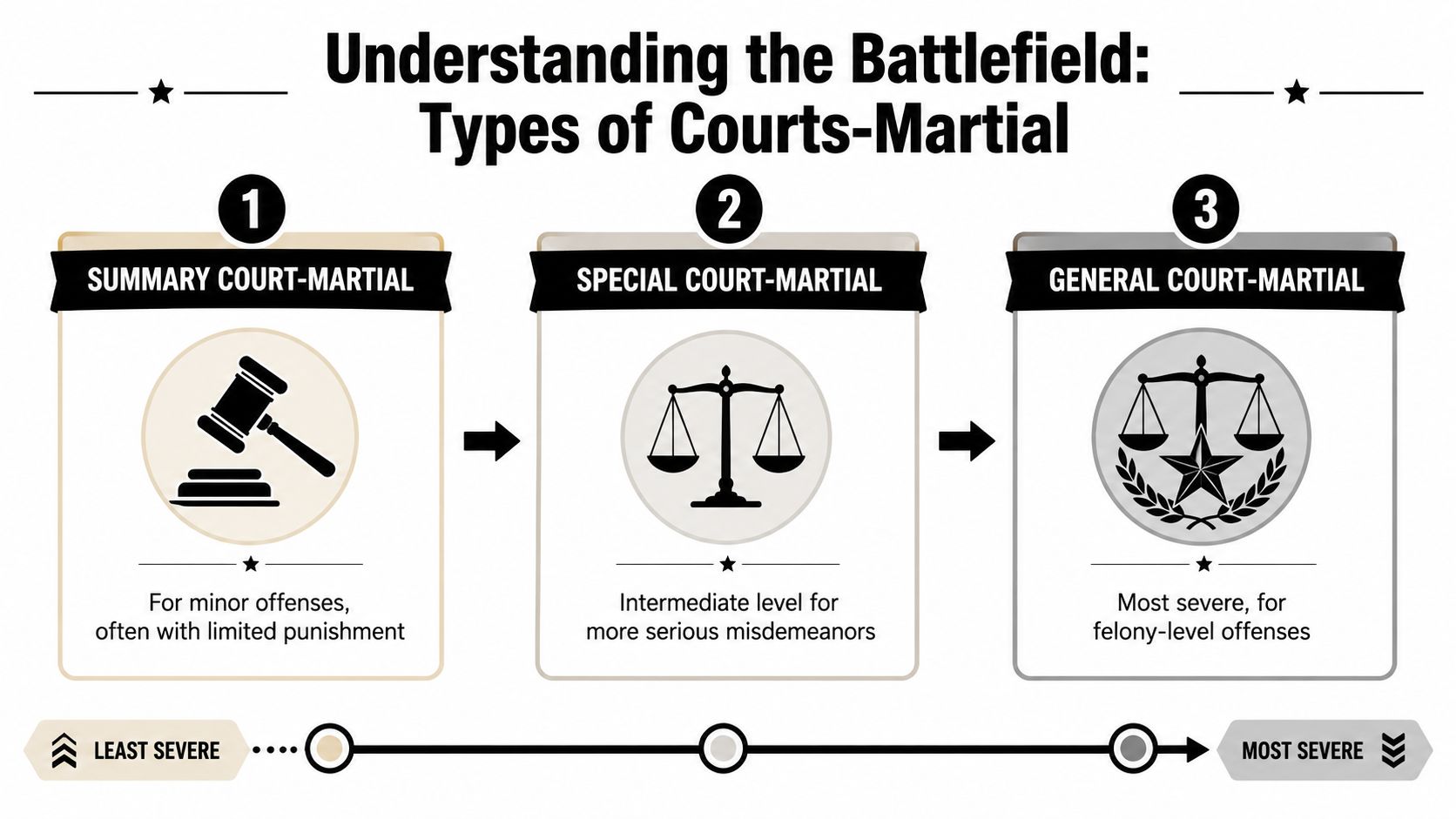
A court-martial is not one thing. It is three different forums with three different levels of risk. If you misread which fight you are in, you make bad decisions early, and those decisions get expensive fast.
Summary is not harmless
A Summary Court-Martial gets pitched as the quick, lesser option. That pitch serves the system. It does not serve you.
Summary can still leave a conviction on your record and create problems long after you leave the Army. Employers, investigators, licensing boards, and anyone reviewing your background may not care that command treated it as “minor.” They care that it happened.
If you need a basic orientation to the tiers, this court-martial basics guide is a useful starting point. Then stop reading summaries online and get advice tied to your actual facts.
Free reassurance is expensive here. If someone tells you summary is no big deal, ask whether that person will be around when the record follows you into a clearance review, a federal job application, or a professional licensing interview. They will not.
Special and General put much more at risk
A Special Court-Martial is the middle tier, and soldiers often misjudge it because the label sounds less severe than “general.” That is a serious mistake. Special cases can still cost rank, pay, promotion potential, and the kind of discharge that shadows you after service.
A General Court-Martial is the highest level. Confinement, a punitive discharge, and permanent damage to your record are all real possibilities. If the allegation involves sexual assault under Article 120, violence, major fraud, serious drug charges, or any case command wants to make an example of, treat it like the career and freedom threat it is.
Use this table as your plain-English read on the risk:
| Court-martial type | What you should hear |
|---|---|
| Summary | “This can still damage my record and future employment.” |
| Special | “This can wreck my career and change my discharge status.” |
| General | “My freedom, discharge, and long-term future are on the line.” |
The level of court-martial is a strategy signal from the government. It shows how much punishment they want available and how much pressure they expect to use.
Your reaction should match the forum. If you are facing summary, do not treat it like paperwork. If you are facing special, do not assume you can clean it up later. If you are facing general, stop trying to manage command impressions and start building a real defense team.
The system rewards speed, compliance, and uninformed decisions. Your job is the opposite. Slow the process down, read the exposure correctly, and make choices based on consequences, not labels.
The Court-Martial Process From Investigation to Appeal
CID asks for “your side.” Your first sergeant says cooperation will help. A buddy tells you the assigned lawyer will sort it out later. That is how soldiers hand the government evidence before the actual fight even starts.
The court-martial process rewards speed, silence from the defense, and early mistakes by the accused. If you want a better outcome, you need to treat each stage as a decision point, not a formality. The system is building a record against you from day one. You need to start shaping that record just as early.
Early in that process, keep the sequence in mind:
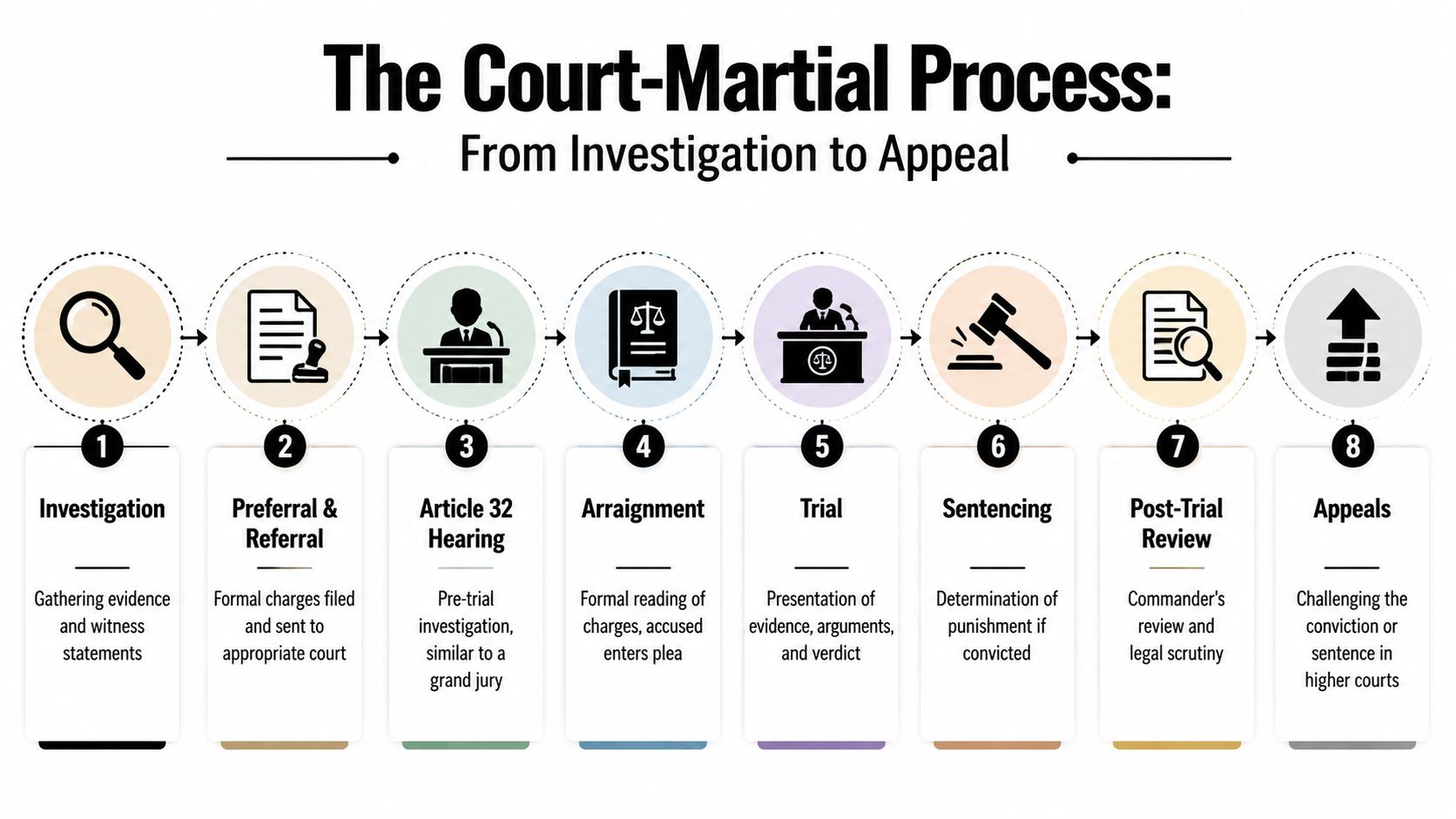
Step 1 through Step 3, where bad early choices poison the case
Step 1 is the investigation. During this stage, the government starts locking in its version of events. CID, command, digital examiners, and witnesses collect phones, text chains, social media posts, barracks rumors, prior statements, and unit paperwork. If you talk casually, consent to searches without thinking, or try to “clear things up,” you help them do it.
Read up on your Article 31 rights before any questioning starts. Then use them. Free advice from command, friends, or investigators is often the most expensive advice you will ever take.
Step 2 is preferral and referral of charges. At this stage, rumor turns into a charging document and a chosen forum. Read every word. Dates matter. Language matters. The exact act alleged matters. Sloppy charging decisions, inflated theories, and vague timelines create openings, but only if your defense catches them early and presses them.
Step 3 is the Article 32 preliminary hearing in qualifying cases. Good defense counsel uses this hearing to test the case, pin down witnesses, expose holes, and force the government to commit to facts it may later regret. Weak counsel treats it like a checkpoint on the road to trial. That is a mistake.
Here’s a short video overview if you need a visual reset before making decisions:
Step 4 through Step 6, where preparation beats panic
Step 4 is arraignment. Charges are read, pleas are entered, and the case posture becomes public. By this point, your defense team should already know what evidence needs independent review, what motions are coming, and what theory fits the facts. If your lawyer is still “getting up to speed” here, you are behind.
Step 5 is motions and trial preparation. This stage decides more cases than soldiers realize. Suppression issues. Search challenges. Discovery failures. Witness bias. Bad forensic handling. Unlawful command influence. These are not technical side issues. They are often the difference between a winnable case and a conviction that could have been avoided.
This is also where independence matters. Assigned military counsel may be smart and hardworking, but they still work inside the same institution prosecuting you. You need someone willing to push hard, demand records, challenge command assumptions, and make unpopular arguments when the facts support them.
Step 6 is trial. Panel selection matters. Cross-examination matters. The order of witnesses matters. One careless answer can hurt, but one well-prepared attack on a shaky statement, a compromised interview, or a witness with motive can break the government’s story.
Good army court martial defense is disciplined pressure on weak evidence. It is not courtroom drama.
Ask one question at every stage: how does this help the government prove the case, and what can my defense do now to stop that?
Step 7 and Step 8, where many soldiers give up too early
Step 7 is sentencing and post-trial review. If there is a conviction, the fight shifts to damage control. Service record, character evidence, rehabilitation potential, medical history, combat service, and collateral consequences all matter. Soldiers who mentally check out after findings leave punishment on the table that could have been reduced.
Step 8 is appeal. Appeals matter, but they are not your primary plan. Appellate courts review legal error and preserved issues. They do not re-run your case because the outcome feels unfair. If trial counsel built a clean record against you and your defense failed to preserve the right objections, your options shrink fast.
Use this checklist now, not after the case gets worse:
- Stop discussing the facts with investigators, supervisors, friends, and group chats.
- Preserve evidence including texts, emails, photos, duty records, location data, and witness names.
- Get independent case-specific counsel early enough to challenge the investigation before the record hardens.
Your Rights and Defenses Are Not Automatic
The trap starts with one bad decision. CID wants to “clear a few things up.” Command acts calm. A supervisor tells you to cooperate. You think your rights will protect you anyway.
They will not.
Rights in a court-martial case are only useful if you assert them at the right time, in the right way, and with a lawyer who knows how to turn them into rulings, exclusions, and advantage. If you wait for someone in uniform to explain the stakes, you are already behind.
Rights only matter if you claim them early
Your right to remain silent does not protect you after you start filling in gaps for investigators. Your right to counsel does nothing until you ask for counsel. Your right to refuse consent does nothing if you hand over your phone because you want to look cooperative.
Read Article 31 rights under the UCMJ before you answer a single question. Then use them.
Silence is disciplined. Asking for a lawyer is smart. Refusing a broad search is self-protection. The system will treat those choices as inconvenient. Make them anyway.
Panel voting rules matter too, but do not get distracted by percentages and internet summaries. The essential point is simpler. The government still has to prove its case to the required standard, and your defense wins by breaking confidence in the parts of the story that do not hold up under pressure.
A real defense attacks pressure points
Bad defense lawyering chases fairness and hopes the panel feels uneasy. Good defense lawyering identifies the points where the government can be forced to retreat.
That can mean exposing a witness who changed the story after speaking with others. It can mean showing that a text thread is incomplete, out of order, or missing context that helps you. It can mean proving investigators locked onto a theory early and ignored facts that cut the other way. It can mean raising a lawful explanation the government wants the panel to overlook.
The goal is not to “tell your side” in some broad emotional sense. The goal is to make specific parts of the government’s proof unreliable.
Use this filter on every allegation, every interview, and every exhibit:
| Question | Why it matters |
|---|---|
| What exact element is the government trying to prove? | Charges sound broad. Cases are won and lost on specific elements. |
| Which witness has motive, bias, or a memory problem? | Credibility failures can sink an otherwise polished case. |
| What evidence should exist but does not? | Missing records, missing messages, and missing witnesses create doubt. |
| What facts did investigators ignore? | Overlooked facts often become suppression issues or trial themes. |
Free advice is often the most expensive advice in this process. Command advice protects command. Investigator “clarifications” help investigators. Even assigned counsel may be managing a heavy docket inside the same system that is trying to convict you.
Treat your rights like tools that require immediate use, not slogans you can save for later. If you do not assert them early and use them strategically, the government will build its case out of your own words, your consent, and your hesitation.
Common Mistakes That End Careers and Cost Freedom
The government loves a cooperative target. Cooperative targets confess badly, consent broadly, and destroy useful evidence out of panic. That is how careers end before trial.
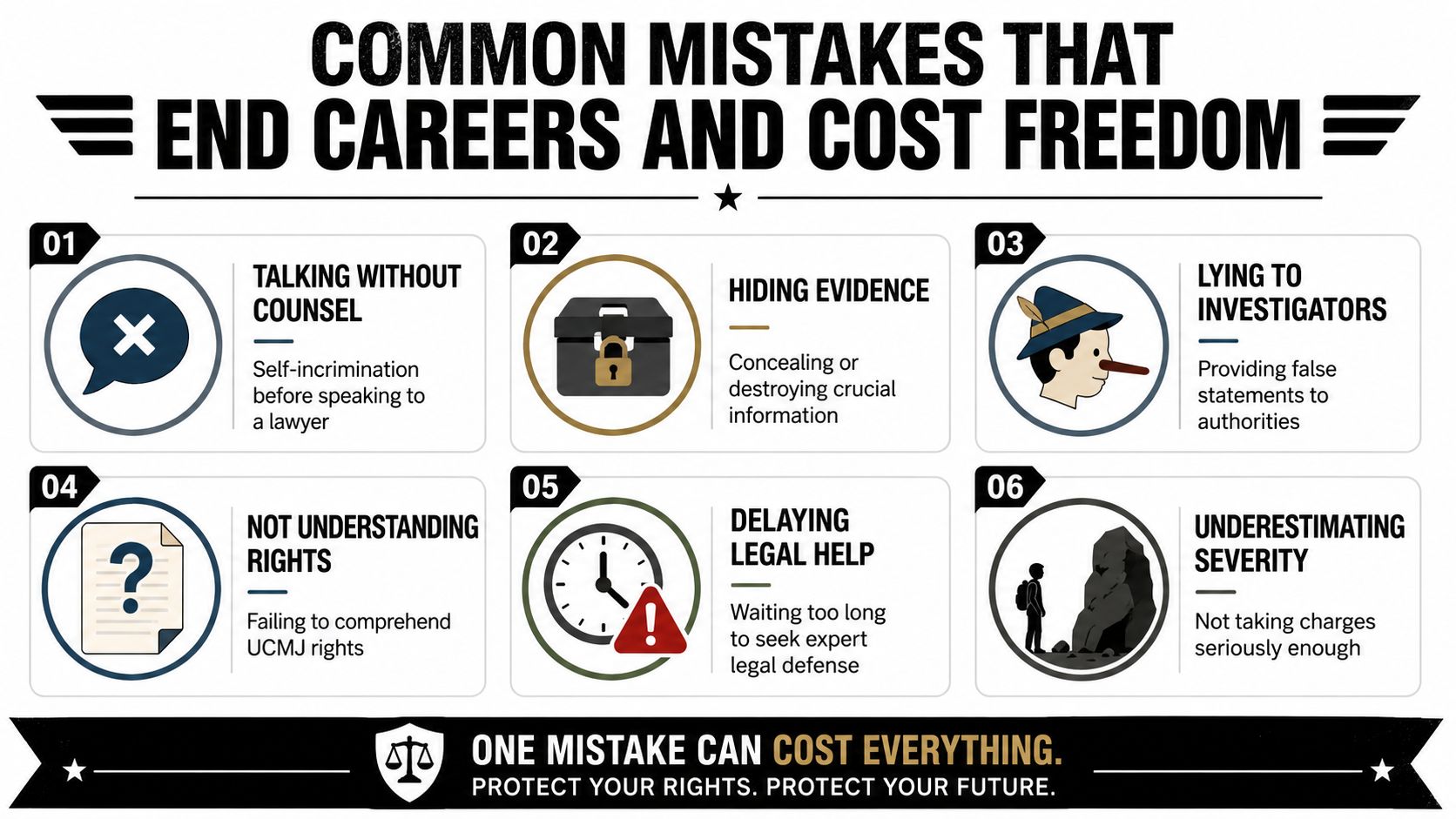
The errors that hand the government your case
Here are the mistakes that come up over and over:
- Talking to investigators without counsel: Soldiers think they can clear things up. Instead, they commit to details they later can’t perfectly repeat.
- Trusting command to protect you: Command protects the unit, the mission, and itself. You are not the mission.
- Deleting texts or files: Panic deletion looks like guilt and can erase context that would have helped you.
- Lying when the facts are inconvenient: A damaging truth can sometimes be defended. A proven lie poisons everything.
- Waiting for charges before hiring a lawyer: By then, witnesses may be locked in and evidence may already be framed against you.
- Discussing the case with friends in uniform: Today’s loyal friend can become tomorrow’s witness.
- Assuming there is no evidence because nobody has shown you any: Investigators often know much more than you think.
- Treating a “minor” action casually: Administrative action, Article 15 choices, and lower-level proceedings can still wreck your record.
What disciplined soldiers do instead
Replace panic with procedure:
- Say less. Invoke your rights and stop freelancing.
- Save everything. Screenshots, names, dates, travel records, duty logs, and messages.
- Write a private timeline for your lawyer. Not for your chain of command. Not for CID.
- Identify witnesses fast. Good witnesses disappear, PCS, deploy, or forget details.
- Control your digital footprint. No social media posts, no “venting,” no cleanup project.
Most accused soldiers don’t lose because they were outmatched at trial. They lose because they made preventable mistakes before the case ever reached the courtroom.
Why Your Assigned Military Lawyer May Not Be Enough
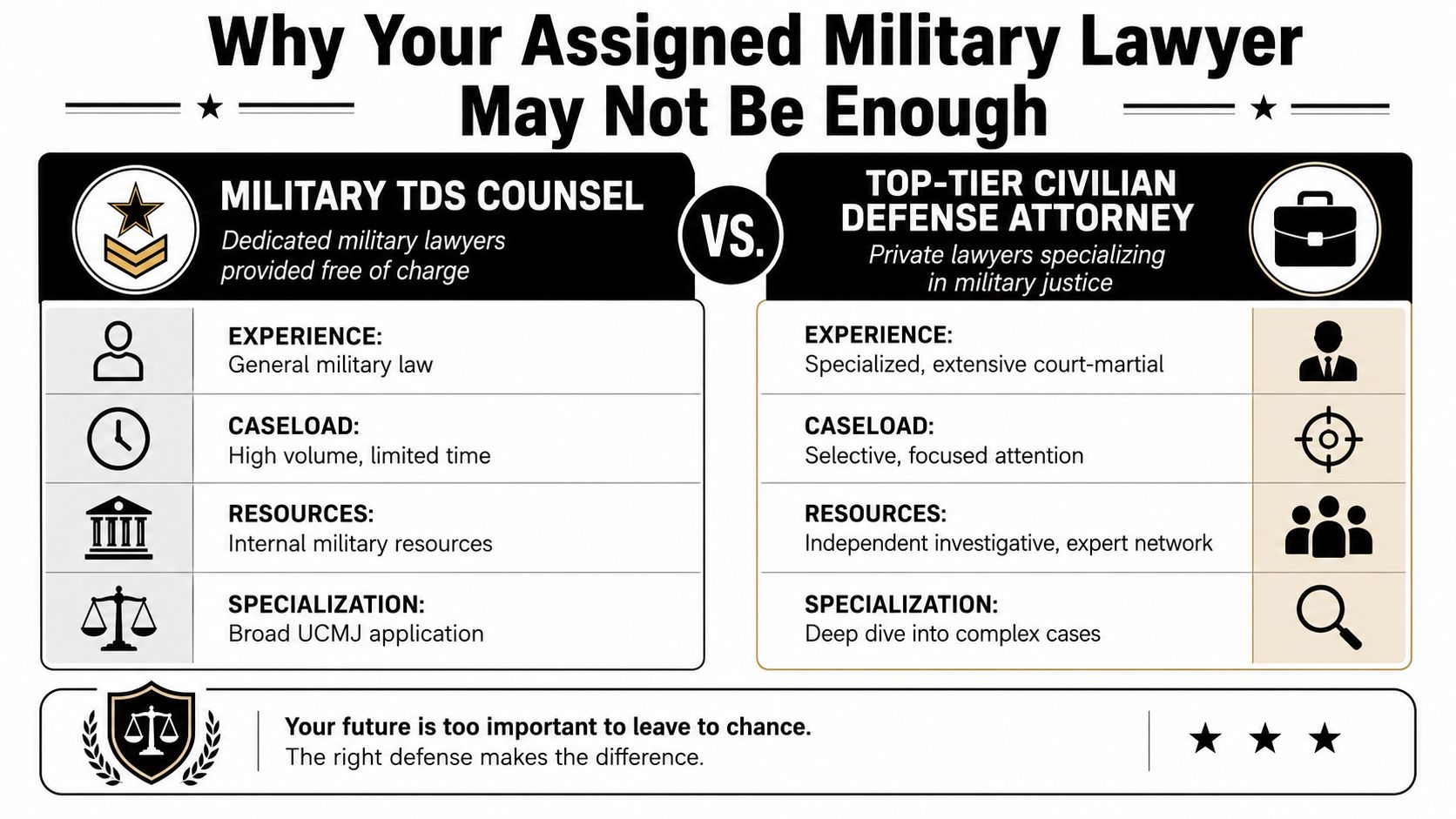
Relying only on assigned counsel is a bet on a system that is already building a case against you. Your TDS lawyer may be hardworking and honest. That still does not make “free” good enough when the charge sheet can take your rank, pay, retirement, gun rights, and freedom.
The real issue is independence and depth
Assigned military defense counsel serve an important role. They know the system, they know the local players, and many fight hard. The problem is structural. They work inside the same institution that investigated you, funds the prosecution, and pushes the case toward a result.
That does not mean your lawyer is compromised. It means your defense starts inside a command-driven machine, and that machine is not designed around your future.
A seasoned civilian lawyer brings something different. Independence. Selectivity. Repetition. The right one has handled contested courts-martial over and over, seen how CID cases are built, knows where military prosecutors cut corners, and is willing to challenge assumptions your assigned counsel may treat as normal.
That difference matters fast in cases involving sexual assault allegations, alleged violent offenses, digital evidence, fraud, and credibility fights. Those cases turn on details. Phone extraction reports. Interview tactics. Timeline gaps. Forensic shortcuts. A witness who changes one key sentence. You do not need a generalist who is smart and sincere. You need someone who knows how these cases break apart.
What strong civilian counsel changes
Here is the practical difference:
| Issue | Assigned military counsel | Experienced civilian counsel |
|---|---|---|
| Independence | Works within the military system | Answers only to you |
| Experience depth | May rotate across many matters | Focused court-martial practice |
| Time allocation | Often carries a heavy caseload | Can devote more attention to your case |
| Expert support | May face institutional limits | Can bring in outside experts and investigators |
Free advice can be the most expensive advice you ever take if it keeps you passive. A strong defense is not just showing up at trial with a nice uniform and a clean haircut. It is shaping the case early, attacking weak points before they harden, and forcing the government to prove what it usually assumes.
If you are comparing options, start by reviewing experienced court-martial defense lawyers who can explain what they would do differently in your case this week, not someday.
Use your assigned lawyer. Do not rely on assigned counsel by default. In a serious army court martial defense case, that is how soldiers sleepwalk into convictions they might have avoided.
Your Next Move Finding and Hiring the Right Civilian Counsel
If you’re still reading, the right question is no longer “Is this serious?” It is “Who is going to fight this the right way?”
Start with fit, not marketing. The right lawyer for army court martial defense is not the person with the slickest website or the fastest callback. It’s the person who can explain your exposure, identify pressure points in the government’s case, and tell you what needs to happen this week.
If you need a vetted starting point, review experienced court-martial defense lawyers and then speak with more than one. Compare strategy, not just personality.
Questions to ask before you hire anyone
Ask direct questions and expect direct answers:
- How many contested courts-martial have you handled?
- How often do you handle my type of allegation?
- What weaknesses do you see immediately in a case like mine?
- Do you personally handle Article 32 hearings, motions, and trial, or hand parts off?
- How do you approach digital evidence, witness impeachment, and expert consultation?
- What should I do in the next 24 hours?
- What should I stop doing today?
A good answer is specific. A weak answer is vague, flattering, or built around “we’ll see what happens.”
FAQ
Can I refuse to talk to CID?
Yes. You should invoke your rights and speak with counsel before any questioning.
Do I need a lawyer before charges are preferred?
Yes. Earlier is better. A lot of the damage happens before formal charges.
Will my command help me if I’ve been a good soldier?
Do not count on that. Good service helps in some contexts, but it will not stop an investigation from moving forward.
What happens at an Article 32 hearing?
It is a critical pretrial stage where the government’s case can be tested, challenged, and narrowed.
Should I rely only on my assigned military lawyer?
In a minor matter, maybe. In a serious matter, that’s a risk you should examine hard and early.
Is it too early to hire civilian counsel if I’m only under investigation?
No. That’s often the best time to do it.
Will I go to jail?
That depends on the charges, the evidence, the forum, and the quality of your defense. If confinement is possible, treat the case like your freedom is on the line from day one.
What should I do right now?
Stop discussing the facts, preserve evidence, and get counsel.
If you are under investigation, facing an Article 15 decision, preparing for an Article 32 hearing, or staring at court-martial charges, move now. Don’t wait for command to “see reason.” Don’t assume CID is still gathering and hasn’t formed a theory. Don’t trust that free advice will be enough because it doesn’t come with an invoice.
Your career is on the line. Your freedom may be on the line. Your record, benefits, clearance, and civilian future are all in play.
Start calling qualified civilian military defense lawyers immediately. The government has already started. You need to start faster.