You’re sitting outside the commander’s office or in a CID, NCIS, OSI, or CGIS waiting room. Your phone is buzzing. Your spouse wants to know what’s happening. Your first sergeant told you to “just be honest.” Somebody hinted it might only be an Article 15. Somebody else said it could get bigger fast.
That’s the moment punishments in the military stop being abstract and start becoming personal.
Here is the blunt version. The military justice system is built to preserve order, protect the mission, and give commanders tools to act fast. It is not built around giving you the benefit of the doubt. If you treat this like a misunderstanding that will clear itself up, you can talk yourself into punishment, separation, or a conviction before you understand what game is being played.
Your first moves matter more than is widely understood. What you say, who you text, whether you accept paperwork, whether you make a written statement, whether you trust command to “take care of you,” whether you hire outside counsel early. Those decisions shape the outcome.
Table of Contents
- Your Career Is on the Line
- The Two Tracks of Military Justice
- The Commander’s Hammer Non-Judicial Punishment
- Strategic Realities of Military Punishment
- The Arsenal of Military Punishments
- Why Your Free Military Lawyer Is Not Enough
- Urgent Questions About Military Punishments
Your Career Is on the Line
A lot of service members make the same mistake in the first hour. They think the people calling them in are trying to sort things out. They aren’t. They’re trying to lock down facts, statements, and admissions that support a decision already moving forward.
What that first meeting really means
You get told, “Come down and answer a few questions.” Your chain of command says cooperation looks better. Someone hints that silence makes you look guilty. That pressure is real, and it works on good troops every day.
Here’s the truth. Once you’re under investigation, you are not in a normal workplace problem. You are in a process that can cost you rank, pay, security clearance, promotion potential, freedom, retirement, and discharge status. If your case ends in separation, the damage can spill into civilian life and benefits. If you need to understand what a bad discharge can mean later, read this breakdown of other than honorable discharge consequences and benefits issues.
Practical rule: The military rewards obedience in daily service. It punishes blind obedience when you’re under investigation.
Your first job is damage control
Your first job is not explaining yourself. Your first job is stopping the damage.
That means:
- Stop talking casually: Your squad leader, buddy, roommate, and ex are not safe places to “clear things up.”
- Stop creating evidence: Don’t send apology texts, don’t delete messages, don’t try to coach witnesses.
- Start thinking strategically: Ask what process you’re in, what allegation exists, and what decision point comes next.
- Get counsel early: Early cases are often won or lost before charges are ever filed.
Most punishments in the military start with a service member handing the government exactly what it needed. A statement. A poorly worded text. An emotional explanation. A half-true admission meant to sound cooperative.
You need a plan, not a confession dressed up as professionalism.
The Two Tracks of Military Justice
Military punishment runs on two tracks at once. If you don’t understand that, you’ll misread the threat.

Punitive track
This is the formal discipline side under the UCMJ. It includes Article 15 nonjudicial punishment and court-martial. The range is wide. At the top end, the UCMJ still authorizes the death penalty for 14 offenses in the most extreme cases, and one study reported 37,383 nonjudicial punishment cases, representing more than 96% of all U.S. military justice cases in the period studied, which shows most cases are handled by commanders without a trial (military justice punishment data and UCMJ framework).
That tells you two things.
First, commanders have enormous power to punish without sending every case to trial. Second, the legal system keeps severe punishment on the table for the cases command wants to hit hard.
Administrative track
This track includes counseling, reprimands, adverse paperwork, and separation processing. It may not sound as dramatic as a court-martial, but don’t get comfortable. Administrative action can still crush your career.
A separation board or serious reprimand can end your service, block advancement, kill reenlistment, and poison future employment. It can also become the fallback tool when command doesn’t want the burden of proving a criminal case but still wants you out.
Some of the worst career outcomes happen in cases that never reach a courtroom.
Why commanders choose one track over another
Commanders don’t choose tracks in a vacuum. They look at proof, optics, unit discipline, mission demands, and whether they want quick control or formal punishment.
A simple way to understand this:
| Track | Main purpose | Typical result |
|---|---|---|
| Punitive | Immediate discipline or criminal prosecution | NJP, court-martial, confinement, discharge |
| Administrative | Corrective action or removal from service | Reprimands, adverse records, separation |
The most common mistake is this: a service member relaxes because they hear “it’s only administrative.” That can be career-ending. Another service member panics because they hear “Article 15” and assumes they have no options. That’s also wrong.
The right move is to identify the track early, then ask what command is really trying to accomplish. If they want a fast example, you need a containment strategy. If they want you gone, you need to prepare for a record fight, not just a discipline fight.
The Commander’s Hammer Non-Judicial Punishment
Article 15, NJP, and Captain’s Mast are command tools. Fast, practical, and dangerous. They let a commander punish without a court-martial. Service members hear “non-judicial” and think “minor.” That’s a rookie mistake.
What Article 15 really is
Under Army Article 15 procedures, a company-grade Article 15 can bring 7 days’ pay forfeiture, 14 days’ restriction, and 14 days’ extra duty. A field-grade Article 15 can impose ½ month’s pay forfeiture for 2 months, 45 days’ extra duty, and 60 days’ restriction (Army Article 15 punishment limits).
Those penalties aren’t paperwork trivia. They hit your wallet, your home life, your reputation in the unit, and often your future with that command.
If you’re trying to understand the basics before making a decision, this guide on what an NJP is in the military is a useful starting point.
The decision that can change everything
The biggest Article 15 question is simple. Do you accept it, or do you refuse and demand trial?
There is no universal answer. Anybody who tells you “always take the Article 15” or “always turn it down” doesn’t know what they’re doing.
Sometimes accepting NJP is the smart move because the evidence is ugly and command is offering a contained result. Sometimes refusing is the only rational move because the allegation is weak, the witnesses are bad, or command is overreaching and betting you’ll fold.
What matters is influence.
Ask these questions:
- How strong is the proof really? Not rumors. Actual evidence.
- Who are the witnesses? Angry exes, weak identifiers, people with motives.
- What is command likely to do if you refuse? Bluffing matters in military justice.
- What record are you creating? NJP can shape later separation or promotion decisions.
- What branch-specific consequences attach? A small punishment on paper can become a major career wound.
If you make the accept-or-refuse decision without a real defense review, you’re gambling with your career in the dark.
What to do before you answer
Don’t wing this. Do these things first:
- Get the paperwork and read every line. Wrong dates, vague allegations, and inflated language matter.
- Write down your version privately. Don’t submit it yet. Preserve details while they’re fresh.
- Identify favorable witnesses. The ones who truly help, not the ones who “mean well.”
- Pull your records. Prior counseling, awards, evaluations, treatment records, and text chains can strengthen your position.
- Get legal advice before speaking to command. Not after.
A lot of punishments in the military look predetermined. They aren’t. They become predetermined when the accused responds late, emotionally, and without strategy.
Strategic Realities of Military Punishment
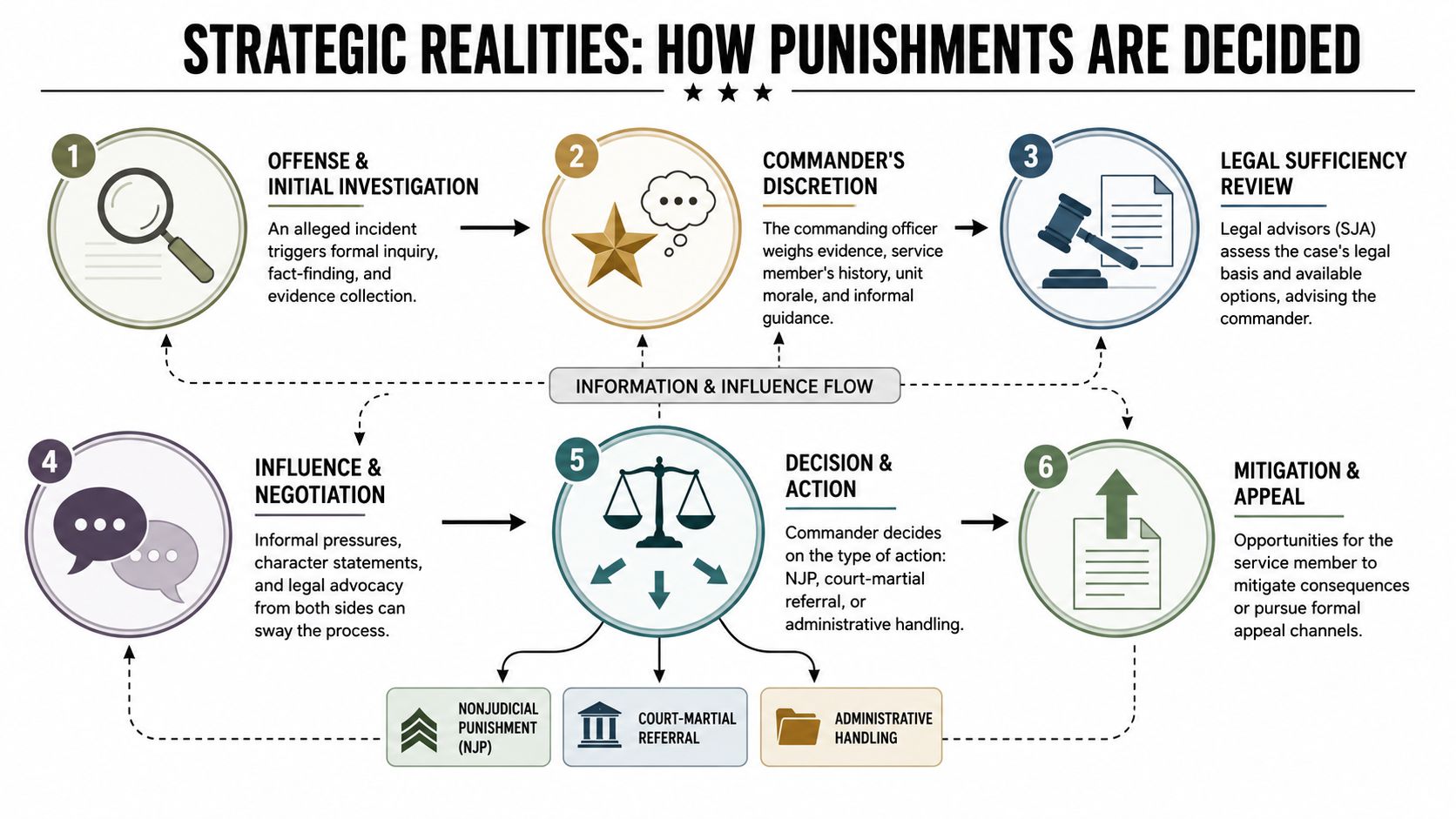
The military talks about fairness. In practice, punishment is often driven by command judgment, command culture, and command appetite for risk. That’s the part most public guides miss.
Same conduct different outcome
Two service members can do something similar and get very different outcomes. That isn’t a glitch. That’s how the system works.
Military justice coverage has emphasized that punishment is command-driven, not standardized like civilian sentencing. It also notes that alcohol-related misconduct often ends at Article 15, while drug-related misconduct is more likely to escalate toward court-martial. It further notes that punishment can be rank-sensitive, and for enlisted members a court-martial sentence with a punitive discharge or confinement of more than 180 days can trigger automatic reduction to E-1 (command-driven NJP realities and rank-sensitive consequences).
That’s the strategic point. Your case is not just about what happened. It’s about how command sees the allegation.
A commander might think:
- Alcohol case? Contain it, punish fast, move on.
- Drug case? Send a message.
- NCO involved? Set an example.
- Junior enlisted with strong file? Maybe salvageable.
- Bad timing before deployment or inspection? Expect less patience.
What experienced defense lawyers look at first
The starting point is not “What’s the maximum punishment?” It is decision pressure.
Here’s what matters early:
| Factor | Why it matters |
|---|---|
| Command climate | Some commands want rehabilitation. Others want public deterrence. |
| Rank and role | Leaders get judged harder because command expects example-setting. |
| Unit mission | Sensitive missions often produce harsher reactions to trust-related allegations. |
| Paper trail | Strong prior performance can support mitigation. Prior issues can fuel escalation. |
| Narrative control | The first coherent story often shapes the commander’s view of the case. |
The charge sheet matters. The command story matters more, especially early.
Good lawyering changes outcomes, not by magic, but by attacking the pressure points.
That can mean pushing back on weak evidence, exposing witness motive, reframing the event as a contained lapse instead of a character defect, or showing that command is mixing discipline with personal frustration. It can also mean steering a case away from criminal processing and into a survivable administrative lane when the facts aren’t good enough for a clean win.
If you don’t understand the commander’s real concern, you’re not defending the case. You’re just reacting to paperwork.
The Arsenal of Military Punishments
Service members often focus on the headline punishment and miss the aftershocks. That’s a mistake. In real life, punishments in the military often hurt most in the secondary effects.
Short-term punishment long-term damage
Reduction in rank is more than losing stripes. It changes how people treat you, how leadership sees you, and what future options stay open. For many enlisted members, a sentence that includes a punitive discharge or confinement over 180 days causes an automatic reduction to pay grade E-1 under military law procedures (military law procedure and automatic reduction consequences).
Forfeitures hit families immediately. Rent doesn’t care that command says the punishment is “corrective.” Child support doesn’t pause because you’re on restriction. A punishment that looks manageable on paper can start a financial crisis at home fast.
Confinement is its own world. Even when it’s short, it changes your record, your influence, and your future. It also tends to trigger other consequences that keep moving after you’re released.
Why discharge punishment follows you home
A punitive discharge is one of the most serious outcomes in military justice. People hear “discharge” and think “I’ll just move on.” That’s not how it works.
A Bad Conduct Discharge or Dishonorable Discharge can stain job applications, licensing issues, background checks, and benefit eligibility. Even administrative discharges that aren’t technically punitive can still create years of fallout.
Here’s the blunt takeaway:
- Pay punishment hurts now
- Rank punishment hurts daily
- Confinement hurts legally and personally
- Discharge punishment follows you into civilian life
If you’re facing a proceeding where discharge is on the table, stop thinking only about next month. Think about the next decade.
Why Your Free Military Lawyer Is Not Enough
You have the right to military defense counsel. Use that right. But don’t confuse having a free lawyer with having enough firepower for a high-risk case.
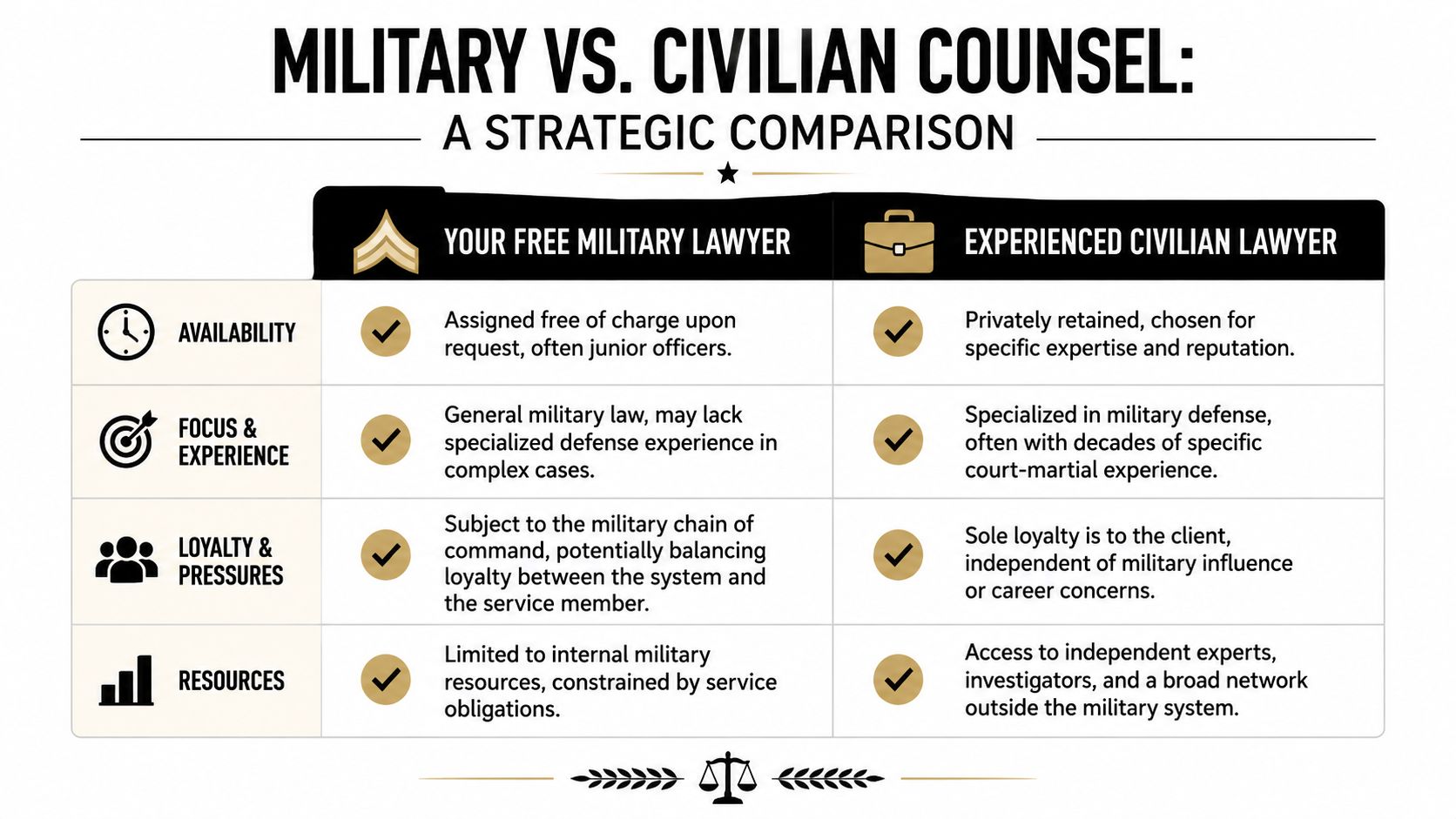
The difference is independence
A military lawyer may be smart, hardworking, and committed. Some are excellent. But they still work inside the same institution that is processing your case. They rotate assignments. They carry caseloads. Their experience level varies widely.
A seasoned civilian military defense attorney works for one person only. You.
That independence matters when the case requires unpopular advice, aggressive investigation, hard negotiation, or a direct challenge to command assumptions. If you’re comparing options, this guide to civilian court-martial defense lawyers can help you identify attorneys focused on UCMJ defense.
What private counsel actually changes
Good civilian counsel doesn’t just show up at trial. They change the shape of the case earlier.
They can:
- Control communication: Stop you from making fixable mistakes worse.
- Investigate independently: Not every useful fact comes from the government file.
- Build mitigation properly: Character letters and service records need strategy, not volume.
- Challenge weak referrals: Some cases shouldn’t become courts-martial at all.
- Coordinate with family: Spouses often become key support and key risk points.
Hire the lawyer who will tell you the hard truth early, not the one who makes you feel calm for fifteen minutes.
If your liberty, career, clearance, or discharge status is in play, outside counsel is not a luxury. It’s a strategic asset.
Urgent Questions About Military Punishments
People facing this usually don’t want a lecture. They want direct answers they can act on today. Good. Here they are.
Frequently asked questions
| Question | Answer |
|---|---|
| Can I refuse to talk to investigators? | Yes. In most serious situations, that’s the smarter move until you’ve spoken with counsel. Talking early is how many cases get built. |
| Should I trust my command to be fair? | You should stay respectful. You should not rely on command to protect you. Command’s job is discipline and mission, not your defense. |
| Is an Article 15 minor enough to handle on my own? | No. It may be quicker than a court-martial, but it can still damage rank, pay, promotion, and future separation decisions. |
| Why did someone else get lighter punishment for something similar? | Because outcomes are often shaped by command discretion, rank, record, unit needs, and timing. Similar facts do not guarantee similar results. |
| Will I go to jail? | Maybe. That depends on the allegation, the evidence, and how command decides to proceed. Don’t assume confinement is off the table. |
| Can punishment affect my rank automatically? | Yes. In some enlisted court-martial outcomes, punishment can trigger automatic reduction to E-1. Secondary consequences matter. |
| Do I need a civilian lawyer if I already have appointed counsel? | In a serious case, yes, you should at least consult one immediately. Appointed counsel and civilian counsel can work together, but outside experience and independence often matter. |
| What should I do today if I’ve been notified of action? | Stay silent about the facts, preserve evidence, avoid texting about the case, get the paperwork, and call experienced counsel now. |
A few final mistakes to avoid:
- Talking to “clear things up”
- Believing cooperation guarantees leniency
- Posting online
- Deleting messages
- Assuming admin action is harmless
- Waiting until formal charges
- Using your spouse or friends as a sounding board for facts
- Choosing a lawyer based only on price or rank familiarity
If you are under investigation, facing Article 15, dealing with court-martial charges, or staring at separation paperwork, move now.
Don’t talk your way into punishment. Don’t let command define the story before your side is ready. Don’t assume a “minor” action stays minor.
Your career is on the line. Your record is on the line. In some cases, your freedom is on the line.
Talk to an experienced civilian military defense lawyer immediately.